REVIEW 2 major objections 3 minor 50 references
On the quantum dynamics of long-ranged Bose-Hubbard Hamiltonians
T0 review · 2 major / 3 minor · reviewed 2026-08-16 · deepseek-v4-flash
Pith's one-line read When hopping and interaction amplitudes decay as |x−y|^(−α) with α > d+1, this paper proves that all moments of the local particle number propagate ballistically, and that correlations obey a Lieb-Robinson bound whose error is independent…
desk verdict The p-independent ballistic moment bounds are a genuine advance; the Lieb-Robinson theorem as stated has a threshold bug that needs fixing before the paper can be accepted. read the letter →
The pith
A machine-rendered reading of the paper's core claim, the machinery that carries it, and where it could break.
The reading
What carries the argument
The engine is the multiscale ASTLO (adiabatic space-time localization observable) method. ASTLOs are smoothed, time-dependent particle-counting operators $N_{f,t}^{(\sigma)}=\sum_x f_\pm(|x|,t,\sigma)n_x$ whose support moves with the light cone. The paper's new step is to differentiate the logarithm of $\langle N_{f,t}^p\rangle_t$ rather than the expectation itself; the resulting denominator makes the heavy tail of the power-law hopping controllable by a downward multiscale induction in length scale and an induction in the moment order $p$, which is what removes the $N$-dependence from the error terms.
What would settle it
On a finite lattice with fixed density and a particle-free shell of width $\xi$, compute the expectation of $[\alpha_t(A),B]$ for observables separated by $2\xi$ and increase $N$ at fixed $\xi$; the theorem predicts an $N$-independent bound, so any growth of the commutator expectation with $N$ would falsify the thermodynamic-stability claim. For the particle-transport bound, the non-interacting case at $\alpha=d+1$ is the natural test: if a single-particle wavepacket's local moments violate the claimed ballistic exponential, the sharp-threshold claim is refuted.
Extended reading notes
Core claim
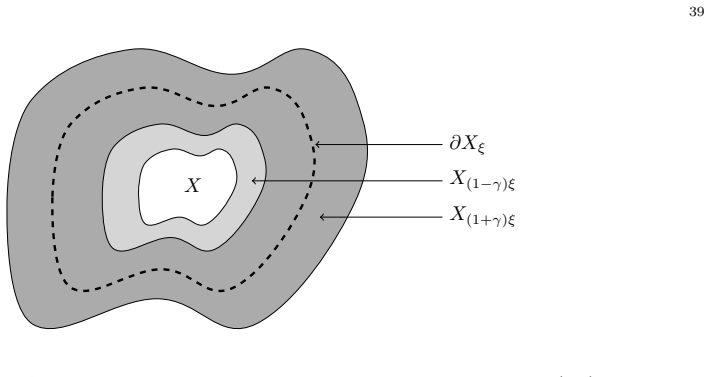
The central discovery is a pair of propagation bounds. First (Theorem 2.1): if the initial state satisfies the two-sided density bound $(\lambda_1 r^d)^q \le \langle N_{B_r(x)}^q\rangle_0 \le (\lambda_2 r^d)^q$ for $q\le p$, then for $\alpha>d+1$ and any velocity $v>12\kappa$ the $p$-th moments satisfy, for $0\le vt\le R-r$, $\langle N_{B_r}^p\rangle_t \le \langle N_{B_R}^p\rangle_0 \exp\{(C R^d + vt)/(R-r)\}$ and the matching lower bound. Second (Theorems 2.2-2.3): if the initial state has a particle-free shell $N_{X_{2\xi}\setminus X}\psi_0=0$ and a bounded density, then for $\alpha>3d+1$ the Heisenberg evolution $\alpha_t(A)$ is approximated by the localized evolution $\alpha_t^{X_\xi}(A)$ with error $O(\|A\|\|B\||t|\xi^{-\beta})$, $\beta=\lfloor\alpha-3d-1\rfloor$, with every constant independent of the total particle number $N$; this yields the thermodynamically stable Lieb-Robinson bound.
Load-bearing premise
The most fragile premise is the geometry of the initial state: the Lieb-Robinson result requires a completely empty shell around the region of interest, and the moment bounds require every ball at every scale to contain between $\lambda_1 r^d$ and $\lambda_2 r^d$ particles; if either condition fails, the proof's error terms are uncontrolled and may grow with the particle number.
Editorial extensions
If this is right
- For any fixed $\alpha>d+1$, the bound on all moments $p\ge1$ is uniform in $N$, so arbitrarily many bosons can pile up on a single site without invalidating the ballistic speed; this directly controls local particle-number accumulation in the thermodynamic limit.
- The Lieb-Robinson bound with $N$-independent error means that for states with a particle-free shell, the light cone is a genuine structural feature in the infinite-system limit, not an artifact of finite-size normalization.
- The error exponent $\beta=\lfloor\alpha-3d-1\rfloor$ implies the light cone sharpens as $\alpha$ grows; for very long-ranged interactions the bound is weaker, consistent with the known divergence of the single-particle velocity at $\alpha=d+1$.
- The maximal speed $\kappa$ defined from the one-particle hopping matrix controls both particle and information transport for this class of Hamiltonians.
Reading between the lines
- The logarithmic-ASTLO trick -- differentiating the log of the moment -- should transfer to other unbounded long-range many-body models, such as lattice oscillator chains or Fermi-Hubbard models with power-law hopping, because the denominator it creates is a general mechanism for taming heavy tails.
- If the threshold $\alpha>d+1$ is truly sharp for all moments as the paper argues, then the same threshold likely governs whether super-ballistic information transport is possible for general bounded-density initial states; the paper's LRB theorem covers only the particle-free-shell case, leaving the bounded-density super-ballistic regime as the natural next target.
- The proof's uncontrolled term $\langle N_{X_{2\xi}\setminus X}N_\Lambda\rangle_0$ when the shell is dropped suggests a quantitative trade-off: a partially filled shell with density decaying in $\xi$ should yield a mixed bound interpolating between the $N$-independent and $N$-dependent regimes.
Signed reviews
Editorial analysis
A structured set of objections, weighed in public.
Referee Report
Summary. This paper studies the quantum dynamics of Bose-Hubbard Hamiltonians on finite lattices with power-law hopping and interactions, |J_xy|, |V_xy| ≤ C|x−y|^{−α}. The two main results are: (1) for α > d+1 and initial states satisfying a two-sided density bound (2.10), all p-th moments of local particle numbers satisfy ballistic growth bounds uniformly in the particle number N (Theorem 2.1); and (2) for initial states with a particle-free shell, the Heisenberg evolution of a local observable can be approximated by the evolution restricted to a light-cone region, with an N-independent power-law error, yielding a thermodynamically stable Lieb-Robinson bound (Theorems 2.2–2.3). The proofs develop a multiscale ASTLO method with logarithmic renormalization and are presented in considerable detail. The main central issue is that Theorem 2.2 is stated with α > 3d+1 while its error exponent β defined in (2.23) vanishes for 3d+1 < α < 3d+2, so the advertised light-cone approximation has no separation decay in that parameter range.
Significance. The results are potentially significant: Theorem 2.1 removes the p-dependent decay threshold of earlier work and reaches the conjecturally sharp condition α > d+1 for all moments, while Theorem 2.2 aims to give the first thermodynamically stable Lieb-Robinson bound for long-range bosons. The paper is careful about its initial-state hypotheses and explicitly acknowledges the cost of dropping the particle-free shell in Remark 2(ii), which is a strength. The multiscale induction for Theorem 2.1 is developed in detail and appears internally coherent. However, the Lieb-Robinson theorem contains a load-bearing threshold inconsistency: for the range 3d+1 < α < 3d+2 the defined error exponent in (2.23) is zero, so the bound does not decay in the separation ξ; the introduction states α > 3d+2, and the proof mechanism also points to α ≥ 3d+2 for a positive exponent. This must be corrected before the central LRB claim can be accepted as stated.
major comments (2)
- [Section 2.3, Theorem 2.2 and Eq. (2.23)] Theorem 2.2 is stated for α > 3d+1 in (2.18), but the error exponent is defined as β = ⌊α−3d−1⌋ in (2.23). For every α in (3d+1, 3d+2), β = 0, so the right-hand sides of (2.22) and (2.24) are C‖A‖‖B‖|t|, independent of ξ. Such a bound has no light-cone content: increasing the separation between X and Y does not suppress the error, and the claimed approximation by the localized evolution becomes vacuous. This is not a cosmetic issue. The proof's own estimates show why: the base case and Lemmas 7.5–7.7 produce errors of order ξ^{−n+dp} (see (7.23) and (8.20)), while the available n is constrained by n ≤ α−d−1 through (7.19). Requiring ξ^{−n+2d} to decay as ξ^{−β} forces β ≤ α−3d−1; a positive exponent β ≥ 1 therefore requires α ≥ 3d+2. This agrees with the informal statement in the introduction, which says “Assume α > 3d+2” for the Lieb-Robinson result. Theorem 2.2 and its corollary Theorem 2.3 should be restated with the corrected threshold (α > 3d+2, or the exact condition needed for β ≥ 1), and the proof adjusted accordingly.
- [Section 7.6, Proposition 7.8 and Eq. (7.45)] The generalization in Proposition 7.8 inherits the same threshold problem. For Q = 1 the assumptions give α > max{3d/2+1, 2d+1} = 2d+1 and the error exponent is ⌊α−2d−1⌋, which is zero for α in (2d+1, 2d+2). For Q = 2 the stated threshold is α > 3d+1 and the exponent is ⌊α−3d−1⌋, exactly the zero-exponent range identified for Theorem 2.2. Moreover, if the Q = 1 case of Proposition 7.8 is intended to cover the same Hamiltonian as Theorem 2.2, the thresholds in (2.18) and (7.41) are inconsistent with each other. The proof of Proposition 7.8 is only sketched as a “straightforward adaption,” so it currently cannot resolve which threshold is the correct one. This needs to be clarified and corrected.
minor comments (3)
- [Section 2.2, Eq. (2.10)] The density condition is written “∞ > λ2 > λ1 > 0”; please use the more conventional 0 < λ1 < λ2 < ∞, and clarify that B_r(x) denotes the intersection with Λ so that the lower bound is meaningful near the boundary of a finite lattice.
- [Section 7.1, Theorem 7.1] Theorem 7.1, quoted from the authors' previous work [32], is a load-bearing input for the annular propagation estimates used in the proof of Theorem 2.2. Since the present paper does not prove this theorem, please state its proof status and verify that the version imported here has hypotheses matching the corrected threshold of Theorem 2.2.
- [Throughout] There are several small presentation inconsistencies: the abstract says the second result is a Lieb-Robinson bound, while the body first states a light-cone approximation and derives the commutator bound as a corollary; the notation “α > 3d+1” in Theorem 2.2 and “α > 3d+2” in the introduction should be reconciled; and there are typographical slips such as “thermodynamicall” in Remark 2(i). None of these affect the mathematics, but they should be fixed in a revision.
Circularity Check
No circular derivation: central bounds are proved from explicit estimates; the only self-citation burden is Theorem 7.1 from [32], which is a distinct prior theorem and not an input equivalent to the claims.
full rationale
I walked the derivation chain of Theorems 2.1, 2.2, and 2.3. Theorem 2.1 assumes the two-sided density bound (2.10) on the initial state and proves moment bounds (2.12)-(2.13); the assumption bounds the initial data, not the propagated quantities, and the proof controls the ASTLO denominators through the separately proved lower bound on the bad time T1 (Prop. 3.8). Theorem 2.2's proof does import Theorem 7.1 from the authors' earlier preprint [32] ('we will repeatedly use the propagation bounds obtained in our previous work [32]'), and this citation is load-bearing for the annular maximum-velocity bound and the base case of Prop. 7.3. However, [32, Thm 2.1] is a different theorem—a particle propagation estimate, not a light-cone approximation—with its own proof and stated assumptions that do not include the target conclusion, so the use is self-citation but not a reduction of the result to its inputs. The beta=0 issue for 3d+1<alpha<3d+2 flagged in skeptical review is a correctness/consistency problem in the statement (the claimed error xi^{-beta} does not decay), not a circularity. No fitted parameter is renamed as a prediction, and no uniqueness theorem is invoked to forbid alternatives. Accordingly, no specific circular step is exhibited.
Assumptions & free parameters
assumptions (4)
- domain assumption Initial density lower and upper bounds (2.10) on every ball at all scales.
- domain assumption Particle-free shell condition (2.20) and density upper bound (2.19) for Theorem 2.2.
- domain assumption Power-law decay, Hermitian J, symmetric V, and self-adjointness of H on the Fock space.
- standard math Standard tools: Stone's theorem, Schur test, Holder inequality for commuting positive operators (Lemma 6.1), multiscale induction on truncated Fock space plus extension Proposition 4.2.
Cite this review
Pith. "Pith review of On the quantum dynamics of long-ranged Bose-Hubbard Hamiltonians." pith.science (2026). https://pith.science/paper/6DWOX6T3
@misc{pith2026250501786,
  author       = {Pith},
  title        = {Pith review of: On the quantum dynamics of long-ranged Bose-Hubbard Hamiltonians},
  year         = {2026},
  howpublished = {\url{https://pith.science/paper/6DWOX6T3}},
  note         = {Machine review of arXiv:2505.01786}
}
abstract
We study the quantum dynamics generated by Bose-Hubbard Hamiltonians with long-ranged (power law) terms. We prove two ballistic propagation bounds for suitable initial states: (i) A bound on all moments of the local particle number for all power law exponents $\alpha>d+1$ in $d$ dimensions, the sharp condition. (ii) The first thermodynamically stable Lieb-Robinson bound (LRB) for these Hamiltonians. To handle the long-ranged and unbounded terms, we further develop the multiscale ASTLO (adiabatic space time localization observables) method introduced in our recent work [arXiv:2310.14896].
Figures


Figures from the paper (5 more)



Reference graph
Works this paper leans on
-
[32]
M. Lemm, C. Rubiliani, and J. Zhang, On the microscopic propagation speed of long-range quantum many-body systems, arXiv preprint arXiv:2310.14896 (2023)
arXiv 2023
-
[1]
S. Bachmann, S. Michalakis, B. Nachtergaele, and R. Sims , Automorphic equivalence within gapped phases of quantum lattice systems , Communications in Mathematical Physics 309 (2012), no. 3, 835–871
work page 2012
-
[2]
S. Bachmann and G. D. Nittis, Lieb–robinson bounds in the continuum via localized frames , Annales henri poincaré, 2024, pp. 1–40
work page 2024
-
[3]
T. A Bespalova, K. Delić, G. Pupillo, F. Tacchino, and I. T avernelli, Simulating the fermi-hubbard model with long-range hopping on a quantum computer , arXiv preprint arXiv:2410.07789 (2024)
arXiv 2024
- [4]
-
[5]
O. Bratteli and D. W Robinson, Operator Algebras and Quantum Statistical Mechanics II Equ ilibrium States Models in Quantum Statistical Mechanics (1997)
work page 1997
-
[6]
C. Brennecke and B. Schlein, Gross–pitaevskii dynamics for bose–einstein condensates , Analysis & PDE 12 (2019), no. 6, 1513–1596
work page 2019
-
[7]
C.-F. Chen and A. Lucas, Finite speed of quantum scrambling with long range interact ions, Physical review letters 123 (2019), no. 25, 250605
work page 2019
Show all 50 references
-
[8]
Cheneau, P
M. Cheneau, P. Barmettler, D. Poletti, M. Endres, P. Scha uß, T. Fukuhara, C. Gross, I. Bloch, C. Kollath, and S. Kuhr, Light-cone-like spreading of correlations in a quantum man y-body system , Nature 481 (2012), no. 7382, 484–487
2012
-
[9]
Eisert and D
J. Eisert and D. Gross, Supersonic quantum communication , Physical review letters 102 (2009), no. 24, 240501
2009
-
[10]
Erdös, B
L. Erdös, B. Schlein, and H.-T. Yau, Rigorous derivation of the gross-pitaevskii equation with a large interaction potential, Journal of the American Mathematical Society 22 (2009), no. 4, 1099–1156
2009
-
[11]
, Derivation of the gross-pitaevskii equation for the dynami cs of bose-einstein condensate , Annals of Math- ematics 172 (2010), no. 1
2010
-
[12]
Faupin, M
J. Faupin, M. Lemm, and I. M. Sigal, Maximal speed for macroscopic particle transport in the Bos e-Hubbard model, Physical Review Letters 128 (2022), no. 15, 150602
2022
-
[13]
3, 1011–1037
, On Lieb–Robinson Bounds for the Bose–Hubbard Model , Communications in Mathematical Physics 394 (2022), no. 3, 1011–1037
2022
-
[14]
Faupin, M
J. Faupin, M. Lemm, I. M. Sigal, and J. Zhang, Macroscopic suppression of supersonic quantum transport , arXiv preprint arXiv:2503.19788 (2025)
2025
-
[15]
Gebert, B
M. Gebert, B. Nachtergaele, J. Reschke, and R. Sims, Lieb–robinson bounds and strongly continuous dynamics for a class of many-body fermion systems in r d , Annales Henri Poincaré 21 (2020), no. 11, 3609–3637
2020
-
[16]
Ginibre and G
J. Ginibre and G. Velo, The classical field limit of scattering theory for non-relat ivistic many-boson systems. i , Communications in Mathematical Physics 66 (1979), 37–76
1979
-
[17]
Greiner and S
M. Greiner and S. Fölling, Optical lattices, Nature 453 (2008), no. 7196, 736–738
2008
-
[18]
B Hastings, Decay of correlations in fermi systems at nonzero temperatu re, Physical Review Letters 93 (2004), no
M. B Hastings, Decay of correlations in fermi systems at nonzero temperatu re, Physical Review Letters 93 (2004), no. 12, 126402
2004
-
[19]
10, 104431
, Lieb-Schultz-Mattis in higher dimensions , Physical Review B 69 (2004), no. 10, 104431. 53
2004
-
[20]
08, P08024
, An area law for one-dimensional quantum systems , Journal of Statistical Mechanics: Theory and Experi- ment 2007 (2007), no. 08, P08024
2007
-
[21]
20, 201102
, Quantum belief propagation: An algorithm for thermal quant um systems , Physical Review B 76 (2007), no. 20, 201102
2007
-
[22]
B Hastings and T
M. B Hastings and T. Koma, Spectral gap and exponential decay of correlations , Communications in Mathematical Physics 265 (2006), 781–804
2006
-
[23]
B Hastings and X.-G
M. B Hastings and X.-G. W en, Quasiadiabatic continuation of quantum states: The stabil ity of topological ground- state degeneracy and emergent gauge invariance , Physical Review B 72 (2005), no. 4, 045141
2005
-
[24]
Hepp, The classical limit for quantum mechanical correlation fun ctions, Communications in Mathematical Physics 35 (1974), 265–277
K. Hepp, The classical limit for quantum mechanical correlation fun ctions, Communications in Mathematical Physics 35 (1974), 265–277
1974
-
[25]
Hinrichs, M
B. Hinrichs, M. Lemm, and O. Siebert, On lieb–robinson bounds for a class of continuum fermions , Annales henri poincaré, 2024, pp. 1–40
2024
-
[26]
M Kaufman and K.-K
A. M Kaufman and K.-K. Ni, Quantum science with optical tweezer arrays of ultracold at oms and molecules , Nature Physics 17 (2021), no. 12, 1324–1333
2021
-
[27]
Kuwahara and M
T. Kuwahara and M. Lemm, Enhanced lieb-robinson bounds for a class of bose-hubbard t ype hamiltonians , arXiv preprint arXiv:2405.04672 (2024)
2024 arXiv
-
[28]
Kuwahara and K
T. Kuwahara and K. Saito, Strictly linear light cones in long-range interacting syst ems of arbitrary dimensions , Physical Review X 10 (2020), no. 3, 031010
2020
-
[29]
Kuwahara, T
T. Kuwahara, T. V. Vu, and K. Saito, Effective light cone and digital quantum simulation of inter acting bosons , Nature Communications 15 (2024), no. 1, 2520
2024
-
[30]
M. Lemm, S. Rademacher, and J. Zhang, Local enhancement of the mean-field approximation for boson s, arXiv preprint arXiv:2412.13868 (2024)
2024 arXiv
-
[31]
M. Lemm, C. Rubiliani, I. M. Sigal, J. Zhang, et al., Information propagation in long-range quantum many-body systems, Physical Review A 108 (2023), no. 6, L060401
2023
-
[33]
H Lieb and D
E. H Lieb and D. W Robinson, The finite group velocity of quantum spin systems , Communications in Mathematical Physics 28 (1972), no. 3, 251–257
1972
-
[34]
Nachtergaele, Y
B. Nachtergaele, Y. Ogata, and R. Sims, Propagation of correlations in quantum lattice systems , Journal of Statis- tical Physics 124 (2006), 1–13
2006
-
[35]
Nachtergaele, H
B. Nachtergaele, H. Raz, B. Schlein, and R. Sims, Lieb-robinson bounds for harmonic and anharmonic lattice systems., Communications in Mathematical Physics 286 (2009), no. 3
2009
-
[36]
Nachtergaele and R
B. Nachtergaele and R. Sims, Lieb-Robinson bounds and the exponential clustering theor em, Communications in Mathematical Physics 265 (2006), 119–130
2006
-
[37]
Radin and B
C. Radin and B. Simon, Invariant domains for the time-dependent schrödinger equa tion, Journal of Differential Equations 29 (1978), no. 2, 289–296
1978
-
[38]
Reed and B
M. Reed and B. Simon, Iv: Analysis of operators , Vol. 4, Elsevier, 1978
1978
-
[39]
Rodnianski and B
I. Rodnianski and B. Schlein, Quantum fluctuations and rate of convergence towards mean fie ld dynamics , Com- munications in Mathematical Physics 291 (2009), no. 1, 31–61
2009
-
[40]
M Roses, H
M. M Roses, H. Landa, and E. G Dalla Torre, Simulating long-range hopping with periodically driven su percon- ducting qubits , Physical Review Research 3 (2021), no. 3, 033288
2021
-
[41]
Schuch, S
N. Schuch, S. K Harrison, T. J Osborne, and J. Eisert, Information propagation for interacting-particle system s, Physical Review A 84 (2011), no. 3, 032309
2011
-
[42]
I. M. Sigal and J. Zhang, On propagation of information in quantum many-body systems , arXiv preprint arXiv:2212.14472 (2022)
2022 arXiv
-
[43]
C Tran, C.-F
M. C Tran, C.-F. Chen, A. Ehrenberg, A. Y Guo, A. Deshpand e, Y. Hong, Z.-X. Gong, A. V Gorshkov, and A. Lucas, Hierarchy of linear light cones with long-range interactio ns, Physical Review X 10 (2020), no. 3, 031009
2020
-
[44]
C Tran, A
M. C Tran, A. Y Guo, C. L Baldwin, A. Ehrenberg, A. V Gorshk ov, and A. Lucas, Lieb-Robinson light cone for power-law interactions, Physical Review Letters 127 (2021), no. 16, 160401
2021
-
[45]
C Tran, A
M. C Tran, A. Y Guo, A. Deshpande, A. Lucas, and A. V Gorshk ov, Optimal state transfer and entanglement generation in power-law interacting systems , Physical Review X 11 (2021), no. 3, 031016
2021
-
[46]
Van Vu, T
T. Van Vu, T. Kuwahara, and K. Saito, Optimal light cone for macroscopic particle transport in lo ng-range systems: A quantum speed limit approach , Quantum 8 (2024), 1483
2024
-
[47]
W ang, K
S.-S. W ang, K. Li, Y.-M. Dai, H.-H. W ang, Y.-C. Zhang, an d Y.-Y. Zhang, Quantum transports in two-dimensions with long range hopping , Scientific Reports 13 (2023), no. 1, 5763
2023
-
[48]
W ang and K
Z. W ang and K. R. Hazzard, Tightening the Lieb-Robinson bound in locally interacting systems, PRX Quantum 1 (2020), no. 1, 010303
2020
-
[49]
P W oods and M
M. P W oods and M. B Plenio, Dynamical error bounds for continuum discretisation via ga uss quadrature rules—a lieb-robinson bound approach, Journal of Mathematical Physics 57 (2016), no. 2
2016
-
[50]
Yin and A
C. Yin and A. Lucas, Finite speed of quantum information in models of interactin g bosons at finite density , Physical Review X 12 (2022), no. 2, 021039. 54 MARIUS LEMM, CARLA RUBILIANI, AND JINGXUAN ZHANG Department of Mathematics, University of Tübingen, 72076 Tü bingen, Germ...
2022
Reviewed August 16, 2026 · model on record in the stance chip above.
Discussion (0). Continue with ORCID to comment.