pith. machine review for the scientific record. sign in

math.AP

Analysis of PDEs

Existence and uniqueness, boundary conditions, linear and non-linear operators, stability, soliton theory, integrable PDE's, conservation laws, qualitative dynamics

0
math.AP 2026-05-13 Recognition

New sampling method sizes clamped obstacles from one wave

Novel implementation of the extended sampling method for inverse biharmonic scattering

Derived from factorization analysis, the ESM uses sound-hard and soft disks to find location and size with noisy limited data.
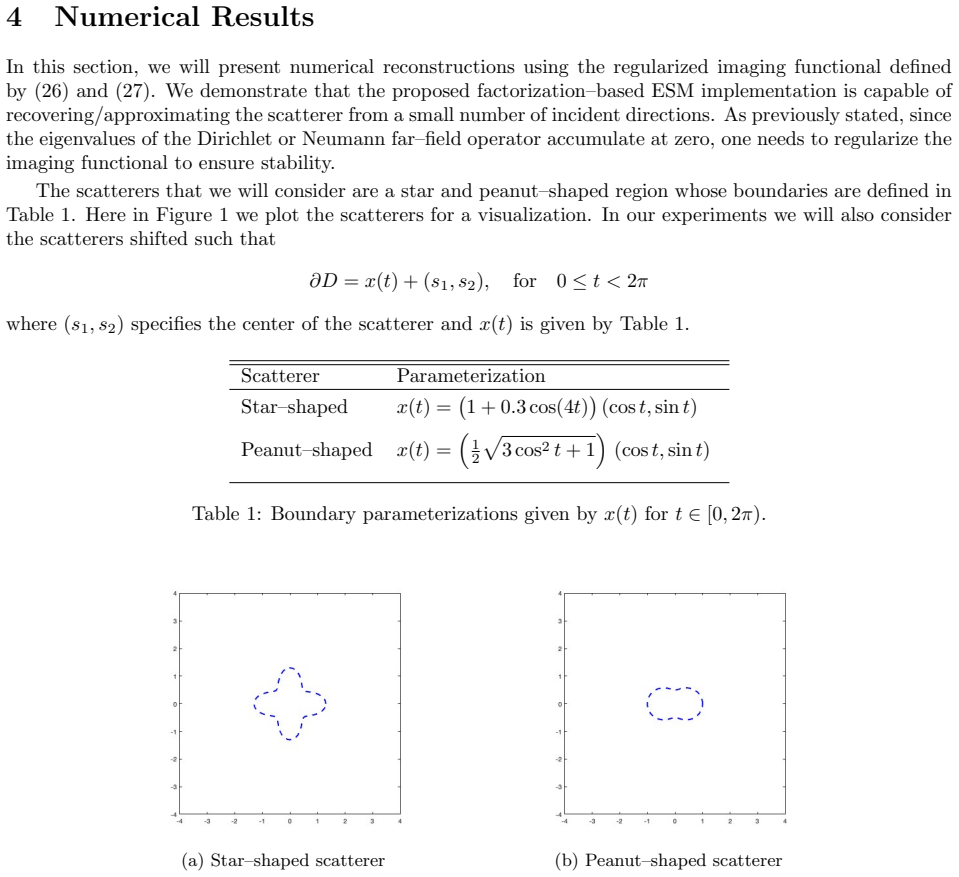
Figure from the paper full image
abstract click to expand
This paper considers an inverse shape problem for recovering an unknown clamped obstacle in two dimensions from far--field measurements generated by a single incident wave or just a few incident waves for the biharmonic (flexural) wave equation. Here we will develop a new extended sampling method (ESM) that is derived using the analysis of the well--known factorization method. We will also consider an ESM using both sound--soft and sound--hard sampling disks to identify sampling points where the reference disk intersects the unknown cavity. The use of a sound--hard sampling disk has not been studied in the literature whereas the sound--soft sampling disk has been used in most recent works. Traditionally the ESM seeks to find the location of the scatterer from limited incident directional data. Here, our method acts more like the factorization method to obtain the location as well as the size (and possibly the shape) of the obstacle. We present numerical experiments with synthetic data that demonstrate how effective this new implementation is with respect to noisy data and illustrate the influence of the reference disk radius on the reconstruction.
0
0
math.AP 2026-05-13 2 theorems

Stability bounds enable point-source gas leak recovery

Leak localisation with a measure source convection-diffusion model

Convection-diffusion model with Radon measure and joint parameter estimation locates leaks from concentration data.

abstract click to expand
We study the inverse problem of locating gas leaks from line-of-sight concentration measurements using a convection-diffusion model with the source term a Radon measure. By imposing sparsity-promoting regularisation on this measure, we recover point sources - identifying both their locations and intensities - rather than diffuse approximations. We jointly estimate the underlying physical convection (wind) and diffusion parameters. Our main theoretical contribution is the stability analysis of the convection-diffusion equation with respect to its parameters: the measure, and the convection and diffusion fields. Numerically, we employ a semi-grid-free optimisation approach for reconstructing the source measure. Our experiments demonstrate accurate localisation, highlighting the potential of the method for practical gas emission detection.
0
0
math.AP 2026-05-13 2 theorems

Fractional p-Laplacian derivative yields logarithmic nonlocal operator

On the fractional logarithmic p-Laplacian

The resulting operator admits an integral formula that enables critical compactness and eigenvalue results in adapted spaces.

abstract click to expand
In this paper, we introduce and investigate the fractional logarithmic $p$-Laplacian $(-\Delta)_{p}^{s+\log}$, defined as the first-order derivative with respect to the parameter $t$ of the fractional $p$-Laplacian $(-\Delta)_{p}^{t}$ evaluated at $t=s$. We establish that this operator admits the following integral representation \[ \begin{aligned} (-\Delta)_{p}^{s+\log} u(x) &= B(N,s,p)(-\Delta)_{p}^{s}u(x)\\ &\quad -pC(N,s,p)\mathrm{P.V.}\int_{\mathbb{R}^{N}}\frac{|u(x)-u(y)|^{p-2}(u(x)-u(y))\ln |x-y|}{|x-y|^{N+sp}}dy, \end{aligned} \] where $C(N,s,p)$ denotes the standard normalization constant associated with the fractional $p$-Laplacian, and $B(N,s,p)=\frac{d}{ds}\left(\ln C(N,s,p)\right)$. As a consequence of this representation, it follows that the operator is nonlocal and of logarithmic type, and may be viewed as a nonlinear analogue of the fractional logarithmic Laplace operator recently introduced by Chen et al. \cite{Chen-Chen-Hauer}. We further develop the associated functional framework in both $\mathbb{R}^{N}$ and bounded Lipschitz domains by introducing the natural energy spaces adapted to problems driven by $(-\Delta)_{p}^{s+\log}$. Within this framework, fundamental functional inequalities are established, in particular Pohozaev-type identities and D\'{\i}az-Saa inequalities, which are of independent interest and applicable to a broader class of problems. Moreover, we derive results concerning density, continuity, and compact embedding properties. We emphasize that the compactness of the embedding is proved at the critical exponent $p^{*}_{s}=\frac{Np}{N-sp}$, which distinguishes the present setting from the classical Sobolev and fractional Sobolev frameworks. Finally, as an application, we investigate the associated Dirichlet eigenvalue problem and derive existence, uniqueness, and boundedness results for the corresponding solutions.
0
0
math.AP 2026-05-13 Recognition

Unique weak solution exists near homogenized limit for small parameters

An H-convergence-based implicit function theorem for homogenization of nonlinear non-smooth elliptic systems

H-convergence of diffusion tensors plus non-degeneracy of the limit solution yields exactly one nearby solution to the heterogeneous problem

abstract click to expand
We consider homogenization of Dirichlet problems for semilinear elliptic systems with non-smooth data. We suppose that the diffusion tensors H-converge if the homogenization parameter tends to zero. Our result is of implicit function theorem type: For small homogenization parameter there exists exactly one weak solution close to a given non-degenerate weak solution to the homogenized problem. For the proofs we use gradient estimates of Meyers (if the space dimension is two) or Morrey (if the diffusion tensors are triangular) type for solutions to linear elliptic systems.
0
0
math.AP 2026-05-13 2 theorems

Variational principle yields reduced bubbly flow models

A variational approach to the derivation of reduced models for bubbly flows

Constraining bubble surfaces to finite-parameter families produces substitute interface conditions that close the dynamics and admit well-

abstract click to expand
In this paper, we derive reduced models for the motion of gas bubbles in an ambient inviscid liquid, using Hamilton's least action principle. We first explain how to recover from this principle the classical sharp interface model, in which the pressure is continuous across the surfaces of the bubbles. We then show how to reduce the complexity of the model, by simplifying the description of those surfaces. Namely, we impose them to evolve within a subclass of hypersurfaces described by a finite number of parameters (the simplest example being spheres, that is neglecting deviation of the bubbles from sphericity). The difficulty from a mathematical and modeling point of view is to determine the interface conditions that substitute to pressure continuity. We complete the derivation of the reduced models by some well-posedness analysis, in the case of curl-free liquid flow and homogeneous pressure in the bubbles.
0
0
math.AP 2026-05-13 Recognition

Transform enables blow-up criterion for semilinear heat equation

On the existence and nonexistence of global solutions of the semilinear heat equation

Forward similarity change of variables lets the potential well method separate global solutions from those that explode in finite time for p

abstract click to expand
We consider the semilinear heat equation $$ u_t-\Delta u=|u|^{p-1}u,\ \ (t,x)\in\mathbb{R}^+\times\mathbb{R}^n. $$ The well-known difficulty with this problem is that the potential well method cannot be applied directly, due to the scaling invariance which leads to a potential well of zero depth. We employ the forward similarity transform to convert the equation into a new parabolic equation, so that we can apply the potential well method in weighted Sobolev spaces. As a result, we obtain a new criterion that establishes whether solutions to the heat equation blow up in finite time or exist globally. This work extends the partial results of Ikehata et al. (\textit{Ann. Inst. H. Poincar\'e Anal. Non Lin\'eaire}, \textbf{27} (2010) 877-900) from critical Sobolev exponent to the case $p_F<p<p_S$, where $p_F=1+2/n$ is the Fujita exponent and $p_S=(n+2)/(n-2)$ (for $n\ge3$) is the critical Sobolev exponent.
0
0
math.AP 2026-05-13 2 theorems

Degenerate SIR model with policy boundaries has unique solutions

A degenerate reaction-diffusion SIR model in interconnected regions

Faedo-Galerkin proof gives existence, uniqueness and positivity for two-region epidemic spread under lockdown switches.

Figure from the paper full image
abstract click to expand
This paper presents a novel time-space SIR (Susceptible-Infected-Recovered) model for simulating infectious disease dynamics in two interconnected regions. The model is formulated as a coupled reaction-diffusion system with boundary conditions that dynamically switch from Robin to Neumann types, effectively modelling policy-driven interventions such as lockdowns. A key innovation lies in the incorporation of degenerate diffusion, arising from vanishing population density, which significantly influences transmission behaviour near regional borders. The wellposedness of the model is rigorously established using the Faedo-Galerkin method, ensuring the existence, uniqueness, and positivity of weak solutions. Numerical simulations, performed using the Finite Volume Method, validate the theoretical findings and demonstrate the impact of migration and mobility restrictions on epidemic progression. This framework offers valuable insights for understanding and controlling disease spread in spatially heterogeneous and interconnected settings.
0
0
math.AP 2026-05-13 2 theorems

Branched transport bounds Ahlfors-regular measures to dimension 8/5

Sharp upper bound for a branched transport problem coming from Ginzburg-Landau models

The result for a superconductor limit model confirms the conjectured limit on network dimensionality.

abstract click to expand
We consider a branched transport type problem with weakly imposed boundary conditions, which can be seen as a blown-up version of a reduced model for type-I superconductors in the regime of vanishing external magnetic field. We prove that if the irrigated measure is (locally) Ahlfors regular then it is of dimension at most $8/5$ in agreement with the conjecture by Conti, the third author and Serfaty.
0
0
math.AP 2026-05-13 Recognition

Integral solution stabilizes finite flow model

The unified transform for Burgers' equation: Application to unsaturated flow in finite interval

Unified transform gives explicit form for linearized Burgers equation in soil infiltration that converges better than Fourier series

Figure from the paper full image
abstract click to expand
In this paper, we focus on one-dimensional vertical infiltration, assuming constant diffusivity and a quadratic relationship between hydraulic conductivity and water content. Under these assumptions, Richards' equation reduces to Burgers' equation, which we then linearize via the Hopf-Cole transformation. This turns the initial boundary value problem into a diffusion equation on a finite interval with mixed boundary conditions. To solve it, we use the Unified Transform Method (also known as the Fokas method). This approach gives an explicit integral representation of the solution, and when evaluated numerically, the results match classical Fourier series solutions exactly, but with better convergence and stability. Two examples from hydrological applications are examined.
0
0
math.AP 2026-05-13 2 theorems

Regularization yields global strong solutions for atmospheric phase transition

Global Existence and Uniqueness of Strong Solutions for a Phase Transition Model in Atmospheric Dynamics

The smoothed precipitation term converges to justify the tropical climate model on R squared without extra humidity viscosity.

abstract click to expand
In this work, we study a phase transition model in atmospheric dynamics, inspired by the works [6,14,15], which analyze the primitive equations governing the evolution of velocity, temperature, and specific humidity. The main difficulty arises from the presence of a multivalued discontinuous nonlinear term in the temperature and in the humidity equations, describing the formation of precipitations, which becomes active under supersaturation conditions. To overcome this issue, we introduce a regularized formulation that ensures the existence and uniqueness of approximate solutions. By employing classical compactness arguments, we then establish the existence of a strong solution to the original model. Additionally, we establish uniqueness under a conditional and physically meaningful assumption. This approach allows us to provide a rigorous justification of the tropical climate model on the whole space $\mathbb{R}^2$, while avoiding the introduction of a viscosity term in the humidity equation.
0
0
math.AP 2026-05-13 1 theorem

NLS solutions depend continuously on nonlinearity power

Dependence of the nonlinear Schr{\"o}dinger flow upon the nonlinearity

Global behavior, logarithmic limit, and scattering continuity hold in the defocusing energy-subcritical regime.

abstract click to expand
We consider the defocusing nonlinear Schr{\"o}dinger equation in the energy-subcritical case, and investigate the dependence of the solution upon the power of the nonlinearity. Special attention is paid to the global in time description. The main three aspects addressed, in the decreasing order of difficulty, are the limit when the total power tends to one, along with the connection with the logarithmic Schr{\"o}dinger equation, the description when long range effects may be present, and the continuity of the scattering operator in the short range case. This text resumes the presentation given by the first author at {\'E}cole polytechnique for the Laurent Schwartz seminar, in May 2026.
0
0
math.AP 2026-05-13 Recognition

Minimal resistance profiles end at slope 1/sqrt(3) with exponential density

The Newton's problem assuming non-constant density of the fluid

Fixed-point theorem gives local existence for radial solutions whose domain stops when the derivative reaches exactly 1 over square root of

Figure from the paper full image
abstract click to expand
This paper investigates the Newton's problem of minimal resistance for a body moving through a fluid whose density decreases exponentially with altitude. We prove the local existence and regularity of radial solutions $u(r)$ satisfying the initial conditions $u(0)=u'(0)=0$ using a fixed-point theorem. We show that the maximal domain of the solution is finite, $[0, r_M)$, terminating at a critical slope $u'(r_M) = \frac{1}{\sqrt{3}}$.
0
0
math.AP 2026-05-13 2 theorems

Moving observations yield Cesàro observability for PDEs

Moving localized observations and Ces{\`a}ro asymptotic observability for conservative PDEs

Convex combinations of small sets and spectral tail reduction recover full energy over long times for waves and Schrödinger equations.

abstract click to expand
We develop a deterministic large-time mechanism yielding Ces{\`a}ro asymptotic observability inequalities from moving localized observations for conservative evolutions. On each observation interval, exact convexification on a compact measured homogeneous space replaces full observation on the whole observation manifold by a finite convex combination of translates of one prototype subset. A switching realization theorem then turns that static design into a genuinely moving observer, while a Hilbertian tail-reduction proposition shows that interval estimates proved only on growing spectral windows still recover the full conserved energy after Ces{\`a}ro averaging. The resulting design-to-observability chain applies to interior observations for wave, Klein-Gordon, and Schr{\"o}dinger equations on compact measured homogeneous manifolds, to moving boundary caps on the Euclidean ball, and to a singular almost-separated gas-giant boundary model. The framework is especially relevant when each instantaneous observation set is too small for one to expect a finite-time GCC or time-dependent GCC statement.
0
0
math.AP 2026-05-13 2 theorems

Slow fractional Schrödinger solution converges to averaged effective equation

Averaging principle for a slow-fast stochastic nonlinear fractional Schr\"odinger equation

As the fast timescale vanishes, the slow component converges strongly to the equation whose drift is averaged over the fast dynamics' unique

abstract click to expand
We establish an averaging principle for a structural multiscale stochastic nonlinear fractional Schr\"odinger system on the one-dimensional torus driven by a multiplicative Wiener noise. The slow component is governed by a fractional Schr\"odinger operator with a general polynomial nonlinearity, while the fast component evolves on a shorter time scale and exhibits dissipative diffusion, nonlinear interactions, and stochastic forcing. Under suitable dissipative assumptions, we have shown that, as the scale separation parameter tends to zero, the slow component converges strongly to an effective stochastic fractional Schr\"odinger equation. The effective drift is obtained by averaging the coupling term with respect to the unique invariant measure of the frozen fast dynamics. The proof relies on uniform a priori estimates, ergodicity of the fast equation, H\"older time regularity of the slow component obtained via a vanishing viscosity method, and a Khasminskii-type time discretization argument adapted to fractional dispersive operators. The analysis is technically challenging due to limited smoothing of the fractional Schr\"odinger semigroup and the presence of general polynomial nonlinearities, which are handled through refined estimates and viscosity approximation.
0
0
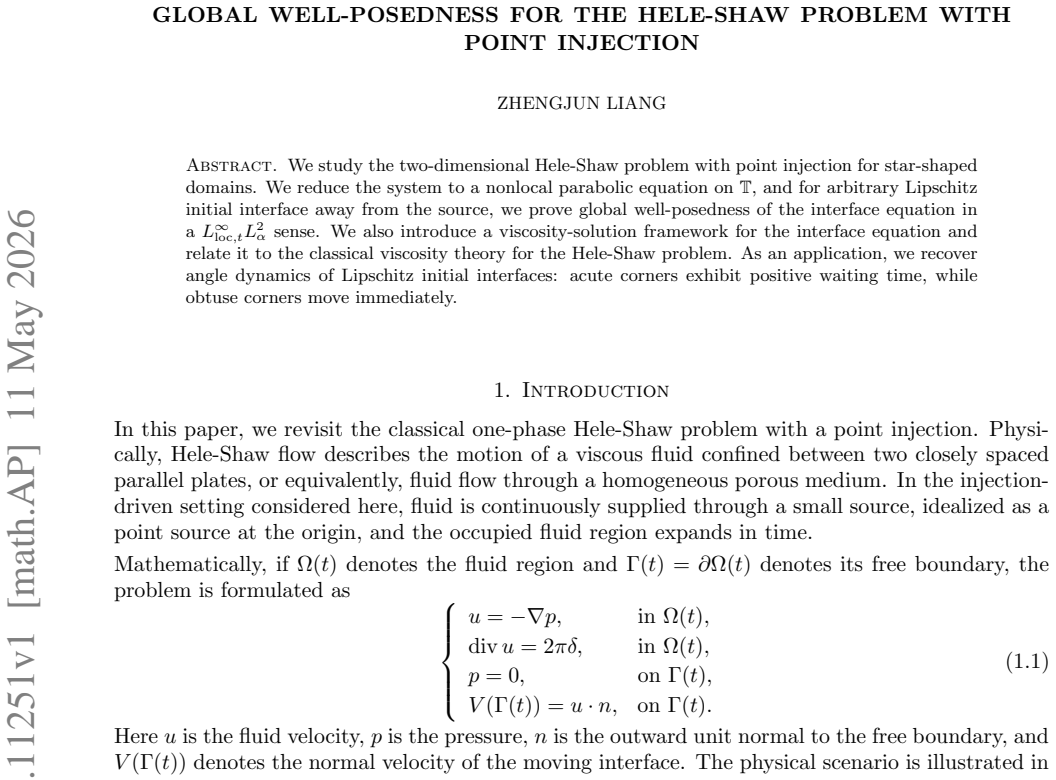
math.AP 2026-05-12 2 theorems

Global strong solutions exist for Hele-Shaw flow with point injection

Global well-posedness for the Hele-Shaw problem with point injection

Reduction to a nonlocal parabolic equation on the interface yields existence for all time when the domain is star-shaped and the initial lip

Figure from the paper full image
abstract click to expand
We study the two-dimensional Hele-Shaw problem with point injection for star-shaped domains. We reduce the system to a nonlocal parabolic equation of the interface, and for arbitrary Lipschitz initial interface away from the source, we prove global well-posedness of the interface equation in a strong sense. We also introduce a viscosity-solution framework for the interface equation and relate it to the classical viscosity theory for the Hele-Shaw problem. As an application, we recover angle dynamics of Lipschitz initial interfaces: acute corners exhibit positive waiting time, while obtuse corners move immediately.
0
0
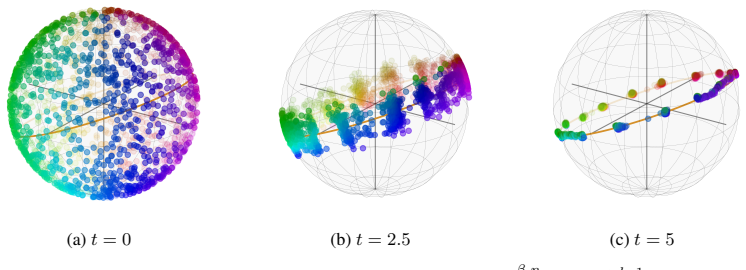
math.AP 2026-05-12 1 theorem

Mean-field transformer tokens concentrate at rate scaling with √(log β / β)

Quantifying Concentration Phenomena of Mean-Field Transformers in the Low-Temperature Regime

Wasserstein distance decays as √(log(β+1)/β) exp(Ct) + exp(-ct) as temperature drops, staying metastable up to log β times.

Figure from the paper full image
abstract click to expand
Transformers with self-attention modules as their core components have become an integral architecture in modern large language and foundation models. In this paper, we study the evolution of tokens in deep encoder-only transformers at inference time which is described in the large-token limit by a mean-field continuity equation. Leveraging ideas from the convergence analysis of interacting multi-particle systems, with particles corresponding to tokens, we prove that the token distribution rapidly concentrates onto the push-forward of the initial distribution under a projection map induced by the key, query, and value matrices, and remains metastable for moderate times. Specifically, we show that the Wasserstein distance of the two distributions scales like $\sqrt{{\log(\beta+1)}/{\beta}}\exp(Ct)+\exp(-ct)$ in terms of the temperature parameter $\beta^{-1}\to 0$ and inference time $t\geq 0$. For the proof, we establish Lyapunov-type estimates for the zero-temperature equation, identify its limit as $t\to\infty$, and employ a stability estimate in Wasserstein space together with a quantitative Laplace principle to couple the two equations. Our result implies that for time scales of order $\log\beta$ the token distribution concentrates at the identified limiting distribution. Numerical experiments confirm this and, beyond that, complement our theory by showing that for finite $\beta$ and large $t$ the dynamics enter a different terminal phase, dominated by the spectrum of the value matrix.
0
0
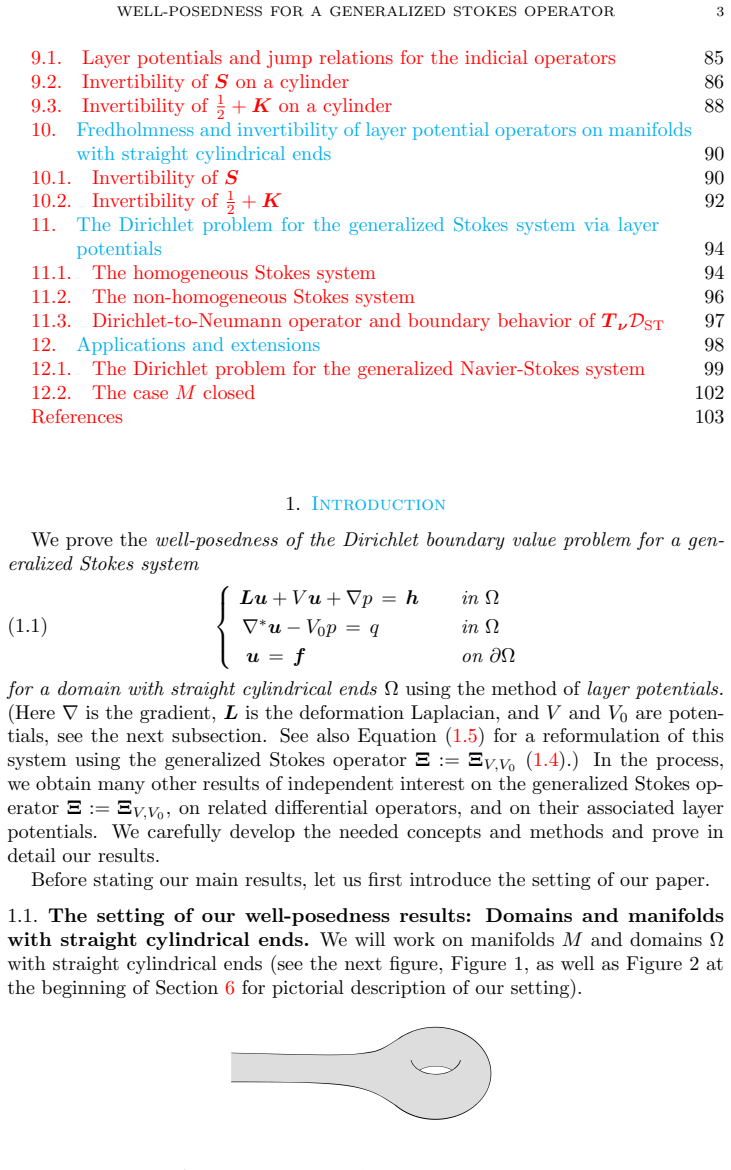
math.AP 2026-05-12 2 theorems

Positivity makes generalized Stokes operator invertible on cylindrical domains

Well-posedness of a generalized Stokes operator on domains with cylindrical ends via layer-potentials

The result gives well-posedness for the Dirichlet Stokes problem and for small-data generalized Navier-Stokes on domains with ends.

Figure from the paper full image
abstract click to expand
We study the \emph{generalized Stokes operator} \begin{equation*} \bsXi \ede \bsXi _{V,V_0} \ede \left(\begin{array}{ccc} \bsL + V & \nabla \\ \nabla^* & -V_0 \end{array}\right) \end{equation*} on a \emph{domain with straight cylindrical ends} $\Omega$ using \emph{the method of layer potentials} on $M \supset \Omega$. The operator $\bsXi_{0, 0}$ is the classical Stokes operator. Under suitable positivity assumptions on $V$ and $V_{0}$, we prove that $\bsXi$ is Fredholm. This allows us then to define the single- and double-layer potentials $\bsS$ and $\frac12 + \bsK$. Under further positivity assumptions, we prove that $\bsS$ and $\frac12 + \bsK$ are also Fredholm. Under slightly stronger assumptions on $V$ and $V_{0}$, we prove \emph{the invertibility} of the operators $\bsXi$, $\bsS$, and $\frac12 + \bsK$. The invertibility of these operators leads to \emph{well-posedness results} for the associated (linear) Stokes boundary value problem with Dirichlet boundary conditions on $\Omega$. The proofs of these results required us to develop many related tools. In particular, we develop an ``algebra tool kit'' to deal with \emph{limit and jump relations of layer potentials.} We also develop Green formulas and energy estimates for our generalized Stokes operator $\bsXi$ on manifolds with straight cylindrical ends, which requires a careful geometric study of the related differential operators, such as the deformation operator $\Def$. For completeness, we review suitable classes of pseudodifferential operators on manifolds with straight cylindrical ends that were studied in some previous papers of ours (including ``The Stokes operator on manifolds with cylindrical ends,'' J. Diff. Equations, 2024). As an application, we prove the well-posedness result for the Dirichlet problem for the generalized Navier-Stokes system with small data on a domain with cylindrical ends.
0
0
math.AP 2026-05-12 2 theorems

One-sided balance condition yields new entropy structures for 3-wave equations

Entropy Structures and Long-Time Relaxation for 3-Wave Kinetic Equations

The structures produce global weak L1_loc solutions that relax locally to zero equilibrium as time advances.

abstract click to expand
We establish a new class of entropy structures for \(3\)-wave kinetic equations with a broad family of interaction weights. Unlike the classical entropies arising from detailed balance, these estimates are generated by a one-sided algebraic balance condition encoded in the interaction weights. To the best of our knowledge, this family of entropy estimates has not previously appeared in the physical literature on wave turbulence. These estimates form the central a priori mechanism of the paper and are the key ingredient in the construction of global weak \(L^1_{\mathrm{loc}}\) solutions. We also prove a long-time rigidity result, showing that the solutions obtained by this entropy compactness method relax locally to the zero equilibrium as \(t\to\infty\).
0
0
math.AP 2026-05-12 Recognition

Existence of positive solutions for sublinear semilinear equations

Existence of Positive Solutions to Semilinear Equations with Sublinear Nonlinearities and Compact Positivity-Improving Resolvent

Compact positivity-improving resolvents suffice without extra smoothing properties.

abstract click to expand
We prove a Br\'ezis--Oswald type existence theorem for positive solutions of semilinear equations in an abstract setting in which the underlying linear operator has a compact positivity-improving resolvent. The assumptions imposed on the sublinear nonlinearity are comparable to those used in the classical elliptic theory, but no additional regularizing properties of the resolvent, such as ultracontractivity or smoothing, are required. The proof combines the method of sub- and supersolutions with spectral ideas of Br\'ezis--Oswald type and several new arguments adapted to the abstract operator-theoretic framework. In this way, the paper provides a bridge between order-theoretic methods and the classical energy-based theory of sublinear problems.
0
0
math.AP 2026-05-12 2 theorems

Background field stabilizes 3D compressible MHD with weak dissipation

Global uniform regularity for the 3D compressible MHD equations near a background magnetic field

Uniform bounds independent of horizontal viscosities and vertical resistivity justify the vanishing-dissipation limit with explicit rates.

abstract click to expand
This paper resolves the global regularity problem for the three-dimensional compressible magnetohydrodynamics (MHD) equations in the three-dimensional whole space, in the presence of a background magnetic field. Motivated by geophysical applications, we consider an anisotropic compressible MHD system with weak dissipation in the $x_2$ and $x_3$ directions and small vertical magnetic diffusion. By exploiting the stabilizing effect induced by the background magnetic field and constructing a hierarchy of four energy functionals, we establish global-in-time uniform bounds that are independent of the viscosity in the $x_2$ and $x_3$ directions and the vertical resistivity. A key innovation in our analysis is the development of a two-tier energy method, which couples the boundedness of vertical derivatives with the decay of horizontal derivatives. The analysis of time scale, together with global regularity estimates and sharp decay rates, enable us to rigorously justify the vanishing dissipation limit and derive explicit long-time convergence rates to the compressible MHD system with vanishing dissipation in the $x_2$ and $x_3$ directions and no vertical magnetic diffusion. In the absence of magnetic field and background magnetic field, the global-in-time well-posedness and vanishing viscosity limit for the 3D compressible Navier-Stokes equations with only one direction dissipation remains a challenging open problem. This work reveals the mechanism by which the magnetic field enhances dissipation and stabilizes the fluid dynamics in the global well-posedness and vanishing viscosity limit.
0
0
math.AP 2026-05-12 2 theorems

Background magnetic field grants global regularity to 3D compressible MHD

Global uniform regularity for the 3D compressible MHD equations near a background magnetic field

Stabilization yields uniform bounds independent of weak horizontal viscosity and vertical resistivity, justifying the vanishing dissipation

abstract click to expand
This paper resolves the global regularity problem for the three-dimensional compressible magnetohydrodynamics (MHD) equations in the three-dimensional whole space, in the presence of a background magnetic field. Motivated by geophysical applications, we consider an anisotropic compressible MHD system with weak dissipation in the $x_2$ and $x_3$ directions and small vertical magnetic diffusion. By exploiting the stabilizing effect induced by the background magnetic field and constructing a hierarchy of four energy functionals, we establish global-in-time uniform bounds that are independent of the viscosity in the $x_2$ and $x_3$ directions and the vertical resistivity. A key innovation in our analysis is the development of a two-tier energy method, which couples the boundedness of vertical derivatives with the decay of horizontal derivatives. The analysis of time scale, together with global regularity estimates and sharp decay rates, enable us to rigorously justify the vanishing dissipation limit and derive explicit long-time convergence rates to the compressible MHD system with vanishing dissipation in the $x_2$ and $x_3$ directions and no vertical magnetic diffusion. In the absence of magnetic field and background magnetic field, the global-in-time well-posedness and vanishing viscosity limit for the 3D compressible Navier-Stokes equations with only one direction dissipation remains a challenging open problem. This work reveals the mechanism by which the magnetic field enhances dissipation and stabilizes the fluid dynamics in the global well-posedness and vanishing viscosity limit.
0
0
math.AP 2026-05-12 Recognition

Counterexample shows vanishing-viscosity limit fails

Nonexistence of vanishing-viscosity limits for mechanical Hamiltonian ergodic problems

In one dimension a C^3 potential makes solutions to the viscous ergodic equation diverge as viscosity goes to zero.

Figure from the paper full image
abstract click to expand
For $\varepsilon>0$, let $\phi^\varepsilon$ be the solution of the ergodic problem \[ \frac12 |D\phi^\varepsilon|^2+F(x)-\varepsilon\Delta\phi^\varepsilon=c(\varepsilon) \qquad \text{on } \mathbb{T}^n, \] normalized by $\phi^\varepsilon(0)=0$. We construct a one-dimensional example with $F\in C^3$ for which the vanishing-viscosity limit $\lim_{\varepsilon\to0}\phi^\varepsilon$ does not exist. This gives a negative answer to a problem proposed by Jauslin, Kreiss, and Moser [10].
0
0
math.AP 2026-05-12 Recognition

Viscoelasticity solutions are curves of maximal slope in metric space

Gradient-flow characterizations of one-dimensional quasistatic viscoelasticity with Bhattacharya-like viscosity

When viscosity is comparable to the Bhattacharya metric, spatial discretization yields global weak solutions and variational inequalities in

abstract click to expand
We study the equation of one-dimensional quasistatic nonlinear viscoelasticity with Dirichlet boundary conditions, in the particular case that the underlying dissipation geometry (provided by the viscosity) is comparable to the Bhattacharya metric on probability densities. We establish a global existence result for weak solutions, with an approach based on a spatial discretization allowing us to work directly with the Riemannian metric associated to the viscosity. Strong convergence of spatially discrete solutions is shown directly - this is possible thanks to Lipschitz estimates achieved locally on energy sublevels enabled by an explicit derivation of the stretching of tangent vectors under the flow in the discrete setting and the relationship to the Bhattacharya metric. We furthermore prove gradient-flow representations for the solutions: they are curves of maximal slope and, under a global convexity hypothesis on the energy sublevels, we prove they satisfy a metric evolutionary variational inequality.
0
0
math.AP 2026-05-12 Recognition

Diverging volume sum kills positive solutions to p-Laplace inequality

A Volume-Growth Criterion for the p-Laplace Inequality on Weighted Graphs

On non-p-parabolic weighted graphs, the sum condition on ball volumes forces every nonnegative solution to be zero.

abstract click to expand
We prove a nonexistence result for nonnegative solutions of the quasi-linear elliptic inequality \[ -\Delta_p u\ge u^\sigma \] on infinite locally finite connected weighted graphs, where $1<p<\infty$ and $\sigma>p-1$. Under the non-$p$-parabolic setting, we show that every nonnegative solution is identically zero, provided the weighted ball volumes $W_n=\mu(B(o,n))$ satisfy \[ \sum_{n=1}^{\infty} \frac{n^{\frac{p\sigma}{p-1}-1}} {W_n^{\frac{\sigma-p+1}{p-1}}} =\infty . \] This criterion recovers the known sharp pointwise critical volume-growth threshold and is strictly more flexible, since it allows irregular growth and does not require uniform upper bounds at every large radius. The proof adapts the finite-network current method to the $p$-Laplace setting, combining a path decomposition with one-dimensional Hardy estimates, $p$-parallel-sum bounds across metric cuts, and the global $p$-Green function furnished by non-$p$-parabolicity.
0
0
math.AP 2026-05-12 2 theorems

Vorticity must be orthogonal to pseudo-harmonic fields for solvability

On the Multi-Dimensional Divergence-Curl Problem and Its Connection with Pseudo-Harmonic Fields

New criterion turns the multi-dimensional divergence-curl problem with no-slip boundaries into a well-posed system.

abstract click to expand
This article addresses the solvability of the multi-dimensional divergence-curl problem with a no-slip boundary condition. A solvability criterion is derived as an orthogonality condition of the vorticity function to pseudo-harmonic fields. A countable family of such fields, sufficient for the solvability of the three-dimensional problem in the exterior of a sphere, is also presented.
0
0
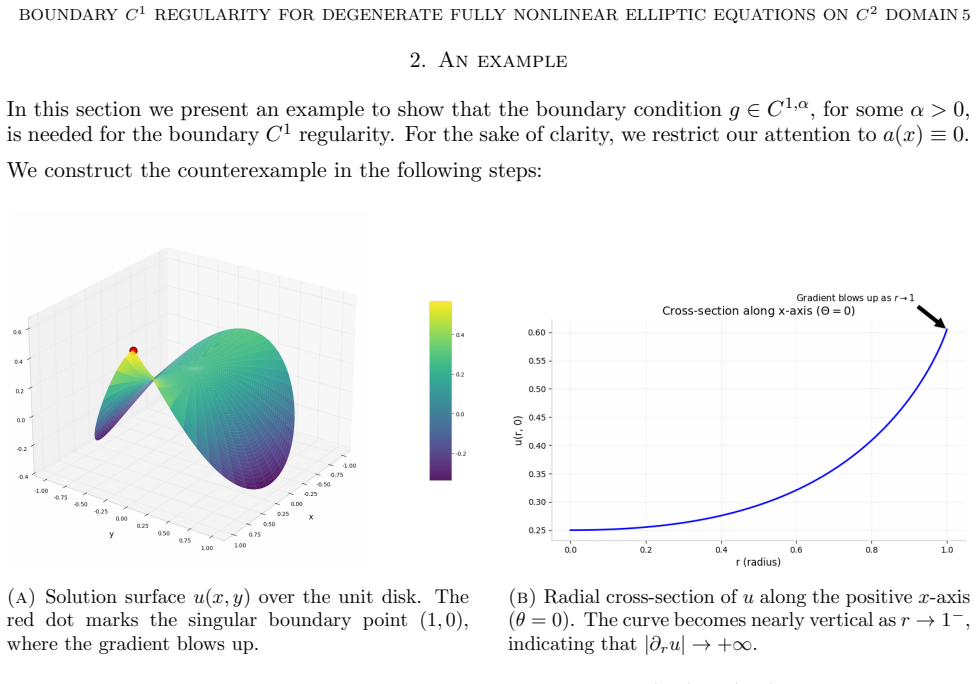
math.AP 2026-05-12 2 theorems

Degenerate nonlinear equations gain C^1 boundary regularity on C^2 domains

Boundary C¹ regularity for degenerate fully nonlinear elliptic equations on C² domain

Global C^0,γ to C^1 estimates hold for a class of degenerate fully nonlinear PDEs when the domain is C^2 and boundary data is C^{1,α}, with

Figure from the paper full image
abstract click to expand
In this article, we establish global regularity results ($ C^{0,\gamma}$, $ C^{0,1} $ and $ C^{1}$ estimates) for a class of degenerate fully nonlinear equation on $ C^{2} $-domain. This corresponds to the boundary counterpart of the interior $ C^{1}$ regularity results by \cite{APPT22} and \cite{AN25}. By example we show that $ C^{1,\alpha} $ regularity of boundary datum is sharp within the scale of H\"{o}lder spaces. As a byproduct, we also provide global $ C^{1,\beta} $ regularity for a class singular fully nonlinear equation.
0
0
math.AP 2026-05-12 Recognition

Nudging converges for parabolic equations with noisy observations

Continuous Data Assimilation for Semilinear Parabolic Equations with Multiplicative Observation Noise

Mean-square error vanishes and almost-sure uniform convergence holds under extra noise conditions for models like Navier-Stokes and Allen-Ca

abstract click to expand
The problem of continuous data assimilation for semilinear parabolic equations based on partial observations corrupted by noise is investigated. The noise is allowed to be multiplicative, with additive noise arising as a special case. In a general Gelfand triple framework, an abstract theory for the nudging equation is developed that covers both weak and strong formulations. Mean square convergence of the assimilation error is proved under suitable assumptions, and, under additional integrability conditions on the noise, a uniform almost sure convergence result is established. Finally, the framework is applied to several PDE models, including the 2D Navier-Stokes, 2D magnetohydrodynamics, 2D quasi-geostrophic, and 1D Allen-Cahn equations.
0
0
math.AP 2026-05-12 2 theorems

Rotating cylinder films have unique steady states for non-integer length ratios

Analysis of a three-dimensional fluid flow in rotating cylinders

Without gravity the states stay stable only for lengths below pi times radius, with a manifold of periodic solutions and slow ODE dynamics,

abstract click to expand
Subject of consideration is the modelling and analysis of a capillary-driven three-dimensional rimming-flow problem. We present the derivation of a fourth-order quasilinear degenerate-parabolic partial differential equation for the height $h > 0$ of a fluid film coating the inner wall of a cylinder that rotates around a horizontal axis. The equation arises from a rescaled Navier-Stokes system for thin fluid films by means of a lubrication approximation and accounts for the physical effects of rotation, surface tension and gravity. The effect of the latter is measured by a non-dimensional parameter $0 \leq \delta \ll 1$. We characterise the structure of the steady states depending on the ratio $\ell$ of the cylinder length to its radius. In the absence of gravity ($\delta=0$), in the case $\frac{\ell}{\pi} \notin \mathbb{Z}$, steady states are unique. For $0 < \delta \ll 1$, steady states are shown to be locally unique for any $\ell$. These steady states are stable for $\ell < \pi$, while they are unstable for $\ell > \pi$. Furthermore, in the absence of gravity, for all $\ell > 0$, we show that there exists a manifold of time-periodic solutions. In the critical case $\ell = \pi$, we study the dynamics of the solutions close to the manifold of periodic orbits in the critical case $\ell = \pi$ on the large time scale $\tau = \delta^2 t$. It turns out that in the time scale $\tau$ this dynamics can be approximated by a system of ordinary differential equations.
0
0
math.AP 2026-05-12 2 theorems

Algebraic cancellation yields global large solutions for multi-species Boltzmann

Global Well-posedness for the Multi-species Boltzmann Equation with Large Amplitude Initial Data

Asymmetric collisions from unequal masses are tamed by an extra identity that bounds the frequency from below and forces exponential return.

abstract click to expand
This paper establishes the global well-posedness of the multi-species Boltzmann equation with large-amplitude initial data in the periodic domain $\mathbb{T}^3$. In contrast to the single-species case, the multi-species mixture model lacks structural symmetry in its collision operators due to the distinct masses of different species. This asymmetry makes it difficult to obtain pointwise estimates for the nonlinear collision terms. Although the Carleman representation for the mixture model introduced in \cite{BD2016} provides a useful reduction of the collision integral, it does not directly yield the desired estimate. To overcome this difficulty, we identify an additional algebraic cancellation structure which leads to the pointwise estimates for the nonlinear terms. By applying this refined approach, we derive the necessary velocity-weighted $L^\infty$ estimates for the nonlinear terms. Furthermore, under the smallness assumption on the initial relative entropy, we establish a uniform lower bound for the nonlinear collision frequency and prove that the large-amplitude solutions exist globally in time and decay exponentially to the global equilibrium.
0
0
math.AP 2026-05-12 2 theorems

Elastica energy limits to 2π multiples at each concentration

Concentration effects and Gamma-limit for the elastica functional for open and closed curves

The first-order limit for open and closed immersed curves depends only on the count of curvature singularities.

Figure from the paper full image
abstract click to expand
We study the $\Gamma$-convergence of a class of elastica-type energies defined on immersed planar curves and depending on a small positive parameter $\epsilon$. As $\epsilon\to 0^+$, sequences with equibounded energy develop concentration phenomena in the curvature, leading to the emergence of singularities described by atomic measures. This naturally gives rise to a limiting framework in terms of pointed curves, consisting of a curve together with a measure encoding curvature concentration. We characterize the first-order $\Gamma$-limit in two settings: for immersed open curves with fixed endpoints and boundary conditions on the tangents, and for immersed closed curves of prescribed length. In both cases, the limiting energy depends only on the number of concentration points and is expressed as a sum of contributions, each given by an integer multiple of $2\pi$. A key feature of the problem is that the rescaled energies exhibit a structure closely related to one-dimensional Modica--Mortola type functionals.
0
0
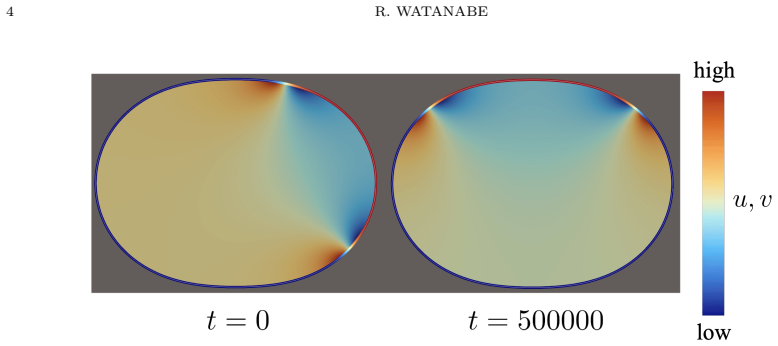
math.AP 2026-05-12 2 theorems

Cell geometry sets polarization pulse positions via Green's function potential

Geometry-induced pulse dynamics in a bulk-surface reaction-diffusion system for cell polarization

Reduced equations show slow drift follows a gradient flow whose geometry term produces stationary sites and pitchfork bifurcations in dumbb1

Figure from the paper full image
abstract click to expand
This paper studies a bulk-surface reaction-diffusion system for cell polarization in two-dimensional domains. The model describes the formation of localized patterns through the wave-pinning mechanism, while explicitly incorporating the effect of cell shape. Using singular perturbation methods, we formally derive reduced ordinary differential equations describing the wave-pinning dynamics on a fast time scale and the subsequent slow drift of pulse solutions induced by domain geometry. The resulting slow dynamics is a gradient flow of a potential function whose geometry-dependent part is expressed in terms of the Neumann Green's function. We then analyze the reduced dynamics in several concrete geometries, including dumbbell-shaped domains and perforated disks. In these examples, we characterize stationary pulse positions, their stability, and the bifurcation structures arising from changes in geometric parameters. To evaluate the geometric terms appearing in the reduced dynamics, we use a conformal mapping method to compute the Neumann Green's function for these domains. Our analysis reveals geometry-induced phenomena such as nontrivial stationary pulse locations and both supercritical and subcritical pitchfork bifurcations. Finally, we perform numerical simulations to support the theoretical predictions.
0
0
math.AP 2026-05-11 Recognition

3D Navier-Stokes solutions stay smooth for all time

A Classical Two-Part First-Threshold Proof of Global Smoothness for Navier--Stokes: Axisymmetric Swirl Closure and Full-System Reduction

Any hypothetical singularity reduces to axisymmetric swirl or 2D flow, both already known to remain regular.

abstract click to expand
We prove global smooth continuation for smooth finite-energy solutions of the three-dimensional incompressible Navier--Stokes equations by a two-part first-threshold argument. Part I proves the axisymmetric-with-swirl theorem in the exact five-dimensional lifted formulation. The central variables are the lifted vorticity ratio \(G=\omega_\theta/r\), the regularized swirl derivative \(F=u^\theta/r\), and the squared source density \(H=F^2\). In these variables the derivative source in the \(G\)-equation and the compressive feedback generated by the recovered strain \(U=u^r/r\) form a single pair-transfer mechanism. The proof combines localized energy identities, Hardy--Littlewood--Sobolev and Sobolev interpolation estimates, pair-threshold absorption, finite-overlap descendant exclusion, localized temporal source-to-score estimates, compactness of endpoint profiles, projected Pohozaev--Morawetz strictness, and an auxiliary recovery estimate for \(F\). Part II gives a full three-dimensional finite-threshold front-end. Starting from a hypothetical singular terminal packet, it removes leakage, shell, pressure, tail, fragmentation, passive-strain, angular phase-lock, and transfer-active temporal channels by finite-overlap descendants or strict terminal loss. A zero final defect forces the active frame measure into either a constant-frame locally two-dimensional class or a physical azimuthal orbit around one fixed axis. The first alternative is excluded by the classical two-dimensional Navier--Stokes theory, and the second is precisely the axisymmetric-with-swirl class proved in Part I.
0
0
math.AP 2026-05-11 2 theorems

Neumann eigenvalues converge to Steklov under boundary concentration

Weighted Neumann-to-Steklov limits for nonlinear eigenvalues and trace constants

First nontrivial weighted Neumann eigenvalue with concentrating bulk weight approaches the boundary Steklov eigenvalue, and minimizers also

abstract click to expand
We study a nonlinear Neumann-to-Steklov limit generated by a family of interior weights concentrating at the boundary. On a class of admissible possibly irregular domains obtained from the unit ball by trace-compatible Sobolev homeomorphisms, we consider the first nontrivial weighted \((p,q)\)-Neumann eigenvalue with respect to a concentrating bulk weight \(\gamma_a\). We prove that, as \(a\to0\), these eigenvalues converge to the corresponding weighted \((p,q)\)-Steklov eigenvalue with boundary weight \(\beta\). Moreover, normalized minimizers converge, up to subsequences, strongly in \(W^{1,p}\) to Steklov minimizers. Equivalently, the best constants in the weighted Poincar\'e inequalities converge to the best constants in the weighted trace inequalities; in fact, a quantitative convergence estimate is obtained in the subcritical trace range.
0
0
math.AP 2026-05-11 1 theorem

Forced Navier-Stokes solutions beat generic decay limits

Solutions of the Navier-Stokes equations with forced rapid space-time decay

A fixed spatial force profile, adjusted only in time, produces solutions decaying faster than |x|^{-(n+1)} and t^{-(n+1)/2}.

abstract click to expand
We study the pointwise decay properties of solutions to the incompressible Navier-Stokes equations, both in the space and time variables. It is well known that generic global solutions on $\mathbb{R}^n$ do not decay faster at infinity than $|x|^{-(n+1)}$ and $t^{-(n+1)/2}$ in the pointwise sense. In this paper, we address the control problem of constructing an external forcing and a solution to the Navier-Stokes equations whose space-time decay properties go beyond these limiting rates. A distinctive feature of the forcing term is that its spatial profile can be fixed once and for all, independently of the initial data of the problem, and localized in an arbitrarily small region of $\mathbb{R}^n$. Only the temporal profile of the external force displays a dependency on the initial datum.
0
0
math.AP 2026-05-11 2 theorems

U-shaped attention profile explains lost-in-the-middle

Kinetic theory for Transformers and the lost-in-the-middle phenomenon

Closed-form mean-field solution for uniform tokens predicts higher retrieval at prompt ends than in the middle under a smallness condition.

Figure from the paper full image
abstract click to expand
We study causal self-attention dynamics -- a toy model for decoder Transformers -- which we interpret as a non-exchangeable interacting particle system. Adapting cumulant expansions to the triangular causal dependency structure of the model, and appealing to non-hierarchical methods to estimate correlations using Glauber calculus, we prove a quantitative mean-field limit result and a next-order characterization of correlations. For iid uniformly distributed tokens, the limiting correlation equation can be solved in closed form and we obtain a rigorous explanation of the empirically observed \emph{lost-in-the-middle} phenomenon: the token retrieval profile, as a function of the source position in the prompt, is $\mathsf{U}$-shaped, with primacy, recency, and a unique interior minimum under an explicit smallness condition.
0
0
math.AP 2026-05-11 2 theorems

Solutions to singular fractional Orlicz problems converge to local limit

On singular problems in nonreflexive fractional Orlicz-Sobolev spaces

Unique positive solutions exist in nonreflexive spaces and approach the local problem solution as the fractional order s rises to 1.

abstract click to expand
In this work, we deal with existence and uniqueness of positive solution $u_s$ for the singular quasilinear problem $(-\Delta_{\Phi})^su=u^{-\gamma}$ in the nonreflexive fractional Orlicz-Sobolev $ W^{s}_0L^{\Phi}(\Omega)$ for $0<s<1$. Furthermore, we show that $u_s$ converges in $L^{\Phi}(\Omega)$ to the unique positive solution $u\in W^{1}_0L^{\Phi}(\Omega)$ of the problem $-\Delta_{\Psi}u=u^{-\gamma}$ as $s \uparrow 1$, where $\Psi$ is an appropriate $N$-function equivalent to the $N$-function $\Phi$. The main difficulties to obtain existence of weak solutions for both singular quasilinear problems are that their associate energy functionals may not be well-defined on their whole natural workspaces due to the lack of the reflexivity and the presence of the singular term. To overcome these difficulties, we will use the minimization method and present a new approach to building appropriate test functions to prove that the problems have positive minimizers that we showed to be weak solutions of them, respectively.
0
0
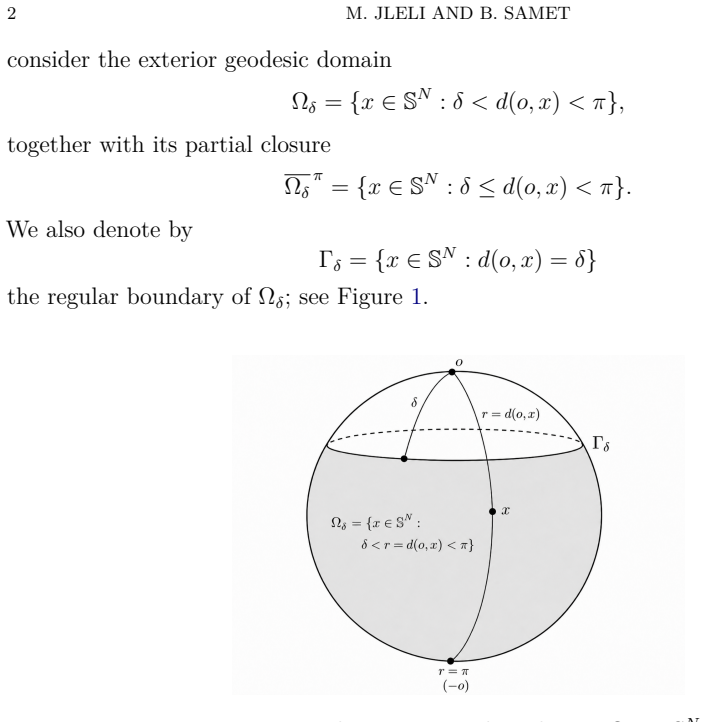
math.AP 2026-05-11 2 theorems

Critical exponent splits existence and nonexistence for sphere Hardy heat inequality

Semilinear Heat Inequalities with a Hardy-Type Potential in an Exterior Geodesic Domain on mathbb{S}^N

Above p_crit no weak solutions exist for nontrivial sources; below it solutions appear for suitable data when α > −2.

Figure from the paper full image
abstract click to expand
We study an inhomogeneous semilinear heat inequality on the unit sphere \(\mathbb S^N\), \(N\ge3\), in an exterior geodesic domain associated with a fixed pole. The equation involves the singular Hardy-type potential \(\lambda/\sin^2 r\), where \(r=d(o,x)\), and the weighted nonlinearity \((\sin r)^\alpha |u|^p\). For \(\alpha>-2\) and \(0<\lambda\le \lambda^*=((N-2)/2)^2\), we prove the existence of a critical exponent \(p_{\mathrm{crit}}=p_{\mathrm{crit}}(\alpha,N,\lambda)\) governing the existence and nonexistence of solutions. More precisely, we prove that no weak solution exists for any nontrivial nonnegative source in the range \(p>p_{\mathrm{crit}}\), whereas classical solutions exist for some positive continuous sources in the range \(1<p<p_{\mathrm{crit}}\). Under suitable additional assumptions, we also prove nonexistence at the critical exponent \(p=p_{\mathrm{crit}}\). If \(\alpha\le -2\), we show that nonexistence holds for all \(p>1\). The analysis is based on the construction of radial Hardy barriers adapted to the antipodal singularity and on sharp integral estimates involving power and logarithmic cutoffs near \(r=\pi\).
0
0
math.AP 2026-05-11 Recognition

Two critical exponents govern biharmonic heat equation

Double Criticality for a Hardy-Rellich Biharmonic Heat Equation in an Exterior Domain

Fujita-type threshold and source-decay threshold together decide existence of weak solutions in exterior domains with singular potential

abstract click to expand
We study the existence and nonexistence of weak solutions to an inhomogeneous semilinear biharmonic heat equation in an exterior domain, involving a singular Hardy--Rellich potential, a weighted nonlinearity $|x|^{\sigma}|u|^{p}$, and a positive source term $f(x)$. We identify two distinct critical regimes governing the behavior of solutions. More precisely, we first determine a Fujita-type critical exponent that separates nonexistence from existence. We then show that, in the supercritical range, a second critical exponent arises in terms of the decay exponent of the source, in the sense of Lee and Ni. Our results extend the recent work \cite{Tobakhanov} by considering a singular Hardy--Rellich potential and a weighted nonlinearity, leading to a different critical behavior.
0
0
math.AP 2026-05-11 Recognition

Courant nodal theorem holds for degenerate elliptic operators

Some Key Properties of Eigenfunctions Linked to Degenerate Elliptic Differential Operators

Eigenfunctions obey the classical bound on nodal domains and simple eigenvalues are generic even with boundary-vanishing weights.

abstract click to expand
In this study, we address the eigenvalue problem given by: \begin{equation*} \begin{cases} -\Div (w\nabla u_i)=\la_iu_i &\text{in } \Om\subset \mathbb{R}^n,\\ u_i=0 &\text{on } \pt \Om, \end{cases} \end{equation*} where $w > 0$ within $\Om$ and $w = 0$ on part of $\partial \Omega$. We establish Courant's nodal domain theorem for the corresponding degenerate elliptic differential operator $\mathcal{A}$. Unlike uniformly elliptic operators, degenerate cases often result in the loss of many advantageous properties. Despite this, we show that the essential property that the set $\{\rho \in L^\infty(\Omega) \colon \mathcal{A} + \rho \text{ has simple eigenvalues}\}$ forms a residual subset within $(L^\infty(\Omega), |\cdot|_\infty)$ still holds for the degenerate elliptic differential operator $\mathcal{A}$.
0
0
math.AP 2026-05-11 2 theorems

Weak solutions exist for semilinear PDEs with rough initial data

Well-posedness and regularity for seminlinear time-dependent second and fourth order in space equations

A single Faedo-Galerkin compactness argument covers both Laplacian and bi-Laplacian cases and extends from smooth to non-smooth starting u.

Figure from the paper full image
abstract click to expand
This article discusses a unified convergence analysis of the semilinear time-dependent equation $\partial_t u + (-1)^\mathrm{m}\Delta^{\mathrm{m}}u + u^3 - u = f$ with $\mathrm{m} \in \{1,2\}$ and homogeneous Dirichlet boundary conditions. The analysis relies on Faedo-Galerkin approximation and convergence via compactness estimates. The existence and uniqueness of the weak solution is proved when the initial data is smooth. A refined and novel analysis extends the existence result to problems with rough initial data also.
0
0
math.AP 2026-05-11 Recognition

Positivity holds in Ekeland-Nirenberg problem exactly when d ≤ a c

The Ekeland--Nirenberg Variational Problem:A Sharp Positivity Threshold and Extensions

The unique minimizer and its kernel remain positive on the quadrant below this threshold and change sign above it.

Figure from the paper full image
abstract click to expand
We study the Ekeland--Nirenberg variational problem in the two-dimensional diagonal family \[ J_{a,c,d}(u)=\int_{\Rp^2}\bigl(u_{xy}^2+a u_x^2+c u_y^2+d u^2\bigr)\dd x\dd y, \qquad a,c,d>0, \] under the constraint $u(0,0)=1$. If $u_{a,c,d}$ is the unique minimizer and $K_{a,c,d}$ is its cosine kernel, we prove the sharp classification \[ K_{a,c,d}>0 \hbox{ on } \Rp^2\quad\Longleftrightarrow\quad u_{a,c,d}>0 \hbox{ on } \Rp^2\quad\Longleftrightarrow\quad d\le ac . \] Thus every supercritical triple $d>ac$ produces sign change. We also prove local sign-change stability under small two-dimensional non-diagonal perturbations and a sharp product-type $n$-dimensional diagonal threshold. The domain and evolution results are stated in precise auxiliary settings: a free-boundary capacity formulation for domains and a selected decaying branch of the second-order evolution equation.
0
0
math.AP 2026-05-11 Recognition

Sign of singular integral decides half-space flow separation

On the Existence of Boundary Layer Separation for Incompressible Fluid Flow in the Half-Space

Negative value triggers a boundary-layer separation point in Stokes flow; positive value prevents it, and the pattern persists under Navier–

abstract click to expand
We consider the Stokes system in the half-space with localized boundary data. We prove that a boundary layer separation point exists provided that a certain singular integral determined by the boundary data is negative. On the other hand, if this integral is strictly positive, then boundary layer separation does not occur. When boundary layer separation occurs, we also investigate the dynamics of the separation point and the sign of the pressure gradient. Furthermore, by a perturbation argument, we construct solutions to the Navier--Stokes equations in the half-space that exhibit the same qualitative behavior as in the Stokes case.
0
0
math.AP 2026-05-11 2 theorems

Local well-posedness shown for noise-driven free boundaries in compressible fluids

Noise-Driven Free Boundaries In The Compressible Navier-Stokes Equations

The boundary evolves by a stochastic flow; solutions with positive density exist up to a random positive time and are pathwise unique.

abstract click to expand
A stochastic free-boundary problem for the three-dimensional barotropic compressible Navier--Stokes equations is studied. The main feature of the model is that the free boundary is transported by a Stratonovich stochastic flow, so that the noise enters the kinematic boundary condition and hence the evolution of the moving domain. An additional It\^o forcing in the momentum equation is also allowed. The problem is transformed by a stochastic Lagrangian map generated by the velocity and the transport vector fields. In these coordinates the density is represented through the Jacobian of the flow, and the remaining system is solved by combining stochastic maximal regularity, deterministic %\rL^p%-%\rL^q$ estimates, and a localized contraction argument. Local pathwise well-posedness is obtained up to an a.s. positive stopping time, with strictly positive density and pathwise uniqueness.
0
0
math.AP 2026-05-11 2 theorems

Finite Morse index Bernoulli solutions in 3D are axially symmetric

Finite index solutions to the Bernoulli problem in three dimensions are axially symmetric

Entire solutions with finite index to the one-phase free boundary problem must rotate around a fixed axis, reducing the problem to two space

abstract click to expand
We show that every entire solution to the Bernoulli (or one-phase) free boundary problem with finite Morse index in $\mathbb{R}^3$ is axially symmetric. In fact, we additionally prove that the same result would follow in any dimension $4 \le n \le 6$ in which stable entire solutions are shown to be flat.
0
0
math.AP 2026-05-11 2 theorems

Large initial data force finite-time blow-up in mixed parabolic equations

Blow-up of solutions to semilinear parabolic equations driven by mixed local-nonlocal operators with large initial data

Adapting the Kaplan method shows the result holds for any power p greater than one, including the fractional Laplacian case.

abstract click to expand
We investigate finite-time blow-up for nonnegative solutions to the Cauchy problem associated with semilinear parabolic equations driven by a mixed local--nonlocal operator. The reaction term is assumed to satisfy suitable structural hypotheses, the prototype being $f(u)=u^p$ with $p>1$. By adapting the Kaplan method to the present framework, we prove that solutions blow up in finite time whenever the initial datum is sufficiently large. In the prototype case $f(u)=u^p$, this conclusion holds for every $p>1$. As a particular case of our operator, we also include the fractional Laplacian; to the best of our knowledge, this type of result is new even in that special case.
0
0
math.AP 2026-05-11 Recognition

Neuron networks synchronize exponentially when coupling exceeds explicit threshold

Global Dynamics and Synchronization of Hodgkin-Huxley-Wilson Neural Networks

The Hodgkin-Huxley-Wilson model yields sharp bounds on solutions and a computable condition for complete synchronization.

abstract click to expand
Hodgkin-Huxley equations as a monumental breakthrough in biological and physiological theory of the 20th century had been distilled into many simplified models to study, typically FitzHugh-Nagumo equations and Hindmarsh-Rose equations, but the model itself not being fully investigated in terms of global and asymptotic dynamics due to its strong nonlinearity and higher dimensionality. In this paper a new model called Hodgkin-Huxley-Wilson neural networks is proposed and investigated. This model captured the essential features of the nonlinearity and the conductances of two dominant ionic current channels of sodium and potassium coupled with the membrane equation in the original Hodgkin-Huxley model. Through uniform and sharp \emph{a priori} estimates by hard analysis on the solutions of the model equations and the interneuron differencing equations, It is rigorously proved that global solution dynamics are robustly dissipative with a sharp ultimate bound and that complete synchronization of the Hodgkin-Huxley-Wilson neural networks at an exponential convergence rate occurs if the interneuron coupling strength satisfies an explicitly computable threshold condition. The main results are further extended to Caputo fractional memristive Hodgkin-Huxley-Wilson neural networks.
0
0
math.AP 2026-05-11 3 theorems

Compressible Euler dissipates energy on shocks

Dissipative structures in compressible inviscid fluids

Weak solutions show energy defect concentrated on codim-1 discontinuities, unlike incompressible models.

abstract click to expand
This note aims at the following problem. In an ideal density dependent fluid system, is the total energy dissipated on shock type discontinuities? To this end, we study the local energy balance for weak solutions to the isentropic compressible Euler system and derive fine properties of the defect measure. This is done by a careful analysis of the small scale properties of the solutions at the shock discontinuity. By means of the same technique, we also consider the inhomogeneous incompressible case, and, comparing the result, we confirm the general principle that the accumulation of the total energy on codimension one singular structures is a feature that distinguishes compressible and incompressible models.
0
0
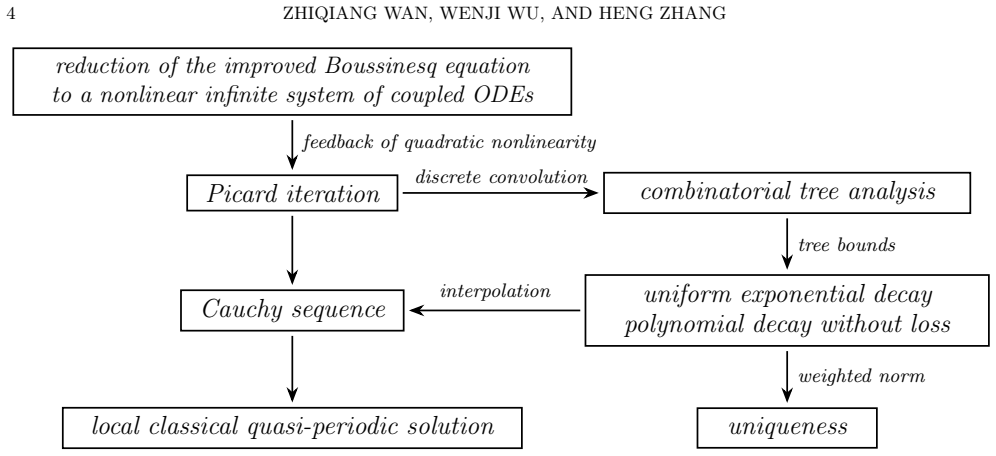
math.AP 2026-05-11 Recognition

Non-resonant frequencies allow local quasi-periodic Boussinesq solutions

The Cauchy problem for the improved Boussinesq equation with spatially quasi-periodic initial data

Unique classical solutions exist and preserve the initial exponential or polynomial Fourier decay.

Figure from the paper full image
abstract click to expand
We study the Cauchy problem for the improved Boussinesq equation \[ u_{tt}-u_{xx}-u_{xxtt}-(u^2)_{xx}=0 \] on the real line with spatially quasi-periodic initial data. For a non-resonant frequency vector $\omega\in\mathbb R^\nu$, we prove local existence and uniqueness of classical spatially quasi-periodic solutions with the same frequency vector $\omega$ in two Fourier-side classes. First, for exponentially decaying initial Fourier coefficients, we obtain a spatially quasi-periodic solution whose Fourier coefficients remain exponentially decaying on an explicit time interval. Second, for initial Fourier coefficients $c(n)$ and $d(n)$ satisfying the polynomial decay $ |c(n)|+|d(n)|\lesssim (1+|n|)^{-r}, \; r>\nu+2, $ we prove that the corresponding spatially quasi-periodic solution preserves the same polynomial decay rate as the initial data. We also extend these results to the nonlinearity $u^p$ with integer $p \geq 3$.
0
0
math.AP 2026-05-11 2 theorems

Small boundary data give unique stationary NSK solutions

Stationary solutions to the spherically symmetric compressible fluid with capillarity effect

On exterior domains the solutions decay exponentially or algebraically and converge to Navier-Stokes equilibria as capillarity vanishes.

Figure from the paper full image
abstract click to expand
We consider the spherically symmetric Navier--Stokes--Korteweg (NSK) system on the exterior domain $\Omega=\{x\in\mathbb{R}^n~|~|x|>1\}$ with $n\ge2$ when the boundary and far-field data are given. We show that, if the boundary data are sufficiently small, then there exists a unique smooth stationary solution to the spherically symmetric NSK system with impermeable wall, inflow, and outflow boundary conditions. We also establish the decay rate of the stationary solutions. Precisely, the stationary solution for the impermeable wall problem exponentially decays to the far-field states, while that of the inflow/outflow problem algebraically decays. Finally, we investigate the asymptotic convergences of the stationary solution for the impermeable wall problem as the capillarity coefficient vanishes. Numerical results validate that our theoretical convergence rate of the stationary solution is optimal.
0
0
math.AP 2026-05-11 2 theorems

Boundary traces uniquely identify coefficient matrix in parabolic system

Uniqueness for an inverse coefficient problem of a weakly coupled parabolic system

When the initial condition is a generating element, the 2x2 symmetric matrix P(x) is recovered from endpoint measurements u(0,t) and u(1,t).

abstract click to expand
This paper considers the weakly coupled parabolic system $\partial_t u-\partial^2_xu +P(x)u=0$ with the homogeneous Neumann boundary condition, where \(P(x)\) is a \(2\times2\) symmetric real-valued function matrix. Under the assumption that the initial value \(a(x)\) is a generating element (i.e., it has a nonzero inner product with every eigenfunction), we prove that the coefficient matrix $ P(x)$ is uniquely determined by the boundary observation $u(0, t)$, $u(1, t)$, $0 < t < T$. The proof relies on the eigenfunction expansion of the solution to the initial-boundary value problem and an extension of the Gel'fand-Levitan theory to the parabolic system.
0
0
math.AP 2026-05-11 Recognition

Ball minimizes ratio of fractional perimeters locally

Stability of the ball in isoperimetric inequalities between two fractional perimeters

For sets close to the sphere the scale-invariant combination of t-perimeter and s-perimeter is smallest at the ball

abstract click to expand
We consider the isoperimetric inequality involving the $s$-perimeter and the $t$-perimeter with $0<s<t<1$, and show that the ball is a local minimizer of the (scale-invariant) isoperimetric ratio $\mathcal{F}(E):=P_t(E)^{\frac{1}{n-t}}/ P_s(E)^{\frac{1}{n-s}}$ among sets $E$ that are nearly spherical. To this end, we rewrite $\mathcal{F}$ as a functional of $u$, where $u$ is a scalar function on the unit sphere in $\mathbb{R}^n$ that parametrizes the boundary of $E$, and prove a quantitative stability result for $\mathcal{F}$ around $u=0$ with respect to a suitable Sobolev norm. This parallels known results where the $s$-perimeter is replaced by the volume.
0
0
math.AP 2026-05-11 2 theorems

3D compressible Couette flow stable at O(ν^{3/2}) threshold

Nonlinear stability threshold for 3D compressible Couette flow

Frequency-space separation of zero and non-zero modes controls wave couplings to prove the nonlinear threshold.

abstract click to expand
We establish the nonlinear stability threshold $O(\nu^{3/2})$ for the three-dimensional Couette flow governed by the compressible Navier--Stokes equations. While stability thresholds are well understood in two dimensions for both compressible and incompressible flows, and in three dimensions for incompressible flows, the three-dimensional compressible case remains open due to additional structural features, strong mode interactions, and wave coupling. The proof is based on a refined frequency-space approach. For zero modes, we improve upon two-dimensional methods by clearly separating and precisely estimating the main contributions from diffusion waves, acoustic waves, and the lift-up mechanism, leading to a systematic way to handle their nonlinear coupling. For the non-zero modes, we introduce new multiplier estimates and a decomposition based on the structure of the compressible system, which allows us to track the interaction between dissipation and acoustic effects.
0
0
math.AP 2026-05-11 1 theorem

Small support speeds blow-up in conservation laws with sources

Gradient Catastrophe for Solutions to the Conservation Laws with Source Term

Weaker initial conditions than prior studies still force finite-time singularities, so only large-support data can remain smooth globally.

Figure from the paper full image
abstract click to expand
This paper studies singularity formation for conservation laws with a source term. Motivated by John (1974) and Barlin (2023), we prove finite-time blow-up under initial data conditions weaker than those in Barlin. Moreover, we show that a sufficiently small compact support length of the initial data promotes blow-up. Hence, global existence can only be achieved when the initial data have a large compact support length.
0
0
math.AP 2026-05-11 2 theorems

1D fluid model with volume velocity has global solutions for any data size

Global Existence of Classical Solutions to Brenner-Navier-Stokes-Fourier System for Large Data

The Brenner-Navier-Stokes-Fourier system stays in the classical class forever in Lagrangian coordinates even when initial perturbations are

abstract click to expand
We study the 1D Brenner-Navier-Stokes-Fourier (BNSF) system, proposed as a refinement of the classical Navier--Stokes--Fourier model through the introduction of the volume velocity, distinct from the mass velocity describing convective transport. When formulated in the Lagrangian mass coordinates with the volume velocity, the discrepancy between the two velocities induces a dissipative structure in the mass conservation law. We prove the global existence of classical solutions for arbitrarily large initial data. More precisely, for initial data in $H^k(\mathbb{R})$ with $k\ge3$, with the specific volume and absolute temperature initially bounded away from zero, we construct global-in-time solutions that remain in the same regularity class. Our result accommodates arbitrarily large initial data. A major difficulty is to establish lower and upper bounds for the specific volume \(v\). The additional dissipation yields an $L_t^2 L_x^2$ bound for $v_x$, which is further improved to an $L_t^\infty L_x^\infty$ bound of $v$ and $1/v$ via the parabolic De Giorgi method. We also apply the maximum principle to obtain a positive lower bound for the absolute temperature.
0
0
math.AP 2026-05-11 2 theorems

Lifespan bounds obtained for wave equations with space-derivative nonlinearity

Lifespan estimate for one dimensional wave equation with semilinear terms of spatial derivative

Upper and lower estimates follow from reducing selected cases to a known ODE inequality and applying an iteration-plus-slicing argument.

abstract click to expand
This paper studies the upper and lower bounds of the lifespan for the classical solutions to the initial value problems of one dimensional wave equations with non-autonomous semilinear terms including the space-derivative of the unknown function.This is a non-trivial business comparing to the analogous results with time-derivative type semilinear terms, especially for the proof to obtain the sharp upper bound of the lifespan as we have to deal with space dependent weights among iteration procedures of the weighted functional of the solution. Also it is surprising that a part of them reaches to the same ordinary differential inequality for classical semilinear damped wave equations introduced by Li and Zhou (Discrete Contin. Dynam. Systems, 1995, 1(4): 503-520), and we show a simple proof for blow up result from this ordinary differential inequality by iteration argument and slicing method in more general situation.
0
0
math.AP 2026-05-11 Recognition

Slicing method gives simple blow-up proof for 2D quadratic waves

A revisit via slicing method on a quadratic semilinear wave equation in two space dimensions

Iteration argument produces pointwise estimates with logarithmic lifespan loss when initial speed moment is nonzero and supports numerical应用

abstract click to expand
In this paper, we are focusing on proofs of a blow-up result for a quadratic semilinear wave equation in two space dimensions. There is a logarithmic loss in estimating the lifespan of a classical solution if the 0th moment of the initial speed does not vanish. This result is already known with almost sharp constants. But in order to have a direct application to the numerical analysis, we show a simple proof by iteration argument for a point-wise estimate of the solution with a slicing technique. Such a research direction can be found in the case of critical nonlinearity.
0
0
math.AP 2026-05-11 Recognition

Unique solutions and sharp bounds for multi-term sublinear Lane-Emden problems

Dirichlet problem for Lane-Emden type equations with several sublinear terms

Positive bounded solutions exist uniquely with bilateral pointwise estimates on A-regular domains for elliptic operators with Green function

abstract click to expand
We prove the existence, uniqueness, and sharp bilateral pointwise estimates for positive bounded solutions to the Lane--Emden type problem \[ \begin{cases} L u = \sum\limits_{i=1}^{m}\sigma_{i} u^{q_{i}}+\sigma_0, \quad u\geq0 & \text{in } \Omega, \liminf \limits_{x \rightarrow y} u(x) = f(y), & y \in \partial^\infty\Omega, \end{cases} \] where $0 < q_{i} < 1$. Here $Lu = - \text{div}(A \nabla u)$ is a uniformly elliptic operator with bounded coefficients, $\sigma_{i}$ is a nonnegative locally finite Borel measure on an $A$-regular domain $\Omega \subset \mathbb{R}^n$ which possesses a positive Green function associated with $L$, and $f$ is a nonnegative continuous function on the boundary $\partial^\infty\Omega$. An analogous result for positive continuous solutions to the problem is also illustrated. Our method can be adapted to address related sublinear problems with zero boundary conditions involving the fractional Laplace operator $(-\Delta)^{\alpha}$ for $0< \alpha < n/2$, in place of $L$, in $\mathbb{R}^n$ as well.
0
0
math.AP 2026-05-08 2 theorems

Segregation free boundaries form C^1 manifolds away from critical angles

The Free Boundary in a Higher-Dimensional Long-Range Segregation Model

In higher dimensions the interface is a smooth hypersurface unless local angles equal nω_n/2, and convex population supports become polytops

Figure from the paper full image
abstract click to expand
We consider a system of elliptic equations, depending on a small parameter $\eps$, that models long-range segregation of populations. The diffusion is governed by the Laplacian. This system was previously investigated by Caffarelli, Patrizi, and Quitalo in \cite{CL2} as a model in population dynamics, and they established the regularity of the free boundary in two dimensions. In this paper we study the free boundary in the higher dimensional case. We extend the concept of angles and asymptotic cones to higher dimensions, and give a characterization of regular and singular points in terms of their densities and angles. We obtain a structure result of the free boundary and show that, if the angles at the singular points are away from $\frac{n\omega_n}{2}$, the regular set is open in the free boundary and locally a $C^1$ manifold of dimension $n-1$. We also show that, if the supports of the populations are convex, they are convex polytopes. A weak form of the equality of angles for the convex configuration is also derived.
0
0
math.AP 2026-05-08 2 theorems

1D mean field games give Lipschitz pressure at free boundary

Optimal regularity at the free boundary in one-dimensional first-order mean field games

Nondegeneracy on initial data yields C^{1,1/2} value function and time-smooth boundaries for compactly supported density.

abstract click to expand
We establish sharp regularity for the value function, the pressure, and the free boundary in one-dimensional first-order mean field games with power coupling and compactly supported density. Under a standard nondegeneracy assumption on the initial datum, the pressure \(p=m^\theta\) is Lipschitz continuous, the value function \(u\) is \(C^{1,1/2}\), and the two free boundary curves are smooth in time. If the initial pressure is smooth, then both \(p\) and \(u\) are smooth up to the free boundary from inside the positive phase. The proof works in Lagrangian coordinates and, through a singular change of variables, recasts the boundary degeneracy as a removable radial axis in effective dimension \(N=4+2/\theta\), allowing the application of recent estimates for even solutions to elliptic problems with degenerate weights.
0
0
math.AP 2026-05-08 Recognition

Ferroelectric nematic energy reduces to high-anisotropy nematic

Asymptotic analysis of the energy for a ferroelectric nematic

Gamma-convergence under high elastic anisotropy scaling connects the model to a simpler nematic energy while preserving distinct physics.

abstract click to expand
The variational model for a ferroelectric nematic bears close resemblance to the well-known energy model for micromagnetics. Despite this similarity, the two models operate in fundamentally distinct parameter regimes describing different physics. In this paper we establish that the ferroelectric nematic energy functional $\Gamma$-converges to the energy of a nematic with high elastic anisotropy.
0
0
math.AP 2026-05-08

Positivity estimate yields classical master equations on graphs without boundaries

Master equations with an individual noise on finite state graphs

A quantitative bound prevents finite-time degeneracy at the simplex boundary and removes the need for boundary conditions.

abstract click to expand
We develop a classical well-posedness and regularity theory on a finite connected weighted graph for an extended mean field game system, its associated master equation, and a Hamilton-Jacobi- Bellman equation on the probability simplex, all in the presence of an individual noise operator. The geometric structure is inherited from the logarithmic-mean activation functional of discrete optimal transport, under which the entropic Fokker-Planck equation appears as a gradient flow on the graph and the individual noise operator is a bilinear form in the probability vector and the Wasserstein gradient. A central technical step is a quantitative preservation-of-positivity estimate for the discrete continuity equation, which rules out finite-time boundary degeneracy and yields a classical solution theory for the master equation on the open simplex without imposing any boundary condition. As an application, we recover a Nash equilibrium interpretation of the discrete system in terms of Markov chains on the graph. Our setup is inspired by the computational algorithms for optimal mass transport of [10, 11] and provides a rigorous well-posedness theory for several of the equations derived in [25].
0
0
math.AP 2026-05-08

Eigenfunctions of quantum cat maps equidistribute on the torus

Equidistribution of Eigenfunctions of Quantum Cat Maps

Short-period examples concentrate their large norms on a few coordinates while spreading evenly in phase space.

Figure from the paper full image
abstract click to expand
We prove that the short-period eigenfunctions of quantum cat maps constructed by Kim and the author equidistribute on $\mathbb{T}^2$ in the sense of semiclassical measures. We also show that their logarithmically large $\ell^\infty$-norm is asymptotically concentrated on a bounded number of coordinates. Thus, for this explicit family, strong coordinate localization coexists with semiclassical equidistribution. These results confirm the behavior suggested by earlier numerical evidence of Kim and the author, and contrast with the scarring phenomena for short-period eigenfunctions observed by Faure, Nonnenmacher, and De Bi\`evre.
0
0
math.AP 2026-05-08

Hirota-Satsuma gains sharp local well-posedness off-diagonal

Sharp local well-posedness for the Hirota-Satsuma system

Existence holds for unequal regularities when dispersion coefficients meet a ratio condition.

Figure from the paper full image
abstract click to expand
We establish sharp local existence results for the Hirota-Satsuma system in $H^k(\mathbb{R}) \times H^s(\mathbb{R})$, depending on the ratio between the dispersion of the components. These theorems significantly generalize previous works, which were restricted to the diagonal case of equal regularity $s=k$. Furthermore, we extend the known global well-posedness theory to the off-diagonal regime. The argument relies on the Fourier restriction norm method coupled with the concept of integrated-by-parts strong solution - a framework that generalizes the classical notion of strong solution.
0
0
math.AP 2026-05-08

Global weak solutions for liquid crystal in flexible shell

The simplified 2D Ericksen-Leslie liquid crystal model interacting with a 1D flexible shell

Solutions converge to the original Ericksen-Leslie model once the Ginzburg-Landau term is removed, provided the shell stays non-degenerate.

abstract click to expand
We consider the evolution and interaction of a 2-dimensional nematic liquid crystal of Ericksen-Leslie type within a 1-dimensional flexible viscoelastic structure. This is a fully macroscopic model in which the nematic liquid crystal is modelled by the simplified Ericksen-Leslie system with Ginzburg-Landau approximation. The liquid crystal is contained in a thin viscoelastic shell of arbitrary reference configuration that evolves with respect to the forces exerted by the liquid crystal. Barring any degeneracies in the shell, we construct a global weak solution for the coupled system. We then show that any family of such weak solutions that are parametrized by the Ginzburg-Landau coefficient, converges to a weak solution of the original simplified Ericksen-Leslie system without the Ginzburg-Landau term.
0
0
math.AP 2026-05-08

Polynomial and sine-Gordon flows stable on the sphere

Formal Stability of Tetrahedral Non-Zonal Flows on the Sphere

Subcritical polynomial and supercritical sine-Gordon profiles give negative second variation while sinh-Gordon and Liouville profiles form s

abstract click to expand
We investigate the formal stability of finite-amplitude non-zonal flows bifurcating from the trivial state in the unforced 2D Euler equations on the sphere. To bypass the degeneracy of the spherical Laplacian and filter out the low-frequency Fj{\o}rtoft instabilities, we restrict the functional space to the invariant subspace of the tetrahedral symmetry group. Using Arnold's Energy-Casimir method, we prove that the linearized elliptic operator derived via Liapunov-Schmidt reduction acts as the Hessian of the conserved functional. By tracking the critical eigenvalue along the bifurcating branches via the Crandall-Rabinowitz theorem, we establish a relation between the bifurcation topology and formal stability. Applying this framework to four distinct geophysical profile functions, we demonstrate that subcritical polynomial and supercritical sine-Gordon flows achieve a negative-definite second variation, that is, their formal stability. In contrast, subcritical sinh-Gordon and supercritical Liouville exponential flows generate saddle points, making them unstable. This classification identifies the specific nonlinear interactions required for the persistence of large-scale coherent waves in planetary atmospheres.
0
0
math.AP 2026-05-08

Entire spacelike radial graphs exist uniquely with prescribed mean curvature

Entire spacelike radial graphs with prescribed mean curvature in the Lorentz--Minkowski space

Star-shaped hypersurfaces in Lorentz-Minkowski space are unique when asymptotic to a light cone and obey a Willmore inequality, with non-sov

abstract click to expand
In this paper we address the existence and uniqueness of entire spacelike hypersurfaces in the Lorentz--Minkowski space $\mathbb{L}^{m+1}$ with prescribed mean curvature that are star-shaped with respect to a point and asymptotic to a light cone. We also establish a Willmore-type inequality and prove a non-existence result for spacelike radial graphs asymptotic to the light cone whose mean curvature belongs to $L^p$ for $1 \leq p\leq m$, in particular in the case of compactly supported mean curvature.
0
0
math.AP 2026-05-08

Uniqueness from analytic data implies Hölder stability on compact sets

H\"older Stability from Exact Uniqueness for Finite-Dimensional Analytic Inverse Problems

When the measurement operator is real analytic, exact uniqueness automatically gives a Hölder modulus of continuity for the recovered finite

abstract click to expand
We prove a stability theorem for finite-dimensional analytic inverse problems. Let \(U\subset\R^m\) be an open parameter set, let \(F(p)\) be a boundary measurement operator, and let \(R(p)\) be the finite-dimensional quantity to be recovered. If \(F\) is real analytic and \[ F(p)=F(q)\quad\Longrightarrow\quad R(p)=R(q), \] then \(R\) satisfies a H\"older stability estimate on every compact subset of \(U\). The proof uses a Hilbert--Schmidt scalarization of the operator equation \(F(p)=F(q)\) and the \L{}ojasiewicz distance inequality. We also prove that, after fixing countable dense families of boundary inputs and tests, finitely many scalar matrix elements of the data give the same H\"older recovery on compact parameter sets. This finite-measurement conclusion is qualitative: the proof does not give an effective measurement list, exponent, or constant. The finite-measurement statement follows from finite determinacy of real analytic zero sets. We apply the result to local Neumann-to-Dirichlet data for piecewise constant anisotropic conductivities and to localized Dirichlet-to-Neumann data for piecewise homogeneous anisotropic elasticity.
0
0
math.AP 2026-05-08

Small energy implies regularity for all fractional s

Uniform small energy regularity for fractional geometric problems

Proven uniformly for parabolic boundary Ginzburg-Landau problems and fractional harmonic maps to spheres as s approaches 1.

abstract click to expand
We prove small energy regularity for a parabolic boundary reaction Ginzburg-Landau problem in the full range $s\in (0,1)$, answering a question posed by Hyder, Segatti, Sire and Wang. We also obtain a similar small energy regularity result for fractional harmonic maps to spheres. Both results are uniform as $s\to 1$.
0
0
math.AP 2026-05-08

Zero-order limit of s-harmonic functions given by logarithmic Laplacian

s-harmonic functions in the small order limit

The same operator also controls the derivative with respect to s and yields monotonicity for wide classes of exterior data.

abstract click to expand
We study families $u_s$ of functions satisfying the equations $(-\Delta)^s u_s=0$, $s \in (0,1)$ in a smooth bounded open set $\Omega \subset \mathbb{R}^N$. The main purpose of this paper is twofold. First, we provide a detailed analysis of the asymptotics of these families in the zero order limit $s \to 0^+$. Second, we study the differentiability of $u_s$ as a function of $s$. Most of our results are devoted to the associated Poisson problem, where the family $u_s$ is determined by the exterior condition $u_s = g$ in $\mathbb{R}^N \setminus \Omega$ for some fixed function $g \in L^\infty(\mathbb{R}^N \setminus \Omega)$. Our results show that both the zero order asymptotics and the differentiability properties of $u_s$ can be expressed in terms of the logarithmic Laplacian of suitable extensions of $g$. This allows to deduce pointwise monotonicity properties of $u_s$ in the order parameter $s$ for a large class of functions $g$.
0
0
math.AP 2026-05-08

Point interactions create unique standing waves for defocusing NLS

Standing waves for defocusing nonlinear Schr\"odinger equations with point interaction

In 2D and 3D the modified Laplacian produces energy minimizers that are radially symmetric, positive, and stable, with sharp decay in the零 -

abstract click to expand
We consider standing waves of the nonlinear Schr\"odinger equation $i\partial_t u = -\Delta_\alpha u + |u|^{p-1}u$ in the defocusing case in dimensions $N=2$ and $N=3$. Here, $-\Delta_\alpha$ denotes the Laplacian with a point interaction. This operator is bounded from below by a negative constant; consequently, unlike in the free case, the associated energy functional admits non-trivial minimizers. We establish existence and uniqueness of standing waves, and prove further qualitative properties, including radial symmetry, positivity, and stability. Moreover, we build an appropriate functional space for the zero-mass case and establish sharp decay estimates in this case.
0
0
math.AP 2026-05-08

Nonlocal thin film energies Gamma-converge to local 2D functionals

Multiscale analysis and homogenization of nonlocal thin films

As thickness gamma and interaction range epsilon vanish the limit energy is given by an asymptotic formula that may separate into successive

Figure from the paper full image
abstract click to expand
In this paper, we introduce a nonlocal, variational model for thin films. We consider convolution-type functionals defined on a thin domain whose thickness is of order $\gamma$, where the effective interactions range between points is of order $\varepsilon$. We study the $\Gamma$-convergence of these energies, as both parameters vanish, to a local integral functional defined on a lower-dimensional domain. In the periodic homogenization setting, the limit energy density is characterized by an asymptotic formula that depends on the interplay between $\varepsilon$ and $\gamma$. Under suitable assumptions, this formula exhibits a separation of scales effect, namely, the limit energy can be obtained by performing two successive $\Gamma$-limits, first letting one parameter tend to zero while keeping the other fixed.
0
0
math.AP 2026-05-08

Shallow water model consistent for general non-periodic topographies

Consistency analysis for combined homogenization and shallow water limit of water waves

Consistency holds once the sea floor meets only minimal regularity and boundedness, removing periodicity and non-resonance requirements.

abstract click to expand
We consider a shallow water model in a homogenization framework. For periodic topographies, Craig, Lannes and Sulem have established a consistency result under some non-resonance conditions. In the present contribution, we significantly relax the periodicity condition and treat general topographies under minimal assumptions.
0
0
math.AP 2026-05-08

Characteristic data give smooth asymptotics for ultrahyperbolic solutions

Asymptotic properties of solutions to the characteristic problem for the ultrahyperbolic equation

Along lines crossing the data hyperplane transversally the solution stays regular and follows an explicit expansion determined by the given

abstract click to expand
The paper concerns the problem for the ultrahyperbolic equation in the Euclidean space with data on a characteristic hyperplane. Smoothness and asymptotics of the solution along characteristic lines transversal to the initial hyperplane are investigated.
0
0
math.AP 2026-05-08

Global solutions for 2D chemotaxis-Euler system with small initial oxygen

Global solutions to a two-dimensional chemotaxis-Euler system with robin boundary conditions on oxygen

The initial-boundary value problem has a unique solution for all time if the starting oxygen concentration is small enough.

abstract click to expand
This paper is concerned with the global well-posedness of a chemotaxis-Euler system in bounded domains of $\mathbb{R}^2$. Completing the system with physical boundary conditions, we show that the corresponding initial boundary value problem admits a unique global solution provided that the initial oxygen concentration is suitably small.
0
0
math.AP 2026-05-08

Discounted HJ equation stable only above critical threshold c0

On the inhomogeneous discounted Hamilton-Jacobi equations

Convergence rate equals integral of discount factor over Mather measures, dictating their large-c concentration on the manifold.

abstract click to expand
In this paper, we study the family of inhomogeneous discounted Hamilton-Jacobi equations \begin{equation}\label{hjs1} \lambda(x)u+h(x,d_x u)=c \quad \tag{$\ast$} \end{equation} on a closed manifold $M$ with a non-identically vanishing discount factor $\lambda(x)$. There is a critical value $c_0\in[-\infty,\infty)$ such that \eqref{hjs1} admits a viscosity solution if $c>c_0$ and no solution if $c<c_0$. Inspired by the recent development [34] on the stability theory of viscosity solution, we show that the equation admits an asymptotically stable solution if and only if $c>c_0$. In this case, we determine the basin of the stable solution and investigate the long time behavior of the solution semigroup associated to \eqref{hjs1}. In particular, we relate the lowest convergence rate to the integral of $\lambda$ over Mather measures, which leads to an asymptotic behavior of Mather measures when $c$ goes to infinity. Assume $c\geqslant c_0$ and the equation admits a solution, we classify ergodic Mather measures and locate their distribution in the phase space.
0
0
math.AP 2026-05-08

Commutator bounds close well-posedness for transport equations in TL spaces

Commutator estimates and their applications to the transport-type equations

New estimates via para-products and maximal functions give local existence, uniqueness, and blow-up criteria in subcritical and critical TL-

abstract click to expand
In this paper, we derive new commutator estimates in the Triebel-Lizorkin spaces by employing Bony's para-product decomposition, the Nikol'skij representation, and the Fefferman-Stein vector-valued maximal function. These estimates are then applied to develop a general theory for transport equations. Although analogous results are already available in the setting of Besov spaces, the methods developed there do not carry over directly to the Triebel-Lizorkin case. Our approach works for Triebel-Lizorkin spaces and, as a byproduct, also yields the corresponding results in Besov spaces. All proofs are presented in a unified manner that applies to both scales of function spaces, thereby extending and sharpening previous results on transport equations in these frameworks. Furthermore, the general theory we obtain is widely applicable to evolution equations, including incompressible and compressible ideal fluid flows, shallow water waves, and related models. As an illustration, we consider the two-component Euler-Poincar\'e system. Using the theoretical framework developed herein, we establish its local well-posedness and a blow-up criterion in both sub-critical and critical Triebel-Lizorkin spaces.
0
0
math.AP 2026-05-08

Radial L^p integrability forces stationary Navier-Stokes solutions to vanish

Liouville Theorems for Stationary Navier-Stokes Equations via the Radial Velocity Component

Ḣ¹ solutions in R³ are zero when only the radial velocity component meets the integrability threshold, with no global decay required.

abstract click to expand
We study Liouville-type results for the stationary Navier--Stokes equations in $\mathbb{R}^3$. We prove that any $\dot{H}^1(\mathbb{R}^3)$ solution is trivial under an integrability condition imposed only on the radial component of the velocity, namely $u_\rho(x) \in L^p(\mathbb{R}^3)$ with $3/2 < p \leq 3$. We also establish a uniqueness result in a variable-exponent setting, where an $L^6$-type condition is required only on a bounded region, while the exponent approaches the critical value $3$ at infinity. Our analysis reveals that the rigidity of the stationary Navier--Stokes system can be driven by localized and radial integrability properties, rather than uniform global conditions.
1 0
0
math.AP 2026-05-08 2 theorems

Two new regions extend Liouville theorems for 3D Navier-Stokes

Notes on Liouville-type theorems for the 3D stationary Navier-Stokes equations

Variable exponent p(·) satisfies assumptions in two additional non-negligible areas of R^3

abstract click to expand
In \cite{CV23}, Chamorro and Vergara-Hermosilla established several Liouville-type theorems to the Navier-Stokes equations in the framework of the variable Lebesgue spaces. These results may allow the variable exponent $p(\cdot)$ beyond the range of $[3,\frac{9}{2}]$ in some non-negligible regions in $\mathbb{R}^3$. In this paper we find two new non-negligible regions, in which the Liouville-type theorems still hold under some assumptions imposed on $p(\cdot)$ in these regions. Our results can be regarded as the generalization of the results in \cite{CV23}.
0
0
math.AP 2026-05-08

Two new regions extend Liouville theorems for 3D Navier-Stokes

Notes on Liouville-type theorems for the 3D stationary Navier-Stokes equations

The theorems hold in variable Lebesgue spaces when the exponent satisfies extra conditions that close the estimates at the boundary of prior

abstract click to expand
In \cite{CV23}, Chamorro and Vergara-Hermosilla established several Liouville-type theorems to the Navier-Stokes equations in the framework of the variable Lebesgue spaces. These results may allow the variable exponent $p(\cdot)$ beyond the range of $[3,\frac{9}{2}]$ in some non-negligible regions in $\mathbb{R}^3$. In this paper we find two new non-negligible regions, in which the Liouville-type theorems still hold under some assumptions imposed on $p(\cdot)$ in these regions. Our results can be regarded as the generalization of the results in \cite{CV23}.
0

browse all of math.AP → full archive · search · sub-categories