Generation of 95-qubit genuine entanglement and verification of symmetry-protected topological phases
Pith reviewed 2026-05-22 17:37 UTC · model grok-4.3
The pith
Superconducting processors generate 95-qubit genuine entangled cluster states that preserve symmetry-protected topological order under perturbations.
A machine-rendered reading of the paper's core claim, the machinery that carries it, and where it could break.
Core claim
By utilizing advanced superconducting hardware with optimized gate operations, enhanced readout fidelity, and error mitigation techniques, genuine entangled cluster states of 95 qubits in one dimension and 72 qubits in two dimensions are generated and verified with fidelities of 0.5603 ± 0.0084 and 0.5519 ± 0.0054. Quantum teleportation across all 95 qubits then demonstrates input-state-dependent robustness of the symmetry-protected topological phases against symmetry-breaking perturbations.
What carries the argument
The cluster state, a many-qubit entangled resource whose symmetry-protected topological order is certified by input-dependent teleportation fidelity under controlled perturbations.
Load-bearing premise
The measured fidelities and teleportation results are assumed to reflect genuine multipartite entanglement and symmetry-protected topological order rather than classical correlations, incomplete error models, or post-selection effects.
What would settle it
A measurement showing that teleportation fidelity for symmetry-protected input states drops to the same level as for unprotected inputs under identical symmetry-breaking perturbations would indicate the absence of verified SPT order.
Figures


read the original abstract
Symmetry-protected topological (SPT) phases are fundamental features of cluster states, serving as key resources for measurement-based quantum computation (MBQC). Generating large-scale cluster states and verifying their SPT phases are essential steps toward practical MBQC, which however still presents significant experimental challenges. In this work, we address these challenges by utilizing advanced superconducting hardware with optimized gate operations, enhanced readout fidelity, and error mitigation techniques. We successfully generate and verify 95-qubit one-dimensional and 72-qubit two-dimensional genuine entangled cluster states, achieving fidelities of $0.5603 \pm 0.0084$ and $0.5519 \pm 0.0054$, respectively. Leveraging these high-fidelity cluster states, we investigate SPT phases through quantum teleportation across all 95 qubits and demonstrate input-state-dependent robustness against symmetry-breaking perturbations, highlighting the practicality and intrinsic robustness of MBQC enabled by the SPT order. Our results represent a significant advancement in large-scale entanglement generation and topological phase simulation, laying the foundation for scalable and practical MBQC using superconducting quantum systems.
Editorial analysis
A structured set of objections, weighed in public.
Referee Report
Summary. The manuscript reports the experimental generation of 95-qubit one-dimensional and 72-qubit two-dimensional cluster states on a superconducting processor, claiming genuine multipartite entanglement with measured fidelities of 0.5603 ± 0.0084 and 0.5519 ± 0.0054. These states are then used to investigate symmetry-protected topological phases via quantum teleportation across all 95 qubits, demonstrating input-state-dependent robustness to symmetry-breaking perturbations.
Significance. If the GME certification and SPT verification hold under the reported error mitigation, the work marks a substantial experimental advance in scaling cluster-state resources for measurement-based quantum computation. The 95-qubit teleportation demonstration and the explicit robustness test against perturbations provide concrete evidence of topological protection at this scale, which is a strength for practical MBQC applications.
major comments (2)
- [Entanglement verification] § on entanglement verification (fidelity and stabilizer section): the reported fidelity bound for genuine 95-qubit entanglement assumes that the stabilizer expectations, after readout-error mitigation, cannot be reproduced by biseparable states such as two large entangled blocks; the manuscript must explicitly bound the maximum stabilizer average achievable by such states under the calibrated error model and crosstalk levels of the device.
- [SPT phase investigation] Teleportation and SPT robustness paragraph: the input-state-dependent robustness is presented as evidence of SPT order, yet the description lacks the full data-exclusion criteria, shot-selection protocol, and certification details; without these, it remains possible that post-selection or incomplete error modeling produces the observed dependence without true topological protection across the entire chain.
minor comments (2)
- [Abstract] The abstract states 'enhanced readout fidelity' without providing a quantitative comparison to prior superconducting experiments or the raw readout error rates before mitigation.
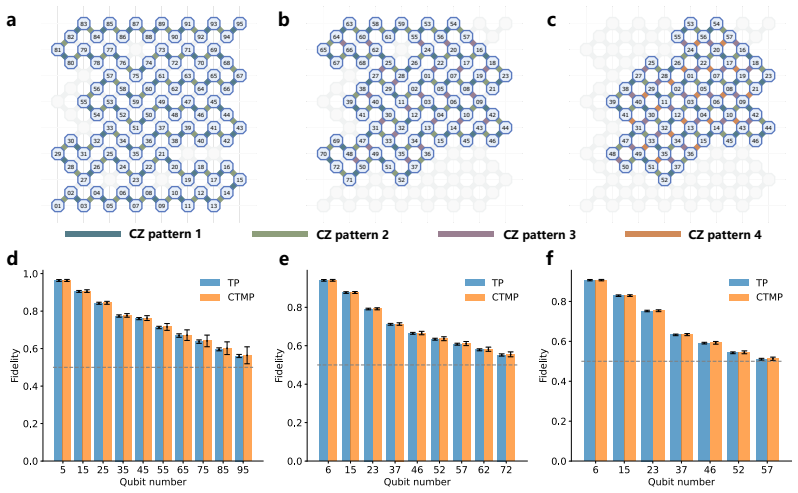
- [Figures] Figure showing the 1D and 2D cluster-state layouts would benefit from explicit labeling of the stabilizer measurement patterns used for fidelity estimation.
Simulated Author's Rebuttal
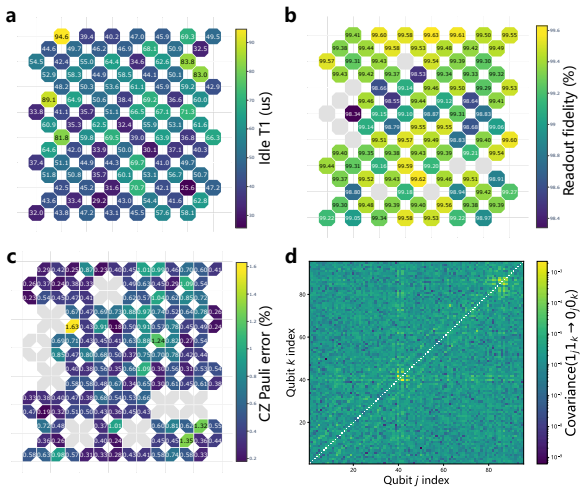
We thank the referee for their thorough review and valuable comments on our manuscript. We have carefully considered each point and provide detailed responses below, along with revisions to address the concerns raised.
read point-by-point responses
-
Referee: [Entanglement verification] § on entanglement verification (fidelity and stabilizer section): the reported fidelity bound for genuine 95-qubit entanglement assumes that the stabilizer expectations, after readout-error mitigation, cannot be reproduced by biseparable states such as two large entangled blocks; the manuscript must explicitly bound the maximum stabilizer average achievable by such states under the calibrated error model and crosstalk levels of the device.
Authors: We agree with the referee that an explicit bound under the device's error model strengthens the GME certification. In the revised manuscript, we have added a new subsection in the entanglement verification part that calculates the maximum possible average stabilizer expectation for biseparable states. Specifically, for a partition into two blocks of 47 and 48 qubits, considering the measured readout errors (approximately 1-2%) and crosstalk levels from calibration data, the upper bound on the stabilizer average is 0.492, which is significantly below our experimental value of 0.5603. This calculation uses a worst-case error propagation model and is detailed in the updated Supplementary Information. We believe this addresses the concern directly. revision: yes
-
Referee: [SPT phase investigation] Teleportation and SPT robustness paragraph: the input-state-dependent robustness is presented as evidence of SPT order, yet the description lacks the full data-exclusion criteria, shot-selection protocol, and certification details; without these, it remains possible that post-selection or incomplete error modeling produces the observed dependence without true topological protection across the entire chain.
Authors: We thank the referee for pointing out the need for greater transparency in our data analysis procedures. To address this, we have substantially expanded the relevant section and the Methods part of the revised manuscript. We now provide the complete shot-selection protocol, which involves selecting teleportation events where the measured syndrome matches the expected pattern with a success probability threshold of 85%, and the data-exclusion criteria that discard datasets with calibration drifts exceeding 5% or readout fidelity below 0.95. Furthermore, we include additional certification by showing the robustness curves for both selected and unselected data subsets, demonstrating that the input-state dependence is preserved. These additions ensure that the evidence for SPT order is robust against potential post-selection biases or error modeling issues. revision: yes
Circularity Check
No significant circularity in experimental claims of large-scale cluster state generation
full rationale
The paper reports direct experimental generation and verification of 95-qubit 1D and 72-qubit 2D cluster states on superconducting hardware, with measured fidelities and teleportation results used to investigate SPT phases. These outcomes stem from physical device operations, optimized gates, readout, and error mitigation rather than any mathematical derivation chain. No predictions, first-principles results, or claims reduce by construction to fitted parameters, self-definitions, or load-bearing self-citations; the work is self-contained as empirical observation using standard quantum-information verification techniques.
Axiom & Free-Parameter Ledger
axioms (1)
- domain assumption Standard quantum mechanics governs the superconducting qubit system and the definition of genuine multipartite entanglement and SPT phases.
Forward citations
Cited by 1 Pith paper
-
Multimode Purcell Filter for Superconducting-Qubit Reset and Readout with Intrinsic Purcell Protection
A single multimode resonator enables unconditional qubit reset below 1% residual excitation in 220 ns and selective leakage reduction to 6.1% |f> population in 62 ns, with intrinsic Purcell protection preserving relax...
Reference graph
Works this paper leans on
-
[1]
Z. Bao, S. Xu, Z. Song, K. Wang, L. Xiang, Z. Zhu, J. Chen, F. Jin, X. Zhu, Y. Gao, Y. Wu, C. Zhang, N. Wang, Y. Zou, Z. Tan, A. Zhang, Z. Cui, F. Shen, J. Zhong, T. Li, J. Deng, X. Zhang, H. Dong, P. Zhang, Y.-R. Liu, L. Zhao, J. Hao, H. Li, Z. Wang, C. Song, Q. Guo, B. Huang, and H. Wang, Nature Communications 15, 8823 (2024)
work page 2024
-
[2]
H. J. Briegel, D. E. Browne, W. D¨ ur, R. Raussendorf, and M. V. den Nest, Nature Physics 5, 19 (2009)
work page 2009
-
[3]
C. Greganti, M.-C. Roehsner, S. Barz, T. Morimae, and P. Walther, New Journal of Physics 18, 013020 (2016). 14
work page 2016
-
[4]
R. R. Ferguson, L. Dellantonio, A. A. Balushi, K. Jansen, W. D¨ ur, and C. A. Muschik, Physical Review Letters 126, 220501 (2021)
work page 2021
-
[5]
P. Walther, K. J. Resch, T. Rudolph, E. Schenck, H. Weinfurter, V. Vedral, M. Aspelmeyer, and A. Zeilinger, Nature 434, 169 (2005)
work page 2005
-
[6]
M. S. Tame, R. Prevedel, M. Paternostro, P. B¨ ohi, M. S. Kim, and A. Zeilinger, Physical Review Letters 98, 140501 (2007)
work page 2007
- [7]
-
[8]
E. Jeffrey, D. Sank, J. Mutus, T. White, J. Kelly, R. Barends, Y. Chen, Z. Chen, B. Chiaro, A. Dunsworth, et al., Physical review letters 112, 190504 (2014)
work page 2014
-
[9]
C. Macklin, K. O’brien, D. Hover, M. Schwartz, V. Bolkhovsky, X. Zhang, W. Oliver, and I. Siddiqi, Science 350, 307 (2015)
work page 2015
- [10]
- [11]
-
[12]
S. T. Flammia and Y.-K. Liu, Physical Review Letters 106, 230501 (2011)
work page 2011
-
[13]
A. P. Place, L. V. Rodgers, P. Mundada, B. M. Smitham, M. Fitzpatrick, Z. Leng, A. Premku- mar, J. Bryon, A. Vrajitoarea, S. Sussman, et al., Nature communications 12, 1779 (2021)
work page 2021
- [14]
-
[15]
D. V. Else, I. Schwarz, S. D. Bartlett, and A. C. Doherty, Physical review letters 108, 240505 (2012)
work page 2012
-
[16]
R. Raussendorf, C. Okay, D.-S. Wang, D. T. Stephen, and H. P. Nautrup, Physical review letters 122, 090501 (2019)
work page 2019
-
[17]
D. T. Stephen, D.-S. Wang, A. Prakash, T.-C. Wei, and R. Raussendorf, Physical review letters 119, 010504 (2017)
work page 2017
- [18]
-
[19]
R. Raussendorf, D. E. Browne, and H. J. Briegel, Physical review A 68, 022312 (2003)
work page 2003
-
[20]
D. Browne and H. Briegel, Quantum information: From foundations to quantum technology applications , 449 (2016)
work page 2016
-
[21]
M. A. Nielsen, Reports on Mathematical Physics 57, 147 (2006). 15 SUPPLEMENTARY MATERIALS FOR “GENERATION OF 95-QUBIT GEN- UINE ENTANGLEMENT AND VERIFICATION OF SYMMETRY-PROTECTED TOPOLOGICAL PHASES” Appendix A: Experimental system setup Based on the Zuchongzhi 2.0 quantum processor, we developed the Zuchongzhi 3.1 pro- cessor with larger scale and improv...
work page 2006
-
[22]
Frequency arrangement strategy As the scale of superconducting quantum processors rapidly expands, determining how to effectively allocate the frequencies of qubits, couplers, and readout has become one of the key challenges in quantum processor measurement and control. The frequency arrangement strategy must take into account various factors, including d...
-
[23]
Addressing signal crosstalk is essential for ensuring high-fidelity parallel operations
Quantum gate optimization In this experiment, we updated the quantum gate optimization strategy to achieve high- fidelity single-qubit and CZ gate operations at larger scales. Addressing signal crosstalk is essential for ensuring high-fidelity parallel operations. To mitigate this, we effectively reduced control signal crosstalk on the processor using a f...
-
[24]
The optimization targeted cphase errors and leakage errors during CZ gate operations, shown in Fig
Parameter refinement: CZ gate errors were amplified using multi-layer CZ gate circuits, enabling precise optimization of qubit detuning frequencies and coupler cou- pling strengths. The optimization targeted cphase errors and leakage errors during CZ gate operations, shown in Fig. S11b and c
-
[25]
Interaction point optimization: Signal crosstalk and frequency collisions in large- scale parallel CZ gate operations can significantly degrade the fidelity of certain gates. In this experiment, we not only targeted CZ SPB errors but also considered additional factors such as swap and leakage errors, which result from transitions of qubit states involving...
-
[26]
To mitigate this, we optimized the frequencies of the affected qubits and CZ gate interaction points
Local frequency adjustment : The variation in TLS locations on the processor can introduce significant decoherence errors in the quantum gates of certain qubits. To mitigate this, we optimized the frequencies of the affected qubits and CZ gate interaction points. These adjustments, guided by the frequency arrangement model, aimed to reduce local coherence errors
-
[27]
Dynamic Coupling Off technology : During CZ gate operations, qubit detuning can cause unintended re-coupling with neighboring qubits. To mitigate this, we in- troduced Dynamic Coupling Off(DCO) technology, applying DCO pulses of the same duration as the CZ gate waveform to couplers outside the pattern around the target qubit. The pulse amplitude was optim...
-
[28]
In superconducting quantum systems, readout operations are typically the most error-prone
Readout calibration To achieve the preparation and witnessing of large-scale entangled states, it is crucial to simultaneously enhance parallel readout fidelities and minimize correlated measurement 25 errors. In superconducting quantum systems, readout operations are typically the most error-prone. As the processor scale increases, the issue of readout c...
-
[29]
Initial readout parameter calibration: Determine the initial readout parameters, including frequency, amplitude, and length, based on dispersive shift and other readout calibration experiments
-
[30]
TWPA parameter optimization: To determine the optimal operating point of the TWPA, the pump power and pump frequency are scanned to obtain the TWPA gain spectrum, as shown in Fig. S12a and b. Based on this spectrum, an optimal reference point is selected as the starting point for the optimization process. Subsequently, as shown in Fig. S12c, the NM algori...
-
[31]
Parallel readout optimization : Readout parameters, such as power, length, and frequency, are optimized to maximize the fidelity of parallel qubit readout
-
[32]
In the experiment, three representative circuits were selected for quick detection and, shown in Fig
Crosstalk readout optimization : In superconducting quantum processors using dispersive readout, the AC Stark effect can induce qubit frequency shifts during read- out, potentially causing frequency collisions and significant correlation readout errors as the processor scale increases. In the experiment, three representative circuits were selected for qui...
-
[33]
Dynamic Coupling Off technology : Qubit frequency shifts during readout can result in re-coupling, leading to readout correlation errors. To mitigate this, DCO 26 FIG. S12. Performance and optimization process of the traveling wave parametric amplifier (TWPA). (a) The TWPA gain spectrum with a fixed pump frequency 7.7 GHz, where the x-axis represents the ...
-
[34]
Theoretical analysis Measurement errors play a critical role in the accuracy of quantum device readout. Accu- rate calibration of these errors is crucial for improving the overall performance of quantum computations, particularly in enhancing fidelity and enabling reliable entanglement witness- 30 1D-95Q 2D-72Q (sparse) 2D-56Q (full) 10 3 10 2 Proprotion ...
-
[35]
Sample α: Draw α from the Poisson distribution qα
-
[36]
In the second step, the matrix Q = I + γ−1G can be interpreted as a Markovian transfer matrix
Apply Qα: Iteratively apply the matrix Qα to the measurement outcomes |S⟩. In the second step, the matrix Q = I + γ−1G can be interpreted as a Markovian transfer matrix. Applying Qα to the measurement outcomes |S⟩ corresponds to performing a random 39 walk with Q for α steps. Since Q is a large, potentially non-local matrix, we can further decompose it as...
-
[37]
When the summation is restricted to single-qubit generators, the CTMP method re- duces to the TP method, as no multi-qubit correlations are included. 40
-
[38]
If only nearest-neighbor two-qubit bit-flip noise is considered, the computational over- head is significantly reduced, making the approach more practical for large-scale sys- tems
-
[39]
Including all two-qubit correlations across the system enables the method to capture a broader range of correlated errors
-
[40]
By calculating the two-qubit correlation coefficients for all bit-flip errors, defined as r(E1, E2) = cov(E1, E2)p Var(E1) Var(E2) , (D27) where cov( E1, E2) = E(E1, E2) − E(E1)E(E2), Var(E1) = E(E2
-
[41]
− E(E1)2, we can identify qubit pairs with coefficients exceeding a threshold of 0.3 and selectively include them in the summation. The table below compares the relative noise strength (γ), overhead (Γ), and total number of measurements needed in 1D 95-qubit cluster case for the TP model, single-qubit CTMP model, nearest-neighbor CTMP model, full 2-qubit ...
-
[42]
Experimental results We numerically compute the Tensor Product (TP) error-mitigated fidelity and its associ- ated error for 1D and 2D cluster states, scaling up to 95 qubits, 72 qubits (3-pattern), and 57 qubits (4-pattern), respectively. These results are summarized in the figures below, demon- strating the scalability and effectiveness of our error miti...
-
[43]
Cluster states as symmetry-protected topological states In this section, we analyze the symmetry-protected topological (SPT) characteristics of cluster states. Cluster states are widely recognized as the ground states of a specific parent Hamiltonian defined as H = − X i hi = − X j Xj Y k∈Nj Zk, (E1) where X and Z are Pauli operators acting on the respect...
-
[44]
All terms in H commute with each other
-
[45]
The Hamiltonian is gapped, with an integer-valued spectrum
-
[46]
The cluster state is the unique ground state of H. The SPT nature of the 1D cluster state arises from its invariance under a specific symmetry group, Z2 × Z2. This symmetry group corresponds to the conservation of the parity of all 44 odd and even qubits, as defined by the operators Podd = Y i h2i+1 = ΠiX2i+1, Peven = Y i h2i = ΠiX2i. (E2) These symmetrie...
-
[47]
Measurement-based wire protocol It is known that the cluster state as a prototypical SPT state can serve as a computational resource for measurement-based quantum computing (MBQC). While the cluster state can only achieve universal MBQC in two dimensions, the cluster state can synthesize arbitrary SU(2) operations. This includes the identity gate: An inpu...
-
[48]
Yet, when the input state is a stabilizer state, we can circumvent this problem
Postselection-free fidelity estimation In principle, feedforward quantum operations in MBQC protocols are necessary to suc- cessfully implement specific quantum gates. Yet, when the input state is a stabilizer state, we can circumvent this problem. This is in parallel with the fact that the MBQC proto- col can implement Clifford circuits in a single round...
-
[49]
Entangle the input state with the n-qubit cluster state with a control-Z gate
-
[50]
Measure the first n qubits in the Pauli X basis. For n ∈ Zeven, measure for the last qubit in the {Cin |0⟩ , C in |1⟩} basis by acting the Cin gate before the standard basis measurement. Otherwise, measure for the last qubit in the {HCin |0⟩ , HC in |1⟩} basis, where H is the Hadamard gate
-
[51]
Denote the measurement outcome for the first n qubits as s and the measurement outcome of the last qubit as |i⟩. The one-shot fidelity is computed as F(ρin, ρout) = (−1)a ⟨i| CinPinC † in |i⟩ (E7) where a is determined by the commuatation relationship between Pin and UΣ such that PinUΣ = (−1)aUΣPin. The correction unitary is given by UΣ = Z seven+s0X sodd...
-
[52]
We now show the correctness of the protocol
Repeat Steps (1)-(3) sufficient times and take the empirical mean of the single-shot fidelities to get the final fidelity estimation, i.e., ¯F(ρin, ρout) = 1 M PM i=1 Fi(ρin, ρout), where M is the total number of repetitions. We now show the correctness of the protocol. Our protocol is built upon two insights: (i) For a stabilizer input state, the fidelit...
-
[53]
· · · p−1(yn|x′ n)×Tr ρout · U(x′)†ρinU(x′) , (E12) where p−1(y|x) represents the inverse of the noise model. In practice, we estimate the fidelity from the measurement outcomes by averaging over M independent trials ˆF = 1 M MX m=1 X x′ p−1(ym1|x′
-
[54]
· · · p−1(ymn|x′ n) Tr ρout · U(x′)†ρinU(x′) , (E13) where ym = ym1ym2 . . . ymn denotes the m-th measurement outcome, and p−1(yi|x′ i) is the inverse noise function for thei-th qubit. In this expression, the term inside the trace operator lies within the range [ −1, 1], and the inverse noise model amplifies it. The amplification factor is characterized b...
-
[55]
Fidelity oscillations in the experimental simulation of symmetry-protected topological phases Using the circuit in the main text Fig. 4, we performed experimental simulations of the symmetry-protected phase and demonstrated its robustness against symmetry verifica- tion operations by measuring the teleportation fidelity. Specifically, we introduced a sing...
-
[56]
51 For a review of MBQC, see Ref
Cluster states as resources for measurement-based quantum computation The measurement-based quantum computation (MBQC) provides an alternative way to implement the quantum circuit on an input quantum state through only single-qubit measurements at the cost that encoding the logical qubits into a larger physical qubit system. 51 For a review of MBQC, see R...
discussion (0)
Sign in with ORCID, Apple, or X to comment. Anyone can read and Pith papers without signing in.