REVIEW 2 major objections 5 minor 108 references
Thermonuclear Heating of Accreting Neutron Stars
T0 review · 2 major / 5 minor · reviewed 2026-08-16 · deepseek-v4-flash
Pith's one-line read Thermonuclear burning in accreting neutron star envelopes can deposit at most a few hundred keV per baryon into the crust, far below the MeV-scale shallow heating that observations require.
desk verdict A useful and reproducible envelope boundary-condition package that supports the conclusion that thermonuclear leakage can't explain shallow heating, though the GR validation gap leaves the quantitative bound a bit fuzzy. read the letter →
The pith
A machine-rendered reading of the paper's core claim, the machinery that carries it, and where it could break.
The reading
What carries the argument
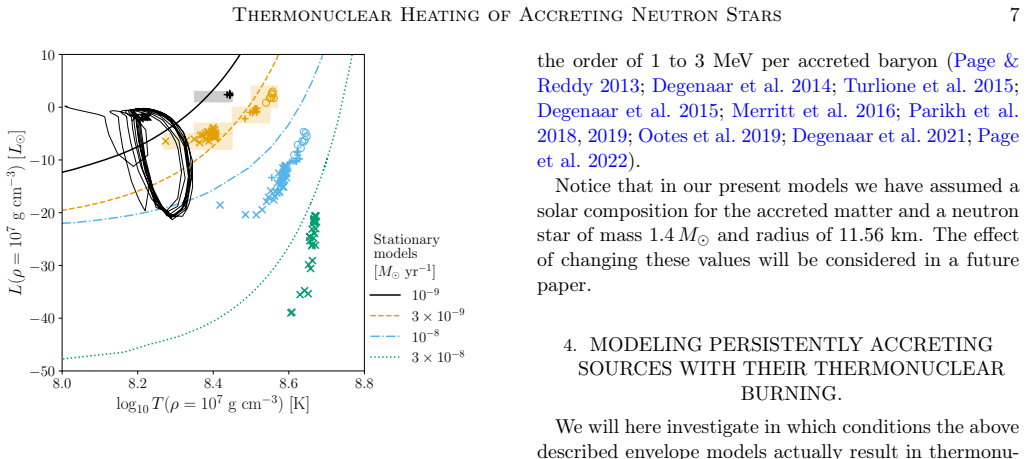
The load-bearing object is the stationary accreting envelope model used as a thermal-structural boundary condition at density rho_b = $10^{7}$ g $cm^{-3}$. Each model integrates the envelope inward from the photosphere with a 380-isotope nuclear network, so the resulting relation between boundary temperature T_b and boundary luminosity L_b automatically contains the heat produced by hydrogen, helium, and rp-process burning; the key feature is a temperature inversion in which the luminosity at the base, L_b = Mdot Q_b / m_u, can become negative, meaning thermonuclear energy leaks into the crust. The stationary maps are checked against burst averages of a time-dependent envelope code and then imposed as outer boundary conditions on a neutron star cooling code, letting the star relax to steady state under constant or periodically repeating accretion. The machinery's work is to translate a large parameter space, including accretion rate, outburst duty cycle, crust impurity parameter, shallow-heating strength and depth, and slow versus fast neutrino cooling, into one number: Q_b at the crust-envelope interface.
What would settle it
Run a time-dependent envelope simulation at a low accretion rate for many burst cycles until the temperature at the boundary density stops rising, then compare the burst-averaged Q_b with the stationary prediction; if the averages fall systematically below the stationary curves, the few-hundred-keV ceiling is an artifact of incomplete convergence rather than a physical limit.
Extended reading notes
Core claim
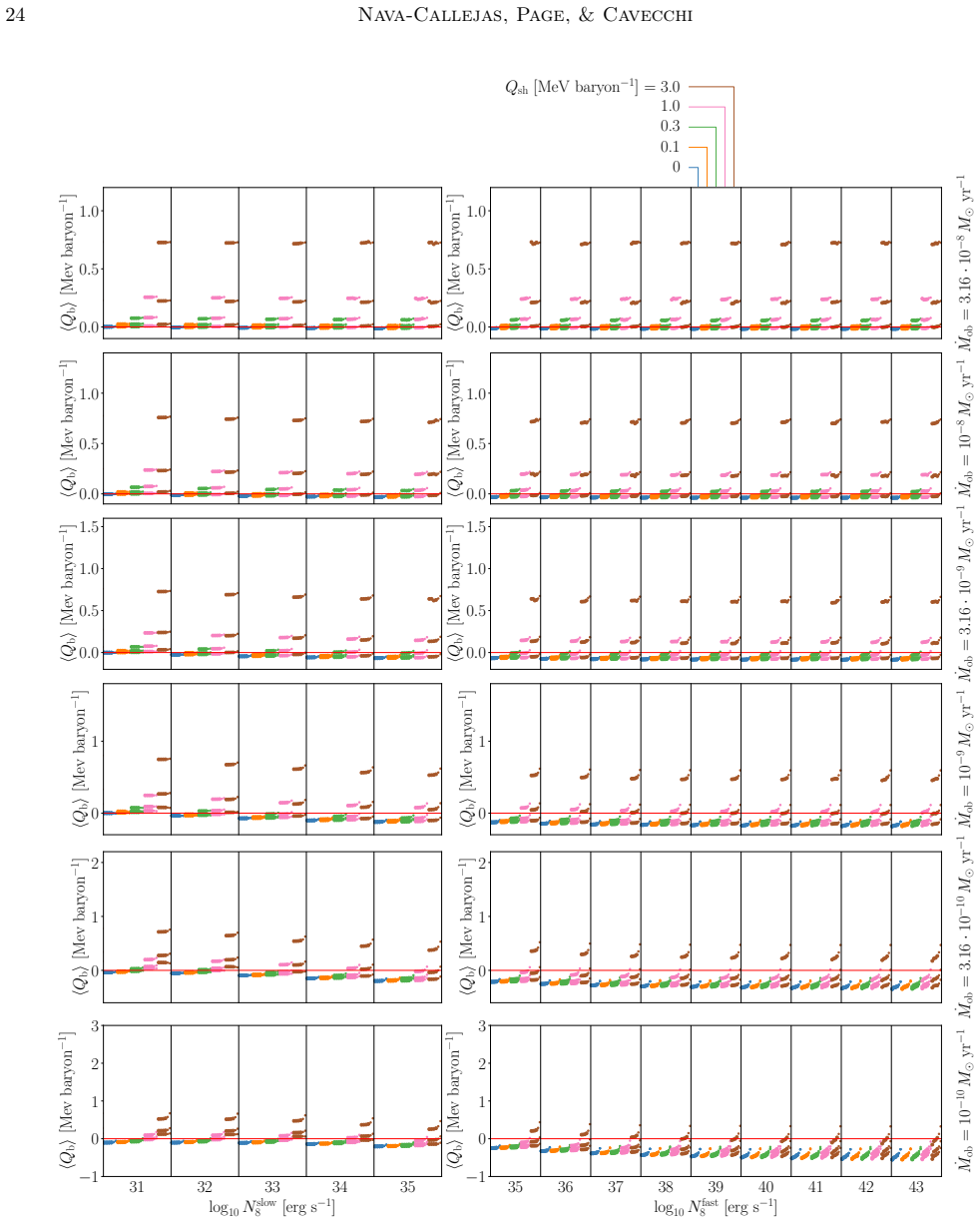
The central claim is that a self-consistent treatment of accretion, envelope nuclear burning, and crust/core thermal evolution limits the envelope's contribution to interior heating. Using stationary accreting-envelope models at a boundary density of rho_b = $10^{7}$ g $cm^{-3}$ that include hydrogen, helium, and rp-process burning, the authors construct accretion-rate-dependent relations between the boundary temperature T_b and the boundary luminosity L_b, validated by comparing burst averages from a time-dependent envelope code. When these relations are imposed on a full neutron star cooling code run to steady state, values of Q_b (the heat per accreted baryon crossing the crust-envelope interface) that are negative, meaning heat flows from the envelope into the crust, reach only a few hundred keV per baryon in the most extreme cases. This is far below the 1 to 3 MeV per baryon shallow heating that observations require, so envelope thermonuclear burning cannot by itself explain shallow heating. The sign and magnitude of Q_b are controlled by the competition between core neutrino cooling, which cools the interior and favors inward flow, and accretion rate plus shallow heating, which warm the crust and favor outward flow.
Load-bearing premise
The entire quantitative map rests on treating the envelope's time-averaged structure as a stationary sequence of models: the time-dependent burst simulations used for validation never reached a true steady state, and the temperature at the boundary density was still rising when those runs stopped.
Editorial extensions
If this is right
- Observed MeV-scale shallow heating in quiescent neutron stars must come from mechanisms other than envelope thermonuclear leakage, since the inward flux is capped near a few hundred keV per baryon.
- Inward envelope-to-crust heat flow is mostly confined to low mass accretion rates, roughly below 3 x 10^-9 solar masses per year, and to cores with strong fast-neutrino cooling.
- Transiently accreting sources, with colder cores from quiescent periods, are more likely to show heat flowing from the envelope into the crust than persistently accreting sources.
- The inward heat flow is self-limiting: the layers just below the envelope heat up within about a day, quenching the temperature inversion and reducing the flux.
- The computed maps of crust-to-envelope heat flow provide a diagnostic that can be inverted with observed cooling curves and burst-quenching accretion rates to constrain crust impurity and core neutrino luminosity.
Reading between the lines
- Editorial inference: if the stationary-average picture survives true steady-state checks, the missing MeV-scale shallow heat must be sought in non-thermonuclear mechanisms such as interface shear, compositional settling, or deep-crust nuclear reactions beyond the standard deep crustal heating.
- Editorial inference: applying the same boundary-condition machinery to helium-rich or metal-poor accreted compositions would shift the burning layers and could move the inward-flux ceiling either up or down.
- Editorial inference: the agreement between burst averages and stationary curves suggests the time-averaged envelope structure is set mainly by the mean accretion rate, so stochastic burst-to-burst variability should not change Q_b by more than the few-hundred-keV ceiling; a dedicated long-duration burst simulation could test this.
- Testable extension: the published boundary-condition tables can be plugged into independent thermal evolution codes to see whether the inward-flux regions shift when different equations of state or neutrino emission models are adopted.
Signed reviews
Editorial analysis
A structured set of objections, weighed in public.
Referee Report
Summary. The paper develops a practical method for including thermonuclear burning in the envelope of accreting neutron stars in long-term thermal evolution simulations. The authors compute stationary accreting envelope models with a 380-isotope nuclear network, convert them into mass-accretion-rate-dependent T_b–L_b boundary conditions at ρ_b = 10^7 g cm⁻³, and validate the stationary approximation against time-dependent MESA envelope models, with the caveat that the MESA runs are not fully relaxed. These boundary conditions are then implemented in NSCool and used to explore persistent and transient accretion over a large parameter space spanning neutrino luminosity, accretion rate, shallow heating strength and depth, and crust impurity parameter. The central result is that heat can flow from the envelope into the crust (Q_b < 0), but the leakage reaches at most a few hundred keV per accreted baryon in the most extreme cases, so it cannot by itself explain the MeV-scale shallow heating inferred from observations. The paper also provides useful by-products, including tables of boundary conditions and a discussion of the implications for X-ray burst quenching.
Significance. If the central quantitative bound survives scrutiny, this is a valuable negative result: it separates envelope thermonuclear burning from the class of mechanisms that could produce the observationally required shallow heating, and it provides a reusable tool for future transient-source modeling. The paper's strengths are its transparency, the large parameter scan (over 7,000 models), the independent MESA comparison, the public availability of the NSCool framework and MESA inlists, and the fact that Q_b is an emergent output rather than a fitted quantity. Several limitations are explicitly disclosed by the authors, including incomplete convergence of the MESA runs and the inability of stationary envelope models to describe the first hours of an outburst. The main concern is a verification gap: the validation was performed in a non-relativistic code setup while the production boundary conditions include general-relativistic effects.
major comments (2)
- [Sections 2, 3, and Appendix A] The validation of the stationary envelope models is carried out in non-relativistic mode, while the boundary conditions actually used in NSCool include general-relativistic effects. Section 2 states that the stationary code was adapted to be non-relativistic to match MESA, and Section 3 states that the production envelope models include GR effects 'artificially excluded' from the comparison. Appendix A shows that MESA's c_grav implementation misses factors of e^Λ in the temperature-gradient and luminosity equations (Eqs. A4 and A9). The manuscript, however, never compares the relativistic and non-relativistic T_b–L_b relations. Because Q_b is a residual difference between envelope nuclear luminosity and crust thermal flux, a shift in L_b(T_b) of the order implied by e^Λ ≈ 1.3 in a 1.4 M_⊙, 11.56 km model can move the L_b = 0 crossing and change Q_b by hundreds of keV. This gap directly affects the central claim in Section 6 that negative Q_b reaches 'at most a few hundreds keVs'. I request a quantitative comparison of the GR and non-GR T_b–L_b curves (or an equivalent sensitivity analysis) and an assessment of its effect on Figures 6 and 8.
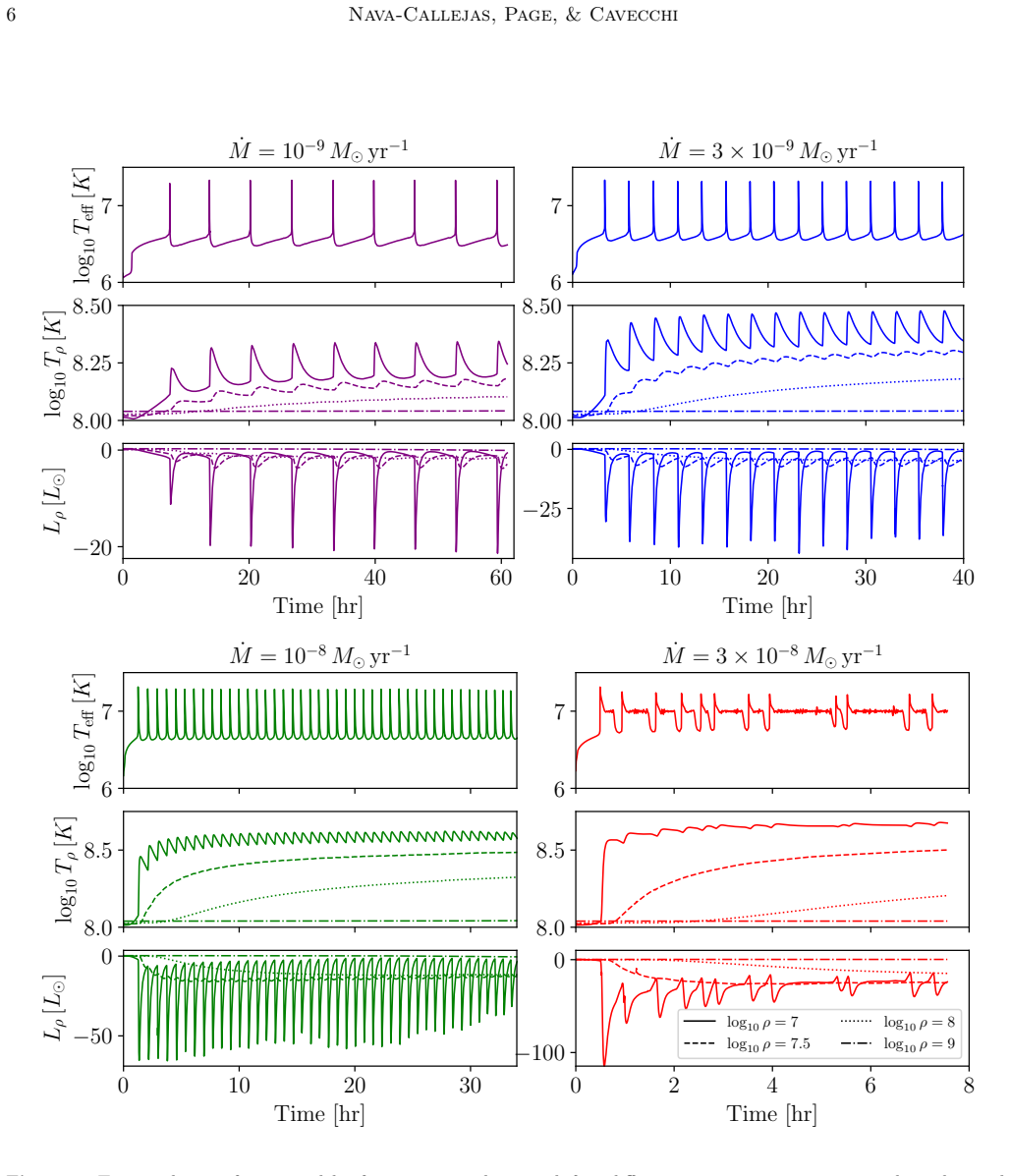
- [Section 2, Figures 3 and 4] The MESA validation is not a true steady-state test. The text states that 'reaching the stationary states would require much more computing time', and the caption to Figure 3 notes that T at ρ = 10^7 g cm⁻³ is still increasing with time. The comparison therefore uses burst averages that are still evolving toward the stationary curves. Figure 4, with the boundary placed at ρ_b = 10^7 g cm⁻³, is reassuring, particularly near L_b = 0, but it is not a quantitative convergence test. Since the stationarity assumption is load-bearing for the method, I ask the authors to estimate the remaining drift (for example, by extrapolating the trend in time or by quoting an implied uncertainty in the derived T_b–L_b relation and in Q_b) so that the possible bias in the boundary conditions can be judged.
minor comments (5)
- [Figures 6, 8, 10–14] The unit 'Mev' should be 'MeV' throughout the figure labels and captions (e.g., 'Q_b [Mev baryon−1]').
- [Figure 10 caption] The caption says 'suppressed deep crustal heating according to the model of Haensel & Zdunik (2008)', but the text of Appendix B and the referenced model describe the suppressed heating case of Gusakov & Chugunov (2020); the caption should be corrected.
- [Equation (2) and Section 4] The notation eT_8 for the redshifted core temperature is introduced without defining the tilde; use a single, consistently defined symbol such as ~T_8 throughout the text and equations.
- [Section 3, right panel of Figure 5] The text states that for a cold crust the inward energy can be 'very significant, actually comparable to the amount of shallow heating', while Section 6 later explains that the self-consistent models reduce this to a few hundred keV. A forward reference or caveat at the first mention would prevent the reader from over-interpreting Figure 5.
- [References] The reference 'Page, Garibay, Nava-Callejas, & Cavecchi 2025' has no journal or publication status; it should be updated or marked as in preparation, especially since it is cited for numerical values of neutrino luminosities.
Circularity Check
No significant circularity; Qb emerges from coupled envelope–interior evolution with an external MESA benchmark.
full rationale
The paper's central quantity Qb is not fitted to a target or defined as its own output. It is obtained by using ˙M-dependent Tb–Lb boundary tables from stationary envelope models as outer boundary conditions in the independent NSCool interior evolution; the interior heat balance then determines Tb and hence Qb. The key negative result — that self-consistent models give negative Qb of at most a few hundred keV, far smaller than the cold-crust values in Figure 5 — is not a restatement of the input tables: it emerges because the crust heats up and quenches the inward gradient, as shown in Figure 9. The stationary-envelope approximation is benchmarked against time-dependent MESA runs, an external public code using a different nuclear network, which provides independent support rather than a self-citation chain. Self-citations to Nava-Callejas et al. (2024a) for the envelope code/net380, to Nava-Callejas et al. (2024b) for the Approx149 network, and to Page (2016) for NSCool are tool or microphysics references, not load-bearing theorems or fitted results. The acknowledged limitations — the GR-versus-non-GR comparison gap in Section 2 and Appendix A, and the fact that MESA runs were not evolved to true steady state ('reaching the stationary states would require much more computing time') — are correctness and validation risks, but they do not make the derivation equivalent to its inputs. No step in the derivation chain reduces by construction to a prior fit, a self-citation, or a renamed known result.
Assumptions & free parameters
free parameters (6)
- Impurity parameter Qimp =
Grid: 0, 1, 3, 10, 30, 100
- Shallow heating strength Qsh =
Grid: 0, 0.1, 0.3, 1, 3 MeV baryon^-1
- Shallow heating deposition density rho_sh =
Grid: 1e8, 1e9, 1e10 g cm^-3
- Core neutrino luminosity normalization N8 =
Slow: 1e31 to 1e35 erg/s; fast: 1e35 to 1e43 erg/s
- Mass accretion rate Mdot or Mdot_ob =
Grid: 1e-10 to 3.16e-8 Msun/yr
- Deep crustal heating strength =
1.9 MeV baryon^-1 (Haensel and Zdunik 2008) or 0.5 MeV baryon^-1 (Gusakov and Chugunov 2020)
assumptions (6)
- domain assumption Stationary envelope models are a valid first approximation to burst-averaged time-dependent envelopes at the rho_b boundary.
- domain assumption Nuclear energy generation is negligible at densities above rho_b = 1e7 g/cm3.
- domain assumption The accreted matter has solar composition and the star has M = 1.4 Msun and R = 11.56 km.
- domain assumption Core neutrino emission can be represented by generic T^8 or T^6 luminosity laws with normalization N8.
- domain assumption The core is isothermal due to its extremely high thermal conductivity.
- domain assumption Crust thermal conductivity is dominated by electron scattering with nu_e = nu_e-ph + nu_e-imp, with Qimp parametrizing impurity scattering.
Cite this review
Pith. "Pith review of Thermonuclear Heating of Accreting Neutron Stars." pith.science (2026). https://pith.science/paper/HN4252BJ
@misc{pith2026250502600,
  author       = {Pith},
  title        = {Pith review of: Thermonuclear Heating of Accreting Neutron Stars},
  year         = {2026},
  howpublished = {\url{https://pith.science/paper/HN4252BJ}},
  note         = {Machine review of arXiv:2505.02600}
}
read the original abstract
We describe a new method to incorporate thermonuclear heating in the envelope of accreting neutron star into long term simulations of their thermal evolution. We obtain boundary conditions for the heat exchange between the envelope and the crust based on stationary models which include nuclear burning and validate these values comparing to the results of the time-dependent code \texttt{MESA}. These simple boundary conditions allow us to explore a large parameter space. We quantify the amount of heat flowing from the envelope into the crust, or viceversa, depending on the mass accretion rate, outburst duration and duty cycle, and especially crust/core physical parameters such as impurities, crustal heating, and neutrino cooling rate.
Figures

Figures from the paper (11 more)




Reference graph
Works this paper leans on
-
[1]
Akmal , A., Pandharipande , V. R., & Ravenhall , D. G. 1998, , 58, 1804, 10.1103/PhysRevC.58.1804
-
[2]
1998, in NATO Advanced Study Institute (ASI) Series C, Vol
Bildsten , L. 1998, in NATO Advanced Study Institute (ASI) Series C, Vol. 515, The Many Faces of Neutron Stars., ed. R. Buccheri , J. van Paradijs , & A. Alpar , 419. astro-ph/9709094
arXiv 1998
-
[3]
Bisnovaty i -Kogan , G. S., & Chechetkin , V. M. 1979, Soviet Physics Uspekhi, 22, 89, 10.1070/PU1979v022n02ABEH005418
-
[4]
F., Bildsten , L., & Rutledge , R
Brown , E. F., Bildsten , L., & Rutledge , R. E. 1998, , 504, L95, 10.1086/311578
doi:10.1086/311578 1998
-
[5]
Brown , E. F., & Cumming , A. 2009, , 698, 1020, 10.1088/0004-637X/698/2/1020
-
[6]
Caplan , M. E., & Horowitz , C. J. 2017, Reviews of Modern Physics, 89, 041002, 10.1103/RevModPhys.89.041002
-
[7]
Cavecchi , Y., Galloway , D. K., Goodwin , A. J., Johnston , Z., & Heger , A. 2020, , 499, 2148, 10.1093/mnras/staa2858
-
[8]
Cavecchi , Y., Watts , A. L., & Galloway , D. K. 2017, , 851, 1, 10.3847/1538-4357/aa9897
Show all 108 references
-
[9]
F., Zdunik, J
Chamel, N., Fantina, A. F., Zdunik, J. L., & Haensel, P. 2020, Phys. Rev. C, 102, 015804, 10.1103/PhysRevC.102.015804
2020 doi
-
[10]
2001, , 548, L175, 10.1086/319107
Colpi , M., Geppert , U., Page , D., & Possenti , A. 2001, , 548, L175, 10.1086/319107
2001 doi
- [11]
- [12]
-
[13]
Cornelisse , R., in't Zand , J. J. M., Verbunt , F., et al. 2003, , 405, 1033, 10.1051/0004-6361:20030629
2003 doi
-
[14]
2000, , 544, 453, 10.1086/317191
Cumming , A., & Bildsten , L. 2000, , 544, 453, 10.1086/317191
2000 doi
- [15]
-
[16]
F., Fattoyev, F
Cumming, A., Brown, E. F., Fattoyev, F. J., et al. 2017, Phys. Rev. C, 95, 025806, 10.1103/PhysRevC.95.025806
2017 doi
-
[17]
Cumming , A., Macbeth , J., in't Zand , J. J. M., & Page , D. 2006, , 646, 429, 10.1086/504698
2006 doi
-
[18]
2021, , 508, 882, 10.1093/mnras/stab2202
Degenaar , N., Page , D., van den Eijnden , J., et al. 2021, , 508, 882, 10.1093/mnras/stab2202
2021 doi
-
[19]
2014, , 791, 47, 10.1088/0004-637X/791/1/47
Degenaar , N., Medin , Z., Cumming , A., et al. 2014, , 791, 47, 10.1088/0004-637X/791/1/47
2014 doi
-
[20]
2015, , 451, 2071, 10.1093/mnras/stv1054
Degenaar , N., Wijnands , R., Bahramian , A., et al. 2015, , 451, 2071, 10.1093/mnras/stv1054
2015 doi
-
[21]
F., & Page, D
Deibel, A., Cumming, A., Brown, E. F., & Page, D. 2015, The Astrophysical Journal Letters, 809, L31, 10.1088/2041-8205/809/2/L31
2015 doi
-
[22]
Dohi , A., Hashimoto , M.-a., Yamada , R., Matsuo , Y., & Fujimoto , M. Y. 2020, Progress of Theoretical and Experimental Physics, 2020, 033E02, 10.1093/ptep/ptaa010
2020 doi
-
[23]
2021, , 923, 64, 10.3847/1538-4357/ac2821
Dohi , A., Nishimura , N., Hashimoto , M., et al. 2021, , 923, 64, 10.3847/1538-4357/ac2821
2021 doi
-
[24]
2022, , 937, 124, 10.3847/1538-4357/ac8dfe
Dohi , A., Nishimura , N., Sotani , H., et al. 2022, , 937, 124, 10.3847/1538-4357/ac8dfe
2022 doi
-
[25]
L., Tan, W., G \"o rres, J., Wiescher, M., & Cooper, R
Fisker, J. L., Tan, W., G \"o rres, J., Wiescher, M., & Cooper, R. L. 2007, The Astrophysical Journal, 665, 637, 10.1086/519517
2007 doi
-
[26]
1976, , 206, 218, 10.1086/154375
Flowers , E., & Itoh , N. 1976, , 206, 218, 10.1086/154375
1976 doi
-
[27]
F., et al
Fortin , M., Taranto , G., Burgio , G. F., et al. 2018, , 475, 5010, 10.1093/mnras/sty147
2018 doi
-
[28]
Y., Hanawa , T., Iben , I., J., & Richardson , M
Fujimoto , M. Y., Hanawa , T., Iben , I., J., & Richardson , M. B. 1984, , 278, 813, 10.1086/161851
1984 doi
-
[29]
Y., Hanawa , T., Iben , Icko, J., & Richardson , M
Fujimoto , M. Y., Hanawa , T., Iben , Icko, J., & Richardson , M. B. 1987, , 315, 198, 10.1086/165124
1987 doi
-
[30]
K., & Keek , L
Galloway , D. K., & Keek , L. 2021, in Astrophysics and Space Science Library, Vol. 461, Astrophysics and Space Science Library, ed. T. M. Belloni , M. M \'e ndez , & C. Zhang , 209--262, 10.1007/978-3-662-62110-3\_5
2021 doi
-
[31]
K., Muno , M
Galloway , D. K., Muno , M. P., Hartman , J. M., Psaltis , D., & Chakrabarty , D. 2008, , 179, 360, 10.1086/592044
2008 doi
-
[32]
H., Pethick , C
Gudmundsson , E. H., Pethick , C. J., & Epstein , R. I. 1982, , 259, L19, 10.1086/183840
1982 doi
-
[33]
1983, , 272, 286, https://doi.org/10.1086/161292
---. 1983, , 272, 286, https://doi.org/10.1086/161292
1983 doi
-
[34]
F., Schatz , H., M \"o ller , P., & Kratz , K.-L
Gupta , S., Brown , E. F., Schatz , H., M \"o ller , P., & Kratz , K.-L. 2007, , 662, 1188, 10.1086/517869
2007 doi
-
[35]
S., Kawano , T., & M \"o ller , P
Gupta , S. S., Kawano , T., & M \"o ller , P. 2008, , 101, 231101, 10.1103/PhysRevLett.101.231101
2008 doi
-
[36]
E., & Chugunov , A
Gusakov , M. E., & Chugunov , A. I. 2020, , 124, 191101, 10.1103/PhysRevLett.124.191101
2020 doi
-
[37]
2021, , 103, L101301, 10.1103/PhysRevD.103.L101301
---. 2021, , 103, L101301, 10.1103/PhysRevD.103.L101301
2021 doi
-
[38]
Haensel , P., & Zdunik , J. L. 1990, , 227, 431
1990
-
[39]
2003, , 404, L33, 10.1051/0004-6361:20030708
---. 2003, , 404, L33, 10.1051/0004-6361:20030708
2003 doi
-
[40]
2008, , 480, 459, 10.1051/0004-6361:20078578
---. 2008, , 480, 459, 10.1051/0004-6361:20078578
2008 doi
-
[41]
Hanawa , T., & Fujimoto , M. Y. 1984, , 36, 199
1984
-
[42]
Heger , A., Cumming , A., & Woosley , S. E. 2007, , 665, 1311, 10.1086/517491
2007 doi
-
[43]
O., Zheng , J., Maccarone , T
Heinke , C. O., Zheng , J., Maccarone , T. J., et al. 2024, arXiv e-prints, arXiv:2407.18867, 10.48550/arXiv.2407.18867
2024 doi
-
[44]
K., Wijnands, R., et al
Homan, J., Fridriksson, J. K., Wijnands, R., et al. 2014, The Astrophysical Journal, 795, 131, 10.1088/0004-637X/795/2/131
2014 doi
-
[45]
J., Dussan , H., & Berry , D
Horowitz , C. J., Dussan , H., & Berry , D. K. 2008, , 77, 045807, 10.1103/PhysRevC.77.045807
2008 doi
- [46]
-
[47]
2010, Astronomy Letters, 36, 848, 10.1134/S1063773710120029
---. 2010, Astronomy Letters, 36, 848, 10.1134/S1063773710120029
2010 doi
-
[48]
in't Zand , J. J. M., Keek , L., Cumming , A., et al. 2009, , 497, 469, 10.1051/0004-6361/200811432
2009 doi
-
[49]
1993, , 404, 268, 10.1086/172275
Itoh , N., & Kohyama , Y. 1993, , 404, 268, 10.1086/172275
1993 doi
-
[50]
S., Bauer , E
Jermyn , A. S., Bauer , E. B., Schwab , J., et al. 2023, , 265, 15, 10.3847/1538-4365/acae8d
2023 doi
-
[51]
2011, , 743, 189, 10.1088/0004-637X/743/2/189
Keek , L., & Heger , A. 2011, , 743, 189, 10.1088/0004-637X/743/2/189
2011 doi
- [52]
-
[53]
Keek , L., Heger , A., & in't Zand , J. J. M. 2012, , 752, 150, 10.1088/0004-637X/752/2/150
2012 doi
-
[54]
Keek , L., in't Zand , J. J. M., Kuulkers , E., et al. 2008, , 479, 177, 10.1051/0004-6361:20078464
2008 doi
-
[55]
Keek , L., Langer , N., & in't Zand , J. J. M. 2009, , 502, 871, 10.1051/0004-6361/200911619
2009 doi
-
[56]
2012, Stellar Structure and Evolution (Berlin, Heidelberg: Springer Berlin Heidelberg), 10.1007/978-3-642-30304-3
Kippenhahn , R., Weigert , A., & Weiss , A. 2012, Stellar Structure and Evolution (Berlin, Heidelberg: Springer Berlin Heidelberg), 10.1007/978-3-642-30304-3
2012 doi
-
[57]
S., et al
Lau , R., Beard , M., Gupta , S. S., et al. 2018, , 859, 62, 10.3847/1538-4357/aabfe0
2018 doi
-
[58]
2011, , 730, 97, 10.1088/0004-637X/730/2/97
Medin , Z., & Cumming , A. 2011, , 730, 97, 10.1088/0004-637X/730/2/97
2011 doi
-
[59]
2014, , 783, L3, 10.1088/2041-8205/783/1/L3
---. 2014, , 783, L3, 10.1088/2041-8205/783/1/L3
2014 doi
-
[60]
2015, , 802, 29, 10.1088/0004-637X/802/1/29
---. 2015, , 802, 29, 10.1088/0004-637X/802/1/29
2015 doi
-
[61]
2024, , 535, 1575, 10.1093/mnras/stae2413
Meisel , Z. 2024, , 535, 1575, 10.1093/mnras/stae2413
2024 doi
-
[62]
L., Cackett , E
Merritt , R. L., Cackett , E. M., Brown , E. F., et al. 2016, , 833, 186, 10.3847/1538-4357/833/2/186
2016 doi
-
[63]
1990, , 362, 572, 10.1086/169295
Miralda-Escude , J., Haensel , P., & Paczynski , B. 1990, , 362, 572, 10.1086/169295
1990 doi
-
[64]
2025, MESA: Thermonuclear Heating of Accreting Neutron Stars, Zenodo, 10.5281/zenodo.15828636
Nava-Callejas, M. 2025, MESA: Thermonuclear Heating of Accreting Neutron Stars, Zenodo, 10.5281/zenodo.15828636
2025 doi
-
[65]
2024 a , RAS Techniques and Instruments, 3, 800, 10.1093/rasti/rzae055
Nava-Callejas , M., Cavecchi , Y., & Page , D. 2024 a , RAS Techniques and Instruments, 3, 800, 10.1093/rasti/rzae055
2024 doi
- [66]
-
[67]
W., & Vautherin , D
Negele , J. W., & Vautherin , D. 1973, , 207, 298, 10.1016/0375-9474(73)90349-7
1973 doi
-
[68]
D., Fortin , M., Haensel , P., Yakovlev , D
Ofengeim , D. D., Fortin , M., Haensel , P., Yakovlev , D. G., & Zdunik , J. L. 2017, , 96, 043002, 10.1103/PhysRevD.96.043002
2017 doi
-
[69]
S., Wijnands , R., Page , D., & Degenaar , N
Ootes , L. S., Wijnands , R., Page , D., & Degenaar , N. 2018, , 477, 2900, 10.1093/mnras/sty825
2018 doi
-
[70]
S., Vats , S., Page , D., et al
Ootes , L. S., Vats , S., Page , D., et al. 2019, , 487, 1447, 10.1093/mnras/stz1406
2019 doi
-
[71]
2016, NSCool: Neutron star cooling code
Page , D. 2016, NSCool: Neutron star cooling code . 1609.009
2016
-
[72]
Page , D., Garibay , I., Nava-Callejas , M., & Cavecchi , Y. 2025
2025
-
[73]
2006, Nuclear Physics A, 777, 497, https://doi.org/10.1016/j.nuclphysa.2005.09.019
Page, D., Geppert, U., & Weber, F. 2006, Nuclear Physics A, 777, 497, https://doi.org/10.1016/j.nuclphysa.2005.09.019
2006 doi
-
[74]
2022, The Astrophysical Journal, 933, 216, 10.3847/1538-4357/ac72a8
Page, D., Homan, J., Nava-Callejas, M., et al. 2022, The Astrophysical Journal, 933, 216, 10.3847/1538-4357/ac72a8
2022 doi
-
[75]
M., Prakash, M., & Steiner, A
Page, D., Lattimer, J. M., Prakash, M., & Steiner, A. W. 2004, The Astrophysical Journal Supplement Series, 155, 623, 10.1086/424844
2004 doi
-
[76]
2013, Phys
Page, D., & Reddy, S. 2013, Phys. Rev. Lett., 111, 241102, 10.1103/PhysRevLett.111.241102
2013 doi
-
[77]
S., Wijnands , R., Degenaar , N., Ootes , L., & Page , D
Parikh , A. S., Wijnands , R., Degenaar , N., Ootes , L., & Page , D. 2018, , 476, 2230, 10.1093/mnras/sty416
2018 doi
-
[78]
S., Homan , J., Wijnands , R., et al
Parikh , A. S., Homan , J., Wijnands , R., et al. 2017, , 851, L28, 10.3847/2041-8213/aa9e03
2017 doi
-
[79]
S., Wijnands , R., Ootes , L
Parikh , A. S., Wijnands , R., Ootes , L. S., et al. 2019, , 624, A84, 10.1051/0004-6361/201834412
2019 doi
-
[80]
2011, , 192, 3, 10.1088/0067-0049/192/1/3
Paxton , B., Bildsten , L., Dotter , A., et al. 2011, , 192, 3, 10.1088/0067-0049/192/1/3
2011 doi
-
[81]
2013, , 208, 4, 10.1088/0067-0049/208/1/4
Paxton , B., Cantiello , M., Arras , P., et al. 2013, , 208, 4, 10.1088/0067-0049/208/1/4
2013 doi
-
[82]
2015, , 220, 15, 10.1088/0067-0049/220/1/15
Paxton , B., Marchant , P., Schwab , J., et al. 2015, , 220, 15, 10.1088/0067-0049/220/1/15
2015 doi
-
[83]
B., et al
Paxton , B., Schwab , J., Bauer , E. B., et al. 2018, , 234, 34, 10.3847/1538-4365/aaa5a8
2018 doi
-
[84]
2019, , 243, 10, 10.3847/1538-4365/ab2241
Paxton , B., Smolec , R., Schwab , J., et al. 2019, , 243, 10, 10.3847/1538-4365/ab2241
2019 doi
- [85]
- [86]
-
[87]
Y., Chabrier, G., & Yakovlev, D
Potekhin, A. Y., Chabrier, G., & Yakovlev, D. G. 1997, Astron. Astrophys., 323, 415. astro-ph/9706148
1997 arXiv
-
[88]
Y., Gusakov , M
Potekhin , A. Y., Gusakov , M. E., & Chugunov , A. I. 2023, , 522, 4830, 10.1093/mnras/stad1309
2023 doi
-
[89]
Y., Pons , J
Potekhin , A. Y., Pons , J. A., & Page , D. 2015, , 191, 239, 10.1007/s11214-015-0180-9
2015 doi
-
[90]
Y., & Yakovlev , D
Potekhin , A. Y., & Yakovlev , D. G. 2001, , 374, 213, 10.1051/0004-6361:20010698
2001 doi
-
[91]
2017, , 835, 119, 10.3847/1538-4357/835/2/119
Poutanen , J. 2017, , 835, 119, 10.3847/1538-4357/835/2/119
2017 doi
-
[92]
2016, , 94, 015803, 10.1103/PhysRevC.94.015803
Roggero , A., & Reddy , S. 2016, , 94, 015803, 10.1103/PhysRevC.94.015803
2016 doi
-
[93]
1979, Progress of Theoretical Physics, 62, 957, 10.1143/PTP.62.957
Sato , K. 1979, Progress of Theoretical Physics, 62, 957, 10.1143/PTP.62.957
1979 doi
-
[94]
1999, , 524, 1014, 10.1086/307837
Schatz , H., Bildsten , L., Cumming , A., & Wiescher , M. 1999, , 524, 1014, 10.1086/307837
1999 doi
-
[95]
L., & Teukolsky , S
Shapiro , S. L., & Teukolsky , S. A. 1983, Black holes, white dwarfs, and neutron stars: The physics of compact objects (Wiley-Interscience, New York)
1983
-
[96]
N., Gusakov , M
Shchechilin , N. N., Gusakov , M. E., & Chugunov , A. I. 2021, , 507, 3860, 10.1093/mnras/stab2415
2021 doi
- [97]
-
[98]
S., & Yakovlev , D
Shternin , P. S., & Yakovlev , D. G. 2006, , 74, 043004, 10.1103/PhysRevD.74.043004
2006 doi
- [99]
-
[100]
Thorne , K. S. 1977, , 212, 825, 10.1086/155108
1977 doi
-
[101]
N., & Pons , J
Turlione , A., Aguilera , D. N., & Pons , J. A. 2015, , 577, A5, 10.1051/0004-6361/201322690
2015 doi
- [102]
- [103]
-
[104]
2013, , 432, 2366, 10.1093/mnras/stt599
Wijnands , R., Degenaar , N., & Page , D. 2013, , 432, 2366, 10.1093/mnras/stt599
2013 doi
-
[105]
G., & Pethick, C
Yakovlev, D. G., & Pethick, C. J. 2004, Ann. Rev. Astron. Astrophys., 42, 169, 10.1146/annurev.astro.42.053102.134013
2004
-
[106]
G., & Urpin , V
Yakovlev , D. G., & Urpin , V. A. 1980, , 24, 303
1980
-
[107]
2014, , 445, 3278, 10.1093/mnras/stu1927
Zamfir , M., Cumming , A., & Niquette , C. 2014, , 445, 3278, 10.1093/mnras/stu1927
2014 doi
-
[108]
L., Haensel , P., Paczynski , B., & Miralda-Escude , J
Zdunik , J. L., Haensel , P., Paczynski , B., & Miralda-Escude , J. 1992, , 384, 129, 10.1086/170858
1992 doi
Reviewed August 16, 2026 · model on record in the stance chip above.
Discussion (0). Continue with ORCID to comment.