REVIEW 4 major objections 6 minor 68 references
NTIRE 2025 Challenge on UGC Video Enhancement: Methods and Results
T0 review · 4 major / 6 minor · reviewed 2026-08-16 · deepseek-v4-flash
Pith's one-line read Pairwise crowd preferences, aggregated by the Bradley-Terry model, rank UGC video enhancement without reference ground truth, putting a four-stage pipeline first.
desk verdict A solid NTIRE challenge report that contributes a genuinely useful public UGC video enhancement benchmark with raw pairwise votes; the leaderboard is probably right, but the paper under-specifies how 'can't choose' votes and random balancing were handled, so the exact ordering is provisional until those details are released. read the letter →
The pith
A machine-rendered reading of the paper's core claim, the machinery that carries it, and where it could break.
The reading
What carries the argument
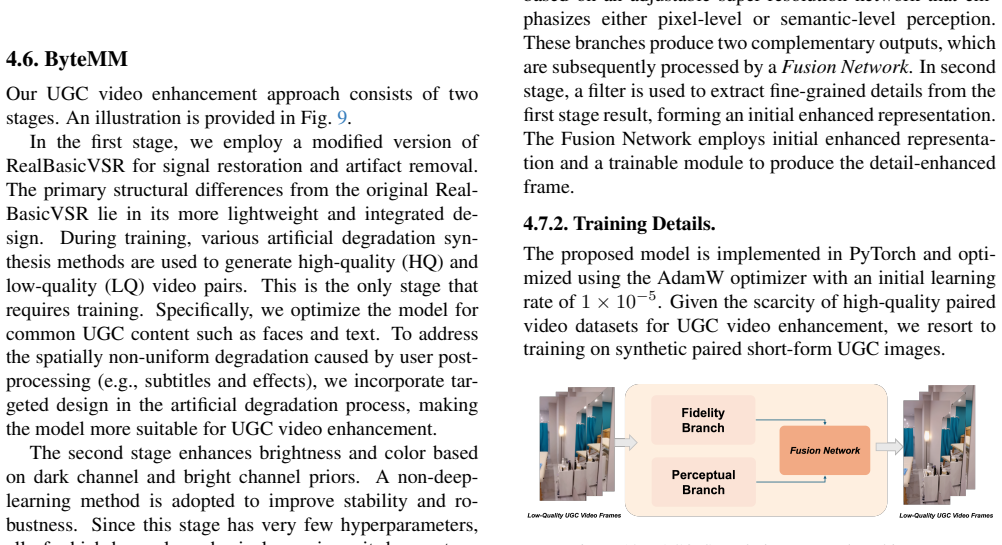
The load-bearing mechanism is pairwise subjective comparison aggregated by the Bradley-Terry model, a probability model for paired preferences that assigns each video a scalar score $s_i$ such that the probability of preferring $i$ over $j$ is $P(i \succ j)=e^{s_i}/(e^{s_i}+e^{s_j})$. The organizers gave each pair exactly 10 votes, screened workers with two embedded validation questions, and computed 95% confidence intervals from the inverse Fisher information matrix of the maximum-likelihood estimate. The second mechanism is the winner's four-stage pipeline: CLUT color enhancement, a lightweight U-Net denoiser, BasicVSR++ for temporal stabilization, and a U-Net-like SwinIR refinement stage, linked by residual connections and inference-time feature interpolation.
What would settle it
Download the released pairwise votes and refit the Bradley-Terry model while counting 'can't choose' responses as ties rather than discarding them; if the top two or adjacent teams swap order, the reported leaderboard depends on an undocumented tie-handling choice.
Extended reading notes
Core claim
The paper's central claim is that subjective side-by-side preference, aggregated through the Bradley-Terry model, can serve as a reproducible no-reference benchmark for UGC video enhancement. On the 150-video final set, ShannonLab's cascaded pipeline of CLUT color enhancement, U-Net denoising, BasicVSR++ temporal restoration, and U-Net-like SwinIR refinement reaches a score of 1.848 relative to the original's zero, with a 95% confidence interval of ±0.060. The order is the same on the 120 public and 30 private videos, which the paper presents as evidence that the leaderboard is consistent rather than an artifact of the visible test portion.
Load-bearing premise
The entire leaderboard rests on the assumption that crowd workers who pass a two-question attention check give reliable preferences, and that the handling of 'can't choose' answers does not change the ranking.
Editorial extensions
If this is right
- Under the challenge protocol, every finalist's enhancement is preferred to the original video, since all final scores are positive relative to the zero baseline.
- The ranking order is identical on the public and private subsets, suggesting the leaderboard is not driven by overfitting to the visible test videos.
- The released data, including processed videos and pairwise votes, make the benchmark reusable for future no-reference UGC enhancement comparisons.
- The winning staged architecture, trained with recompression in mind, offers a concrete design pattern for enhancement systems deployed on short-form video platforms.
Reading between the lines
- Editorial inference: the paper does not state how 'can't choose' votes enter the Bradley-Terry fit, so re-fitting the released votes with ties modeled explicitly would test whether the gaps between adjacent teams are robust.
- Editorial inference: the winner's 1.2x color residual amplification and feature interpolation across 30-frame segments are manual inference-time choices; ablating them would separate architectural gains from tuning gains.
- Editorial inference: with only 10 votes per pair, the precision of the leaderboard is limited, and the released vote counts could be used to determine how many votes per pair are needed for a stable ranking in future challenges.
Signed reviews
Editorial analysis
A structured set of objections, weighed in public.
Referee Report
Summary. This NTIRE 2025 challenge report describes a UGC video enhancement benchmark built from 150 real-world videos without ground truth, evaluated by crowdsourced pairwise subjective comparisons. Seven finalist teams passed source-code verification. The organizers fit a Bradley-Terry model to pairwise votes, report per-team scores with 95% confidence intervals relative to the original video in Table 1, and also give public/private score splits and runtime measurements. The paper includes method descriptions for each team and states that all processed videos, votes, and scores will be released publicly. The central claim is that the Table 1 ranking is a fair, statistically grounded evaluation of all submissions.
Significance. If the evaluation pipeline is fully reproducible, this is a valuable benchmark artifact: a public UGC video set, raw crowd votes, and a standard Bradley-Terry aggregation would give the community a reusable subjective benchmark. The paper's strengths include the public release commitment, source-code verification for finalists, reporting of public/private consistency, and the use of a standard statistical model with asymptotically justified confidence intervals. The central derivation is not circular: the ranking is a direct measurement from crowd votes, and no author-written normalization forces the scores. However, the evaluation's reproducibility and statistical completeness are currently compromised by unspecified treatment of the 'can't choose' response and by an unreported random balancing step, both of which can affect the leaderboard.
major comments (4)
- [Section 2.2, Eq. (1)] The paper defines P(i≻j)=e^{s_i}/(e^{s_i}+e^{s_j}) as the only outcome probability, but assessors were explicitly given three options: 'left', 'right', or 'can't choose'. The manuscript never states whether 'can't choose' votes were discarded before fitting, counted as ties, or assigned fractional weight. This is load-bearing because the instruction tells assessors to use 'can't choose' when quality is 'almost the same', so the tie rate carries information about |s_i−s_j|; discarding ties conditions the fit on a preference being expressed, while modeling them (e.g., with a Davidson-type term) can shift the point estimates. Please state the likelihood actually used, report the number of 'can't choose' responses per pair, and provide a sensitivity analysis (e.g., ties dropped vs. modeled as half-votes) to show the Table 1 ordering is robust.
- [Section 2.2, balancing step] The same paragraph states that 'the matrix of pairwise votes was randomly balanced so that each pair had exactly 10 votes', but it does not report the random seed, the number of votes discarded, or the number of balancing draws. Since the balancing is random and unreported, the released vote set may not uniquely determine the published scores; a different balancing draw could change the estimates. This is not merely a cosmetic issue: in Table 1, ranks 4 and 5 differ by only 0.040 (1.140 ± 0.057 vs. 1.100 ± 0.057), so the middle of the leaderboard is exactly where this choice could alter the ordering. Please release the exact preprocessing code or, failing that, report the seed and demonstrate that scores are stable across multiple balancing draws.
- [Section 2.2, assessor screening and reliability] The only quality control described is that each assessor answered 20 pairs, 2 of which were validation questions with predefined answers, and only assessors who passed both were kept. The paper does not report the validation pass rate, the number of assessors excluded, or any inter-rater reliability measure. With only two screening questions, noisy or inattentive workers can pass and add unstructured noise to the vote matrix. Please report the screening statistics and, ideally, compute scores with and without low-agreement assessors or with assessor-level random effects to confirm that the ranking is stable.
- [Section 2.2, Table 1] The confidence-interval formula is given for the difference s_i − s_j, but Table 1 reports intervals only relative to the original video. As a result, the paper does not tell readers whether adjacent systems (e.g., ranks 3/4 or 4/5) are statistically distinguishable from each other. Consistent with the claim of a 'fair and statistically grounded evaluation', please add pairwise confidence intervals for adjacent ranks or an equivalence/significance test for the differences between consecutive leaderboard entries.
minor comments (6)
- [Table 1 caption] 'Zero scores corresponds to the original' should be 'Zero scores correspond to the original'.
- [Section 2.1] The sentence 'Challenge dataset was split into training, validation, and testing sets with sizes of 40, 20, 20, 20, and 90 videos' is confusing because it lists five numbers for four named split types; please rewrite to clarify the three validation sets and the test set.
- [Section 2.2] 'participants has access only to subjective assessments results' should be 'participants had access only to the subjective assessment results'.
- [Section 4.7.1] 'aFusion Network' should be 'a Fusion Network'.
- [Section 4.1.3] The phrase 'two optimization strategies to improve objective evaluation metrics' should say 'perceptual' or 'subjective' metrics, since the challenge evaluation is subjective.
- [After Figure 1] The manuscript text contains a long run of '/uni' codepoint-corruption tokens after Figure 1; this appears to be a PDF-extraction artifact and should be removed from the submitted version.
Circularity Check
No circularity: the leaderboard is a direct measurement from crowdsourced pairwise votes, not a derived prediction from fitted inputs.
full rationale
The paper's central claim is an empirical ranking of seven UGC video enhancement methods based on crowdsourced pairwise comparisons aggregated with the Bradley-Terry model. The scores in Table 1 are maximum-likelihood estimates of preference strengths from the collected votes; they are measurements, not predictions derived from an input that already contains the answer. The Bradley-Terry model is cited as a standard external statistical tool (Reference [3]), not as a self-citation, and it is not used to define the scores in terms of themselves. The participant methods are described independently of the organizers' evaluation pipeline, and the organizers and participants are distinct groups. The only identified weaknesses concern reproducibility and statistical robustness: the paper does not specify how 'can't choose' responses were handled in the Bradley-Terry likelihood, and the pairwise vote matrix was 'randomly balanced' without reporting the random seed or number of discarded votes. These are correctness or transparency concerns, not circularity, because the scores are not forced by construction to equal any fitted parameter or by any self-referential definition. No load-bearing step reduces to its own inputs, and no prediction is equivalent to a fitted input. The paper is self-contained as an empirical benchmark report, so the circularity score is 0.
Assumptions & free parameters
free parameters (4)
- votes_per_pair =
10
- x265_recompression_bitrate =
3000 kbps
- shannonlab_color_residual_coefficient =
1.2
- validation_question_crf =
high, exact value not stated
assumptions (4)
- standard math Pairwise preferences follow the Bradley-Terry logistic model with independent comparisons.
- domain assumption Workers who answer both validation questions correctly produce trustworthy votes on the remaining 18 pairs.
- domain assumption The 'can't choose' response option does not bias the Bradley-Terry scores.
- domain assumption Balancing the vote matrix to exactly 10 votes per pair yields unbiased estimates.
Cite this review
Pith. "Pith review of NTIRE 2025 Challenge on UGC Video Enhancement: Methods and Results." pith.science (2026). https://pith.science/paper/NF4SVADM
@misc{pith2026250503007,
  author       = {Pith},
  title        = {Pith review of: NTIRE 2025 Challenge on UGC Video Enhancement: Methods and Results},
  year         = {2026},
  howpublished = {\url{https://pith.science/paper/NF4SVADM}},
  note         = {Machine review of arXiv:2505.03007}
}
read the original abstract
This paper presents an overview of the NTIRE 2025 Challenge on UGC Video Enhancement. The challenge constructed a set of 150 user-generated content videos without reference ground truth, which suffer from real-world degradations such as noise, blur, faded colors, compression artifacts, etc. The goal of the participants was to develop an algorithm capable of improving the visual quality of such videos. Given the widespread use of UGC on short-form video platforms, this task holds substantial practical importance. The evaluation was based on subjective quality assessment in crowdsourcing, obtaining votes from over 8000 assessors. The challenge attracted more than 25 teams submitting solutions, 7 of which passed the final phase with source code verification. The outcomes may provide insights into the state-of-the-art in UGC video enhancement and highlight emerging trends and effective strategies in this evolving research area. All data, including the processed videos and subjective comparison votes and scores, is made publicly available at https://github.com/msu-video-group/NTIRE25_UGC_Video_Enhancement.
Figures


Figures from the paper (5 more)


Reference graph
Works this paper leans on
- [1]
-
[2]
Quality assessment of enhanced videos guided by aesthetics and technical quality attributes
Mirko Agarla, Luigi Celona, Claudio Rota, and Raimondo Schettini. Quality assessment of enhanced videos guided by aesthetics and technical quality attributes. In Proceedings of the IEEE/CVF Conference on Computer Vision and Pattern Recognition, pages 1533–1541, 2023. 2
work page 2023
-
[3]
Rank analysis of incomplete block designs: I
Ralph Allan Bradley and Milton E Terry. Rank analysis of incomplete block designs: I. the method of paired compar- isons. Biometrika, 39(3/4):324–345, 1952. 2, 3
1952
-
[4]
Learning photographic global tonal adjustment with a database of input / output image pairs
Vladimir Bychkovsky, Sylvain Paris, Eric Chan, and Fr ´edo Durand. Learning photographic global tonal adjustment with a database of input / output image pairs. In The Twenty- Fourth IEEE Conference on Computer Vision and Pattern Recognition, 2011. 6
work page 2011
-
[5]
Basicvsr++: Improving video super- resolution with enhanced propagation and alignment
Kelvin CK Chan, Shangchen Zhou, Xiangyu Xu, and Chen Change Loy. Basicvsr++: Improving video super- resolution with enhanced propagation and alignment. InPro- ceedings of the IEEE/CVF conference on computer vision and pattern recognition, pages 5972–5981, 2022. 1, 4
work page 2022
-
[6]
Simple baselines for image restoration
Liangyu Chen, Xiaojie Chu, Xiangyu Zhang, and Jian Sun. Simple baselines for image restoration. In European confer- ence on computer vision, pages 17–33. Springer, 2022. 1
work page 2022
-
[7]
NTIRE 2025 challenge on image super-resolution (×4): Methods and results
Zheng Chen, Kai Liu, Jue Gong, Jingkai Wang, Lei Sun, Zongwei Wu, Radu Timofte, Yulun Zhang, et al. NTIRE 2025 challenge on image super-resolution (×4): Methods and results. In Proceedings of the IEEE/CVF Conference on Computer Vision and Pattern Recognition (CVPR) Work- shops, 2025. 2
2025
-
[8]
NTIRE 2025 challenge on real-world face restoration: Methods and results
Zheng Chen, Jingkai Wang, Kai Liu, Jue Gong, Lei Sun, Zongwei Wu, Radu Timofte, Yulun Zhang, et al. NTIRE 2025 challenge on real-world face restoration: Methods and results. In Proceedings of the IEEE/CVF Conference on Computer Vision and Pattern Recognition (CVPR) Work- shops, 2025. 2
2025
Show all 68 references
-
[9]
NTIRE 2025 challenge on raw image restoration and super-resolution
Marcos Conde, Radu Timofte, et al. NTIRE 2025 challenge on raw image restoration and super-resolution. In Proceed- ings of the IEEE/CVF Conference on Computer Vision and Pattern Recognition (CVPR) Workshops, 2025. 2
2025
-
[10]
Raw image reconstruc- tion from RGB on smartphones
Marcos Conde, Radu Timofte, et al. Raw image reconstruc- tion from RGB on smartphones. NTIRE 2025 challenge re- port. In Proceedings of the IEEE/CVF Conference on Com- puter Vision and Pattern Recognition (CVPR) Workshops ,
2025
-
[11]
Spatio-temporal deformable convolution for compressed video quality enhancement
Jianing Deng, Li Wang, Shiliang Pu, and Cheng Zhuo. Spatio-temporal deformable convolution for compressed video quality enhancement. In Proceedings of the AAAI con- ference on artificial intelligence, pages 10696–10703, 2020. 2
2020
-
[12]
NTIRE 2025 challenge on night photography rendering
Egor Ershov, Sergey Korchagin, Alexei Khalin, Artyom Pan- shin, Arseniy Terekhin, Ekaterina Zaychenkova, Georgiy Lobarev, Vsevolod Plokhotnyuk, Denis Abramov, Elisey Zhdanov, Sofia Dorogova, Yasin Mamedov, Nikola Banic, Georgii Perevozchikov, Radu Timofte, et al. NTIRE 2025 ch...
2025
-
[13]
NTIRE 2025 challenge on cross-domain few-shot object detection: Methods and results
Yuqian Fu, Xingyu Qiu, Bin Ren Yanwei Fu, Radu Timofte, Nicu Sebe, Ming-Hsuan Yang, Luc Van Gool, et al. NTIRE 2025 challenge on cross-domain few-shot object detection: Methods and results. In Proceedings of the IEEE/CVF Con- ference on Computer Vision and Pattern Recognition ...
2025
-
[14]
Vdpve: Vqa dataset for perceptual video enhancement
Yixuan Gao, Yuqin Cao, Tengchuan Kou, Wei Sun, Yunlong Dong, Xiaohong Liu, Xiongkuo Min, and Guangtao Zhai. Vdpve: Vqa dataset for perceptual video enhancement. In Proceedings of the IEEE/CVF Conference on Computer Vi- sion and Pattern Recognition, pages 1474–1483, 2023. 2
2023
-
[15]
Automatic color enhancement (ace) and its fast implementation
Pascal Getreuer. Automatic color enhancement (ace) and its fast implementation. Image Process. On Line , 2:266–277,
-
[16]
Mfqe 2.0: A new approach for multi-frame quality enhancement on compressed video
Zhenyu Guan, Qunliang Xing, Mai Xu, Ren Yang, Tie Liu, and Zulin Wang. Mfqe 2.0: A new approach for multi-frame quality enhancement on compressed video. IEEE transac- tions on pattern analysis and machine intelligence , 43(3): 949–963, 2019. 2
2019
-
[17]
Minimum mean brightness error contrast enhancement of color images us- ing adaptive gamma correction with color preserving frame- work
Bhupendra Gupta and Mayank Tiwari. Minimum mean brightness error contrast enhancement of color images us- ing adaptive gamma correction with color preserving frame- work. Optik, 127(4):1671–1676, 2016. 1
2016
-
[18]
NTIRE 2025 challenge on text to image generation model quality assess- ment
Shuhao Han, Haotian Fan, Fangyuan Kong, Wenjie Liao, Chunle Guo, Chongyi Li, Radu Timofte, et al. NTIRE 2025 challenge on text to image generation model quality assess- ment. In Proceedings of the IEEE/CVF Conference on Com- puter Vision and Pattern Recognition (CVPR) Workshops ,
2025
-
[19]
Space-time-aware multi-resolution video enhance- ment
Muhammad Haris, Greg Shakhnarovich, and Norimichi Ukita. Space-time-aware multi-resolution video enhance- ment. In Proceedings of the IEEE/CVF Conference on Com- puter Vision and Pattern Recognition , pages 2859–2868,
-
[20]
A recurrent video quality enhancement framework with multi-granularity frame-fusion and frame difference based attention
Yongkai Huo, Qiyan Lian, Shaoshi Yang, and Jianmin Jiang. A recurrent video quality enhancement framework with multi-granularity frame-fusion and frame difference based attention. Neurocomputing, 431:34–46, 2021. 2
2021
-
[21]
NTIRE 2025 challenge on video quality enhancement for video con- ferencing: Datasets, methods and results
Varun Jain, Zongwei Wu, Quan Zou, Louis Florentin, Hen- rik Turbell, Sandeep Siddhartha, Radu Timofte, et al. NTIRE 2025 challenge on video quality enhancement for video con- ferencing: Datasets, methods and results. In Proceedings of the IEEE/CVF Conference on Computer Vision...
2025
-
[22]
A style-based generator architecture for generative adversarial networks
Tero Karras, Samuli Laine, and Timo Aila. A style-based generator architecture for generative adversarial networks
-
[23]
Deblurgan: Blind motion deblurring using conditional adversarial networks
Orest Kupyn, V olodymyr Budzan, Mykola Mykhailych, Dmytro Mishkin, and Ji ˇr´ı Matas. Deblurgan: Blind motion deblurring using conditional adversarial networks. In Pro- ceedings of the IEEE Conference on Computer Vision and Pattern Recognition (CVPR), 2018. 1
2018
-
[24]
NTIRE 2025 challenge on efficient burst hdr and restoration: Datasets, methods, and results
Sangmin Lee, Eunpil Park, Angel Canelo, Hyunhee Park, Youngjo Kim, Hyungju Chun, Xin Jin, Chongyi Li, Chun-Le Guo, Radu Timofte, et al. NTIRE 2025 challenge on efficient burst hdr and restoration: Datasets, methods, and results. In Proceedings of the IEEE/CVF Conference on Com...
2025
-
[25]
Self-supervised blind motion deblurring with deep expectation maximiza- tion
Ji Li, Weixi Wang, Yuesong Nan, and Hui Ji. Self-supervised blind motion deblurring with deep expectation maximiza- tion. In Proceedings of the IEEE/CVF Conference on Com- puter Vision and Pattern Recognition , pages 13986–13996,
-
[26]
NTIRE 2025 challenge on day and night raindrop removal for dual-focused images: Methods and results
Xin Li, Yeying Jin, Xin Jin, Zongwei Wu, Bingchen Li, Yufei Wang, Wenhan Yang, Yu Li, Zhibo Chen, Bihan Wen, Robby Tan, Radu Timofte, et al. NTIRE 2025 challenge on day and night raindrop removal for dual-focused images: Methods and results. In Proceedings of the IEEE/CVF Conf...
2025
-
[27]
NTIRE 2025 challenge on short-form ugc video quality assessment and enhancement: Kwaisr dataset and study
Xin Li, Xijun Wang, Bingchen Li, Kun Yuan, Yizhen Shao, Suhang Yao, Ming Sun, Chao Zhou, Radu Timofte, and Zhibo Chen. NTIRE 2025 challenge on short-form ugc video quality assessment and enhancement: Kwaisr dataset and study. In Proceedings of the IEEE/CVF Conference on Com- p...
2025
-
[28]
NTIRE 2025 challenge on short-form ugc video quality assessment and enhancement: Methods and results
Xin Li, Kun Yuan, Bingchen Li, Fengbin Guan, Yizhen Shao, Zihao Yu, Xijun Wang, Yiting Lu, Wei Luo, Suhang Yao, Ming Sun, Chao Zhou, Zhibo Chen, Radu Timofte, et al. NTIRE 2025 challenge on short-form ugc video quality assessment and enhancement: Methods and results. In Pro- c...
2025
-
[29]
Swinir: Image restoration us- ing swin transformer
Jingyun Liang, Jiezhang Cao, Guolei Sun, Kai Zhang, Luc Van Gool, and Radu Timofte. Swinir: Image restoration us- ing swin transformer. InProceedings of the IEEE/CVF inter- national conference on computer vision , pages 1833–1844,
-
[30]
NTIRE 2025 the 2nd restore any image model (RAIM) in the wild challenge
Jie Liang, Radu Timofte, Qiaosi Yi, Zhengqiang Zhang, Shuaizheng Liu, Lingchen Sun, Rongyuan Wu, Xindong Zhang, Hui Zeng, Lei Zhang, et al. NTIRE 2025 the 2nd restore any image model (RAIM) in the wild challenge. In Proceedings of the IEEE/CVF Conference on Computer Vi- sion a...
2025
-
[31]
Motion-adaptive separable collaborative filters for blind motion deblurring
Chengxu Liu, Xuan Wang, Xiangyu Xu, Ruhao Tian, Shuai Li, Xueming Qian, and Ming-Hsuan Yang. Motion-adaptive separable collaborative filters for blind motion deblurring. In Proceedings of the IEEE/CVF Conference on Computer Vi- sion and Pattern Recognition, pages 25595–25605, 2024. 1
2024
-
[32]
Video super-resolution based on deep learning: a compre- hensive survey
Hongying Liu, Zhubo Ruan, Peng Zhao, Chao Dong, Fan- hua Shang, Yuanyuan Liu, Linlin Yang, and Radu Timofte. Video super-resolution based on deep learning: a compre- hensive survey. Artificial Intelligence Review, 55(8):5981– 6035, 2022. 4, 5
2022
-
[33]
Robust multi-frame super-resolution based on spatially weighted half-quadratic estimation and adaptive btv regular- ization
Xiaohong Liu, Lei Chen, Wenyi Wang, and Jiying Zhao. Robust multi-frame super-resolution based on spatially weighted half-quadratic estimation and adaptive btv regular- ization. IEEE Transactions on Image Processing , 27(10): 4971–4986, 2018. 1
2018
-
[34]
End-to-end trainable video super-resolution based on a new mechanism for implicit motion estimation and compensation
Xiaohong Liu, Lingshi Kong, Yang Zhou, Jiying Zhao, and Jun Chen. End-to-end trainable video super-resolution based on a new mechanism for implicit motion estimation and compensation. In Proceedings of the IEEE/CVF Winter Con- ference on Applications of Computer Vision , pages...
2020
-
[35]
NTIRE 2025 XGC quality assessment chal- lenge: Methods and results
Xiaohong Liu, Xiongkuo Min, Qiang Hu, Xiaoyun Zhang, Jie Guo, et al. NTIRE 2025 XGC quality assessment chal- lenge: Methods and results. In Proceedings of the IEEE/CVF Conference on Computer Vision and Pattern Recognition (CVPR) Workshops, 2025. 2
2025
-
[36]
NTIRE 2025 challenge on low light image enhancement: Methods and results
Xiaoning Liu, Zongwei Wu, Florin-Alexandru Vasluianu, Hailong Yan, Bin Ren, Yulun Zhang, Shuhang Gu, Le Zhang, Ce Zhu, Radu Timofte, et al. NTIRE 2025 challenge on low light image enhancement: Methods and results. In Proceedings of the IEEE/CVF Conference on Computer Vi- sion ...
2025
-
[37]
Deep kalman filtering network for video compression artifact reduction
Guo Lu, Wanli Ouyang, Dong Xu, Xiaoyun Zhang, Zhiyong Gao, and Ming-Ting Sun. Deep kalman filtering network for video compression artifact reduction. In Proceedings of the European Conference on Computer Vision (ECCV) , pages 568–584, 2018. 2
2018
-
[38]
Mbllen: Low-light image/video enhancement using cnns
Feifan Lv, Feng Lu, Jianhua Wu, and Chongsoon Lim. Mbllen: Low-light image/video enhancement using cnns. In BMVC, page 4, 2018. 1
2018
-
[39]
Ntire 2021 challenge on image deblurring
Seungjun Nah, Sanghyun Son, Suyoung Lee, Radu Timofte, Kyoung Mu Lee, Liangyu Chen, Jie Zhang, Xin Lu, Xiaojie Chu, Chengpeng Chen, et al. Ntire 2021 challenge on image deblurring. In Proceedings of the IEEE/CVF Conference on Computer Vision and Pattern Recognition , pages 149–165,
2021
-
[40]
Anurag Ranjan and Michael J. Black. Optical flow estimation using a spatial pyramid network. CoRR, abs/1611.00850, 2016. 6
2016 arXiv
-
[41]
The tenth NTIRE 2025 efficient super- resolution challenge report
Bin Ren, Hang Guo, Lei Sun, Zongwei Wu, Radu Timo- fte, Yawei Li, et al. The tenth NTIRE 2025 efficient super- resolution challenge report. In Proceedings of the IEEE/CVF Conference on Computer Vision and Pattern Recognition (CVPR) Workshops, 2025. 2
2025
-
[42]
High-resolution image synthesis with latent diffusion models
Robin Rombach, Andreas Blattmann, Dominik Lorenz, Patrick Esser, and Bj ¨orn Ommer. High-resolution image synthesis with latent diffusion models. In Proceedings of the IEEE/CVF conference on computer vision and pattern recognition, pages 10684–10695, 2022. 7
2022
-
[43]
NTIRE 2025 challenge on event-based image deblurring: Methods and results
Lei Sun, Andrea Alfarano, Peiqi Duan, Shaolin Su, Kaiwei Wang, Boxin Shi, Radu Timofte, Danda Pani Paudel, Luc Van Gool, et al. NTIRE 2025 challenge on event-based image deblurring: Methods and results. In Proceedings of the IEEE/CVF Conference on Computer Vision and Pattern R...
2025
-
[44]
The tenth ntire 2025 image denoising challenge report
Lei Sun, Hang Guo, Bin Ren, Luc Van Gool, Radu Timo- fte, Yawei Li, et al. The tenth ntire 2025 image denoising challenge report. In Proceedings of the IEEE/CVF Confer- ence on Computer Vision and Pattern Recognition (CVPR) Workshops, 2025. 2
2025
-
[45]
NTIRE 2025 image shadow removal challenge report
Florin-Alexandru Vasluianu, Tim Seizinger, Zhuyun Zhou, Cailian Chen, Zongwei Wu, Radu Timofte, et al. NTIRE 2025 image shadow removal challenge report. In Proceed- ings of the IEEE/CVF Conference on Computer Vision and Pattern Recognition (CVPR) Workshops, 2025. 2
2025
-
[46]
NTIRE 2025 ambi- ent lighting normalization challenge
Florin-Alexandru Vasluianu, Tim Seizinger, Zhuyun Zhou, Zongwei Wu, Radu Timofte, et al. NTIRE 2025 ambi- ent lighting normalization challenge. In Proceedings of the IEEE/CVF Conference on Computer Vision and Pattern Recognition (CVPR) Workshops, 2025. 2
2025
-
[47]
A new hdr video reconstruction benchmark, dataset and metric
Mikhail V oronin, Nickolay Safonov, and Dmitriy Vatolin. A new hdr video reconstruction benchmark, dataset and metric. In Proceedings of the 2024 8th International Conference on Digital Signal Processing, pages 27–32, 2024. 2
2024
-
[48]
Brightness preserving his- togram equalization with maximum entropy: a variational perspective
Chao Wang and Zhongfu Ye. Brightness preserving his- togram equalization with maximum entropy: a variational perspective. IEEE Trans. Consum. Electron. , 51(4):1326– 1334, 2005. 1
2005
-
[49]
Multi-level wavelet-based generative adver- sarial network for perceptual quality enhancement of com- pressed video
Jianyi Wang, Xin Deng, Mai Xu, Congyong Chen, and Yuhang Song. Multi-level wavelet-based generative adver- sarial network for perceptual quality enhancement of com- pressed video. In European conference on computer vision, pages 405–421. Springer, 2020. 2
2020
-
[50]
A novel deep learning-based method of improving coding efficiency from the decoder-end for hevc
Tingting Wang, Mingjin Chen, and Hongyang Chao. A novel deep learning-based method of improving coding efficiency from the decoder-end for hevc. In 2017 data compression conference (DCC), pages 410–419. IEEE, 2017. 2
2017
-
[51]
Real-esrgan: Training real-world blind super-resolution with pure synthetic data
Xintao Wang, Liangbin Xie, Chao Dong, and Ying Shan. Real-esrgan: Training real-world blind super-resolution with pure synthetic data. In International Conference on Com- puter Vision Workshops (ICCVW). 6
-
[52]
Esrgan: Enhanced super-resolution generative adversarial networks
Xintao Wang, Ke Yu, Shixiang Wu, Jinjin Gu, Yihao Liu, Chao Dong, Chen Change Loy, Yu Qiao, and Xiaoou Tang. Esrgan: Enhanced super-resolution generative adversarial networks. 2018. 6
2018
-
[53]
NTIRE 2025 challenge on light field image super-resolution: Methods and results
Yingqian Wang, Zhengyu Liang, Fengyuan Zhang, Lvli Tian, Longguang Wang, Juncheng Li, Jungang Yang, Radu Timofte, Yulan Guo, et al. NTIRE 2025 challenge on light field image super-resolution: Methods and results. In Pro- ceedings of the IEEE/CVF Conference on Computer Vision a...
2025
-
[54]
One-step effective diffusion network for real-world image super-resolution
Rongyuan Wu, Lingchen Sun, Zhiyuan Ma, and Lei Zhang. One-step effective diffusion network for real-world image super-resolution. Advances in Neural Information Process- ing Systems, 37:92529–92553, 2024. 7
2024
-
[55]
Non-local convlstm for video compression artifact re- duction
Yi Xu, Longwen Gao, Kai Tian, Shuigeng Zhou, and Huyang Sun. Non-local convlstm for video compression artifact re- duction. In Proceedings of the IEEE/CVF international con- ference on computer vision, pages 7043–7052, 2019. 2
2019
-
[56]
NTIRE 2025 challenge on single image reflection removal in the wild: Datasets, methods and results
Kangning Yang, Jie Cai, Ling Ouyang, Florin-Alexandru Vasluianu, Radu Timofte, Jiaming Ding, Huiming Sun, Lan Fu, Jinlong Li, Chiu Man Ho, Zibo Meng, et al. NTIRE 2025 challenge on single image reflection removal in the wild: Datasets, methods and results. In Proceedings of th...
2025
-
[57]
Ntire 2021 challenge on quality enhancement of compressed video: Dataset and study
Ren Yang. Ntire 2021 challenge on quality enhancement of compressed video: Dataset and study. In Proceedings of the IEEE/CVF Conference on Computer Vision and Pattern Recognition, pages 667–676, 2021. 2
2021
-
[58]
Ntire 2021 challenge on quality enhancement of compressed video: Methods and results
Ren Yang. Ntire 2021 challenge on quality enhancement of compressed video: Methods and results. In Proceedings of the IEEE/CVF Conference on Computer Vision and Pattern Recognition, pages 647–666, 2021. 2
2021
-
[59]
Decoder-side hevc quality enhancement with scalable convolutional neural net- work
Ren Yang, Mai Xu, and Zulin Wang. Decoder-side hevc quality enhancement with scalable convolutional neural net- work. In 2017 IEEE International Conference on Multimedia and Expo (ICME), pages 817–822. IEEE, 2017. 2
2017
-
[60]
Enhancing quality for hevc compressed videos
Ren Yang, Mai Xu, Tie Liu, Zulin Wang, and Zhenyu Guan. Enhancing quality for hevc compressed videos. IEEE Trans- actions on Circuits and Systems for Video Technology, 29(7): 2039–2054, 2018
2018
-
[61]
Quality-gated convolutional lstm for enhancing compressed video
Ren Yang, Xiaoyan Sun, Mai Xu, and Wenjun Zeng. Quality-gated convolutional lstm for enhancing compressed video. In 2019 IEEE International Conference on Multime- dia and Expo (ICME), pages 532–537. IEEE, 2019
2019
-
[62]
Learning for video compression with hierarchical quality and recurrent enhancement
Ren Yang, Fabian Mentzer, Luc Van Gool, and Radu Timo- fte. Learning for video compression with hierarchical quality and recurrent enhancement. InProceedings of the IEEE/CVF Conference on Computer Vision and Pattern Recognition , pages 6628–6637, 2020. 2
2020
-
[63]
AIM 2022 challenge on super-resolution of compressed image and video: Dataset, methods and results
Ren Yang, Radu Timofte, et al. AIM 2022 challenge on super-resolution of compressed image and video: Dataset, methods and results. In European Conference on Computer Vision Workshops, 2022. 4, 5
2022
-
[64]
NTIRE 2025 challenge on hr depth from images of specular and transparent surfaces
Pierluigi Zama Ramirez, Fabio Tosi, Luigi Di Stefano, Radu Timofte, Alex Costanzino, Matteo Poggi, Samuele Salti, Ste- fano Mattoccia, et al. NTIRE 2025 challenge on hr depth from images of specular and transparent surfaces. In Pro- ceedings of the IEEE/CVF Conference on Compu...
2025
-
[65]
Learning image-adaptive 3d lookup tables for high perfor- mance photo enhancement in real-time
Hui Zeng, Jianrui Cai, Lida Li, Zisheng Cao, and Lei Zhang. Learning image-adaptive 3d lookup tables for high perfor- mance photo enhancement in real-time. IEEE Transactions on Pattern Analysis and Machine Intelligence, 44(04):2058– 2073, 2022. 6
2022
-
[66]
Clut-net: Learning adaptively compressed representations of 3dluts for lightweight image enhancement
Fengyi Zhang, Hui Zeng, Tianjun Zhang, and Lin Zhang. Clut-net: Learning adaptively compressed representations of 3dluts for lightweight image enhancement. In Proceedings of the 30th ACM International Conference on Multimedia , pages 6493–6501, 2022. 4
2022
-
[67]
Deep color consistent network for low-light image enhancement
Zhao Zhang, Huan Zheng, Richang Hong, Mingliang Xu, Shuicheng Yan, and Meng Wang. Deep color consistent network for low-light image enhancement. In Proc. IEEE Comput. Soc. Conf. Comput. Vision Pattern Recognit., pages 1899–1908, 2022. 1
1908
-
[68]
Semantic-guided zero-shot learning for low-light image/video enhancement
Shen Zheng and Gaurav Gupta. Semantic-guided zero-shot learning for low-light image/video enhancement. In Proc. IEEE/CVF Winter Conf. Appl. Comput. Vis., pages 581–590,
Reviewed August 16, 2026 · model on record in the stance chip above.
Discussion (0). Continue with ORCID to comment.