REVIEW 3 major objections 5 minor 62 references
Airdrop Games
T0 review · 3 major / 5 minor · reviewed 2026-08-15 · deepseek-v4-flash
Pith's one-line read The paper derives an exact airdrop threshold that, for threshold technologies, selects the successful equilibrium with probability one in the vanishing-noise limit.
desk verdict Solid equilibrium-selection model for airdrop design, but the advertised convergence-time bounds have a real error that needs fixing before the 'expedient launch' guidance is usable. read the letter →
The pith
A machine-rendered reading of the paper's core claim, the machinery that carries it, and where it could break.
The reading
What carries the argument
The load-bearing object is the exact potential function $\varphi(a)=\frac{\rho}{n}V(a)-\sum_i c_i a_i$. It makes every airdrop game a potential game, meaning a single numerical quantity changes in step with every player's utility changes, and under logit dynamics it controls the stationary distribution, which is proportional to $\exp(\beta\varphi(a))$; when $\beta\to\infty$ the distribution concentrates on the potential maximizers. For threshold technologies, comparing $\varphi(\tau)$ against $\varphi(0)$ collapses the selection problem to the single inequality $\frac{\rho}{n}(V_{\mathrm{high}}-V_{\mathrm{low}})>\alpha\tau$, which is exactly $\rho>\rho_c$. Birth-and-death process tools then turn this selection criterion into explicit bounds on mixing time and on the time to first reach the threshold, connecting equilibrium selection to launch timing.
What would settle it
Run a controlled participation experiment with $n$ binary contributors, known uniform cost $\alpha$, and a threshold technology at $\tau$, and set the airdrop fraction just below and just above $\rho_c=\alpha n\tau/(V_{\mathrm{high}}-V_{\mathrm{low}})$; if the high-value outcome is selected with probability near one below $\rho_c$, or the zero-participation outcome persists above $\rho_c$ after many revisions, Theorem 6 is falsified. Alternatively, estimate the stationary distribution at finite noise: it must match the logistic form $1/(1+C\exp(-\rho\beta(V_{\mathrm{high}}-V_{\mathrm{low}})/n))$ with $C$ independent of $\rho$, so a robust deviation in how success probability depends on $\rho$ would refute the model.
Extended reading notes
Core claim
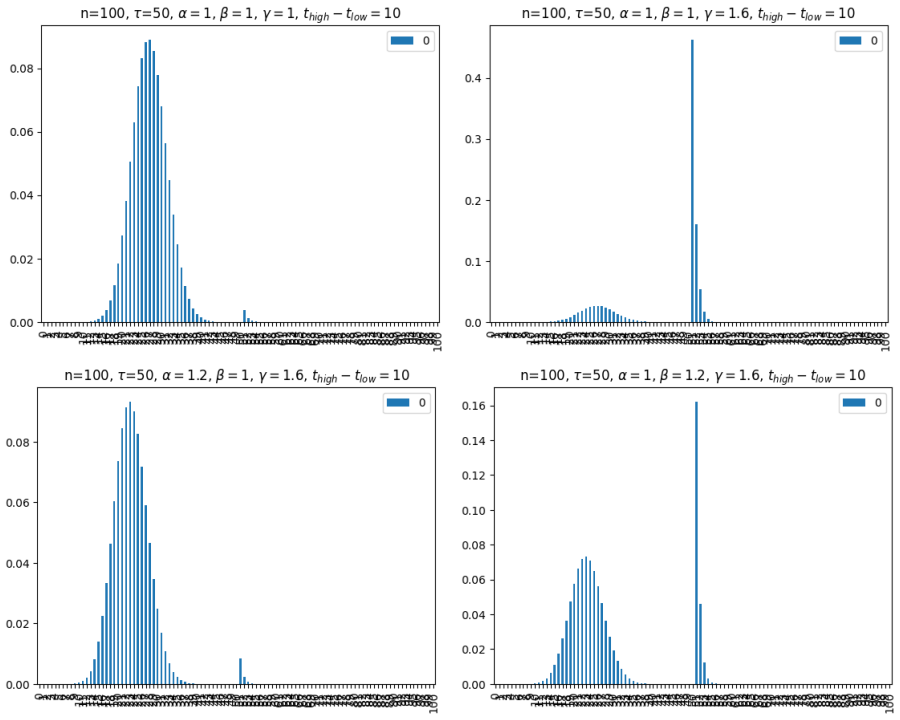
On the paper's own terms, the central discovery is that airdrop size acts as a control parameter in a sharp equilibrium-selection transition. For a threshold technology with binary contributions and uniform cost $\alpha$, the potential function $\varphi(a)=\frac{\rho}{n}V(a)-\sum_i c_i a_i$ has only two candidate maxima in the vanishing-noise limit: the zero-participation profile and the profiles with exactly $\tau$ contributors. Comparing $\varphi(\tau)$ with $\varphi(0)$ gives the threshold $\rho_c=\alpha n\tau/(V_{\mathrm{high}}-V_{\mathrm{low}})$, and Theorem 6 states that as $\beta\to\infty$ the logit dynamics select the high-value outcome with probability tending to 1 above $\rho_c$ and the low-value outcome with probability tending to 1 below it; at $\rho=\rho_c$ the distribution splits evenly between the bad state and the $\binom{n}{\tau}$ good states. In the finite-noise regime the transition softens to the logistic form $p_{\mathrm{high}}(\rho)=1/(1+C\exp(-\rho\beta(V_{\mathrm{high}}-V_{\mathrm{low}})/n))$, with $C$ independent of $\rho$ and of the two value levels, which the authors use to characterize the profit-maximizing airdrop.
Load-bearing premise
The load-bearing premise is that players update by logit choice probabilities with a common noise level and that the token price exactly equals fundamental participation value $V(a)/T_{\mathrm{tot}}$; if real learning differs or speculation moves the price, the critical fraction $\rho_c$ no longer governs equilibrium selection.
Editorial extensions
If this is right
- For threshold technologies, a designer who can choose $\rho$ freely can force the good equilibrium: announcing any $\rho>\rho_c$ makes the high-value outcome selected with probability tending to one, provided $\alpha n\tau<V_{\mathrm{high}}-V_{\mathrm{low}}$.
- If the total cost of reaching the threshold exceeds the value gap, $\alpha n\tau>V_{\mathrm{high}}-V_{\mathrm{low}}$, no airdrop of any size can make the launch succeed in the vanishing-noise limit, and the best the designer can do is give nothing and keep the low value.
- When $V_{\mathrm{low}}>0$ there is an intermediate cost band in which a sufficiently large airdrop would make the system succeed but the profit-maximizing designer still prefers no airdrop; only below $\alpha n\tau=(V_{\mathrm{high}}-V_{\mathrm{low}})(1-V_{\mathrm{low}}/V_{\mathrm{high}})$ does setting $\rho$ just above $\rho_c$ maximize profit.
- With finite noise, the success probability is monotone in $\rho$ and follows the logistic law $p_{\mathrm{high}}(\rho)=1/(1+C\exp(-\rho\beta(V_{\mathrm{high}}-V_{\mathrm{low}})/n))$, and for $V_{\mathrm{low}}=0$ the optimal airdrop is either zero or at most $1-n/(\beta V_{\mathrm{high}})$.
- The time to reach a participation level $\ell^*=n/(1+\exp(\alpha\beta))$ is short, but reaching the threshold $\tau$ takes time exponential in $\tau-\ell^*$ when $\ell^*<\tau$, so low participation costs, not just high rewards, are what make a launch timely.
Reading between the lines
- A direct extension the authors leave implicit is a calibration recipe for practice: estimate $\tau$ as the minimum viable participation level, $\alpha$ as the recipients' opportunity cost, and $V_{\mathrm{high}}-V_{\mathrm{low}}$ as the value jump, then set the airdrop to the smallest $\rho$ above $\rho_c$; the same formula also predicts which projects are hopeless from the start.
- Because the potential-game reduction applies to any anonymous technology, the threshold-style analysis can be repeated for quadratic network-value, linear, S-shaped, and concave technologies, and the paper's own appendix suggests each will have its own critical airdrop region.
- If token prices are set by speculation rather than by participation value, the model's advice should be amended: the relevant value gap would be based on expected future participation, and the sharp threshold would likely become a band whose width depends on market beliefs.
- The dependence of convergence time on $\alpha$ suggests a testable extension: airdrop campaigns that target low-cost incumbents—existing validators or restakers—should both reach the good equilibrium faster and require a smaller critical airdrop than campaigns aimed at entirely new entrants, a comparison that field data from real launches could check.
Signed reviews
Editorial analysis
A structured set of objections, weighed in public.
Referee Report
Summary. The paper introduces a game-theoretic model of blockchain airdrops. A designer allocates a fraction ρ of the token supply equally among n potential contributors; each contributor chooses whether to participate (`ai=1` or `ai=0`), incurring a uniform cost `α`, and the token's value is determined by a technology function `V(ℓ)` of the number of contributors. The main results are: (i) the game is an exact potential game with potential `ρ/n·V(a)-SC(a)` (Theorem 1), and the pure Nash equilibria are characterized (Theorem 2); (ii) under logit dynamics with vanishing noise, stochastically stable states are exactly the potential maximizers (Theorem 3); (iii) for threshold technologies, the high-value outcome is selected with probability tending to 1 iff `ρ > ρ_c = αnτ/(V_high−V_low)` (Theorem 6), with a finite-noise logistic characterization `p_high(ρ)=1/(1+C e^{-ρB})` (Theorem 7) and profit-maximizing airdrop rules (Theorem 8); (iv) birth-death arguments give bounds on mixing and hitting times (Theorems 4, 5, 9, 10), used to argue that low costs allow "expedient" convergence to the good outcome. The paper also applies the framework to quadratic (Metcalfe), linear, and S-shaped technologies.
Significance. The model is parameter-free in the sense that the main results are derived without fitted parameters, and the threshold transition (Theorem 6) gives a crisp, falsifiable design rule. The authors report machine-checkable-style derivations from standard tools (Blume logit response, Chen-Saloff-Coste birth-death bounds, Palacios-Tetali hitting-time identities), and Theorems 1-3, 6-8 are, based on my reading, correct; in particular, Theorem 7's derivation of the logistic form is careful and sound. The practical discussion (restaking, partner chains, cost reduction) connects the theory to real airdrop design. The main weakness is the convergence-time part: as stated, Lemma 1, Theorem 9, and Theorem 10(2) contain concrete mathematical errors (a sign error, an inverted stationary ratio, and an exponent error). These errors are localized and appear repairable without changing the model or the equilibrium-selection conclusions, but they currently undermine the paper's claim to provide tight bounds on the speed of convergence, which is part of the announced contribution.
major comments (3)
- [Lemma 1, Appendix A.4] Equation (28) has a sign error. The correct stationary distribution for the birth-death chain with binary efforts and uniform costs is `πhat(ℓ) = πhat(0) * binom(n,ℓ) * exp(βγ(t(ℓ)-t(0)) - αβℓ)`, i.e., the term `exp(-αβℓ)` appears with a negative exponent. As printed, the lemma states `exp(αβℓ)` with a positive exponent, which is false: for a technology with increasing `t(ℓ)`, it would incorrectly predict that the stationary distribution grows with both rewards and costs. The proof in A.4 makes the same sign error when moving from the denominator `exp(βαℓ)` to the final expression. Although the subsequent proofs of Theorems 5 and 9 effectively use the correct negative sign in their ratio computations, the lemma itself and its proof must be corrected, and all references to equation (28) should be rechecked.
- [Theorem 9, Section 5.3 and Appendix A.9] The lower bound in (27) is stated as `T_cutoff ≥ exp(αβ(τ-1)) * binom(n,τ-1)`, but the stationary ratio in the proof is `πhat(0)/πhat(τ-1) = exp(αβ(τ-1)) / binom(n,τ-1)`; the binomial factor is inverted. As printed, the theorem is false: for `n=10, τ=5, αβ=10` the claimed bound exceeds the exact birth-death expected hitting quantities by several orders of magnitude. The proof line in (47) therefore needs correction, and the asserted step `Σ_{ℓ=0}^{τ-1} πhat([0,ℓ])/(πhat(ℓ)p(ℓ)) ≥ πhat(0)/πhat(τ-1)` is not self-evident and requires a valid argument. Because the convergence-time results are what the abstract's "expedient manner" rests on, this is a load-bearing error that must be fixed before publication.
- [Theorem 10(2), Section 5.3 and Appendix A.11] The exponent in the lower bound should be `τ-1-ℓ`, not `τ-ℓ`. For a threshold technology, `V` is 0-steep only on the interval `[ℓ, τ-1]`, not on `[ℓ, τ]`, because `V(τ)-V(τ-1)=V_high-V_low>0`. Applying Theorem 5 with the correct interval yields `T_hitting(τ) ≥ (exp(αβ)(ℓ+1)/(n-ℓ))^{τ-1-ℓ}`. The stated bound with exponent `τ-ℓ` is stronger than what the proof can establish and is false; for example, with `n=10, τ=5, αβ=10` and a reward term making `p(τ-1)≈1`, the Palacios-Tetali formula gives `E_0 T_τ ≈ 4×10^15`, whereas the claimed lower bound is approximately `5×10^16`. The derived consequence `T_hitting(τ) ≥ (1+1/ℓ*)^{τ-ℓ*-1}` can still be recovered from the corrected exponent by taking `ℓ=ℓ*`, but the statement and proof must be revised accordingly.
minor comments (5)
- [Theorem 6, edge case] For `ρ = ρ_c`, the probability of selecting the high value outcome should be `binom(n,τ)/(1 + binom(n,τ))`, equivalently `1/(1 + 1/binom(n,τ))`, consistent with the uniform concentration over the `1 + binom(n,τ)` potential maximizers described in the proof of A.6. The printed expression appears to be `1/(1 + binom(n,τ))`, which is inconsistent with that proof.
- [Corollary 1, Eq. (14)] The quantity `c^(1)_max` is defined as `max{ci : a_i = 0}` but the text says it is the largest cost among contributing players; it should be `max{ci : a_i = 1}`.
- [Theorem 9 statement, Eq. (27)] The summation in the theorem statement runs to `τ`, while the proof in A.9 uses the sum from `ℓ=0` to `τ-1`. These should be aligned.
- [Appendix A.4, proof of Lemma 1] The algebra line in the proof of Lemma 1 writes `exp(βαℓ)` in the denominator and then `exp(αβℓ)` in the numerator of the final expression, which is the source of the sign error; the intermediate step showing the cancellation should be written out correctly.
- [Theorem 10 proof, Appendix A.11] The phrase "starting tom the state" should read "starting from the state", and the statement "for all `0≤ℓ≤τ`" should be "for all `0≤ℓ<τ`" (or stated with the corrected exponent) to avoid trivial or undefined cases.
Circularity Check
No load-bearing circularity; the phase-transition ρ_c is derived from the potential, and self-citations are background rather than definitional; the Theorem 10(2) exponent issue is a correctness typo, not circularity.
full rationale
The derivation chain is self-contained: utilities (Eq. 4) determine the exact potential (Eq. 10), and Theorem 6's critical value ρ_c = α n τ/(V_high − V_low) is obtained directly by comparing potential values φ(0) < φ(τ) in the proof (A.6), not by fitting or renaming an input. Stochastic stability (Theorem 3) is imported from Blume's external logit-dynamics theorem, and the mixing/hitting-time bounds rest on Chen–Saloff-Coste and Palacios–Tetali, which are external results. The self-citations (Auletta et al., 2011; Penna, 2018; Georganas, 2011; Chaidos et al., 2023) appear as background or as standard Markov-chain facts and are not used to define the target theorems; the Appendix D.2 β-calibration is illustrative and does not enter the theorem statements. No parameter is fitted to a subset and then 'predicted' as a closely related quantity. The one substantive mathematical concern is not circular: Theorem 10(2) applies Theorem 5(2) to the interval [ℓ,τ], although a threshold technology is 0-steep only on [ℓ,τ−1], so the exponent should be τ−1−ℓ; this is a correctness/typo issue and does not make any stated result equivalent to its inputs by construction.
Assumptions & free parameters
assumptions (5)
- standard math In the vanishing noise limit beta approaches infinity, logit dynamics concentrate on the set of potential maximizers (Blume 1993, 2003).
- domain assumption Token value equals V(a)/T_tot and airdrop rewards are gamma*t(a) = (rho/n)*V(a) (Eqs. 1-4).
- domain assumption Technology functions V are monotone non-decreasing (Section 2.1).
- domain assumption Players use logit response with common inverse-noise beta (Eq. 6).
- standard math Chen-Saloff-Coste birth-death mixing time bounds and Palacios-Tetali expected hitting time formulas.
Cite this review
Pith. "Pith review of Airdrop Games." pith.science (2026). https://pith.science/paper/J5U3OMAL
@misc{pith2026250503428,
  author       = {Pith},
  title        = {Pith review of: Airdrop Games},
  year         = {2026},
  howpublished = {\url{https://pith.science/paper/J5U3OMAL}},
  note         = {Machine review of arXiv:2505.03428}
}
read the original abstract
Launching a new blockchain system or application is frequently facilitated by a so called airdrop, where the system designer chooses a pre-existing set of potentially interested parties and allocates newly minted tokens to them with the expectation that they will participate in the system - such engagement, especially if it is of significant level, facilitates the system and raises its value and also the value of its newly minted token, hence benefiting the airdrop recipients. A number of challenging questions befuddle designers in this setting, such as how to choose the set of interested parties and how to allocate tokens to them. To address these considerations we put forward a game-theoretic model for such airdrop games. Our model can be used to guide the designer's choices based on the way the system's value depends on participation (modeled by a ''technology function'' in our framework) and the costs that participants incur. We identify both bad and good equilibria and identify the settings and the choices that can be made where the designer can influence the players towards good equilibria in an expedient manner.
Figures


Figures from the paper (4 more)


Reference graph
Works this paper leans on
-
[1]
Digital blockchain networks appear to be following Metcalfe’s Law
Ken Alabi. Digital blockchain networks appear to be following Metcalfe’s Law . Electronic Commerce Research and Applications, 24: 0 23--29, 2017. ISSN 1567-4223. doi:https://doi.org/10.1016/j.elerap.2017.06.003. URL https://www.sciencedirect.com/science/article/pii/S1567422317300480
-
[2]
Crypto airdrops: An evolutionary approach
Darcy WE Allen. Crypto airdrops: An evolutionary approach. Journal of Evolutionary Economics, pages 1--24, 2024
work page 2024
-
[3]
Why airdrop cryptocurrency tokens? Journal of Business Research, 163: 0 113945, 2023
Darcy WE Allen, Chris Berg, and Aaron M Lane. Why airdrop cryptocurrency tokens? Journal of Business Research, 163: 0 113945, 2023
work page 2023
-
[4]
Carlos Al \'o s-Ferrer and Nick Netzer. The logit-response dynamics. Games and Economic Behavior, 68 0 (2): 0 413--427, 2010
work page 2010
-
[5]
Carlos Al \'o s-Ferrer and Nick Netzer. Robust stochastic stability. Economic Theory, 58: 0 31--57, 2015
work page 2015
-
[6]
On the convergence of logit-response to (strict) nash equilibria
Carlos Al \'o s-Ferrer and Nick Netzer. On the convergence of logit-response to (strict) nash equilibria. Economic Theory Bulletin, 5: 0 1--8, 2017
work page 2017
-
[7]
The one-shot crowdfunding game
Itai Arieli, Moran Koren, and Rann Smorodinsky. The one-shot crowdfunding game. In Proc. of the ACM Conference on Economics and Computation (EC), page 213–214, 2018. ISBN 9781450358293. doi:10.1145/3219166.3219215. URL https://doi.org/10.1145/3219166.3219215
-
[8]
On the inefficiency ratio of stable equilibria in congestion games
Arash Asadpour and Amin Saberi. On the inefficiency ratio of stable equilibria in congestion games. In Proc. of the 5th International Workshop on Internet and Network Economics (WINE), pages 545--552. Springer, 2009
work page 2009
Show all 62 references
-
[9]
Convergence to equilibrium of logit dynamics for strategic games
Vincenzo Auletta, Diodato Ferraioli, Francesco Pasquale, Paolo Penna, and Giuseppe Persiano. Convergence to equilibrium of logit dynamics for strategic games. In Proc. of the 23rd annual ACM Symposium on Parallelism in Algorithms and Architectures (SPAA), pages 197--206, 2011
2011
-
[10]
Metastability of logit dynamics for coordination games
Vincenzo Auletta, Diodato Ferraioli, Francesco Pasquale, and Giuseppe Persiano. Metastability of logit dynamics for coordination games. In Proc. of the 23rd annual ACM-SIAM Symposium on Discrete Algorithms (SODA), pages 1006--1024. SIAM, 2012
2012
-
[11]
Logit dynamics with concurrent updates for local interaction games
Vincenzo Auletta, Diodato Ferraioli, Francesco Pasquale, Paolo Penna, and Giuseppe Persiano. Logit dynamics with concurrent updates for local interaction games. In Proc. of the 21st Annual European Symposium on Algorithms (ESA), pages 73--84. Springer, 2013 a
2013
-
[12]
Mixing time and stationary expected social welfare of logit dynamics
Vincenzo Auletta, Diodato Ferraioli, Francesco Pasquale, and Giuseppe Persiano. Mixing time and stationary expected social welfare of logit dynamics. Theory of Computing Systems, 53: 0 3--40, 2013 b
2013
-
[13]
Combinatorial agency
Moshe Babaioff, Michal Feldman, Noam Nisan, and Eyal Winter. Combinatorial agency. Journal of Economic Theory, 147 0 (3): 0 999--1034, 2012. ISSN 0022-0531. doi:https://doi.org/10.1016/j.jet.2012.01.010. URL https://www.sciencedirect.com/science/article/pii/S0022053112000117
2012 doi
-
[14]
Project games
Vittorio Bil \` o , Laurent Gourv \` e s, and J \' e r \^ o me Monnot. Project games. Theor. Comput. Sci., 940 0 (Part): 0 97--111, 2023. doi:10.1016/J.TCS.2022.10.043. URL https://doi.org/10.1016/j.tcs.2022.10.043
2023 doi
-
[15]
The statistical mechanics of strategic interaction
Lawrence E Blume. The statistical mechanics of strategic interaction. Games and economic behavior, 5 0 (3): 0 387--424, 1993
1993
-
[16]
Lawrence E. Blume. How noise matters. Games and Economic Behavior, 44 0 (2): 0 251--271, 2003. ISSN 0899-8256. doi:https://doi.org/10.1016/S0899-8256(02)00554-7. URL https://www.sciencedirect.com/science/article/pii/S0899825602005547
2003 doi
-
[17]
Stochastic stability in best shot network games
Leonardo Boncinelli and Paolo Pin. Stochastic stability in best shot network games. Games and Economic Behavior, 75 0 (2): 0 538--554, 2012
2012
-
[18]
Public goods in networks
Yann Bramoull \'e and Rachel Kranton. Public goods in networks. Journal of Economic theory, 135 0 (1): 0 478--494, 2007
2007
-
[19]
A game theoretic framework for incentives in P2P systems
Chiranjeeb Buragohain, Divyakant Agrawal, and Subhash Suri. A game theoretic framework for incentives in P2P systems. In Proc. of the 3rd International Conference on Peer-to-Peer Computing (P2P), pages 48--56. IEEE, 2003
2003
-
[20]
Blockchain participation games
Pyrros Chaidos, Aggelos Kiayias, and Evangelos Markakis. Blockchain participation games. In Proc. of the 19th International Conference on Web and Internet Economics (WINE), pages 169--187. Springer, 2023
2023
-
[21]
The economics of crowdfunding
Jen-Wen Chang. The economics of crowdfunding. American Economic Journal: Microeconomics, 12 0 (2): 0 257--280, 2020
2020
-
[22]
On the mixing time and spectral gap for birth and death chains
Guan-Yu Chen and Laurent Saloff-Coste. On the mixing time and spectral gap for birth and death chains. ALEA-Latin American Journal of Probability and Mathematical Statistics, 10 0 (1): 0 293--321, 2013
2013
-
[23]
Logit price dynamics
James Costain and Anton Nakov. Logit price dynamics. Journal of Money, Credit and Banking, 51 0 (1): 0 43--78, 2019
2019
-
[24]
General revision protocols in best response algorithms for potential games
Pierre Coucheney, St \'e phane Durand, Bruno Gaujal, and Corinne Touati. General revision protocols in best response algorithms for potential games. In 7th Int. Conference on NETwork Games, COntrol and OPtimization (NetGCoop), pages 239--246. IEEE, 2014
2014
-
[25]
Level-k auctions: Can a nonequilibrium model of strategic thinking explain the winner's curse and overbidding in private-value auctions? Econometrica, 75 0 (6): 0 1721--1770, 2007
Vincent P Crawford and Nagore Iriberri. Level-k auctions: Can a nonequilibrium model of strategic thinking explain the winner's curse and overbidding in private-value auctions? Econometrica, 75 0 (6): 0 1721--1770, 2007
2007
-
[26]
Optimal equilibria of the best shot game
Luca Dall’Asta, Paolo Pin, and Abolfazl Ramezanpour. Optimal equilibria of the best shot game. Journal of Public Economic Theory, 13 0 (6): 0 885--901, 2011
2011
-
[27]
Tight inapproximability of nash equilibria in public goods games
J \'e r \'e mi Do Dinh and Alexandros Hollender. Tight inapproximability of nash equilibria in public goods games. Information Processing Letters, 186: 0 106486, 2024
2024
-
[28]
The universal intersubjective work token
EigenLabs. The universal intersubjective work token. White paper, 2014. url: https://www.blog.eigenlayer.xyz/eigen/
2014
-
[29]
Altruistic and profit-oriented: Making sense of roles in web3 community from airdrop perspective
Sizheng Fan, Tian Min, Xiao Wu, and Wei Cai. Altruistic and profit-oriented: Making sense of roles in web3 community from airdrop perspective. In Proc. of the Conference on Human Factors in Computing Systems (CHI). Association for Computing Machinery, 2023. ISBN 9781450394215....
2023
-
[30]
Social pressure in opinion games
Diodato Ferraioli and Carmine Ventre. Social pressure in opinion games. In Proc. of the 26th International Joint Conference on Artificial Intelligence (IJCAI), pages 3661--3667, 2017
2017
-
[31]
Decentralized dynamics for finite opinion games
Diodato Ferraioli, Paul W Goldberg, and Carmine Ventre. Decentralized dynamics for finite opinion games. Theoretical Computer Science, 648: 0 96--115, 2016
2016
-
[32]
o wis and Rainer B \
Michael Fr \"o wis and Rainer B \"o hme. The operational cost of ethereum airdrops. In Data Privacy Management, Cryptocurrencies and Blockchain Technology: ESORICS 2019 International Workshops, DPM 2019 and CBT 2019, pages 255--270. Springer, 2019
2019
-
[33]
The law of the few
Andrea Galeotti and Sanjeev Goyal. The law of the few. American Economic Review, 100 0 (4): 0 1468–92, September 2010. doi:10.1257/aer.100.4.1468. URL https://www.aeaweb.org/articles?id=10.1257/aer.100.4.1468
2010 doi
-
[34]
Network games
Andrea Galeotti, Sanjeev Goyal, Matthew O Jackson, Fernando Vega-Redondo, and Leeat Yariv. Network games. The review of economic studies, 77 0 (1): 0 218--244, 2010
2010
-
[35]
English auctions with resale: An experimental study
Sotiris Georganas. English auctions with resale: An experimental study. Games and Economic Behavior, 73 0 (1): 0 147--166, 2011
2011
-
[36]
Complexity of public goods games on graphs
Matan Gilboa and Noam Nisan. Complexity of public goods games on graphs. In Proc. of the 15th International Symposium on Algorithmic Game Theory (SAGT), pages 151--168. Springer, 2022
2022
-
[37]
Ten little treasures of game theory and ten intuitive contradictions
Jacob K Goeree and Charles A Holt. Ten little treasures of game theory and ten intuitive contradictions. American Economic Review, 91 0 (5): 0 1402--1422, 2001
2001
-
[38]
Announcing the alpha v1 release of the partner chains toolkit
Omer Husain. Announcing the alpha v1 release of the partner chains toolkit. IOHK blog post, August 2024. URL https://iohk.io/en/blog/posts/2024/08/page-1/
2024
-
[39]
Attracting the right crowd under asymmetric information: A game theory application to rewards-based crowdfunding
Francisca Jiménez-Jiménez, Maria Virtudes Alba-Fernández, and Cristina Martínez-Gómez. Attracting the right crowd under asymmetric information: A game theory application to rewards-based crowdfunding. Mathematics, 9 0 (21), 2021. ISSN 2227-7390. doi:10.3390/math9212757. URL ht...
2021 doi
-
[40]
Sampling from the gibbs distribution in congestion games
Pieter Kleer. Sampling from the gibbs distribution in congestion games. In Proc. of the 22nd ACM Conference on Economics and Computation (EC), pages 679--680, 2021
2021
-
[41]
Stahlberg
Max Klimm and Maximilian J. Stahlberg. Complexity of equilibria in binary public goods games on undirected graphs. In Proc. of the 24th ACM Conference on Economics and Computation (EC), page 938–955, New York, NY, USA, 2023. Association for Computing Machinery. ISBN 9798400701...
2023
-
[42]
Levin, Yuval Peres, and Elizabeth L
David A. Levin, Yuval Peres, and Elizabeth L. Wilmer. Markov chains and mixing times . American Mathematical Society, 2006
2006
-
[43]
Designing airdrops
Kristof Lommers, Christos Makridis, and Lieven Verboven. Designing airdrops. Available at SSRN 4427295, 2023
2023
-
[44]
Makridis, Michael Fröwis, Kiran Sridhar, and Rainer Böhme
Christos A. Makridis, Michael Fröwis, Kiran Sridhar, and Rainer Böhme. The rise of decentralized cryptocurrency exchanges: Evaluating the role of airdrops and governance tokens . Journal of Corporate Finance, 79 0 (C), 2023. doi:10.1016/j.jcorpfin.2023.1. URL https://ideas.rep...
2023 doi
-
[45]
Tighter bounds on the inefficiency ratio of stable equilibria in load balancing games
Akaki Mamageishvili and Paolo Penna. Tighter bounds on the inefficiency ratio of stable equilibria in load balancing games. Oper. Res. Lett., 44 0 (5): 0 645--648, 2016. doi:10.1016/J.ORL.2016.07.014. URL https://doi.org/10.1016/j.orl.2016.07.014
2016 doi
-
[46]
Airdrops: Giving money away is harder than it seems
Johnnatan Messias, Aviv Yaish, and Benjamin Livshits. Airdrops: Giving money away is harder than it seems. arXiv preprint arXiv:2312.02752, 2023
2023 arXiv
-
[47]
Convergence to equilibrium in local interaction games
Andrea Montanari and Amin Saberi. Convergence to equilibrium in local interaction games. In Proc. of the 50th Annual IEEE Symposium on Foundations of Computer Science (FOCS), page 303–312. IEEE Computer Society, 2009. ISBN 9780769538501. doi:10.1109/FOCS.2009.64. URL https://d...
2009 doi
-
[48]
Dynamic pricing under nested logit demand
David M \"u ller, Yurii Nesterov, and Vladimir Shikhman. Dynamic pricing under nested logit demand. arXiv preprint arXiv:2101.04486, 2021
2021 arXiv
-
[49]
Log-linear dynamics and local potential
Daijiro Okada and Olivier Tercieux. Log-linear dynamics and local potential. Journal of Economic Theory, 147 0 (3): 0 1140--1164, 2012
2012
-
[50]
A note on expected hitting times for birth and death chains
JoséLuis Palacios and Prasad Tetali. A note on expected hitting times for birth and death chains. Statistics & Probability Letters, 30 0 (2): 0 119--125, 1996. ISSN 0167-7152. doi:https://doi.org/10.1016/0167-7152(95)00209-X. URL https://www.sciencedirect.com/science/article/p...
1996
-
[51]
Public goods games in directed networks
Christos Papadimitriou and Binghui Peng. Public goods games in directed networks. In Proc. of the 22nd ACM Conference on Economics and Computation (EC), page 745–762, 2021. ISBN 9781450385541. doi:10.1145/3465456.3467616. URL https://doi.org/10.1145/3465456.3467616
2021
-
[52]
The price of anarchy and stability in general noisy best-response dynamics
Paolo Penna. The price of anarchy and stability in general noisy best-response dynamics. Int. J. Game Theory, 47 0 (3): 0 839--855, 2018. doi:10.1007/S00182-017-0601-Y. URL https://doi.org/10.1007/s00182-017-0601-y
2018 doi
-
[53]
Stochastic stability under logit choice in coalitional bargaining problems
Ryoji Sawa. Stochastic stability under logit choice in coalitional bargaining problems. Games and economic behavior, 113: 0 633--650, 2019
2019
-
[54]
Crowdfunding with cognitive limitations
Qi Shao, Man Hon Cheung, and Jianwei Huang. Crowdfunding with cognitive limitations. IEEE/ACM Trans. Netw., 31 0 (6): 0 2714–2729, may 2023. ISSN 1063-6692. doi:10.1109/TNET.2023.3274114. URL https://doi.org/10.1109/TNET.2023.3274114
2023
-
[55]
Game-theoretic analysis of effort allocation of contributors to public projects
Jared Soundy, Chenhao Wang, Clay Stevens, and Hau Chan. Game-theoretic analysis of effort allocation of contributors to public projects. 2021
2021
-
[56]
Price optimization under the finite-mixture logit model
Ruben van de Geer and Arnoud V den Boer. Price optimization under the finite-mixture logit model. Management Science, 68 0 (10): 0 7480--7496, 2022
2022
-
[57]
Bundling and pricing strategies in crowdfunding
Lu Wang, Xue Wang, and Hang Wei. Bundling and pricing strategies in crowdfunding. Available at SSRN 4432999, 2023
2023
-
[58]
Partner chains are coming to cardano
Mike Ward. Partner chains are coming to cardano. IOHK blog post, November 2024. URL https://iohk.io/en/blog/posts/2023/11/page-1/
2024
-
[59]
Description available at https://world.org/worldcoin-token
Worldcoin, 2025. Description available at https://world.org/worldcoin-token
2025
-
[60]
Tierdrop: Harnessing airdrop farmers for user growth, 06 2024
Aviv Yaish and Benjamin Livshits. Tierdrop: Harnessing airdrop farmers for user growth, 06 2024
2024
-
[61]
Optimal crowdfunding design
Xiang Yan and Yiling Chen. Optimal crowdfunding design. In Proc. of the 20th International Conference on Autonomous Agents and MultiAgent Systems (AAMAS), pages 1704--1706, 2021
2021
-
[62]
Computing equilibria in binary networked public goods games
Sixie Yu, Kai Zhou, Jeffrey Brantingham, and Yevgeniy Vorobeychik. Computing equilibria in binary networked public goods games. In Proceedings of the AAAI Conference on Artificial Intelligence, volume 34, pages 2310--2317, 2020
2020
Reviewed August 15, 2026 · model on record in the stance chip above.
Discussion (0). Continue with ORCID to comment.