REVIEW 4 major objections 4 minor 41 references
Sustainable Smart Farm Networks: Enhancing Resilience and Efficiency with Decision Theory-Guided Deep Reinforcement Learning
T0 review · 4 major / 4 minor · reviewed 2026-08-15 · deepseek-v4-flash
Pith's one-line read The paper reports that a decision-theory-guided PPO agent trains 47.5% faster than a transfer-learning-enhanced PPO while matching its monitoring quality and energy sustainability.
desk verdict A plausible new combination of a decision-theoretic prior with PPO for energy-constrained sensor monitoring, but the energy bookkeeping is inconsistent enough that the headline 47.5% runtime claim needs verification. read the letter →
The pith
A machine-rendered reading of the paper's core claim, the machinery that carries it, and where it could break.
The reading
What carries the argument
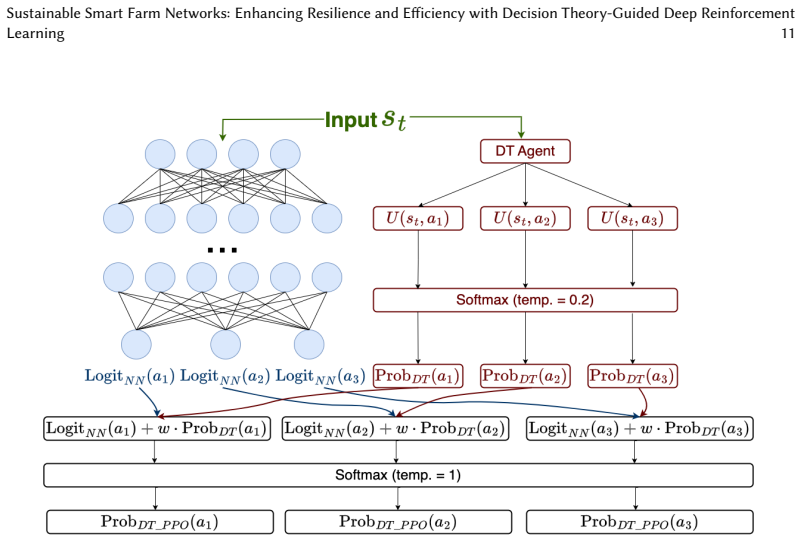
The carrying mechanism is the integrated action distribution $\mathrm{Logit}_{NN}(a^*)+w\cdot \mathrm{Prob}_{DT}(a^*)$, followed by a softmax, where $\mathrm{Prob}_{DT}$ is the softmax of the decision-theoretic utility function $U(s_t,a_t)=w_1 A(s_t,a_t)+w_2 E(s_t,a_t)$ and $w$ decays from 1 at rate 0.0003. This single additive identity lets a static expected-utility heuristic seed the deep policy and then surrender control to it, which is what produces the reported early-training speedup. The secondary mechanism is the Subjective-Logic aggregation stage, which maintains belief, uncertainty, and base-rate masses over three health-state classes, uses uncertainty maximization to handle conflicting evidence, and computes a projected distance to reject deceptive data.
What would settle it
Re-run the simulation with a realistic sensor battery, a few watt-hours of storage and milliwatt-scale solar charging; if the DT-PPO advantages in remaining energy and runtime shrink or reverse, the central energy-efficiency claim fails.
Extended reading notes
Core claim
The central claim is that DT-PPO outperforms TL-enhanced DRL: with a 30% compromised-sensor ratio and attack probability $P_A=0.1$, the DT-guided agent matches a fully transferred PPO model in monitoring quality and accumulated reward during early training, exceeds partially transferred and untransferred PPO, and reduces average training runtime by 47.5%. The mechanism is an integration of the two decision processes: the decision-theory component computes utilities for the actions 'increase', 'decrease', or 'hold' the transmission threshold $\rho$, converts them to a probability distribution via softmax, and adds that distribution to the PPO neural network's logits with a weight that decays from 1 at rate 0.0003. This gives the agent a non-random, utility-based starting policy, avoiding DRL's cold-start penalty, while the learned network gradually takes over as training proceeds. The paper also claims the DT component is less exposed than a learned policy to neural-network attacks such as trojan triggers, FGSM, and PGD.
Load-bearing premise
The load-bearing premise is the energy model: each ear-tag sensor starts with 5,000 watts of stored power yet recharges at about 10 milliwatts per square centimeter outdoors, a physically inconsistent pair of numbers on which the reported remaining-energy and runtime results rest.
Editorial extensions
If this is right
- DT-PPO offers the early-training benefit of fully transferred PPO even when no pre-trained model exists, which matters for deployments where source policies are unavailable.
- Because the agent's action space is only three discrete choices on a single threshold $\rho$, the learning cost does not scale with the number of sensors or animals.
- Raising sensor attack probability lowers monitoring quality but increases remaining energy for all schemes, while DT-PPO's advantage over TL-PPO-FT grows as adversarial-example severity on gateways rises.
- The uncertainty-aware opinion aggregation filters deceptive data before reward computation, supporting the paper's claim of resilience against false-data injection and non-compliant sensor behavior.
Reading between the lines
- A natural extension, not tested in the paper, is to make the DT weight $w$ decay adaptively, for example based on policy entropy or reward stagnation, rather than at the fixed rate 0.0003; the reported 47.5% runtime gain uses only this fixed schedule.
- The same DT-bootstrap pattern could accelerate other DRL tasks with a cold-start problem whenever a cheap heuristic utility function exists, such as network routing or robot control; the paper confines its claim to smart farm monitoring.
- If the physically inconsistent energy numbers, 5,000 watts of stored power with milliwatt-scale solar charging, are corrected to realistic battery capacities, the ranking of schemes might change, so the energy-efficiency claims should be re-validated in a consistent energy simulator before hardware deployment.
Signed reviews
Editorial analysis
A structured set of objections, weighed in public.
Referee Report
Summary. The paper proposes a multi-agent deep reinforcement learning (DRL) framework for a solar-powered smart farm sensor network, where agents on LoRa gateways select a transmission threshold to balance monitoring quality (MQ) and remaining energy (RE) under cyber and adversarial threats. To accelerate DRL training, the authors introduce decision-theory-guided PPO (DT-PPO), in which a hand-designed utility function is converted into a softmax distribution and combined with the neural network logits during early training. The approach is compared with PPO, transfer-learning-enhanced PPO (full and partial), a pure DT agent, a rule-based adaptive-energy-distance heuristic, fixed-energy, and random baselines using a semi-synthetic dataset derived from the Virginia Tech SmartFarm testbed. The central empirical claim is that DT-PPO outperforms transfer-learning-enhanced DRL, reducing training runtime by 47.5% while achieving comparable monitoring quality and energy efficiency. The manuscript also contributes an uncertainty-aware data aggregation method based on Subjective Logic to filter deceptive data under false data injection and other attacks.
Significance. If the reported results hold after correcting the modeling issues below, the paper would provide a useful engineering result: a decision-theoretic warm-start for PPO that avoids the need for a pre-trained model and remains robust to adversarial examples. The paper's strengths include a clearly described multi-agent architecture, a compact three-action threshold formulation, a concrete attack taxonomy, and a Subjective-Logic-based deceptive-data filter. The LoRa/BLE energy-per-bit comparison in Eqs. (4)-(7) is a nice, physically grounded detail. However, the significance is currently undermined by load-bearing inconsistencies in the monitoring-quality and energy models, a lack of statistical evidence for the headline claims, and a DT utility function that is effectively a hand-tuned proxy of the same reward being optimized. The claimed 47.5% runtime reduction is not derived anywhere in the results section, and the energy model inconsistency is severe enough that the reported remaining-energy curves may describe a different system than the one in the text. The central idea is defensible, but the manuscript requires substantive revision before the claims can be accepted.
major comments (4)
- [Eq. (2), Section 5.1.3] Equation (2) is not a properly normalized monitoring quality measure. The numerator sums over T_current(a_t), X, and d, but the denominator is only X*d. Consequently MQ grows with the number of time steps and is not confined to [0,1] as stated, despite being used directly in the reward r_t = MQ + RE and in all learning curves in Section 7. In addition, the function mq(i,j) has no time index, so the summation over t=1,...,T_current is not well-defined. The formula should either divide by T_current(a_t) as well or remove the sum over t, and the time dependence of mq must be made explicit.
- [Section 4.2, Eq. (3), Section 4.4] The energy model is internally inconsistent and load-bearing. Section 4.2 states that each sensor node starts with a 5 kW power reserve, while solar panels charge at about 10 mW/cm2 outdoors and 0.1 mW/cm2 indoors. A 5 kW reserve is a power rating, not an energy capacity, and is physically implausible for an ear-tag sensor; the stated charging rates are many orders of magnitude too small to replenish such a reserve. Section 4.4 then normalizes energy to [0,1] and Section 6.1 initializes HESs at 1.0 and LESs in [0.1,0.2), which does not map to a 5 kW reserve. Moreover, Eq. (3) defines RE as a monotone decrease with no solar-harvesting term, even though the text says charging efficiency varies with weather and shelter. Because the RE reward, the HES/LES classification, and the threshold policy rho all depend on this bookkeeping, the reported remaining-energy and runtime comparisons may describe a system that is not the sustainable solar-powered network claimed in the title and abstract. Please correct the units, specify the energy update equation including any charging term, and reconcile the initialization with the normalized range.
- [Section 7, Figs. 4-7, Abstract] The abstract and Section 8.1 state that DT-guided DRL 'proves' superior performance and reduces training runtime by 47.5%, but the results section provides no error bars, confidence intervals, or statistical significance tests. Section 6.1 mentions 100 simulation runs, and Section 7.2 states that data points are derived from average values over the first 50 episodes, but the variance across runs is never reported. Without dispersion measures, the reader cannot assess whether the observed differences between DT-PPO, TL-PPO-FT, and TL-PPO-PT are robust, and the 47.5% runtime reduction is not derived from any reported number in Section 7. Please add error bars or statistical tests and temper the 'prove' language accordingly.
- [Eq. (8), Section 5.2.1] The DT utility function in Eq. (8) is constructed from the same monitoring-quality and remaining-energy components that define the DRL reward in Eq. (1), and Section 5.2.1 describes A(s_t,a_t) and E(s_t,a_t) as 'quantified by combining the average values of monitoring quality and remaining energy from previous states with the change in rho.' As written, the DT guidance is therefore a hand-tuned proxy of the reward rather than an independent source of information, which partially explains the observed early-training speedup. This does not invalidate the engineering comparison, but the paper should state this design choice explicitly. In addition, no closed-form expressions for A(s_t,a_t) and E(s_t,a_t) are provided, and the values of w1 and w2 are never reported; without these, the DT component is not fully specified and the experiments are not reproducible.
minor comments (4)
- [Abstract and Section 8] The word 'prove' in the abstract and conclusions is too strong for a simulation study without statistical tests; 'suggest' or 'indicate' would be more appropriate. The 47.5% runtime figure also does not appear in the results section, so either add the supporting calculation or remove the specific number from the abstract.
- [Section 5.2.2] The DT influence weight w is initialized to 1 and decays at a rate of 0.0003, but no justification or sensitivity analysis is given for either value. Since the decay schedule directly controls the transition from DT-guided to learned behavior, a brief sensitivity discussion would strengthen the paper.
- [Eqs. (9)-(10), Section 5.4] The notation in Eq. (9) uses a nonstandard symbol for the uncertainty-maximized vacuity, and the threshold phi in Eq. (10) is never assigned a value in Section 6.1. Please define phi explicitly and report the chosen value and how it was set.
- [References] Reference [32] uses 'et al.' in the author list rather than listing all authors; since other references list all authors, this should be made consistent. The manuscript also does not include a data availability or code availability statement, which would be useful given the semi-synthetic dataset and the reproducibility concerns noted above.
Circularity Check
No significant circularity: the DT utility intentionally mirrors the reward, and the central runtime/performance claims are empirical comparisons under a common objective.
full rationale
The paper's central claim is that DT-guided PPO converges faster and outperforms TL-enhanced PPO. That claim is evaluated by accumulated reward, monitoring quality, remaining energy, and runtime. The DT utility in Eq. (8) is admittedly 'akin to a reward function' (Sec. 5.2.1) and is built from the same MQ/RE terms as Eq. (1); this is an intentional warm-start heuristic rather than a derivation of the result from the result. All schemes optimize the same reward, so the comparison is not forced by construction. The 47.5% runtime improvement is an empirical measurement of training time over 50 episodes, not an algebraic consequence of the definitions. There are no load-bearing self-citations: the cited decision-theory and PPO references are external, and no uniqueness theorem or prior author result is invoked to forbid alternatives. The energy-model inconsistency (a '5 kW power reserve' vs. mW/cm^2 charging rates, and Eq. (3) omitting solar recharge) is a serious physical/correctness concern and could undermine the empirical validity of the energy results, but it is not circularity: the energy model is an input assumption, not a conclusion derived from the target claim. The acknowledged limitation that real-world validation is future work affects external validity, not circular reasoning. Therefore no circular step meeting the quoted-evidence standard is present.
Assumptions & free parameters
free parameters (6)
- Utility weights w1, w2 =
not reported (w1+w2=1)
- Threshold rho initial value and step size tau =
tau = 0.05 (example); rho initial not reported
- DT influence decay rate =
0.0003
- HES/LES energy threshold L_bl =
0.3 (example)
- Deceptive data threshold phi =
not reported
- PPO batch size and learning rate =
batch 500, learning rate 0.0008
assumptions (5)
- domain assumption Ground-truth data is available during training to compute the MQ reward.
- ad hoc to paper The sensor energy model with a 5 kW initial reserve and solar charging around 10 mW/cm2 is realistic enough for conclusions to transfer.
- domain assumption Artificially generated compromised data preserves the real distributions of animal attributes.
- standard math Subjective Logic provides a faithful model of opinion and deception for monitoring data.
- domain assumption LoRa and BLE hardware parameters and energy-per-bit ratios from datasheets are accurate for the simulated environment.
Cite this review
Pith. "Pith review of Sustainable Smart Farm Networks: Enhancing Resilience and Efficiency with Decision Theory-Guided Deep Reinforcement Learning." pith.science (2026). https://pith.science/paper/AGW7JCS4
@misc{pith2026250503721,
  author       = {Pith},
  title        = {Pith review of: Sustainable Smart Farm Networks: Enhancing Resilience and Efficiency with Decision Theory-Guided Deep Reinforcement Learning},
  year         = {2026},
  howpublished = {\url{https://pith.science/paper/AGW7JCS4}},
  note         = {Machine review of arXiv:2505.03721}
}
read the original abstract
Solar sensor-based monitoring systems have become a crucial agricultural innovation, advancing farm management and animal welfare through integrating sensor technology, Internet-of-Things, and edge and cloud computing. However, the resilience of these systems to cyber-attacks and their adaptability to dynamic and constrained energy supplies remain largely unexplored. To address these challenges, we propose a sustainable smart farm network designed to maintain high-quality animal monitoring under various cyber and adversarial threats, as well as fluctuating energy conditions. Our approach utilizes deep reinforcement learning (DRL) to devise optimal policies that maximize both monitoring effectiveness and energy efficiency. To overcome DRL's inherent challenge of slow convergence, we integrate transfer learning (TL) and decision theory (DT) to accelerate the learning process. By incorporating DT-guided strategies, we optimize monitoring quality and energy sustainability, significantly reducing training time while achieving comparable performance rewards. Our experimental results prove that DT-guided DRL outperforms TL-enhanced DRL models, improving system performance and reducing training runtime by 47.5%.
Figures


Figures from the paper (4 more)


Reference graph
Works this paper leans on
-
[1]
Frederik Aerts, Luca Lanzilao, and Johan Meyers. 2023. Bayesian uncertainty quantification framework for wake model calibration and validation with historical wind farm power data. Wind Energy 26, 8 (2023), 786–802
work page 2023
-
[2]
Temesgen Seyoum Alemayehu and Jai-Hoon Kim. 2017. Efficient nearest neighbor heuristic TSP algorithms for reducing data acquisition latency of UAV relay WSN. Wireless Personal Communications 95 (2017), 3271–3285
work page 2017
-
[3]
Ahmed Abubakar Aliyu and Jinshuo Liu. 2023. Blockchain-Based Smart Farm Security Framework for the Internet of Things. Sensors 23, 18 (2023), 7992
work page 2023
-
[4]
Kai Arulkumaran, Marc Peter Deisenroth, Miles Brundage, and Anil Anthony Bharath. 2017. Deep Reinforcement Learning: A Brief Survey.IEEE Signal Processing Magazine 34, 6 (2017), 26–38. https://doi.org/10.1109/MSP.2017.2743240 ACM Comput. Surv., Vol. 1, No. 1, Article . Publication date: May 2025. Sustainable Smart Farm Networks: Enhancing Resilience and E...
arXiv 2017
-
[5]
Mustafa Sinasi Ayas, Selen Ayas, and Seddik M. Djouadi. 2022. Projected Gradient Descent Adversarial Attack and Its Defense on a Fault Diagnosis System. In2022 45th International Conference on Telecommunications and Signal Processing (TSP). 36–39. https://doi.org/10.1109/TSP55681.2022.9851334
-
[6]
Robert Bogue. 2012. Solar-powered sensors: a review of products and applications. Sensor Review 32, 2 (2012), 95–100
work page 2012
-
[7]
Cheol-Joo Chae and Han-Jin Cho. 2018. Enhanced secure device authentication algorithm in P2P-based smart farm system. Peer-to-peer networking and applications 11 (2018), 1230–1239
work page 2018
-
[8]
Mark Cutler and Jonathan P How. 2015. Efficient reinforcement learning for robots using informative simulated priors. In 2015 IEEE international conference on robotics and automation (ICRA) . IEEE, 2605–2612
work page 2015
Show all 41 references
-
[9]
B R dos Reis, Z Easton, R R White, and D Fuka. 2021. A LoRa sensor network for monitoring pastured livestock location and activity. Translational Animal Science 5, 2 (Jan. 2021), 1–9
2021
-
[10]
Lukas Eichner, Ronald Schneider, and Matthias Baeßler. 2023. Optimal vibration sensor placement for jacket support structures of offshore wind turbines based on value of information analysis. Ocean Engineering 288 (2023), 115407
2023
-
[11]
Pier Francesco Giordano, Leandro Iannacone, and Maria Pina Limongelli. 2023. Value of Seismic Structural Health Monitoring Information for Management of Civil Structures Under Different Prior Knowledge Scenarios. InInternational Conference on Experimental Vibration Analysis fo...
2023
-
[12]
Ian Goodfellow, Jonathon Shlens, and Christian Szegedy. 2015. Explaining and Harnessing Adversarial Examples. In International Conference on Learning Representations (ICLR)
2015
-
[13]
Maanak Gupta, Mahmoud Abdelsalam, Sajad Khorsandroo, and Sudip Mittal. 2020. Security and privacy in smart farming: Challenges and opportunities. IEEE Access 8 (2020), 34564–34584
2020
-
[14]
Audun Jøsang. 2016. Subjective Logic: A Formalism for Reasoning Under Uncertainty (1st ed.). Springer Publishing Company, Incorporated
2016
-
[15]
Katie Kang, Suneel Belkhale, Gregory Kahn, Pieter Abbeel, and Sergey Levine. 2019. Generalization through simulation: Integrating simulated and real data into deep reinforcement learning for vision-based autonomous flight. In 2019 international conference on robotics and autom...
2019
-
[16]
Sangkil Kim, Rushi Vyas, Jo Bito, Kyriaki Niotaki, Ana Collado, Apostolos Georgiadis, and Manos M Tentzeris. 2014. Ambient RF energy-harvesting technologies for self-sustainable standalone wireless sensor platforms. Proc. IEEE 102, 11 (2014), 1649–1666
2014
-
[17]
Siddhant Kumar, Gourav Chowdhary, Venkanna Udutalapally, Debanjan Das, and Saraju P. Mohanty. 2019. gCrop: Internet-of-Leaf-Things (IoLT) for Monitoring of the Growth of Crops in Smart Agriculture. In 2019 IEEE International Symposium on Smart Electronic Systems (iSES) (Former...
2019
-
[18]
Franz Kuntke, Vladimir Romanenko, Sebastian Linsner, Enno Steinbrink, and Christian Reuter. 2022. LoRaWAN security issues and mitigation options by the example of agricultural IoT scenarios.Transactions on Emerging Telecommunications Technologies 33, 5 (2022), e4452
2022
-
[19]
Min Liu, Shijun Xu, and Siyi Sun. 2012. An agent-assisted QoS-based routing algorithm for wireless sensor networks. Journal of Network and Computer Applications 35, 1 (2012), 29–36
2012
-
[20]
Yingqi Liu, Shiqing Ma, Yousra Aafer, Wen-Chuan Lee, Juan Zhai, Weihang Wang, and Xiangyu Zhang. 2018. Trojaning Attack on Neural Networks. In Network and Distributed System Security Symposium (NDSS) . Internet Society
2018
-
[21]
Cian O Mathuna, Terence O’Donnell, Rafael V Martinez-Catala, James Rohan, and Brendan O’Flynn. 2008. Energy scavenging for long-term deployable wireless sensor networks. Talanta 75, 3 (2008), 613–623
2008
-
[22]
Chrysi K Metallidou, Kostas E Psannis, and Eugenia Alexandropoulou Egyptiadou. 2020. Energy efficiency in smart buildings: IoT approaches. IEEE Access 8 (2020), 63679–63699
2020
-
[23]
SAM R34/R35 Low Power LoRa ® Sub-GHz SiP Datasheet
Microchip 2018. SAM R34/R35 Low Power LoRa ® Sub-GHz SiP Datasheet . Microchip. http://ww1.microchip.com/ downloads/en/DeviceDoc/SAMR34-R35-Low-Power-LoRa-Sub-GHz-SiP-Data-Sheet-DS70005356B.pdf
2018
-
[24]
Leonid Nefedov and Nataliia Fil. 2023. The model of the regional environmental monitoring system organization. In The IEEE 13th International Conference on Dependable Systems, Services and Technologies (DESSERT) . 1–6
2023
-
[25]
Tri Gia Nguyen, Trung V Phan, Dinh Thai Hoang, Tu N Nguyen, and Chakchai So-In. 2021. Federated deep reinforcement learning for traffic monitoring in SDN-based IoT networks. IEEE Trans. Cognitive Communications and Networking 7, 4 (2021), 1048–1065
2021
-
[26]
Thu Nga Nguyen, Trong Binh Nguyen, Trinh Van Chien, and Tien Hoa Nguyen. 2023. Utilizing Deep Reinforcement Learning to Control UAV Movement for Environmental Monitoring. International Journal of Electrical and Electronic Engineering & Telecommunications 12, 5 (2023), 317–325
2023
-
[27]
D Warner North. 1968. A Tutorial Introduction to Decision Theory. IEEE Trans. Systems Science and Cybernetics 4, 3 (1968), 200–210
1968
-
[28]
Błażej Osiński, Adam Jakubowski, Paweł Zięcina, Piotr Miłoś, Christopher Galias, Silviu Homoceanu, and Henryk Michalewski. 2020. Simulation-based reinforcement learning for real-world autonomous driving. In 2020 IEEE interna- tional conference on robotics and automation (ICRA)...
2020
-
[29]
Giovanni Parmigiani and Lurdes Inoue. 2009. Decision theory: Principles and approaches . John Wiley & Sons. ACM Comput. Surv., Vol. 1, No. 1, Article . Publication date: May 2025. 22 Dian Chen, Zelin Wan, Dong Sam Ha, and Jin-Hee Cho
2009
-
[30]
Martin Peterson. 2017. An Introduction to Decision Theory . Cambridge University Press
2017
-
[31]
Yakub Kayode Saheed and Micheal Olaolu Arowolo. 2021. Efficient Cyber Attack Detection on the Internet of Medical Things-Smart Environment Based on Deep Recurrent Neural Network and Machine Learning Algorithms. IEEE Access 9 (2021), 161546–161554. https://doi.org/10.1109/ACCES...
2021
-
[32]
John Schulman, et al. 2017. Proximal policy optimization algorithms. arXiv preprint arXiv:1707.06347 (2017)
2017 arXiv
-
[33]
Sina Sontowski, Maanak Gupta, Sai Sree Laya Chukkapalli, Mahmoud Abdelsalam, Sudip Mittal, Anupam Joshi, and Ravi Sandhu. 2020. Cyber Attacks on Smart Farming Infrastructure. In 2020 IEEE 6th International Conference on Collaboration and Internet Computing (CIC) . 135–143. htt...
2020
-
[34]
Salman Md Sultan, Muhammad Waleed, Jae-Young Pyun, and Tai-Won Um. 2021. Energy conservation for Internet of Things tracking applications using deep reinforcement learning. Sensors 21, 9 (2021), 3261
2021
-
[35]
CC2640R2F SimpleLink ™ Bluetooth® 5.1 Low Energy Wireless MCU
Texas Instruments 2016. CC2640R2F SimpleLink ™ Bluetooth® 5.1 Low Energy Wireless MCU . Texas Instruments. https://www.ti.com/product/CC2640R2F Rev. C
2016
-
[36]
Anusha Vangala, Anil Kumar Sutrala, Ashok Kumar Das, and Minho Jo. 2021. Smart contract-based blockchain- envisioned authentication scheme for smart farming. IEEE Internet of Things Journal 8, 13 (2021), 10792–10806
2021
-
[37]
Xiong Wang, Linghe Kong, Zucheng Wu, Long Cheng, Chenren Xu, and Guihai Chen. 2020. SLoRa: Towards secure LoRa communications with fine-grained physical layer features. In Proceedings of the 18th Conference on Embedded Networked Sensor Systems. 258–270
2020
-
[38]
Abbas Yazdinejad, Behrouz Zolfaghari, Amin Azmoodeh, Ali Dehghantanha, Hadis Karimipour, Evan Fraser, Arthur G Green, Conor Russell, and Emily Duncan. 2021. A review on security of smart farming and precision agriculture: Security aspects, attacks, threats and countermeasures....
2021
-
[39]
Won Joon Yun, Soohyun Park, Joongheon Kim, MyungJae Shin, Soyi Jung, David A Mohaisen, and Jae-Hyun Kim
-
[40]
Jain, and Jiayu Zhou
Zhuangdi Zhu, Kaixiang Lin, Anil K. Jain, and Jiayu Zhou. 2023. Transfer Learning in Deep Reinforcement Learning: A Survey. IEEE Trans. Pattern Analysis and Machine Intelligence 45, 11 (2023), 13344–13362. ACM Comput. Surv., Vol. 1, No. 1, Article . Publication date: May 2025
2023
-
[2022]
IEEE Trans
Cooperative multiagent deep reinforcement learning for reliable surveillance via autonomous multi-UAV control. IEEE Trans. Industrial Informatics 18, 10 (2022), 7086–7096
2022
Reviewed August 15, 2026 · model on record in the stance chip above.
Discussion (0). Continue with ORCID to comment.