REVIEW 3 major objections 4 minor 39 references
A Double Inertial Forward-Backward Splitting Algorithm With Applications to Regression and Classification Problems
T0 review · 3 major / 4 minor · reviewed 2026-08-16 · deepseek-v4-flash
Pith's one-line read The paper's central claim is that Algorithm 1*, a forward-backward splitting method with two inertial extrapolation terms, converges weakly to a solution of the monotone inclusion problem $0\in(A+B)z$.
desk verdict The algorithm is a minor variant of existing double-inertial methods, but the convergence proof rests on a false norm identity, so the central theorem is unproven. read the letter →
The pith
A machine-rendered reading of the paper's core claim, the machinery that carries it, and where it could break.
The reading
What carries the argument
The central object is the forward-backward operator $T:=J_\lambda^B(I-\lambda A)$, where $J_\lambda^B=(I+\lambda B)^{-1}$ is the resolvent of $B$. By the cited theorem in [8], $T$ is $\kappa$-averaged with $\kappa=2\alpha/(4\alpha-\lambda)$, which supplies the contractive inequality used throughout. Algorithm 1* is a relaxed inertial iteration over $T$: the three-term momentum $w_k=p_k+\vartheta(p_k-p_{k-1})+\delta(p_{k-1}-p_{k-2})$ is followed by $p_{k+1}=(1-E_k)w_k+E_kTw_k$. The proof is carried by the Lyapunov function $\Gamma_k=\|p_k-p^*\|^2-\vartheta\|p_{k-1}-p^*\|^2-\delta\|p_{k-2}-p^*\|^2+E_1(1-\kappa)/\kappa(1-|\delta|-\vartheta)\|p_k-p_{k-1}\|^2$; showing $\Gamma_{k+1}\le\Gamma_k$ up to a negative term is what yields the limit of successive differences, and demiclosedness of $T$ then converts that into weak convergence.
What would settle it
One could settle the theorem by expanding Eq. (18) symbolically for a concrete Hilbert space and checking whether the printed identity holds; if it does not, the proof of Lemma 3.2 collapses. A second check is to search for an admissible triple $(\vartheta,\delta,E_1)$ under Assumption B for, say, $\alpha=1$, $\lambda=1$; if none exists, the theorem is vacuous. A third, behavioral check is to run Algorithm 1* on a simple two-dimensional problem with a known solution and verify whether $\|p_k-p_{k-1}\|$ and $\|w_k-Tw_k\|$ actually tend to zero for parameters inside the admissible region.
Extended reading notes
Core claim
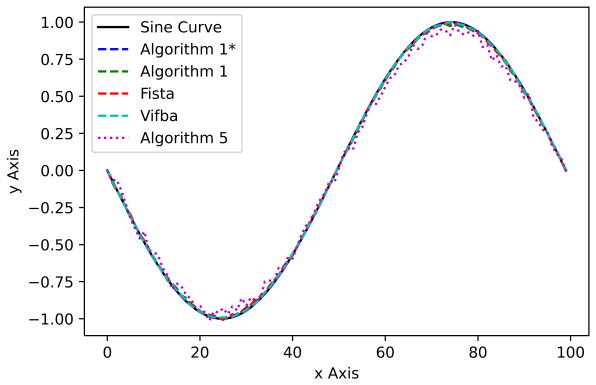
On the paper's own terms, the central result is Theorem 3.3: if $A$ is $\alpha$-co-coercive, $B$ is maximal monotone, $(A+B)^{-1}(0)$ is nonempty, and the parameters satisfy Assumption B, then the sequence $\{p_k\}$ defined by $w_k=p_k+\vartheta(p_k-p_{k-1})+\delta(p_{k-1}-p_{k-2})$ and $p_{k+1}=(1-E_k)w_k+E_kJ_\lambda^B(w_k-\lambda Aw_k)$ converges weakly to a point in $(A+B)^{-1}(0)$. The proof recasts the iteration as a relaxed fixed-point method for the averaged operator $T=J_\lambda^B(I-\lambda A)$, builds a Lyapunov function over three consecutive iterates, shows it is nonincreasing, forces $\|p_k-p_{k-1}\|\to0$, and uses demiclosedness to conclude that every weak cluster point is a solution. The numerical sections then claim that, on sine-curve regression and Iris classification tasks, Algorithm 1* is faster and more accurate than the compared methods in most settings.
Load-bearing premise
The load-bearing premise is that the coupled inequalities in Assumption B admit at least one admissible choice of the parameters and that the algebraic expansion in Eq. (18) is correct; if the parameter region is empty or that identity is wrong, the boundedness proof and the convergence theorem lose their foundation.
Editorial extensions
If this is right
- If the theorem holds, practitioners can add two inertial extrapolation terms to forward-backward splitting for monotone inclusions and still retain a weak-convergence guarantee.
- The relaxation parameters $E_k$ can be tuned inside $(E_1,E_2)$ without leaving the convergence regime, giving a family of algorithms rather than a single fixed update.
- For convex minimization with $B=\partial f$ and $A=\nabla g$, the scheme becomes a two-momentum proximal-gradient method, so the result applies to regression and classification objectives of the kind tested in the paper.
- The convergence is weak, not strong: on infinite-dimensional problems the iterates may fail to converge in norm while still approaching the solution set in the weak topology.
Reading between the lines
- The proof leans on $\delta\le0$ through $|\delta|=-\delta$; a natural extension to test is whether a symmetric $\delta\ge0$ admits the same Lyapunov argument, which would show whether the momentum sign restriction is an artifact of the proof.
- The numerical experiments embed the splitting step inside an extreme learning machine; a direct test on sparse regression, where the resolvent becomes a soft-threshold map and the solution set is nontrivial, would show whether the double-inertial acceleration transfers to the standard Lasso setting.
- Because Assumption B is a system of coupled inequalities, the quickest check of the theorem's substance is to try to exhibit an admissible triple $(\vartheta,\delta,E_1)$ for a concrete pair $(\alpha,\lambda)$; if no such triple exists, the convergence result is vacuous.
- The expansion in Eq. (18) appears to drop cross terms that a correct expansion of a squared three-term combination would contain; whether the Lyapunov proof survives a corrected identity is the decisive check on the paper's main theorem.
Signed reviews
Editorial analysis
A structured set of objections, weighed in public.
Referee Report
Summary. The paper proposes a forward-backward splitting algorithm with two inertial parameters (Algorithm 1*) for finding a zero of A+B, where A is co-coercive and B is maximal monotone in a real Hilbert space. The central theoretical claim is that, under Assumptions A and B, the generated sequence converges weakly to a solution of the monotone inclusion problem. The paper also reports numerical experiments applying the algorithm to regression and classification tasks and compares it with FISTA, VIFBA, and two other algorithms. The main proof is carried out in Lemma 3.2 (boundedness) and Theorem 3.3 (weak convergence), relying on an averagedness property of the forward-backward operator and on a Lyapunov-type quantity Gamma_k.
Significance. If the weak-convergence theorem were correct, the contribution would be a modest but useful addition to the inertial splitting literature: another double-inertial forward-backward method with a convergence guarantee under stated parameter restrictions. The paper appropriately invokes a standard external result on the averagedness of the forward-backward operator, so I do not see a circularity problem. The numerical experiments cover several baselines, but the theoretical core is not sound as written: the key norm identity in Eq. (18) is false, and the feasibility of the coupled parameter conditions in Assumption B(iii) is never demonstrated. These issues undermine the main claim.
major comments (3)
- [Section 3, Lemma 3.2, Eq. (18)] The displayed expansion of ||w_k - p^*||^2 is algebraically false. With x = p_k - p^*, y = p_{k-1} - p^*, z = p_{k-2} - p^*, the correct identity is ||(1+ϑ)x - (ϑ-δ)y - δz||^2 = (1+ϑ)||x||^2 - (ϑ-δ)||y||^2 - δ||z||^2 + (1+ϑ)(ϑ-δ)||x-y||^2 + δ(1+ϑ)||x-z||^2 - δ(ϑ-δ)||y-z||^2, whereas the manuscript writes δ(1-ϑ)||p_k - p_{k-2}||^2 in place of δ(1+ϑ)||p_k - p_{k-2}||^2. A concrete counterexample is H = R, p^* = 0, p_{k-1} = p_{k-2} = 0, p_k = 1, ϑ = 0.1, δ = -0.1, for which the left-hand side equals 1.21 and the manuscript's right-hand side equals 1.23. Since Eq. (18) is used to construct Gamma_k and to derive the monotonicity inequality (24), the boundedness proof of Lemma 3.2 and the weak-convergence conclusion of Theorem 3.3 are unsupported.
- [Section 3, Lemma 3.2, Eqs. (29)-(32)] The proof asserts that from (30) the limit of Gamma_k + c_1||p_{k-1} - p_{k-2}||^2 is zero. Monotone decrease combined with nonnegativity of this sequence yields only existence of a finite limit; the conclusion ||p_{k-1} - p_{k-2}|| -> 0 follows instead by summing the telescoping inequality and using convergence of the series of c_2||p_{k-1} - p_{k-2}||^2. As written, the argument is incorrect, although this particular step is repairable.
- [Section 3, Assumption B(iii)] The manuscript never demonstrates that the parameter restrictions in Assumption B(iii) are jointly feasible. The displayed conditions couple ϑ, δ, E_1, and κ through multiple strict inequalities, and no admissible numerical assignment is provided. If this set of parameters is empty, Theorem 3.3 is vacuous. This issue is independent of the algebraic error in Eq. (18) and needs to be settled explicitly.
minor comments (4)
- [Section 3, Eq. (22)] In the displayed chain of inequalities leading to (22), the expression '-|δ| ||p_{k-1} - p_{k-2}||^2 ϑ^2 ||p_k - p_{k-1}||^2' is missing a plus sign; it should read '-|δ| ||p_{k-1} - p_{k-2}||^2 + ϑ^2 ||p_k - p_{k-1}||^2'.
- [Section 4, Tables 3 and 4] For the sigmoid activation function, FISTA achieves lower MSE, lower RMSE, and higher R^2 than Algorithm 1* in both Table 3 and Table 4, so the abstract's and conclusion's blanket claim that the proposed algorithm yields superior outcomes is not supported by the reported experiments.
- [Introduction, Eq. (2)] The displayed forward-backward iteration in Eq. (2) uses the resolvent of A on the term involving B; for problem (1), with B maximal monotone and A co-coercive, the standard forward-backward iteration is x_{n+1} = (I + λ_n B)^{-1}(I - λ_n A)x_n. Please correct the expression or the attribution.
- [Throughout] The manuscript contains several typographical and linguistic issues, including 'was was first suggested', 'successfull', and 'efficient of the proposed algorithm'; a careful proofreading pass is needed.
Circularity Check
No significant circularity: the convergence proof rests on an external averagedness theorem, and no fitted parameter is relabeled as a prediction.
full rationale
The paper's central theoretical claim (Theorem 3.3) is not circular. Algorithm 1* is defined directly, and the proof imports the κ-averagedness of J_B^λ(I−λA) from [8, Theorem 7], an external result by Bot, Csetnek, and Meier, not by the present authors. This is genuine external support. The algorithm parameters (ϑ, δ, E_k) are constrained by Assumption B before the conclusion and are not fitted to data; the proof then attempts to construct a Lyapunov-type quantity Γ_k and shows monotonicity under algebraic inequalities. No equation is asserted to be equivalent to the target result by definition, and no fitted quantity is renamed as a prediction. The self-citations in the reference list (e.g., [1–3,31] by co-author Karahan) are background citations for inertial and extragradient ideas and are not load-bearing in Lemma 3.2 or Theorem 3.3. Two serious correctness concerns exist, but they are not circularity. First, Eq. (18) is a false norm identity: the right-hand side has coefficients that are linear in (1+ϑ) rather than quadratic, so the squared norm of a linear combination is not expanded correctly. This identity is load-bearing for the boundedness proof and for the existence of the limit in Eq. (32), so the proof as written does not establish the theorem. Second, Assumption B(iii) asserts the joint feasibility of several coupled parameter inequalities without exhibiting an admissible tuple, leaving open the possibility that the admissible parameter set is empty. These concerns undermine the mathematical validity of the derivation, but they do not constitute a reduction of the claimed result to its own inputs. Under the circularity criteria, which require exhibiting a definitional equivalence, a fitted-input-renamed-as-prediction, or a load-bearing self-citation chain, the finding is no significant circularity.
Assumptions & free parameters
free parameters (4)
- ϑ
- δ
- λ
- E_k bounds (E1, E2)
assumptions (3)
- domain assumption A is α-cocoercive and B is maximal monotone on a real Hilbert space; (A+B)^{-1}(0) is nonempty.
- standard math T = J^B_λ(I−λA) is κ-averaged with κ = 2α/(4α−λ).
- ad hoc to paper The parameter restrictions in Assumption B are jointly feasible for a nonempty range of values.
Cite this review
Pith. "Pith review of A Double Inertial Forward-Backward Splitting Algorithm With Applications to Regression and Classification Problems." pith.science (2026). https://pith.science/paper/TSHSEJ5I
@misc{pith2026250503794,
  author       = {Pith},
  title        = {Pith review of: A Double Inertial Forward-Backward Splitting Algorithm With Applications to Regression and Classification Problems},
  year         = {2026},
  howpublished = {\url{https://pith.science/paper/TSHSEJ5I}},
  note         = {Machine review of arXiv:2505.03794}
}
read the original abstract
This paper presents an improved forward-backward splitting algorithm with two inertial parameters. It aims to find a point in the real Hilbert space at which the sum of a co-coercive operator and a maximal monotone operator vanishes. Under standard assumptions, our proposed algorithm demonstrates weak convergence. We present numerous experimental results to demonstrate the behavior of the developed algorithm by comparing it with existing algorithms in the literature for regression and data classification problems. Furthermore, these implementations suggest our proposed algorithm yields superior outcomes when benchmarked against other relevant algorithms in existing literature.
Figures


Figures from the paper (2 more)


Reference graph
Works this paper leans on
-
[1]
Altıparmak, E., & Karahan, I. (2021). Image Restoration Using An ˙Inertial Viscosity Fixed Point Algorithm. Arxiv Preprint Arxiv:2108.05146
work page Pith review arXiv 2021
-
[2]
Altiparmak, E., & Karahan, I. (2022). A Modıfıed Precondıtıonıng Algorıthm For Solvıng Monotone Inclusıon Problem And Applıcatıon To Image Restoratıon Problem. Politeh. Buch. Ser. A, 84, 81-92
work page 2022
-
[3]
Altiparmak, E., & Karahan, I. (2022). A new preconditioning algorithm for finding a zero of the sum of two monotone operators and its application to image restoration problems. International Journal of Computer Mathematics, 99(12), 2482-2498
work page 2022
-
[4]
Alvarez, F., & Attouch, H. (2001). An inertial proximal method for maximal monotone operators via discretization of a nonlinear oscillator with damping. Set-Valued Analysis, 9, 3-11
work page 2001
-
[5]
Attouch, H., Peypouquet, J., & Redont, P. (2014). A dynamical approach to an inertial forward-backward algorithm for convex minimization. SIAM Journal on Optimization, 24(1), 232-256
work page 2014
-
[6]
Bauschke, H. H., & Combettes, P. L. Convex Analysis and Monotone Operator Theory in Hilbert Spaces, 2011. CMS books in mathematics). DOI, 10, 978-1
work page 2011
-
[7]
Beck, A., & Teboulle, M. (2009). A fast iterative shrinkage-thresholding algorithm for linear inverse problems. SIAM journal on imaging sciences, 2(1), 183-202
work page 2009
-
[8]
Bot ¸, R. I., Csetnek, E. R., & Meier, D. (2019). Inducing strong convergence into the asymptotic behaviour of proximal splitting algorithms in Hilbert spaces. Optimization Methods and Software, 34(3), 489-514
work page 2019
Show all 39 references
-
[9]
L., & Wajs, V
Combettes, P. L., & Wajs, V. R. (2005). Signal recovery by proximal forward-backward splitting. Multiscale modeling & simulation, 4(4), 1168-1200
2005
-
[10]
R., Singh, A
Dixit, A., Sahu, D. R., Singh, A. K., & Som, T. (2020). Application of a new accelerated algorithm to regression problems. Soft Computing, 24, 1539-1552
2020
-
[11]
R., Gautam, P., Som, T., & Yao, J
Dixit, A., Sahu, D. R., Gautam, P., Som, T., & Yao, J. C. (2021). An accelerated forward- backward splitting algorithm for solving inclusion problems with applications to regression and link prediction problems. choice, 4(1), 2
2021
-
[12]
L., Cho, Y
Dong, Q. L., Cho, Y. J., & Rassias, T. M. (2018). General inertial Mann algorithms and their convergence analysis for nonexpansive mappings. Applications of Nonlinear Analysis, 175-191
2018
-
[13]
Douglas, J., & Rachford, H. H. (1956). On the numerical solution of heat conduction problems in two and three space variables. Transactions of the American mathematical 18 Society, 82(2), 421-439
1956
-
[14]
Fisher, R. A. (1936). The use of multiple measurements in taxonomic problems. Annals of eugenics, 7(2), 179-188
1936
-
[15]
B., Wang, D
Huang, G. B., Wang, D. H., & Lan, Y. (2011). Extreme learning machines: a survey. International journal of machine learning and cybernetics, 2, 107-122
2011
-
[16]
Inthakon, W., Suantai, S., Sarnmeta, P., & Chumpungam, D. (2020). A new machine learning algorithm based on optimization method for regression and classification prob- lems. Mathematics, 8(6), 1007
2020
-
[17]
S., & Shehu, Y
Iyiola, O. S., & Shehu, Y. (2022). Convergence results of two-step inertial proximal point algorithm. Applied Numerical Mathematics, 182, 57-75
2022
-
[18]
O., Shehu, Y., YAO, J
Jolaoso, L. O., Shehu, Y., YAO, J. C., & Xu, R. (2023). Double Inertıal Parameters Forward-Backward Splıttıng Method: Applıcatıons To Compressed Sensıng, Image Pro- cessıng, And Scad Penalty Problems. Journal of Nonlinear & Variational Analysis, 7(4)
2023
-
[19]
Kitkuan, D., Kumam, P., & Mart´ ınez-Moreno, J. (2020). Generalized Halpern-type forward–backward splitting methods for convex minimization problems with application to image restoration problems. Optimization, 69(7-8), 1557-1581
2020
-
[20]
L., & Mercier, B
Lions, P. L., & Mercier, B. (1979). Splitting algorithms for the sum of two nonlinear operators. SIAM Journal on Numerical Analysis, 16(6), 964-979
1979
-
[21]
L´ opez, G., Mart´ ın-M´ arquez, V., Wang, F., & Xu, H. K. (2012, January). Forward- backward splitting methods for accretive operators in Banach spaces. In Abstract and Applied Analysis (Vol. 2012). Hindawi
2012
-
[22]
A., & Pock, T
Lorenz, D. A., & Pock, T. (2015). An inertial forward-backward algorithm for monotone inclusions. Journal of Mathematical Imaging and Vision, 51, 311-325
2015
-
[23]
Moudafi, A. (2000). Viscosity approximation methods for fixed-points problems. Journal of mathematical analysis and applications, 241(1), 46-55
2000
-
[24]
Moudafi, A., & Oliny, M. (2003). Convergence of a splitting inertial proximal method for monotone operators. Journal of Computational and Applied Mathematics, 155(2), 447-454
2003
-
[25]
Nesterov, Y. E. E. (1983). A method of solving a convex programming problem with convergence rate O 1 k2 . In Doklady Akademii Nauk (Vol. 269, No. 3, pp. 543-547). Russian Academy of Sciences
1983
-
[26]
Peeyada, P., Cholamjiak, W., & Yambangwai, D. (2022). A hybrid inertial parallel sub- gradient extragradient-line algorithm for variational inequalities with an application to image recovery, J. Nonlinear Funct. Anal., 2022 (2022), 9
2022
-
[27]
Polyak, B. T. (1964). Some methods of speeding up the convergence of iteration methods. Ussr computational mathematics and mathematical physics, 4(5), 1-17
1964
-
[28]
Polyak, B. T. (1987). Introduction to optimization
1987
-
[29]
Poon, C., & Liang, J. (2019). Trajectory of alternating direction method of multipliers and adaptive acceleration. Advances in Neural Information Processing Systems, 32
2019
-
[30]
Poon, C., & Liang, J. (2020). Geometry of first-order methods and adaptive acceleration. arXiv preprint arXiv:2003.03910
2020 arXiv
-
[31]
U., ¨Ozdemır, M., Karahan, ˙I., & Waırojjana, N
Rehman, H. U., ¨Ozdemır, M., Karahan, ˙I., & Waırojjana, N. (2022). The Tseng’s Ex- tragradıent Method For Semıstrıctly Quasımonotone Varıatıonal Inequalıtıes. Journal Of Applied & Numerical Optimization, 4(2)
2022
-
[32]
Sitthithakerngkiet, K., Deepho, J., & Kumam, P. (2015). A hybrid viscosity algorithm via modify the hybrid steepest descent method for solving the split variational inclusion in image reconstruction and fixed point problems. Applied Mathematics and Computation, 250, 986-1001
2015
-
[33]
Sra, S., Nowozin, S., & Wright, S. J. (Eds.). (2012). Optimization for machine learning. Mit Press
2012
-
[34]
Suantai, S., Inkrong, P., & Cholamjiak, P. (2023). Forward–backward–forward algorithms involving two inertial terms for monotone inclusions. Computational and Applied Math- ematics, 42(6), 255
2023
-
[35]
Sunthrayuth, P., & Cholamjiak, P. (2018). Iterative methods for solving quasi-variational 19 inclusion and fixed point problem in q-uniformly smooth Banach spaces. Numerical Al- gorithms, 78, 1019-1044
2018
-
[36]
Taiwo, A., & Mewomo, O. T. (2022). Inertial viscosity with alternative regularization for certain optimization and fixed point problems. Journal of Applied & Numerical Opti- mization, 4(3)
2022
-
[37]
Tibshirani, R. (1996). Regression shrinkage and selection via the lasso. Journal of the Royal Statistical Society Series B: Statistical Methodology, 58(1), 267-288
1996
-
[38]
Tseng, P. (2000). A modified forward-backward splitting method for maximal monotone mappings. SIAM Journal on Control and Optimization, 38(2), 431-446
2000
-
[39]
R., & Shukla, K
Verma, M., Sahu, D. R., & Shukla, K. K. (2018). VAGA: a novel viscosity-based acceler- ated gradient algorithm: Convergence analysis and applications. Applied Intelligence, 48, 2613-2627. 20
2018
Reviewed August 16, 2026 · model on record in the stance chip above.
Discussion (0). Continue with ORCID to comment.