REVIEW 3 major objections 6 minor 59 references
Multi-Modal Molecular Representation Learning via Structure Awareness
T0 review · 3 major / 6 minor · reviewed 2026-08-15 · deepseek-v4-flash
Pith's one-line read The paper claims that MMSA, a self-supervised molecular pretraining framework combining multi-modal autoencoders, hypergraph convolution, and a memory bank, produces embeddings that outperform prior methods on MoleculeNet classification…
desk verdict MMSA is a workmanlike multi-modal pretraining plugin with modest benchmark gains, but the pretraining objective is underspecified and the ablation numbers contradict the main tables—don't trust the SOTA claim until those are fixed. read the letter →
The pith
A machine-rendered reading of the paper's core claim, the machinery that carries it, and where it could break.
The reading
What carries the argument
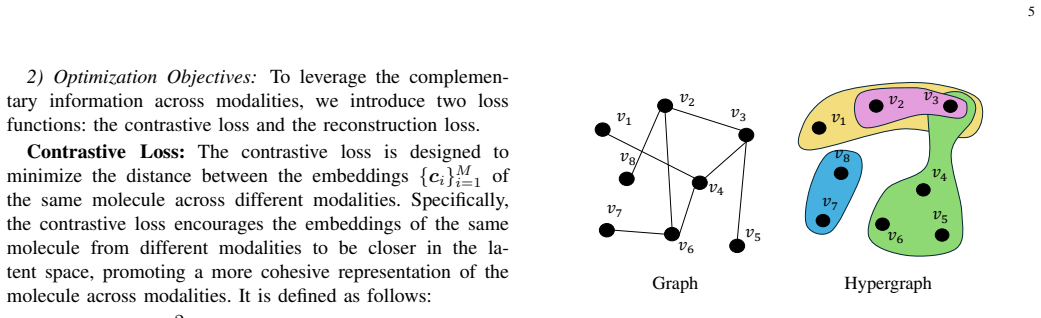
The load-bearing object is the structure-awareness module. A hypergraph is constructed by connecting each molecule to its $K-1$ nearest neighbors in embedding space, so each hyperedge links $K$ molecules; hypergraph convolution (HGNNConv) propagates information along these hyperedges, allowing the model to represent interactions that involve more than two molecules. A memory bank holds $L$ learnable anchor embeddings; the model scores how similar a molecule's embedding is to each anchor, takes a softmax-weighted sum of the anchors to form an aligned embedding, and trains with a memory loss that keeps the aligned embedding close to the original plus prediction losses for molecular geometry and property targets. These two mechanisms are what the paper credits with capturing higher-order correlations and invariant knowledge, and they are the components that distinguish MMSA from earlier modality-fusion methods.
What would settle it
Compute the overlap between the 100K GEOM Drugs pretraining set and each MoleculeNet dataset using canonical SMILES or InChI keys, then rerun the eight classification and four regression benchmarks with all overlapping molecules removed from pretraining; if MMSA's reported advantages shrink to near-baseline levels, the central claim of representation-level improvement is not supported. The same check applies to scaffold-disjoint splits, since the paper's evaluation uses scaffold splitting.
Extended reading notes
Core claim
The central claim is that invariant knowledge shared across molecules, rather than information confined to individual molecules, is what makes molecular representations transfer. Concretely, MMSA encodes a molecule with three feature extractors—GIN for the 2D graph, ResNet-18 for the 2D image, and ComENet for the 3D conformation—projects each modality into a shared latent space with autoencoders, and fuses them into one embedding. The structure-awareness module then places every molecule as a node in a hypergraph built by K-nearest-neighbor search, applies hypergraph convolution to capture dependencies among several molecules at once, and aligns the resulting embedding with learnable memory anchors. The authors report that this pipeline achieves 75.94% average ROC-AUC on eight MoleculeNet classification tasks, gains of 1.80 to 10.01 points over reproduced baselines, best average RMSE on four regression tasks, and successful within- and cross-dataset molecular retrieval.
Load-bearing premise
The comparison assumes that the 100K GEOM Drugs molecules used for pretraining do not overlap with the MoleculeNet molecules used for downstream evaluation, and no overlap filter is reported; if test molecules appeared in pretraining, the reported ROC-AUC gains could reflect memorization rather than representation learning.
Editorial extensions
If this is right
- If the central claim holds, pretraining with MMSA yields one encoder whose embeddings serve classification, regression, and retrieval, so a single pretrained model can replace task-specific pretraining pipelines.
- Because the paper shows MMSA improving five existing baselines (AttrMask, GraphCL, GraphMVP, GraphMAE, Mole-BERT), the mechanism is claimed to be a plug-in that raises the performance of whatever graph encoder already exists.
- The hypergraph component is doing real work: replacing it with a GCN of matched capacity lowers ROC-AUC on BBBP, Tox21, and ClinTox and raises RMSE on ESOL and Lipo.
- The memory bank is doing distinct work: ablating the memory loss hurts BBBP and Tox21 ROC-AUC more than ablating the prediction loss, which the paper reads as evidence that invariant knowledge improves generalization.
- The gains are not tied to one architecture, since MMSA improves GCN, GAT, GIN, GraphSAGE, and Graphformer backbones.
Reading between the lines
- Editorial inference: the paper does not report filtering overlaps between the 100K GEOM Drugs pretraining molecules and the MoleculeNet evaluation sets, so some of the reported advantage could reflect memorization of near-duplicate molecules; a scaffold-disjoint pretraining split would test this.
- Editorial inference: the memory bank is effectively a soft clustering of embeddings around learnable prototypes, so the same structure-awareness recipe could transfer to other graph-level self-supervised settings, such as protein or materials property prediction, though the paper does not test this.
- Editorial inference: because hyperedges are built within each training batch, the higher-order signal depends on batch composition; larger or more diverse batches could strengthen the effect without any architectural change.
- Editorial inference: the image branch uses a fixed pretrained ResNet-18, and the reported gains from adding images come with that encoder frozen; fine-tuning the image encoder during pretraining is an untested extension that might push the image modality further.
Signed reviews
Editorial analysis
A structured set of objections, weighed in public.
Referee Report
Summary. The paper proposes MMSA, a multi-modal molecular representation pre-training framework that combines modality-specific auto-encers over 2D graphs, 2D images, and 3D conformations with a hypergraph-based structure-awareness module and a memory bank of prototype anchors. The model is pre-trained on 100K molecules sampled from GEOM Drugs, then fine-tuned on eight MoleculeNet classification datasets and four regression datasets, reporting an average ROC-AUC of 75.94% and best RMSE on all regression tasks. The paper also presents retrieval experiments, ablations, and a versatility study in which MMSA is plugged into several existing graph-based methods. The central claim is that MMSA achieves state-of-the-art molecular property prediction by exploiting higher-order inter-molecular relations and invariant knowledge.
Significance. If the evaluation is clean, the work is a useful contribution to molecular representation learning: hypergraph modeling of inter-molecular relations and memory-anchor alignment are reasonable and relatively novel extensions of existing multi-modal pre-training, and the plugin-style integration with multiple GNN baselines (Fig. 4) is practically attractive. The paper also provides a fairly broad evaluation across classification, regression, retrieval, ablation, and backbone-architecture analyses. However, two verification blockers prevent me from assessing whether the reported gains are due to the proposed mechanism or to leakage and unspecified supervision: the prediction targets in Eq. (13) are never defined, and the pretraining corpus is not shown to be disjoint from the downstream evaluation sets.
major comments (3)
- [§IV-B-2, Eq. (13)] The prediction loss Lpre uses "true labels for molecular geometry and chemical properties," Ygeom and Yprop, but these labels are never defined: no dimensionality, source, or computation method is given for the 100K GEOM Drugs pretraining corpus. Lpre enters Lsa (Eq. 14) and Loverall (Eq. 15), so the pretraining objective is underspecified and cannot be reproduced as written. This also undermines the self-supervised claim and the statement in Section V-D that MMSA "does not heavily depend on labeled data," because the objective includes supervised prediction targets. Please define these targets precisely and, if they are obtained from external labels, clarify how the method remains self-supervised.
- [§V-A.1, §V-A.2] The paper does not state whether the 100K GEOM Drugs pretraining subset was checked for overlap with the molecules in the MoleculeNet classification and regression datasets used for downstream evaluation. MoleculeNet datasets draw from public chemical libraries, and GEOM Drugs is a large collection of drug-like molecules, so without an overlap filter there is a concrete risk that test molecules or near-duplicates appeared in pretraining. Please report overlap statistics after exact-matching and, ideally, InChI/ECFP-based near-duplicate filtering, and clarify whether any leaked molecules were excluded before the final runs.
- [§V-G vs. §V-A.3] There is a direct inconsistency between the hyperparameter settings: Section V-A.3 states λ=0.6 and α=0.5, while Section V-G states that the main experiments use λ=0.7 and α=0.2, and Fig. 6 reports the best BACE ROC-AUC of 82.8 at λ=0.6, whereas Table II lists BACE=82.4 for the final MMSA model. This makes it unclear which configuration produced the headline results. Because hyperparameters appear to have been tuned on BACE while BACE is included in the headline table, please disclose the model-selection procedure, report results for a fixed configuration chosen before seeing test labels, and either exclude BACE from the headline or present it as a validation-tuned result.
minor comments (6)
- [Reproducibility Statement] The reproducibility statement says the code is "accessible on here," but no URL or repository identifier is provided; please insert a working link so the listed code, datasets, and configurations are actually available.
- [Table II caption] The phrase "with values ranging from 0 to 4" is unclear; I assume it refers to the standard deviation values, but as written it seems to describe the ROC-AUC scores themselves. Please reword.
- [§V-D, §V-G] There are minor formatting inconsistencies: "Table 6" should be "Table VI," and "TABLE IX" should be formatted consistently with the other table references.
- [Table VIII] The row label "Graphformor" is a typo and should read "Graphformer" to match the text and the cited model.
- [Fig. 4] The figure includes GraphCL as a baseline, but GraphCL is not listed in the baselines of Section V-A.2 and no reference is provided; please add the citation and clarify the evaluation protocol for this method.
- [§V-D] The sentence "MMSA without Lpre outperforms the model without Lme, suggesting that the proposed method does not heavily depend on labeled data" is not logically supported: removing Lpre does not remove all label dependence, and the comparison of two ablations does not establish a general claim about label dependence. Please rephrase or remove this claim once the Ygeom/Yprop targets are specified.
Circularity Check
Hyperparameters are validated on BACE and the same BACE result is then reported inside the headline MoleculeNet average; otherwise the derivation is self-contained.
-
fitted input called prediction
[Section V-G (Hyperparametric Analysis), Fig. 6; Table II, BACE column and Average.]
""While our main experiments employ empirically validated settings (λ = 0.7, α = 0.2, K = 10), we also conduct a comprehensive sensitivity analysis to evaluate their impact. As illustrated in Fig. 6, the model maintains robust performance within the range of λ∈ [0.5, 0.9], with the best ROC-AUC score of 82.8 on the BACE task achieved at λ = 0.6" (Section V-G). Table II lists "MMSA (Ours) ... BACE ... 82.4 ± 0.4" and "Average ... 75.94"."
The same BACE dataset is used twice: Section V-G and Fig. 6 select and validate the hyperparameters λ and α by plotting ROC-AUC on the BACE task, and Table II then reports the BACE ROC-AUC (82.4) as one of the eight tasks entering the headline average 75.94. The BACE column is therefore not an out-of-sample prediction with a fixed configuration; it is the tuning target used to justify the hyperparameters. Reporting it inside the average double-counts that fit. This is the fitted-input-called-prediction pattern at the hyperparameter level. The remaining modules (autoencoders, hypergraph convolution, memory bank) are not fitted to downstream labels, so the circularity is partial rather than total.
full rationale
I found no self-definitional or self-citation circularity in the core derivation. The multi-modal autoencoder objective (Eqs. 5-7), hypergraph convolution (Eq. 9), memory loss (Eq. 12), and prediction loss (Eq. 13) are stated as standalone objectives over molecular features, and the downstream MoleculeNet tasks are not used to construct Lae or the hypergraph. The only step that reduces a reported prediction to its own tuning input is the BACE-based hyperparameter validation in Section V-G feeding the BACE row and the 75.94 average in Table II; I scored this as partial circularity (5). Two additional weaknesses are real but are not derivation-level circularity under the strict definition: (1) Eq. (13) uses Ygeom and Yprop described only as 'true labels for molecular geometry and chemical properties', with no source, dimensionality, or generation procedure given, so the self-supervised pretraining objective is under-specified and cannot be reproduced; if those labels were downstream MoleculeNet labels, the evaluation would be circular, but the paper does not demonstrate that. (2) Section V-A.1 reports no overlap filter between the randomly selected 100K GEOM Drugs pretraining molecules and the MoleculeNet evaluation sets, so if overlap exists, the SOTA comparison is contaminated rather than circular. The Reproducibility Statement also lacks an actual URL ('accessible on here'). These issues should be corrected, but they are missing support and verification gaps, not reductions of the derivation to its inputs.
Assumptions & free parameters
free parameters (7)
- lambda (cross-modal alignment weight) =
0.6 (reported in V.A) and 0.7 (reported in V.G), conflicting
- alpha (memory update coefficient) =
0.5 (reported in V.A) and 0.2 (reported in V.G), conflicting
- K (hypergraph neighborhood size) =
10
- L (number of memory anchors) =
128
- dc (embedding and anchor dimension) =
256
- tau (reconstruction balance) =
not reported
- conformations per molecule =
5
assumptions (4)
- domain assumption 2D graph, 2D image, and 3D graph representations of the same molecule are complementary enough that aligning them via contrastive and reconstruction losses improves downstream molecular property prediction.
- domain assumption The KNN hypergraph built over molecule embeddings captures higher-order relationships that are useful for molecular property prediction.
- domain assumption The random 100K GEOM Drugs pretraining set is disjoint from the MoleculeNet evaluation samples.
- ad hoc to paper Pretraining targets Ygeom and Yprop are well-defined and available for the pretraining corpus.
Cite this review
Pith. "Pith review of Multi-Modal Molecular Representation Learning via Structure Awareness." pith.science (2026). https://pith.science/paper/VAAVZRIR
@misc{pith2026250505877,
  author       = {Pith},
  title        = {Pith review of: Multi-Modal Molecular Representation Learning via Structure Awareness},
  year         = {2026},
  howpublished = {\url{https://pith.science/paper/VAAVZRIR}},
  note         = {Machine review of arXiv:2505.05877}
}
read the original abstract
Accurate extraction of molecular representations is a critical step in the drug discovery process. In recent years, significant progress has been made in molecular representation learning methods, among which multi-modal molecular representation methods based on images, and 2D/3D topologies have become increasingly mainstream. However, existing these multi-modal approaches often directly fuse information from different modalities, overlooking the potential of intermodal interactions and failing to adequately capture the complex higher-order relationships and invariant features between molecules. To overcome these challenges, we propose a structure-awareness-based multi-modal self-supervised molecular representation pre-training framework (MMSA) designed to enhance molecular graph representations by leveraging invariant knowledge between molecules. The framework consists of two main modules: the multi-modal molecular representation learning module and the structure-awareness module. The multi-modal molecular representation learning module collaboratively processes information from different modalities of the same molecule to overcome intermodal differences and generate a unified molecular embedding. Subsequently, the structure-awareness module enhances the molecular representation by constructing a hypergraph structure to model higher-order correlations between molecules. This module also introduces a memory mechanism for storing typical molecular representations, aligning them with memory anchors in the memory bank to integrate invariant knowledge, thereby improving the model generalization ability. Extensive experiments have demonstrated the effectiveness of MMSA, which achieves state-of-the-art performance on the MoleculeNet benchmark, with average ROC-AUC improvements ranging from 1.8% to 9.6% over baseline methods.
Figures


Figures from the paper (4 more)


Reference graph
Works this paper leans on
-
[1]
M. Demirel, B. Mills, E. Gaughan, K. Dhaliwal, and J. R. Hopgood, “Bayesian statistical analysis for bacterial detection in pulmonary en- domicroscopic fluorescence lifetime imaging,” IEEE Transactions on Image Processing, vol. 33, pp. 1241–1256, 2024
work page 2024
-
[2]
AS-GCL: Asymmetric Spectral Augmentation on Graph Contrastive Learning
R. Liu, R. Yin, Y . Liu, X. Hao, H. Shi, C. Ma, and W. Wang, “As-gcl: Asymmetric spectral augmentation on graph contrastive learning,” arXiv preprint arXiv:2502.13525, 2025
work page Pith review arXiv 2025
-
[3]
Sketch kernel ridge regres- sion using circulant matrix: Algorithm and theory,
Y . Rong, L. Yong, W. Weiping, and M. Dan, “Sketch kernel ridge regres- sion using circulant matrix: Algorithm and theory,” IEEE transactions on neural networks and learning systems, vol. 31, no. 9, pp. 3512–3524, 2019
work page 2019
-
[4]
Divide-and-conquer learning with nystr ¨om: Optimal rate and algorithm,
R. Yin, Y . Liu, L. Lu, W. Wang, and D. Meng, “Divide-and-conquer learning with nystr ¨om: Optimal rate and algorithm,” in Proceedings of the AAAI conference on artificial intelligence , vol. 34, no. 04, 2020, pp. 6696–6703
work page 2020
-
[5]
Self- supervised graph transformer on large-scale molecular data,
Y . Rong, Y . Bian, T. Xu, W. Xie, Y . Wei, W. Huang, and J. Huang, “Self- supervised graph transformer on large-scale molecular data,” Advances in Neural Information Processing Systems , vol. 33, pp. 12 559–12 571, 2020
work page 2020
-
[6]
Distributed randomized sketching kernel learning,
R. Yin, Y . Liu, and D. Meng, “Distributed randomized sketching kernel learning,” in Proceedings of the AAAI conference on artificial intelligence, vol. 36, no. 8, 2022, pp. 8883–8891
work page 2022
-
[7]
Randomized sketches for clustering: Fast and optimal kernel k-means,
R. Yin, Y . Liu, W. Wang, and D. Meng, “Randomized sketches for clustering: Fast and optimal kernel k-means,” Advances in Neural Information Processing Systems , vol. 35, pp. 6424–6436, 2022
work page 2022
-
[8]
Scalable kernel k-means with randomized sketching: From theory to algorithm,
R. Yin, Y . Liu, and D. Meng, “Scalable kernel k-means with randomized sketching: From theory to algorithm,” IEEE Transactions on Knowledge and Data Engineering , vol. 35, no. 9, pp. 9210–9224, 2022
work page 2022
Show all 59 references
-
[9]
Extremely sparse johnson- lindenstrauss transform: From theory to algorithm,
R. Yin, Y . Liu, W. Wang, and D. Meng, “Extremely sparse johnson- lindenstrauss transform: From theory to algorithm,” in 2020 IEEE International Conference on Data Mining (ICDM) . IEEE, 2020, pp. 1376–1381
2020
-
[10]
Mapfusion: A novel bev feature fusion network for multi-modal map construction,
X. Hao, Y . Diao, M. Wei, Y . Yang, P. Hao, R. Yin, H. Zhang, W. Li, S. Zhao, and Y . Liu, “Mapfusion: A novel bev feature fusion network for multi-modal map construction,” arXiv preprint arXiv:2502.04377 , 2025
2025 arXiv
-
[11]
Aswt-sgnn: Adaptive spec- tral wavelet transform-based self-supervised graph neural network,
R. Liu, R. Yin, Y . Liu, and W. Wang, “Aswt-sgnn: Adaptive spec- tral wavelet transform-based self-supervised graph neural network,” in Proceedings of the AAAI Conference on Artificial Intelligence , vol. 38, no. 12, 2024, pp. 13 990–13 998
2024
-
[12]
Refor- mulating graph kernels for self-supervised space-time correspondence learning,
Z. Qin, X. Lu, D. Liu, X. Nie, Y . Yin, J. Shen, and A. C. Loui, “Refor- mulating graph kernels for self-supervised space-time correspondence learning,” IEEE Transactions on Image Processing , vol. 32, pp. 6543– 6557, 2023
2023
-
[13]
Bctr: bidirectional conditioning transformer for scene graph generation,
P. Hao, W. Wang, X. Wang, Y . Jiang, H. Jia, S. Cui, J. Wei, and X. Hao, “Bctr: bidirectional conditioning transformer for scene graph generation,” Information Fusion, p. 103260, 2025
2025
-
[14]
Atomic imaging of zeolite-confined single molecules by electron microscopy,
B. Shen, H. Wang, H. Xiong, X. Chen, E. G. Bosch, I. Lazi ´c, W. Qian, and F. Wei, “Atomic imaging of zeolite-confined single molecules by electron microscopy,” Nature, vol. 607, no. 7920, pp. 703–707, 2022
2022
-
[15]
Rdkit: A software suite for cheminformatics, computational chemistry, and predictive modeling,
G. Landrum et al. , “Rdkit: A software suite for cheminformatics, computational chemistry, and predictive modeling,” Journal of Chem- informatics, vol. 8, no. 31.10, p. 5281, 2013
2013
-
[16]
Image restoration in x- ray microscopy: Psf determination and biological applications,
J. Lehr, J.-B. Sibarita, and J.-M. Chassery, “Image restoration in x- ray microscopy: Psf determination and biological applications,” IEEE Transactions on Image Processing , vol. 7, no. 2, pp. 258–263, 1998
1998
-
[17]
Strategies for pre-training graph neural networks,
W. Hu, B. Liu, J. Gomes, M. Zitnik, P. Liang, V . Pande, and J. Leskovec, “Strategies for pre-training graph neural networks,” in Proceedings of the 8th International Conference on Learning Representations (ICLR) , 2020. 13
2020
-
[18]
Umcgl: Universal multi- view consensus graph learning with consistency and diversity,
S. Du, Z. Cai, Z. Wu, Y . Pi, and S. Wang, “Umcgl: Universal multi- view consensus graph learning with consistency and diversity,” IEEE Transactions on Image Processing , vol. 33, pp. 3399–3412, 2024
2024
-
[19]
Molecular persistent spectral image (mol-psi) representation for ma- chine learning models in drug design,
P. Jiang, Y . Chi, X.-S. Li, Z. Meng, X. Liu, X.-S. Hua, and K. Xia, “Molecular persistent spectral image (mol-psi) representation for ma- chine learning models in drug design,” Briefings in Bioinformatics , vol. 23, no. 1, pp. 527–540, 2022
2022
-
[20]
Mole- bert: Rethinking pre-training graph neural networks for molecules,
J. Xia, C. Zhao, B. Hu, Z. Gao, C. Tan, Y . Liu, S. Li, and S. Z. Li, “Mole- bert: Rethinking pre-training graph neural networks for molecules,” 2023
2023
-
[21]
Graphmae: Self-supervised masked graph autoencoders,
Z. Hou, X. Liu, Y . Cen, Y . Dong, H. Yang, C. Wang, and J. Tang, “Graphmae: Self-supervised masked graph autoencoders,” in Proceed- ings of the 28th ACM SIGKDD Conference on Knowledge Discovery and Data Mining , 2022, pp. 594–604
2022
-
[22]
Correntropy-induced wasserstein gcn: Learning graph embedding via domain adaptation,
W. Wang, G. Zhang, H. Han, and C. Zhang, “Correntropy-induced wasserstein gcn: Learning graph embedding via domain adaptation,” IEEE Transactions on Image Processing, vol. 32, pp. 3980–3993, 2023
2023
-
[23]
Pre-training via denoising for molecular property prediction,
S. Zaidi, M. Schaarschmidt, J. Martens, H. Kim, Y . W. Teh, A. Sanchez- Gonzalez, P. Battaglia, R. Pascanu, and J. Godwin, “Pre-training via denoising for molecular property prediction,” arXiv preprint arXiv:2206.00133, 2022
2022 arXiv
-
[24]
Fractional denoising for 3d molecular pre-training,
S. Feng, Y . Ni, Y . Lan, Z.-M. Ma, and W.-Y . Ma, “Fractional denoising for 3d molecular pre-training,” in International Conference on Machine Learning. PMLR, 2023, pp. 9938–9961
2023
-
[25]
Molecular geometry pretraining with se(3)- invariant denoising distance matching,
S. Liu, H. Guo, and J. Tang, “Molecular geometry pretraining with se(3)- invariant denoising distance matching,” in The Eleventh International Conference on Learning Representations . OpenReview.net, 2023
2023
-
[26]
Time frequency representations and deep convolutional neural networks: a recipe for molecular properties prediction,
A. B. Tchagang and J. J. Vald ´es, “Time frequency representations and deep convolutional neural networks: a recipe for molecular properties prediction,” in 2021 IEEE Canadian Conference on Electrical and Computer Engineering (CCECE) . IEEE, 2021, pp. 1–5
2021
-
[27]
Pre-training molecular graph representation with 3d geometry,
S. Liu, H. Wang, W. Liu, J. Lasenby, H. Guo, and J. Tang, “Pre-training molecular graph representation with 3d geometry,” arXiv preprint arXiv:2110.07728, 2021
2021 arXiv
-
[28]
Quantitative toxicity prediction via meta ensembling of multitask deep learning models,
A. Karim, V . Riahi, A. Mishra, M. H. Newton, A. Dehzangi, T. Balle, and A. Sattar, “Quantitative toxicity prediction via meta ensembling of multitask deep learning models,” ACS Omega, vol. 6, no. 18, pp. 12 306– 12 317, 2021
2021
-
[29]
A comprehensive survey on graph neural networks,
Z. Wu, S. Pan, F. Chen, G. Long, C. Zhang, and P. S. Yu, “A comprehensive survey on graph neural networks,” IEEE Transactions on Neural Networks and Learning Systems , vol. 32, no. 1, pp. 4–24, 2020
2020
-
[30]
Gpt-gnn: Generative pre-training of graph neural networks,
Z. Hu, Y . Dong, K. Wang, K.-W. Chang, and Y . Sun, “Gpt-gnn: Generative pre-training of graph neural networks,” in Proceedings of the 26th ACM SIGKDD International Conference on Knowledge Discovery & Data Mining , 2020, pp. 1857–1867
2020
-
[31]
An effective self-supervised framework for learning expres- sive molecular global representations for drug discovery,
P. Li, J. Wang, Y . Qiao, H. Chen, Y . Yu, X. Yao, P. Gao, G. Xie, and S. Song, “An effective self-supervised framework for learning expres- sive molecular global representations for drug discovery,” Briefings in Bioinformatics, vol. 22, no. 6, pp. 109–122, 2021
2021
-
[32]
Motif-based graph self-supervised learning for molecular property prediction,
Z. Zhang, Q. Liu, H. Wang, C. Lu, and C.-K. Lee, “Motif-based graph self-supervised learning for molecular property prediction,” Advances in Neural Information Processing Systems , vol. 34, pp. 15 870–15 882, 2021
2021
-
[33]
Unified 2d and 3d pre-training of molecular representations,
J. Zhu, Y . Xia, L. Wu, S. Xie, T. Qin, W. Zhou, H. Li, and T.-Y . Liu, “Unified 2d and 3d pre-training of molecular representations,” in Proceedings of the 28th ACM SIGKDD Conference on Knowledge Discovery and Data Mining , 2022, pp. 2626–2636
2022
-
[34]
3d infomax improves gnns for molecular property prediction,
H. St ¨ark, D. Beaini, G. Corso, P. Tossou, C. Dallago, S. G¨umemann, and P. Li`o, “3d infomax improves gnns for molecular property prediction,” in International Conference on Machine Learning . PMLR, 2022, pp. 20 479–20 502
2022
-
[35]
Graph-based molecular representation learning,
Z. Guo, K. Guo, B. Nan, Y . Tian, R. G. Iyer, Y . Ma, O. Wiest, X. Zhang, W. Wang, C. Zhang et al. , “Graph-based molecular representation learning,” arXiv preprint arXiv:2207.04869 , 2022
2022 arXiv
-
[36]
Geometry-enhanced molecular representation learning for property prediction,
X. Fang, L. Liu, J. Lei, D. He, S. Zhang, J. Zhou, F. Wang, H. Wu, and H. Wang, “Geometry-enhanced molecular representation learning for property prediction,” Nature Machine Intelligence, vol. 4, no. 2, pp. 127–134, 2022
2022
-
[37]
Accurate prediction of molecular properties and drug targets using a self-supervised image representation learning framework,
X. Zeng, H. Xiang, L. Yu, J. Wang, K. Li, R. Nussinov, and F. Cheng, “Accurate prediction of molecular properties and drug targets using a self-supervised image representation learning framework,” Nature Machine Intelligence, vol. 4, no. 11, pp. 1004–1016, 2022
2022
-
[38]
Learning functional group chemistry from molecular images leads to accurate prediction of activity cliffs,
J. Iqbal, M. V ogt, and J. Bajorath, “Learning functional group chemistry from molecular images leads to accurate prediction of activity cliffs,” Artificial Intelligence in the Life Sciences , vol. 1, pp. 100 022–100 030, 2021
2021
-
[39]
Graseq: Graph and sequence fusion learning for molecular property prediction,
Z. Guo, W. Yu, C. Zhang, M. Jiang, and N. V . Chawla, “Graseq: Graph and sequence fusion learning for molecular property prediction,” in Proceedings of the 29th ACM International Conference on Information & Knowledge Management , 2020, pp. 435–443
2020
-
[40]
Semi-supervised classification with graph convolutional networks,
T. N. Kipf and M. Welling, “Semi-supervised classification with graph convolutional networks,” in Proceedings of the 5th International Con- ference on Learning Representations (ICLR) , 2017
2017
-
[41]
Bidirectional lstm-crf models for sequence tagging,
Z. Huang, W. Xu, and K. Yu, “Bidirectional lstm-crf models for sequence tagging,” arXiv preprint arXiv:1508.01991 , 2015
2015 arXiv
-
[42]
An image-enhanced molecular graph representation learning framework,
H. Xiang, S. Jin, J. Xia et al. , “An image-enhanced molecular graph representation learning framework,” in Proceedings of the Thirty-Third International Joint Conference on Artificial Intelligence, 2023, pp. 6107– 6115
2023
-
[43]
How powerful are graph neural networks?
K. Xu, W. Hu, J. Leskovec, and S. Jegelka, “How powerful are graph neural networks?” in Proceedings of the 7th International Conference on Learning Representations (ICLR) , 2019
2019
-
[44]
Deep residual learning for image recognition,
K. He, X. Zhang, S. Ren, and J. Sun, “Deep residual learning for image recognition,” in Proceedings of the IEEE Conference on Computer Vision and Pattern Recognition, 2016, pp. 770–778
2016
-
[45]
Comenet: Towards complete and efficient message passing for 3d molecular graphs,
L. Wang, Y . Liu, Y . Lin, H. Liu, and S. Ji, “Comenet: Towards complete and efficient message passing for 3d molecular graphs,” Advances in Neural Information Processing Systems , vol. 35, pp. 650–664, 2022
2022
-
[46]
Hgnn+: General hypergraph neural networks,
Y . Gao, Y . Feng, S. Ji, and R. Ji, “Hgnn+: General hypergraph neural networks,” IEEE Transactions on Pattern Analysis and Machine Intelli- gence, vol. 45, no. 3, pp. 3181–3199, 2022
2022
-
[47]
Geom, energy-annotated molec- ular conformations for property prediction and molecular generation,
S. Axelrod and R. Gomez-Bombarelli, “Geom, energy-annotated molec- ular conformations for property prediction and molecular generation,” Scientific Data, vol. 9, no. 1, pp. 185–198, 2022
2022
-
[48]
Moleculenet: A benchmark for molecular machine learning,
Z. Wu, B. Ramsundar, E. N. Feinberg, J. Gomes, C. Geniesse, A. S. Pappu, K. Leswing, and V . Pande, “Moleculenet: A benchmark for molecular machine learning,” Chemical Science, vol. 9, no. 2, pp. 513– 530, 2018
2018
-
[49]
Ramsundar, P
B. Ramsundar, P. Eastman, P. Walters, and V . Pande, Deep learning for the life sciences: applying deep learning to genomics, microscopy, drug discovery, and more. ” O’Reilly Media, Inc.”, 2019
2019
-
[50]
Inductive representation learning on large graphs,
W. Hamilton, Z. Ying, and J. Leskovec, “Inductive representation learning on large graphs,” Advances in Neural Information Processing Systems, vol. 30, p. 1025–1035, 2017
2017
-
[51]
Infograph: Unsupervised and semi-supervised graph-level representation learning via mutual information maximization,
F.-Y . Sun, J. Hoffmann, V . Verma, and J. Tang, “Infograph: Unsupervised and semi-supervised graph-level representation learning via mutual information maximization,” arXiv preprint arXiv:1908.01000 , 2019
1908 arXiv
-
[52]
Self-supervised graph-level representation learning with local and global structure,
M. Xu, H. Wang, B. Ni, H. Guo, and J. Tang, “Self-supervised graph-level representation learning with local and global structure,” in International Conference on Machine Learning . PMLR, 2021, pp. 11 548–11 558
2021
-
[53]
Graph contrastive learning automated,
Y . You, T. Chen, Y . Shen, and Z. Wang, “Graph contrastive learning automated,” in International Conference on Machine Learning. PMLR, 2021, pp. 12 121–12 132
2021
-
[54]
Mole- bert: Rethinking pre-training graph neural networks for molecules,
J. Xia, C. Zhao, B. Hu, Z. Gao, C. Tan, Y . Liu, S. Li, and S. Z. Li, “Mole- bert: Rethinking pre-training graph neural networks for molecules,” in Proceedings of the 11th International Conference on Learning Repre- sentations (ICLR), 2023
2023
-
[55]
A group symmetric stochastic differential equation model for molecule multi-modal pretrain- ing,
S. Liu, W. Du, Z.-M. Ma, H. Guo, and J. Tang, “A group symmetric stochastic differential equation model for molecule multi-modal pretrain- ing,” in International Conference on Machine Learning . PMLR, 2023, pp. 21 497–21 526
2023
-
[56]
Graph attention networks,
P. Velickovic, G. Cucurull, A. Casanova, A. Romero, P. Lio, Y . Bengio et al., “Graph attention networks,” Stat, vol. 1050, no. 20, pp. 10–48 550, 2017
2017
-
[57]
Do transformers really perform badly for graph representation?
C. Ying, T. Cai, S. Luo, S. Zheng, G. Ke, D. He, Y . Shen, and T.-Y . Liu, “Do transformers really perform badly for graph representation?” Ad- vances in Neural Information Processing Systems , vol. 34, pp. 28 877– 28 888, 2021
2021
-
[58]
A cluster separation measure,
D. L. Davies and D. W. Bouldin, “A cluster separation measure,” IEEE Transactions on Pattern Analysis and Machine Intelligence , no. 2, pp. 224–227, 1979. 14 Rong Yin received the Ph.D. degree from the School of Cyber Security, University of Chinese Academy of Sciences, Beijin...
1979
-
[2016]
Excellent Talent Introduction
He is tenure-track faculty with the Gaoling School of Artificial Intelligence, Renmin University of China. His research interests are mainly about machine learning, with special attention to large- scale machine learning, autoML, statistical machine learning theory, etc. He ha...
2012
Reviewed August 15, 2026 · model on record in the stance chip above.
Discussion (0). Continue with ORCID to comment.