REVIEW 4 major objections 5 minor 5 references
MonetGPT: Solving Puzzles Enhances MLLMs' Image Retouching Skills
T0 review · 4 major / 5 minor · reviewed 2026-08-15 · deepseek-v4-flash
Pith's one-line read A puzzle-solving training recipe lets a multimodal LLM retouch photos with explainable, identity-preserving edits, beating open-source baselines on three of four metrics.
desk verdict A genuinely new puzzle-based fine-tuning recipe for MLLMs, with promising results that would be much more convincing with fixed-expert scoring, error bars, and a proper ablation. read the letter →
The pith
A machine-rendered reading of the paper's core claim, the machinery that carries it, and where it could break.
The reading
What carries the argument
The key machinery is the three-puzzle curriculum, each puzzle acting as a proxy loss function for the MLLM's image-operation awareness. Puzzle A teaches operation-to-effect mapping by supervised regression on (source, edited) pairs with reasoning text; Puzzle B teaches aesthetic optimality by ranking perturbed expert edits, exploiting the assumption that any sufficiently large perturbation of an expert edit yields a worse image; Puzzle C teaches sequential planning by inverting synthetic degradations of expert edits within three operation categories (lighting, color/temperature, color-specific). The training data is synthesized without using the expert-pair labels directly: a pretrained LLM (Gemini 2.0 Flash) generates grounded reasoning for each puzzle, and the fine-tuned MLLM (Qwen-VL-7B) learns to reproduce that reasoning, which then mediates parameter regression at inference. The procedural library of 33 operations, each with a single master parameter on a perceptually linear scale from -100 to +100, keeps the parameter space small enough for the MLLM to regress values the library can execute directly as JSON.
What would settle it
Take a set of photographs in one domain (e.g., landscapes) plus expert edits from multiple professional retouchers who disagree stylistically; if MonetGPT's retouching plans rated by independent expert judges are not preferred over the original images or over a simple histogram-matching baseline at least as often as the paper reports on portraits, the assumption that perturbation-of-expert-edit approximates aesthetic optimality fails for that domain. More directly, train the same model on Puzzles A and C but omit Puzzle B's ranking objective; if the resulting plans are not measurably worse on SSIM and LPIPS, then the aesthetic-ordering task is not the component carrying the benefit.
Extended reading notes
Core claim
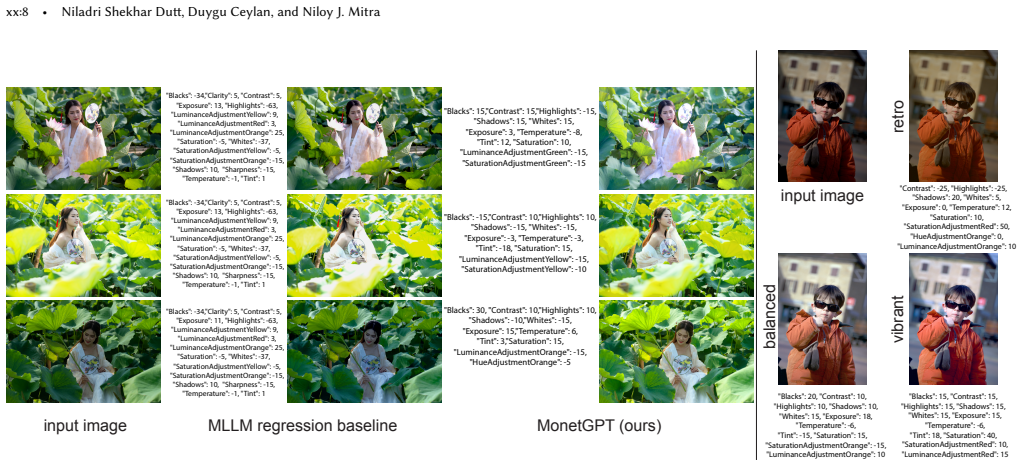
The paper's central claim is that solving carefully designed visual puzzles teaches an MLLM the 'strategic knowledge' of image retouching: identifying visual issues, deciding which procedural operations to apply, and regressing precise parameter values. Three puzzles build this knowledge sequentially: Puzzle A teaches what each operation does by asking the model to identify an operation and its adjustment value given a before-and-after pair; Puzzle B teaches aesthetic judgment by asking the model to order perturbed variants of an expert-edited image and identify the optimal version; Puzzle C teaches planning by asking the model to reconstruct an expert edit from a degraded source, stage by stage, producing an <Adjustment, Issue, Solution> reasoning triplet per operation. The authors show that the resulting fine-tuned model, built on Qwen-VL-7B with DoRA adapters, generalizes to unpaired Adobe5k test images and responds to subtle input variation, while a direct regression baseline overfits and predicts nearly identical values. Reasoning acts as a pathway: the model first writes a plan, then regresses numerical parameters conditioned on that plan, with the staged pipeline feeding each stage's edited image back into the next stage.
Load-bearing premise
The load-bearing premise is that any sufficiently large perturbation of an expert-edited image produces a worse image, so the expert edit is the unique 'optimal' image, and the synthesized puzzles therefore teach genuine aesthetic judgment rather than just inversion of synthetic distortions.
Editorial extensions
If this is right
- If MonetGPT's recipe is correct, MLLM-based photo editing can be non-destructive, resolution-preserving, and explainable by design, providing an alternative to generative editing that can alter identity.
- The puzzle-based fine-tuning strategy may transfer to other procedural graphics tasks where an MLLM must learn to reason about a constrained tool library, such as video color grading or print prepress.
- Operation-aware MLLMs could serve as interactive copilots where users edit a plan at any stage and the model re-derives downstream parameters, an interaction demonstrated by the paper's autoregressive editing.
- Because the system trains only on synthetically perturbed expert edits, it can be adapted to new operation libraries or new expert styles without requiring paired human annotations at scale.
- The quantitative comparison suggests that closed-source auto-enhance systems are not necessarily superior to an open, fine-tuned MLLM pipeline, making it plausible that such an assistant can be deployed fully locally on consumer hardware such as an RTX 4090.
Reading between the lines
- A testable extension would be to evaluate whether the puzzle curriculum transfers to non-portrait domains, since the paper trains on PPR10K (mostly portraits) and the aesthetic prior may not generalize to landscapes or macro photography.
- The paper's implicit claim that 'expert edit equals optimum' could be probed directly by measuring how model performance degrades when the expert edit is itself stylistically unusual or when different experts disagree.
- A more surgical falsification would compare MonetGPT against a variant trained on the same synthetic perturbations but without the reasoning-text grounding, to isolate whether the benefit comes from the puzzles or from the reasoning supervision.
- The staged pipeline's feedback loop (feeding the edited image into the next stage) resembles a model-predictive or closed-loop control scheme; it might be worth testing whether a single forward pass with all parameters predicted at once performs comparably, which would indicate the benefit of stage-wise visual feedback.
Signed reviews
Editorial analysis
A structured set of objections, weighed in public.
Referee Report
Summary. The paper proposes MonetGPT, a multimodal large language model (MLLM) fine-tuned on three synthetic visual puzzles to learn procedural image retouching. Puzzle A teaches operation identification, Puzzle B teaches aesthetic ordering and optimal-level identification, and Puzzle C teaches multi-stage retouching planning. Reasoning text is generated by Gemini 2.0 Flash, grounded on ground-truth operations and adjustment values. At inference, the model produces a staged plan that is executed with a custom Python library of 33 procedural operations. The authors evaluate on 400 held-out Adobe5k images against Exposure, Unpaired, RSFNet, InstructP2P, MGIE, Gemini CoT, Google Photos, and a direct-regression MLLM baseline, and report a user study with 15 novices and 10 experts. They claim that MonetGPT outperforms all open-source baselines on three of four metrics and is comparable to Google Photos.
Significance. If the quantitative claims hold, MonetGPT supplies a novel and practical recipe: a small open MLLM can be made operation-aware for procedural retouching using unpaired synthetic puzzles and limited expert data, while preserving identity, resolution, interpretability, and user override. This is a good fit for TOG, and the paper has concrete strengths: held-out Adobe5k generalization testing, a wide baseline set including a commercial auto-enhance tool, a user study with novice/expert splits, and a commitment to release code, data, and models. The central novelty—puzzle-based operation awareness plus staged procedural planning—is clearly articulated and worth publishing if the evaluation concerns are resolved. The main weaknesses are in the quantitative evaluation protocol (best-of-five expert scoring, no uncertainty measures) and the lack of an ablation that isolates the puzzle-solving contribution; both are fixable with additional experiments.
major comments (4)
- [Section 5, Quantitative Comparison] The headline quantitative claim is not supported by the reporting protocol. The paper states, 'For each sample and metric, we take the highest score achieved against any of these five experts.' Because MonetGPT and the MLLM Regression baseline are trained on expert A from PPR10K, the fair comparison is against expert A's edits or a fixed pre-registered expert, not the maximum over five experts. The best-of-five protocol can inflate scores for methods that produce generic edits by giving each method five chances to match some expert. The reported margins (SSIM 0.90 vs 0.88, LPIPS 0.07 vs 0.08, PSNR 23.75 vs 22.94 over RSFNet) may not persist under a single-expert or average-expert protocol. Please report per-expert scores, a fixed-expert comparison, and the exact aggregation rule for the histogram metric.
- [Section 5, Table 1] No measure of uncertainty is reported for any quantitative result. With 400 test images, the differences between Ours and RSFNet on LPIPS (0.07 vs 0.08) and SSIM (0.90 vs 0.88) may be within sampling variability; no confidence intervals, standard deviations, or significance tests are provided. Similarly, the claim of being 'comparable to Google Photos' is not statistically tested, and the gaps of 2.11 dB in PSNR and 6.97 in histogram intersection could be substantial. Please report bootstrap confidence intervals or per-metric paired tests for all methods.
- [Section 5, ablation ('MLLM Regression')] The comparison with the 'MLLM Regression' baseline does not isolate the effect of puzzle-solving. The regression baseline differs from MonetGPT in two major ways: it is trained on paired expert edits (source and target) rather than the synthetic unpaired puzzles, and it directly regresses parameters rather than being trained on the generated reasoning and staged plans. The observed gain could therefore come from the synthetic perturbation data, the reasoning supervision, or the staged planning, rather than from the puzzles themselves. A proper ablation should train an MLLM on the same synthetic unpaired data and reasoning while ablating the puzzle tasks, or train the regression baseline on the puzzle data, to support the paper's central claim that solving puzzles enhances retouching.
- [Section 4.2 and 4.3, optimality assumption] The design of Puzzles B and C assumes that any perturbation of an expert-edited image IX is worse, and that operations are invertible; the paper states this explicitly. This assumption is load-bearing because, combined with the portrait-heavy PPR10K training set and single expert A, the model may learn to invert the synthetic perturbation process rather than acquire a general aesthetic prior. The Adobe5k evaluation tests transfer to other expert edits but does not separate these two hypotheses. I request a concrete diagnostic: evaluate the trained model on inputs whose edits were not generated by the same perturbation procedure, or compare the model's performance on images perturbed by unseen magnitudes or distributions, to demonstrate that the learned prior is not merely an inverse of the puzzle generator.
minor comments (5)
- [Section 5, Perceptual User Study] The number of test images is inconsistent: the qualitative comparison paragraph says '15 source images' and 'a total of 200 questions', while the perceptual user study paragraph says the study was 'on 50 images from Adobe5k and Reddit'. Please clarify the actual number of images and how images map to questions.
- [Section 5, Quantitative Comparison] The sentence 'except for histogram intersections, which consider all experts' is ambiguous: does 'consider all experts' mean averaging the histogram metric over five experts or taking the maximum? Specify the exact aggregation.
- [Section 4.4] The phrase 'regress precise adjustment values regress from high-level reasoning' contains a duplicated verb; please revise the sentence.
- [Figure 1 caption] The caption reads 'orange saturation + 2 5', which should presumably be '+25'; please also check for similar spacing or typographical issues in other figure text.
- [Table 1] The table lists no sample size or measures of spread; at minimum add n and standard deviations or confidence intervals to each metric.
Circularity Check
No significant circularity: MonetGPT's puzzle training uses known synthetic labels and is validated on held-out expert edits.
full rationale
MonetGPT's derivation chain is self-contained against external benchmarks. The puzzle datasets (Section 4) are synthesized by applying known operations with known parameter values to expert-edited images, so the ground-truth labels for Puzzle A (operation and value), Puzzle B (ordering and optimal image), and Puzzle C (edit plan) are known by construction; the Gemini-generated reasoning is answer-conditioned but functions only as auxiliary supervision, and at inference the model receives only the source image. The central quantitative claim (Section 5, Table 1) is evaluated on 400 held-out Adobe5k images against five external expert edits, so the predicted edit sequences are not compared to the training labels and no fitted value is renamed as a prediction. The paper's assumption that perturbing an expert edit degrades quality (Sections 4.2-4.3) is a substantive modeling assumption, not a circular definition, because the final retouching quality is validated against held-out expert edits rather than against the perturbation construction. The only self-citations (e.g., FlairGPT in Related Work) are contextual and not load-bearing for any claim. The best-of-five expert scoring protocol could inflate metrics, but that is an evaluation-validity concern, not circularity. No step reduces by construction to its inputs.
Assumptions & free parameters
free parameters (2)
- Perturbation value range in puzzle generation =
[-100, +100]
- Number of adjusted variants in Puzzle B =
four
assumptions (5)
- domain assumption Any sufficiently large perturbation of an expert-edited image results in a worse image
- domain assumption The image operations are invertible
- domain assumption Adjustment values follow a perceptually linear scale in [-100, +100]
- domain assumption Matching any of the five Adobe5k expert edits is a desirable outcome
- domain assumption The three-stage ordering (lighting, color/temperature, selective color) matches expert workflows
Cite this review
Pith. "Pith review of MonetGPT: Solving Puzzles Enhances MLLMs' Image Retouching Skills." pith.science (2026). https://pith.science/paper/ZYM2DP3R
@misc{pith2026250506176,
  author       = {Pith},
  title        = {Pith review of: MonetGPT: Solving Puzzles Enhances MLLMs' Image Retouching Skills},
  year         = {2026},
  howpublished = {\url{https://pith.science/paper/ZYM2DP3R}},
  note         = {Machine review of arXiv:2505.06176}
}
read the original abstract
Retouching is an essential task in post-manipulation of raw photographs. Generative editing, guided by text or strokes, provides a new tool accessible to users but can easily change the identity of the original objects in unacceptable and unpredictable ways. In contrast, although traditional procedural edits, as commonly supported by photoediting tools (e.g., Gimp, Lightroom), are conservative, they are still preferred by professionals. Unfortunately, professional quality retouching involves many individual procedural editing operations that is challenging to plan for most novices. In this paper, we ask if a multimodal large language model (MLLM) can be taught to critique raw photographs, suggest suitable remedies, and finally realize them with a given set of pre-authored procedural image operations. We demonstrate that MLLMs can be first made aware of the underlying image processing operations, by training them to solve specially designed visual puzzles. Subsequently, such an operation-aware MLLM can both plan and propose edit sequences. To facilitate training, given a set of expert-edited photos, we synthesize a reasoning dataset by procedurally manipulating the expert edits and then grounding a pretrained LLM on the visual adjustments, to synthesize reasoning for finetuning. The proposed retouching operations are, by construction, understandable by the users, preserve object details and resolution, and can be optionally overridden. We evaluate our setup on a variety of test examples and show advantages, in terms of explainability and identity preservation, over existing generative and other procedural alternatives. Code, data, models, and supplementary results can be found via our project website at https://monetgpt.github.io.
Figures


Figures from the paper (7 more)




Reference graph
Works this paper leans on
-
[3]
InProceedings of the IEEE/CVF International Conference on Computer Vision
Rsfnet: A white-box image retouching approach using region-specific color filters. InProceedings of the IEEE/CVF International Conference on Computer Vision. 12160–12169. Xichen Pan, Li Dong, Shaohan Huang, Zhiliang Peng, Wenhu Chen, and Furu Wei. 2023. Kosmos-G: Generating Images in Context with Multimodal Large Language Models. arXiv preprint arXiv:2310...
arXiv 2023
-
[5]
Llama: Open and efficient foundation language models.arXiv preprint arXiv:2302.13971(2023). Peng Wang, Shuai Bai, Sinan Tan, Shijie Wang, Zhihao Fan, Jinze Bai, Keqin Chen, Xuejing Liu, Jialin Wang, Wenbin Ge, Yang Fan, Kai Dang, Mengfei Du, Xuancheng Ren, Rui Men, Dayiheng Liu, Chang Zhou, Jingren Zhou, and Junyang Lin. 2024a. Qwen2-VL: Enhancing Vision-...
arXiv 2023
-
[2021]
InProceedings of the IEEE/CVF Conference on Computer Vision and Pattern Recognition (CVPR)
Learning by Planning: Language-Guided Global Image Editing. InProceedings of the IEEE/CVF Conference on Computer Vision and Pattern Recognition (CVPR). 13590–13599. Gemini Team. 2024. Gemini 1.5: Unlocking multimodal understanding across millions of tokens of context. arXiv:2403.05530 [cs.CL] https://arxiv.org/abs/2403.05530 Hugo Touvron, Thibaut Lavril, ...
arXiv 2024
-
[2023]
MasaCtrl: Tuning-Free Mutual Self-Attention Control for Consistent Image Synthesis and Editing. InICCV. 22503–22513. https://api.semanticscholar.org/ CorpusID:258179432 Qifeng Chen, Jia Xu, and Vladlen Koltun. 2017. Fast Image Processing With Fully- Convolutional Networks. InProceedings of the IEEE International Conference on Computer Vision (ICCV). Weixi...
work page Pith review arXiv 2024
-
[2024]
Tim Brooks, Aleksander Holynski, and Alexei A
Open-Universe Indoor Scene Generation using LLM Program Synthesis and Uncurated Object Databases.arXiv preprint arXiv:2403.09675(2024). Tim Brooks, Aleksander Holynski, and Alexei A. Efros. 2022. InstructPix2Pix: Learn- ing to Follow Image Editing Instructions. InCVPR. 18392–18402. https://api. semanticscholar.org/CorpusID:253581213 Tim Brooks, Aleksander...
arXiv 2024
Reviewed August 15, 2026 · model on record in the stance chip above.
Discussion (0). Continue with ORCID to comment.