REVIEW 4 major objections 7 minor 44 references
ABE: A Unified Framework for Robust and Faithful Attribution-Based Explainability
T0 review · 4 major / 7 minor · reviewed 2026-08-16 · deepseek-v4-flash
Pith's one-line read The paper claims that any user-supplied update rule inside its Fundamental Attribution Method loop satisfies Completeness and Sensitivity.
desk verdict A practical XAI toolkit whose central theoretical guarantee is overstated: the completeness proof only holds in the continuous limit, not for the discrete algorithm actually implemented. read the letter →
The pith
A machine-rendered reading of the paper's core claim, the machinery that carries it, and where it could break.
The reading
What carries the argument
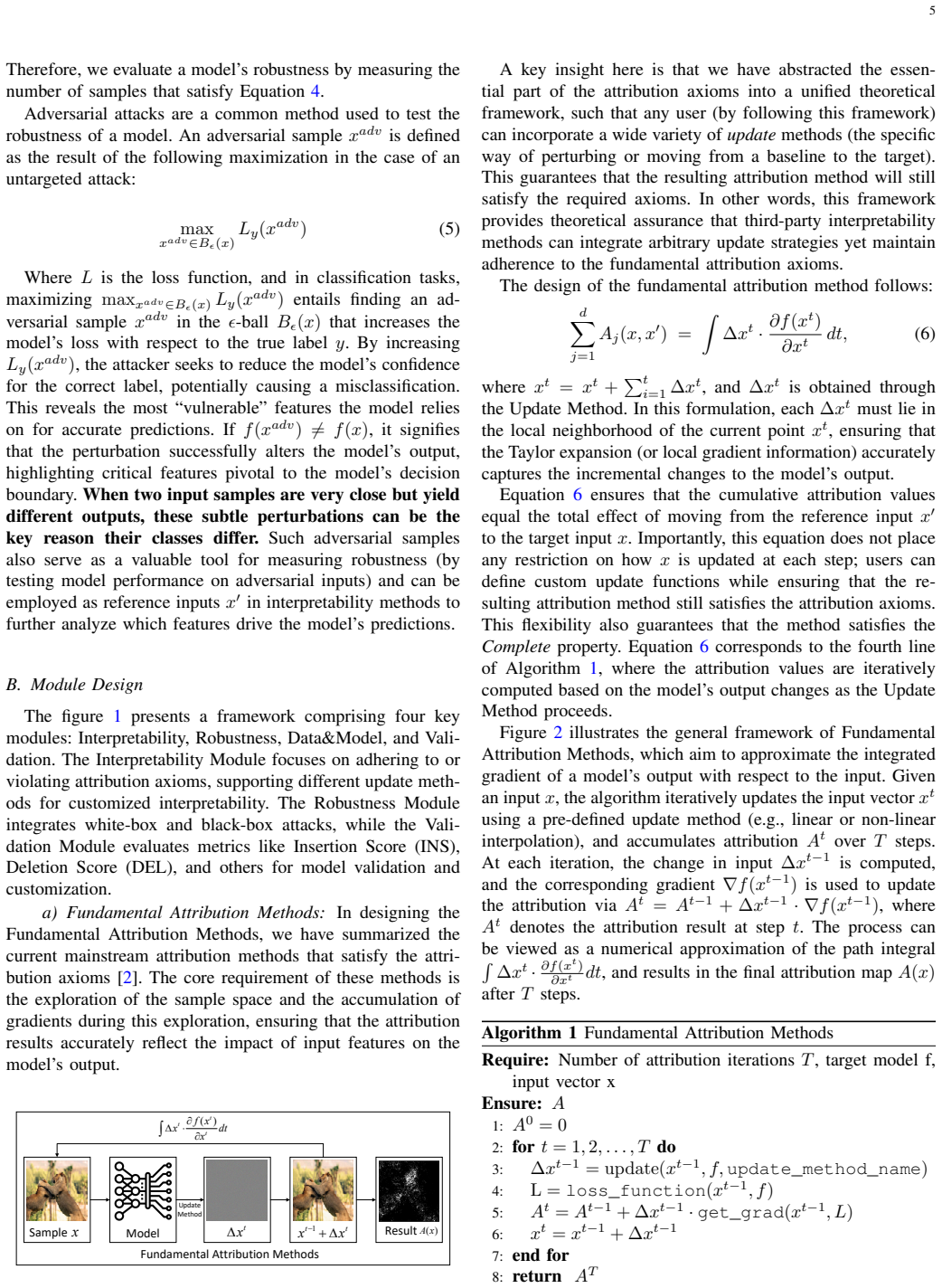
The central object is the Fundamental Attribution Method, an iterative loop that unifies attribution algorithms. It maintains an attribution accumulator $A_t$ and an input state $x_t$; at each step an update rule produces $\Delta x_{t-1}$, the gradient $\nabla f(x_{t-1})$ is dotted into the accumulator, and the state advances. Equation 6 is the continuum form of this loop, and the proof machinery is the first-order Taylor identity in Eq. 7 plus the telescoping cancellation in Eq. 9. A second piece of machinery is the $\ell^\infty$ sign-gradient argument, which shows that $\epsilon\,\mathrm{sign}(\nabla_x f(x))$ is the step of fixed per-feature size that maximizes the first-order output change, justifying adversarial attacks as recommended update rules.
What would settle it
Run Algorithm 1 on the scalar model $f(x)=x^2$ with baseline $x'=0$, target $x=1$, and one update step $\Delta x=1$. The loop returns $A = \Delta x \cdot f'(0) = 0$, while Completeness demands $A = f(1)-f(0) = 1$. Reproducing that mismatch, or sweeping step counts on ImageNet and plotting the residual $|\sum_j A_j - (f(x)-f(x'))|$, would settle where the claimed universal guarantee actually holds.
Extended reading notes
Core claim
The central discovery is a reduction: path-based attribution methods can be expressed as one arithmetic identity. Equation 6 defines the sum of feature attributions as $\sum_{j=1}^{d} A_j(x,x') = \int \Delta x_t \cdot \frac{\partial f(x_t)}{\partial x_t}\,dt$, where $\Delta x_t$ comes from any user-supplied update method, and Algorithm 1 computes the same quantity by accumulating $\Delta x_{t-1}\cdot \nabla f(x_{t-1})$. The authors argue that the terms telescope through a first-order Taylor expansion, so the attribution sum equals $f(x)-f(x')$, which is the Completeness property, and any change in output forces at least one nonzero feature attribution, which is Sensitivity. Implementation Invariance follows because only input-output gradients are accumulated, not internal architecture. The framework then treats this loop as the shared skeleton of 17 implemented methods, with update rules ranging from linear baseline interpolation to adversarial attack paths.
Load-bearing premise
The proof assumes the first-order Taylor expansion in Eq. 7 is exact at every finite update step, so the discrete accumulation in Algorithm 1 equals the continuous path integral in Eq. 6; for a general nonlinear model with large update steps, leftover second-order terms can break the equality and break Completeness.
Editorial extensions
If this is right
- If the proof is right, a researcher adding a new attribution method to ABE only needs to supply an update rule; Completeness and Sensitivity are inherited from the loop.
- The robustness module doubles as an attack library and an attribution generator, so the same adversarial perturbation used to test a model can define the explanation path for that model.
- Axiom-compliant methods such as ISA, AttEXplore, MFABA, AGI, BIG, IG, EG, and FIG can be compared under a common validation interface, while faster non-axiomatic methods remain available for resource-constrained use.
- The framework's use of the impossibility theorems implies that adversarially updated attributions, because they violate the Linear property, can outperform random feature selection and avoid the triviality that affects linear-complete attribution rules.
- Multimodal and object-detection tasks inherit the same loop through task-specific wrappers and metrics such as ICD/ICI, TCD/TCI, INS/DEL, and FPS, making attribution axioms portable across modalities.
Reading between the lines
- The universal guarantee is strictly about the continuum integral; for finite step counts the implementation inherits only an approximate Completeness, so the framework's practical promise would be stronger if it exposed a step-size or residual diagnostic.
- The path-agnostic formulation suggests treating the update rule as a design object: one could learn or search over update paths that maximize insertion score while checking the completeness residual, effectively turning attack methods into tunable explanation generators.
- Because the loop absorbs any update rule, the same machinery could extend to non-gradient update directions by substituting finite-difference gradient estimates, at the cost of approximate axioms.
- If adversarial update rules really are axiom-compliant, then robustness evaluation and explanation generation become the same computation, which would tie attack-transferability research to explanation-consistency research more tightly.
Signed reviews
Editorial analysis
A structured set of objections, weighed in public.
Referee Report
Summary. The paper proposes ABE, a PyTorch-based framework for attribution-based explainability, with four modules (Interpretability, Robustness, Validation, and Data & Model). Its central theoretical contribution is a class of Fundamental Attribution Methods formalized by Eq. (6) as a path integral over arbitrary update trajectories, with the claim that any user-specified update strategy yields an attribution method satisfying Completeness, Sensitivity, and Implementation Invariance. The paper also reports benchmarks of 17 attribution methods on image, text, multimodal, and object-detection tasks, and studies how different adversarial update methods affect AttEXplore's insertion/deletion scores. The authors provide an open-source implementation at https://github.com/LMBTough/ABE-XAI.
Significance. If the theoretical guarantee held, the unifying formulation would be genuinely useful: it would let practitioners plug a wide range of adversarial update methods into an axiom-preserving attribution pipeline, and the framework's modular design and task coverage (image, text, multimodal, object detection) are valuable for the interpretability community. The empirical comparison of many attribution methods across models and the study of different update methods in Figure 3 are useful resources, and the released code supports reproducibility. However, the central axiom-preservation proof is not valid as written, and the experimental sections do not directly validate the framework's claimed advantages over existing libraries such as InterpretDL and OmniXAI.
major comments (4)
- [Section III-B0a and III-B0b, Eq. (7)] Eq. (7) treats the first-order Taylor expansion f(x_t) = f(x_{t-1}) + ∇f(x_{t-1})·(x_t - x_{t-1}) as an exact equality for finite update steps. For any nonlinear model and any nonzero step, this is false, so the telescoping argument in Eqs. (8)-(10) does not establish f(x_T) - f(x_0) = Σ_j A_j. Algorithm 1 computes a left Riemann sum approximating the continuous path integral in Eq. (6), but no step-size condition, number-of-steps bound, or convergence requirement is given. Since the guarantee that arbitrary update methods preserve the axioms is the paper's central theoretical claim, the proof must be repaired: either restrict to models that are affine along each update step, or state the result as an approximation with an explicit error bound and a procedure for choosing T accordingly.
- [Section III-B0b, Sensitivity proof] The proof of the Sensitivity axiom is also invalid. From f(x_T) ≠ f(x_0) and Σ_j A_j = f(x_T) - f(x_0), at most one can conclude that at least one feature has a nonzero attribution; one cannot conclude that every feature j with x_j ≠ x'_j receives a nonzero attribution as Eq. (1) requires. Furthermore, Eq. (1) is stronger than the standard Sensitivity axiom and is violated by simple models, e.g., f(x) = x_1^2 with an irrelevant feature x_2 differing. The authors must state precisely which sensitivity property they prove and align the statement of the axiom with the proof.
- [Section III-B0d, Eq. (11) and impossibility discussion] The claim that adversarial update methods "guarantee that interpretability methods will avoid the issues of impossibility theorems" because they "inherently do not satisfy the Linear" property is unsupported. Eq. (11) is a first-order approximation, not an exact identity, and failing one axiom in an impossibility theorem does not by itself show that the other axioms can be simultaneously satisfied. Additionally, the statement that "any update method can satisfy the attribution axioms" is too broad: update methods that do not define a continuous path from the baseline to the input, or that leave the differentiability region, are not covered by Eq. (6).
- [Section III-B0c, Implementation Invariance proof] The proof of Implementation Invariance is only a restatement: the sentence "by accumulating the gradients at each step, the final attribution results will remain consistent" does not demonstrate invariance for adversarial update methods whose update rule may depend on model internals beyond the input-output mapping. For path methods based only on gradients of the function, invariance follows from the gradient theorem, but here the update methods (e.g., those using attention maps or intermediate representations) are not proved to be function-only. This needs a statement of the conditions under which the update method itself is implementation invariant.
minor comments (7)
- [Section III-B, Eq. (6)] The definition x_t = x_t + Σ_{i=1}^t Δx_i is circular and dimensionally inconsistent; it should read x_t = x' + Σ_{i=1}^t Δx_i. The integral in Eq. (6) also lacks a rigorous definition of the path parameterization.
- [Algorithm 1] Algorithm 1 does not take a baseline input x' as an argument and does not specify how x_0 is chosen for methods that do not use baselines, making the correspondence between the algorithm and Eq. (6) ambiguous.
- [Table II and Table III] The check and cross symbols used in Tables II and III do not render in the text; please replace them with explicit ✓/✗ or textual labels so the reader can determine which axioms each method satisfies.
- [Table V and Figure 3] Table V contains several concatenated numbers without separators (e.g., "0.3890.033"), and Figure 3's legend and axis labels are difficult to read; please clean up the formatting.
- [Section III-B0b and III-B0d] There are typos: "will will" in Section III-B0d and "thereby satisfying the Sensitivity axiom Complete property" in Section III-B0b; both should be corrected.
- [References] References [8] and [15] are duplicates of the same SHAP paper, and references [29] and [32] are the same ICML paper; please consolidate the duplicates.
- [Section IV] The experiments benchmark attribution methods, but they do not compare the ABE framework against InterpretDL, OmniXAI, or Captum on usability, scalability, or integration effort; such a comparison would substantiate the framework-level claims in the introduction and Table I.
Circularity Check
Completeness guarantee is largely constructed into the path-integral definition, while the finite-step proof assumes the exact Taylor equality it needs.
-
self definitional
[Section III-B0a (Eq. 6) and Section III-B0b (Eqs. 7-10)]
"Equation 6 ensures that the cumulative attribution values equal the total effect of moving from the reference input x′ to the target input x. Importantly, this equation does not place any restriction on how x is updated at each step; users can define custom update functions while ensuring that the resulting attribution method still satisfies the attribution axioms. ... Then, for each t: f(xt)=f(xt−1)+ ∂f(xt−1)/∂xt−1 (xt−xt−1). (7)"
Algorithm 1's accumulation step is A_t = A_{t-1} + Δx_{t-1}·∇f(x_{t-1}), so Completeness is exactly the statement that the sum of these gradient-dot-increment terms equals f(x_T)-f(x_0). Equation 6 is the design equation that defines the method's sum as the path integral ∫∇f·dx, and by the gradient theorem this integral is f(x_T)-f(x_0). The proof then uses Eq. 7 to assert that each finite output difference f(x_t)-f(x_{t-1}) equals the gradient-dot-step term that is accumulated. Summing Eq. 7 gives Eq. 10, which is precisely the Completeness equation. Thus the guarantee is built into the definition/assumption: Completeness holds because A is defined as a gradient path integral, and Eq. 7 assumes the incremental equality the proof needs.
full rationale
The self-citations to MFABA, AttEXplore, LA, and ISA are to peer-reviewed prior work and appear as implemented methods or baseline comparisons, not as the justification for the axiom guarantee; they are not load-bearing, so they do not make the paper circular. The experimental evaluation uses external benchmarks (ImageNet, IMDb, Yelp, COCO, etc.), which are independent of the paper's fitted values. The central theoretical guarantee is, however, definitionally flavored: the Fundamental Attribution Method is defined by Eq. 6 as a path integral of gradients, so Completeness is automatic in the continuous formulation, and the proof's Eq. 7 assumes the finite-step output difference equals the accumulated gradient-dot-step term, which is the same property being established. This is a mild self-definitional pattern rather than a fitted-parameter tautology or a self-citation chain, so it warrants a low score. The stronger skeptical concern that Eq. 7 is exact only for affine models and that Algorithm 1 is a finite approximation is a correctness and convergence issue, not circularity; it would require step-size or error-bound conditions, which the paper does not provide.
Assumptions & free parameters
free parameters (2)
- T
- epsilon
assumptions (4)
- standard math The target model f is differentiable on the input space, so all gradients and path integrals are well defined.
- ad hoc to paper The first-order Taylor expansion in Eq 7 is exact for finite update steps.
- domain assumption The axioms in Section III-A are the ones relevant to the impossibility theorems [26].
- ad hoc to paper Adversarial update methods inherently fail the Linear property.
Cite this review
Pith. "Pith review of ABE: A Unified Framework for Robust and Faithful Attribution-Based Explainability." pith.science (2026). https://pith.science/paper/NBYYI547
@misc{pith2026250506258,
  author       = {Pith},
  title        = {Pith review of: ABE: A Unified Framework for Robust and Faithful Attribution-Based Explainability},
  year         = {2026},
  howpublished = {\url{https://pith.science/paper/NBYYI547}},
  note         = {Machine review of arXiv:2505.06258}
}
read the original abstract
Attribution algorithms are essential for enhancing the interpretability and trustworthiness of deep learning models by identifying key features driving model decisions. Existing frameworks, such as InterpretDL and OmniXAI, integrate multiple attribution methods but suffer from scalability limitations, high coupling, theoretical constraints, and lack of user-friendly implementations, hindering neural network transparency and interoperability. To address these challenges, we propose Attribution-Based Explainability (ABE), a unified framework that formalizes Fundamental Attribution Methods and integrates state-of-the-art attribution algorithms while ensuring compliance with attribution axioms. ABE enables researchers to develop novel attribution techniques and enhances interpretability through four customizable modules: Robustness, Interpretability, Validation, and Data & Model. This framework provides a scalable, extensible foundation for advancing attribution-based explainability and fostering transparent AI systems. Our code is available at: https://github.com/LMBTough/ABE-XAI.
Figures


Reference graph
Works this paper leans on
-
[1]
Evaluating the quality of machine learning explanations: A survey on methods and metrics,
J. Zhou, A. H. Gandomi, F. Chen, and A. Holzinger, “Evaluating the quality of machine learning explanations: A survey on methods and metrics,”Electronics, vol. 10, no. 5, p. 593, 2021
work page 2021
-
[2]
Axiomatic attribution for deep networks,
M. Sundararajan, A. Taly, and Q. Yan, “Axiomatic attribution for deep networks,” inInternational conference on machine learning, pp. 3319– 3328, PMLR, 2017
2017
-
[3]
Robust models are more interpretable because attributions look normal,
Z. Wang, M. Fredrikson, and A. Datta, “Robust models are more interpretable because attributions look normal,”arXiv preprint arXiv:2103.11257, 2021
arXiv 2021
-
[4]
Grad-cam: Visual explanations from deep networks via gradient-based localization,
R. R. Selvaraju, M. Cogswell, A. Das, R. Vedantam, D. Parikh, and D. Batra, “Grad-cam: Visual explanations from deep networks via gradient-based localization,” inProceedings of the IEEE international conference on computer vision, pp. 618–626, 2017
work page 2017
-
[5]
Explaining deep neural network models with adversarial gradient integration,
D. Pan, X. Li, and D. Zhu, “Explaining deep neural network models with adversarial gradient integration,” inThirtieth International Joint Conference on Artificial Intelligence (IJCAI), 2021
work page 2021
-
[6]
Mfaba: A more faithful and accelerated boundary-based attribution method for deep neural networks,
Z. Zhu, H. Chen, J. Zhang, X. Wang, Z. Jin, M. Xue, D. Zhu, and K.- K. R. Choo, “Mfaba: A more faithful and accelerated boundary-based attribution method for deep neural networks,” inProceedings of the AAAI Conference on Artificial Intelligence, vol. 38, pp. 17228–17236, 2024. 12
work page 2024
-
[7]
Attexplore: Attribution for explanation with model parameters exploration,
Z. Zhu, H. Chen, J. Zhang, X. Wang, Z. Jin, J. Xue, and F. D. Salim, “Attexplore: Attribution for explanation with model parameters exploration,” inThe Twelfth International Conference on Learning Representations, 2024
work page 2024
-
[8]
A unified approach to interpreting model predictions,
S. M. Lundberg and S.-I. Lee, “A unified approach to interpreting model predictions,” inAdvances in Neural Information Processing Systems 30 (I. Guyon, U. V . Luxburg, S. Bengio, H. Wallach, R. Fergus, S. Vish- wanathan, and R. Garnett, eds.), pp. 4765–4774, Curran Associates, Inc., 2017
work page 2017
Show all 44 references
-
[9]
Omnixai: A library for explainable ai,
W. Yang, H. Le, T. Laud, S. Savarese, and S. C. Hoi, “Omnixai: A library for explainable ai,”arXiv preprint arXiv:2206.01612, 2022
2022 arXiv
-
[10]
Interpretdl: explaining deep models in paddlepaddle,
X. Li, H. Xiong, X. Li, X. Wu, Z. Chen, and D. Dou, “Interpretdl: explaining deep models in paddlepaddle,”Journal of Machine Learning Research, vol. 23, no. 197, pp. 1–6, 2022
2022
-
[11]
Deep inside convolutional networks: Visualising image classification models and saliency maps,
K. Simonyan, A. Vedaldi, and A. Zisserman, “Deep inside convolutional networks: Visualising image classification models and saliency maps,” arXiv preprint arXiv:1312.6034, 2013
2013 arXiv
-
[12]
Smoothgrad: removing noise by adding noise,
D. Smilkov, N. Thorat, B. Kim, F. Vi ´egas, and M. Wattenberg, “Smoothgrad: removing noise by adding noise,”arXiv preprint arXiv:1706.03825, 2017
2017 arXiv
-
[13]
Layer-wise relevance propagation for neural networks with local renor- malization layers,
A. Binder, G. Montavon, S. Lapuschkin, K.-R. M ¨uller, and W. Samek, “Layer-wise relevance propagation for neural networks with local renor- malization layers,” inArtificial Neural Networks and Machine Learning– ICANN 2016: 25th International Conference on Artificial Neural Ne...
2016
-
[14]
Learning important features through propagating activation differences,
A. Shrikumar, P. Greenside, and A. Kundaje, “Learning important features through propagating activation differences,” inInternational conference on machine learning, pp. 3145–3153, PMLR, 2017
2017
-
[15]
A unified approach to interpreting model predictions,
S. M. Lundberg and S.-I. Lee, “A unified approach to interpreting model predictions,”Advances in neural information processing systems, vol. 30, 2017
2017
-
[16]
” why should i trust you?
M. T. Ribeiro, S. Singh, and C. Guestrin, “” why should i trust you?” explaining the predictions of any classifier,” inProceedings of the 22nd ACM SIGKDD international conference on knowledge discovery and data mining, pp. 1135–1144, 2016
2016
-
[17]
Captum: A unified and generic model inter- pretability library for pytorch,
N. Kokhlikyan, V . Miglani, M. Martin, E. Wang, B. Alsallakh, J. Reynolds, A. Melnikov, N. Kliushkina, C. Araya, S. Yan, and O. Reblitz-Richardson, “Captum: A unified and generic model inter- pretability library for pytorch,” 2020
2020
-
[18]
dattri: A library for efficient data attribution,
J. Deng, T.-W. Li, S. Zhang, S. Liu, Y . Pan, H. Huang, X. Wang, P. Hu, X. Zhang, and J. W. Ma, “dattri: A library for efficient data attribution,” inAdvances in Neural Information Processing Systems, vol. 37, 2024
2024
-
[19]
Interpretml: A uni- fied framework for machine learning interpretability,
H. Nori, S. Jenkins, P. Koch, and R. Caruana, “Interpretml: A uni- fied framework for machine learning interpretability,”arXiv preprint arXiv:1909.09223, 2019
1909 arXiv
-
[20]
Interpretdl: Explaining deep models in paddlepaddle,
X. Li, H. Xiong, X. Li, X. Wu, Z. Chen, and D. Dou, “Interpretdl: Explaining deep models in paddlepaddle,”Journal of Machine Learning Research, vol. 23, no. 197, pp. 1–6, 2022
2022
-
[21]
Omnixai: A library for explainable ai,
W. Yang, H. Le, S. Savarese, and S. Hoi, “Omnixai: A library for explainable ai,” 2022
2022
-
[22]
Improving performance of deep learning models with axiomatic attribution priors and expected gradients,
G. Erion, J. D. Janizek, P. Sturmfels, S. M. Lundberg, and S.-I. Lee, “Improving performance of deep learning models with axiomatic attribution priors and expected gradients,”Nature machine intelligence, vol. 3, no. 7, pp. 620–631, 2021
2021
-
[23]
Fast axiomatic attribution for neural networks,
R. Hesse, S. Schaub-Meyer, and S. Roth, “Fast axiomatic attribution for neural networks,”Advances in Neural Information Processing Systems, vol. 34, pp. 19513–19524, 2021
2021
-
[24]
Guided integrated gradients: An adaptive path method for removing noise,
A. Kapishnikov, S. Venugopalan, B. Avci, B. Wedin, M. Terry, and T. Bolukbasi, “Guided integrated gradients: An adaptive path method for removing noise,” inProceedings of the IEEE/CVF conference on computer vision and pattern recognition, pp. 5050–5058, 2021
2021
-
[25]
Adversarial examples in the physical world,
A. Kurakin, I. J. Goodfellow, and S. Bengio, “Adversarial examples in the physical world,” inArtificial intelligence safety and security, pp. 99– 112, Chapman and Hall/CRC, 2018
2018
-
[26]
Impossibility theo- rems for feature attribution,
B. Bilodeau, N. Jaques, P. W. Koh, and B. Kim, “Impossibility theo- rems for feature attribution,”Proceedings of the National Academy of Sciences, vol. 121, no. 2, p. e2304406120, 2024
2024
-
[27]
Rise: Randomized input sampling for explanation of black-box models,
V . Petsiuk, A. Das, and K. Saenko, “Rise: Randomized input sampling for explanation of black-box models,” inProceedings of the British Machine Vision Conference (BMVC), 2018
2018
-
[28]
Enhancing model interpretability with local attribution over global exploration,
Z. Zhu, Z. Jin, J. Zhang, and H. Chen, “Enhancing model interpretability with local attribution over global exploration,” inProceedings of the 32nd ACM International Conference on Multimedia, pp. 5347–5355, 2024
2024
-
[29]
Iterative search attribution for deep neural networks,
Z. Zhu, H. Chen, X. Wang, J. Zhang, Z. Jin, J. Xue, and J. Shen, “Iterative search attribution for deep neural networks,” inForty-first International Conference on Machine Learning
-
[30]
Generic attention-model explain- ability for interpreting bi-modal and encoder-decoder transformers,
H. Chefer, S. Gur, and L. Wolf, “Generic attention-model explain- ability for interpreting bi-modal and encoder-decoder transformers,” in Proceedings of the IEEE/CVF International Conference on Computer Vision, pp. 397–406, 2021
2021
-
[31]
Visual explanations of image-text representations via multi-modal information bottleneck attri- bution,
Y . Wang, T. G. J. Rudner, and A. G. Wilson, “Visual explanations of image-text representations via multi-modal information bottleneck attri- bution,” inThirty-seventh Conference on Neural Information Processing Systems, 2023
2023
-
[32]
Iterative search attribution for deep neural networks,
Z. Zhu, H. Chen, X. Wang, J. Zhang, Z. Jin, J. Xue, and J. Shen, “Iterative search attribution for deep neural networks,” inForty-first International Conference on Machine Learning, 2024
2024
-
[33]
Rethinking the inception architecture for computer vision,
C. Szegedy, V . Vanhoucke, S. Ioffe, J. Shlens, and Z. Wojna, “Rethinking the inception architecture for computer vision,” inProceedings of the IEEE conference on computer vision and pattern recognition, pp. 2818– 2826, 2016
2016
-
[34]
Deep residual learning for image recognition,
K. He, X. Zhang, S. Ren, and J. Sun, “Deep residual learning for image recognition,” inProceedings of the IEEE conference on computer vision and pattern recognition, pp. 770–778, 2016
2016
-
[35]
Very deep convolutional networks for large-scale image recognition,
K. Simonyan and A. Zisserman, “Very deep convolutional networks for large-scale image recognition,”arXiv preprint arXiv:1409.1556, 2014
2014 arXiv
-
[36]
An image is worth 16x16 words: Transformers for image recognition at scale,
A. Dosovitskiy, “An image is worth 16x16 words: Transformers for image recognition at scale,”arXiv preprint arXiv:2010.11929, 2020
2010 arXiv
-
[37]
ImageNet Large Scale Visual Recognition Challenge,
O. Russakovsky, J. Deng, H. Su, J. Krause, S. Satheesh, S. Ma, Z. Huang, A. Karpathy, A. Khosla, M. Bernstein, A. C. Berg, and L. Fei-Fei, “ImageNet Large Scale Visual Recognition Challenge,” International Journal of Computer Vision (IJCV), vol. 115, no. 3, pp. 211–252, 2015
2015
-
[38]
A sensitivity analysis of (and practitioners’ guide to) convolutional neural networks for sentence classification,
Y . Zhang and B. Wallace, “A sensitivity analysis of (and practitioners’ guide to) convolutional neural networks for sentence classification,” arXiv preprint arXiv:1510.03820, 2015
2015 arXiv
-
[39]
Empirical evaluation of gated recurrent neural networks on sequence modeling,
J. Chung, C. Gulcehre, K. Cho, and Y . Bengio, “Empirical evaluation of gated recurrent neural networks on sequence modeling,”arXiv preprint arXiv:1412.3555, 2014
2014 arXiv
-
[40]
Learning transferable visual models from natural language supervision,
A. Radford, J. W. Kim, C. Hallacy, A. Ramesh, G. Goh, S. Agarwal, G. Sastry, A. Askell, P. Mishkin, J. Clark,et al., “Learning transferable visual models from natural language supervision,” inInternational conference on machine learning, pp. 8748–8763, PMLR, 2021
2021
-
[41]
Conceptual captions: A cleaned, hypernymed, image alt-text dataset for automatic image captioning,
P. Sharma, N. Ding, S. Goodman, and R. Soricut, “Conceptual captions: A cleaned, hypernymed, image alt-text dataset for automatic image captioning,” inProceedings of ACL, 2018
2018
-
[42]
Framing image description as a ranking task: Data, models and evaluation metrics,
M. Hodosh, P. Young, and J. Hockenmaier, “Framing image description as a ranking task: Data, models and evaluation metrics,”Journal of Artificial Intelligence Research, vol. 47, pp. 853–899, 2013
2013
-
[43]
Focal loss for dense object detection,
T. Lin, “Focal loss for dense object detection,”arXiv preprint arXiv:1708.02002, 2017
2017 arXiv
-
[44]
Microsoft coco: Common objects in context,
T.-Y . Lin, M. Maire, S. Belongie, J. Hays, P. Perona, D. Ramanan, P. Doll ´ar, and C. L. Zitnick, “Microsoft coco: Common objects in context,” inComputer Vision–ECCV 2014: 13th European Conference, Zurich, Switzerland, September 6-12, 2014, Proceedings, Part V 13, pp. 740–755...
2014
Reviewed August 16, 2026 · model on record in the stance chip above.
Discussion (0). Continue with ORCID to comment.