REVIEW 4 major objections 5 minor 52 references
Human in the Latent Loop (HILL): Interactively Guiding Model Training Through Human Intuition
T0 review · 4 major / 5 minor · reviewed 2026-08-15 · deepseek-v4-flash
Pith's one-line read Human-guided edits to a model's latent space, injected as a knowledge-distillation-style loss, improve accuracy and convergence without sacrificing generalization.
desk verdict Fresh combination of online latent-space editing with a KD-style guidance loss, but the loss is never specified and the only quantitative evidence comes from a validation set participants were actively tuning against. read the letter →
The pith
A machine-rendered reading of the paper's core claim, the machinery that carries it, and where it could break.
The reading
What carries the argument
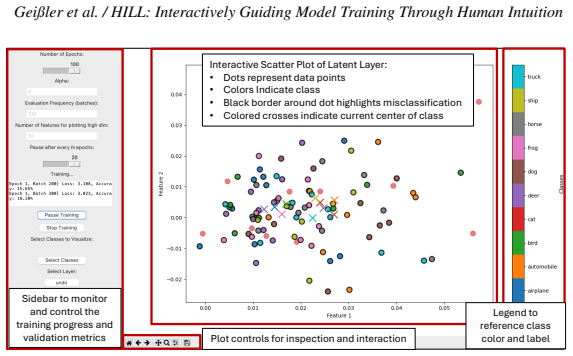
The load-bearing object is the human-as-teacher loss $\mathcal{L}_{\text{human}}$, a geometric loss computed from class center movement, class spread, and cluster separation between pairs of classes, normalized by the number of pairwise comparisons $K$. It is added to cross-entropy as $\mathcal{L}_{\text{global}} = \mathcal{L}_{CE} + \alpha \mathcal{L}_{\text{human}} + \lambda |1 - \text{scale}_{\text{model}}|$, with the scale term keeping feature magnitudes stable. A frozen deterministic fully-connected projection gives users a stable 2D view of the latent space, so a drag gesture maps directly onto the loss targets. Together these pieces turn human intuition into a soft gradient signal that guides, but does not replace, the data-driven objective.
What would settle it
Run the same user study with two disjoint splits: a visible validation set that participants interact with and receive accuracy feedback on, and a locked test set evaluated only once at the end. If HILL models continue to beat baseline on the locked set by the same margin, the generalization claim holds; if the advantage shrinks or disappears, the reported gains are at least partly validation-set tuning.
Extended reading notes
Core claim
The central discovery is that a human can act as a teacher for a deep network by editing its latent geometry during training, and that this improves both optimization and final accuracy. The user's drag operations are translated into three measurable targets — center movement, spread, and separation — and combined with cross-entropy in a global loss, with $\alpha=0.5$ balancing human guidance against classification and $\lambda=0.1$ regularizing feature scale. Because the projection to 2D is deterministic and frozen after the first epoch, the edits correspond to real changes in the representation, not to visualization artifacts. Across both datasets the first intervention produced the largest jump, and even the weakest participant run outperformed the baseline; the authors attribute this to the human providing structure that pure data-driven optimization misses.
Load-bearing premise
Participants see validation accuracy after every edit and use it to decide their next move, and that same validation set is then reported as the evaluation metric; the claim that HILL preserves generalization assumes this set faithfully represents how the model will behave on truly unseen data.
Editorial extensions
If this is right
- Users can steer a deep model's internal representation without changing the dataset, architecture, or inference procedure.
- Even inefficient or inconsistent human strategies, as in the worst participant run, still beat passive training, suggesting the guidance term is robust to noisy feedback.
- The largest accuracy gain comes from the first interaction, so a single early structuring of the latent space may capture most of the benefit.
- Faster convergence means a target accuracy can be reached with fewer training epochs, reducing compute cost.
- Because human edits enter only through a weighted loss, the model can partially resist biased guidance; but if a user switches strategy mid-training, accuracy can fluctuate, as in the worst PAMAP2 run.
Reading between the lines
- Because participants saw validation accuracy after every interaction and used it to choose edits, the reported gains may partly reflect human search over that specific validation set; a locked hold-out set, shown only at the end, would distinguish genuine generalization from validation-set tuning.
- The same geometric loss could be generated automatically, for example from a pretrained teacher's cluster structure, making the benefit testable without a user study and turning 'human intuition' into a tunable prior.
- Human strategies such as merging semantically related classes suggest HILL can inject world knowledge absent from the data; a cross-dataset transfer test would show whether that knowledge generalizes or overfits to the dataset's label structure.
- The projection is frozen after epoch one, so as the model's features drift the visualization may become stale; an adaptive projection or a freshness warning could change which interventions later interactions produce.
Signed reviews
Editorial analysis
A structured set of objections, weighed in public.
Referee Report
Summary. The paper introduces HILL, an interactive framework that lets users inspect and modify the latent space of a deep model during training. The user's drag-and-drop manipulations are encoded in a loss term inspired by knowledge distillation, which is combined with cross-entropy and a scale-regularization term. The authors report a user study with 14 participants on CIFAR-10 and PAMAP2 in which human-guided training improved validation accuracy by 1.6 and 2.2 percentage points respectively, while also claiming faster convergence and maintained generalization. They also present qualitative analyses of user strategies, questionnaires, and interviews, and release the tool as open source.
Significance. If the central quantitative claims were sound, HILL would be a valuable contribution to interactive machine learning and human-AI collaboration, offering a concrete way for users to steer internal representations rather than only labels or data. The paper's strengths include a clear motivation, an open-source implementation, a thoughtful qualitative analysis of user strategies (cluster compactness, cluster distance, merging similar classes), and an explicit discussion of the risks of injecting human bias. The qualitative HCI findings and the proposed loss-insertion paradigm are interesting. However, the quantitative evidence for the headline claims—improved performance and maintained generalization—is not established by the evaluation as presented, and the mechanism itself is not fully specified, so the paper's main contribution cannot currently be verified.
major comments (4)
- [Section 3.2, Figure 2] The central mechanism of the paper, the loss function L_human that encodes human guidance, is never written down as an explicit equation. The text describes center alignment, spread, separation, normalization over pairwise comparisons K, and the parameters α and λ, but no concrete formula for L_human or for the scale term |1.0 − scale_model| is provided. Without this definition, the claimed knowledge-distillation-inspired loss cannot be reproduced, checked, or independently evaluated, which undermines the paper's central technical contribution.
- [Sections 4.1 and 4.2.1] The claim that HILL improves model performance 'while maintaining generalization' is not supported by the evaluation design. Section 4.1 states that participants see the updated model performance after each training iteration and use it to decide their interactions, and Section 4.2.1 explicitly says 'The evaluation was conducted on the unseen validation dataset, the same as during training.' The validation split is therefore used both as the participants' interactive feedback signal and as the reported evaluation metric. The reported accuracy gains (CIFAR-10 +1.6 pp to 87.3%, PAMAP2 +2.2 pp to 75%) may simply reflect participants tuning to that split rather than human intuition transferring to genuinely unseen data. A held-out test set, never accessed during interaction, is required to support the generalization claim; none is reported.
- [Section 4.2.1] The statement that the best-performing HILL runs 'significantly surpassed' the baseline is not backed by any inferential statistics. With only 14 participants, no error bars or confidence intervals in Figure 5, and only best/worst participant envelopes shown, the reported improvements cannot be distinguished from noise or from random variation across training runs. The authors should provide per-participant results, significance tests or effect sizes, and ideally repeated baseline runs, before claiming statistical or practical significance.
- [Section 4.2.1] The claim of faster convergence is presented without quantitative support. No learning curves beyond the validation accuracy of Figure 5 are shown, and no metric such as epochs-to-target-accuracy or computational cost is reported. As the convergence claim is listed as a key outcome, it needs a concrete operationalization and comparison against baseline.
minor comments (5)
- [Abstract and Figure 1] There are typographical errors: 'Inefficent' in Figure 1 should be 'Inefficient', and the title styling 'Human in the Latent Loop (HILL)' is rendered inconsistently with 'Human In the Latent Loop' in the body.
- [Section 3.2] The symbol K in 'normalized over the total number of pairwise comparisons K' is never defined in the text; please clarify how K is computed and how the normalization is applied.
- [Section 4.1] There is a typo: 'In order to to prevent excessive experiment durations' should read 'In order to prevent excessive experiment durations'.
- [Figure 5] The caption mentions 'the light grey area' representing the range of participants, but the figure itself is not fully described in the text; please ensure the figure legend and caption are self-contained.
- [Table 1] Question Q2 has a grammatical error: 'The system distracting me' should be 'The system distracted me'.
Circularity Check
No significant circularity: HILL's performance claim is empirically tested rather than derived from its own loss construction.
full rationale
The paper makes no first-principles derivation of HILL's effectiveness. The central claim—that human-guided latent-space edits improve accuracy and convergence—is supported by a direct empirical comparison between user-study runs and a passive baseline (Section 4.2.1), and the loss L_human is not constructed so as to guarantee the reported gains; the worst-participant curves and strategy changes show the outcome was not forced by construction. Hyperparameters α=0.5 and λ=0.1 are tuned by experimentation, which is fitting rather than circular. The self-citations [10], [11], and [24] appear only in related-work and future-work contexts and are not load-bearing: [10] and [11] motivate the existence of training-time feedback and strategy variability, while [24] is a passing pointer for LLM-based feedback. No uniqueness theorem or ansatz is imported from prior work by the authors, and no equation of the reported result is equivalent to an input by definition. The separate methodological concern that the same validation split is shown to participants during interaction and then reported as the evaluation metric does not make the derivation circular; it is a question of whether the empirical comparison establishes generalization, not a reduction of the claimed result to its own inputs.
Assumptions & free parameters
free parameters (2)
- alpha (α) =
0.5
- lambda (λ) =
0.1
assumptions (4)
- domain assumption Human intuition about data structure, expressed as cluster compactness, separation, and center movement in a 2D projection, is a useful training signal for deep models.
- domain assumption A deterministic fully connected projection, frozen after the first epoch, preserves enough of the latent structure that edits in 2D correspond to meaningful changes in the high-dimensional latent space.
- ad hoc to paper The global loss formed as L_CE + α·L_human + λ·|1.0 - scale_model| is an appropriate combination, and the chosen α and λ generalize across datasets and users.
- standard math Standard cross-entropy classification is a valid baseline objective for both datasets.
Cite this review
Pith. "Pith review of Human in the Latent Loop (HILL): Interactively Guiding Model Training Through Human Intuition." pith.science (2026). https://pith.science/paper/4COXRVUI
@misc{pith2026250506325,
  author       = {Pith},
  title        = {Pith review of: Human in the Latent Loop (HILL): Interactively Guiding Model Training Through Human Intuition},
  year         = {2026},
  howpublished = {\url{https://pith.science/paper/4COXRVUI}},
  note         = {Machine review of arXiv:2505.06325}
}
read the original abstract
Latent space representations are critical for understanding and improving the behavior of machine learning models, yet they often remain obscure and intricate. Understanding and exploring the latent space has the potential to contribute valuable human intuition and expertise about respective domains. In this work, we present HILL, an interactive framework allowing users to incorporate human intuition into the model training by interactively reshaping latent space representations. The modifications are infused into the model training loop via a novel approach inspired by knowledge distillation, treating the user's modifications as a teacher to guide the model in reshaping its intrinsic latent representation. The process allows the model to converge more effectively and overcome inefficiencies, as well as provide beneficial insights to the user. We evaluated HILL in a user study tasking participants to train an optimal model, closely observing the employed strategies. The results demonstrated that human-guided latent space modifications enhance model performance while maintaining generalization, yet also revealing the risks of including user biases. Our work introduces a novel human-AI interaction paradigm that infuses human intuition into model training and critically examines the impact of human intervention on training strategies and potential biases.
Figures


Figures from the paper (4 more)


Reference graph
Works this paper leans on
-
[1]
Controlling machine-learning algorithms and their biases.McKin- sey Insights, 2017
Tobias Baer and Vishnu Kamalnath. Controlling machine-learning algorithms and their biases.McKin- sey Insights, 2017
work page 2017
-
[2]
Determining what individual sus scores mean: Adding an adjective rating scale.Journal of usability studies, 4(3):114–123, 2009
Aaron Bangor, Philip Kortum, and James Miller. Determining what individual sus scores mean: Adding an adjective rating scale.Journal of usability studies, 4(3):114–123, 2009
2009
-
[3]
Morgan & Claypool Publishers, 2016
Ann Blandford, Dominic Furniss, and Stephann Makri.Qualitative HCI research: Going behind the scenes. Morgan & Claypool Publishers, 2016
work page 2016
-
[4]
Human-in-the-loop techniques in machine learning.IEEE Data Eng
Chengliang Chai and Guoliang Li. Human-in-the-loop techniques in machine learning.IEEE Data Eng. Bull., 43(3):37–52, 2020
work page 2020
-
[5]
Joymallya Chakraborty, Suvodeep Majumder, and Tim Menzies. Bias in machine learning software: Why? how? what to do? InProceedings of the 29th ACM joint meeting on european software engineering conference and symposium on the foundations of software engineering, pages 429–440, 2021
work page 2021
-
[6]
Human-ai ensembles: When can they work?Journal of Management, 51(2):536–569, 2025
Vivek Choudhary, Arianna Marchetti, Yash Raj Shrestha, and Phanish Puranam. Human-ai ensembles: When can they work?Journal of Management, 51(2):536–569, 2025
work page 2025
-
[7]
User modelling for avoiding overfitting in interactive knowledge elicitation for prediction
Pedram Daee, Tomi Peltola, Aki Vehtari, and Samuel Kaski. User modelling for avoiding overfitting in interactive knowledge elicitation for prediction. InProceedings of the 23rd International Conference on Intelligent User Interfaces, pages 305–310, 2018
work page 2018
-
[8]
Bold: Dataset and metrics for measuring biases in open-ended language generation
Jwala Dhamala, Tony Sun, Varun Kumar, Satyapriya Krishna, Yada Pruksachatkun, Kai-Wei Chang, and Rahul Gupta. Bold: Dataset and metrics for measuring biases in open-ended language generation. In Proceedings of the 2021 ACM conference on fairness, accountability, and transparency, pages 862–872, 2021
2021
Show all 52 references
-
[9]
Interactive machine learning
Jerry Alan Fails and Dan R Olsen Jr. Interactive machine learning. InProceedings of the 8th interna- tional conference on Intelligent user interfaces, pages 39–45, 2003
2003
-
[10]
Latent inspector: An interactive tool for probing neural network behaviors through arbitrary latent activation
Daniel Geißler, Bo Zhou, and Paul Lukowicz. Latent inspector: An interactive tool for probing neural network behaviors through arbitrary latent activation. InIJCAI, pages 7127–7130, 2023
2023
-
[11]
Strategies and challenges of efficient white-box training for human activity recognition.arXiv preprint arXiv:2412.08507, 2024
Daniel Geissler, Bo Zhou, and Paul Lukowicz. Strategies and challenges of efficient white-box training for human activity recognition.arXiv preprint arXiv:2412.08507, 2024
2024 arXiv
-
[12]
Towards human-guided machine learning
Yolanda Gil, James Honaker, Shikhar Gupta, Yibo Ma, Vito D’Orazio, Daniel Garijo, Shruti Gadewar, Qifan Yang, and Neda Jahanshad. Towards human-guided machine learning. InProceedings of the 24th international conference on intelligent user interfaces, pages 614–624, 2019
2019
-
[13]
Explain- ing explanations: An overview of interpretability of machine learning
Leilani H Gilpin, David Bau, Ben Z Yuan, Ayesha Bajwa, Michael Specter, and Lalana Kagal. Explain- ing explanations: An overview of interpretability of machine learning. In2018 IEEE 5th International Conference on data science and advanced analytics (DSAA), pages 80–89. IEEE, 2018
2018
-
[14]
A survey of methods for explaining black box models.ACM computing surveys (CSUR), 51(5):1–42, 2018
Riccardo Guidotti, Anna Monreale, Salvatore Ruggieri, Franco Turini, Fosca Giannotti, and Dino Pe- dreschi. A survey of methods for explaining black box models.ACM computing surveys (CSUR), 51(5):1–42, 2018
2018
-
[15]
Nasa-task load index (nasa-tlx); 20 years later
Sandra G Hart. Nasa-task load index (nasa-tlx); 20 years later. InProceedings of the human factors and ergonomics society annual meeting, volume 50, pages 904–908. Sage publications Sage CA: Los Angeles, CA, 2006
2006
-
[16]
Hart and Lowell E
Sandra G. Hart and Lowell E. Staveland. Development of NASA-TLX (task load index): Results of empirical and theoretical research. In Peter A. Hancock and Najmedin Meshkati, editors,Human Mental Workload, volume 52 ofAdvances in Psychology, pages 139–183. North-Holland, 1988
1988
-
[17]
Distilling the knowledge in a neural network.arXiv preprint arXiv:1503.02531, 2015
Geoffrey Hinton. Distilling the knowledge in a neural network.arXiv preprint arXiv:1503.02531, 2015
2015 arXiv
-
[18]
Interactive machine learning for health informatics: when do we need the human- in-the-loop?Brain informatics, 3(2):119–131, 2016
Andreas Holzinger. Interactive machine learning for health informatics: when do we need the human- in-the-loop?Brain informatics, 3(2):119–131, 2016
2016
-
[19]
An empirical evaluation of predicted outcomes as explanations in human-ai decision-making
Johannes Jakubik, Jakob Sch ¨offer, Vincent Hoge, Michael V ¨ossing, and Niklas K ¨uhl. An empirical evaluation of predicted outcomes as explanations in human-ai decision-making. InJoint European Conference on Machine Learning and Knowledge Discovery in Databases, pages 353–36...
2022
-
[20]
Heinrich
Christian Janiesch, Patrick Zschech, and K. Heinrich. Machine learning and deep learning.Electronic Markets, 31:685 – 695, 2021
2021
-
[21]
Studying the transfer of biases from pro- grammers to programs.arXiv preprint arXiv:2005.08231, 2020
Johanna Johansen, Tore Pedersen, and Christian Johansen. Studying the transfer of biases from pro- grammers to programs.arXiv preprint arXiv:2005.08231, 2020
2005 arXiv
-
[22]
In- terpretability beyond feature attribution: Quantitative testing with concept activation vectors (tcav)
Been Kim, Martin Wattenberg, Justin Gilmer, Carrie Cai, James Wexler, Fernanda Viegas, et al. In- terpretability beyond feature attribution: Quantitative testing with concept activation vectors (tcav). In International conference on machine learning, pages 2668–2677. PMLR, 201...
2018
-
[23]
Learning multiple layers of features from tiny images
Alex Krizhevsky, Geoffrey Hinton, et al. Learning multiple layers of features from tiny images. 2009
2009
-
[24]
Llm-generated tips rival expert-created tips in helping students answer quantum-computing questions.arXiv preprint arXiv:2407.17024, 2024
Lars Krupp, Jonas Bley, Isacco Gobbi, Alexander Geng, Sabine M ¨uller, Sungho Suh, Ali Moghiseh, Arcesio Castaneda Medina, Valeria Bartsch, Artur Widera, et al. Llm-generated tips rival expert-created tips in helping students answer quantum-computing questions.arXiv preprint a...
2024 arXiv
-
[25]
Principles of explanatory de- bugging to personalize interactive machine learning
Todd Kulesza, Margaret Burnett, Weng-Keen Wong, and Simone Stumpf. Principles of explanatory de- bugging to personalize interactive machine learning. InProceedings of the 20th international conference on intelligent user interfaces, pages 126–137, 2015
2015
-
[26]
Deep learning.nature, 521(7553):436–444, 2015
Yann LeCun, Yoshua Bengio, and Geoffrey Hinton. Deep learning.nature, 521(7553):436–444, 2015
2015
-
[27]
Umux-lite: when there’s no time for the sus
James R Lewis, Brian S Utesch, and Deborah E Maher. Umux-lite: when there’s no time for the sus. InProceedings of the SIGCHI conference on human factors in computing systems, pages 2099–2102, 2013
2013
-
[28]
Investigating the correspondence between umux- lite and sus scores
James R Lewis, Brian S Utesch, and Deborah E Maher. Investigating the correspondence between umux- lite and sus scores. InDesign, User Experience, and Usability: Design Discourse: 4th International Conference, DUXU 2015, Held as Part of HCI International 2015, Los Angeles, CA,...
2015
-
[29]
Xuhong Li, Haoyi Xiong, Xingjian Li, Xuanyu Wu, Xiao Zhang, Ji Liu, Jiang Bian, and D. Dou. In- terpretable deep learning: interpretation, interpretability, trustworthiness, and beyond.Knowledge and Information Systems, 64:3197 – 3234, 2021
2021
-
[30]
The mythos of model interpretability: In machine learning, the concept of inter- pretability is both important and slippery.Queue, 16(3):31–57, 2018
Zachary C Lipton. The mythos of model interpretability: In machine learning, the concept of inter- pretability is both important and slippery.Queue, 16(3):31–57, 2018
2018
-
[31]
Bahar Mahmud, Guan Hong, and Bernard Fong. A study of human–ai symbiosis for creative work: Re- cent developments and future directions in deep learning.ACM Transactions on Multimedia Computing, Communications and Applications, 20(2):1–21, 2023
2023
-
[32]
Umap: Uniform manifold approximation and projec- tion for dimension reduction.arXiv preprint arXiv:1802.03426, 2018
Leland McInnes, John Healy, and James Melville. Umap: Uniform manifold approximation and projec- tion for dimension reduction.arXiv preprint arXiv:1802.03426, 2018
2018 arXiv
-
[33]
Simon and Schuster, 2021
Robert Munro Monarch.Human-in-the-Loop Machine Learning: Active learning and annotation for human-centered AI. Simon and Schuster, 2021
2021
-
[34]
Du, Eunyee Koh, and T
Sugeerth Murugesan, Sana Malik, F. Du, Eunyee Koh, and T. Lai. Deepcompare: Visual and interactive comparison of deep learning model performance.IEEE Computer Graphics and Applications, 39:47– 59, 2019
2019
-
[35]
Designs for en- abling collaboration in human-machine teaming via interactive and explainable systems.arXiv preprint arXiv:2406.05003, 2024
Rohan Paleja, Michael Munje, Kimberlee Chang, Reed Jensen, and Matthew Gombolay. Designs for en- abling collaboration in human-machine teaming via interactive and explainable systems.arXiv preprint arXiv:2406.05003, 2024
2024 arXiv
-
[36]
Pytorch: An imperative style, high-performance deep learning library
Adam Paszke, Sam Gross, Francisco Massa, Adam Lerer, James Bradbury, Gregory Chanan, Trevor Killeen, Zeming Lin, Natalia Gimelshein, Luca Antiga, Alban Desmaison, Andreas Kopf, Edward Yang, Zachary DeVito, Martin Raison, Alykhan Tejani, Sasank Chilamkurthy, Benoit Steiner, Lu ...
2019
-
[37]
Tehreem Qamar and N. Bawany. Understanding the black-box: towards interpretable and reliable deep learning models.PeerJ Computer Science, 9, 2023
2023
-
[38]
Robust speech recognition via large-scale weak supervision, 2022
Alec Radford, Jong Wook Kim, Tao Xu, Greg Brockman, Christine McLeavey, and Ilya Sutskever. Robust speech recognition via large-scale weak supervision, 2022
2022
-
[39]
Introducing a new benchmarked dataset for activity monitoring
Attila Reiss and Didier Stricker. Introducing a new benchmarked dataset for activity monitoring. In 2012 16th international symposium on wearable computers, pages 108–109. IEEE, 2012
2012
-
[40]
” why should i trust you?” explaining the predictions of any classifier
Marco Tulio Ribeiro, Sameer Singh, and Carlos Guestrin. ” why should i trust you?” explaining the predictions of any classifier. InProceedings of the 22nd ACM SIGKDD international conference on knowledge discovery and data mining, pages 1135–1144, 2016
2016
-
[41]
Human-ai collaboration: Exploring interfaces for interactive machine learning.Tuijin Jishu/Journal of Propulsion Technology, 44(2):2023, 2023
Gonesh Chandra Saha, Sanjay Kumar, Avinash Kumar, Hasi Saha, TK Lakshmi, and Niyati Bhat. Human-ai collaboration: Exploring interfaces for interactive machine learning.Tuijin Jishu/Journal of Propulsion Technology, 44(2):2023, 2023
2023
-
[42]
Visual integration of model and data spaces in classification problems
Bruno Schneider. Visual integration of model and data spaces in classification problems. 2023
2023
-
[43]
Active learning literature survey
Burr Settles. Active learning literature survey. 2009
2009
-
[44]
Are bias mitigation techniques for deep learning effective?arXiv e-prints, pages arXiv–2104, 2021
Robik Shrestha, Kushal Kafle, and Christopher Kanan. Are bias mitigation techniques for deep learning effective?arXiv e-prints, pages arXiv–2104, 2021
2021
-
[45]
/ HILL: Interactively Guiding Model Training Through Human Intuition Erin Sullivan, and Jonathan Herlocker
Simone Stumpf, Vidya Rajaram, Lida Li, Weng-Keen Wong, Margaret Burnett, Thomas Dietterich, Geißler et al. / HILL: Interactively Guiding Model Training Through Human Intuition Erin Sullivan, and Jonathan Herlocker. Interacting meaningfully with machine learning systems: Three ...
2009
-
[46]
Evolution and impact of bias in human and machine learning algorithm interaction.Plos one, 15(8):e0235502, 2020
Wenlong Sun, Olfa Nasraoui, and Patrick Shafto. Evolution and impact of bias in human and machine learning algorithm interaction.Plos one, 15(8):e0235502, 2020
2020
-
[47]
Explanatory interactive machine learning
Stefano Teso and Kristian Kersting. Explanatory interactive machine learning. InProceedings of the 2019 AAAI/ACM Conference on AI, Ethics, and Society, pages 239–245, 2019
2019
-
[48]
Visualizing data using t-sne.Journal of machine learning research, 9(11), 2008
Laurens Van der Maaten and Geoffrey Hinton. Visualizing data using t-sne.Journal of machine learning research, 9(11), 2008
2008
-
[49]
An interactive approach to bias mitigation in machine learning
Hao Wang, Snehasis Mukhopadhyay, Yunyu Xiao, and Shiaofen Fang. An interactive approach to bias mitigation in machine learning. In2021 IEEE 20th International Conference on Cognitive Informatics & Cognitive Computing (ICCI* CC), pages 199–205. IEEE, 2021
2021
-
[50]
Spaceediting: Inte- grating human knowledge into deep neural networks via interactive latent space editing.arXiv preprint arXiv:2212.04065, 2022
Jiafu Wei, Ding Xia, Haoran Xie, Chia-Ming Chang, Chuntao Li, and Xi Yang. Spaceediting: Inte- grating human knowledge into deep neural networks via interactive latent space editing.arXiv preprint arXiv:2212.04065, 2022
2022 arXiv
-
[51]
Evaluating the promise of human-algorithm collaborations in everyday work practices.Proceedings of the ACM on Human-Computer Interaction, 3(CSCW):1–23, 2019
Christine Wolf and Jeanette Blomberg. Evaluating the promise of human-algorithm collaborations in everyday work practices.Proceedings of the ACM on Human-Computer Interaction, 3(CSCW):1–23, 2019
2019
-
[52]
Acceler- ating human-in-the-loop machine learning: Challenges and opportunities
Doris Xin, Litian Ma, Jialin Liu, Stephen Macke, Shuchen Song, and Aditya Parameswaran. Acceler- ating human-in-the-loop machine learning: Challenges and opportunities. InProceedings of the second workshop on data management for end-to-end machine learning, pages 1–4, 2018
2018
Reviewed August 15, 2026 · model on record in the stance chip above.
Discussion (0). Continue with ORCID to comment.