REVIEW 2 major objections 5 minor 96 references
Weakly Supervised Temporal Sentence Grounding via Positive Sample Mining
T0 review · 2 major / 5 minor · reviewed 2026-08-15 · deepseek-v4-flash
Pith's one-line read In weakly supervised temporal grounding, mining text-similar training clips as positives—rather than pushing them away—produces more discriminative supervision and higher localization accuracy.
desk verdict A solid, honest WSTSG plug-in with consistent gains, but the 'positive sample' premise is asserted rather than demonstrated. read the letter →
The pith
A machine-rendered reading of the paper's core claim, the machinery that carries it, and where it could break.
The reading
What carries the argument
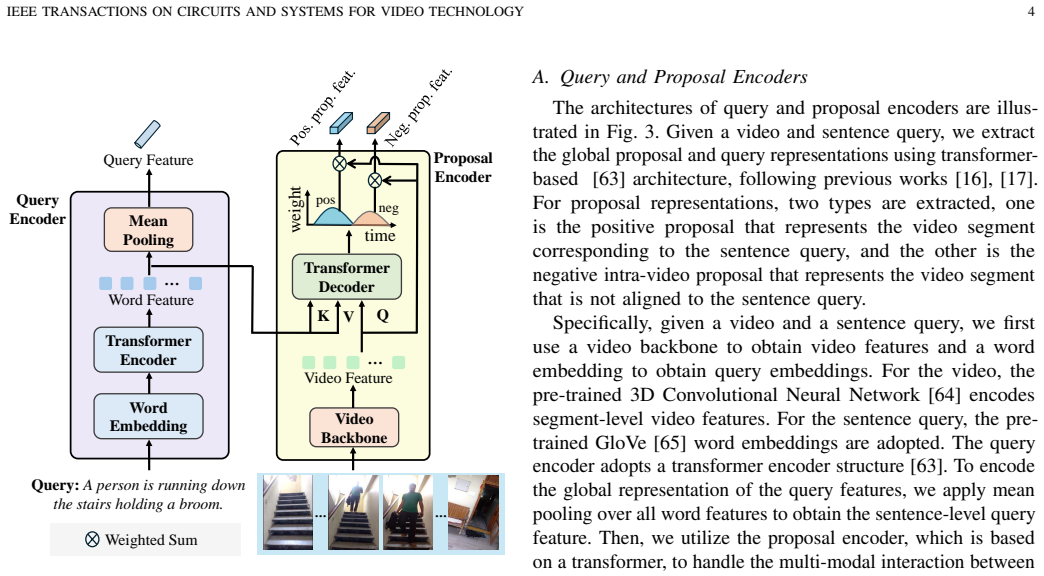
The load-bearing object is the similar/dissimilar partition of the training set, computed by cosine similarity of SentenceTransformer text embeddings. For an anchor query $Q_i$, the top-$k$ most similar queries form the positive set $S_i^{\mathrm{sim}}$ and all remaining samples form $S_i^{\mathrm{dis}}$. Two margin losses then carry the signal: the PSM-guided contrastive loss $\mathcal{L}^{\mathrm{CL}}_{\mathrm{PSM}}$ enforces $p\cdot q_{\mathrm{dis}} - p\cdot q_{\mathrm{sim}} + \gamma_1 \le 0$ (and the analogous proposal term), and the PSM-guided rank loss $\mathcal{L}^{\mathrm{rank}}_{\mathrm{PSM}}$ reuses those contrastive values as distance measures so that the similar sample is closer to the anchor proposal than to the negative intra-video proposal. The machinery matters because it converts a text-similarity structure into local proposal-space supervision without any timestamp labels.
What would settle it
Select a subset of a grounding dataset where each anchor's top-k text-similar queries are intentionally chosen to describe different moments from the anchor (same objects and verbs but different sub-events), train with PSM, and compare grounding accuracy on that subset against the no-PSM baseline; a drop would show the similarity assumption is violated. A simpler observation: compute the ground-truth temporal IoU between anchor moments and their mined similar samples; if a large share have near-zero IoU, the pull-close term is being supervised toward wrong moments.
Extended reading notes
Core claim
The central claim is that some remaining training samples are positive evidence, not noise: for each anchor query-video pair, PSM computes cosine similarity between the anchor text query and all other queries using pretrained SentenceTransformer features, keeps the top-k as a similar subset and the rest as a dissimilar subset, and then supervises the proposal encoder with two losses. The PSM-guided contrastive loss makes the anchor proposal closer to a similar sample than to a dissimilar sample, in both query and proposal modalities. The PSM-guided rank loss makes a similar sample closer to the anchor proposal than to the negative intra-video proposal, which sharpens the contrast between the predicted moment and confusing segments within the same video. The paper reports consistent improvements across the CNM, CPL, and PPS backbones, and its ablations show the two losses are complementary.
Load-bearing premise
The paper assumes that if two text queries are close in SentenceTransformer embedding space, their corresponding video moments should also be close in proposal space; that equivalence can fail when sentences share words or style but describe different events, and the paper concedes that complex queries often have no reliable similar samples.
Editorial extensions
If this is right
- On Charades-STA, PPS+PSM raises R@1 at IoU=0.5 from 51.49 to 54.36 and R@1 at IoU=0.7 from 26.16 to 28.73.
- On ActivityNet Captions, PPS+PSM raises R@1 at IoU=0.5 from 59.29 to 60.81 and improves most R@5 metrics across IoU thresholds.
- On NExT-GQA, NG+PSM improves mIoP, mIoU, and Acc@GQA over both the NG baseline and the NG+ variant, without needing GPT-4 annotations.
- Ablations on CNM, CPL, and PPS show the scheme transfers across different backbone proposal generators, and the training-time-only design adds no inference cost.
- The two losses are complementary: the ablation table's best configuration uses all four loss terms together.
Reading between the lines
- Inference: the same recipe could transfer to other weakly supervised video-language tasks, such as text-to-video retrieval or weakly supervised temporal action localization, wherever contrastive losses currently repel all cross-sample pairs.
- Inference: because PSM outperforms a method that relies on GPT-4-generated annotations, cross-sample mining may serve as a general substitute for LLM pseudo-labels in grounded QA and similar annotation-hungry settings.
- Inference: the fixed top-$k$ cutoff leaves room for an adaptive or confidence-weighted similar set; the paper's own ablation shows performance saturates around $k=20$, hinting that noisy members begin to contaminate the positive set.
- Inference: a natural extension is sub-event-level mining for complex queries, which the paper names as its main limitation; retrieving positives for decomposed query fragments could directly attack the case where whole-sentence neighbors are unreliable.
Signed reviews
Editorial analysis
A structured set of objections, weighed in public.
Referee Report
Summary. The paper proposes Positive Sample Mining (PSM) for weakly supervised temporal sentence grounding (WSTSG). For each anchor query-video sample, PSM partitions the remaining training samples into similar and dissimilar subsets using SentenceTransformer cosine similarity of the text queries (Eqs. (1)-(3)). It then adds a PSM-guided contrastive loss, which pulls the anchor proposal toward the mined similar sample and pushes it away from the dissimilar sample, and a PSM-guided rank loss, which encourages the anchor proposal to be closer to the similar sample than the intra-video negative proposal. The method is evaluated on Charades-STA, ActivityNet Captions, and NExT-GQA, showing consistent improvements over PPS and NG baselines, with ablations on each loss term, the number of similar samples, feature types, backbones, and hyperparameters. The paper claims this is the first positive-sample-mining approach for WSTSG and that it also improves grounded VideoQA without requiring additional annotations.
Significance. If the mechanism holds, PSM provides a new source of discriminative supervision for WSTSG by exploiting cross-sample semantic correlations instead of treating all non-anchor samples as negatives. The paper is thorough on the experimental side: it validates on three benchmarks, integrates PSM with CNM, CPL, and PPS, ablates each component, and shows that the mining overhead is small relative to training cost. The NExT-GQA results are interesting because PSM improves grounding and QA over NG+ without the GPT-4 annotations used by NG+. The central claim is falsifiable, and the main open questions concern whether the mined samples are truly positive and whether the rank loss implements the stated distance objective; these are empirically and analytically checkable. If the authors resolve those questions, the contribution would be a useful addition to weakly supervised video-language grounding.
major comments (2)
- [III-B, Eqs. (1)-(3); Sec. V] The key premise of the method is that samples whose queries are textually similar to the anchor query have target moments that are semantically similar to the anchor moment. This premise is introduced in Eqs. (1)-(3), where the similar subset is selected purely by SentenceTransformer cosine similarity of text queries, but it is never measured or validated. The only direct evidence is the two hand-picked examples in Fig. 5, and the paper's own Limitations section (Sec. V) states that complex queries often have no reliable similar samples, with Fig. 6(d) showing a failure case. Because both PSM losses are applied only to the mined subset, a non-negligible false-positive rate would make the losses actively pull the anchor proposal toward unrelated temporal intervals, and the gains in Tables I-III could stem from generic inter-sample regularization rather than from positive-sample semantics. Please provide a quantitative validation of the mining: for a random sample of anchors on Charades-STA and ActivityNet Captions, compute the tIoU between the ground-truth moments of the anchor and the ground-truth moments of the top-k mined samples (or have a subset human-annotated), report precision@k for the k values considered in Table VI, and compare against a control with randomly selected 'similar' sets of the same size. This would directly test the causal claim in Sec. IV-D that the improvement is primarily due to discriminative supervision from positive samples.
- [III-D, Eqs. (7)-(12)] In Eqs. (7)-(12), the paper sets d(p,q_sim)=L_query and d(p,p_sim)=L_prop, i.e., it uses the clipped margin losses as distances. However, L_query = max(p·q_dis - p·q_sim + γ1, 0) measures how much the anchor proposal fails to be more similar to q_sim than to q_dis by margin γ1; it is not a distance to q_sim. The same holds for L_prop. Consequently, the rank loss in Eq. (11) does not implement the stated objective that similar samples are closer to the anchor proposal than to the negative intra-video proposal: when both L_query and L^n_query are zero, L^query_rank equals the constant γ5 with zero gradient; when both are nonzero, the loss can be reduced by lowering p·q_dis without increasing p·q_sim. The supporting statement in Sec. III-D that 'a lower PSM-guided contrastive loss indicates that the intra-video proposal is closer to similar samples' is therefore not supported. I recommend either reformulating the rank loss with an actual similarity/distance measure (e.g., max(p·q_sim - pn·q_sim + γ, 0)) and reporting whether the gains in Table IV persist, or providing a rigorous analysis of the hinge-based distance, including what happens in the inactive and double-active regions. The CR-loss ablation in Table V is related but does not by itself justify the hinge-based quantity as a distance.
minor comments (5)
- [III-D, Eq. (12)] Equation (12) writes L^prop_rank with d(p,q_sim)-d(pn,q_sim) but then substitutes L_prop - L^n_prop; based on Eq. (10), the first arguments should be p_sim, not q_sim. Please fix the typo.
- [IV-D] In the ActivityNet results paragraph, five metrics are listed (R@1 IoU=0.5, R@1 IoU=0.7, R@5 IoU=0.3, R@5 IoU=0.5, R@5 IoU=0.7) but only four percentage gains are reported; please correct the enumeration.
- [Fig. 2 caption] The caption mentions 'PSM-guided contrastive loss' twice in the final sentence; the second occurrence appears to mean 'PSM-guided rank loss' and should be corrected.
- [Tables I-III] The main results are reported without variance across runs; given that several improvements are in the 1-3 point range, please report multiple-seed means and standard deviations, or state explicitly if this is not standard practice for the baselines used.
- [Table III] The row 'Ours (NG + PSM)' is based on the NG baseline, while the comparison row 'NG+' uses additional GPT-4 annotations; please make this explicit in the table caption or in a footnote so that the comparison is not read as using the same training signal.
Circularity Check
No significant circularity: PSM's similar-sample supervision is an external, frozen-input training signal, and all headline gains are measured against independent ground-truth temporal IoU.
full rationale
The paper's derivation chain is self-contained with respect to its stated objective. The similar/dissimilar partition in Eqs. (1)-(3) is computed from a frozen, external SentenceTransformer embedding of the text queries, not from the trained model and not from the evaluation metric. The PSM-guided contrastive and rank losses in Eqs. (4)-(13) are training objectives defined directly on those mined pseudo-labels, and the reported results (e.g., PPS+PSM raising R@1, IoU=0.5 from 51.49 to 54.36 on Charades-STA; R@1, IoU=0.5 from 59.29 to 60.81 on ActivityNet Captions; gains on NExT-GQA in Table III) are measured against ground-truth temporal annotations that are not functions of the mined similar set or of any fitted constant recycled as a prediction. No parameter is fitted to the target metric and then reported as a prediction of that same metric. The architecture is inherited from cited baselines (CPL, PPS, NG), but those citations are used as backbones and comparisons, not as a load-bearing uniqueness or justification chain authored by the present authors. The limitations section concedes that complex queries often have no reliable similar samples and that text-similar queries may not correspond to semantically similar moments; this is an empirical correctness risk about an assumption in the method, not a case where a derived output is equivalent to an input by construction. The minor self-citations (e.g., UGS [47], EgoExoLearn [3]) are contextual and do not support the central claim. Overall, the paper's core result is an independent, externally benchmarked empirical claim, so the circularity score is 0.
Assumptions & free parameters
free parameters (2)
- Margin hyperparameters gamma1-gamma6 =
0.5 for gamma1-gamma4; 0.15 for gamma5-gamma6
- Top-k similar samples =
20
assumptions (5)
- domain assumption Query-text similarity is a valid proxy for proposal temporal similarity.
- domain assumption SentenceTransformer embeddings provide a useful semantic similarity distribution for top-k retrieval.
- domain assumption The base reconstruction loss Lbase from CPL/PPS is a reliable proposal-quality signal.
- standard math L2 normalization makes inner product equal cosine similarity.
- ad hoc to paper Hinge loss values can be interpreted as distances between samples.
Cite this review
Pith. "Pith review of Weakly Supervised Temporal Sentence Grounding via Positive Sample Mining." pith.science (2026). https://pith.science/paper/IUPYBRPT
@misc{pith2026250506557,
  author       = {Pith},
  title        = {Pith review of: Weakly Supervised Temporal Sentence Grounding via Positive Sample Mining},
  year         = {2026},
  howpublished = {\url{https://pith.science/paper/IUPYBRPT}},
  note         = {Machine review of arXiv:2505.06557}
}
read the original abstract
The task of weakly supervised temporal sentence grounding (WSTSG) aims to detect temporal intervals corresponding to a language description from untrimmed videos with only video-level video-language correspondence. For an anchor sample, most existing approaches generate negative samples either from other videos or within the same video for contrastive learning. However, some training samples are highly similar to the anchor sample, directly regarding them as negative samples leads to difficulties for optimization and ignores the correlations between these similar samples and the anchor sample. To address this, we propose Positive Sample Mining (PSM), a novel framework that mines positive samples from the training set to provide more discriminative supervision. Specifically, for a given anchor sample, we partition the remaining training set into semantically similar and dissimilar subsets based on the similarity of their text queries. To effectively leverage these correlations, we introduce a PSM-guided contrastive loss to ensure that the anchor proposal is closer to similar samples and further from dissimilar ones. Additionally, we design a PSM-guided rank loss to ensure that similar samples are closer to the anchor proposal than to the negative intra-video proposal, aiming to distinguish the anchor proposal and the negative intra-video proposal. Experiments on the WSTSG and grounded VideoQA tasks demonstrate the effectiveness and superiority of our method.
Figures


Figures from the paper (2 more)


Reference graph
Works this paper leans on
-
[1]
Video summarization with long short-term memory
Ke Zhang, Wei-Lun Chao, Fei Sha, and Kristen Grauman. Video summarization with long short-term memory. In European Conference on Computer Vision , pages 766–782, 2016
2016
-
[2]
Video summarization using fully convolutional sequence networks
Mrigank Rochan, Linwei Ye, and Yang Wang. Video summarization using fully convolutional sequence networks. In Proceedings of the European Conference on Computer Vision (ECCV) , pages 347–363, 2018
2018
-
[3]
Egoexolearn: A dataset for bridging asynchronous ego-and exo-centric view of procedural activities in real world
Yifei Huang, Guo Chen, Jilan Xu, Mingfang Zhang, Lijin Yang, Baoqi Pei, Hongjie Zhang, Lu Dong, Yali Wang, Limin Wang, et al. Egoexolearn: A dataset for bridging asynchronous ego-and exo-centric view of procedural activities in real world. In Proceedings of the IEEE Conference on Computer Vision and Pattern Recognition , pages 22072–22086, 2024
2024
-
[4]
Dual encoding for zero-example video retrieval
Jianfeng Dong, Xirong Li, Chaoxi Xu, Shouling Ji, Yuan He, Gang Yang, and Xun Wang. Dual encoding for zero-example video retrieval. In Proceedings of the IEEE/CVF Conference on Computer Vision and Pattern Recognition, pages 9346–9355, 2019
2019
-
[5]
Multi-modal transformer for video retrieval
Valentin Gabeur, Chen Sun, Karteek Alahari, and Cordelia Schmid. Multi-modal transformer for video retrieval. In European Conference on Computer Vision, pages 214–229, 2020
2020
-
[6]
T2vlad: global-local sequence alignment for text-video retrieval
Xiaohan Wang, Linchao Zhu, and Yi Yang. T2vlad: global-local sequence alignment for text-video retrieval. In Proceedings of the IEEE/CVF Conference on Computer Vision and Pattern Recognition , pages 5079– 5088, 2021
2021
-
[7]
Mutual context network for jointly estimating egocentric gaze and action
Yifei Huang, Minjie Cai, Zhenqiang Li, Feng Lu, and Yoichi Sato. Mutual context network for jointly estimating egocentric gaze and action. IEEE Transactions on Image Processing , 29:7795–7806, 2020
2020
-
[8]
Look closer to ground better: Weakly-supervised temporal grounding of sentence in video
Zhenfang Chen, Lin Ma, Wenhan Luo, Peng Tang, and Kwan-Yee K Wong. Look closer to ground better: Weakly-supervised temporal grounding of sentence in video. arXiv preprint arXiv:2001.09308 , 2020
arXiv 2001
Show all 96 references
-
[9]
Predicting gaze in egocentric video by learning task-dependent attention transition
Yifei Huang, Minjie Cai, Zhenqiang Li, and Yoichi Sato. Predicting gaze in egocentric video by learning task-dependent attention transition. In Proceedings of the European Conference on Computer Vision , 2018
2018
-
[10]
Tall: Temporal activity localization via language query
Jiyang Gao, Chen Sun, Zhenheng Yang, and Ram Nevatia. Tall: Temporal activity localization via language query. In Proceedings of the IEEE International Conference on Computer Vision , pages 5267–5275, 2017
2017
-
[11]
Boundary proposal network for two-stage natural language video localization
Shaoning Xiao, Long Chen, Songyang Zhang, Wei Ji, Jian Shao, Lu Ye, and Jun Xiao. Boundary proposal network for two-stage natural language video localization. In Proceedings of the AAAI Conference on Artificial Intelligence, volume 35, pages 2986–2994, 2021
2021
-
[12]
Univtg: Towards unified video-language temporal grounding
Kevin Qinghong Lin, Pengchuan Zhang, Joya Chen, Shraman Pramanick, Difei Gao, Alex Jinpeng Wang, Rui Yan, and Mike Zheng Shou. Univtg: Towards unified video-language temporal grounding. In Proceedings of the IEEE/CVF International Conference on Computer Vision , pages 2794–2804, 2023
2023
-
[13]
Mac: Mining activity concepts for language-based temporal localization
Runzhou Ge, Jiyang Gao, Kan Chen, and Ram Nevatia. Mac: Mining activity concepts for language-based temporal localization. In 2019 IEEE Winter Conference on Applications of Computer Vision (WACV) , pages 245–253. IEEE, 2019
2019
-
[14]
Learning 2d temporal adjacent networks for moment localization with natural language
Songyang Zhang, Houwen Peng, Jianlong Fu, and Jiebo Luo. Learning 2d temporal adjacent networks for moment localization with natural language. In Proceedings of the AAAI Conference on Artificial Intelligence , volume 34, pages 12870–12877, 2020
2020
-
[15]
Progressive localization networks for language-based moment localization
Qi Zheng, Jianfeng Dong, Xiaoye Qu, Xun Yang, Yabing Wang, Pan Zhou, Baolong Liu, and Xun Wang. Progressive localization networks for language-based moment localization. ACM Transactions on Multimedia Computing, Communications and Applications , 19(2):1–21, 2023
2023
-
[16]
Weakly supervised temporal sentence grounding with gaussian- based contrastive proposal learning
Minghang Zheng, Yanjie Huang, Qingchao Chen, Yuxin Peng, and Yang Liu. Weakly supervised temporal sentence grounding with gaussian- based contrastive proposal learning. In Proceedings of the IEEE/CVF Conference on Computer Vision and Pattern Recognition , pages 15555– 15564, 2022
2022
-
[17]
Gaussian mixture proposals with pull-push learning scheme to capture diverse events for weakly supervised temporal video grounding
Sunoh Kim, Jungchan Cho, Joonsang Yu, YoungJoon Yoo, and Jin Young Choi. Gaussian mixture proposals with pull-push learning scheme to capture diverse events for weakly supervised temporal video grounding. In Proceedings of the AAAI Conference on Artificial Intelligence, volume...
2024
-
[18]
Wslln: Weakly supervised natural language localization networks
Mingfei Gao, Larry S Davis, Richard Socher, and Caiming Xiong. Wslln: Weakly supervised natural language localization networks. arXiv preprint arXiv:1909.00239, 2019
1909 arXiv
-
[19]
Cross-sentence temporal and semantic relations in video activity localisation
Jiabo Huang, Yang Liu, Shaogang Gong, and Hailin Jin. Cross-sentence temporal and semantic relations in video activity localisation. In Proceedings of the IEEE/CVF International Conference on Computer Vision, pages 7199–7208, 2021
2021
-
[20]
Logan: Latent graph co-attention network for weakly-supervised video moment IEEE TRANSACTIONS ON CIRCUITS AND SYSTEMS FOR VIDEO TECHNOLOGY 12 retrieval
Reuben Tan, Huijuan Xu, Kate Saenko, and Bryan A Plummer. Logan: Latent graph co-attention network for weakly-supervised video moment IEEE TRANSACTIONS ON CIRCUITS AND SYSTEMS FOR VIDEO TECHNOLOGY 12 retrieval. In Proceedings of the IEEE/CVF Winter Conference on Applications o...
2021
-
[21]
Weakly- supervised video moment retrieval via semantic completion network
Zhijie Lin, Zhou Zhao, Zhu Zhang, Qi Wang, and Huasheng Liu. Weakly- supervised video moment retrieval via semantic completion network. In Proceedings of the AAAI Conference on Artificial Intelligence, volume 34, pages 11539–11546, 2020
2020
-
[22]
Weakly- supervised multi-level attentional reconstruction network for grounding textual queries in videos
Yijun Song, Jingwen Wang, Lin Ma, Zhou Yu, and Jun Yu. Weakly- supervised multi-level attentional reconstruction network for grounding textual queries in videos. arXiv preprint arXiv:2003.07048 , 2020
2003 arXiv
-
[23]
Weakly supervised video moment localization with contrastive negative sample mining
Minghang Zheng, Yanjie Huang, Qingchao Chen, and Yang Liu. Weakly supervised video moment localization with contrastive negative sample mining. In Proceedings of the AAAI Conference on Artificial Intelligence , volume 36, pages 3517–3525, 2022
2022
-
[24]
Localizing moments in video with natural language
Lisa Anne Hendricks, Oliver Wang, Eli Shechtman, Josef Sivic, Trevor Darrell, and Bryan Russell. Localizing moments in video with natural language. In Proceedings of the IEEE International Conference on Computer Vision, pages 5803–5812, 2017
2017
-
[25]
Cross-modal video moment retrieval with spatial and language-temporal attention
Bin Jiang, Xin Huang, Chao Yang, and Junsong Yuan. Cross-modal video moment retrieval with spatial and language-temporal attention. In Proceedings of the 2019 on International Conference on Multimedia Retrieval, pages 217–225, 2019
2019
-
[26]
Temporally grounding natural sentence in video
Jingyuan Chen, Xinpeng Chen, Lin Ma, Zequn Jie, and Tat-Seng Chua. Temporally grounding natural sentence in video. In Proceedings of the 2018 Conference on Empirical Methods in Natural Language Processing , pages 162–171, 2018
2018
-
[27]
Semantic conditioned dynamic modulation for temporal sentence grounding in videos
Yitian Yuan, Lin Ma, Jingwen Wang, Wei Liu, and Wenwu Zhu. Semantic conditioned dynamic modulation for temporal sentence grounding in videos. Advances in Neural Information Processing Systems , 32, 2019
2019
-
[28]
Multi-modal interaction graph convolutional network for temporal language localization in videos
Zongmeng Zhang, Xianjing Han, Xuemeng Song, Yan Yan, and Liqiang Nie. Multi-modal interaction graph convolutional network for temporal language localization in videos. IEEE Transactions on Image Processing, 30:8265–8277, 2021
2021
-
[29]
Thinking inside uncertainty: Interest moment perception for diverse temporal grounding
Hao Zhou, Chongyang Zhang, Yan Luo, Chuanping Hu, and Wenjun Zhang. Thinking inside uncertainty: Interest moment perception for diverse temporal grounding. IEEE Transactions on Circuits and Systems for Video Technology, 32(10):7190–7203, 2022
2022
-
[30]
Camg: Context-aware moment graph network for multimodal temporal activity localization via language
Yuelin Hu, Yuanwu Xu, Yuejie Zhang, Rui Feng, Tao Zhang, Xuequan Lu, and Shang Gao. Camg: Context-aware moment graph network for multimodal temporal activity localization via language. In CCF International Conference on Natural Language Processing and Chinese Computing, pages ...
2023
-
[31]
Video moment retrieval via comprehensive relation-aware network
Xin Sun, Jialin Gao, Yizhe Zhu, Xuan Wang, and Xi Zhou. Video moment retrieval via comprehensive relation-aware network. IEEE Transactions on Circuits and Systems for Video Technology , 33(9):5281–5295, 2023
2023
-
[32]
Video corpus moment retrieval via deformable multi granularity feature fusion and adversarial training
Xuemei Zhang, Peng Zhao, Jinsheng Ji, Xiankai Lu, and Yilong Yin. Video corpus moment retrieval via deformable multi granularity feature fusion and adversarial training. IEEE Transactions on Circuits and Systems for Video Technology, 2023
2023
-
[33]
Collaborative debias strategy for temporal sentence grounding in video
Zhaobo Qi, Yibo Yuan, Xiaowen Ruan, Shuhui Wang, Weigang Zhang, and Qingming Huang. Collaborative debias strategy for temporal sentence grounding in video. IEEE Transactions on Circuits and Systems for Video Technology, 2024
2024
-
[34]
Uncovering hidden challenges in query-based video moment retrieval
Mayu Otani, Yuta Nakashima, Esa Rahtu, and Janne Heikkilä. Uncovering hidden challenges in query-based video moment retrieval. arXiv preprint arXiv:2009.00325, 2020
2009 arXiv
-
[35]
Cola: Weakly-supervised temporal action localization with snippet contrastive learning
Can Zhang, Meng Cao, Dongming Yang, Jie Chen, and Yuexian Zou. Cola: Weakly-supervised temporal action localization with snippet contrastive learning. In Proceedings of the IEEE/CVF Conference on Computer Vision and Pattern Recognition , pages 16010–16019, 2021
2021
-
[36]
Exploring sub-action granularity for weakly supervised temporal action localization
Binglu Wang, Xun Zhang, and Yongqiang Zhao. Exploring sub-action granularity for weakly supervised temporal action localization. IEEE Transactions on Circuits and Systems for Video Technology , 32(4):2186– 2198, 2021
2021
-
[37]
Learning proposal-aware re-ranking for weakly- supervised temporal action localization
Yufan Hu, Jie Fu, Mengyuan Chen, Junyu Gao, Jianfeng Dong, Bin Fan, and Hongmin Liu. Learning proposal-aware re-ranking for weakly- supervised temporal action localization. IEEE Transactions on Circuits and Systems for Video Technology , 34(1):207–220, 2023
2023
-
[38]
Cross-video contextual knowledge exploration and exploitation for ambiguity reduction in weakly supervised temporal action localization
Songchun Zhang and Chunhui Zhao. Cross-video contextual knowledge exploration and exploitation for ambiguity reduction in weakly supervised temporal action localization. IEEE Transactions on Circuits and Systems for Video Technology, 2023
2023
-
[39]
A snippets relation and hard-snippets mask network for weakly-supervised temporal action localization
Yibo Zhao, Hua Zhang, Zan Gao, Weili Guan, Meng Wang, and Shengyong Chen. A snippets relation and hard-snippets mask network for weakly-supervised temporal action localization. IEEE Transactions on Circuits and Systems for Video Technology , 2024
2024
-
[40]
Solve the puzzle of instance segmentation in videos: A weakly supervised framework with spatio-temporal collaboration
Liqi Yan, Qifan Wang, Siqi Ma, Jingang Wang, and Changbin Yu. Solve the puzzle of instance segmentation in videos: A weakly supervised framework with spatio-temporal collaboration. IEEE Transactions on Circuits and Systems for Video Technology , 33(1):393–406, 2022
2022
-
[41]
Weakly supervised video instance segmentation with scale adaptive generation regulation
ZHANG Yinhui, HAI Weiqi, HE Zifen, HUANG Ying, and CHEN Dongdong. Weakly supervised video instance segmentation with scale adaptive generation regulation. Optics and Precision Engineering , 31(18):2736–2751, 2023
2023
-
[42]
Towards video anomaly detection in the real world: A binarization embedded weakly-supervised network
Zhen Yang, Yuanfang Guo, Junfu Wang, Di Huang, Xiuguo Bao, and Yunhong Wang. Towards video anomaly detection in the real world: A binarization embedded weakly-supervised network. IEEE Transactions on Circuits and Systems for Video Technology , 2023
2023
-
[43]
Vadclip: Adapting vision-language models for weakly supervised video anomaly detection
Peng Wu, Xuerong Zhou, Guansong Pang, Lingru Zhou, Qingsen Yan, Peng Wang, and Yanning Zhang. Vadclip: Adapting vision-language models for weakly supervised video anomaly detection. In Proceedings of the AAAI Conference on Artificial Intelligence , volume 38, pages 6074–6082, 2024
2024
-
[44]
Batchnorm-based weakly supervised video anomaly detection
Yixuan Zhou, Yi Qu, Xing Xu, Fumin Shen, Jingkuan Song, and Heng Tao Shen. Batchnorm-based weakly supervised video anomaly detection. IEEE Transactions on Circuits and Systems for Video Technology, 2024
2024
-
[45]
Weakly supervised video moment retrieval from text queries
Niluthpol Chowdhury Mithun, Sujoy Paul, and Amit K Roy-Chowdhury. Weakly supervised video moment retrieval from text queries. In Proceedings of the IEEE/CVF Conference on Computer Vision and Pattern Recognition, pages 11592–11601, 2019
2019
-
[46]
Vlanet: Video-language alignment network for weakly-supervised video moment retrieval
Minuk Ma, Sunjae Yoon, Junyeong Kim, Youngjoon Lee, Sunghun Kang, and Chang D Yoo. Vlanet: Video-language alignment network for weakly-supervised video moment retrieval. In European Conference on Computer Vision , pages 156–171, 2020
2020
-
[47]
Weakly supervised temporal sentence grounding with uncertainty-guided self-training
Yifei Huang, Lijin Yang, and Yoichi Sato. Weakly supervised temporal sentence grounding with uncertainty-guided self-training. In Proceed- ings of the IEEE/CVF Conference on Computer Vision and Pattern Recognition, pages 18908–18918, 2023
2023
-
[48]
Unsupervised hard example mining from videos for improved object detection
SouYoung Jin, Aruni RoyChowdhury, Huaizu Jiang, Ashish Singh, Aditya Prasad, Deep Chakraborty, and Erik Learned-Miller. Unsupervised hard example mining from videos for improved object detection. In Proceedings of the European Conference on Computer Vision (ECCV) , pages 307–324, 2018
2018
-
[49]
Contrastive learning with hard negative samples
Joshua Robinson, Ching-Yao Chuang, Suvrit Sra, and Stefanie Jegelka. Contrastive learning with hard negative samples. arXiv preprint arXiv:2010.04592, 2020
2010 arXiv
-
[50]
Video corpus moment retrieval with contrastive learning
Hao Zhang, Aixin Sun, Wei Jing, Guoshun Nan, Liangli Zhen, Joey Tianyi Zhou, and Rick Siow Mong Goh. Video corpus moment retrieval with contrastive learning. In Proceedings of the 44th International ACM SIGIR Conference on Research and Development in Information Retrieval, pag...
2021
-
[51]
Selective query-guided debiasing for video corpus moment retrieval
Sunjae Yoon, Ji Woo Hong, Eunseop Yoon, Dahyun Kim, Junyeong Kim, Hee Suk Yoon, and Chang D Yoo. Selective query-guided debiasing for video corpus moment retrieval. In European Conference on Computer Vision, pages 185–200. Springer, 2022
2022
-
[52]
Counterfactual two-stage debiasing for video corpus moment retrieval
Sunjae Yoon, Ji Woo Hong, Soohwan Eom, Hee Suk Yoon, Eunseop Yoon, Daehyeok Kim, Junyeong Kim, Chanwoo Kim, and Chang D Yoo. Counterfactual two-stage debiasing for video corpus moment retrieval. In ICASSP 2023-2023 IEEE International Conference on Acoustics, Speech and Signal ...
2023
-
[53]
Curriculum multi-negative augmentation for debiased video grounding
Xiaohan Lan, Yitian Yuan, Hong Chen, Xin Wang, Zequn Jie, Lin Ma, Zhi Wang, and Wenwu Zhu. Curriculum multi-negative augmentation for debiased video grounding. In Proceedings of the AAAI Conference on Artificial Intelligence , volume 37, pages 1213–1221, 2023
2023
-
[54]
Bias-conflict sample synthesis and adversarial removal debias strategy for temporal sentence grounding in video
Zhaobo Qi, Yibo Yuan, Xiaowen Ruan, Shuhui Wang, Weigang Zhang, and Qingming Huang. Bias-conflict sample synthesis and adversarial removal debias strategy for temporal sentence grounding in video. In Proceedings of the AAAI Conference on Artificial Intelligence, volume 38, pag...
2024
-
[55]
Learnable negative proposals using dual-signed cross-entropy loss for weakly supervised video moment localization
Sunoh Kim, Daeho Um, HyunJun Choi, and Jin Young Choi. Learnable negative proposals using dual-signed cross-entropy loss for weakly supervised video moment localization. In Proceedings of the 32nd ACM International Conference on Multimedia , pages 5318–5327, 2024
2024
-
[56]
Contextual similarity distillation for asymmetric image retrieval
Hui Wu, Min Wang, Wengang Zhou, Houqiang Li, and Qi Tian. Contextual similarity distillation for asymmetric image retrieval. In Proceedings of the IEEE/CVF Conference on Computer Vision and Pattern Recognition, pages 9489–9498, 2022
2022
-
[57]
Ames: Asymmetric and memory-efficient similarity estimation for instance-level retrieval
Pavel Suma, Giorgos Kordopatis-Zilos, Ahmet Iscen, and Giorgos Tolias. Ames: Asymmetric and memory-efficient similarity estimation for instance-level retrieval. In European Conference on Computer Vision , pages 307–325, 2025
2025
-
[58]
D3still: Decoupled differential distillation for IEEE TRANSACTIONS ON CIRCUITS AND SYSTEMS FOR VIDEO TECHNOLOGY 13 asymmetric image retrieval
Yi Xie, Yihong Lin, Wenjie Cai, Xuemiao Xu, Huaidong Zhang, Yong Du, and Shengfeng He. D3still: Decoupled differential distillation for IEEE TRANSACTIONS ON CIRCUITS AND SYSTEMS FOR VIDEO TECHNOLOGY 13 asymmetric image retrieval. In Proceedings of the IEEE/CVF Conference on Co...
2024
-
[59]
Domain adaptation by constraining inter-domain variability of latent feature representation
Ivan Titov. Domain adaptation by constraining inter-domain variability of latent feature representation. In proceedings of the 49th annual meeting of the Association for Computational Linguistics: Human language technologies, pages 62–71, 2011
2011
-
[60]
Exploiting inter-sample affinity for knowability-aware universal domain adaptation
Yifan Wang, Lin Zhang, Ran Song, Hongliang Li, Paul L Rosin, and Wei Zhang. Exploiting inter-sample affinity for knowability-aware universal domain adaptation. International Journal of Computer Vision , 132(5):1800–1816, 2024
2024
-
[61]
Mining inter-video proposal relations for video object detection
Mingfei Han, Yali Wang, Xiaojun Chang, and Yu Qiao. Mining inter-video proposal relations for video object detection. In European Conference on Computer Vision , pages 431–446, 2020
2020
-
[62]
Imc- det: Intra–inter modality contrastive learning for video object detection
Qiang Qi, Zhenyu Qiu, Yan Yan, Yang Lu, and Hanzi Wang. Imc- det: Intra–inter modality contrastive learning for video object detection. International Journal of Computer Vision , pages 1–20, 2024
2024
-
[63]
Attention is all you need
A Vaswani. Attention is all you need. Advances in Neural Information Processing Systems, 2017
2017
-
[64]
Learning spatiotemporal features with 3d convolutional networks
Du Tran, Lubomir Bourdev, Rob Fergus, Lorenzo Torresani, and Manohar Paluri. Learning spatiotemporal features with 3d convolutional networks. In Proceedings of the IEEE International Conference on Computer Vision, pages 4489–4497, 2015
2015
-
[65]
Glove: Global vectors for word representation
Jeffrey Pennington, Richard Socher, and Christopher D Manning. Glove: Global vectors for word representation. In Proceedings of the 2014 Conference on Empirical Methods in Natural Language Processing (EMNLP), pages 1532–1543, 2014
2014
-
[66]
Sentence-bert: Sentence embeddings using siamese bert-networks
Nils Reimers and Iryna Gurevych. Sentence-bert: Sentence embeddings using siamese bert-networks. In Proceedings of the 2019 Conference on Empirical Methods in Natural Language Processing . Association for Computational Linguistics, 11 2019
2019
-
[67]
Dense-captioning events in videos
Ranjay Krishna, Kenji Hata, Frederic Ren, Li Fei-Fei, and Juan Carlos Niebles. Dense-captioning events in videos. In Proceedings of the IEEE International Conference on Computer Vision , pages 706– 715, 2017
2017
-
[68]
Can i trust your answer? visually grounded video question answering
Junbin Xiao, Angela Yao, Yicong Li, and Tat-Seng Chua. Can i trust your answer? visually grounded video question answering. In Proceedings of the IEEE/CVF Conference on Computer Vision and Pattern Recognition , pages 13204–13214, 2024
2024
-
[69]
Quo vadis, action recognition? a new model and the kinetics dataset
Joao Carreira and Andrew Zisserman. Quo vadis, action recognition? a new model and the kinetics dataset. In proceedings of the IEEE Conference on Computer Vision and Pattern Recognition , pages 6299– 6308, 2017
2017
-
[70]
Revisiting the" video" in video-language understanding
Shyamal Buch, Cristóbal Eyzaguirre, Adrien Gaidon, Jiajun Wu, Li Fei- Fei, and Juan Carlos Niebles. Revisiting the" video" in video-language understanding. In Proceedings of the IEEE/CVF Conference on Computer Vision and Pattern Recognition , pages 2917–2927, 2022
2022
-
[71]
Zero-shot video question answering via frozen bidirectional language models
Antoine Yang, Antoine Miech, Josef Sivic, Ivan Laptev, and Cordelia Schmid. Zero-shot video question answering via frozen bidirectional language models. Advances in Neural Information Processing Systems , 35:124–141, 2022
2022
-
[72]
Weakly supervised temporal adjacent network for language grounding
Yuechen Wang, Jiajun Deng, Wengang Zhou, and Houqiang Li. Weakly supervised temporal adjacent network for language grounding. IEEE Transactions on Multimedia , 24:3276–3286, 2021
2021
-
[73]
Reinforcement learning for weakly supervised temporal grounding of natural language in untrimmed videos
Jie Wu, Guanbin Li, Xiaoguang Han, and Liang Lin. Reinforcement learning for weakly supervised temporal grounding of natural language in untrimmed videos. In Proceedings of the 28th ACM International Conference on Multimedia , pages 1283–1291, 2020
2020
-
[74]
Counterfactual contrastive learning for weakly-supervised vision-language grounding
Zhu Zhang, Zhou Zhao, Zhijie Lin, Xiuqiang He, et al. Counterfactual contrastive learning for weakly-supervised vision-language grounding. Advances in Neural Information Processing Systems , 33:18123–18134, 2020
2020
-
[75]
Regularized two-branch proposal networks for weakly-supervised moment retrieval in videos
Zhu Zhang, Zhijie Lin, Zhou Zhao, Jieming Zhu, and Xiuqiang He. Regularized two-branch proposal networks for weakly-supervised moment retrieval in videos. In Proceedings of the 28th ACM International Conference on Multimedia , pages 4098–4106, 2020
2020
-
[76]
Visual co-occurrence alignment learning for weakly-supervised video moment retrieval
Zheng Wang, Jingjing Chen, and Yu-Gang Jiang. Visual co-occurrence alignment learning for weakly-supervised video moment retrieval. In Proceedings of the 29th ACM International Conference on Multimedia , pages 1459–1468, 2021
2021
-
[77]
Local correspondence network for weakly supervised temporal sentence grounding
Wenfei Yang, Tianzhu Zhang, Yongdong Zhang, and Feng Wu. Local correspondence network for weakly supervised temporal sentence grounding. IEEE Transactions on Image Processing , 30:3252–3262, 2021
2021
-
[78]
Explore inter- contrast between videos via composition for weakly supervised temporal sentence grounding
Jiaming Chen, Weixin Luo, Wei Zhang, and Lin Ma. Explore inter- contrast between videos via composition for weakly supervised temporal sentence grounding. In Proceedings of the AAAI Conference on Artificial Intelligence, volume 36, pages 267–275, 2022
2022
-
[79]
Dynamic contrastive learning with pseudo-samples intervention for weakly supervised joint video mr and hd
Shuhan Kong, Liang Li, Beichen Zhang, Wenyu Wang, Bin Jiang, Chenggang Yan, and Changhao Xu. Dynamic contrastive learning with pseudo-samples intervention for weakly supervised joint video mr and hd. In Proceedings of the 31st ACM International Conference on Multimedia , pages...
2023
-
[80]
Counterfactual cross-modality reasoning for weakly supervised video moment localization
Zezhong Lv, Bing Su, and Ji-Rong Wen. Counterfactual cross-modality reasoning for weakly supervised video moment localization. In Proceed- ings of the 31st ACM International Conference on Multimedia , pages 6539–6547, 2023
2023
-
[81]
Scanet: Scene complexity aware network for weakly-supervised video moment retrieval
Sunjae Yoon, Gwanhyeong Koo, Dahyun Kim, and Chang D Yoo. Scanet: Scene complexity aware network for weakly-supervised video moment retrieval. In Proceedings of the IEEE/CVF International Conference on Computer Vision, pages 13576–13586, 2023
2023
-
[82]
Omnipotent distillation with llms for weakly- supervised natural language video localization: When divergence meets consistency
Peijun Bao, Zihao Shao, Wenhan Yang, Boon Poh Ng, Meng Hwa Er, and Alex C Kot. Omnipotent distillation with llms for weakly- supervised natural language video localization: When divergence meets consistency. In Proceedings of the AAAI Conference on Artificial Intelligence, vol...
2024
-
[83]
Local-global multi-modal distillation for weakly-supervised temporal video grounding
Peijun Bao, Yong Xia, Wenhan Yang, Boon Poh Ng, Meng Hwa Er, and Alex C Kot. Local-global multi-modal distillation for weakly-supervised temporal video grounding. In Proceedings of the AAAI Conference on Artificial Intelligence, volume 38, pages 738–746, 2024
2024
-
[84]
Swin transformer: Hierarchical vision transformer using shifted windows
Ze Liu, Yutong Lin, Yue Cao, Han Hu, Yixuan Wei, Zheng Zhang, Stephen Lin, and Baining Guo. Swin transformer: Hierarchical vision transformer using shifted windows. In Proceedings of the IEEE/CVF International Conference on Computer Vision, pages 10012–10022, 2021
2021
-
[85]
Learning transferable visual models from natural language supervision
Alec Radford, Jong Wook Kim, Chris Hallacy, Aditya Ramesh, Gabriel Goh, Sandhini Agarwal, Girish Sastry, Amanda Askell, Pamela Mishkin, Jack Clark, et al. Learning transferable visual models from natural language supervision. In International Conference on Machine Learning , p...
2021
-
[86]
Blip: Bootstrapping language-image pre-training for unified vision-language understanding and generation
Junnan Li, Dongxu Li, Caiming Xiong, and Steven Hoi. Blip: Bootstrapping language-image pre-training for unified vision-language understanding and generation. In International Conference on Machine Learning, pages 12888–12900. PMLR, 2022
2022
-
[87]
Gpt-4 technical report
OpenAI. Gpt-4 technical report. 2023
2023
-
[88]
Video graph transformer for video question answering
Junbin Xiao, Pan Zhou, Tat-Seng Chua, and Shuicheng Yan. Video graph transformer for video question answering. In European Conference on Computer Vision, pages 39–58, 2022
2022
-
[89]
Rich feature hierarchies for accurate object detection and semantic segmentation
Ross Girshick, Jeff Donahue, Trevor Darrell, and Jitendra Malik. Rich feature hierarchies for accurate object detection and semantic segmentation. In Proceedings of the IEEE Conference on Computer Vision and Pattern Recognition , pages 580–587, 2014
2014
-
[90]
Bert: Pre-training of deep bidirectional transformers for language understanding
Jacob Devlin. Bert: Pre-training of deep bidirectional transformers for language understanding. arXiv preprint arXiv:1810.04805 , 2018
2018 arXiv
-
[91]
An empirical study of end-to-end video- language transformers with masked visual modeling
Tsu-Jui Fu, Linjie Li, Zhe Gan, Kevin Lin, William Yang Wang, Lijuan Wang, and Zicheng Liu. An empirical study of end-to-end video- language transformers with masked visual modeling. In Proceedings of the IEEE/CVF Conference on Computer Vision and Pattern Recognition , pages 2...
2023
-
[92]
Video swin transformer
Ze Liu, Jia Ning, Yue Cao, Yixuan Wei, Zheng Zhang, Stephen Lin, and Han Hu. Video swin transformer. In Proceedings of the IEEE/CVF Conference on Computer Vision and Pattern Recognition , pages 3202– 3211, 2022
2022
-
[93]
Roberta: A robustly optimized bert pretraining approach
Yinhan Liu. Roberta: A robustly optimized bert pretraining approach. arXiv preprint arXiv:1907.11692 , 364, 2019
1907 arXiv
-
[94]
An image is worth 16x16 words: Transformers for image recognition at scale
Alexey Dosovitskiy. An image is worth 16x16 words: Transformers for image recognition at scale. arXiv preprint arXiv:2010.11929 , 2020
2010 arXiv
-
[95]
Deberta: Decoding-enhanced bert with disentangled attention
Pengcheng He, Xiaodong Liu, Jianfeng Gao, and Weizhu Chen. Deberta: Decoding-enhanced bert with disentangled attention. arXiv preprint arXiv:2006.03654, 2020
2006 arXiv
-
[96]
Visualizing data using t-sne
Laurens Van der Maaten and Geoffrey Hinton. Visualizing data using t-sne. Journal of Machine Learning Research , 9(11), 2008
2008
Reviewed August 15, 2026 · model on record in the stance chip above.
Discussion (0). Continue with ORCID to comment.