REVIEW 5 major objections 9 minor 76 references
DAPE: Dual-Stage Parameter-Efficient Fine-Tuning for Consistent Video Editing with Diffusion Models
T0 review · 5 major / 9 minor · reviewed 2026-08-15 · deepseek-v4-flash
Pith's one-line read DAPE claims that tuning a video editor's normalization layers and then a single small visual adapter, in two separate stages, improves temporal consistency and text-video alignment for diffusion-based video editing at low training cost.
desk verdict The dual-stage PEFT recipe and the benchmark are worth a look, but the paper's central quantitative claim is confounded by per-video fine-tuning and unsupported by error bars, so the 'significantly outperforms' should be taken with skepticism. read the letter →
The pith
A machine-rendered reading of the paper's core claim, the machinery that carries it, and where it could break.
The reading
What carries the argument
Two small trainable modules carry the argument. Adjustable norm-tuning applies $\hat{z}_t = \gamma \cdot \mathit{Norm}(z_t) + \beta + \gamma_0 z_t$, letting the model rebalance normalized and residual features through a learnable scale $\gamma_0$ initialized at zero. The visual adapter is a residual block of layer normalization, down-projection, a depth-wise $5\times 5$ convolution, GELU activation, and up-projection, inserted only in the first cross-attention block of the decoder. The dual-stage training schedule first tunes norm parameters (400 timesteps), then freezes them and trains the adapter (70 timesteps), with a Huber loss replacing the usual mean-squared-error loss. DDIM inversion provides the noise initialization at inference.
What would settle it
Take a set of source videos, fit DAPE to one video, then apply the same fitted model to edit a different source video with the same prompt type; if the consistency and alignment gains over baselines disappear on these unseen videos, the reported improvements are memorization of the fitted clip rather than a general editing ability.
Extended reading notes
Core claim
On the paper's own terms, DAPE establishes that a dual-stage parameter-efficient fine-tuning recipe can improve the temporal consistency and prompt alignment of text-guided video editors without full model retraining. Stage one tunes normalization affine parameters plus a learnable residual scale; stage two trains a lightweight visual adapter inserted only at the first cross-attention block of the decoder. The central empirical claim is that decoupling these two modules removes the harmful interaction that joint training produces, and that the resulting method outperforms prior methods on temporal and alignment metrics across four datasets. The paper further claims that existing video-editing benchmarks are inadequate and that its 232-video dataset, with balanced categories and standardized frame counts and resolutions, enables fairer evaluation.
Load-bearing premise
The method fine-tunes on the very video clip it later edits, so the central assumption is that the fitted norm and adapter parameters learn a reusable editing behavior rather than memorizing the appearance of that clip.
Editorial extensions
If this is right
- Applying DAPE on top of an existing video editor improves its temporal consistency and text alignment on most metrics, with the largest gains on warp error, up to about 35 percent relative improvement.
- Training the norm parameters and the adapter in one stage degrades both, supporting the paper's dual-stage schedule as the reason the components do not cancel out.
- Adapter placement matters: the first decoder cross-attention block yields the best balance of smoothness and semantic alignment, while all-position or shallow placements hurt structural coherence.
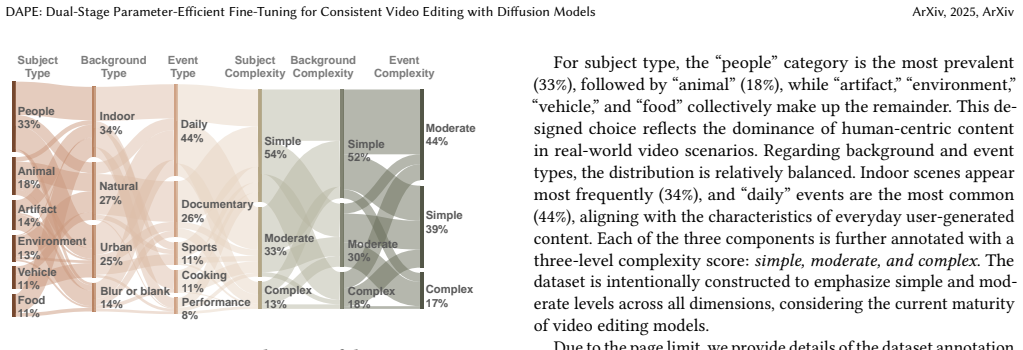
- The new benchmark standardizes resolution at 512x512 and frame counts at 32, 64, or 128 with balanced subject, background, and event categories, giving evaluation coverage that earlier datasets lack.
- User-study rankings place DAPE first on temporal consistency, text alignment, and overall quality compared with the five baselines tested.
Reading between the lines
- If the per-video fitting is what carries the gains, DAPE is best understood as a test-time personalization tool; a held-out generalization test would clarify whether the learned norm and adapter weights transfer to new source videos.
- The depth-wise 5x5 kernel in the adapter suggests local texture is what most improves perceived quality; ablating kernel size could reveal whether global structure matters at all.
- Because DAPE is demonstrated on top of several different editors, the norm-tuning and adapter recipe may generalize to other temporal-attention diffusion backbones and could be tested on longer or higher-resolution videos.
- The benchmark's difficulty labels could be used to identify which edit types (subject, background, event, style, combination) remain failure-prone, which the current aggregate metrics do not reveal.
Signed reviews
Editorial analysis
A structured set of objections, weighed in public.
Referee Report
Summary. The paper proposes DAPE, a dual-stage parameter-efficient fine-tuning (PEFT) framework for text-guided video editing. In Stage I, adjustable norm-tuning tunes the affine parameters of normalization layers plus a learnable residual scale to improve temporal consistency; in Stage II, a vision-friendly adapter (down-projection, depth-wise 5x5 convolution, up-projection, with a layer-normalization and skip connection) is inserted at the first cross-attention block of the decoder to improve visual quality. The authors argue that jointly training both modules produces negative interactions, motivating the two-stage schedule. They also introduce the DAPE Dataset, a curated benchmark of 232 videos with category/complexity annotations and multiple edit prompts. Experiments on BalanceCC, LOVEU-TGVE, RAVE, and the DAPE Dataset compare DAPE variants applied on top of five baselines (Tune-A-Video, CAMEL, SimDA, RAVE, CCEdit), reporting CLIP-Frame, interpolation error/PSNR, warping error, and CLIP-Text, plus a user study. The main quantitative evidence is Table 1 with per-baseline deltas.
Significance. If the central claims were established with matched controls, DAPE would be a practically useful contribution: it offers a parameter-efficient way to adapt a video-editing diffusion model to a single clip while decoupling temporal and visual adaptation, and the paper includes useful ablations of adapter placement and module interactions. The dataset contribution is also potentially valuable for standardized evaluation. However, the current evaluation does not establish the headline claim: the protocol trains on the same clip that is later edited, so the gains could be due to generic per-video test-time adaptation rather than the proposed modules, and no error bars or significance tests are provided. The central 'significantly outperforms' claim therefore needs additional experimental controls before it can be accepted. Strengths of the manuscript include the clear architectural description of both stages, the thorough dataset-construction pipeline in the supplementary material, and the honest reporting of the negative interaction that motivates the two-stage design.
major comments (5)
- [§5.2, Table 1] The evaluation protocol confounds per-video fine-tuning with the proposed method design. DAPE is fine-tuned on the same source video that is later edited (§3.2), whereas the baselines RAVE (training-free) and CCEdit (offline-trained) are not per-video adapted. The largest deltas (e.g., DAPE(CCEdit) on RAVE Dataset: Int. Err. -18.09%, War. Err. -34.98%) appear exactly where the baseline lacks per-video training. A matched control is required, such as per-video full fine-tuning or per-video LoRA/adapter-only tuning of the same backbone with the same training budget, to separate generic test-time adaptation from DAPE's specific design. Without this, the comparison is not apples-to-apples and the central claim is not established.
- [§5.2, Table 1] No error bars, multi-seed runs, or significance tests are reported. Many deltas are below 1% or negative (e.g., DAPE(TAV) on BalanceCC CLIP-T 0.00%, DAPE(CAMEL) on loveu-tgve War. Err. -0.99%, DAPE(SimDA) on loveu-tgve CLIP-T -0.55%), so the word 'significantly' in the abstract is unsupported. Please report variance across at least three seeds and use a paired statistical test or confidence intervals for the main comparisons.
- [§5.1 and Table 1] The instantiation of DAPE on each baseline is underspecified. Section 5.1 gives hyperparameters only for the CCEdit-initialized model and does not state how adjustable norm-tuning and the visual adapter are inserted into TAV, CAMEL, SimDA, RAVE, or CCEdit. Given the architectural differences (RAVE uses grid concatenation and noise shuffling; CCEdit uses a trident network), the insertion rules are nontrivial and must be specified for reproducibility and for interpreting the per-baseline gains.
- [§3.2 / §5.2] Transferability of the fine-tuned modules is not tested. DAPE is tuned on the clip that is later edited, and all metrics are computed on edits of that same clip, so the improvements may reflect memorization of the source appearance rather than generalizable editing behavior. The paper provides no held-out experiment, such as fine-tuning on clip A and editing clip B, or evaluating on prompts unseen during tuning. Please add such a transfer experiment, or explicitly scope the claims to per-video test-time adaptation.
- [§5.2] The claim that 'DAPE achieves the best performance across all datasets' is contradicted by several per-metric results in Table 1: DAPE(CCEdit) on BalanceCC has higher Int. Err. than CCEdit (7.58 vs 7.29), DAPE(CCEdit) on loveu-tgve has lower CLIP-F than CCEdit (93.76 vs 94.00), and DAPE(CAMEL) on loveu-tgve has higher War. Err. than CAMEL (4.07 vs 4.03). Please report per-metric wins and losses transparently and avoid the blanket 'outperforming previous state-of-the-art' claim unless an aggregate or statistical comparison justifies it.
minor comments (9)
- [Abstract / §4] The abstract says '6 editing prompts,' while §4 and Figure 9 describe five editing perspectives with two random-combination prompts (six total); align the wording.
- [Eq. (5)] The notation 'f = z + ω_dw ⊗_dw z_down' is ambiguous; the initial z should likely be z_norm, and the roles of down-projection and depth-wise convolution should be defined explicitly.
- [Table 3] Define 'w/o All' clearly (presumably the RAVE baseline on the RAVE dataset) and specify which dataset the ablation uses.
- [§5.1] Clarify whether the pre-trained ControlNet from CCEdit is used during inference for all baselines or only for DAPE variants, since this affects fairness.
- [Figure 2] Indicate which norm layers are tuned in Stage I (all LayerNorm and GroupNorm blocks?) and which remain frozen.
- [§4.1] The dataset name 'DAPE Dataset' is the same as the method name; consider renaming to avoid confusion in future citations.
- [§5.2 / Appendix B] User study numbers are inconsistent: 30 participants × 25 sets would be 750 sets, but the text reports 1,536 responses, and the supplementary mentions 21 video-text pairs; clarify the counting.
- [References] Reference [7] appears twice in the bibliography; merge the duplicate entries.
- [Table 1] 'LOVEU-TGVE' is typeset inconsistently as 'loveu-tgve' in Table 1; standardize the capitalization.
Circularity Check
No meaningful circularity: the method is an explicitly stated architectural ansatz assessed by external metrics; per-video fitting is an evaluation-protocol concern, not a circular reduction.
full rationale
The paper does not present a derivation chain that reduces to its own inputs. The core components are introduced as explicit design choices: adjustable norm-tuning is defined by Eq. (3) with a learnable scale initialized to zero, and the visual adapter is defined by Eqs. (4)-(5) as a standard adapter with a depth-wise convolution. Neither equation is derived from the reported metrics, and the reported metrics (CLIP-Frame, CLIP-Text, interpolation error/PSNR, warping error, and a user study) are external measurements rather than algebraic functions of the fitted parameters. The main caveat raised by the reader is that DAPE fine-tunes on the same source video that is later edited, so some measured gains may reflect test-time adaptation rather than the specific PEFT modules; that is a legitimate experimental-comparison concern, but it is not circularity in the derivation sense because the paper never claims to predict from unfitted constants and the evaluation is not defined in terms of the training objective. The self-citations in the motivation, references [63]-[65] by co-author Dongshuo Yin, are background support for the usefulness of adapters and are externally published, parameter-free with respect to the present result, and they are not invoked as a uniqueness theorem or as the sole justification for the central claim. The dual-stage design and adapter placement are supported by the paper's own ablation tables, not imported as forced conclusions. Overall, the central claims are empirical and independently checkable, so no circular step is exhibited.
Assumptions & free parameters
free parameters (4)
- Norm affine parameters gamma and beta =
learnable per video
- Residual scale gamma_0 =
initialized to 0, learned
- Visual adapter weights (Wdown, Wup, depthwise 5x5 conv, layer norm scale) =
learned per video
- Huber loss threshold delta =
not reported
assumptions (6)
- standard math The latent diffusion objective in Eq. 1 and DDIM inversion provide the correct training and inference procedure.
- domain assumption Stable Diffusion v1.5 plus CCEdit temporal layers and ControlNet provide a suitable generative prior for one-shot video editing.
- domain assumption Per-video fine-tuning of norm and adapter parameters transfers to the edited prompts used at inference.
- domain assumption CLIP-Frame, interpolation and warp errors, and CLIP-Text are valid proxies for temporal consistency and text alignment.
- domain assumption Huber loss is more appropriate than MSE for this per-video distribution shift.
- ad hoc to paper The two-stage schedule avoids negative interactions because the second stage does not disturb the first stage's normalization.
Cite this review
Pith. "Pith review of DAPE: Dual-Stage Parameter-Efficient Fine-Tuning for Consistent Video Editing with Diffusion Models." pith.science (2026). https://pith.science/paper/H5X4BP6T
@misc{pith2026250507057,
  author       = {Pith},
  title        = {Pith review of: DAPE: Dual-Stage Parameter-Efficient Fine-Tuning for Consistent Video Editing with Diffusion Models},
  year         = {2026},
  howpublished = {\url{https://pith.science/paper/H5X4BP6T}},
  note         = {Machine review of arXiv:2505.07057}
}
read the original abstract
Video generation based on diffusion models presents a challenging multimodal task, with video editing emerging as a pivotal direction in this field. Recent video editing approaches primarily fall into two categories: training-required and training-free methods. While training-based methods incur high computational costs, training-free alternatives often yield suboptimal performance. To address these limitations, we propose DAPE, a high-quality yet cost-effective two-stage parameter-efficient fine-tuning (PEFT) framework for video editing. In the first stage, we design an efficient norm-tuning method to enhance temporal consistency in generated videos. The second stage introduces a vision-friendly adapter to improve visual quality. Additionally, we identify critical shortcomings in existing benchmarks, including limited category diversity, imbalanced object distribution, and inconsistent frame counts. To mitigate these issues, we curate a large dataset benchmark comprising 232 videos with rich annotations and 6 editing prompts, enabling objective and comprehensive evaluation of advanced methods. Extensive experiments on existing datasets (BalanceCC, LOVEU-TGVE, RAVE) and our proposed benchmark demonstrate that DAPE significantly improves temporal coherence and text-video alignment while outperforming previous state-of-the-art approaches.
Figures


Figures from the paper (7 more)


Reference graph
Works this paper leans on
-
[1]
Jie An, Songyang Zhang, Harry Yang, Sonal Gupta, Jia-Bin Huang, Jiebo Luo, and Xi Yin. 2023. Latent-shift: Latent diffusion with temporal shift for efficient text-to-video generation. arXiv preprint arXiv:2304.08477 (2023). ArXiv, 2025, ArXiv Junhao Xia, Chaoyang Zhang, Yecheng Zhang, Chengyang Zhou, Zhichang Wang, Bochun Liu, and Dongshuo Yin Input Video...
arXiv 2023
-
[2]
Shuai Bai, Keqin Chen, Xuejing Liu, Jialin Wang, Wenbin Ge, Sibo Song, Kai Dang, Peng Wang, Shijie Wang, Jun Tang, Humen Zhong, Yuanzhi Zhu, Mingkun Yang, Zhaohai Li, Jianqiang Wan, Pengfei Wang, Wei Ding, Zheren Fu, Yiheng Xu, Jiabo Ye, Xi Zhang, Tianbao Xie, Zesen Cheng, Hang Zhang, Zhibo Yang, Haiyang Xu, and Junyang Lin. 2025. Qwen2.5-VL Technical Rep...
arXiv 2025
-
[3]
Max Bain, Arsha Nagrani, Gül Varol, and Andrew Zisserman. 2022. Frozen in Time: A Joint Video and Image Encoder for End-to-End Retrieval. arXiv:2104.00650 [cs.CV] https://arxiv.org/abs/2104.00650
arXiv 2022
-
[4]
Samyadeep Basu, Shell Hu, Daniela Massiceti, and Soheil Feizi. 2024. Strong baselines for parameter-efficient few-shot fine-tuning. In Proceedings of the AAAI Conference on Artificial Intelligence, Vol. 38. 11024–11031
work page 2024
-
[5]
Andreas Blattmann, Tim Dockhorn, Sumith Kulal, Daniel Mendelevitch, Maciej Kilian, Dominik Lorenz, Yam Levi, Zion English, Vikram Voleti, Adam Letts, et al. 2023. Stable video diffusion: Scaling latent video diffusion models to large datasets. arXiv preprint arXiv:2311.15127 (2023)
arXiv 2023
-
[7]
Andreas Blattmann, Robin Rombach, Huan Ling, Tim Dockhorn, Seung Wook Kim, Sanja Fidler, and Karsten Kreis. 2023. Align your latents: High-resolution video synthesis with latent diffusion models. In Proceedings of the IEEE/CVF conference on computer vision and pattern recognition . 22563–22575
2023
-
[8]
Tim Brooks, Aleksander Holynski, and Alexei A Efros. 2023. Instructpix2pix: Learning to follow image editing instructions. In Proceedings of the IEEE/CVF conference on computer vision and pattern recognition . 18392–18402
2023
-
[9]
Guillaume Couairon, Jakob Verbeek, Holger Schwenk, and Matthieu Cord. 2022. Diffedit: Diffusion-based semantic image editing with mask guidance. arXiv preprint arXiv:2210.11427 (2022)
arXiv 2022
Show all 76 references
-
[10]
Prafulla Dhariwal and Alexander Nichol. 2021. Diffusion models beat gans on image synthesis. Advances in neural information processing systems 34 (2021), 8780–8794
2021
-
[11]
Zhongjie Duan, Wenmeng Zhou, Cen Chen, Yaliang Li, and Weining Qian. 2024. Exvideo: Extending video diffusion models via parameter-efficient post-tuning. arXiv preprint arXiv:2406.14130 (2024)
2024 arXiv
-
[12]
Ruoyu Feng, Wenming Weng, Yanhui Wang, Yuhui Yuan, Jianmin Bao, Chong Luo, Zhibo Chen, and Baining Guo. 2024. Ccedit: Creative and controllable video editing via diffusion models. In Proceedings of the IEEE/CVF Conference on Computer Vision and Pattern Recognition . 6712–6722
2024
-
[13]
Michal Geyer, Omer Bar-Tal, Shai Bagon, and Tali Dekel. 2023. Tokenflow: Consis- tent diffusion features for consistent video editing.arXiv preprint arXiv:2307.10373 (2023)
2023 arXiv
-
[14]
Amir Hertz, Ron Mokady, Jay Tenenbaum, Kfir Aberman, Yael Pritch, and Daniel Cohen-Or. 2022. Prompt-to-prompt image editing with cross attention control. arXiv preprint arXiv:2208.01626 (2022)
2022 arXiv
-
[15]
Kingma, Ben Poole, Mohammad Norouzi, David J
Jonathan Ho, William Chan, Chitwan Saharia, Jay Whang, Ruiqi Gao, Alexey Gritsenko, Diederik P. Kingma, Ben Poole, Mohammad Norouzi, David J. Fleet, and Tim Salimans. 2022. Imagen Video: High Definition Video Generation with Diffusion Models. arXiv:2210.02303 [cs.CV] https://a...
2022 arXiv
-
[16]
Jonathan Ho, Ajay Jain, and Pieter Abbeel. 2020. Denoising diffusion probabilistic models. Advances in Neural Information Processing Systems 33 (2020), 6840–6851
2020
-
[17]
Jonathan Ho and Tim Salimans. 2022. Classifier-free diffusion guidance. arXiv preprint arXiv:2207.12598 (2022)
2022 arXiv
-
[18]
Jonathan Ho, Tim Salimans, Alexey Gritsenko, William Chan, Mohammad Norouzi, and David J Fleet. 2022. Video diffusion models. Advances in Neu- ral Information Processing Systems 35 (2022), 8633–8646
2022
-
[19]
Neil Houlsby, Andrei Giurgiu, Stanislaw Jastrzebski, Bruna Morrone, Quentin De Laroussilhe, Andrea Gesmundo, Mona Attariyan, and Sylvain Gelly. 2019. Parameter-efficient transfer learning for NLP. In International conference on machine learning. PMLR, 2790–2799
2019
-
[20]
Edward J Hu, Yelong Shen, Phillip Wallis, Zeyuan Allen-Zhu, Yuanzhi Li, Shean Wang, Lu Wang, Weizhu Chen, et al. 2022. Lora: Low-rank adaptation of large language models. ICLR 1, 2 (2022), 3
2022
-
[21]
Xun Huang and Serge Belongie. 2017. Arbitrary style transfer in real-time with adaptive instance normalization. In Proceedings of the IEEE international conference on computer vision . 1501–1510
2017
-
[22]
Aaron Hurst, Adam Lerer, Adam P Goucher, Adam Perelman, Aditya Ramesh, Aidan Clark, AJ Ostrow, Akila Welihinda, Alan Hayes, Alec Radford, et al. 2024. Gpt-4o system card. arXiv preprint arXiv:2410.21276 (2024)
2024 arXiv
-
[23]
Huaizu Jiang, Deqing Sun, Varun Jampani, Ming-Hsuan Yang, Erik Learned- Miller, and Jan Kautz. 2018. Super slomo: High quality estimation of multiple intermediate frames for video interpolation. In Proceedings of the IEEE conference on computer vision and pattern recognition ....
2018
-
[24]
Ozgur Kara, Bariscan Kurtkaya, Hidir Yesiltepe, James M Rehg, and Pinar Ya- nardag. 2024. Rave: Randomized noise shuffling for fast and consistent video editing with diffusion models. In Proceedings of the IEEE/CVF Conference on Computer Vision and Pattern Recognition . 6507–6516
2024
-
[25]
Wei-Sheng Lai, Jia-Bin Huang, Oliver Wang, Eli Shechtman, Ersin Yumer, and Ming-Hsuan Yang. 2018. Learning blind video temporal consistency. In Proceed- ings of the European conference on computer vision (ECCV) . 170–185
2018
-
[26]
Brian Lester, Rami Al-Rfou, and Noah Constant. 2021. The power of scale for parameter-efficient prompt tuning. arXiv preprint arXiv:2104.08691 (2021)
2021 arXiv
-
[27]
Xirui Li, Chao Ma, Xiaokang Yang, and Ming-Hsuan Yang. 2024. Vidtome: Video token merging for zero-shot video editing. In Proceedings of the IEEE/CVF Confer- ence on Computer Vision and Pattern Recognition . 7486–7495
2024
-
[28]
Shaoteng Liu, Yuechen Zhang, Wenbo Li, Zhe Lin, and Jiaya Jia. 2024. Video- p2p: Video editing with cross-attention control. In Proceedings of the IEEE/CVF Conference on Computer Vision and Pattern Recognition . 8599–8608
2024
-
[29]
OpenAI. 2024. Sora: Creating video from text. https://openai.com/sora. Accessed: [2025-02-22]
2024
-
[30]
William Peebles and Saining Xie. 2023. Scalable diffusion models with transform- ers. In Proceedings of the IEEE/CVF international conference on computer vision . 4195–4205
2023
-
[31]
Zelin Peng, Zhengqin Xu, Zhilin Zeng, Lingxi Xie, Qi Tian, and Wei Shen. 2024. Parameter efficient fine-tuning via cross block orchestration for segment anything model. In Proceedings of the IEEE/CVF Conference on Computer Vision and Pattern Recognition. 3743–3752
2024
-
[32]
Federico Perazzi, Jordi Pont-Tuset, Brian McWilliams, Luc Van Gool, Markus Gross, and Alexander Sorkine-Hornung. 2016. A benchmark dataset and eval- uation methodology for video object segmentation. In Proceedings of the IEEE conference on computer vision and pattern recogniti...
2016
-
[33]
Pexels. [n. d.]. https://www.pexels.com/. Accessed: 2025-04-06
2025
-
[34]
Pixabay. [n. d.]. https://pixabay.com/. Accessed: 2025-04-06
2025
-
[35]
Chenyang Qi, Xiaodong Cun, Yong Zhang, Chenyang Lei, Xintao Wang, Ying Shan, and Qifeng Chen. 2023. Fatezero: Fusing attentions for zero-shot text-based video editing. InProceedings of the IEEE/CVF International Conference on Computer Vision. 15932–15942. ArXiv, 2025, ArXiv Ju...
2023
-
[36]
Alec Radford, Jong Wook Kim, Chris Hallacy, Aditya Ramesh, Gabriel Goh, Sandhini Agarwal, Girish Sastry, Amanda Askell, Pamela Mishkin, Jack Clark, et al. 2021. Learning transferable visual models from natural language supervision. In International conference on machine learni...
2021
-
[37]
Aditya Ramesh, Prafulla Dhariwal, Alex Nichol, Casey Chu, and Mark Chen
-
[38]
Robin Rombach, Andreas Blattmann, Dominik Lorenz, Patrick Esser, and Björn Ommer. 2022. High-resolution image synthesis with latent diffusion models. In CVPR. 10684–10695
2022
-
[39]
Chitwan Saharia, William Chan, Saurabh Saxena, Lala Li, Jay Whang, Emily L Denton, Kamyar Ghasemipour, Raphael Gontijo Lopes, Burcu Karagol Ayan, Tim Salimans, et al. 2022. Photorealistic text-to-image diffusion models with deep language understanding. Advances in neural infor...
2022
-
[40]
Christoph Schuhmann, Romain Beaumont, Richard Vencu, Cade Gordon, Ross Wightman, Mehdi Cherti, Theo Coombes, Aarush Katta, Clayton Mullis, Mitchell Wortsman, et al. 2022. Laion-5b: An open large-scale dataset for training next generation image-text models. Advances in neural i...
2022
-
[41]
Chaehun Shin, Heeseung Kim, Che Hyun Lee, Sang-gil Lee, and Sungroh Yoon
-
[42]
Uriel Singer, Adam Polyak, Thomas Hayes, Xi Yin, Jie An, Songyang Zhang, Qiyuan Hu, Harry Yang, Oron Ashual, Oran Gafni, et al. 2022. Make-a-video: Text-to-video generation without text-video data. arXiv preprint arXiv:2209.14792 (2022)
2022 arXiv
-
[43]
Jiaming Song, Chenlin Meng, and Stefano Ermon. 2020. Denoising diffusion implicit models. arXiv preprint arXiv:2010.02502 (2020)
2020 arXiv
-
[44]
Yisheng Song, Ting Wang, Puyu Cai, Subrota K Mondal, and Jyoti Prakash Sahoo
-
[46]
Wenhao Sun, Rong-Cheng Tu, Jingyi Liao, and Dacheng Tao. 2024. Diffusion model-based video editing: A survey. arXiv preprint arXiv:2407.07111 (2024)
2024 arXiv
-
[47]
Zachary Teed and Jia Deng. 2020. Raft: Recurrent all-pairs field transforms for optical flow. In Computer Vision–ECCV 2020: 16th European Conference, Glasgow, UK, August 23–28, 2020, Proceedings, Part II 16 . Springer, 402–419
2020
-
[48]
Samuel Teodoro, Agus Gunawan, Soo Ye Kim, Jihyong Oh, and Munchurl Kim
-
[49]
Videvo. [n. d.]. https://www.videvo.net/. Accessed: 2025-04-06
2025
-
[50]
Carl Vondrick, Hamed Pirsiavash, and Antonio Torralba. 2016. Generating videos with scene dynamics. Advances in neural information processing systems 29 (2016)
2016
-
[51]
Wenjing Wang, Huan Yang, Zixi Tuo, Huiguo He, Junchen Zhu, Jianlong Fu, and Jiaying Liu. 2023. Videofactory: Swap attention in spatiotemporal diffusions for text-to-video generation. (2023)
2023
-
[52]
arXiv preprint arXiv:2412.12877 (2024)
MIVE: New Design and Benchmark for Multi-Instance Video Editing. arXiv preprint arXiv:2412.12877 (2024)
2024 arXiv
-
[53]
Xiaofeng Wang, Kang Zhao, Feng Liu, Jiayu Wang, Guosheng Zhao, Xiaoyi Bao, Zheng Zhu, Yingya Zhang, and Xingang Wang. 2024. EgoVid-5M: A Large- Scale Video-Action Dataset for Egocentric Video Generation. arXiv preprint arXiv:2411.08380 (2024)
2024 arXiv
-
[54]
Jay Zhangjie Wu, Yixiao Ge, Xintao Wang, Stan Weixian Lei, Yuchao Gu, Yufei Shi, Wynne Hsu, Ying Shan, Xiaohu Qie, and Mike Zheng Shou. 2023. Tune-a- video: One-shot tuning of image diffusion models for text-to-video generation. In Proceedings of the IEEE/CVF International Con...
2023
-
[55]
Jay Zhangjie Wu, Xiuyu Li, Difei Gao, Zhen Dong, Jinbin Bai, Aishani Singh, Xiaoyu Xiang, Youzeng Li, Zuwei Huang, Yuanxi Sun, Rui He, Feng Hu, Junhua Hu, Hai Huang, Hanyu Zhu, Xu Cheng, Jie Tang, Mike Zheng Shou, Kurt Keutzer, and Forrest Iandola. 2023. CVPR 2023 Text Guided ...
2023 arXiv
-
[56]
Xin Wang, Jiawei Wu, Junkun Chen, Lei Li, Yuan-Fang Wang, and William Yang Wang. 2019. Vatex: A large-scale, high-quality multilingual dataset for video- and-language research. In Proceedings of the IEEE/CVF international conference on computer vision. 4581–4591
2019
-
[57]
Zhen Xing, Qi Dai, Han Hu, Zuxuan Wu, and Yu-Gang Jiang. 2024. Simda: Simple diffusion adapter for efficient video generation. In Proceedings of the IEEE/CVF Conference on Computer Vision and Pattern Recognition . 7827–7839
2024
-
[58]
Zhen Xing, Qijun Feng, Haoran Chen, Qi Dai, Han Hu, Hang Xu, Zuxuan Wu, and Yu-Gang Jiang. 2024. A survey on video diffusion models. Comput. Surveys 57, 2 (2024), 1–42
2024
-
[59]
Jun Xu, Tao Mei, Ting Yao, and Yong Rui. 2016. Msr-vtt: A large video description dataset for bridging video and language. In Proceedings of the IEEE conference on computer vision and pattern recognition . 5288–5296
2016
-
[60]
Yi Xin, Siqi Luo, Haodi Zhou, Junlong Du, Xiaohong Liu, Yue Fan, Qing Li, and Yuntao Du. 2024. Parameter-efficient fine-tuning for pre-trained vision models: A survey. arXiv preprint arXiv:2402.02242 (2024)
2024
-
[61]
Xiangpeng Yang, Linchao Zhu, Hehe Fan, and Yi Yang. 2025. VideoGrain: Mod- ulating Space-Time Attention for Multi-grained Video Editing. arXiv preprint arXiv:2502.17258 (2025)
2025 arXiv
-
[62]
Zhuoyi Yang, Jiayan Teng, Wendi Zheng, Ming Ding, Shiyu Huang, Jiazheng Xu, Yuanming Yang, Wenyi Hong, Xiaohan Zhang, Guanyu Feng, et al . 2024. Cogvideox: Text-to-video diffusion models with an expert transformer. arXiv preprint arXiv:2408.06072 (2024)
2024 arXiv
-
[63]
Dongshuo Yin, Xueting Han, Bin Li, Hao Feng, and Jing Bai. 2024. Parameter- efficient is not sufficient: Exploring parameter, memory, and time efficient adapter tuning for dense predictions. In Proceedings of the 32nd ACM International Con- ference on Multimedia. 1398–1406
2024
-
[64]
Shuai Yang, Yifan Zhou, Ziwei Liu, and Chen Change Loy. 2023. Rerender a video: Zero-shot text-guided video-to-video translation. In SIGGRAPH Asia 2023 Conference Papers. 1–11
2023
-
[65]
Dongshuo Yin, Yiran Yang, Zhechao Wang, Hongfeng Yu, Kaiwen Wei, and Xian Sun. 2023. 1% vs 100%: Parameter-efficient low rank adapter for dense predictions. In Proceedings of the IEEE/CVF conference on computer vision and pattern recognition. 20116–20126
2023
-
[66]
YouTube. [n. d.]. https://www.youtube.com/. Accessed: 2025-04-06
2025
-
[67]
Guiwei Zhang, Tianyu Zhang, Guanglin Niu, Zichang Tan, Yalong Bai, and Qing Yang. 2024. Camel: Causal motion enhancement tailored for lifting text-driven video editing. In Proceedings of the IEEE/CVF Conference on Computer Vision and Pattern Recognition. 9079–9088
2024
-
[68]
Dongshuo Yin, Leiyi Hu, Bin Li, Youqun Zhang, and Xue Yang. 2024. 5%> 100%: Breaking performance shackles of full fine-tuning on visual recognition tasks. arXiv preprint arXiv:2408.08345 (2024)
2024 arXiv
-
[69]
Richard Zhang, Phillip Isola, Alexei A Efros, Eli Shechtman, and Oliver Wang
-
[70]
Renrui Zhang, Wei Zhang, Rongyao Fang, Peng Gao, Kunchang Li, Jifeng Dai, Yu Qiao, and Hongsheng Li. 2022. Tip-adapter: Training-free adaption of clip for few-shot classification. In European conference on computer vision . Springer, 493–510
2022
-
[71]
Yabo Zhang, Yuxiang Wei, Dongsheng Jiang, Xiaopeng Zhang, Wangmeng Zuo, and Qi Tian. 2023. Controlvideo: Training-free controllable text-to-video genera- tion. arXiv preprint arXiv:2305.13077 (2023)
2023 arXiv
-
[72]
Jeffrey O Zhang, Alexander Sax, Amir Zamir, Leonidas Guibas, and Jitendra Malik
-
[78]
A blindfolded child attempts to cut a watermelon on a table, using a knife
Zicheng Zhang, Bonan Li, Xuecheng Nie, Congying Han, Tiande Guo, and Luoqi Liu. 2023. Towards Consistent Video Editing with Text-to-Image Diffusion Models. In Advances in Neural Information Processing Systems, A. Oh, T. Naumann, A. Globerson, K. Saenko, M. Hardt, and S. Levine...
2023
-
[2018]
The Unreasonable Effectiveness of Deep Features as a Perceptual Metric. In CVPR
-
[2020]
In Computer Vision–ECCV 2020: 16th European Conference, Glasgow, UK, August 23–28, 2020, Proceedings, Part III 16
Side-tuning: a baseline for network adaptation via additive side networks. In Computer Vision–ECCV 2020: 16th European Conference, Glasgow, UK, August 23–28, 2020, Proceedings, Part III 16 . Springer, 698–714
2020
-
[2022]
arXiv preprint arXiv:2204.06125 1, 2 (2022), 3
Hierarchical text-conditional image generation with clip latents. arXiv preprint arXiv:2204.06125 1, 2 (2022), 3
2022 arXiv
-
[2023]
A comprehensive survey of few-shot learning: Evolution, applications, challenges, and opportunities. Comput. Surveys 55, 13s (2023), 1–40
2023
-
[2024]
In Asian Conference on Machine Learning
Edit-a-video: Single video editing with object-aware consistency. In Asian Conference on Machine Learning . PMLR, 1215–1230
Reviewed August 15, 2026 · model on record in the stance chip above.
Discussion (0). Continue with ORCID to comment.