REVIEW 3 major objections 6 minor 70 references
TPT-Bench: A Large-Scale, Long-Term and Robot-Egocentric Dataset for Benchmarking Target Person Tracking
T0 review · 3 major / 6 minor · reviewed 2026-08-15 · deepseek-v4-flash
Pith's one-line read TPT-Bench, a 48-sequence robot-egocentric dataset, shows that current target-person trackers reach only 66.06 F-score and 16.26 zero-false-positive recall in crowded environments.
desk verdict TPT-Bench fills a real gap as a public robot-egocentric long-term tracking dataset, but the annotation-validation evidence is too thin to fully trust the difficulty claims. read the letter →
The pith
A machine-rendered reading of the paper's core claim, the machinery that carries it, and where it could break.
The reading
What carries the argument
The load-bearing object is the dataset's annotation layer: 571,982 frames of panoramic RGB images with tight 2D bounding boxes, absent-indicator labels, and per-sequence language descriptions covering appearance, lighting, scenario, and clothing changes. These labels convert long-term tracking into a measurable re-identification problem, since disappearance intervals are long enough and crowded enough to make target search necessary. The supporting evaluation machinery is the long-term tracking metric pair from Lukežič et al. 2020: F-score, which balances precision and recall over a confidence threshold, and AMR, average max recall at 100% precision, which penalizes any false positive that would make a robot follow the wrong person. The annotation pipeline also supplies a prior: MOT+Target-ReID trackers are run first, the best visual result is selected as a seed, and annotators refine boxes and absent labels, with 15 Hz annotations interpolated to 30 Hz.
What would settle it
Re-annotate a random sample of sequences from scratch without showing annotators any tracker output, then compare the new boxes to the released ones; if mean intersection-over-union falls below about 0.9 on visible frames, or if re-running the top methods on the re-annotated subset changes their F-score ranking, then the benchmark's difficulty claims rest on annotation bias rather than on the tracking task itself.
Extended reading notes
Core claim
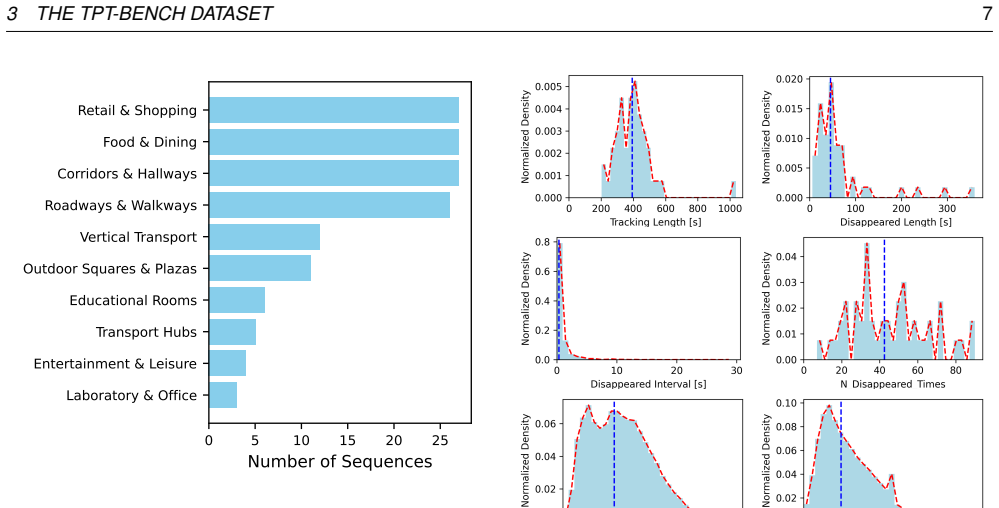
The paper introduces TPT-Bench as the first large-scale, multi-modal, robot-egocentric target-person-tracking benchmark, and demonstrates that state-of-the-art trackers fail on it. The dataset consists of 5.3 hours of recordings across 48 sequences in crowded indoor and outdoor settings, captured by a human pushing a sensor-equipped cart; annotations are frame-level 2D bounding boxes with explicit absent labels, totaling 571,982 frames. Target disappearances are frequent, averaging 45.4 per sequence and 65.3 seconds absent per sequence, and while the target is gone the field of view contains an average of 9.6 distractor pedestrians. Under long-term tracking metrics, the strongest method, RPF-ReID with KPR features, reaches only 66.06 F-score and 16.26 AMR, while the same method class scores 70.3 F-score on LaSOT and 99.1 F-score on Chen's dataset. The authors conclude that no current method reliably re-identifies a target person after long disappearance in crowded public spaces.
Load-bearing premise
The benchmark's ground-truth boxes are assumed to be accurate and neutral, but they are seeded by the same family of MOT-plus-target-re-identification trackers the paper evaluates, with no published inter-annotator agreement or manual-validation statistics; if those priors carry tracker-specific bias, the measured difficulty and method rankings could shift.
Editorial extensions
If this is right
- Long-term re-identification is the main bottleneck: targets disappear on average 45.4 times per sequence, for 65.3 seconds in aggregate, and even the best tracker loses them.
- MOT-plus-target-ReID methods with human priors beat generic single-object trackers by a wide margin, with the best SOT method at 40.05 F-score versus 66.06 for the best overall method.
- The performance drop relative to older datasets, up to 33 points of F-score versus Chen's dataset, implies that laboratory-style person-following evaluations overstate the readiness of current methods for crowded public spaces.
- Zero-false-positive recall is especially low for every method, so a robot using these trackers could confidently follow the wrong person; the safest current method still scores only 16.26 AMR.
- The released multi-modal streams, including panoramic, RGB-D, LiDAR, IMU, and odometry data, provide the substrate for moving beyond vision-only tracking, although only panoramic images are annotated in this version.
Reading between the lines
- The large jump from ResNet18 to KPR features suggests that part-aware, occlusion-robust re-identification, rather than better short-term tracking, is the highest-leverage direction; a direct test would be training a part-based ReID model on these sequences and watching whether the 66 F-score ceiling moves.
- Because online continual learning adds roughly 12 F-score points to the same method, TPT-Bench is well suited as a stress test for memory-consolidation and replay algorithms under appearance drift, an extension the paper motivates but does not run.
- The 2.5D ground-plane tool suggests a concrete fusion baseline: using projected LiDAR depth to gate re-identification candidates could reduce the false positives that AMR punishes, since AMR of the best method is only 16.26.
- The dataset includes person-search episodes, so it can be repurposed beyond tracking as an active-search benchmark, measuring how long a robot takes to locate and re-acquire a disappeared target.
Signed reviews
Editorial analysis
A structured set of objections, weighed in public.
Referee Report
Summary. The paper introduces TPT-Bench, a large-scale, long-term, robot-egocentric dataset for target person tracking (TPT), collected by a human pushing a sensor-equipped cart in crowded indoor and outdoor environments. The dataset includes 48 sequences totaling 5.3 hours, with panoramic, RGB-D, LiDAR, IMU, and odometry data, and 571,982 frames of 2D bounding-box annotations at 30 Hz (interpolated from 15 Hz manual annotations). The authors describe the annotation pipeline, which uses MOT+Target-ReID method outputs as priors and human refinement, and then evaluate a wide range of SOT, MOT+Target-ReID, and Detection+ReID baselines using measures such as F-score and average max recall at 100% precision (AMR). The results show that existing methods perform poorly, with the best method (RPF-ReID with KPR features) reaching an F-score of 66.06 and AMR of 16.26, and the paper claims TPT-Bench is more challenging than LaSOT and Chen's dataset for long-term tracking.
Significance. If the ground-truth annotations are reliable and the evaluation is unbiased, TPT-Bench is a valuable contribution to the HRI, robotics, and computer-vision communities. Its strengths are the large multi-modal dataset, the inclusion of long-term challenges such as target disappearance and re-identification among many distractors, the comprehensive evaluation of current state-of-the-art methods, and the public release of data, code, and development tools. The benchmark fills a clear gap in TPT evaluation, which has been limited to controlled or short-term settings.
major comments (3)
- [Sec. 3.2, Annotation and Labels] The ground-truth labels are generated with a prior from the same family of algorithms that are later evaluated: the text states, "we apply all MOT + Target-ReID methods to a given sequence and visually inspect the resulting tracking videos to select the best tracking result as a prior annotation." This introduces a risk of circularity. If the prior method systematically loses the target or mislabels absent frames, the human annotators may unconsciously inherit those errors, and the evaluated MOT+Target-ReID methods (including the authors' own RPF-ReID, Ye et al. 2024) would be favored. The paper provides no quantitative evidence that the final ground truth is independent of the prior, e.g., inter-annotator agreement, comparison between the prior and final labels, or analysis of annotation error rates. This is load-bearing because the central claims that the benchmark is difficult and that MOT+Target-ReID methods outperform SOT methods depend directly on the validity and unbiasedness of the ground truth.
- [Sec. 3.2, annotation upsampling] The paper states that annotations are made at 15 Hz and then "upsample the annotations from 15 Hz to 30 Hz using linear interpolation." No validation of this interpolation is reported. Since the evaluation metrics in Sec. 4.1, especially AMR in Eq. (3), rely on IoU thresholds, any distortion of interpolated boxes during fast motion could significantly change the measured performance, potentially inflating the apparent difficulty of the benchmark. The authors should provide an interpolation error analysis (e.g., comparing interpolated boxes against independently annotated 30 Hz boxes on a random subset) and report sensitivity results by running the evaluation on the 15 Hz hand-annotated frames alone.
- [Sec. 4.1, evaluation protocol] The definition of AMR in Eq. (3) sums over a set of IoU thresholds, but the exact values of this set are not specified anywhere in the paper. Similarly, the method for selecting the primary F-score ("the highest F-score at an optimal threshold") needs a precise description (grid, step size, per-sequence vs. pooled). Without these details, the reported numbers cannot be independently reproduced, and the cross-dataset comparisons in Table 3 lose their evidential value.
minor comments (6)
- [Sec. 3.2, Annotation and Labels] The phrase "tightest up-right one" should be "tightest upright one"; this is a typographical error.
- [Table 1, caption] The symbols "%" and "!" in the "Robot Egocentric" column are not explained in the caption or the text; the legend should be made explicit.
- [Sec. 4.1, evaluation protocol] The set of IoU thresholds used to compute AMR is unspecified; the authors should list the exact thresholds, e.g., {0.5, 0.75, 0.9} or a range of values.
- [Sec. 4.1, evaluation protocol] The statement "using the initial template" is ambiguous: it should clarify whether the trackers are initialized with only the first-frame bounding box or also with the textual sequence descriptions provided in the dataset.
- [Sec. 4.5, comparison with other datasets] The comparisons in Table 3 involve datasets with different sequence counts (48 vs. 20 vs. 11); reporting sequence-level standard deviations or confidence intervals would make the claim of higher difficulty more robust.
- [Sec. 3.3, dataset statistics] The units "114.3 pixel 2" and "167.4 pixel2" should be rendered as pixels² (or px²) for clarity.
Circularity Check
No circularity: the benchmark's central claims are empirical measurements, and the model-assisted annotation pipeline is a validity concern, not a derivation that reduces to its own inputs.
full rationale
TPT-Bench is an empirical benchmark paper rather than a derivation from first principles. Its central claims—best tracker F-score of 66.06, long disappearance intervals, and the difficulty comparison against LaSOT and Chen's dataset—are measurements made against released annotations and independent external benchmarks. No parameter is fitted to the headline result, no metric is defined in terms of the quantity it is used to predict, and no uniqueness theorem or ansatz is imported from the authors' prior work as the load-bearing justification. The annotation pipeline in Sec. 3.2 does bootstrap a prior from MOT+Target-ReID outputs, and the absence of inter-annotator agreement or manual-validation statistics is a legitimate quality weakness that could affect ground-truth validity and tracker rankings. However, the paper's own text describes human refinement of every frame, explicit correction of false-absent labels by selecting the target ID from tracked boxes, and manual drawing of missing boxes; the final labels are therefore not forced to equal any single tracker's output by construction. The main conclusions also include evaluations on LaSOT and Chen's dataset, which are independent of the TPT-Bench annotation bootstrap. Self-citations such as Ye et al. (2024) appear as evaluated baselines, not as unverified justifications of the central claims. Method-assisted annotation is common benchmark practice and, absent a demonstrated equation-level reduction of the benchmark result to the annotation prior, this is a validity risk rather than circularity. Accordingly, no circular derivation step is present and the score is 0.
Assumptions & free parameters
assumptions (3)
- domain assumption Push-cart egocentric observations are representative of mobile robot egocentric perception.
- domain assumption The semi-automatically generated and interpolated 2D bounding boxes are accurate ground truth.
- domain assumption Selection of the best tracking result as annotation prior does not introduce bias toward the evaluated methods.
Cite this review
Pith. "Pith review of TPT-Bench: A Large-Scale, Long-Term and Robot-Egocentric Dataset for Benchmarking Target Person Tracking." pith.science (2026). https://pith.science/paper/U3ZLKRRC
@misc{pith2026250507446,
  author       = {Pith},
  title        = {Pith review of: TPT-Bench: A Large-Scale, Long-Term and Robot-Egocentric Dataset for Benchmarking Target Person Tracking},
  year         = {2026},
  howpublished = {\url{https://pith.science/paper/U3ZLKRRC}},
  note         = {Machine review of arXiv:2505.07446}
}
read the original abstract
Tracking a target person from robot-egocentric views is crucial for developing autonomous robots that provide continuous personalized assistance or collaboration in Human-Robot Interaction (HRI) and Embodied AI. However, most existing target person tracking (TPT) benchmarks are limited to controlled laboratory environments with few distractions, clean backgrounds, and short-term occlusions. In this paper, we introduce a large-scale dataset designed for TPT in crowded and unstructured environments, demonstrated through a robot-person following task. The dataset is collected by a human pushing a sensor-equipped cart while following a target person, capturing human-like following behavior and emphasizing long-term tracking challenges, including frequent occlusions and the need for re-identification from numerous pedestrians. It includes multi-modal data streams, including odometry, 3D LiDAR, IMU, panoramic images, and RGB-D images, along with exhaustively annotated 2D bounding boxes of the target person across 48 sequences, both indoors and outdoors. Using this dataset and visual annotations, we perform extensive experiments with existing SOTA TPT methods, offering a thorough analysis of their limitations and suggesting future research directions.
Figures


Figures from the paper (8 more)




Reference graph
Works this paper leans on
- [1]
-
[2]
C ehovin L, Leonardis A and Kristan M (2016) Visual object tracking performance measures revisited. IEEE Trans. Image Process. 25(3): 1261--1274
work page 2016
-
[3]
Chaudhry A, Rohrbach M, Elhoseiny M, Ajanthan T, Dokania PK, Torr PH and Ranzato M (2019) Continual learning with tiny episodic memories. In: Int. Conf. Mach. Learn. PMLR
work page 2019
-
[4]
Chen BX, Sahdev R and Tsotsos JK (2017 a ) Integrating stereo vision with a cnn tracker for a person-following robot. In: Int. Conf. Comput. Vis. Syst. (ICVS). Springer, pp. 300--313
work page 2017
-
[5]
Chen BX, Sahdev R and Tsotsos JK (2017 b ) Person following robot using selected online ada-boosting with stereo camera. In: Conf. Comput. Rob. Vis. (CRV). pp. 48--55. doi:10.1109/CRV.2017.55
- [6]
-
[7]
Cui Y, Jiang C, Wu G and Wang L (2024) Mixformer: End-to-end tracking with iterative mixed attention. IEEE Trans. Pattern Anal. Mach. Intell
work page 2024
- [8]
Show all 70 references
-
[9]
arXiv preprint arXiv:2003.09003
Dendorfer P (2020) Mot20: A benchmark for multi object tracking in crowded scenes. arXiv preprint arXiv:2003.09003
2020 arXiv
-
[10]
IEEE Access
Eirale A, Martini M and Chiaberge M (2025) Human following and guidance by autonomous mobile robots: A comprehensive review. IEEE Access
2025
-
[11]
In: Proc
Eisenbach M, L \"u bberstedt J, Aganian D and Gross HM (2023) A little bit attention is all you need for person re-identification. In: Proc. IEEE Int. Conf. Robot. Autom. IEEE, pp. 7598--7605
2023
-
[12]
(2021) Lasot: A high-quality large-scale single object tracking benchmark
Fan H, Bai H, Lin L, Yang F, Chu P, Deng G, Yu S, Harshit, Huang M, Liu J et al. (2021) Lasot: A high-quality large-scale single object tracking benchmark. Int. J. Comput. Vis. 129: 439--461
2021
-
[13]
(2025) Principles and guidelines for evaluating social robot navigation algorithms
Francis A, P \'e rez-d’Arpino C, Li C, Xia F, Alahi A, Alami R, Bera A, Biswas A, Biswas J, Chandra R et al. (2025) Principles and guidelines for evaluating social robot navigation algorithms. ACM Transactions on Human-Robot Interaction 14(2): 1--65
2025
-
[14]
arXiv preprint arXiv:2107.08430
Ge Z (2021) Yolox: Exceeding yolo series in 2021. arXiv preprint arXiv:2107.08430
2021 arXiv
-
[15]
In: IEEE Int
Goldhoorn A, Garrell A, Alqu \'e zar R and Sanfeliu A (2014) Continuous real time pomcp to find-and-follow people by a humanoid service robot. In: IEEE Int. Conf. Humanoid Robots . IEEE, pp. 741--747
2014
-
[16]
(2017) Roreas: robot coach for walking and orientation training in clinical post-stroke rehabilitation—prototype implementation and evaluation in field trials
Gross HM, Scheidig A, Debes K, Einhorn E, Eisenbach M, Mueller S, Schmiedel T, Trinh TQ, Weinrich C, Wengefeld T et al. (2017) Roreas: robot coach for walking and orientation training in clinical post-stroke rehabilitation—prototype implementation and evaluation in field trial...
2017
-
[17]
IEEE Trans
Honig SS, Oron-Gilad T, Zaichyk H, Sarne-Fleischmann V, Olatunji S and Edan Y (2018) Toward socially aware person-following robots. IEEE Trans. Cogn. Dev. Syst. 10(4): 936--954
2018
-
[18]
In: AAAI Conf
Huang L, Zhao X and Huang K (2020) Globaltrack: A simple and strong baseline for long-term tracking. In: AAAI Conf. Artif. Intell., volume 34. pp. 11037--11044
2020
-
[19]
Islam MJ, Hong J and Sattar J (2019) Person-following by autonomous robots: A categorical overview. Int. J. Robot. Res. (IJRR) 38(14): 1581--1618
2019
-
[20]
IEEE Trans
Javed S, Danelljan M, Khan FS, Khan MH, Felsberg M and Matas J (2022) Visual object tracking with discriminative filters and siamese networks: a survey and outlook. IEEE Trans. Pattern Anal. Mach. Intell. 45(5): 6552--6574
2022
-
[21]
IEEE Robot
Karnan H, Nair A, Xiao X, Warnell G, Pirk S, Toshev A, Hart J, Biswas J and Stone P (2022) Socially compliant navigation dataset (scand): A large-scale dataset of demonstrations for social navigation. IEEE Robot. Autom. Lett. 7(4): 11807--11814
2022
-
[22]
Karunarathne D, Morales Y, Kanda T and Ishiguro H (2018) Model of side-by-side walking without the robot knowing the goal. Int. J. Social Robot. (IJSR) 10: 401--420
2018
-
[23]
Koide K, Miura J and Menegatti E (2020) Monocular person tracking and identification with on-line deep feature selection for person following robots. Robot. and Auton. Syst. 124: 103348
2020
-
[24]
In: Proc
Leigh A, Pineau J, Olmedo N and Zhang H (2015) Person tracking and following with 2d laser scanners. In: Proc. IEEE Int. Conf. Robot. Autom. pp. 726--733. doi:10.1109/ICRA.2015.7139259
2015
-
[25]
In: Proc
Li B, Wu W, Wang Q, Zhang F, Xing J and Yan J (2019) Siamrpn++: Evolution of siamese visual tracking with very deep networks. In: Proc. IEEE Conf. Comput. Vis. Pattern Recognit. pp. 4282--4291
2019
-
[26]
(2024) Deepseek-v3 technical report
Liu A, Feng B, Xue B, Wang B, Wu B, Lu C, Zhao C, Deng C, Zhang C, Ruan C et al. (2024) Deepseek-v3 technical report. arXiv preprint arXiv:2412.19437
2024 arXiv
-
[27]
IEEE Trans
Luke \'z i c A, Zajc L C , Voj \' r T, Matas J and Kristan M (2020) Performance evaluation methodology for long-term single-object tracking. IEEE Trans. Cybern. 51(12): 6305--6318
2020
-
[28]
Artificial intelligence 293: 103448
Luo W, Xing J, Milan A, Zhang X, Liu W and Kim TK (2021) Multiple object tracking: A literature review. Artificial intelligence 293: 103448
2021
-
[29]
Neurocomputing 469: 28--51
Mai Z, Li R, Jeong J, Quispe D, Kim H and Sanner S (2022) Online continual learning in image classification: An empirical survey. Neurocomputing 469: 28--51
2022
-
[30]
In: Proc
Manen S, Gygli M, Dai D and Van Gool L (2017) Pathtrack: Fast trajectory annotation with path supervision. In: Proc. IEEE Int. Conf. Comput. Vis. pp. 290--299
2017
-
[31]
IEEE Trans
Martin-Martin R, Patel M, Rezatofighi H, Shenoi A, Gwak J, Frankel E, Sadeghian A and Savarese S (2021) Jrdb: A dataset and benchmark of egocentric robot visual perception of humans in built environments. IEEE Trans. Pattern Anal. Mach. Intell. 45(6): 6748--6765
2021
-
[32]
In: Proc
Mayer C, Danelljan M, Bhat G, Paul M, Paudel DP, Yu F and Van Gool L (2022) Transforming model prediction for tracking. In: Proc. IEEE Conf. Comput. Vis. Pattern Recognit. pp. 8731--8740
2022
-
[33]
In: Proc
Mayer C, Danelljan M, Paudel DP and Van Gool L (2021) Learning target candidate association to keep track of what not to track. In: Proc. IEEE Int. Conf. Comput. Vis. pp. 13444--13454
2021
-
[34]
In: Proc
Mayer C, Danelljan M, Yang MH, Ferrari V, Van Gool L and Kuznetsova A (2024) Beyond sot: Tracking multiple generic objects at once. In: Proc. IEEE Winter Conf. App. Comput. Vis. (WACV) . pp. 6826--6836
2024
-
[35]
In: Proc
Miao J, Wu Y, Liu P, Ding Y and Yang Y (2019) Pose-guided feature alignment for occluded person re-identification. In: Proc. IEEE Int. Conf. Comput. Vis. pp. 542--551
2019
-
[36]
arXiv preprint arXiv:1603.00831
Milan A (2016) Mot16: A benchmark for multi-object tracking. arXiv preprint arXiv:1603.00831
2016 arXiv
-
[37]
Morales Y, Miyashita T and Hagita N (2017) Social robotic wheelchair centered on passenger and pedestrian comfort. Robot. and Auton. Syst. 87: 355--362
2017
-
[38]
In: Proc
Muller M, Bibi A, Giancola S, Alsubaihi S and Ghanem B (2018) Trackingnet: A large-scale dataset and benchmark for object tracking in the wild. In: Proc. Eur. Conf. Comput. Vis. pp. 300--317
2018
-
[39]
In: Proc
Nguyen DM, Nazeri M, Payandeh A, Datar A and Xiao X (2023) Toward human-like social robot navigation: A large-scale, multi-modal, social human navigation dataset. In: Proc. IEEE/RJS Int. Conf. Intell. Robots Syst. IEEE, pp. 7442--7447
2023
-
[40]
://openai.com/research/gpt-4o
OpenAI (2025) Gpt-4o: A large-scale language model. ://openai.com/research/gpt-4o
2025
-
[41]
(2024) Sam 2: Segment anything in images and videos
Ravi N, Gabeur V, Hu YT, Hu R, Ryali C, Ma T, Khedr H, R \"a dle R, Rolland C, Gustafson L et al. (2024) Sam 2: Segment anything in images and videos. arXiv preprint arXiv:2408.00714
2024 arXiv
-
[42]
In: IROS
Repiso E, Garrell A and Sanfeliu A (2018) Robot approaching and engaging people in a human-robot companion framework. In: IROS. IEEE, pp. 8200--8205
2018
-
[43]
Repiso E, Garrell A and Sanfeliu A (2020 a ) Adaptive side-by-side social robot navigation to approach and interact with people. Int. J. Social Robot. (IJSR) 12(4): 909--930
2020
-
[44]
RAL 5(2): 2387--2394
Repiso E, Garrell A and Sanfeliu A (2020 b ) People's adaptive side-by-side model evolved to accompany groups of people by social robots. RAL 5(2): 2387--2394
2020
-
[45]
In: 2023 IEEE International Conference on Advanced Robotics and Its Social Impacts (ARSO)
Rollo F, Zunino A, Raiola G, Amadio F, Ajoudani A and Tsagarakis N (2023) Followme: A robust person following framework based on visual re-identification and gestures. In: 2023 IEEE International Conference on Advanced Robotics and Its Social Impacts (ARSO). IEEE, pp. 84--89
2023
-
[46]
In: Proc
Rollo F, Zunino A, Tsagarakis N, Hoffman EM and Ajoudani A (2024) Continuous adaptation in person re-identification for robotic assistance. In: Proc. IEEE Int. Conf. Robot. Autom. pp. 425--431. doi:10.1109/ICRA57147.2024.10611226
2024
-
[47]
Singamaneni PT, Bachiller-Burgos P, Manso LJ, Garrell A, Sanfeliu A, Spalanzani A and Alami R (2024) A survey on socially aware robot navigation: Taxonomy and future challenges. Int. J. Robot. Res. (IJRR) : 02783649241230562
2024
-
[48]
IJRR 41(7): 706--720
Siva S and Zhang H (2022) Robot perceptual adaptation to environment changes for long-term human teammate following. IJRR 41(7): 706--720. doi:10.1177/0278364919896625
2022 doi
-
[49]
In: Proc
Somers V, Alahi A and Vleeschouwer CD (2025) Keypoint promptable re-identification. In: Proc. Eur. Conf. Comput. Vis. Springer, pp. 216--233
2025
-
[50]
Tang H, Liang KJ, Grauman K, Feiszli M and Wang W (2024) Egotracks: A long-term egocentric visual object tracking dataset. Adv. Neural Inf. Process. Syst. 36
2024
-
[51]
(2016) Spencer: A socially aware service robot for passenger guidance and help in busy airports
Triebel R, Arras K, Alami R, Beyer L, Breuers S, Chatila R, Chetouani M, Cremers D, Evers V, Fiore M et al. (2016) Spencer: A socially aware service robot for passenger guidance and help in busy airports. In: Proc. 10th Int. Conf. Field Serv. Robot. (FSR). Springer, pp. 607--622
2016
-
[52]
In: Proc
Voigtlaender P, Luiten J, Torr PH and Leibe B (2020) Siam r-cnn: Visual tracking by re-detection. In: Proc. IEEE Conf. Comput. Vis. Pattern Recognit. pp. 6578--6588
2020
-
[53]
arXiv preprint arXiv:2505.23189
Wang S, Zhang J, Li M, Liu J, Li A, Wu K, Zhong F, Yu J, Zhang Z and Wang H (2025) Trackvla: Embodied visual tracking in the wild. arXiv preprint arXiv:2505.23189
2025 arXiv
-
[54]
IJRR : 02783649241303525
Wei H, Jiao J, Hu X, Yu J, Xie X, Wu J, Zhu Y, Liu Y, Wang L and Liu M (2024) Fusionportablev2: A unified multi-sensor dataset for generalized slam across diverse platforms and scalable environments. IJRR : 02783649241303525
2024
-
[55]
In: Proc
Wu Y, Lim J and Yang MH (2013) Online object tracking: A benchmark. In: Proc. IEEE Conf. Comput. Vis. Pattern Recognit
2013
-
[56]
In: Proc
Yan B, Peng H, Fu J, Wang D and Lu H (2021) Learning spatio-temporal transformer for visual tracking. In: Proc. IEEE Int. Conf. Comput. Vis. pp. 10448--10457
2021
-
[57]
In: CVPR
Yang L, Kang B, Huang Z, Xu X, Feng J and Zhao H (2024) Depth anything: Unleashing the power of large-scale unlabeled data. In: CVPR
2024
-
[58]
In: Proc
Ye H, Zhao J, Pan Y, Chen W, He L and Zhang H (2023) Robot person following under partial occlusion. In: Proc. IEEE Int. Conf. Robot. Autom. IEEE, pp. 7591--7597
2023
-
[59]
IEEE Robot
Ye H, Zhao J, Zhan Y, Chen W, He L and Zhang H (2024) Person re-identification for robot person following with online continual learning. IEEE Robot. Autom. Lett
2024
-
[60]
IEEE Trans
Ye M, Shen J, Lin G, Xiang T, Shao L and Hoi SC (2021) Deep learning for person re-identification: A survey and outlook. IEEE Trans. Pattern Anal. Mach. Intell. 44(6): 2872--2893
2021
-
[61]
In: IROS
Yoshimi T, Nishiyama M, Sonoura T, Nakamoto H, Tokura S, Sato H, Ozaki F, Matsuhira N and Mizoguchi H (2006) Development of a person following robot with vision based target detection. In: IROS. IEEE, pp. 5286--5291
2006
-
[62]
In: Proc
Yu J, Ye H, Jiao J, Tan P and Zhang H (2024) Gv-bench: Benchmarking local feature matching for geometric verification of long-term loop closure detection. In: Proc. IEEE/RJS Int. Conf. Intell. Robots Syst. IEEE, pp. 7922--7928
2024
-
[63]
In: Proc
Yu T, Li D, Yang Y, Hospedales TM and Xiang T (2019) Robust person re-identification by modelling feature uncertainty. In: Proc. IEEE Int. Conf. Comput. Vis. pp. 552--561
2019
-
[64]
IEEE Trans
Zhang M, Liu X, Xu D, Cao Z and Yu J (2019) Vision-based target-following guider for mobile robot. IEEE Trans. Ind. Electron. 66(12): 9360--9371
2019
-
[65]
Zhang Y, Sun P, Jiang Y, Yu D, Weng F, Yuan Z, Luo P, Liu W and Wang X (2022) Bytetrack: Multi-object tracking by associating every detection box. Proc. Eur. Conf. Comput. Vis
2022
-
[66]
In: 2024 IEEE/RSJ International Conference on Intelligent Robots and Systems (IROS)
Zhao J, Ye H, Zhan Y, Luan H and Zhang H (2024) Human orientation estimation under partial observation. In: 2024 IEEE/RSJ International Conference on Intelligent Robots and Systems (IROS). IEEE, pp. 11544--11551
2024
-
[67]
, " * write output.state after.block = add.period write newline
ENTRY address author booktitle chapter doi edition editor eid howpublished institution isbn journal key month note number organization pages publisher school series title type url volume year label extra.label sort.label short.list INTEGERS output.state before.all mid.sentence...
-
[68]
write newline
" write newline "" before.all 'output.state := FUNCTION n.dashify 't := "" t empty not t #1 #1 substring "-" = t #1 #2 substring "--" = not "--" * t #2 global.max substring 't := t #1 #1 substring "-" = "-" * t #2 global.max substring 't := while if t #1 #1 substring * t #2 gl...
-
[69]
, " * write output.state after.block = add.period write newline
ENTRY address archive author booktitle chapter doi edition editor eid eprint howpublished institution isbn journal key month note number organization pages publisher school series title type url volume year label INTEGERS output.state before.all mid.sentence after.sentence aft...
-
[70]
write newline
" write newline "" before.all 'output.state := FUNCTION n.dashify 't := "" t empty not t #1 #1 substring "-" = t #1 #2 substring "--" = not "--" * t #2 global.max substring 't := t #1 #1 substring "-" = "-" * t #2 global.max substring 't := while if t #1 #1 substring * t #2 gl...
Reviewed August 15, 2026 · model on record in the stance chip above.
Discussion (0). Continue with ORCID to comment.