REVIEW 1 major objections 5 minor 67 references
Thermal and Kinematic Properties of Ejecta in SN1987A revealed by XRISM
T0 review · 1 major / 5 minor · reviewed 2026-08-15 · deepseek-v4-flash
Pith's one-line read The 1.7–10 keV spectrum of SN 1987A is dominated by reverse-shocked outer ejecta with LMC-like abundances, and its 1,500–1,700 km/s line widths are bulk motion, not thermal broadening.
desk verdict First resolved X-ray line profiles in SN 1987A make a strong, mostly well-supported case that the 2024 X-ray emission is dominated by kinematically broadened, non-metal-rich shocked ejecta; the remaining issues are wording and one underargued assumption. read the letter →
The pith
A machine-rendered reading of the paper's core claim, the machinery that carries it, and where it could break.
The reading
What carries the argument
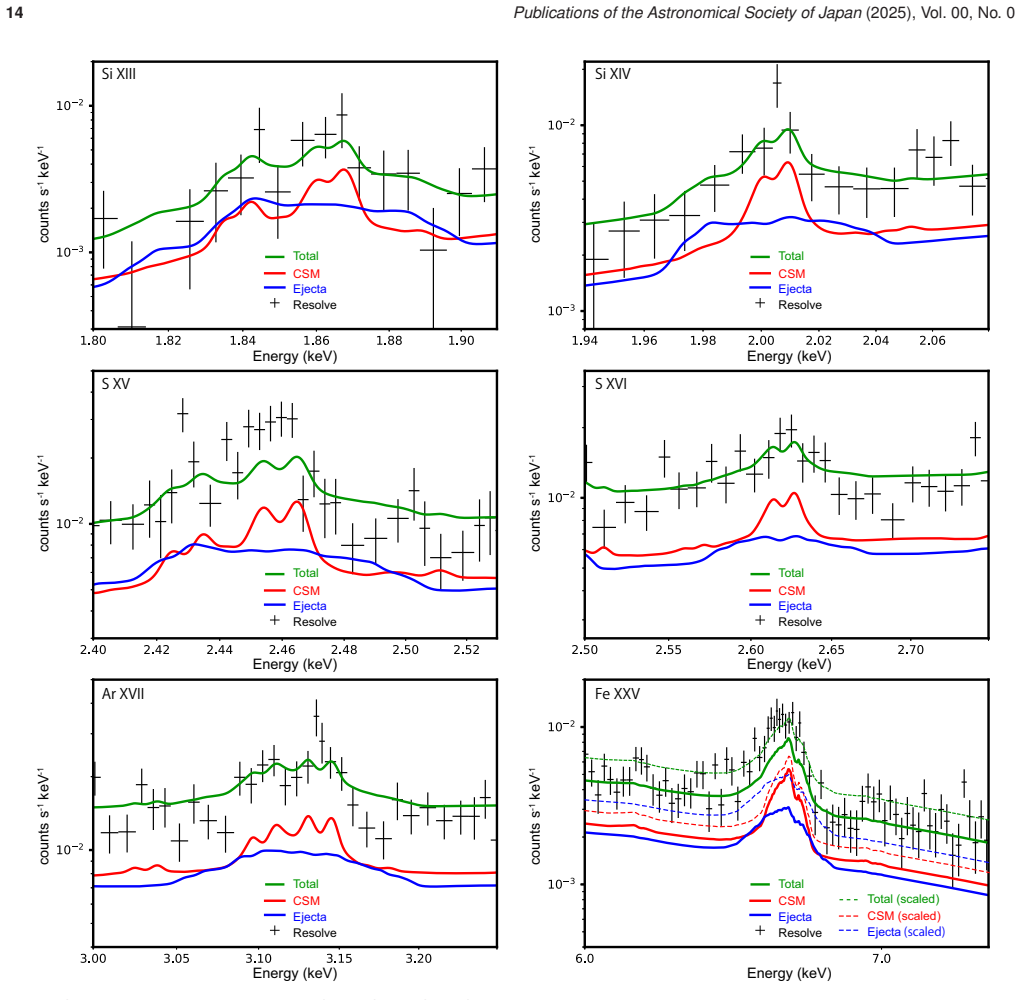
The load-bearing tool is the plane-parallel shock plasma model (bvpshock in XSPEC), which parameterizes the post-shock plasma by temperature $kT$ and an upper ionization timescale $\tau_u$ and assigns each atomic line a Doppler broadening velocity. The paper fits this model over three sub-bands and the full 1.7–10 keV band, checks internal consistency, and additionally compares the observed spectrum with a synthetic spectrum built from a 3D MHD simulation of SN 1987A, which separates the contributions of circumstellar matter and ejecta to the line cores and wings. The diagnostic that turns measured widths into bulk velocities is the comparison with thermal broadening, using the known scaling of thermal line width with ion mass and the measured energy dependence $\alpha \simeq 1.25$ of the broadening. The observation itself is made with the Resolve microcalorimeter, whose roughly 4.5 eV resolution is what makes the line widths measurable.
What would settle it
Measure Doppler widths of emission lines from ions of very different masses, such as O or Ne near 16–20 amu against Fe or Ni near 56–58 amu, in the same shocked plasma. Kinematic broadening predicts nearly the same velocity for all ions, while thermal broadening predicts widths proportional to $m^{-1/2}$, so Fe lines would be only about 0.6 times as wide as O lines; a high-signal spectrum deciding between those two scaling laws would settle whether the 1,500–1,700 km/s widths are bulk motion. The current XRISM Fe and Si measurements already point to Fe being as wide as or wider than Si, but with larger error bars than this test requires.
Extended reading notes
Core claim
The paper's central claim is that in June 2024 the X-rays from SN 1987A were emitted by non-metal-rich, shock-heated ejecta, and that the enhanced width of the X-ray lines is kinematic. The full 1.7–10 keV Resolve spectrum is described by one plane-parallel shock plasma with $kT = 2.84^{+0.09}_{-0.08}$ keV and an ionization parameter $\tau_u = 2.64^{+0.58}_{-0.45} \times 10^{11}$ s cm$^{-3}$, and the metal abundances agree with LMC values rather than with metal-enriched ejecta. Doppler widths of Si XIII, Si XIV, S XV, S XVI, Ar XVII, and Fe XXV lines correspond to velocities of 1,500–1,700 km/s. Because at this temperature and composition the electrons and ions should be Coulomb-equilibrated, thermal broadening is negligible, so the line widths must reflect bulk motion of the ejecta. The paper states that these are the first clear evidence of X-ray emission from shocked ejecta in SN 1987A, and that the reverse shock has not reached the inner metal-rich region of the ejecta.
Load-bearing premise
The argument's load-bearing premise is that electrons and ions in the non-metal-rich shocked plasma are Coulomb-equilibrated, so that at $kT \approx 2.8$ keV the true thermal line broadening is negligible; if the collisionless shock instead heats ions preferentially and they remain much hotter than the electrons, part or all of the 1,500–1,700 km/s widths could be thermal and the bulk-motion conclusion would weaken.
Editorial extensions
If this is right
- If the central claim is right, continued monitoring should show the X-ray spectrum gradually becoming metal-rich as the reverse shock reaches the inner ejecta, and the timing of that transition would constrain the density and asymmetry of the progenitor's envelope.
- The measured 1,500–1,700 km/s velocities are slower than the early 3,000–4,000 km/s expansion of the blast wave, implying that the X-ray-emitting ejecta have been decelerated while the forward shock has left the equatorial ring.
- Because the Fe XXV line appears broader than the model predicts and its wings are under-reproduced, the data hint that some Fe-rich plasma may already be contributing or has its own velocity component, a point future MHD comparisons should settle.
- The 44Sc K line upper limit of $1.0 \times 10^{-6}$ photons cm$^{-2}$ s$^{-1}$ translates to an initial $^{44}$Ti mass of roughly $2 \times 10^{-4} M_\odot$, consistent with NuSTAR and INTEGRAL, so the finding introduces no new nucleosynthesis discrepancy.
- The pulsar wind nebula upper limit of $4.3 \times 10^{-13}$ erg cm$^{-2}$ s$^{-1}$ in the 2–10 keV band aligns with NuSTAR, leaving the presence of a compact object in SN 1987A unconfirmed.
Reading between the lines
- A direct test of the kinematic interpretation is to compare line widths of low- and high-mass ions: bulk motion gives nearly equal velocities, while thermal broadening gives widths $\propto m^{-1/2}$; a longer XRISM exposure or an imaging calorimeter could make that test decisive.
- If the reverse shock is still in the LMC-composition envelope, SN 1987A offers a rare clean laboratory for measuring the composition and velocity structure of the outer layers of a core-collapse supernova before metal-rich ejecta arrive, and the transition time will calibrate simulations of mixing and reverse-shock propagation.
- The apparent excess in the Fe line wings may be an early sign of the onset of metal-rich ejecta emission, in which case the non-metal-rich phase could last only a few more years and repeat observations should see the line centers and widths change.
- The same approach of fitting a single shock model and comparing with 3D MHD predictions could be applied to other young supernova remnants with high-resolution spectra, where line-width ratios between different ions would discriminate thermal from kinematic broadening even when equilibration assumptions are less secure.
Signed reviews
Editorial analysis
A structured set of objections, weighed in public.
Referee Report
Summary. The paper presents the first high-resolution X-ray spectroscopic analysis of SN 1987A with XRISM Resolve, using a 290.5 ks observation from June 2024. The 1.7–10 keV spectrum is well reproduced by a single plane-parallel shock (bvpshock) model with kT = 2.84 keV, ionization parameter τ = 2.64×10^11 s cm^-3, and abundances consistent with LMC values for Si, S, Ar, Ca, and Fe. Doppler-broadened line widths of roughly 1,500–1,700 km/s are measured, and the authors argue that thermal broadening is negligible in the LMC-abundance plasma, so the widths represent bulk kinematic motion of the ejecta. The 3D MHD simulation of Orlando et al. (2020) reproduces the observed spectrum and line profiles, with ejecta dominating the line wings and circumstellar material the line cores, supporting the shocked-ejecta interpretation. The paper also reports a 90% upper limit on pulsar wind nebula emission and a 1σ upper limit on the 44Sc K line, corresponding to an initial 44Ti mass below about 2.6×10^-4 M_sun.
Significance. If correct, this is a major observational result: it provides the first direct, high-resolution evidence that the reverse shock in SN 1987A is now heating the outer, LMC-composition ejecta envelope, and that the inner metal-rich layers have not yet been reached. The analysis is careful and reproducible in structure: the non-X-ray background is modeled and its normalization checked, LMC and solar-flare contamination are quantified and shown to be negligible, three energy bands are fitted independently and found consistent, and the results are robust to different abundance priors. The comparison with the previously published 3D MHD simulation is a genuine, parameter-free prediction that strengthens the ejecta interpretation. The upper limits on the pulsar wind nebula and 44Ti yield are consistent with NuSTAR and INTEGRAL results and are useful additions. The conclusion is falsifiable with continued XRISM monitoring, which should reveal the transition to metal-rich ejecta.
major comments (1)
- [Section 6.3] The claim that "the electron and ion temperatures are expected to have reached equilibrium at τ ∼ 10^10–10^11 cm^-3 s, even for Fe" is asserted without any derivation or reference. This assumption is load-bearing because the conclusion that the measured 1,500–1,700 km/s line widths are purely kinematic rests on thermal broadening being negligible. A quantitative estimate of the Coulomb equilibration timescale for Fe and Si at kT ≈ 2.8 keV and the plausible post-shock density should be provided, along with the resulting thermal line widths if T_i were a factor of 3–10 above T_e. Even if the final conclusion remains unchanged, the paper should demonstrate this explicitly rather than stating it. The supporting MHD simulation, which presumably assumes a single plasma temperature, does not by itself rule out a hotter ion population.
minor comments (5)
- [Abstract and Section 6.3] The stated line-width range of 1,500–1,700 km/s (abstract) and 1,500–1,800 km/s (Section 6.3) appears to refer to the full-band model values in Tables 2 and 3, but the line-by-line measurements in Table 4 span roughly 800–2,100 km/s. Please clarify which quantity is being quoted to avoid apparent inconsistency.
- [Figure 10] The axis labels in the top row of Figure 10 are garbled in the arXiv version (e.g., "4J9***"); please ensure the final published figure renders correctly.
- [Section 2] The phrase "The observation id of this observation was" should be "The observation ID was" for style consistency.
- [Section 4.1] When introducing the Fe XXVI lines at 6.952 and 6.973 keV, please state explicitly that these energies are in the rest frame, given that the paper elsewhere discusses Doppler shifts.
- [Section 6.5] The -1,000 km/s shift applied to the 44Sc line should be explicitly identified as a blueshift relative to the systemic velocity, since the text describes it as the sum of intrinsic and recession velocities.
Circularity Check
No significant circularity: the MHD spectral prediction predates the XRISM observation and was not refitted, and the kinematic-broadening interpretation rests on an explicit physical assumption rather than on a relation that reduces to its own inputs.
full rationale
The derivation chain is not circular. The bvpshock model parameters (kT, tau_u, abundances, Doppler broadening) are free parameters fitted to the Resolve data, so reporting them is measurement rather than prediction. The ejecta identification is supported by a synthetic XRISM-Resolve spectrum from the Orlando et al. (2020) MHD simulation, generated following Sapienza et al. (2024a); the paper states that the synthetic spectrum 'agrees remarkably well with the data and self-consistently reproduces all the main spectral features without the need for performing ad-hoc fitting.' Because the simulation and its spectral prediction predate the June 2024 observation and are not refitted to these data, the agreement is genuine a priori evidence, not a re-statement of the inputs. The LMC-composition conclusion follows from fitted abundances (Si ~ 1.2, S ~ 1.2, Fe ~ 0.7 relative to LMC), not from fixing them to LMC values. The kinematic interpretation of the 1500-1700 km/s line widths does depend on the unproven assertion in Section 6.3 that 'the electron and ion temperatures are expected to have reached equilibrium at tau ~ 10^10-11 cm^-3 s, even for Fe'; however, that equilibrium claim is an assumed physical condition, not an equation fitted from or defined in terms of the measured line widths, so the argument is an assumption subject to correctness risk rather than circular reasoning. Self-citations to Orlando et al. (2020) and Sapienza et al. (2024a) are not load-bearing in a circular sense: the cited simulation is parameter-free with respect to these data, externally falsifiable, and independently corroborated by Ravi et al. (2024) and Sun et al. (2025). No step was found in which a result equals its input by construction, a fitted parameter is renamed as a prediction, or a self-citation is the sole justification for the central claim.
Assumptions & free parameters
free parameters (7)
- kT (post-shock electron temperature) =
2.84^{+0.09}_{-0.08} keV
- tau_u (upper ionization parameter) =
2.64^{+0.58}_{-0.45} x 10^11 s cm^-3
- Doppler broadening velocity v =
14.5^{+3.2}_{-2.7} x 10^2 km/s
- Doppler shift z =
-3.5^{+6.9}_{-9.2} x 10^-4
- Abundances (Si, S, Ar, Ca, Fe) relative to LMC =
Si 1.21, S 1.23, Ar 0.82, Ca 1.03, Fe 0.72
- Doppler broadening energy power alpha =
1.25^{+0.32}_{-0.37}
- NXB normalization =
0.99 +/- 0.03
assumptions (6)
- domain assumption AtomDB 3.1.2 and the APEC/pshock spectral models correctly compute line emissivities and continua for the shocked plasma.
- domain assumption Adopted distance (51.4 kpc), absorption columns (Galactic 6.0e20, LMC 2.2e21 cm^-2), LMC abundance table (Russell & Dopita 1992), and recession velocity (286.7 km/s) are correct.
- domain assumption A single plane-parallel shock (bvpshock) with a linear ionization-timescale distribution adequately represents the 1.7-10 keV spectrum.
- domain assumption Electron and ion temperatures are Coulomb-equilibrated in the non-metal-rich plasma at tau ~ 1e10-1e11 s cm^-3.
- domain assumption The Orlando et al. (2020) 3D MHD simulation, including the assumed CSM density of 50 cm^-3, is a valid representation of SN1987A's structure.
- domain assumption Standard nuclear data for the 44Ti to 44Sc to 44Ca decay chain (t44 = 85 yr, line yields W68, WSc) and the fluorescence yield at 4.09 keV.
Cite this review
Pith. "Pith review of Thermal and Kinematic Properties of Ejecta in SN1987A revealed by XRISM." pith.science (2026). https://pith.science/paper/D5LC3PFD
@misc{pith2026250507479,
  author       = {Pith},
  title        = {Pith review of: Thermal and Kinematic Properties of Ejecta in SN1987A revealed by XRISM},
  year         = {2026},
  howpublished = {\url{https://pith.science/paper/D5LC3PFD}},
  note         = {Machine review of arXiv:2505.07479}
}
abstract
We present an analysis of high-resolution spectra from the shock-heated plasmas in SN~1987A, based on an observation using the Resolve instrument onboard the X-Ray Imaging and Spectroscopy Mission (XRISM).The 1.7--10 keV Resolve spectra are accurately represented by a single component, plane-parallel shock plasma model, with a temperature of $2.84_{-0.08}^{+0.09}$ keV and an ionization parameter of $2.64_{-0.45}^{+0.58} \times 10^{11}$ s cm$^{-3}$.The Resolve spectra are also well reproduced by the 3-D magneto-hydrodynamic simulation presented by Orlando et al. (2020) suggesting substantial contribution from the ejecta. The metal abundances obtained with Resolve align with the LMC value, indicating that the X-rays in 2024 originate from non-metal-rich shock-heated ejecta and the reverse shock has not reached the inner metal-rich region of ejecta. Doppler widths of the atomic lines from Si, S, and Fe correspond to velocities of 1,500--1,700 km s$^{-1}$, where the thermal broadening effects in this non-metal-rich plasma are negligible. Therefore, the line broadening seen in Resolve spectra is determined by the large bulk motion of ejecta. For reference, we determined a 90\% upper limit on non-thermal emission from a pulsar wind nebula at $4.3 \times 10^{-13}$ erg cm$^{-2}$ s$^{-1}$ in the 2 -- 10 keV range, aligning with NuSTAR findings by Greco et al. (2022). Additionally, we searched for the $^{44}$Sc K line feature and found a $1\sigma$ upper limit of $1.0 \times 10^{-6}$ photons cm$^{-2}$ s$^{-1}$, which translates to an initial $^{44}$Ti mass of approximately $2 \times 10^{-4} M_{\odot}$, consistent with previous X-ray to soft gamma-ray observations (Boggs et al. 2015; Grebenev et al. 2012; Leising 2006).
Figures


Figures from the paper (7 more)



Reference graph
Works this paper leans on
-
[1]
Ahmad, I., Greene, J. P ., Moore, E. F., et al. 2006, Phys. Rev. C, 74, 065803,
work page 2006
- [2]
-
[3]
G., Dwek, E., Bouchet, P ., et al
Arendt, R. G., Dwek, E., Bouchet, P ., et al. 2016, AJ, 151, 62,
work page 2016
- [4]
-
[5]
Boggs, S. E., Harrison, F. A., Miyasaka, H., et al. 2015, Scie nce, 348, 670,
work page 2015
-
[6]
Borkowski, K. J., Lyerly, W. J., & Reynolds, S. P . 2001, ApJ, 548, 820,
work page 2001
-
[7]
Burrows, C. J., Krist, J., Hester, J. J., et al. 1995, ApJ, 452 , 680,
work page 1995
-
[8]
N., Michael, E., Hwang, U., et al
Burrows, D. N., Michael, E., Hwang, U., et al. 2000, ApJL, 543 , L149,
work page 2000
Show all 67 references
-
[9]
M., Ng, C
Cendes, Y ., Gaensler, B. M., Ng, C. Y ., et al. 2018, ApJ, 867, 65,
2018
-
[10]
W., & Lingenfelter, R
Chan, K. W., & Lingenfelter, R. E. 1987, in International Cos mic Ray
1987
-
[11]
A., & Dwarkadas, V
Chevalier, R. A., & Dwarkadas, V . V . 1995, ApJL, 452, L45,
1995
-
[12]
A., McCray, R., & Canizares, C
Dewey, D., Zhekov, S. A., McCray, R., & Canizares, C. R. 2008, ApJL, 676, L131,
2008
-
[13]
Diehl, R., & Timmes, F. X. 1998, PASP, 110, 637,
1998
-
[14]
A., Zhekov, S
Frank, K. A., Zhekov, S. A., Park, S., et al. 2016, ApJ, 829, 40 ,
2016
-
[15]
Fransson, C., Lundqvist, P ., & Chevalier, R. A. 1996, ApJ, 46 1, 993,
1996
-
[16]
2015, ApJL, 80 6, L19,
Fransson, C., Larsson, J., Migotto, K., et al. 2015, ApJL, 80 6, L19,
2015
-
[17]
A., Lutovinov, A
Grebenev, S. A., Lutovinov, A. A., Tsygankov, S. S., & Winkle r, C. 2012, Nature, 490, 373,
2012
-
[18]
2021, ApJL, 908, L4 5, —
Greco, E., Miceli, M., Orlando, S., et al. 2021, ApJL, 908, L4 5, —. 2022, ApJ, 931, 132,
2021
-
[19]
1996, A&A, 312, L9,
Hasinger, G., Aschenbach, B., & Truemper, J. 1996, A&A, 312, L9,
1996
-
[20]
2024, in Society of Photo- Optical Instrumentation Engineers (SPIE) Conference Series, V ol
Hayashi, K., Tashiro, M., Terada, Y ., & et al. . 2024, in Society of Photo- Optical Instrumentation Engineers (SPIE) Conference Series, V ol. 13093, Space Telescopes and Instrumentation 2024: Ultraviolet to Gamma Ray, ed. J.-W. A. den Herder, S. Nikzad, & K. Nakazawa, 130931N,
2024
-
[21]
A., Broos, P
Helder, E. A., Broos, P . S., Dewey, D., et al. 2013, ApJ, 764, 1 1,
2013
-
[22]
F., Diehl, R., Bloemen, H., et al
Iyudin, A. F., Diehl, R., Bloemen, H., et al. 1994, A&A, 284, L 1
1994
-
[23]
S., & Bleeker, J
Kaastra, J. S., & Bleeker, J. A. M. 2016, A&A, 587, A151,
2016
-
[24]
2023, A&A, 675, A1 66,
Kangas, T., Ahola, A., Fransson, C., et al. 2023, A&A, 675, A1 66,
2023
-
[25]
L., Awaki, H., Balleza, J
Kelley, R. L., Awaki, H., Balleza, J. C., & et al. . 2024, in Society of Photo- Optical Instrumentation Engineers (SPIE) Conference Series, V ol. 13093, Space Telescopes and Instrumentation 2024: Ultraviolet to Gamma Ray, ed. J.-W. A. den Herder, S. Nikzad, & K. Nakazawa, 130931J,
2024
-
[26]
2019, ApJ, 886, 147 ,
Larsson, J., Fransson, C., Alp, D., et al. 2019, ApJ, 886, 147 ,
2019
-
[27]
2023, ApJL, 94 9, L27,
Larsson, J., Fransson, C., Sargent, B., et al. 2023, ApJL, 94 9, L27,
2023
-
[28]
Leising, M. D. 2006, ApJ, 651, 1019, 16 Publications of the Astronomical Society of Japan (2025), Vol. 00, No. 0
2025
-
[29]
S., Holland, M
Loewenstein, M., Hill, R. S., Holland, M. P ., et al. 2020, in Society of Photo- Optical Instrumentation Engineers (SPIE) Conference Series, V ol. 11444, Space Telescopes and Instrumentation 2020: Ultraviolet to Gamma Ray, ed. J.-W. A. den Herder, S. Nikzad, & K. Nakazawa, 114445D,
2020
-
[30]
2012, A&A, 548, L 3,
Maggi, P ., Haberl, F., Sturm, R., & Dewey, D. 2012, A&A, 548, L 3,
2012
-
[31]
2022, A&A, 661, A30 ,
Maitra, C., Haberl, F., Sasaki, M., et al. 2022, A&A, 661, A30 ,
2022
-
[32]
G., et al
Matsuura, M., Wesson, R., Arendt, R. G., et al. 2022, MNRAS, 5 17, 4327,
2022
-
[33]
2010, ApJ, 717, 1140,
Mattila, S., Lundqvist, P ., Gröningsson, P ., et al. 2010, ApJ, 717, 1140,
2010
-
[34]
Meaburn, J., Bryce, M., & Holloway, A. J. 1995, Ap&SS, 233, 75 ,
1995
-
[35]
N., et al
Miceli, M., Orlando, S., Burrows, D. N., et al. 2019, Nature A stronomy, 3, 236,
2019
-
[36]
2024, in Society of Photo- Optical Instrumentation Engineers (SPIE) Conference Series, V ol
Mori, K., Tomida, H., Nakajima, H., & et al. . 2024, in Society of Photo- Optical Instrumentation Engineers (SPIE) Conference Series, V ol. 13093, Space Telescopes and Instrumentation 2024: Ultraviolet to Gamma Ray, ed. J.-W. A. den Herder, S. Nikzad, & K. Nakazawa, 130931I,
2024
-
[37]
1983, ApJ, 270, 119,
Morrison, R., & McCammon, D. 1983, ApJ, 270, 119,
1983
-
[38]
Y ., Zanardo, G., Potter, T
Ng, C. Y ., Zanardo, G., Potter, T. M., et al. 2013, ApJ, 777, 13 1,
2013
-
[39]
2025, arXiv e-prints, arXiv:2502.08030,
Noda, H., Mori, K., Tomida, H., et al. 2025, arXiv e-prints, arXiv:2502.08030,
2025 arXiv
-
[40]
2020, ApJ, 888, 111 ,
Ono, M., Nagataki, S., Ferrand, G., et al. 2020, ApJ, 888, 111 ,
2020
-
[41]
2025, arXiv e-prints, arXiv:2504.19896,
Orlando, S., Miceli, M., Ono, M., & et al. 2025, arXiv e-prints, arXiv:2504.19896,
2025 arXiv
-
[42]
L., & Bocchino, F
Orlando, S., Miceli, M., Pumo, M. L., & Bocchino, F. 2015, ApJ , 810, 168,
2015
-
[43]
2019, A&A, 622, A7 3,
Orlando, S., Miceli, M., Petruk, O., et al. 2019, A&A, 622, A7 3,
2019
-
[44]
2020, A&A, 636, A22 ,
Orlando, S., Ono, M., Nagataki, S., et al. 2020, A&A, 636, A22 ,
2020
-
[45]
N., Garmire, G
Park, S., Burrows, D. N., Garmire, G. P ., et al. 2002, ApJ, 567 , 314,
2002
-
[46]
A., Burrows, D
Park, S., Zhekov, S. A., Burrows, D. N., Garmire, G. P ., & McCray, R. 2004, ApJ, 610, 275,
2004
-
[47]
A., Burrows, D
Park, S., Zhekov, S. A., Burrows, D. N., et al. 2006, ApJ, 646, 1001,
2006
-
[48]
A., Burrows, D
Park, S., Zhekov, S. A., Burrows, D. N., & McCray, R. 2005, ApJ L, 634, L73,
2005
-
[49]
A., Burrows, D
Park, S., Zhekov, S. A., Burrows, D. N., et al. 2011, ApJL, 733 , L35,
2011
-
[50]
L., Park, S., Zhekov, S., et al
Racusin, J. L., Park, S., Zhekov, S., et al. 2009, ApJ, 703, 17 52,
2009
-
[51]
P ., Park, S., Zhekov, S
Ravi, A. P ., Park, S., Zhekov, S. A., et al. 2021, ApJ, 922, 140 , —. 2024, ApJ, 966, 147,
2021
-
[52]
2006, ApJL, 64 7, L41,
Renaud, M., Vink, J., Decourchelle, A., et al. 2006, ApJL, 64 7, L41,
2006
-
[53]
C., & Dopita, M
Russell, S. C., & Dopita, M. A. 1992, ApJ, 384, 508,
1992
-
[54]
2016, AJ, 152, 110,
Schenck, A., Park, S., & Post, S. 2016, AJ, 152, 110,
2016
-
[55]
K., Brickhouse, N
Smith, R. K., Brickhouse, N. S., Liedahl, D. A., & Raymond, J. C. 2001, ApJL, 556, L91,
2001
-
[56]
2010, A &A, 515, A5,
Sturm, R., Haberl, F., Aschenbach, B., & Hasinger, G. 2010, A &A, 515, A5,
2010
-
[57]
Lawrence, S. S. 2005, ApJS, 159, 60,
2005
-
[58]
2025, ApJ, 981, 26,
Sun, L., Orlando, S., Greco, E., et al. 2025, ApJ, 981, 26,
2025
-
[59]
2021, ApJ, 916, 41,
Sun, L., Vink, J., Chen, Y ., et al. 2021, ApJ, 916, 41,
2021
-
[60]
2024, in Society of Photo- Optical Instrumentation Engineers (SPIE) Conference Series, V ol
Tashiro, M., Watanabe, S., Maejima, H., & et al. . 2024, in Society of Photo- Optical Instrumentation Engineers (SPIE) Conference Series, V ol. 13093, Space Telescopes and Instrumentation 2024: Ultraviolet to Gamma Ray, ed. J.-W. A. den Herder, S. Nikzad, & K. Nakazawa, 130931G,
2024
-
[61]
2021, Journ al of Astronomical Telescopes, Instruments, and Systems, 7, 037 001,
Terada, Y ., Holland, M., Loewenstein, M., et al. 2021, Journ al of Astronomical Telescopes, Instruments, and Systems, 7, 037 001,
2021
-
[62]
X., Woosley, S
Timmes, F. X., Woosley, S. E., Hartmann, D. H., & Hoffman, R. D . 1996, ApJ, 464, 332,
1996
-
[63]
M., Kaastra, J
Vink, J., Laming, J. M., Kaastra, J. S., et al. 2001, ApJL, 560 , L79,
2001
-
[64]
M., Lauberts, A., Jorgensen, H
West, R. M., Lauberts, A., Jorgensen, H. E., & Schuster, H. E. 1987, A&A, 177, L1
1987
-
[65]
A., McCray, R., Borkowski, K
Zhekov, S. A., McCray, R., Borkowski, K. J., Burrows, D. N., & Park, S. 2005, ApJL, 628, L127, —. 2006, ApJ, 645, 293,
2005
-
[66]
A., McCray, R., Dewey, D., et al
Zhekov, S. A., McCray, R., Dewey, D., et al. 2009, ApJ, 692, 11 90,
2009
-
[67]
A., Park, S., McCray, R., Racusin, J
Zhekov, S. A., Park, S., McCray, R., Racusin, J. L., & Burrows , D. N. 2010, MNRAS, 407, 1157,
2010
Reviewed August 15, 2026 · model on record in the stance chip above.
Discussion (0). Continue with ORCID to comment.