REVIEW 4 major objections 6 minor 27 references
RAI: Flexible Agent Framework for Embodied AI
T0 review · 4 major / 6 minor · reviewed 2026-08-15 · deepseek-v4-flash
Pith's one-line read The paper claims one agent architecture spans a physical robot, a simulated arm, and a simulated tractor.
desk verdict A useful open-source framework paper whose own evaluation undercuts its blanket effectiveness claim, and which needs serious revision before the conclusions can be trusted. read the letter →
The pith
A machine-rendered reading of the paper's core claim, the machinery that carries it, and where it could break.
The reading
What carries the argument
The load-bearing mechanism is the separation of concerns into Agents, Connectors, and Tools, with Connectors acting as the sole bridge between agent reasoning and the robotic stack. Connectors implement three communication modes (publish-subscribe, service, action) so the agent can both observe and actuate a real or simulated environment, while Tools parse or create the data that flows through connectors, including formats compatible with LLM tool-calling. The embodiment mechanism is a retrieval layer called RAI_whoami, which converts documents and images into a vector database so an agent can query its own body and capabilities at runtime; this is what turns a generic LLM into an agent that knows it is a tractor or a mobile robot.
What would settle it
Implement a fourth deployment in a structurally different robotics domain—for example, a legged robot or a fixed-wing drone—using only new Connectors and Tools, while leaving the core Agent, Connector, and Tool class definitions unchanged; if that deployment fails or requires core modifications, the claimed flexibility and scalability across diverse embodied domains is falsified.
Extended reading notes
Core claim
RAI's central claim is that a single, modular architecture can serve as the common substrate for embodied multi-agent robotic systems whose agents are driven by LLMs. The architecture defines each agent through three abstractions—Agents (the decision-making unit with run/stop), Connectors (sensors and actuators supporting publish-subscribe, service, and action communication), and Tools (data converters compatible with LLM tool-calling)—and adds an embodiment layer that feeds the agent retrievable information about its own physical form. This configuration was demonstrated in three deployments: a physical mobile robot with a digital twin used for navigation and human-robot interaction, a simulated manipulator arm performing sorting, stacking, and swapping, and a simulated tractor handling agricultural edge cases. The authors report that the multi-agent setup improved responsiveness during missions, that visual embodiment improved hazard classification, and that the deployments surfaced common LLM weaknesses in spatial reasoning and self-correction.
Load-bearing premise
The load-bearing premise is that the three test deployments—a wheeled mobile robot, a simulated manipulator arm, and a simulated tractor—are representative enough of embodied AI tasks to support the conclusion that RAI is flexible and scalable across diverse robotic domains.
Editorial extensions
If this is right
- A developer can assemble an embodied agent from pre-built pieces—say, a conversational LLM agent, a ROS 2 connector, and a tool for open-set detection—without writing custom middleware.
- The same agent code can be moved between a digital twin and a physical robot, so the simulation serves as a fast-prototyping layer and the transfer confirms robustness.
- Giving an LLM-based agent a visual reference of its own body improves its judgments about what it can safely drive over or interact with.
- Multi-agent organization, with one agent dedicated to human conversation and another to the mission, keeps interaction responsive during task execution.
- Because the framework exposes the underlying LLM's errors in spatial reasoning, self-correction, and perception, it can serve as a testbed for comparing generative models on embodied tasks.
Reading between the lines
- Editorial inference: because RAI implements embodiment as retrievable documents and images, its notion of embodiment is epistemic rather than sensorimotor; the framework will succeed when physical constraints can be described, and likely fail where they must be learned from interaction.
- Editorial inference: the arm experiments suggest a direct extension—augmenting the perception Tool with depth or 3D occupancy data and measuring stacking and swapping success—which would turn RAI into a controlled testbed for how much extra perception closes LLM spatial-reasoning gaps.
- Editorial inference: the observed cross-agent mission-state inconsistencies imply a design rule the authors mention only as future work: synchronization of shared state should be rule-based, and this is testable by re-running the navigation mission with a state-based agent holding the mission state.
Signed reviews
Editorial analysis
A structured set of objections, weighed in public.
Referee Report
Summary. The paper introduces RAI, an open-source framework for building embodied multi-agent systems for robotics. The architecture is based on three abstractions: Agents, Connectors, and Tools, and it provides integration with LLMs, ROS 2, simulation environments, and embodiment data via RAG-based retrieval. The authors report three deployments: an autonomous mobile robot (Husarion ROSBot XL) with a digital twin in Section 3.1, a simulated robotic arm for manipulation tasks in Section 3.2, and a simulated orchard tractor handling edge cases in Section 3.3. The abstract claims that the framework 'has demonstrated effectiveness in all the aforementioned tasks,' and Section 4 concludes that the deployments were successful, supporting the claim of a scalable, extensible, and flexible framework.
Significance. The framework itself is a useful engineering contribution: it is publicly available, integrates with ROS 2 and LangChain-compatible tools, and has been exercised in both physical and simulated environments. The paper is honest about many observed limitations in the body, and the qualitative observations on LLM spatial reasoning and embodiment are of interest to practitioners. However, the paper's central effectiveness claim is not supported by the evidence as reported, since no quantitative metrics, task-completion criteria, or baselines are provided, and several sections describe frequent failures. The value of the paper currently lies in the architecture and the released code, not in a validated demonstration of task-level effectiveness.
major comments (4)
- [Abstract and Section 4 vs. Sections 3.1-3.3] The abstract states that RAI 'has demonstrated effectiveness in all the aforementioned tasks,' but the body reports substantial task failures: Section 3.2 states that the agent 'frequently failed on tasks that require spatial reasoning and action sequencing' and that 'stacking and object replacement errors were common'; Section 3.1 reports that 'error handling and mission success detection were inconsistent'; and Section 3.3 reports that classification errors sometimes led to 'unnecessary maneuvering, or aborting the mission.' The conclusion in Section 4 upgrades 'deployments ran' to 'successful deployments.' This overstates what the reported evidence shows. Please revise the central claim to describe the deployments as operational trials with identified limitations, or add quantitative evidence that supports the effectiveness wording.
- [Sections 3.1, 3.2, 3.3] The evaluation is entirely qualitative. No success rates, number of trials, task-completion criteria, failure counts, or baseline comparisons are reported for any of the three deployments. For example, Section 3.2 says 'success has often been observed' but never defines 'often,' and Section 3.1 says the Robot Control Agent 'successfully achieved navigation' without specifying how success was determined. Since the paper's stated evaluation goals are 'control capabilities, effectiveness of embodiment, and perception ability,' these dimensions need operational definitions and measurements. Without them, the claim of demonstrated effectiveness cannot be assessed. Please add quantitative results, or explicitly scope the paper as an experience report that does not claim validated effectiveness.
- [Abstract and Section 4] The abstract claims that RAI 'enabled identifying and addressing the shortcomings of the generative models,' but no concrete remediation is described or evaluated in the paper. Section 3.2 reports that agents 'frequently failed to recognize its mistakes due to poor image understanding' and that some tasks required 'extremely explicit' prompting. Section 4 lists features 'meant to address limitations of LLMs' only as future work. The paper thus identifies shortcomings but does not demonstrate that they were addressed. Please either provide the mechanism by which RAI addresses these shortcomings and evidence for it, or remove the 'addressing' part of the claim.
- [Section 4 and Section 1] The claim that RAI is 'scalable, extensible, and flexible' is not supported by any comparative or architectural evaluation. The paper does not report metrics for adding a new agent, connector, or tool, nor does it compare the development effort or performance against existing frameworks such as ROSA, AgentGYM, FABRIC, or MARC discussed in Section 1. The three deployments show that the framework can be used in three settings, but they are all built by the same authors and are not external benchmarks. If the contribution is architectural, the paper should present a direct comparison or at least concrete integration-cost evidence; if the contribution is only anecdotal, the generalization claim in Section 4 should be softened accordingly.
minor comments (6)
- [Section 3.1] The abbreviation 'S2S' is used without definition; please spell out 'speech-to-speech' on first use.
- [Section 2.1] The capitalization of 'langchain' is inconsistent with the project name; please use 'LangChain' consistently.
- [Section 3.3] In the 'Overview' paragraph, 'Agent gathered environment understanding' should be 'the Agent gathered environment understanding' for grammatical consistency.
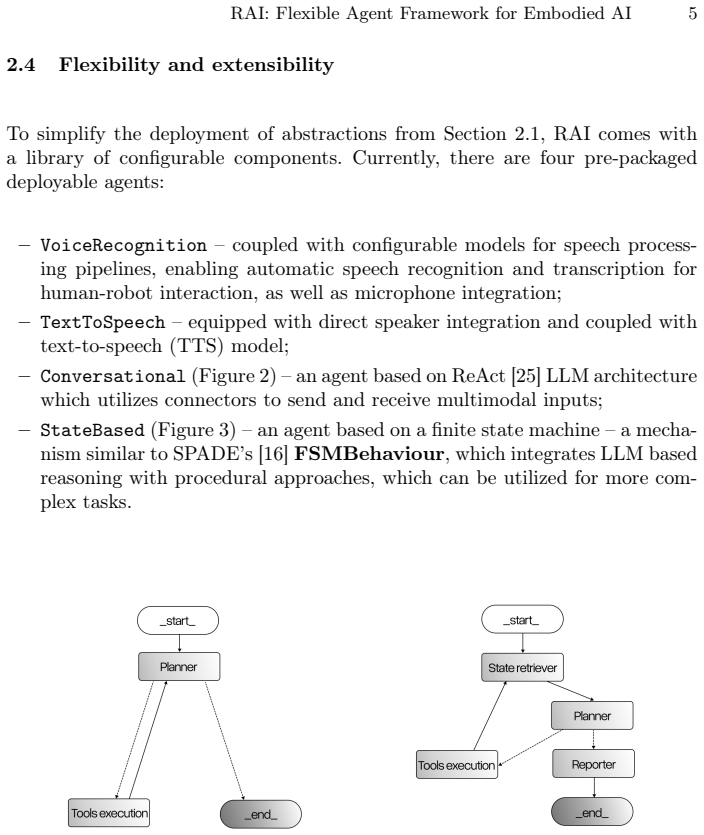
- [Section 2.4] Figures 2 and 3 are referenced in the component list, but their captions are not shown; please ensure the figures are present and clearly labeled.
- [Section 1] The citation [15] for ROS 2 is to a paper on ROS 2 node composition; a more general ROS 2 reference would be more appropriate for the sentence 'ROS and ROS 2'.
- [Section 1] The related-work discussion would benefit from explicitly distinguishing RAI from frameworks such as AgentGYM, since AgentGYM also targets LLM-based agents in environments; the current discussion focuses only on single-agent limitations.
Circularity Check
No significant circularity: the paper makes empirical engineering claims rather than derivations, and no prediction or fitted parameter reduces to an input.
full rationale
This is a framework presentation with no mathematical derivation chain, no fitted parameters, and no quantitative prediction to validate; the central claim is that the RAI abstractions are flexible enough to build embodied multi-agent systems, supported by three deployments. Those deployments are not defined in terms of the effectiveness conclusion: the fact that an agent was 'tested' in three tasks does not by construction make the framework effective. The one self-citation ([8] Hołda et al., including two current authors) is used only to motivate supporting multiple communication modes ('Previous experiences [8] have shown that relying only on one mode of communication can be limiting'); it is not load-bearing for the framework's claimed flexibility or effectiveness. The body's own limitations, e.g., Section 3.2 Results: 'The Agent succeeded in basic manipulation tasks. However, it frequently failed on tasks that require spatial reasoning and action sequencing,' and Section 3.1 Challenges: 'error handling and mission success detection were inconsistent,' undercut the abstract's blanket statement that the framework 'has demonstrated effectiveness in all the aforementioned tasks.' That discrepancy is a correctness/evidence problem, not a definitional or self-referential reduction: the conclusion does not become true by construction from its inputs; it is merely insufficiently supported by the reported trials. Under the stated rubric, no circular step is present.
Assumptions & free parameters
assumptions (4)
- domain assumption The M-Agent model, which defines an agent through its reasoning system, sensors, and actuators, is an appropriate basis for embodied multi-agent systems.
- domain assumption The digital twin in O3DE faithfully represents the ROSBot XL physical robot, so behaviors validated in simulation transfer to the real robot.
- domain assumption The three selected deployments are representative of embodied AI tasks across diverse robotic domains.
- domain assumption LLM-based agents can, when provided with appropriate tools and prompts, perform the required navigation, manipulation, and hazard-classification tasks.
Cite this review
Pith. "Pith review of RAI: Flexible Agent Framework for Embodied AI." pith.science (2026). https://pith.science/paper/IBCWR2Y3
@misc{pith2026250507532,
  author       = {Pith},
  title        = {Pith review of: RAI: Flexible Agent Framework for Embodied AI},
  year         = {2026},
  howpublished = {\url{https://pith.science/paper/IBCWR2Y3}},
  note         = {Machine review of arXiv:2505.07532}
}
read the original abstract
With an increase in the capabilities of generative language models, a growing interest in embodied AI has followed. This contribution introduces RAI - a framework for creating embodied Multi Agent Systems for robotics. The proposed framework implements tools for Agents' integration with robotic stacks, Large Language Models, and simulations. It provides out-of-the-box integration with state-of-the-art systems like ROS 2. It also comes with dedicated mechanisms for the embodiment of Agents. These mechanisms have been tested on a physical robot, Husarion ROSBot XL, which was coupled with its digital twin, for rapid prototyping. Furthermore, these mechanisms have been deployed in two simulations: (1) robot arm manipulator and (2) tractor controller. All of these deployments have been evaluated in terms of their control capabilities, effectiveness of embodiment, and perception ability. The proposed framework has been used successfully to build systems with multiple agents. It has demonstrated effectiveness in all the aforementioned tasks. It also enabled identifying and addressing the shortcomings of the generative models used for embodied AI.
Figures


Figures from the paper (3 more)


Reference graph
Works this paper leans on
- [1]
-
[2]
CoRRabs/1404.3785(2014), http://arxiv.org/abs/1404.3785
Coleman, D., Sucan, I.A., Chitta, S., Correll, N.: Reducing the barrier to entry of complex robotic software: a moveit! case study. CoRRabs/1404.3785(2014), http://arxiv.org/abs/1404.3785
arXiv 2014
-
[3]
Douze, M., Guzhva, A., Deng, C., Johnson, J., Szilvasy, G., Mazaré, P.E., Lomeli, M., Hosseini, L., Jégou, H.: The faiss library (2024)
2024
-
[4]
Duan, K., Suen, C.W.K., Zou, Z.: Marc: A multi-agent robots control framework for enhancing reinforcement learning in construction tasks (2023)
work page 2023
-
[5]
Duffy, B., Joue, G.: Intelligent robots: The question of embodiment (2000)
work page 2000
-
[6]
Guidi-Polanco, F., Cubillos, C.: An agent-based software framework for robotics and automation systems. In: Crisan, M. (ed.) Convergence and Hybrid Information Technologies,chap.7. IntechOpen, Rijeka(2010).https://doi.org/10.5772/9652
-
[7]
Guzman, L., Morellas, V., Papanikolopoulos, N.: Robotic embodiment of human- likemotorskillsviareinforcementlearning.IEEERoboticsandAutomationLetters 7(2), 3711–3717 (2022).https://doi.org/10.1109/LRA.2022.3147453
arXiv 2022
-
[8]
In: Dignum, F., Mathieu, P., Cor- chado, J.M., De La Prieta, F
Hołda, P., Rachwał, K., Sawicki, J., Ganzha, M., Paprzycki, M.: Agents assembly: Domain specific language for agent simulations. In: Dignum, F., Mathieu, P., Cor- chado, J.M., De La Prieta, F. (eds.) Advances in Practical Applications of Agents, Multi-Agent Systems, and Complex Systems Simulation. The PAAMS Collection. pp. 487–492. Springer International ...
work page 2022
Show all 27 references
-
[9]
ACM Transactions on Information Systems43(2), 1–55 (2025)
Huang, L., Yu, W., Ma, W., Zhong, W., Feng, Z., Wang, H., Chen, Q., Peng, W., Feng, X., Qin, B., et al.: A survey on hallucination in large language mod- els: Principles, taxonomy, challenges, and open questions. ACM Transactions on Information Systems43(2), 1–55 (2025)
2025
-
[10]
In: International conference on machine learning
Huang, W., Abbeel, P., Pathak, D., Mordatch, I.: Language models as zero-shot planners: Extracting actionable knowledge for embodied agents. In: International conference on machine learning. pp. 9118–9147. PMLR (2022)
2022
-
[11]
Rachwał et al
Li, C., Chen, H., Yan, M., Shen, W., Xu, H., Wu, Z., Zhang, Z., Zhou, W., Chen, Y., Cheng, C., Shi, H., Zhang, J., Huang, F., Zhou, J.: Modelscope-agent: 12 K. Rachwał et al. Building your customizable agent system with open-source large language models. ArXivabs/2309.00986(20...
2023 arXiv
-
[12]
In: 2009 4th International Conference on Autonomous Robots and Agents
Lim, C.S., Mamat, R., Braunl, T.: Market-based approach for multi-team robot cooperation. In: 2009 4th International Conference on Autonomous Robots and Agents. pp. 62–67. IEEE (2009)
2009
-
[13]
arXiv preprint arXiv:2303.05499 (2023)
Liu, S., Zeng, Z., Ren, T., Li, F., Zhang, H., Yang, J., Li, C., Yang, J., Su, H., Zhu, J., et al.: Grounding dino: Marrying dino with grounded pre-training for open-set object detection. arXiv preprint arXiv:2303.05499 (2023)
2023 arXiv
-
[14]
In: 2020 IEEE/RSJ International Conference on Intelligent Robots and Systems (IROS) (2020)
Macenski, S., Martin, F., White, R., Ginés Clavero, J.: The marathon 2: A navi- gation system. In: 2020 IEEE/RSJ International Conference on Intelligent Robots and Systems (IROS) (2020)
2020
-
[15]
IEEE Robotics and Autonomous Letters (RA-L) (2023)
Macenski, S., Soragna, A., Carroll, M., Ge, Z.: Impact of ros 2 node composition in robotic systems. IEEE Robotics and Autonomous Letters (RA-L) (2023)
2023
-
[16]
com/javipalanca/spade(Last accessed May 10th, 2022)
Palanca, J.: Smart Python Agent Development Environment.https://github. com/javipalanca/spade(Last accessed May 10th, 2022)
2022
-
[17]
arXiv preprint arXiv:2205.06175 (2022)
Reed, S., Zolna, K., Parisotto, E., Colmenarejo, S.G., Novikov, A., Barth-Maron, G., Gimenez, M., Sulsky, Y., Kay, J., Springenberg, J.T., et al.: A generalist agent. arXiv preprint arXiv:2205.06175 (2022)
2022 arXiv
-
[18]
Ren, T., Liu, S., Zeng, A., Lin, J., Li, K., Cao, H., Chen, J., Huang, X., Chen, Y., Yan, F., Zeng, Z., Zhang, H., Li, F., Yang, J., Li, H., Jiang, Q., Zhang, L.: Grounded sam: Assembling open-world models for diverse visual tasks (2024)
2024
-
[19]
In: ROMAN’2006-The 15th IEEE Int
Rogers, T.E., Sekmen, A.S., Peng, J.: Attention mechanisms for social engagements of robots with multiple people. In: ROMAN’2006-The 15th IEEE Int. Symp. on Robot and Human Interactive Communication. pp. 605–610. IEEE (2006)
2006
-
[20]
Royce, R., Kaufmann, M., Becktor, J., Moon, S., Carpenter, K., Pak, K., Towler, A., Thakker, R., Khattak, S.: Enabling novel mission operations and interactions with rosa: The robot operating system agent (2024)
2024
-
[21]
In: 2019 12th International Workshop on Robot Motion and Control (RoMoCo)
Seredyński, D., Winiarski, T., Zieliński, C.: Fabric: Framework for agent-based robot control systems. In: 2019 12th International Workshop on Robot Motion and Control (RoMoCo). pp. 215–222 (2019).https://doi.org/10.1109/RoMoCo. 2019.8787370
2019
-
[22]
arXiv preprint arXiv: Arxiv-2305.16291 (2023)
Wang, G., Xie, Y., Jiang, Y., Mandlekar, A., Xiao, C., Zhu, Y., Fan, L., Anand- kumar, A.: Voyager: An open-ended embodied agent with large language models. arXiv preprint arXiv: Arxiv-2305.16291 (2023)
2023 arXiv
-
[23]
ArXivabs/2406.04151(2024),https: //api.semanticscholar.org/CorpusID:270285866
Xi, Z., Ding, Y., Chen, W., Hong, B., Guo, H., Wang, J., Yang, D., Liao, C., Guo, X., He, W., Gao, S., Chen, L., Zheng, R., Zou, Y., Gui, T., Zhang, Q., Qiu, X., Huang, X., Wu, Z., Jiang, Y.G.: Agentgym: Evolving large language model- based agents across diverse environments. ...
2024 arXiv
-
[24]
arXiv:2402.13457 (2024)
Xu, Z., Liu, Y., Deng, G., Li, Y., Picek, S.: A comprehensive study of jailbreak attack versus defense for large language models. arXiv:2402.13457 (2024)
2024 arXiv
-
[25]
arXiv preprint arXiv:2210.03629 (2022)
Yao, S., Zhao, J., Yu, D., Du, N., Shafran, I., Narasimhan, K., Cao, Y.: React: Syn- ergizing reasoning and acting in language models. arXiv preprint arXiv:2210.03629 (2022)
2022 arXiv
-
[26]
ACM Trans
Zhao, H., Chen, H., Yang, F., Liu, N., Deng, H., Cai, H., Wang, S., Yin, D., Du, M.: Explainability for large language models: A survey. ACM Trans. Intell. Syst. Technol.15(2) (Feb 2024).https://doi.org/10.1145/3639372
2024 doi
-
[27]
In: 2006 IEEE Interna- tional Conference on Systems, Man and Cybernetics
Zhu, H.: A role-based approach to robot agent team design. In: 2006 IEEE Interna- tional Conference on Systems, Man and Cybernetics. vol. 6, pp. 4861–4866. IEEE (2006)
2006
Reviewed August 15, 2026 · model on record in the stance chip above.
Discussion (0). Continue with ORCID to comment.