REVIEW 7 minor 75 references
Three-dimensional Orbit and Dynamical Masses of GJ 105 AC
T0 review · 0 major / 7 minor · reviewed 2026-08-15 · deepseek-v4-flash
Pith's one-line read This paper derives model-independent dynamical masses for both components of the nearby binary GJ 105 AC, at about 2% precision, and argues the stars are effectively single benchmark objects.
desk verdict A solid benchmark-star paper: new MINERVA RVs and archival NIRC2 astrometry sharpen the dynamical masses of GJ 105 AC to ~2%, and the result survives the main error-model worry. read the letter →
The pith
A machine-rendered reading of the paper's core claim, the machinery that carries it, and where it could break.
The reading
What carries the argument
The central object is the three-dimensional Keplerian orbit of the secondary about the primary, parametrized by the period, time of periapsis, eccentricity, argument of periapsis, longitude of the ascending node, inclination, and the two masses, with the radial velocity and astrometry likelihoods linked through Kepler's third law and the velocity semi-amplitude $K_1$. The argument is carried by the joint fit: radial velocities fix the period, eccentricity, and periapsis timing, while relative astrometry fixes the orientation and physical angular scale; together they break the degeneracies that plague either data set alone. A secondary mechanism is the leave-one-out reweighting of the 13 astrometric errors, which the authors use to avoid overfitting the small astrometry sample, and they check that the preferred masses change by only $\sim$2% when the published errors are used instead.
What would settle it
Measure the binary's orbit independently with future astrometry that does not use the same error model, for example a Gaia astrometric orbit or additional high-resolution imaging over the next decade, and compare the total mass $M_1+M_2$ and individual masses with the paper's values; a discrepancy larger than the combined uncertainties at the level of a few percent would show the quoted precision overstates what the data support.
Extended reading notes
Core claim
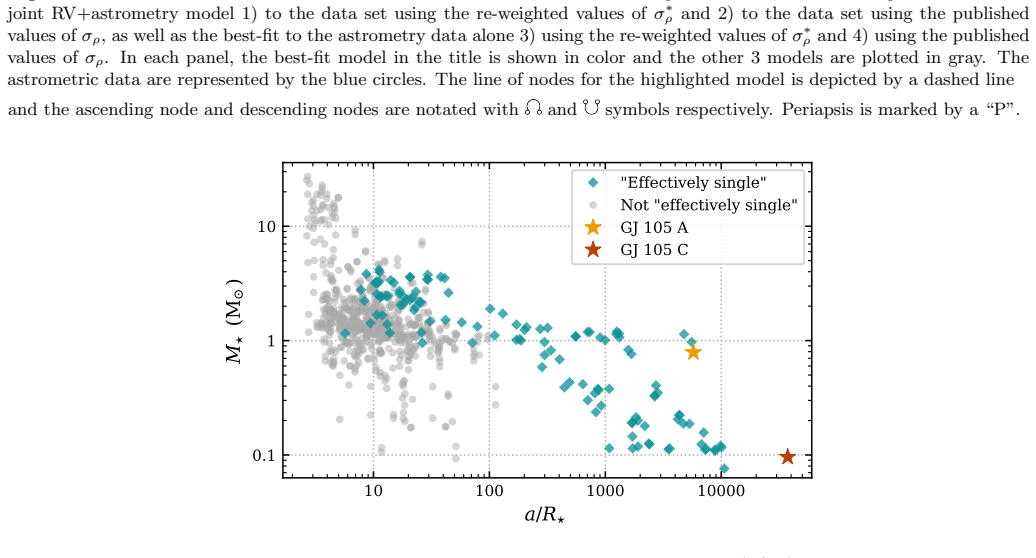
The authors establish that GJ 105 AC is a benchmark binary: combining 569 new MINERVA radial velocities that capture the full periapsis passage and the RV minimum with 13 relative astrometry points spanning 27 years and seven instruments, they fit a single Keplerian model and read off the masses directly from the orbit. The resulting dynamical masses are $M_1 = 0.78 \pm 0.02\,M_\odot$ and $M_2 = 0.098 \pm 0.002\,M_\odot$, with both components agreeing with independent SED and isochrone model masses at the 1.4$\sigma$ level. The paper argues this makes GJ 105 A and C the newest members of a small population of stars with $\sim$2–3% model-independent masses that are effectively single, and notes the system has the widest on-sky separation of any such pair after $\alpha$ Centauri AB, so both stars can be observed without spectral blending.
Load-bearing premise
The ~2 percent mass errors assume the adopted uncertainties on the 13 astrometric measurements, including the assumed 0.5-degree and 3-milliarcsecond errors and the camera distortion model for the new Keck epochs, contain no hidden systematic error; the paper itself notes that with the published errors the precision drops to about 3 percent.
Editorial extensions
If this is right
- GJ 105 A and C join the small set of stars with model-independent masses at roughly 2–3% precision that are effectively single, meaning their properties can be compared directly with single-star evolution models.
- The new MINERVA radial velocities, which cover the full periapsis passage and the RV minimum for the first time, remove the earlier period ambiguity and pin the period to $76.0 \pm 1.3$ years.
- With an average on-sky separation of $2.67''$ and a maximum of $3.51''$, the system is, after $\alpha$ Centauri AB, the widest such precise-mass pair, so both components can be observed with clean, essentially unblended spectra.
- GJ 105 A is a viable target for extreme-precision RV asteroseismology, with a predicted oscillation amplitude of about 1.9 m/s, which could deliver an independent age for the system; TESS photometry alone does not detect the oscillations.
Reading between the lines
- One extension the authors do not pursue is using the dynamical mass of GJ 105 A to calibrate asteroseismic scaling relations directly; the predicted extreme-precision RV oscillation amplitude of about 1.9 m/s makes this comparison feasible.
- At roughly $0.098\,M_\odot$, GJ 105 C sits near the bottom of the main sequence, so a future measurement of its radius and temperature would make it a pointed test of the mass–luminosity relation in a regime where dynamical masses are rare.
- The effectively single criteria introduced here could be applied to the growing sample of astrometric binaries to estimate how many clean-spectrum benchmark stars exist; the paper's own census of 805 precise-mass stars finds only 122 qualifiers, suggesting the usable population is small and worth cataloging.
Signed reviews
Editorial analysis
A structured set of objections, weighed in public.
Referee Report
Summary. The authors present a joint Keplerian fit to new MINERVA radial velocities and 13 relative astrometry points (including new Keck/NIRC2 measurements) for the K3+M7 binary GJ 105 AC. They derive P = 76.0 ± 1.3 yr, M1 = 0.782 ± 0.019 M_sun, and M2 = 0.098 ± 0.002 M_sun, with 2.5% and 2.3% precision, respectively. They compare these dynamical masses with independent EXOFASTv2 SED-based masses, discuss the system's status as a benchmark 'effectively single' star, and assess the prospects for asteroseismic follow-up.
Significance. If the results hold, this paper adds two stars to the small population of 'effectively single' benchmark objects with model-independent masses precise to ~2-3%, and GJ 105 C becomes one of the lowest-mass stars with a dynamical mass. The new MINERVA RV data spanning the periastron passage are a valuable contribution, and the joint fit is carefully tested against the choice of astrometric error weighting. The masses agree with independent SED modeling at 1.4 sigma and with the Feng et al. (2021) mass at 0.5 sigma, which strengthens confidence in the result. The explicit 'effectively single' criteria in Section 6.1 are a useful framework for placing the system in the context of the broader benchmark-star population, even though the thresholds are approximate.
minor comments (7)
- [Section 2] The text 'located in the thin disk ( ?)' contains an unresolved placeholder citation that should be replaced with the appropriate reference.
- [Section 3.1] The HARPS data span is given as 'between 2003 October 27 and 200 September 6'; the year is presumably 2009 and should be corrected.
- [Abstract] The abstract contains a duplicated article in 'as well as the the second-widest true separation', which should be corrected to 'the second-widest'.
- [Section 4.6 and Table 7] The astrometry-only fit with published errors gives Tperi, omega1, and Omega that differ from the preferred joint fit by 5.6-6.6 sigma, yet the text only notes that the periods are consistent within 1.3 sigma; the authors should add a brief discussion of whether this tension reflects the need for the LOO reweighting, a known degeneracy in astrometry-only solutions, or an unresolved systematic in the astrometry.
- [Section 4.6] The LOO reweighting procedure is self-referential in that the same joint model is used both to calibrate the astrometric errors and to perform the final fit; the published-error comparison bounds the impact on the masses, but a sentence in Section 5 or the abstract clarifying that the ~2% uncertainties are conditional on this reweighting and that the alternative error model yields ~3% precision would make the claim easier to parse.
- [Section 6.1.1] The sentence 'all of the low-mass stars in our sample with a/R_star < 100 are isolated' appears to contradict the stated criterion a/R_star > 100; please check whether the inequality should be reversed.
- [Section 4.5] The text 'a class of Markov Markov Chain Monte Carlo' contains a duplicated word and should read 'Markov Chain Monte Carlo'.
Circularity Check
No significant circularity: the dynamical masses come from independent RV and relative astrometry via Kepler's laws, with only a minor self-referential astrometric error reweighting that is explicitly bounded by a published-error comparison.
-
other
[Section 4.6 (Reweighting the Astrometry Data), Eqs. 19-20]
"We use a simplified variant of a Leave-One-Out (LOO) cross-validation model evaluation to determine the approximate scale of the errors σ∗ρ from each instrument. For each of the 13 astrometry data points, we remove the nth astrometry data point and fit the remaining data to the joint model as described in Sections 4.4 and 4.5."
The reweighted astrometric errors are computed from the RMS deviation of each point relative to leave-one-out versions of the very same joint model (Eq. 20), so the preferred fit's error bars are not independent of the model they are used to constrain. This is self-referential rather than an external calibration. It is not load-bearing for the central mass claim, however: the paper also fits with the published errors, the mass centroids shift by only ~2% and ~1.3%, and the adopted masses remain at roughly 3% precision, so the dynamical masses do not reduce to the reweighting procedure.
full rationale
The central derivation is self-contained. The joint fit combines 569 new MINERVA RVs with literature RVs and 13 relative astrometry points, solving Keplerian orbital elements and masses directly via Eqs. (4), (6)-(9); no stellar-model output is fed into the dynamical fit. The EXOFASTv2 SED masses are explicitly computed without priors from the astrometric fit ('our EXOFASTv2 model did not include priors on stellar masses derived from the astrometric fit'), so the 1.4-sigma agreement is an independent cross-check rather than an input. The only self-referential element is the LOO reweighting of astrometric errors in Section 4.6, which affects the quoted uncertainty but not the central values; the published-error comparison bounds its impact, and the resulting masses agree with the external Feng et al. (2021) value. No load-bearing self-citation chain, imported uniqueness theorem, or ansatz-by-citation appears. The paper is therefore essentially non-circular, with at most a minor, non-load-bearing self-referential step.
Assumptions & free parameters
free parameters (5)
- RV zero-point offsets for seven instruments =
γ_Lick = -39.4 m/s, γ_HARPS = -33.2 m/s, γ_HIRES = -37.6 m/s, γ_APF = -45.5 m/s, γ_T1 = -52.6 m/s, γ_T2 = -72 m/s…
- Instrumental jitter variances =
σ²_Lick = -19 m²/s², σ²_HARPS = -0.4, σ²_HIRES = -0.5, σ²_APF = 7.9, σ²_T1 = 170, σ²_T2 = 210, σ²_T3 = 130 m²/s²
- MINERVA power-outage offset Δ_out =
-20 ± 4 m/s
- Astrometric error scaling ln S_ast =
0.37 in the preferred reweighted fit
- LOO-reweighted astrometric errors σ*_ρ =
Per-instrument values in Table 5, e.g. NIRC2 0.032 arcsec, WFPC2 0.041 arcsec, AEOS 0.024 arcsec
assumptions (6)
- standard math Two-body Keplerian dynamics with the primary and secondary on a single conic section
- domain assumption Gaia DR3 parallax 138.34 ± 0.32 mas is accurate
- domain assumption RV contamination from the M7 companion is negligible
- domain assumption The NIRC2 astrometric distortion model of Yelda et al. (2010) applies to all NIRC2 epochs, including those after the 2015 realignment
- ad hoc to paper The LOO cross-validation reweighting yields unbiased per-instrument astrometric errors
- ad hoc to paper The three 'effectively single' criteria thresholds (a/R > 100, ellipticity < 1%, instellation < 1% of surface flux) define physical isolation
Cite this review
Pith. "Pith review of Three-dimensional Orbit and Dynamical Masses of GJ 105 AC." pith.science (2026). https://pith.science/paper/3T7VO3KD
@misc{pith2026250508042,
  author       = {Pith},
  title        = {Pith review of: Three-dimensional Orbit and Dynamical Masses of GJ 105 AC},
  year         = {2026},
  howpublished = {\url{https://pith.science/paper/3T7VO3KD}},
  note         = {Machine review of arXiv:2505.08042}
}
abstract
The precision of stellar models is higher than the precision at which we are able to measure the masses of most stars, with the notable exception of binaries where we can determine dynamical masses of the component stars. In addition to well-measured stellar properties, the ideal benchmark star is far enough from its companion that its properties are indistinguishable from an otherwise identical single star. Currently, there are a handful of stars with precise ($\pm$3 %), model-independent mass measurements that are "effectively single" and for which we can obtain clean spectra (i.e. spectra that are not blended with a close companion). In this paper, we introduce GJ 105 AC as the newest members of this exclusive population. We present an updated orbital analysis for the long-period K3+M7 binary GJ 105 AC. We jointly analyze radial velocity (RV) and relative astrometry data, including new RVs from the Miniature Exoplanet Radial Velocity Array (MINERVA) that capture the full periapsis passage and the RV minimum of the $76.0 \pm 1.3$ yr orbit for the first time. We derive precise dynamical masses of $M_1 = 0.78 \pm 0.02\, \mathrm{M}_\odot$ and $M_2 = 0.098 \pm 0.002\, \mathrm{M}_\odot$. We find that of all stars with similarly precise masses (~2%), GJ 105 AC stands out as having the widest on-sky separation after $\alpha$ Centauri AB, making it one of the most easily accessible to spectroscopy, as well as the the second-widest true separation, ensuring that its members are truly "effectively single" in terms of their evolution.
Figures


Figures from the paper (8 more)




Reference graph
Works this paper leans on
-
[1]
2023, PeerJ Computer Science, 9, e1516
Abril-Pla, O., Andreani, V., Carroll, C., et al. 2023, PeerJ Computer Science, 9, e1516
work page 2023
-
[2]
Allard, F., Homeier, D., & Freytag, B. 2012, Philosophical Transactions of the Royal Society of London Series A, 370, 2765, doi: 10.1098/rsta.2011.0269
arXiv 2012
-
[3]
1991, A&A Rv, 3, 91, doi: 10.1007/BF00873538 Astropy Collaboration, Robitaille, T
Andersen, J. 1991, A&A Rv, 3, 91, doi: 10.1007/BF00873538 Astropy Collaboration, Robitaille, T. P., Tollerud, E. J., et al. 2013, A&A, 558, A33, doi: 10.1051/0004-6361/201322068 Astropy Collaboration, Price-Whelan, A. M., Sip˝ ocz, B. M., et al. 2018, AJ, 156, 123, doi: 10.3847/1538-3881/aabc4f
-
[4]
I., Gibson, S., Nield, K., & Cochrane, D
Barnes, S. I., Gibson, S., Nield, K., & Cochrane, D. 2012, in Society of Photo-Optical Instrumentation Engineers (SPIE) Conference Series, Vol. 8446, Ground-based and Airborne Instrumentation for Astronomy IV, ed. I. S
2012
-
[5]
McLean, S. K. Ramsay, & H. Takami, 844688, doi: 10.1117/12.926527
-
[6]
2023, pymc-devs/pytensor: rel-2.12.3, rel-2.12.3, Zenodo, doi: 10.5281/zenodo.8049794
Bastien, F., Lamblin, P., abergeron, et al. 2023, pymc-devs/pytensor: rel-2.12.3, rel-2.12.3, Zenodo, doi: 10.5281/zenodo.8049794
-
[7]
Benedict, G. F., Henry, T. J., Franz, O. G., et al. 2016, AJ, 152, 141, doi: 10.3847/0004-6256/152/5/141
-
[8]
S., von Braun, K., van Belle, G., et al
Boyajian, T. S., von Braun, K., van Belle, G., et al. 2012, ApJ, 757, 112, doi: 10.1088/0004-637X/757/2/112
Show all 75 references
-
[9]
2008, Astrophysics Processes: The Physics of Astronomical Phenomena (Cambridge University Press)
Bradt, H. 2008, Astrophysics Processes: The Physics of Astronomical Phenomena (Cambridge University Press)
2008
-
[10]
M., Gilliland, R
Brown, T. M., Gilliland, R. L., Noyes, R. W., & Ramsey, L. W. 1991, ApJ, 368, 599, doi: 10.1086/169725
1991 doi
-
[11]
P., Vogt, S
Butler, R. P., Vogt, S. S., Laughlin, G., et al. 2017, AJ, 153, 208, doi: 10.3847/1538-3881/aa66ca
2017 doi
-
[12]
L., Schofield, M., Kuszlewicz, J
Campante, T. L., Schofield, M., Kuszlewicz, J. S., et al. 2016, ApJ, 830, 138, doi: 10.3847/0004-637X/830/2/138
2016 doi
-
[13]
J., Cegla, H
Chaplin, W. J., Cegla, H. M., Watson, C. A., Davies, G. R., & Ball, W. H. 2019, AJ, 157, 163, doi: 10.3847/1538-3881/ab0c01
2019 doi
-
[14]
M., & et al
Cutri, R. M., & et al. 2013, VizieR Online Data Catalog, 2328
2013
-
[15]
B., Henry, T
Dieterich, S. B., Henry, T. J., Golimowski, D. A., Krist, J. E., & Tanner, A. M. 2012, AJ, 144, 64, doi: 10.1088/0004-6256/144/2/64
2012 doi
-
[16]
2016, ApJS, 222, 8, doi: 10.3847/0067-0049/222/1/8
Dotter, A. 2016, ApJS, 222, 8, doi: 10.3847/0067-0049/222/1/8
2016 doi
-
[17]
S., & Agol, E
Eastman, J., Gaudi, B. S., & Agol, E. 2013, PASP, 125, 83, doi: 10.1086/669497
2013 doi
- [18]
-
[19]
P., Jones, H
Feng, F., Butler, R. P., Jones, H. R. A., et al. 2021, MNRAS, 507, 2856, doi: 10.1093/mnras/stab2225
2021 doi
-
[20]
A., Marcy, G
Fischer, D. A., Marcy, G. W., & Spronck, J. F. P. 2014, ApJS, 210, 5, doi: 10.1088/0067-0049/210/1/5
2014 doi
-
[21]
P., Barnes, R., Davenport, J
Fleming, D. P., Barnes, R., Davenport, J. R. A., & Luger, R. 2019, ApJ, 881, 88, doi: 10.3847/1538-4357/ab2ed2
2019 doi
-
[22]
2021, arXiv e-prints, arXiv:2105.01994
Foreman-Mackey, D., Luger, R., Agol, E., et al. 2021, arXiv e-prints, arXiv:2105.01994. https://arxiv.org/abs/2105.01994
2021 arXiv
-
[23]
Foreman-Mackey, D., Luger, R., Agol, E., et al. 2022, exoplanet: Gradient-based Probabilistic Inference for Exoplanet Data & Other Astronomical Time Series, v0.5.1, Zenodo, doi: 10.5281/zenodo.7191939 Gaia Collaboration, Vallenari, A., Brown, A. G. A., et al. 2023, A&A, 674, A...
2022 doi
-
[24]
2003, AJ, 125, 1530, doi: 10.1086/346143 GJ 105 AC 21
Gatewood, G., Coban, L., & Han, I. 2003, AJ, 125, 1530, doi: 10.1086/346143 GJ 105 AC 21
2003 doi
-
[25]
I., Hearnshaw, J., et al
Gibson, S., Barnes, S. I., Hearnshaw, J., et al. 2012, in Society of Photo-Optical Instrumentation Engineers (SPIE) Conference Series, Vol. 8446, Ground-based and Airborne Instrumentation for Astronomy IV, ed. I. S
2012
-
[26]
McLean, S. K. Ramsay, & H. Takami, 844648, doi: 10.1117/12.925501
-
[27]
M., Brasseur, C
Ginsburg, A., Sip˝ ocz, B. M., Brasseur, C. E., et al. 2019, AJ, 157, 98, doi: 10.3847/1538-3881/aafc33
2019 doi
-
[28]
A., Henry, T
Golimowski, D. A., Henry, T. J., Krist, J. E., et al. 2000, AJ, 120, 2082, doi: 10.1086/301567
2000 doi
-
[29]
Oppenheimer, B. R. 1995, ApJL, 444, L101, doi: 10.1086/187870
1995 doi
-
[30]
F., Luhn, J., Wright, J
Gupta, A. F., Luhn, J., Wright, J. T., et al. 2022, AJ, 164, 254, doi: 10.3847/1538-3881/ac96f3
2022 doi
-
[31]
R., Millman, K
Harris, C. R., Millman, K. J., van der Walt, S. J., et al. 2020, Nature, 585, 357, doi: 10.1038/s41586-020-2649-2
2020 doi
-
[32]
D., & Cantor, B
Heintz, W. D., & Cantor, B. A. 1994, PASP, 106, 363, doi: 10.1086/133386 He lminiak, K. G., Konacki, M., Maehara, H., et al. 2019, MNRAS, 484, 451, doi: 10.1093/mnras/sty3528
1994 doi
- [33]
-
[34]
R., Stello, D., et al
Huber, D., Bedding, T. R., Stello, D., et al. 2011, ApJ, 743, 143, doi: 10.1088/0004-637X/743/2/143
2011 doi
-
[35]
Hunter, J. D. 2007, Computing in Science & Engineering, 9, 90, doi: 10.1109/MCSE.2007.55
2007 doi
-
[36]
2022, ApJ, 924, 78, doi: 10.3847/1538-4357/ac3421
Huston, M., & Wright, J. 2022, ApJ, 924, 78, doi: 10.3847/1538-4357/ac3421
2022 doi
-
[37]
Ianna, P. A. 1992, in Astronomical Society of the Pacific Conference Series, Vol. 32, IAU Colloq. 135: Complementary Approaches to Double and Multiple Star Research, ed. H. A. McAlister & W. I. Hartkopf, 323
1992
-
[38]
M., Twicken, J
Jenkins, J. M., Twicken, J. D., McCauliff, S., et al. 2016, in Society of Photo-Optical Instrumentation Engineers (SPIE) Conference Series, Vol. 9913, Software and Cyberinfrastructure for Astronomy IV, ed. G. Chiozzi & J. C. Guzman, 99133E, doi: 10.1117/12.2233418
2016 doi
-
[39]
Kane, S. R. 2014, ApJ, 782, 111, doi: 10.1088/0004-637X/782/2/111
2014 doi
- [40]
- [41]
-
[42]
R., Arentoft, T., et al
Kjeldsen, H., Bedding, T. R., Arentoft, T., et al. 2008, ApJ, 682, 1370, doi: 10.1086/589142
2008 doi
-
[43]
2019, Journal of Open Source Software, 4, 1143, doi: 10.21105/joss.01143 Lightkurve Collaboration, Cardoso, J
Kumar, R., Carroll, C., Hartikainen, A., & Martin, O. 2019, Journal of Open Source Software, 4, 1143, doi: 10.21105/joss.01143 Lightkurve Collaboration, Cardoso, J. V. d. M., Hedges, C., et al. 2018, Lightkurve: Kepler and TESS Time Series Analysis in Python, Astrophysics Sour...
2019 doi
-
[44]
Lippincott, S. L. 1973, AJ, 78, 303, doi: 10.1086/111418
1973 doi
- [45]
- [46]
-
[47]
D., Wycoff, G
Mason, B. D., Wycoff, G. L., Hartkopf, W. I., Douglass, G. G., & Worley, C. E. 2001, AJ, 122, 3466, doi: 10.1086/323920 —. 2019, yCat, B/wds
2001 doi
- [48]
-
[49]
2020, pandas-dev/pandas: Pandas, v1.1.3, Zenodo, doi: 10.5281/zenodo.3715232
Reback, J., McKinney, W., jbrockmendel, et al. 2020, pandas-dev/pandas: Pandas, v1.1.3, Zenodo, doi: 10.5281/zenodo.3715232
2020 doi
-
[50]
R., Winn, J
Ricker, G. R., Winn, J. N., Vanderspek, R., et al. 2015, Journal of Astronomical Telescopes, Instruments, and Systems, 1, 014003, doi: 10.1117/1.JATIS.1.1.014003
2015 doi
-
[51]
C., & Mason, B
Roberts, L. C., & Mason, B. D. 2018, MNRAS, 473, 4497, doi: 10.1093/mnras/stx2559
2018 doi
-
[52]
2020, in XIV.0 Scientific Meeting (virtual) of the Spanish Astronomical Society, 182
Rodrigo, C., & Solano, E. 2020, in XIV.0 Scientific Meeting (virtual) of the Spanish Astronomical Society, 182
2020
-
[53]
2012, SVO Filter Profile Service Version 1.0, IVOA Working Draft 15 October 2012, doi: 10.5479/ADS/bib/2012ivoa.rept.1015R
Rodrigo, C., Solano, E., & Bayo, A. 2012, SVO Filter Profile Service Version 1.0, IVOA Working Draft 15 October 2012, doi: 10.5479/ADS/bib/2012ivoa.rept.1015R
2012 doi
-
[54]
R., Duchˆ ene, G., Tom, H., et al
Rodriguez, D. R., Duchˆ ene, G., Tom, H., et al. 2015, MNRAS, 449, 3160, doi: 10.1093/mnras/stv483
2015 doi
-
[55]
M., & Durlevich, O
Tsvetkova, T. M., & Durlevich, O. V. 2009, PASP, 121, 1378, doi: 10.1086/649432
2009 doi
-
[56]
C., Gomes da Silva, J., Lovis, C., & Melo, C
Santos, N. C., Gomes da Silva, J., Lovis, C., & Melo, C. 2010, A&A, 511, A54, doi: 10.1051/0004-6361/200913433
2010 doi
-
[57]
R., Campbell, R., et al
Service, M., Lu, J. R., Campbell, R., et al. 2016, PASP, 128, 095004, doi: 10.1088/1538-3873/128/967/095004
2016 doi
-
[58]
F., Cutri, R
Skrutskie, M. F., Cutri, R. M., Stiening, R., et al. 2006, AJ, 131, 1163, doi: 10.1086/498708
2006 doi
-
[59]
2015, in Astronomical Society of the Pacific Conference Series, Vol
Southworth, J. 2015, in Astronomical Society of the Pacific Conference Series, Vol. 496, Living Together: Planets, Host Stars and Binaries, ed. S. M. Rucinski, G. Torres, & M. Zejda, 164, doi: 10.48550/arXiv.1411.1219
-
[60]
J., Bottom, M., Johnson, J
Swift, J. J., Bottom, M., Johnson, J. A., et al. 2015, Journal of Astronomical Telescopes, Instruments, and Systems, 1, 027002, doi: 10.1117/1.JATIS.1.2.027002
2015 doi
-
[61]
M., Gelino, C
Tanner, A. M., Gelino, C. R., & Law, N. M. 2010, PASP, 122, 1195, doi: 10.1086/656481 22 Dedrick et al
2010 doi
-
[62]
R., Huber, D., & van Saders, J
Tayar, J., Claytor, Z. R., Huber, D., & van Saders, J. 2022, ApJ, 927, 31, doi: 10.3847/1538-4357/ac4bbc
2022 doi
-
[63]
2018, ApJS, 235, 6, doi: 10.3847/1538-4365/aaa1a5
Tokovinin, A. 2018, ApJS, 235, 6, doi: 10.3847/1538-4365/aaa1a5
2018 doi
-
[64]
Tokovinin, A. A. 1997, A&AS, 124, 75, doi: 10.1051/aas:1997181
1997 doi
-
[65]
2010, A&A Rv, 18, 67, doi: 10.1007/s00159-009-0025-1
Torres, G., Andersen, J., & Gim´ enez, A. 2010, A&A Rv, 18, 67, doi: 10.1007/s00159-009-0025-1
2010 doi
-
[66]
P., & Latham, D
Torres, G., Stefanik, R. P., & Latham, D. W. 2024a, ApJ, 960, 121, doi: 10.3847/1538-4357/ad09db
- [67]
-
[68]
A., Eggleton, P
Tout, C. A., Eggleton, P. P., Fabian, A. C., & Pringle, J. E. 1989, MNRAS, 238, 427, doi: 10.1093/mnras/238.2.427
1989 doi
-
[69]
W., & Wright, J
Tuchow, N. W., & Wright, J. T. 2020, ApJ, 905, 108, doi: 10.3847/1538-4357/abc556 van Belle, G. T., & von Braun, K. 2009, ApJ, 694, 1085, doi: 10.1088/0004-637X/694/2/1085 van Maanen, A. 1938, ApJ, 88, 27, doi: 10.1086/143957
2020 doi
-
[70]
E., et al
Virtanen, P., Gommers, R., Oliphant, T. E., et al. 2020, NatMe, 17, 261, doi: 10.1038/s41592-019-0686-2
2020 doi
-
[71]
2023, pymc-devs/pymc:, v5.10.0, Zenodo, doi: 10.5281/zenodo.10205573
Wiecki, T., Salvatier, J., Vieira, R., et al. 2023, pymc-devs/pymc:, v5.10.0, Zenodo, doi: 10.5281/zenodo.10205573
2023 doi
-
[72]
L., Eastman, J
Wilson, M. L., Eastman, J. D., Cornachione, M. A., et al. 2019, PASP, 131, 115001, doi: 10.1088/1538-3873/ab33c5
2019 doi
-
[73]
T., Marcy, G
Wright, J. T., Marcy, G. W., Fischer, D. A., et al. 2007, ApJ, 657, 533, doi: 10.1086/510553
2007 doi
-
[74]
2017, ApJS, 232, 2, doi: 10.3847/1538-4365/aa80e4
Xiang, M., Liu, X., Shi, J., et al. 2017, ApJS, 232, 2, doi: 10.3847/1538-4365/aa80e4
2017 doi
-
[75]
R., Ghez, A
Yelda, S., Lu, J. R., Ghez, A. M., et al. 2010, ApJ, 725, 331, doi: 10.1088/0004-637X/725/1/331
2010 doi
Reviewed August 15, 2026 · model on record in the stance chip above.
Discussion (0). Continue with ORCID to comment.