REVIEW 4 major objections 5 minor 1 cited by
Black hole spectral states revealed in GRMHD simulations with texture memory accelerated cooling
T0 review · 4 major / 5 minor · reviewed 2026-08-15 · deepseek-v4-flash
Pith's one-line read This paper claims that magnetically arrested black hole accretion undergoes a sharp state transition near 1% of the Eddington rate, collapsing from a hot two-temperature inflow into a truncated thin disk.
desk verdict A genuinely useful GPU cooling toolkit with an honest but floor-limited first GRMHD survey; the transition numbers need a floor-convergence test before they are quoted. read the letter →
The pith
A machine-rendered reading of the paper's core claim, the machinery that carries it, and where it could break.
The reading
What carries the argument
The load-bearing mechanism is a precomputed cooling function $Q(H_{\rm th}, B, n_e, T_e)$ that returns the total radiative loss per unit volume from bremsstrahlung, synchrotron, and inverse-Compton-enhanced synchrotron emission, with an optically thick bridge to blackbody cooling, together with a Coulomb-collision rate table $Q_{cc}(n_e,T_i,T_e)$. Both tables are stored in GPU texture memory and called inside each cell of a two-temperature GRMHD solver, with the cooling added as an external four-force and evolved either explicitly, capped at a 30% internal-energy update, or with an implicit solver. A numerical temperature floor enforcing $(H/R)_{\rm floor}=0.1$ (Eq. 19) sets the minimum thickness of the collapsed thin disk and is the main control on the quoted truncation radius.
What would settle it
Run the two high-accretion MAD cases again with $h_{\rm floor}=0.05$ and $0.02$, raise the resolution so the MRI quality factors stay above 10, and extend the runs beyond roughly $10^7\,r_g/c$ to reach inflow equilibrium; if the outer disk still truncates near $50\,r_g$ and the collapse boundary stays near $0.01\,\dot{M}_{\rm Edd}$, the claims hold, while a significantly different or missing truncation would show the transition is an artifact of the floor and the short runtime.
Extended reading notes
Core claim
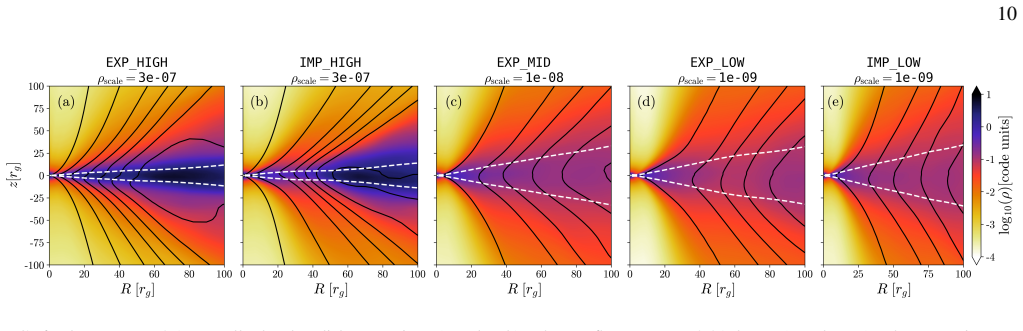
The paper's central discovery, stated on its own terms, is a critical accretion-rate boundary near $\dot{m}_{\rm crit}\sim 0.01$, where $\dot{m}=\dot{M}/\dot{M}_{\rm Edd}$, that separates two accretion regimes in MADs. Below the boundary the flow is a radiatively inefficient, geometrically thick ($H/R\approx 0.2$--$0.35$), two-temperature plasma with near-virial temperatures and $T_e\ll T_i$. Above the boundary, radiative cooling wins beyond $r\approx 50\,r_g$: the outer disk collapses to a thin, optically thick, single-temperature disk with $T_i\approx T_e\sim 10^9$ K in the raw simulations, while the region inside $50\,r_g$ stays puffed up and two-temperature; adding radiation pressure in post-processing lowers the outer temperature to about $10^7$ K. The paper identifies these density and temperature maps with the truncated-disk plus inner-corona configuration invoked for the low/hard state.
Load-bearing premise
The load-bearing premise is that the numerical floor pinning the disk's thickness at 10% of its radius (the temperature floor of Eq. 19) does not decide where the thin disk forms; lower the floor and the outer disk would collapse further, so the 50-$r_g$ truncation and the 0.01 critical rate are predictions set partly by that floor.
Editorial extensions
If this is right
- If the critical rate is real, hard-state X-ray binaries below $\dot{m}_{\rm crit}\sim 0.01$ should naturally present as hot two-temperature flows, and the soft state above it as a thin outer disk with an inner hot flow, so the disk geometry does not have to be imposed by hand.
- A truncation radius of about $50\,r_g$ in the high-accretion runs gives a specific inner edge for reflection-spectrum and quasi-periodic-oscillation models of black hole X-ray binaries, with the inner hot region also being the natural jet-launching zone.
- The transition from one-temperature to two-temperature plasma at $r_{\rm in}$ implies that spectral models of the hard and intermediate states should couple electrons and ions in the thin disk but decouple them in the inner corona.
- The reported computational gains (3--5 times faster than M1-closure radiation schemes, about 5 times faster than a global-memory lookup table) make three-dimensional surveys across the $10^{-6}$--$0.3\,\dot{M}_{\rm Edd}$ range practical at this resolution.
Reading between the lines
- A decisive follow-up that the paper does not carry out is lowering $h_{\rm floor}$ below 0.1 at higher resolution; if the truncation radius and critical rate survive that test, they are physical, and if they move, the published values are floor-limited estimates.
- The texture-memory table approach is portable: the same trick should accelerate other expensive microphysical cooling integrals, such as neutrino cooling in neutron-star merger simulations, wherever the tabulated parameter space is smooth enough for interpolation.
- If the $\sim 0.01\,\dot{M}_{\rm Edd}$ boundary holds, it makes a testable observational prediction: an X-ray binary crossing that accretion rate should show a changing inner reflection edge and a hard-to-soft spectral pivot at the radius where the disk collapses.
Signed reviews
Editorial analysis
A structured set of objections, weighed in public.
Referee Report
Summary. The paper presents a GPU-accelerated cooling toolkit for two-temperature GRMHD simulations, using precomputed lookup tables stored in texture memory to speed up radiative cooling (bremsstrahlung, synchrotron, inverse Compton, Coulomb coupling). The toolkit is implemented in H-AMR and applied to MAD simulations around a Kerr black hole with a*=0.9375, spanning Eddington ratios from ~3e-6 to ~0.26. The central scientific claim is that a critical accretion rate near mdot ~ 0.01 separates two regimes: below it, the flow is a geometrically thick, two-temperature hot flow; above it, an outer single-temperature thin disk forms, truncated at rin ~ 50 rg, with an inner two-temperature hot flow and thin filaments. The paper also reports substantial speedups of the cooling prescription relative to M1 radiation transport and global-memory lookup tables.
Significance. If the central claim holds, this is a significant step: it would demonstrate that spectral-state-like transitions can emerge from first-principles GRMHD simulations with local radiative cooling, rather than being imposed by a model. The technical contribution is solid and reproducible: the texture-memory benchmark speedups (Sec. IV, Appendix A), the comparison between implicit and explicit cooling, and the explicit statement of caveats are all strengths. The claim is not circular: the cooling table is built from standard radiative formulas and no parameter is tuned to produce a particular state. However, the quantitative predictions (mdot_crit ~ 0.01, rin ~ 50 rg) are controlled by numerical choices, particularly the aspect-ratio floor h_floor = 0.1, and the simulations are not in inflow equilibrium at the relevant radii. The qualitative collapse is plausible and consistent with prior work, but the quantitative claims are not yet converged.
major comments (4)
- [Section III.B.2 and Section IV.A] The imposed temperature floor, Eq. (19) with h_floor=(H/R)_floor=0.1, directly sets the minimum thickness of the outer thin disk. Section IV.A states that without this floor, the r>50 rg regions 'would collapse even further,' and Fig. 11(b) shows both high-rate runs saturating at H/R ~ 0.10 at r=60 rg. Because the floor pins the outer disk temperature, it also controls the density and Coulomb-coupling rate there, and hence the one-temperature plasma condition and the derived truncation radius rin ~ 50 rg. The paper does not provide a floor-convergence test (e.g., varying h_floor with matched resolution and runtime), so the quantitative central claim is numerical-control-limited rather than a converged physical prediction. This point is load-bearing for conclusions (iii) and (iv).
- [Section IV.A and Conclusions, caveat 2] The simulations reach inflow equilibrium out to at most ~80 rg (Sec. IV.A, Fig. 2), while the viscous time of the thin disk at the relevant radii is ~10^7 rg/c, as the authors state in the Introduction and in the Conclusions. The truncation radius rin ~ 50 rg and the outer-disk properties are therefore computed from an evolving, non-equilibrium state. The time-averaged profiles in Figs. 4, 5, and 8 may not reflect the steady-state structure. A demonstration that the truncation radius and the outer one-temperature region are stable over a longer timescale, or a quantitative estimate of the expected drift, is needed to support the quantitative claims.
- [Appendix B and Fig. 17] The MRI quality factors in the thin part of EXP_HIGH and IMP_HIGH approach Q_r,theta ~ 5, well below the canonical 10–20 range cited by the authors. This means the collapsed thin disk is underresolved, so the turbulent angular-momentum transport and dissipation in the region where the one-temperature condition develops are not reliably captured. The paper presents this as a resolution 'floor' but does not quantify the systematic uncertainty this introduces into rin, mdot_crit, or the temperature profile. At minimum, a resolution study of one high-rate run (e.g., comparing 384x300x64 to a higher resolution) would establish whether the collapse and truncation are robust.
- [Section V and Fig. 12; Conclusions item (iii)] The critical accretion rate mdot_crit ~ 0.01 is inferred from a bracket between EXP_HIGH/IMP_HIGH at ~0.17–0.26 and EXP_MID at ~5e-4, with no simulation between. The paper appropriately calls it 'roughly estimated,' but the abstract and conclusions present it without the same caveat ('for accretion rates above ~0.01'). Since the transition could be sharp or gradual, a run at ~0.01–0.05 would materially change the quoted critical value. The claim as stated is not falsified by the current set, but it is weaker than 'revealed.'
minor comments (5)
- [Section II.D and Eq. (11)] The optically thick expression in Eq. (11) is attributed to Hubeny 1990; please specify the precise form and the range of validity of the approximation, particularly how the factor 1/(3τ/2 + sqrt(3) + 1/τ_abs) behaves when τ_sca >> τ_abs, since the simulations reach τ_sca ~ 8.
- [Section III.C and Fig. 17] The quality-factor definition in Eq. (B1) uses the local Alfvén speed and rotation frequency; please state explicitly how these are averaged when computing the radial profiles in Fig. 17, since the figure reports 'b^2ρ-weighted' values but the text does not define the weighting.
- [Section IV.B and Eq. (22)] The radiative efficiency in Eq. (22) is computed from the last snapshot only, as noted in the text. Because the cooling output was only saved for the final snapshot, the efficiency values in Table I and Fig. 3 should be labeled as snapshot-based rather than time-averaged; the text does this for the table but Fig. 3 could be misinterpreted.
- [Figure 6 caption and text] The caption for Fig. 6 says the panels are ordered 'from right to left' in accretion rate; the text also uses 'left to right' later. Please make the ordering consistent and unambiguous, and define which panel corresponds to which simulation.
- [Section IV.C and Fig. 11] The two panels in Fig. 11 are both labeled '(a)' and '(b)' redundantly below the figure; the text refers to 'Fig. 11(a,b)' but the internal labels should be cleaned up.
Circularity Check
No significant circularity: the cooling tables and radiative prescriptions are standard external physics, and the truncated-disk transition is an emergent simulation outcome that the paper explicitly acknowledges is limited by the H/R floor rather than fitted to it.
full rationale
The central claim is that GRMHD simulations with tabulated bremsstrahlung, synchrotron, inverse Compton, and Coulomb cooling produce a thick two-temperature hot flow below roughly mdot ~ 0.01 and a floor-limited thin one-temperature outer disk above that rate. Nothing in the cooling table is tuned to produce this state: the table is constructed from published radiative formulae (Esin et al., Pacholczyk, Mahadevan et al., Hubeny, Dermer et al.) over fixed parameter ranges, with no parameter adjusted to reproduce X-ray binary spectral states or truncation radii. The temperature floor h_floor = 0.1 (Eq. 19) is a numerical control, and the paper explicitly states that without it the regions at r > 50 rg 'would collapse even further' (Section IV.A); Fig. 11(b) confirms that both high-accretion-rate runs cool to H/R ~ 0.10 at r = 60 rg. Thus the absolute thickness of the outer thin disk is floor-limited, but this is a numerical-resolution/convergence limitation, not a fitted target or a self-defined prediction. The qualitative state transition, the location r_in ~ 50 rg, and the one-temperature versus two-temperature distinction are not defined in terms of the floor; they emerge from where cooling and Coulomb coupling become strong, and the paper does not claim the floor value as a physical prediction. Self-citations (H-AMR, Liska et al. 2022, Nemmen et al. 2024) supply code infrastructure, comparable simulations, and an empirical comparison relation, but they are not used as the evidence for the transition itself. The paper's own concluding caveats (Section VI) admit the absence of inflow equilibrium, the imposition of min(H/R) = 0.1, and the limited simulation set; these are honest correctness risks, not circular reasoning. No load-bearing step reduces by construction to a fitted input or to a self-citation chain.
Assumptions & free parameters
free parameters (4)
- h_floor =
0.1
- rho_scale =
3e-7, 1e-8, 1e-9 g/cm3 (Table I)
- cooling_step_limit =
30%
- post_hoc_tau_thresholds =
tau_sca = 4.6 and 1.0
assumptions (6)
- domain assumption Semi-analytic cooling formulas (Esin et al. 1996, Narayan and Yi 1995, Hubeny 1990) correctly describe local radiative losses in the MAD flow.
- domain assumption The two-temperature electron-ion model with Coulomb coupling (Liska et al. 2022) captures the thermal decoupling.
- domain assumption Radiation pressure can be neglected during the dynamical evolution.
- domain assumption The MRI is adequately resolved in the collapsed disk despite Q ~ 5.
- domain assumption The MAD initial condition and spin a* = 0.9375 represent the XRB low/hard state.
- domain assumption Quasi-steady time averages over 5,000 rg/c approximate the long-time state.
Cite this review
Pith. "Pith review of Black hole spectral states revealed in GRMHD simulations with texture memory accelerated cooling." pith.science (2026). https://pith.science/paper/SKS7GU2R
@misc{pith2026250508855,
  author       = {Pith},
  title        = {Pith review of: Black hole spectral states revealed in GRMHD simulations with texture memory accelerated cooling},
  year         = {2026},
  howpublished = {\url{https://pith.science/paper/SKS7GU2R}},
  note         = {Machine review of arXiv:2505.08855}
}
abstract
X-ray binaries (XRBs) display spectral state transitions that are accompanied by substantial changes in the hardness, luminosity, and structure of the accretion flow. We developed a GPU-accelerated cooling toolkit for general relativistic magnetohydrodynamic (GRMHD) simulations of accreting black holes that uses texture memory for fast retrieval of pre-computed values. The toolkit incorporates bremsstrahlung, synchrotron, inverse Compton radiation and Coulomb collision processes. We implemented our toolkit into a GRMHD code and used it to simulate a magnetically arrested disk in the context of the XRB low/hard state around a Kerr black hole. We explored the mass accretion rate in the $\sim (10^{-6}-0.3) \dot{M}_{\rm Edd}$ range, where $\dot{M}_{\rm Edd}$ is the Eddington accretion rate. Our simulations reveal that for low accretion rates ($\dot{M} \lesssim 0.01 \dot{M}_{\rm Edd}$), the flow settles into a geometrically thick, low-density, two-temperature hot accretion flow. At higher accretion rates, the flow turns into a cold single-temperature thin disk at $r_{\rm in} \gtrsim 50 r_g$. Inside, the disk breaks up into single-temperature thin filaments embedded into a two-temperature hot thick flow. Our GPU texture memory accelerated cooling prescription is $3-5$ times faster than the standard radiation M1 closure methods, and $\sim5$ times faster than storing the lookup table in global memory.
Figures


Figures from the paper (12 more)



Forward citations
Cited by 1 Pith paper
-
The inner structure and thermodynamics of a thin accretion disc
Global 3D simulations with separate electron and proton temperatures show that the inner region of a thin accretion disk becomes a hot two-temperature flow, starting at a radius that grows as the accretion rate drops.
Reference graph
Works this paper leans on
-
[1]
Implicit vs explicit schemes When cooling is strong, the cooling timescale can become much shorter than the system’s dynamical timescale, requir- ing a very small time step. Additionally, large cooling rates can lead to numerical errors if the associated decrease in en- ergy exceeds the cell internal energy. To manage this, we use two methods: (i) setting...
-
[2]
Temperature floor For reasons not yet fully understood, but related to the disk thermal instability [50], radiative simulations of accre- tion disks at certain accretion rates are prone to runaway cool- ing, leading to the thermal collapse of the disk and making it impossible to numerically resolve its thickness [34, 51]. Our cooling approach encounters t...
-
[3]
R. Fender and T. Belloni, Stellar-mass black holes and ultralu- minous x-ray sources, Science 337, 540 (2012)
work page 2012
-
[4]
Time comparison between texture memory and analytical values In our study, we undertook a comparative analysis to assess the efficiency of retrieving table values from texture memory as opposed to directly calculating cooling equations. The ob- jective was to quantify the time advantage gained by comput- ing values from a pre-calculated cooling table comp...
work page 2000
-
[5]
We also per- form an extra simulation using the standard RAD M1 module implemented in H-AMR
Comparison to the RAD M1 module We compare the time spent to run up to a certain rg/c for implicit and explicit high and low ˙m simulations. We also per- form an extra simulation using the standard RAD M1 module implemented in H-AMR. The results are shown in Figure 16. A slowdown of≈ 1.6× is observed when comparing explicit cooling and no cooling and ≈ 1....
work page 2000
-
[6]
A. A. Esin, J. E. McClintock, and R. Narayan, Advection- Dominated Accretion and the Spectral States of Black Hole X- Ray Binaries: Application to Nova Muscae 1991, Astrophys. J. 489, 865 (1997), arXiv:astro-ph/9705237 [astro-ph]
arXiv 1997
-
[7]
R. A. Remillard and J. E. McClintock, X-ray properties of black-hole binaries, Annual Review of Astronomy and Astro- physics 44, 49 (2006)
work page 2006
-
[8]
A. A. Esin, R. Narayan, E. Ostriker, and I. Yi, Hot One- Temperature Accretion Flows around Black Holes, Astrophys. J. 465, 312 (1996), arXiv:astro-ph/9601074 [astro-ph]
arXiv 1996
Show all 73 references
-
[9]
Corbel and R
S. Corbel and R. P. Fender, Near-Infrared Synchrotron Emis- sion from the Compact Jet of GX 339-4, Astrophys. J. Lett. 573, L35 (2002), arXiv:astro-ph/0205402 [astro-ph]
2002 arXiv
-
[10]
R. P. Fender, T. M. Belloni, and E. Gallo, Towards a unified model for black hole X-ray binary jets, Mon. Not. R. Astron. Soc. 355, 1105 (2004), arXiv:astro-ph/0409360 [astro-ph]
2004 arXiv
-
[11]
Coriat, S
M. Coriat, S. Corbel, M. M. Buxton, C. D. Bailyn, J. A. Tom- sick, E. K ¨ording, and E. Kalemci, The infrared /X-ray corre- lation of GX 339-4: probing hard X-ray emission in accret- ing black holes, Mon. Not. R. Astron. Soc. 400, 123 (2009), arXiv:0909.3283 [astro-ph.HE]
2009 arXiv
-
[12]
Coriat, S
M. Coriat, S. Corbel, L. Prat, J. C. A. Miller-Jones, D. Cseh, A. K. Tzioumis, C. Brocksopp, J. Rodriguez, R. P. Fender, and G. R. Sivako ff, Radiatively e fficient ac- creting black holes in the hard state: the case study of h1743–322, Monthly Notices of the Royal Astronomica...
2011
-
[13]
Ingram and C
A. Ingram and C. Done, A physical model for the con- tinuum variability and quasi-periodic oscillation in accreting black holes, Mon. Not. R. Astron. Soc. 415, 2323 (2011), arXiv:1101.2336 [astro-ph.SR]
2011 arXiv
-
[14]
Yuan and R
F. Yuan and R. Narayan, Hot Accretion Flows Around Black Holes, Annu. Rev. Astron. Astrophys. 52, 529 (2014), arXiv:1401.0586 [astro-ph.HE]
2014 arXiv
-
[15]
N. I. Shakura and R. A. Sunyaev, Black holes in binary systems. Observational appearance., Astron. Astrophys. 24, 337 (1973)
1973
-
[16]
I. D. Novikov and K. S. Thorne, Astrophysics of black holes., in Black Holes (Les Astres Occlus), edited by C. Dewitt and B. S. Dewitt (1973) pp. 343–450
1973
-
[17]
C. Done, M. Gierli ´nski, and A. Kubota, Modelling the be- haviour of accretion flows in x-ray binaries, The Astronomy and Astrophysics Review 15, 1 (2007)
2007
-
[18]
Ferreira, P.-O
J. Ferreira, P.-O. Petrucci, G. Henri, L. Saug ´e, and G. Pelletier, A unified accretion-ejection paradigm for black hole X-ray bi- naries. I. The dynamical constituents, Astronomy and Astro- physics 447, 813 (2006)
2006
-
[19]
D. S. Plant, R. P. Fender, G. Ponti, T. Mu ˜noz-Darias, and M. Coriat, Revealing accretion on to black holes: X-ray re- flection throughout three outbursts of GX 339-4, Mon. Not. R. Astron. Soc. 442, 1767 (2014), arXiv:1404.7498 [astro-ph.HE]
2014 arXiv
-
[20]
J. A. Garc ´ıa, J. F. Steiner, J. E. McClintock, R. A. Remil- lard, V . Grinberg, and T. Dauser, X-Ray Reflection Spec- troscopy of the Black Hole GX 339–4: Exploring the Hard State with Unprecedented Sensitivity, Astrophys. J. 813, 84 (2015), arXiv:1505.03607 [astro-ph.HE]
2015 arXiv
-
[21]
E. Kara, J. F. Steiner, A. C. Fabian, E. M. Cackett, P. Uttley, R. A. Remillard, K. C. Gendreau, Z. Arzoumanian, D. Altami- rano, S. Eikenberry, T. Enoto, J. Homan, J. Neilsen, and A. L. Stevens, The corona contracts in a black-hole transient, Nature (London) 565, 198 (2019), ...
2019 arXiv
-
[22]
J. Wang, G. Mastroserio, E. Kara, J. A. Garc ´ıa, A. Ingram, R. Connors, M. van der Klis, T. Dauser, J. F. Steiner, D. J. K. Buisson, J. Homan, M. Lucchini, A. C. Fabian, J. Bright, R. Fender, E. M. Cackett, and R. A. Remillard, Disk, Corona, Jet Connection in the Intermediate...
2021 arXiv
-
[23]
Marcel, J
G. Marcel, J. Ferreira, M. Clavel, P.-O. Petrucci, J. Malzac, S. Corbel, J. Rodriguez, R. Belmont, M. Coriat, G. Henri, and F. Cangemi, A unified accretion-ejection paradigm for black hole X-ray binaries. IV. Replication of the 2010–2011 activ- ity cycle of GX 339-4, Astronomy...
2019 arXiv
-
[24]
R. D. Blandford and R. L. Znajek, Electromagnetic extraction of energy from Kerr black holes, Mon. Not. R. Astron. Soc. 179, 433 (1977)
1977
-
[25]
Their results showed a truncated cold disk embedded in a hot corona, with the inner radius of the cold disk following rin = 42rg ( ˙m/0.1)−0.60
performed 2D hydrodynamical simulations for accretion rates ranging from 0.02 to 0.35, using a cooling prescription similar to the one used in this work. Their results showed a truncated cold disk embedded in a hot corona, with the inner radius of the cold disk following rin =...
-
[26]
R. D. Blandford and D. G. Payne, Hydromagnetic flows from accretion discs and the production of radio jets, Mon. Not. R. Astron. Soc. 199, 883 (1982)
1982
-
[27]
Marcel, J
G. Marcel, J. Ferreira, P.-O. Petrucci, G. Henri, R. Belmont, M. Clavel, J. Malzac, M. Coriat, S. Corbel, J. Rodriguez, A. Loh, S. Chakravorty, and S. Drappeau, A unified accretion- ejection paradigm for black hole X-ray binaries. II. Observa- tional signatures of jet-emitting...
2018
-
[28]
Marcel, J
G. Marcel, J. Ferreira, P.-O. Petrucci, R. Belmont, J. Malzac, M. Clavel, G. Henri, M. Coriat, S. Corbel, J. Rodriguez, A. Loh, and S. Chakravorty, A unified accretion-ejection paradigm for black hole X-ray binaries. III. Spectral signatures of hybrid disk configurations, Astr...
2018
-
[29]
S. W. Davis and A. Tchekhovskoy, Magnetohydrodynamics Simulations of Active Galactic Nucleus Disks and Jets, Annu. Rev. Astron. Astrophys. 58, 407 (2020), arXiv:2101.08839 [astro-ph.HE]
2020 arXiv
-
[30]
Nemmen, A
R. Nemmen, A. Vemado, I. Almeida, J. Garcia, and P. N. Motta, Emergence of hot corona and truncated disc in simulations of accreting stellar mass black holes, Mon. Not. R. Astron. Soc. 531, 805 (2024), arXiv:2305.11429 [astro-ph.HE]
2024 arXiv
-
[31]
Narayan, I
R. Narayan, I. V . Igumenshchev, and M. A. Abramowicz, Mag- netically Arrested Disk: an Energetically E fficient Accretion Flow, Publ. Astron. Soc. Jpn. 55, L69 (2003), arXiv:astro- ph/0305029
2003
-
[32]
I. V . Igumenshchev, R. Narayan, and M. A. Abramowicz, Three-dimensional Magnetohydrodynamic Simulations of Ra- diatively Inefficient Accretion Flows, Astrophys. J. 592, 1042 (2003), arXiv:astro-ph/0301402
2003 arXiv
-
[33]
Tchekhovskoy, R
A. Tchekhovskoy, R. Narayan, and J. C. McKinney, E fficient generation of jets from magnetically arrested accretion on a rapidly spinning black hole: Jets from magnetically arrested bh accretion, Monthly Notices of the Royal Astronomical Society: Letters 418, L79–L83 (2011)
2011
-
[34]
Tchekhovskoy and D
A. Tchekhovskoy and D. Giannios, Magnetic flux of progenitor stars sets gamma-ray burst luminosity and variability, Monthly Notices of the Royal Astronomical Society 447, 327 (2015), aDS Bibcode: 2015MNRAS.447..327T
2015
-
[35]
Jacquemin-Ide, G
J. Jacquemin-Ide, G. Lesur, and J. Ferreira, Magnetic outflows from turbulent accretion disks - I. Vertical structure and secular evolution, Astronomy & Astrophysics 647, A192 (2021), pub- lisher: EDP Sciences. 19
2021
-
[36]
Liska, A
M. Liska, A. Tchekhovskoy, and E. Quataert, Large-scale poloidal magnetic field dynamo leads to powerful jets in GRMHD simulations of black hole accretion with toroidal field, Monthly Notices of the Royal Astronomical Society 494, 3656 (2020)
2020
-
[37]
Jacquemin-Ide, F
J. Jacquemin-Ide, F. Rincon, A. Tchekhovskoy, and M. Liska, Magnetorotational dynamo can generate large-scale vertical magnetic fields in 3D GRMHD simulations of accreting black holes, Monthly Notices of the Royal Astronomical Society 532, 1522 (2024), publisher: OUP ADS Bibco...
2024
-
[38]
H. R. Takahashi, K. Ohsuga, T. Kawashima, and Y . Sekiguchi, Formation of overheated regions and truncated disks around black holes: Three-dimensional general relativistic radiation- magnetohydrodynamics simulations, The Astrophysical Jour- nal 826, 23 (2016)
2016
-
[40]
Dexter, N
J. Dexter, N. Scepi, and M. C. Begelman, Radiation grmhd sim- ulations of the hard state of black hole x-ray binaries and the collapse of a hot accretion flow, The Astrophysical Journal Let- ters 919, L20 (2021)
2021
-
[41]
Hankla and J
A. Hankla and J. Dexter, The inner structure and thermo- dynamics of a thin accretion disc (2025), aDS Bibcode: 2025arXiv250421207H
2025
-
[42]
Narayan and I
R. Narayan and I. Yi, Advection-dominated Accretion: Un- derfed Black Holes and Neutron Stars, Astrophys. J. 452, 710 (1995), arXiv:astro-ph/9411059 [astro-ph]
1995 arXiv
-
[43]
M. T. P. Liska, K. Chatterjee, D. Issa, D. Yoon, N. Kaaz, A. Tchekhovskoy, D. van Eijnatten, G. Musoke, C. Hesp, V . Ro- hoza, S. Marko ff, A. Ingram, and M. van der Klis, H-amr: A new gpu-accelerated grmhd code for exascale computing with 3d adaptive mesh refinement and local...
2022
-
[44]
M. T. P. Liska, G. Musoke, A. Tchekhovskoy, O. Porth, and A. M. Beloborodov, Formation of Magnetically Truncated Accretion Disks in 3D Radiation-transport Two-temperature GRMHD Simulations, Astrophys. J. Lett. 935, L1 (2022), arXiv:2201.03526 [astro-ph.HE]
2022 arXiv
-
[45]
S. M. Ressler, A. Tchekhovskoy, E. Quataert, M. Chan- dra, and C. F. Gammie, Electron thermodynamics in GRMHD simulations of low-luminosity black hole accre- tion, Monthly Notices of the Royal Astronomical Soci- ety 454, 1848 (2015), https: //academic.oup.com/mnras/article- pd...
2015
-
[46]
A. G. Pacholczyk, Radio astrophysics. Nonthermal processes in galactic and extragalactic sources (1970)
1970
-
[47]
Mahadevan, R
R. Mahadevan, R. Narayan, and I. Yi, Harmony in Electrons: Cyclotron and Synchrotron Emission by Thermal Electrons in a Magnetic Field, Astrophys. J. 465, 327 (1996), arXiv:astro- ph/9601073 [astro-ph]
1996
-
[48]
P. C. Fragile and D. L. Meier, General Relativistic Magnetohy- drodynamic Simulations of the Hard State as a Magnetically Dominated Accretion Flow, Astrophys. J. 693, 771 (2009), arXiv:0810.1082 [astro-ph]
2009 arXiv
-
[49]
C. D. Dermer, E. P. Liang, and E. Canfield, Luminosity En- hancement Factor for Thermal Comptonization and the Elec- tron Energy Balance, Astrophys. J. 369, 410 (1991)
1991
-
[50]
Hubeny, Vertical Structure of Accretion Disks: A Simplified Analytical Model, Astrophys
I. Hubeny, Vertical Structure of Accretion Disks: A Simplified Analytical Model, Astrophys. J. 351, 632 (1990)
1990
-
[51]
Sadowski, M
A. Sadowski, M. Wielgus, R. Narayan, D. Abarca, J. C. McKinney, and A. Chael, Radiative, two-temperature simula- tions of low-luminosity black hole accretion flows in general relativity, Monthly Notices of the Royal Astronomical Soci- ety 466, 705 (2016), https: //academic.oup...
2016
-
[52]
E. E. Schneider and B. E. Robertson, Hydrodynamical Cou- pling of Mass and Momentum in Multiphase Galactic Winds, Astrophys. J. 834, 144 (2017), arXiv:1607.01788 [astro- ph.GA]
2017 arXiv
-
[53]
E. E. Schneider and B. E. Robertson, CHOLLA: A New Mas- sively Parallel Hydrodynamics Code for Astrophysical Simu- lation, Astrophys. J. Suppl. 217, 24 (2015), arXiv:1410.4194 [astro-ph.IM]
2015 arXiv
-
[54]
J. C. McKinney, A. Tchekhovskoy, A. Sadowski, and R. Narayan, Three-dimensional general relativistic radia- tion magnetohydrodynamical simulation of super-Eddington accretion, using a new code harmrad with M1 clo- sure, Monthly Notices of the Royal Astronomical Soci- ety 441, ...
2014
-
[55]
N. I. Shakura and R. A. Sunyaev, A Theory of the Instability of disk Accretion on to Black Holes and the Variability of Binary X-ray Sources, Galactic Nuclei and Quasars, Monthly Notices of the Royal Astronomical Society 175, 613 (1976)
1976
-
[56]
Jiang, J
Y .-F. Jiang, J. M. Stone, and S. W. Davis, On the Thermal Stability of Radiation-dominated Accretion Disks, The Astro- physical Journal 778, 65 (2013), publisher: IOP ADS Bibcode: 2013ApJ...778...65J
2013
-
[57]
S. C. Noble, J. H. Krolik, and J. F. Hawley, Direct Calculation of the Radiative Efficiency of an Accretion Disk Around a Black Hole, Astrophys. J. 692, 411 (2009), arXiv:0808.3140 [astro- ph]
2009 arXiv
-
[58]
L. G. Fishbone and V . Moncrief, Relativistic fluid disks in orbit around Kerr black holes., Astrophys. J. 207, 962 (1976)
1976
-
[59]
M. T. P. Liska, N. Kaaz, K. Chatterjee, R. Emami, and G. Mu- soke, Magnetic Flux Plays an Important Role during a Black Hole X-Ray Binary Outburst in Radiative Two-temperature General Relativistic Magnetohydrodynamic Simulations, As- trophys. J. 966, 47 (2024), arXiv:2309.1592...
2024 arXiv
-
[60]
A. Chael, Survey of radiative, two-temperature magnetically arrested simulations of the black hole m87* i: turbulent elec- tron heating, Monthly Notices of the Royal Astronomical Soci- ety 537, 2496 (2025), https: //academic.oup.com/mnras/article- pdf/537/3/2496/61753784/staf200.pdf
2025
-
[61]
Scepi, M
N. Scepi, M. C. Begelman, and J. Dexter, Magnetic support, wind-driven accretion, coronal heating, and fast outflows in a thin magnetically arrested disc (2023), publication Title: arXiv e-prints ADS Bibcode: 2023arXiv230210226S
2023
-
[62]
Lowell, J
B. Lowell, J. Jacquemin-Ide, M. Liska, and A. Tchekhovskoy, Evidence for Low Universal Equilibrium Black Hole Spin in Luminous Magnetically Arrested Disks (2025), publication Ti- tle: arXiv e-prints ADS Bibcode: 2025arXiv250217559L
2025
-
[63]
Narayan, A
R. Narayan, A. S ¨A dowski, R. F. Penna, and A. K. Kulkarni, GRMHD simulations of magnetized advection-dominated ac- cretion on a non-spinning black hole: role of outflows, Mon. Not. R. Astron. Soc. 426, 3241 (2012), arXiv:1206.1213 [astro- ph.HE]
2012 arXiv
-
[64]
Chen and J
K. Chen and J. P. Halpern, Structure of line-emitting accretion disks in active galactic nuclei - ARP 102B, Astrophys. J. 344, 115 (1989)
1989
-
[65]
Barnier, P.-O
S. Barnier, P.-O. Petrucci, J. Ferreira, and G. Marcel, The jet emitting disk-standard accretion disk model applied to the active galactic nuclei ultra violet–X-ray correla- 20 tion, Astronomische Nachrichten 344, e230020 (2023), eprint: https://onlinelibrary.wiley.com/doi/pdf...
2023 doi
-
[66]
M. J. Avara, J. C. McKinney, and C. S. Reynolds, E fficiency of thin magnetically arrested discs around black holes, Mon. Not. R. Astron. Soc. 462, 636 (2016), arXiv:1508.05323 [astro- ph.HE]
2016 arXiv
-
[67]
I. K. Dihingia, Y . Mizuno, C. M. Fromm, and Z. Younsi, Im- pact of radiative cooling on the magnetised geometrically thin accretion disk around kerr black hole (2023), arXiv:2305.09698 [astro-ph.HE]
2023 arXiv
-
[68]
Islam, T
N. Islam, T. Mihara, M. Sugizaki, B. Paul, and B. B. Nath, Av- erage spectral properties of galactic x-ray binaries with 3 years of maxi data (2013), arXiv:1309.4581 [astro-ph.HE]
2013 arXiv
-
[69]
Carotenuto, S
F. Carotenuto, S. Corbel, E. Tremou, T. D. Russell, A. Tzioumis, R. P. Fender, P. A. Woudt, S. E. Motta, J. C. A. Miller-Jones, J. Chauhan, A. J. Tetarenko, G. R. Sivako ff, I. Heywood, A. Horesh, A. J. van der Horst, E. Koerding, and K. P. Mooley, The black hole transient max...
2021
-
[70]
N. I. Shakura and R. A. Sunyaev, Black holes in binary sys- tems. Observational appearance., Astronomy and Astrophysics 24, 337 (1973)
1973
-
[71]
Sadowski, R
A. Sadowski, R. Narayan, A. Tchekhovskoy, and Y . Zhu, Semi-implicit scheme for treating radiation under M1 clo- sure in general relativistic conservative fluid dynamics codes, Monthly Notices of the Royal Astronomical Soci- ety 429, 3533 (2013), https: //academic.oup.com/mnra...
2013
-
[72]
Sadowski, R
A. Sadowski, R. Narayan, J. C. McKinney, and A. Tchekhovskoy, Numerical simulations of super-critical black hole accretion flows in general relativity, Mon. Not. R. Astron. Soc. 439, 503 (2014), arXiv:1311.5900 [astro-ph.HE]
2014 arXiv
-
[73]
J. C. McKinney, A. Tchekhovskoy, A. Sadowski, and R. Narayan, Three-dimensional general relativistic radiation magnetohydrodynamical simulation of super-Eddington accre- tion, using a new code HARMRAD with M1 closure, Mon. Not. R. Astron. Soc. 441, 3177 (2014), arXiv:1312.6127
2014 arXiv
-
[74]
J. F. Hawley, X. Guan, and J. H. Krolik, ASSESSING QUAN- TITATIVE RESULTS IN ACCRETION SIMULATIONS: FROM LOCAL TO GLOBAL, The Astrophysical Journal738, 84 (2011)
2011
Reviewed August 15, 2026 · model on record in the stance chip above.
Discussion (0). Continue with ORCID to comment.