REVIEW 3 major objections 5 minor 2 cited by
Dynamically-Driven Evolution of Molecular Gas in M83 Traced by CO 2-1/1-0 Line Ratio Variations
T0 review · 3 major / 5 minor · reviewed 2026-08-15 · deepseek-v4-flash
Pith's one-line read Molecular gas in M83 changes state with galactic rotation, not with star formation feedback.
desk verdict A valuable, carefully made 46 pc R21 map of M83 with a robust large-scale pattern, but the paper's central dynamical-evolution interpretation leans on an unquantified beam-filling assumption. read the letter →
The pith
A machine-rendered reading of the paper's core claim, the machinery that carries it, and where it could break.
The reading
What carries the argument
The central tool is the CO J=2-1/1-0 brightness ratio R21, a diagnostic of molecular gas excitation: higher R21 indicates higher H2 volume density and/or kinetic temperature, calibrated by Large Velocity Gradient modeling that ties R21~0.6-0.7 to typical clouds of density ~300 $cm^{-3}$ and temperature ~10 K. The analysis relies on combining interferometer and total-power data to reach 46 pc resolution, close to the ~40 pc typical cloud diameter, and adopts the Milky Way classification of Low Ratio Gas (<0.7), High Ratio Gas (0.7-1.0), and Very High Ratio Gas (>1.0). Multi-wavelength comparisons (H-$\alpha$, infrared, and HI images) separate regions with and without star formation to isolate dynamical compression from feedback heating.
What would settle it
Reconstruct the M83 CO maps at about 10 pc resolution in one interarm and one arm field: if the interarm CO(1-0) breaks into diffuse low-level gas that CO(2-1) misses while the arm emission stays in compact bright clumps, then the low interarm R21 is in part a beam-filling artifact rather than a true change in the bulk gas state.
Extended reading notes
Core claim
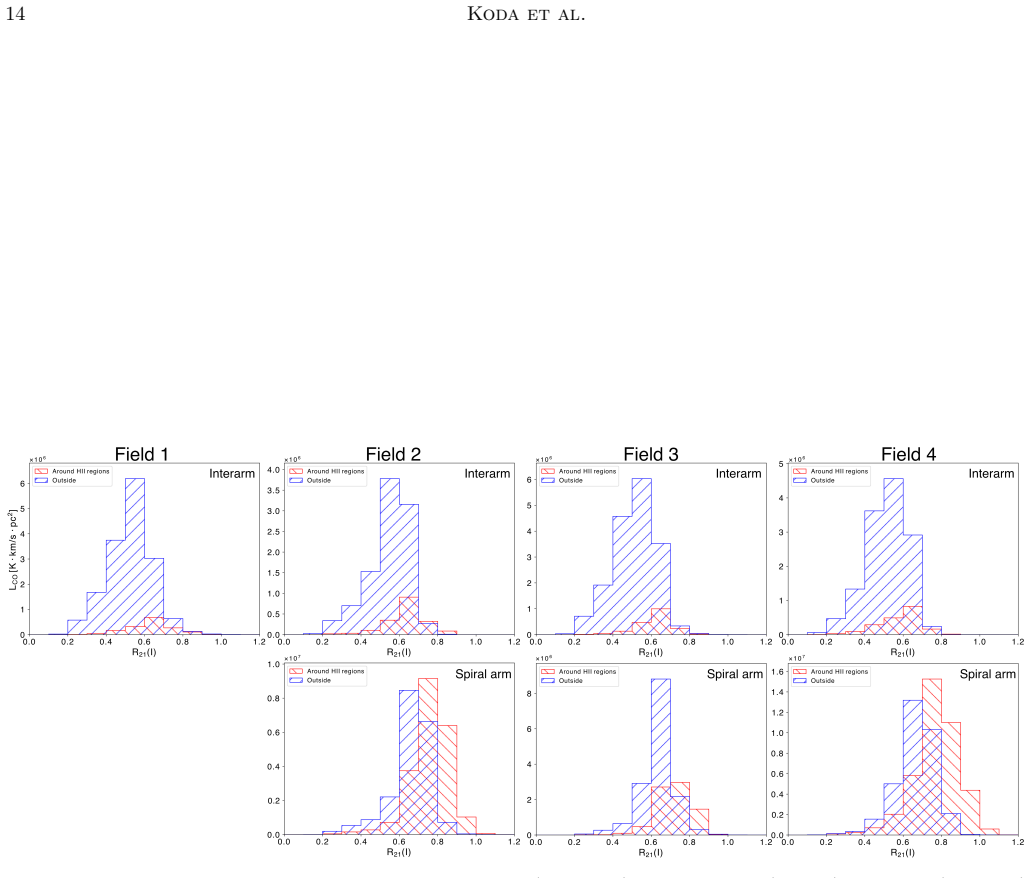
Using high-resolution CO(1-0) and CO(2-1) observations of M83 with a common 46 pc round beam, this paper constructs the line ratio R21 = I21/I10 and finds systematic large-scale variations tied to galactic structures. Azimuthally, R21 rises from below 0.7 in the interarm gas to at least 0.7 in the bar and spiral arms; radially, it is very high (~1.0) in the central 500 pc, drops to about 0.6 through the bar, rises again around the bar end, and declines toward the outer disk. Since R21 is sensitive to H2 density and kinetic temperature, this pattern evidences that the bulk molecular gas is compressed and heated by about a factor of 2-3 as it rotates through spiral-arm shocks, and that this evolution is synchronized with galactic rotation rather than triggered by star formation. The influence of stellar feedback appears localized to within about 100 pc of HII regions, and massive, non-star-forming molecular structures in interarm regions show low R21. The paper argues that molecular gas/cloud evolution in barred spirals is dynamically driven, with cloud lifetimes lasting a substantial fraction of the rotation timescale.
Load-bearing premise
The argument assumes that the 46 pc beam mostly isolates individual molecular clouds, so that the observed R21 variations reflect genuine changes in gas density and temperature rather than beam filling by diffuse, low-excitation gas.
Editorial extensions
If this is right
- Molecular gas and clouds in barred spirals evolve on galactic rotation timescales (order 100 Myr or more), not the short 5-30 Myr cloud lifetimes proposed in recent literature.
- Stellar feedback modifies molecular gas conditions only in localized patches within about 100 pc; feedback is not the main driver of the bulk gas evolution across a disk.
- CO(2-1) cannot be treated as an equivalent mass tracer to CO(1-0) when galactic structures are resolved, since the ratio varies systematically with environment.
- The observed interarm-to-arm R21 contrast provides a direct, resolved test of cloud assembly and disruption along galactic flows.
- Similar R21 patterns in other barred spirals indicate that dynamically driven gas evolution is general among local barred spiral galaxies.
Reading between the lines
- If the pattern holds, star formation prescriptions in galaxy simulations should couple molecular gas state to large-scale kinematics (arm crossings) rather than only to local feedback.
- A testable extension is to compare R21 at matched physical resolution in a strongly flocculent or non-barred spiral; a weaker arm/interarm contrast would confirm that the bar and density waves are the driver rather than rotation alone.
- The authors' assumption of resolved clouds could be checked statistically: the fraction of 46 pc beams containing a single velocity-coherent cloud can be measured from the CO(1-0) data cube, and R21 recomputed after excluding blended beams.
Signed reviews
Editorial analysis
A structured set of objections, weighed in public.
Referee Report
Summary. The paper presents a full-disk map of the CO J=2-1/1-0 line ratio (R21/10) in the barred spiral galaxy M83, constructed from ALMA 12m+7m+Total Power observations that are jointly imaged to a common 46 pc resolution. The authors report systematic large-scale variations: low R21/10 (≲0.7) in interarm regions and higher values (≳0.7) in the bar and spiral arms, with even higher values (0.8-1.0) localized around HII regions, and a radial sequence of high values at the center, lower values in the bar, a rise near the bar ends, and a gradual decline outward. They interpret the pattern as evidence that the density and/or temperature of the bulk molecular gas changes by a factor of ~2-3 in response to galactic structures and dynamics rather than stellar feedback, and they argue that this implies molecular gas and clouds survive and evolve over at least a substantial fraction of the galactic rotation timescale. The paper compares the results with Milky Way HRG/LRG classifications and with other barred galaxies, and discusses the limited, localized impact of star formation feedback.
Significance. If the central interpretation holds, this is a valuable and possibly general result: high-resolution, full-disk R21 imaging of a nearby barred spiral can directly trace where and when molecular gas physical conditions change, and the data appear to support dynamically driven evolution over feedback-dominated evolution. The observational product is strong: the paper combines ALMA 12m, 7m, and Total Power data, carefully matches beams to 46 pc, discusses calibration and sensitivity cuts transparently, and provides a detailed appendix on imaging and HII-region masking. The comparison with the Milky Way and other barred galaxies is constructive, and the authors are appropriately cautious in several places (the causal role of feedback, the crudeness of the LVG conversion, the sensitivity bias). The main risk is that the quantitative claim of a factor-of-2-3 change in gas density/temperature rests on untested beam-filling and on external, model-dependent calibrations, so the significance of the physical conclusion is somewhat uncertain until those issues are quantified.
major comments (3)
- [Section 4 (paragraph beginning 'The R21/10 values reported here...') and Section 5.4] The central interpretation assumes that the 46 pc beam is mostly filled by isolated molecular clouds, so that the observed R21 variation reflects changes in gas density and temperature rather than beam filling. The manuscript states that 'when the clouds are isolated in each beam, the line ratio does not suffer from the beam filling factor' but does not quantify the fraction of beams that satisfy this condition, nor the contribution of diffuse, low-excitation CO(1-0) emission to the interarm flux. Section 4.1 explicitly notes that CO(1-0) is more spatially extended than CO(2-1), especially toward interarm regions, which is exactly the situation in which the low interarm R21 could result from a larger diffuse-to-clump flux ratio rather than from lower n_H2/T_k in the bulk gas. The comparison in Figure 4 between R21/10(I) and R21/10(T) does not remove this degeneracy because both quantities use the same beam and the same diffuse component. This is load-bearing for the abstract and Section 5.4 claim that the bulk molecular gas changes its density/temperature by a factor of 2-3; please quantify the diffuse flux fraction and the beam-isolation fraction, for example by comparing matched-beam maps at coarser resolution or by modeling a two-component (diffuse plus compact) beam-filling decomposition.
- [Section 3.1 and Section 5.4] The quantitative statement that R21 increases by about a factor of 2-3 in density and/or kinetic temperature between interarm and arm/bar regions is imported from external LVG calculations and from Milky Way LRG/HRG/VHRG classifications rather than derived from an inversion of the M83 data. R21 alone has well-known degeneracies among n_H2, T_k, N_CO, line opacity, and beam filling, and Section 3.1 describes the HRG/LRG boundary as a 'crude guideline.' The abstract and conclusions nevertheless present the factor of 2-3 as a quantitative result. Please either provide an explicit LVG-based inversion with assumed M83 parameters and show how the inferred n_H2/T_k ranges depend on those assumptions, or systematically soften the quantitative claim to state that the observations are consistent with such changes under the adopted conversion. Without this, the strongest quantitative conclusion in the abstract is not uniquely supported by the data.
- [Section 5.1 and Section 5.4] The inference that the large-scale R21 pattern demonstrates evolutionary synchronization with galactic rotation is based on a single snapshot. The observed azimuthal sequence (interarm low, arm high, interarm low again) could in principle be maintained by a quasi-static population of molecular clouds whose physical conditions depend on local environment, rather than by individual clouds that travel across the disk and evolve along the flow. The argument that short cloud lifetimes would destroy the large-scale pattern assumes that clouds must be advected between structures; a stationary pattern could also be produced by short-lived clouds forming in situ with different properties in different environments. If the authors wish to claim that the evolution is governed by galactic rotation timescales, they should provide additional support, for example a kinematic test, an azimuthal-phase-resolved analysis that accounts for the pattern speed and possible corotation, or an explicit statistical model showing that a transient-cloud population cannot reproduce the observed azimuthal coherence.
minor comments (5)
- [Throughout] The notation is inconsistent: the paper mostly uses R21/10 but Table 1 and some figure captions use R21; please unify the notation.
- [Appendix A.1] There is a typo in 'sidebloes' (should be 'sidelobes').
- [Section 2.1 and Appendix A.2.2] The CO(2-1) field is smaller than the CO(1-0) field, and the TP filling uses CO(1-0) scaled by 0.55 outside the observed CO(2-1) field. The paper states that this transition zone lies outside the final field of view, but it would be helpful to state explicitly in Section 2.1 whether any pixels in the R21 map near the outer disk and interarm regions could be affected by this procedure.
- [Section 4.4] The statement that the radii of R21/10 > 0.8 regions are ≲100 pc around prominent HII regions is based on visual inspection; please either quantify this (e.g., with radial profiles or median sizes) or explicitly label it as a qualitative impression.
- [Section 5.1] The value of trot,p = 6 Gyr at R = 3 kpc is very sensitive to the adopted pattern speed because Ω and Ωp are nearly equal near corotation; it would be helpful to state this sensitivity and to show how the conclusion would change for a small variation in Ωp.
Circularity Check
No circularity: the R21 measurements are independent observations and the density/temperature calibration is an external LVG mapping, not a fit to the M83 data.
full rationale
The paper's central claim is anchored in direct ALMA measurements of CO(2-1)/CO(1-0) ratios across M83, and the conversion from R21 to nH2/Tk is not fitted to M83 data. Section 3.1 adopts the Milky Way LRG/HRG/VHRG classifications and cites external LVG calculations, and Section 4.3's 'factor of 2-3' statement is explicitly referred to the LVG calculation by Koda et al. (2012) as an external modeling result with stated assumptions, not as a parameter fitted to the present galaxy. The paper's self-citations to Koda et al. (2020, 2023), Hirota et al. (2024), and related work are used for data reduction, cloud identification, rotation parameters, and prior M83 measurements; these are independent observational products rather than definitions that force the conclusion. The main caveat, stated in Section 4, is the assumption that 46 pc beams isolate individual molecular clouds so that beam filling does not affect the line ratio; the paper notes CO(1-0) is more extended than CO(2-1), especially in interarm regions, and does not quantify the fraction of isolated beams. This is a genuine correctness risk for the astrophysical interpretation, but it is not circularity: the paper does not define R21 variations in terms of the claimed density/temperature evolution, nor does any equation reduce the conclusion to the input. The systematic large-scale pattern in R21 is observed independently of the LVG interpretation, so the derivation chain is not self-referential.
Assumptions & free parameters
assumptions (5)
- domain assumption The CO(2-1)/CO(1-0) intensity ratio R21/10 is primarily set by H2 volume density n_H2, kinetic temperature T_k, and CO column density N_CO via LVG radiative transfer.
- domain assumption The Milky Way LRG/HRG/VHRG classification thresholds of R21/10 = 0.7 and 1.0 apply to M83's molecular gas.
- domain assumption At 46 pc resolution, molecular clouds are approximately isolated in the beam, so beam filling does not distort the ratio.
- domain assumption The gas flow across M83 is clockwise, so the leading and trailing sides of the spiral arms can be interpreted as upstream and downstream.
- domain assumption The HST Halpha-based HII-region mask is complete enough that regions outside it are free of stellar feedback.
Cite this review
Pith. "Pith review of Dynamically-Driven Evolution of Molecular Gas in M83 Traced by CO 2-1/1-0 Line Ratio Variations." pith.science (2026). https://pith.science/paper/6ROMM5MX
@misc{pith2026250508876,
  author       = {Pith},
  title        = {Pith review of: Dynamically-Driven Evolution of Molecular Gas in M83 Traced by CO 2-1/1-0 Line Ratio Variations},
  year         = {2026},
  howpublished = {\url{https://pith.science/paper/6ROMM5MX}},
  note         = {Machine review of arXiv:2505.08876}
}
read the original abstract
We show the variations of the CO J=2-1/1-0 line ratio (R21) across the barred spiral galaxy M83, using the 46 pc resolution data from ALMA. The R21 map clearly evidences the systematic large-scale variations as a function of galactic structures. Azimuthally, it starts from low R21<~0.7 in the interarm regions and becomes high ~>0.7 in the bar and spiral arms, suggesting that the density and/or kinetic temperature of molecular gas increase by about a factor of 2-3. This evolution is seen even in the parts of spiral arms without star formation, and R21 is often elevated even higher to ~0.8-1.0 when HII regions exist in the vicinity. Radially, R21 starts very high >~1.0 at the galactic center, remains low <~0.7 in the bar region, increases to >~0.7 around the bar end, and again decreases to <~0.7 in the rest of disk where the spiral arms dominate. The evolutionary sequence is synchronized with galactic rotation, and therefore, it is determined largely by the galactic structures and dynamics and is governed by the galactic rotation timescales. The R21 map also shows that the influence of stellar feedback is localized and limited. Massive, large, and non-star forming molecular structures have low R21, which also suggests that the bulk molecular gas in the disk is not regulated by stellar feedback, but more likely by galactic structures and dynamics. These results are consistent with suggestions by the earlier studies of the Milky Way and other barred spiral galaxies, and thus, are likely general among barred spiral galaxies in the local Universe.
Figures


Figures from the paper (11 more)




Forward citations
Cited by 2 Pith papers
-
The Arizona Molecular ISM Survey with the SMT: The Diverse Carbon Monoxide Line Ratios and Spectral Line Energy Distributions of Star Forming Galaxies
CO line ratios in 47 nearby star-forming galaxies rise with star formation rate, leading to empirical prescriptions for converting higher-J CO luminosities to molecular gas masses.
-
Correlations of ALMA CO(2-1) with JWST mid-infrared fluxes down to scale of $\lesssim$100 parsec in nearby star-forming galaxies from PHANGS
At 100-pc scales in 19 PHANGS galaxies, CO(2-1) correlates log-linearly with JWST PAH and dust emission, with the intercept—not slope—varying bimodally with host star-formation strength.
Reference graph
Works this paper leans on
-
[1]
S., Black , J
Aalto , S., Booth , R. S., Black , J. H., & Johansson , L. E. B. 1995, , 300, 369
1995
-
[2]
Baba , J., Saitoh , T. R., & Wada , K. 2013, , 763, 46, 10.1088/0004-637X/763/1/46
-
[3]
Bautista , J. M. G., Koda , J., Yagi , M., Komiyama , Y., & Yamanoi , H. 2023, , 267, 10, 10.3847/1538-4365/acd3e7
-
[4]
1996, , 117, 393
Bertin , E., & Arnouts , S. 1996, , 117, 393
1996
-
[5]
2008, , 136, 2846, 10.1088/0004-6256/136/6/2846
Bigiel , F., Leroy , A., Walter , F., et al. 2008, , 136, 2846, 10.1088/0004-6256/136/6/2846
-
[6]
Blair , W. P., Chandar , R., Dopita , M. A., et al. 2014, , 788, 55, 10.1088/0004-637X/788/1/55
- [7]
-
[8]
2022, , 164, 32, 10.3847/1538-3881/ac73f0
Calamida , A., Bajaj , V., Mack , J., et al. 2022, , 164, 32, 10.3847/1538-3881/ac73f0
Show all 75 references
-
[9]
2022, , 134, 114501, 10.1088/1538-3873/ac9642
CASA Team , Bean , B., Bhatnagar , S., et al. 2022, , 134, 114501, 10.1088/1538-3873/ac9642
2022 doi
- [10]
-
[11]
Chevance , M., Kruijssen , J. M. D., Hygate , A. P. S., et al. 2020, , 493, 2872, 10.1093/mnras/stz3525
2020 doi
-
[12]
Chevance , M., Kruijssen , J. M. D., Krumholz , M. R., et al. 2022, , 509, 272, 10.1093/mnras/stab2938
2022 doi
- [13]
-
[14]
P., Turner , J
Crosthwaite , L. P., Turner , J. L., Buchholz , L., Ho , P. T. P., & Martin , R. N. 2002, , 123, 1892, 10.1086/339479
2002 doi
-
[15]
A., Cohen , S
Dale , D. A., Cohen , S. A., Johnson , L. C., et al. 2009, , 703, 517, 10.1088/0004-637X/703/1/517
2009 doi
-
[16]
M., Hartmann , D., & Thaddeus , P
Dame , T. M., Hartmann , D., & Thaddeus , P. 2001, , 547, 792, 10.1086/318388
2001 doi
-
[17]
M., Ungerechts , H., Cohen , R
Dame , T. M., Ungerechts , H., Cohen , R. S., et al. 1987, , 322, 706, 10.1086/165766
1987 doi
- [18]
-
[19]
S., Chatzigiannakis , D., Bigiel , F., et al
den Brok , J. S., Chatzigiannakis , D., Bigiel , F., et al. 2021, , 504, 3221, 10.1093/mnras/stab859
2021 doi
-
[20]
S., Leroy , A
den Brok , J. S., Leroy , A. K., Usero , A., et al. 2023, , 10.1093/mnras/stad3091
2023 doi
-
[21]
T., Calzetti , D., et al
Deshmukh , S., Linden , S. T., Calzetti , D., et al. 2024, , 974, L24, 10.3847/2041-8213/ad7ba9
2024 doi
-
[22]
2013, , 766, 34, 10.1088/0004-637X/766/1/34
D'Onghia , E., Vogelsberger , M., & Hernquist , L. 2013, , 766, 34, 10.1088/0004-637X/766/1/34
2013 doi
-
[23]
2022, , 935, 64, 10.3847/1538-4357/ac8050
Egusa , F., Gao , Y., Morokuma-Matsui , K., Liu , G., & Maeda , F. 2022, , 935, 64, 10.3847/1538-4357/ac8050
2022 doi
-
[24]
2009, , 697, 1870, 10.1088/0004-637X/697/2/1870
Egusa , F., Kohno , K., Sofue , Y., Nakanishi , H., & Komugi , S. 2009, , 697, 1870, 10.1088/0004-637X/697/2/1870
2009 doi
-
[25]
2004, , 56, L45, 10.1093/pasj/56.6.L45
Egusa , F., Sofue , Y., & Nakanishi , H. 2004, , 56, L45, 10.1093/pasj/56.6.L45
2004 doi
-
[26]
B., Bolatto , A
Fisher , D. B., Bolatto , A. D., White , H., et al. 2019, , 870, 46, 10.3847/1538-4357/aaee8b
2019 doi
-
[27]
1974, , 189, 441, 10.1086/152821
Goldreich , P., & Kwan , J. 1974, , 189, 441, 10.1086/152821
1974 doi
-
[28]
F., Young , J
Goldsmith , P. F., Young , J. S., & Langer , W. D. 1983, , 51, 203, 10.1086/190845
1983 doi
-
[29]
1997, in IAU Symposium, Vol
Hasegawa , T. 1997, in IAU Symposium, Vol. 170, IAU Symposium, ed. W. B. Latter, S. J. E. Radford, P. R. Jewell, J. G. Mangum, & J. Bally , 39--46
1997
-
[30]
K., et al
Hassani , H., Rosolowsky , E., Leroy , A. K., et al. 2023, , 944, L21, 10.3847/2041-8213/aca8ab
2023 doi
-
[31]
Hillenbrand , L. A. 1997, , 113, 1733, 10.1086/118389
1997 doi
-
[32]
2009, , 61, 441, 10.1093/pasj/61.3.441
Hirota , A., Kuno , N., Sato , N., et al. 2009, , 61, 441, 10.1093/pasj/61.3.441
2009 doi
-
[33]
2024, arXiv e-prints, arXiv:2410.05424
Hirota , A., Koda , J., Egusa , F., et al. 2024, arXiv e-prints, arXiv:2410.05424. 2410.05424
2024 arXiv
-
[34]
P., Marrone , D
Keenan , R. P., Marrone , D. P., Keating , G. K., et al. 2024, , 975, 150, 10.3847/1538-4357/ad7504
2024 doi
-
[35]
C., & Evans , N
Kennicutt , R. C., & Evans , N. J. 2012, , 50, 531, 10.1146/annurev-astro-081811-125610
2012 doi
-
[36]
Kim , J., Chevance , M., Kruijssen , J. M. D., et al. 2022, , 516, 3006, 10.1093/mnras/stac2339
2022 doi
-
[37]
2016, , 823, 76, 10.3847/0004-637X/823/2/76
Koda , J., Scoville , N., & Heyer , M. 2016, , 823, 76, 10.3847/0004-637X/823/2/76
2016 doi
-
[38]
2019, , 131, 054505, 10.1088/1538-3873/ab047e
Koda , J., Teuben , P., Sawada , T., Plunkett , A., & Fomalont , E. 2019, , 131, 054505, 10.1088/1538-3873/ab047e
2019 doi
-
[39]
2009, , 700, L132, 10.1088/0004-637X/700/2/L132
Koda , J., Scoville , N., Sawada , T., et al. 2009, , 700, L132, 10.1088/0004-637X/700/2/L132
2009 doi
-
[40]
2012, , 761, 41, 10.1088/0004-637X/761/1/41
Koda , J., Scoville , N., Hasegawa , T., et al. 2012, , 761, 41, 10.1088/0004-637X/761/1/41
2012 doi
-
[41]
2020, , 890, L10, 10.3847/2041-8213/ab70b7
Koda , J., Sawada , T., Sakamoto , K., et al. 2020, , 890, L10, 10.3847/2041-8213/ab70b7
2020 doi
-
[42]
2023, , 949, 108, 10.3847/1538-4357/acc65e
Koda , J., Hirota , A., Egusa , F., et al. 2023, , 949, 108, 10.3847/1538-4357/acc65e
2023 doi
-
[43]
Kruijssen , J. M. D., Schruba , A., Chevance , M., et al. 2019, , 569, 519, 10.1038/s41586-019-1194-3
2019 doi
-
[44]
M., Koda , J., Hirota , A., Egusa , F., & Heyer , M
Lee , A. M., Koda , J., Hirota , A., Egusa , F., & Heyer , M. 2024, , 968, 97, 10.3847/1538-4357/ad40a0
2024 doi
-
[45]
B., Bolatto , A
Lenki \'c , L., Fisher , D. B., Bolatto , A. D., et al. 2024, , 976, 88, 10.3847/1538-4357/ad758c
2024 doi
-
[46]
K., Walter , F., Brinks , E., et al
Leroy , A. K., Walter , F., Brinks , E., et al. 2008, , 136, 2782, 10.1088/0004-6256/136/6/2782
2008 doi
-
[47]
K., Walter , F., Sandstrom , K., et al
Leroy , A. K., Walter , F., Sandstrom , K., et al. 2013, , 146, 19, 10.1088/0004-6256/146/2/19
2013 doi
-
[48]
K., Schinnerer , E., Hughes , A., et al
Leroy , A. K., Schinnerer , E., Hughes , A., et al. 2021, , 257, 43, 10.3847/1538-4365/ac17f3
2021 doi
-
[49]
K., Rosolowsky , E., Usero , A., et al
Leroy , A. K., Rosolowsky , E., Usero , A., et al. 2022, , 927, 149, 10.3847/1538-4357/ac3490
2022 doi
-
[50]
S., Blair , W
Long , K. S., Blair , W. P., Winkler , P. F., et al. 2022, , 929, 144, 10.3847/1538-4357/ac5aa3
2022 doi
-
[51]
A., Wiklind , T., Olofsson , H., & Rydbeck , G
Lundgren , A. A., Wiklind , T., Olofsson , H., & Rydbeck , G. 2004, , 413, 505, 10.1051/0004-6361:20031507
2004 doi
-
[52]
2022, , 926, 96, 10.3847/1538-4357/ac4505
Maeda , F., Egusa , F., Ohta , K., et al. 2022, , 926, 96, 10.3847/1538-4357/ac4505
2022 doi
-
[53]
2016, , 68, 5, 10.1093/pasj/psv108
Nakanishi , H., & Sofue , Y. 2016, , 68, 5, 10.1093/pasj/psv108
2016 doi
- [55]
-
[56]
1998, , 493, 730, 10.1086/305133
Oka , T., Hasegawa , T., Hayashi , M., Handa , T., & Sakamoto , S. 1998, , 493, 730, 10.1086/305133
1998 doi
-
[57]
J., et al
Saintonge , A., Catinella , B., Tacconi , L. J., et al. 2017, , 233, 22, 10.3847/1538-4365/aa97e0
2017 doi
-
[58]
1997 a , , 486, 276, 10.1086/304479
Sakamoto , S., Hasegawa , T., Handa , T., Hayashi , M., & Oka , T. 1997 a , , 486, 276, 10.1086/304479
1997 doi
-
[59]
1997 b , , 481, 302, 10.1086/304023
Sakamoto , S., Hasegawa , T., Hayashi , M., Morino , J.-I., & Sato , K. 1997 b , , 481, 302, 10.1086/304023
1997 doi
-
[60]
1994, , 425, 641, 10.1086/174011
Sakamoto , S., Hayashi , M., Hasegawa , T., Handa , T., & Oka , T. 1994, , 425, 641, 10.1086/174011
1994 doi
-
[61]
J., Staveley-Smith , L., & Brouw , W
Sault , R. J., Staveley-Smith , L., & Brouw , W. N. 1996, , 120, 375
1996
-
[62]
J., Teuben , P
Sault , R. J., Teuben , P. J., & Wright , M. C. H. 1995, in Astronomical Society of the Pacific Conference Series, Vol. 77, Astronomical Data Analysis Software and Systems IV, ed. R. A. Shaw, H. E. Payne, & J. J. E. Hayes , 433
1995
-
[63]
2001, , 136, 189, 10.1086/321793
Sawada , T., Hasegawa , T., Handa , T., et al. 2001, , 136, 189, 10.1086/321793
2001 doi
- [64]
- [65]
-
[66]
Z., Polletta , M., Ewald , S., et al
Scoville , N. Z., Polletta , M., Ewald , S., et al. 2001, , 122, 3017, 10.1086/323445
2001 doi
-
[67]
Z., & Sanders , D
Scoville , N. Z., & Sanders , D. B. 1987, in Astrophysics and Space Science Library, Vol. 134, Interstellar Processes, ed. D. J. Hollenbach & H. A. Thronson Jr. , 21--50
1987
- [68]
- [69]
-
[70]
K., Schruba , A., et al
Sun , J., Leroy , A. K., Schruba , A., et al. 2018, , 860, 172, 10.3847/1538-4357/aac326
2018 doi
-
[71]
K., Schinnerer , E., et al
Sun , J., Leroy , A. K., Schinnerer , E., et al. 2020, , 901, L8, 10.3847/2041-8213/abb3be
2020 doi
-
[72]
van der Tak , F. F. S., Black , J. H., Sch \"o ier , F. L., Jansen , D. J., & van Dishoeck , E. F. 2007, , 468, 627, 10.1051/0004-6361:20066820
2007 doi
-
[73]
P., & Tilanus , R
Vlahakis , C., van der Werf , P., Israel , F. P., & Tilanus , R. P. J. 2013, , 433, 1837, 10.1093/mnras/stt841
2013 doi
-
[74]
N., Wright , M
Vogel , S. N., Wright , M. C. H., Plambeck , R. L., & Welch , W. J. 1984, , 283, 655, 10.1086/162351
1984 doi
-
[75]
2021, , 73, 257, 10.1093/pasj/psaa119
Yajima , Y., Sorai , K., Miyamoto , Y., et al. 2021, , 73, 257, 10.1093/pasj/psaa119
2021 doi
-
[76]
2010, , 62, 1277, 10.1093/pasj/62.5.1277
Yoda , T., Handa , T., Kohno , K., et al. 2010, , 62, 1277, 10.1093/pasj/62.5.1277
2010 doi
Reviewed August 15, 2026 · model on record in the stance chip above.
Discussion (0). Continue with ORCID to comment.