REVIEW 2 major objections 4 minor 99 references
VAST-MeMeS: Characterising non-thermal radio emission from magnetic massive stars using the Australian SKA Pathfinder
T0 review · 2 major / 4 minor · reviewed 2026-08-15 · deepseek-v4-flash
Pith's one-line read ASKAP data on 70 radio-bright magnetic hot stars confirm that radio luminosity scales with centrifugal-breakout luminosity at slightly lower efficiency than previously reported.
desk verdict Genueninely useful sample expansion for radio-bright magnetic massive stars, but the revised CBO slope is not secure because the two L_rad estimators differ in a luminosity-dependent way. read the letter →
The pith
A machine-rendered reading of the paper's core claim, the machinery that carries it, and where it could break.
The reading
What carries the argument
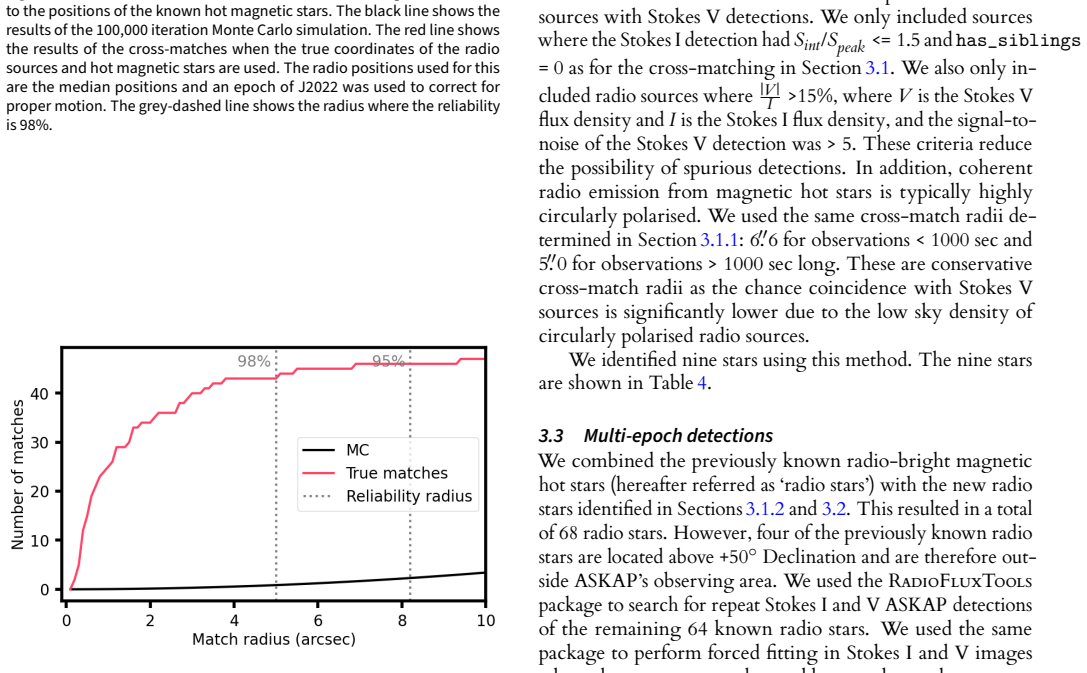
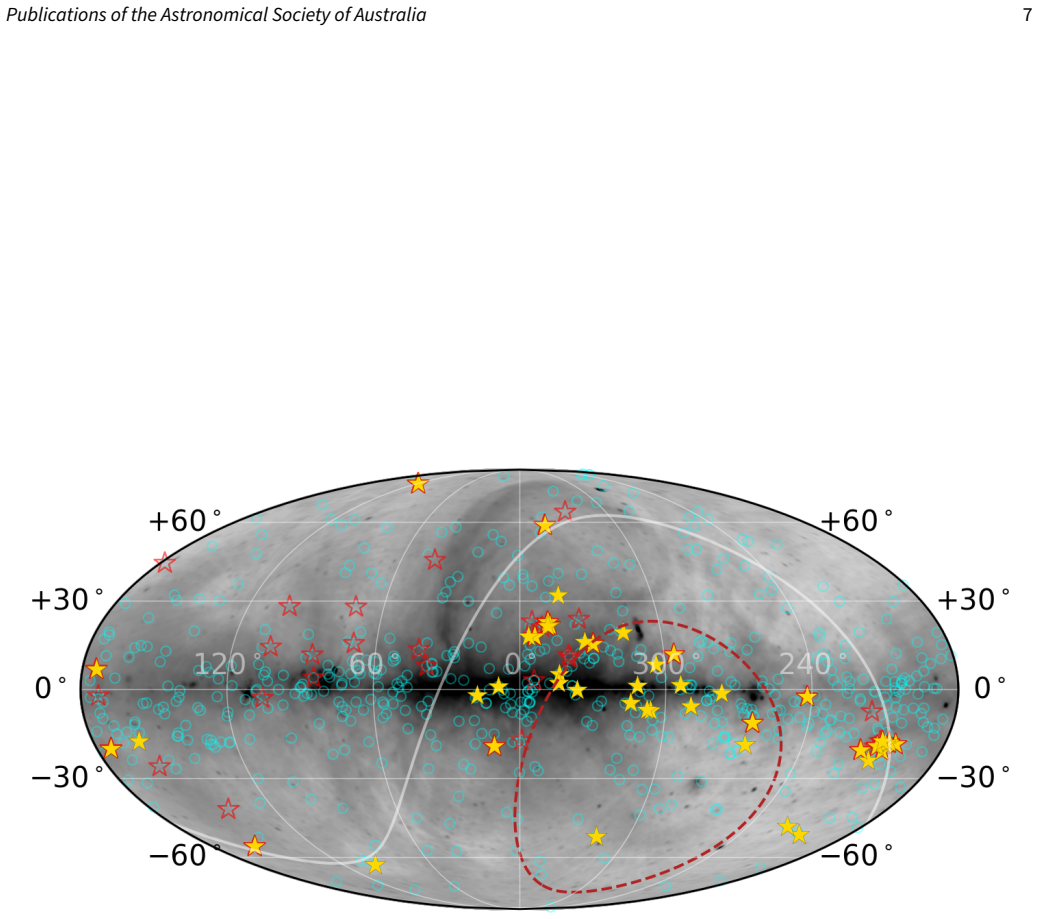
The load-bearing quantity is the centrifugal-breakout luminosity $L_{\mathrm{CBO}} = B_{\mathrm{eq}}^2 R_*^4 \Omega^2 / v_{\mathrm{orb}}$, the power released when plasma trapped in the co-rotating magnetosphere periodically breaks open the field lines; the theory assumes the field behaves like a monopole at the reconnection site. The paper combines this with a prescription for turning sparse radio measurements into luminosities: a trapezoidal spectrum that is flat between about 0.9 GHz and 30 GHz and vanishes at 0.6 and 100 GHz, calibrated on the ten stars with wideband spectra. Cross-matching 761 known magnetic hot stars against ASKAP point-source catalogues at 98% reliability radii, and forced fitting in Stokes I and V images, supplies the flux densities; the fit itself is a Markov Chain Monte Carlo line fit in log-log space.
What would settle it
Observe a sample of the newly detected stars simultaneously from roughly 0.3 to 30 GHz; if their flux densities decline steeply below 1 GHz instead of staying flat, the trapezoid integration overestimates $L_{\mathrm{rad}}$ and the reported slope of 0.87 and intercept of $-8.0$ would need revision.
Extended reading notes
Core claim
The central claim is that the empirical correlation between incoherent radio luminosity $L_{\mathrm{rad}}$ and centrifugal-breakout luminosity $L_{\mathrm{CBO}}$ survives a roughly 50% expansion of the known radio-bright magnetic hot star population. Fitting the 68 usable stars (after excluding the non-CM star HD 148937 and the overluminous outlier HD 101412) gives $L_{\mathrm{rad}} = 10^{-8.0} L_{\mathrm{CBO}}^{0.87}$ with 1$\sigma$ ranges [0.80, 0.94] on the slope and [$-8.1$, $-7.8$] on the intercept; the intercept agrees with the $L_{\mathrm{rad}} = 10^{-8} L_{\mathrm{CBO}}$ reported earlier, while the sub-unity slope indicates a slightly lower efficiency at the high-luminosity end. The paper further reports that for several stars the ~1 GHz ASKAP flux density exceeds what the previously assumed 1.5-30 GHz flat spectrum would predict, and that a full-spectrum integration for HD 142184 changes its luminosity by 0.47 dex relative to the earlier trapezoidal estimate. Partial-correlation analysis finds that $L_{\mathrm{rad}}$ remains strongly correlated with $L_{\mathrm{CBO}}$ after removing effective temperature, with no significant residual dependence on temperature.
Load-bearing premise
The weakest link is the assumption that the newly detected stars have the same flat, trapezoidal incoherent radio spectrum as the ten well-observed stars, so that flux densities measured only near 1 GHz can stand in for the full 0.6-100 GHz luminosity; if the true spectra turn over below 1 GHz or have different shapes, the derived $L_{\mathrm{rad}}$ values and the fitted $L_{\mathrm{rad}}$-$L_{\mathrm{CBO}}$ relation would be biased.
Editorial extensions
If this is right
- The CBO mechanism remains viable across OBA spectral types: the relation built on 47 stars still describes a sample of 70, extending the range of $L_{\mathrm{CBO}}$ by an order of magnitude.
- Incoherent radio spectra can stay flat below 1 GHz, so sub-GHz survey data can contribute directly to measuring radio luminosities rather than being dismissed as dominated by coherent emission.
- Producing radio luminosity does not appear to depend on stellar temperature once $L_{\mathrm{CBO}}$ is accounted for; the correlation between $L_{\mathrm{rad}}$ and $T_{\mathrm{eff}}$ seen in the plot is an indirect effect of the mass-radius-temperature relation.
- Nine stars meet the circular-polarisation or variability criteria for main-sequence radio pulse emitters, widening the hunting ground for electron-cyclotron-maser emission.
- Single-frequency luminosity estimates can be off by factors of two or more: five common stars show ASKAP luminosities at least double the earlier published values, arguing for wideband spectral campaigns.
Reading between the lines
- If flat sub-GHz spectra are the norm rather than the exception, then single-epoch low-frequency surveys could eventually provide nearly unbiased radio luminosities for hundreds of magnetic hot stars, turning the current 70-star sample into a population-scale test of the CBO relation.
- The sub-unity slope (0.87) implies the radio-production efficiency drops as $L_{\mathrm{CBO}}$ grows; one plausible but unmodelled cause is stronger free-free absorption in the denser winds of the more luminous systems, which would flatten the observed relation artificially.
- The HD 142184 case suggests that published $L_{\mathrm{rad}}$ values built on the old trapezoid assumption may be systematically biased; if similar biases affect many stars, re-deriving the fit from true broadband spectra could change both the slope and the scatter of the scaling relation.
- HD 101412, with its unusually steep inferred spectrum and overluminosity, is the clearest test case: simultaneous multi-frequency observations would show whether a cool star can genuinely violate the CBO scaling or whether rotational sampling created an artefact.
Signed reviews
Editorial analysis
A structured set of objections, weighed in public.
Referee Report
Summary. The paper presents the VAST-MeMeS project, an ASKAP survey-based search for non-thermal radio emission from magnetic massive stars, using cross-matching of Selavy source catalogues and forced Stokes I/V photometry. It reports radio detections of 48 magnetic hot stars, 14 of which have no prior radio detection, and identifies nine Main-sequence Radio Pulse emitter candidates. Combining these with previously known radio-bright stars yields an expanded sample of 70 objects, from which the authors re-derive the correlation between incoherent radio luminosity Lrad and centrifugal-breakout luminosity LCBO, obtaining a best fit of log Lrad = -8.0 + 0.87 log LCBO. This is interpreted as a slightly lower radio-production efficiency than the slope-unity relation reported by Owocki et al. (2022). The paper also argues that incoherent radio spectra can extend to lower frequencies than previously assumed, and uses partial correlation coefficients to argue against a direct role of effective temperature in driving the Lrad-LCBO relation.
Significance. If the central quantitative result were secure, this would be an important contribution: it approximately doubles the sample of radio-bright magnetic hot stars, extends the tested range of LCBO, and provides new southern-hemisphere detections and MRP candidates that will be valuable for follow-up. The paper is careful in its catalogue construction, uses publicly available ASKAP data, reports a Monte-Carlo-based cross-match reliability, and explicitly quantifies several systematic limitations in the appendices. However, the headline claim of a slope below unity and a slightly lower efficiency is not yet robust, because the luminosities entering the fit are estimated with two different methods whose difference is luminosity-dependent. The paper's own Appendix 2 shows that the assumed spectral shape can underestimate Lrad by 0.47 dex for a well-observed star, an amount equal to the inferred intrinsic scatter; this makes the specific slope and intercept values in Section 4.1.3 vulnerable to estimator bias.
major comments (2)
- [4.1.2, 4.1.3, Appendix 2] The central quantitative claim, the fitted Lrad = 10^-8.0 L_CBO^0.87 relation, is not secure because of a luminosity-dependent mismatch between the luminosity estimators for the two subsamples. For stars already in Shultz et al. (2022), Section 4.1.2 adopts their wideband/multi-frequency luminosities, while for newly added stars Section 4.1.1 computes Lrad from a single ASKAP flux density near 0.9 GHz under the assumed trapezoidal spectrum. Figure 4 shows that the ratio Lrad,ASKAP/Lrad,Shultz+2022 decreases with increasing Lrad, so the new low-luminosity and previously known high-luminosity stars enter the fit with systematically different biases. Appendix 2 independently shows that for HD 142184 the assumed trapezoid underestimates the directly measured wideband luminosity by 0.47 dex, which is the same size as the 'true uncertainty' returned by the MCMC in Section 4.1.3. The authors should demonstrate that the fitted slope and intercept are robust to a homogeneous luminosity estimation, for example by fitting only stars with multi-frequency spectral coverage, or by applying the single-band/trapezoid estimator to all stars, or by explicitly modeling the spectral-shape bias as a function of Lrad.
- [4.1.3, Table 5] The error bars on Lrad in Table 5 and Figure 6 include only flux-density measurement uncertainties, as the table footnote states, and the fit is performed with is_weighted=False, meaning the quoted 1σ intervals on the slope [0.80, 0.94] and intercept [-8.1, -7.8] do not propagate the dominant systematic uncertainties: spectral shape, rotational-phase variability, and the estimator mismatch described above. The derived 'true uncertainty' of 0.47 dex should therefore be interpreted as absorbing these systematics rather than as a measurement of astrophysical scatter. A sensitivity analysis, such as repeating the fit with the Shultz et al. (2022) luminosities for all stars or with a broader set of spectral-shape priors, would be needed before the claimed deviation from the slope-unity relation can be taken as evidence for a lower radio-production efficiency.
minor comments (4)
- [Section 6 (Summary)] The third summary item states the best-fit relation as Lrad = 10^-8.52 L_CBO^0.88, which is the Keszthelyi et al. (2024) relation before the conversion described in Section 4.1; the paper's own best fit is Lrad = 10^-8.0 L_CBO^0.87. This should be corrected to avoid confusing the paper's result with the earlier untranslated relation.
- [Table 5 caption] The caption begins 'he stellar magnetospheric parameters', which is missing the leading 'T', and the use of '-1' for missing values could be misread as a physical placeholder; a clearer notation such as '...' or 'N/A' would be preferable.
- [4.1.2] The sentence noting that Lrad,ASKAP/Lrad,Shultz+2022 decreases with Lrad is an important observation, but it is not quantified; reporting a rank correlation coefficient and its uncertainty would strengthen the point and make the luminosity dependence more transparent.
- [Appendix 2 and Figure A1] Appendix 2 discusses the two stars with turn-over observed at both ends of the spectrum, but Figure A1 is not cross-referenced anywhere in the main text; adding an explicit reference near Section 4.1.1 or 5.1 would help readers connect the spectral-shape caveat to the luminosity estimates.
Circularity Check
No significant circularity: the CBO scaling test uses independently measured radio luminosities and literature stellar parameters, with no fit parameter reused as an input.
full rationale
The paper's central quantitative result is the best-fit relation between incoherent radio luminosity Lrad and centrifugal-breakout luminosity LCBO. The two quantities are determined independently: Lrad is obtained from ASKAP flux densities (or, for previously known stars, from the wideband luminosities reported by Shultz et al. 2022), while LCBO is computed from Equation 1 using stellar mass, radius, rotation period, and magnetic field strength taken from the literature. The MCMC fit in Section 4.1.3 therefore estimates slope and intercept from data, and these fitted parameters are not fed back into either Lrad or LCBO. The trapezoidal spectral model used to convert single-band ASKAP flux densities into Lrad is inherited from Shultz et al. (2022) and Leto et al. (2021), but it is an empirical spectral assumption, not a definition in terms of LCBO or in terms of the fitted relation. The paper explicitly tests the assumed spectral shape in Appendix 2, finding that for HD 142184 the trapezoid integration underestimates the directly measured wideband luminosity by 0.47 dex; this is a stated caveat about estimator systematics rather than a circular step. The luminosity-dependent comparison in Figure 4 and the resulting concern that new-star Lrad estimates may be systematically low at the bright end are legitimate correctness risks, but they do not amount to a claim whose derivation reduces to its own inputs. Self-citations to Owocki et al. (2022), Shultz et al. (2022), and Leto et al. (2021) are used to motivate the relation and the spectral shape, yet the expanded-sample test itself is an external check on those earlier results, not a restatement of them. No equation in the paper is equivalent to another by construction, and no fitted parameter is renamed as a prediction.
Assumptions & free parameters
free parameters (3)
- Slope m of log Lrad vs log LCBO =
0.87 (1 sigma CI: 0.80-0.94)
- Intercept b of log Lrad vs log LCBO =
-8.0 (1 sigma CI: -8.1 to -7.8)
- Intrinsic scatter in log Lrad =
0.47 (1 sigma CI: 0.43-0.52)
assumptions (4)
- domain assumption The centrifugal-breakout (CBO) theory, with a monopole-like magnetic field at reconnection sites, correctly identifies LCBO as the energy reservoir for incoherent radio emission.
- domain assumption The incoherent radio spectrum of every magnetic hot star follows the trapezoidal shape inferred from ten well-observed stars: zero below 0.6 GHz and above 100 GHz, flat between 1.5 and 30 GHz, with the flat level set by the highest observed flux density.
- domain assumption The stellar parameters (Bd, R*, Prot, M*) used to compute LCBO are sufficiently accurate and are taken from the Shultz et al. (in prep.) catalogue and the references in Table 7.
- domain assumption The ASKAP source catalogues and Stokes V images have well-characterised position uncertainties, and the Monte Carlo-derived cross-match radii (6.6 arcsec for short, 5.0 arcsec for long observations) provide 98% reliability.
Cite this review
Pith. "Pith review of VAST-MeMeS: Characterising non-thermal radio emission from magnetic massive stars using the Australian SKA Pathfinder." pith.science (2026). https://pith.science/paper/W5A372MV
@misc{pith2026250509148,
  author       = {Pith},
  title        = {Pith review of: VAST-MeMeS: Characterising non-thermal radio emission from magnetic massive stars using the Australian SKA Pathfinder},
  year         = {2026},
  howpublished = {\url{https://pith.science/paper/W5A372MV}},
  note         = {Machine review of arXiv:2505.09148}
}
abstract
Magnetic massive stars are stars of spectral types O, B and A that harbour $\sim$ kG strength (mostly dipolar) surface magnetic fields. Their non-thermal radio emission has been demonstrated to be an important magnetospheric probe, provided the emission is fully characterised. A necessary step for that is to build a statistically significant sample of radio-bright magnetic massive stars. In this paper, we present the `VAST project to study Magnetic Massive Stars' or VAST-MeMeS that aims to achieve that by taking advantage of survey data acquired with the Australian SKA Pathfinder telescope. VAST-MeMeS is defined under the `VAriable and Slow Transient' (VAST) survey, although it also uses data from other ASKAP surveys. We found radio detections from 48 magnetic massive stars, out of which, 14 do not have any prior radio detections. We also identified 9 `Main-sequence Radio Pulse Emitter' candidates based on variability and circular polarisation of flux densities. The expanded sample suggests a slightly lower efficiency in the radio production than that reported in earlier work. In addition to significantly expanding the sample of radio-bright magnetic massive stars, the addition of flux density measurements at $\lesssim 1$ GHz revealed that the spectra of incoherent radio emission can extend to much lower frequencies than that assumed in the past. In the future, radio observations spanning wide frequency and rotational phase ranges should be conducted so as to reduce the uncertainties in the incoherent radio luminosities. The results from these campaigns, supplemented with precise estimations of stellar parameters, will allow us to fully understand particle acceleration and non-thermal radio production in large-scale stellar magnetospheres.
Figures

Figures from the paper (5 more)


Reference graph
Works this paper leans on
-
[1]
, " * write output.state after.block = add.period write newline
ENTRY address archivePrefix author booktitle chapter doi edition editor eprint howpublished institution journal key month number organization pages publisher school series title misctitle type volume year version url label extra.label sort.label short.list INTEGERS output.state before.all mid.sentence after.sentence after.block FUNCTION init.state.consts ...
-
[2]
write newline
" write newline "" before.all 'output.state := FUNCTION format.url url empty "" new.block "" url * "" * if FUNCTION format.eprint eprint empty "" archivePrefix empty "" archivePrefix "arXiv" = new.block " " eprint * " " * new.block " " eprint * " " * if if if FUNCTION format.doi doi empty "" " " doi * " " * if FUNCTION format.pid doi empty eprint empty ur...
-
[3]
, " * write output.state after.block = add.period write newline
ENTRY address archivePrefix author booktitle chapter doi edition editor eprint howpublished institution journal key month note number organization pages publisher school series title type volume year label extra.label sort.label short.list INTEGERS output.state before.all mid.sentence after.sentence after.block FUNCTION init.state.consts #0 'before.all :=...
-
[4]
write newline
" write newline "" before.all 'output.state := FUNCTION format.doi doi empty "" "doi:" doi * if FUNCTION format.eprint eprint empty "" archivePrefix empty "" archivePrefix ":" * if eprint field.or.null * if FUNCTION format.pid eprint empty format.doi format.eprint if FUNCTION n.dashify 't := "" t empty not t #1 #1 substring "-" = t #1 #2 substring "--" = ...
-
[5]
2011, , 536, L6
Alecian , E., Kochukhov , O., Neiner , C., et al. 2011, , 536, L6
2011
-
[6]
2014, , 567, A28
Alecian , E., Kochukhov , O., Petit , V., et al. 2014, , 567, A28
2014
-
[7]
2024, , 168, 288
Ayanabha , D., Narang , M., Puravankara , M., et al. 2024, , 168, 288
2024
-
[8]
D., & Izzo , C
Bagnulo , S., Fossati , L., Landstreet , J. D., & Izzo , C. 2015, , 583, A115
2015
Show all 99 references
-
[9]
2020, , 493, 3293
Bernhard , K., H \"u mmerich , S., & Paunzen , E. 2020, , 493, 3293
2020
-
[10]
2023, , 523, 5155
Biswas , A., Das , B., Chandra , P., et al. 2023, , 523, 5155
2023
-
[11]
A., Brown , D
Bohlender , D. A., Brown , D. N., Landstreet , J. D., & Thompson , I. B. 1987, , 323, 325
1987
-
[12]
A., & Landstreet , J
Bohlender , D. A., & Landstreet , J. D. 1990, , 358, 274
1990
-
[13]
A., Landstreet , J
Bohlender , D. A., Landstreet , J. D., & Thompson , I. B. 1993, , 269, 355
1993
-
[14]
T., Harmanec , P., Lyons , R
Bolton , C. T., Harmanec , P., Lyons , R. W., Odell , A. P., & Pyper , D. M. 1998, , 337, 183
1998
-
[15]
F., & Landstreet , J
Borra , E. F., & Landstreet , J. D. 1979, , 228, 809
1979
-
[16]
1980, , 42, 421
---. 1980, , 42, 421
1980
-
[17]
F., Landstreet , J
Borra , E. F., Landstreet , J. D., & Thompson , I. 1983, , 53, 151
1983
-
[18]
Braithwaite , J., & Spruit , H. C. 2004, , 431, 819
2004
-
[19]
2001, , 366, 121
Briquet , M., Aerts , C., & De Cat , P. 2001, , 366, 121
2001
-
[20]
J., et al
Buysschaert , B., Neiner , C., Martin , A. J., et al. 2018, , 478, 2777
2018
-
[21]
2021, , 921, 9
Das , B., & Chandra , P. 2021, , 921, 9
2021
-
[22]
2022 a , , 515, 2008
Das , B., Chandra , P., & Petit , V. 2022 a , , 515, 2008
2022
-
[23]
E., et al
Das , B., Chandra , P., Shultz , M. E., et al. 2022 b , , 517, 5756
2022
-
[24]
E., & Wade , G
Das , B., Chandra , P., Shultz , M. E., & Wade , G. A. 2019, , 489, L102
2019
-
[25]
Das , B., Chandra , P., & Wade , G. A. 2018, , 474, L61
2018
-
[26]
2020, , 499, 702
---. 2020, , 499, 702
2020
-
[27]
E., et al
Das , B., Chandra , P., Shultz , M. E., et al. 2022 c , , 925, 125
2022
-
[28]
N., Pritchard , J., Murphy , T., et al
Driessen , L. N., Pritchard , J., Murphy , T., et al. 2024, arXiv e-prints, arXiv:2404.07418
2024 arXiv
-
[29]
P., Bagnulo , S., Wade , G
Folsom , C. P., Bagnulo , S., Wade , G. A., et al. 2012, , 422, 2072
2012
-
[30]
H., Wade , G
Grunhut , J. H., Wade , G. A., & MiMeS Collaboration . 2012 a , in American Institute of Physics Conference Series, Vol. 1429, Stellar Polarimetry: from Birth to Death, ed. J. L. Hoffman , J. Bjorkman , & B. Whitney , 67--74
2012
-
[31]
H., Rivinius , T., Wade , G
Grunhut , J. H., Rivinius , T., Wade , G. A., et al. 2012 b , , 419, 1610
2012
-
[32]
Havnes , O., & Goertz , C. K. 1984, , 138, 421
1984
-
[33]
W., Bunton , J
Hotan , A. W., Bunton , J. D., Chippendale , A. P., et al. 2021, , 38, e009
2021
-
[34]
2011 a , Astronomische Nachrichten, 332, 1022
Hubrig , S., Sch \"o ller , M., Ilyin , I., et al. 2011 a , Astronomische Nachrichten, 332, 1022
2011
-
[35]
F., et al
Hubrig , S., Mikul \'a s ek , Z., Gonz \'a lez , J. F., et al. 2011 b , , 525, L4
2011
-
[36]
2016, , 152, 104
H \"u mmerich , S., Paunzen , E., & Bernhard , K. 2016, , 152, 104
2016
-
[37]
1989, , 224, 57
Hunger , K., Heber , U., & Groote , D. 1989, , 224, 57
1989
-
[38]
2024, arXiv e-prints, arXiv:2411.17032
Keszthelyi , Z., Kurahara , K., Iwata , Y., et al. 2024, arXiv e-prints, arXiv:2411.17032
2024 arXiv
-
[39]
2014, , 565, A83
Kochukhov , O., L \"u ftinger , T., Neiner , C., Alecian , E., & MiMeS Collaboration . 2014, , 565, A83
2014
-
[40]
2019, , 621, A47
Kochukhov , O., Shultz , M., & Neiner , C. 2019, , 621, A47
2019
-
[41]
D., Land street , J
Kochukhov , O., Silvester , J., Bailey , J. D., Land street , J. D., & Wade , G. A. 2017, , 605, A13
2017
-
[42]
W., Sullivan , D
Kurtz , D. W., Sullivan , D. J., Martinez , P., & Tripe , P. 1994, , 270, 674
1994
-
[43]
D., Bagnulo , S., Andretta , V., et al
Landstreet , J. D., Bagnulo , S., Andretta , V., et al. 2007, , 470, 685
2007
-
[44]
A., Bolton , C
Leone , F., Bohlender , D. A., Bolton , C. T., et al. 2010, , 401, 2739
2010
-
[45]
S., Leone , F., & Umana , G
Leto , P., Trigilio , C., Buemi , C. S., Leone , F., & Umana , G. 2012, , 423, 1766
2012
-
[46]
2017, , 467, 2820
Leto , P., Trigilio , C., Oskinova , L., et al. 2017, , 467, 2820
2017
-
[47]
M., et al
Leto , P., Trigilio , C., Oskinova , L. M., et al. 2018, , 476, 562
2018
-
[48]
2020, , 493, 4657
Leto , P., Trigilio , C., Leone , F., et al. 2020, , 493, 4657
2020
-
[49]
2021, , 507, 1979
Leto , P., Trigilio , C., Krti c ka , J., et al. 2021, , 507, 1979
2021
-
[50]
A., & Linsky , J
Lim , J., Drake , S. A., & Linsky , J. L. 1996, Astronomical Society of the Pacific Conference Series, Vol. 93, Rotational Modulation of Radio Emission from the Magnetic BP Star HR 5624 , ed. A. R. Taylor & J. M. Paredes , 324
1996
-
[51]
1991, , 89, 121
Mathys , G. 1991, , 89, 121
1991
-
[52]
L., Lenc , E., et al
McConnell , D., Hale , C. L., Lenc , E., et al. 2020, , 37, e048
2020
-
[53]
V., Romanyuk , I
Moiseeva , A. V., Romanyuk , I. I., Semenko , E. A., Kudryavtsev , D. O., & Yakunin , I. A. 2019, Astrophysical Bulletin, 74, 62
2019
-
[54]
L., et al
Murphy , T., Chatterjee , S., Kaplan , D. L., et al. 2013, , 30, e006
2013
-
[55]
R., Rauw , G., et al
Naz \'e , Y., Walborn , N. R., Rauw , G., et al. 2008, , 135, 1946
2008
-
[56]
2017, , 468, 2745
Netopil , M., Paunzen , E., H \"u mmerich , S., & Bernhard , K. 2017, , 468, 2745
2017
-
[57]
M., North , P., & Hubrig , S
Netopil , M., Paunzen , E., Maitzen , H. M., North , P., & Hubrig , S. 2008, , 491, 545
2008
-
[58]
B., & Ingargiola , A
Newville , M., Stensitzki , T., Allen , D. B., & Ingargiola , A. 2014, LMFIT: Non-Linear Least-Square Minimization and Curve-Fitting for Python , doi:10.5281/zenodo.11813
2014 doi
-
[59]
North , P., & Adelman , S. J. 1995, , 111, 41
1995
-
[60]
E., Wade , G
Oksala , M. E., Wade , G. A., Marcolino , W. L. F., et al. 2010, , 405, L51
2010
-
[61]
P., Shultz , M
Owocki , S. P., Shultz , M. E., ud-Doula , A., et al. 2022, , arXiv:2202.05449
2022 arXiv
-
[62]
2020, , 499, 5366
---. 2020, , 499, 5366
2020
-
[63]
2015, , 580, A23
Paunzen , E. 2015, , 580, A23
2015
-
[64]
P., Wade , G
Petit , V., Owocki , S. P., Wade , G. A., et al. 2013, , 429, 398
2013
-
[65]
2016, , 588, A55
Pigulski , A., Cugier , H., Popowicz , A., et al. 2016, , 588, A55
2016
-
[66]
Pillitteri , I., Fossati , L., Castro Rodriguez , N., Oskinova , L., & Wolk , S. J. 2018, , 610, L3
2018
-
[67]
2023, , 958, 152
Polisensky , E., Das , B., Peters , W., et al. 2023, , 958, 152
2023
-
[68]
2021, , 502, 5438
Pritchard , J., Murphy , T., Zic , A., et al. 2021, , 502, 5438
2021
-
[69]
M., Ryabchikova , T., Malanushenko , V., et al
Pyper , D. M., Ryabchikova , T., Malanushenko , V., et al. 1998, , 339, 822
1998
-
[70]
M., Stauffer , J
Rebull , L. M., Stauffer , J. R., Cody , A. M., et al. 2018, , 155, 196
2018
-
[71]
Renson , P., & Catalano , F. A. 2001, , 378, 113
2001
-
[72]
2010, , 405, L46
Rivinius , T., Szeifert , T., Barrera , L., et al. 2010, , 405, L46
2010
-
[73]
Rivinius , T., Townsend , R. H. D., Kochukhov , O., et al. 2013, , 429, 177
2013
-
[74]
I., Moiseeva , A
Romanyuk , I. I., Moiseeva , A. V., Semenko , E. A., Kudryavtsev , D. O., & Yakunin , I. A. 2020, Astrophysical Bulletin, 75, 294
2020
-
[75]
I., Semenko , E
Romanyuk , I. I., Semenko , E. A., Kudryavtsev , D. O., Moiseeva , A. V., & Yakunin , I. A. 2017, Astrophysical Bulletin, 72, 391
2017
-
[76]
I., Semenko , E
Romanyuk , I. I., Semenko , E. A., Kudryavtsev , D. O., & Moiseevaa , A. V. 2016, Astrophysical Bulletin, 71, 302
2016
-
[77]
I., Semenko , E
Romanyuk , I. I., Semenko , E. A., Moiseeva , A. V., Yakunin , I. A., & Kudryavtsev , D. O. 2021, Astrophysical Bulletin, 76, 163
2021
-
[78]
2024, , 535, 2812
Semenko , E., Kochukhov , O., Mikul \'a s ek , Z., et al. 2024, , 535, 2812
2024
-
[79]
A., Romanyuk , I
Semenko , E. A., Romanyuk , I. I., Kudryavtsev , D. O., & Yakunin , I. A. 2014, Astrophysical Bulletin, 69, 191
2014
-
[80]
2023, , 955, 123
Shen , D.-X., Li , G., Abdusamatjan , I., et al. 2023, , 955, 123
2023
-
[81]
A., Alecian , E., & BinaMIcS Collaboration
Shultz , M., Wade , G. A., Alecian , E., & BinaMIcS Collaboration . 2015 a , , 454, L1
2015
-
[82]
P., et al
Shultz , M., Rivinius , T., Folsom , C. P., et al. 2015 b , , 449, 3945
2015
-
[83]
E., Wade , G
Shultz , M. E., Wade , G. A., Rivinius , T., et al. 2018, , 475, 5144
2018
-
[84]
2019, , 485, 1508
---. 2019, , 485, 1508
2019
-
[85]
E., Owocki , S., Rivinius , T., et al
Shultz , M. E., Owocki , S., Rivinius , T., et al. 2020, , 499, 5379
2020
-
[86]
E., Owocki , S
Shultz , M. E., Owocki , S. P., ud-Doula , A., et al. 2022, , arXiv:2201.05512
2022 arXiv
-
[87]
A., Power , J., & Neiner , C
Sikora , J., Wade , G. A., Power , J., & Neiner , C. 2019 a , , 483, 2300
2019
-
[88]
2019 b , , 483, 3127
---. 2019 b , , 483, 3127
2019
-
[89]
A., Bohlender , D
Sikora , J., Wade , G. A., Bohlender , D. A., et al. 2015, , 451, 1928
2015
-
[90]
2016, , 460, 1811
---. 2016, , 460, 1811
2016
-
[91]
Silvester , J., Kochukhov , O., & Wade , G. A. 2014, , 440, 182
2014
-
[92]
Sokolov , N. A. 2000, , 353, 707
2000
-
[93]
Townsend , R. H. D., Oksala , M. E., Cohen , D. H., Owocki , S. P., & ud-Doula , A. 2010, , 714, L318
2010
-
[94]
2018, The Journal of Open Source Software, 3, 1026
Vallat , R. 2018, The Journal of Open Source Software, 3, 1026
2018
-
[95]
A., Grunhut , J., Gr \"a fener , G., et al
Wade , G. A., Grunhut , J., Gr \"a fener , G., et al. 2012, , 419, 2459
2012
-
[96]
A., Neiner , C., Alecian , E., et al
Wade , G. A., Neiner , C., Alecian , E., et al. 2016, , 456, 2
2016
-
[97]
2012, , 29, 371
Whiting , M., & Humphreys , B. 2012, , 29, 371
2012
-
[98]
Whiting , M. T. 2012, , 421, 3242
2012
-
[99]
Yakunin , I. A. 2013, Astrophysical Bulletin, 68, 214
2013
Reviewed August 15, 2026 · model on record in the stance chip above.
Discussion (0). Continue with ORCID to comment.