REVIEW 4 major objections 6 minor 37 references
UniCAD: Efficient and Extendable Architecture for Multi-Task Computer-Aided Diagnosis System
T0 review · 4 major / 6 minor · reviewed 2026-08-15 · deepseek-v4-flash
Pith's one-line read A frozen vision transformer with 0.17% trainable parameters matches fully fine-tuned models across 12 medical diagnosis tasks.
desk verdict UniCAD's accuracy story is believable and its 2D/3D unified embedding is a useful extension of MeLo, but the DEAR efficiency metric is internally inconsistent and key implementation details are missing. read the letter →
The pith
A machine-rendered reading of the paper's core claim, the machinery that carries it, and where it could break.
The reading
What carries the argument
Three mechanisms carry the argument. The Unified Embedding Layer (UEL) is a trainable patch-embedding module with two branches: one patches a 2D image $x \in \mathbb{R}^{H \times W \times C}$ with patch size $P_H \times P_W$, the other patches a 3D volume $I \in \mathbb{R}^{D \times H \times W \times C}$ with volumetric patches $P_D \times P_H \times P_W$, each branch followed by learnable positional embeddings and a CLS token; its job is to make 2D and 3D inputs conform to the token format of a frozen 2D-pretrained ViT. The second mechanism is LoRA, the low-rank adaptation identity $h_j = W_0 x_j + BA x_j$ with $B \in \mathbb{R}^{d \times r}$, $A \in \mathbb{R}^{r \times d}$, applied to the attention query and value projections, which confines each task's trainable parameters to a low-dimensional subspace. The third is rank standardization: since independently trained experts may use different ranks $r$, their matrices are zero-padded along the rank dimension to a common $r_{\max}$ so all tasks in a batch share tensor shapes and the forward pass becomes $h_{ij} = W_0 x_{ij} + B'_i A'_i x_{ij}$. Around these, the proposed DEAR metric (Diagnostic Efficacy and Allocation Ratio) quantifies the system-level win as accuracy relative to a fine-tuned ViT divided by GPU memory relative to a single ViT.
What would settle it
Run the four 3D tasks twice, initializing the UEL's 3D patch embedding and the 3D positional embeddings once by inflation or interpolation from the pretrained 2D weights and once from random values: if accuracy on NoduleMNIST3D and AdrenalMNIST3D collapses in the second case, the frozen attention's 3D transfer is load-bearing; if both runs match, the trainable embedding alone carries the result. A complementary check is a 3D dataset with strong orientation sensitivity, where a 2D attention prior might plausibly fail, which would mark the scope of the claim.
Extended reading notes
Core claim
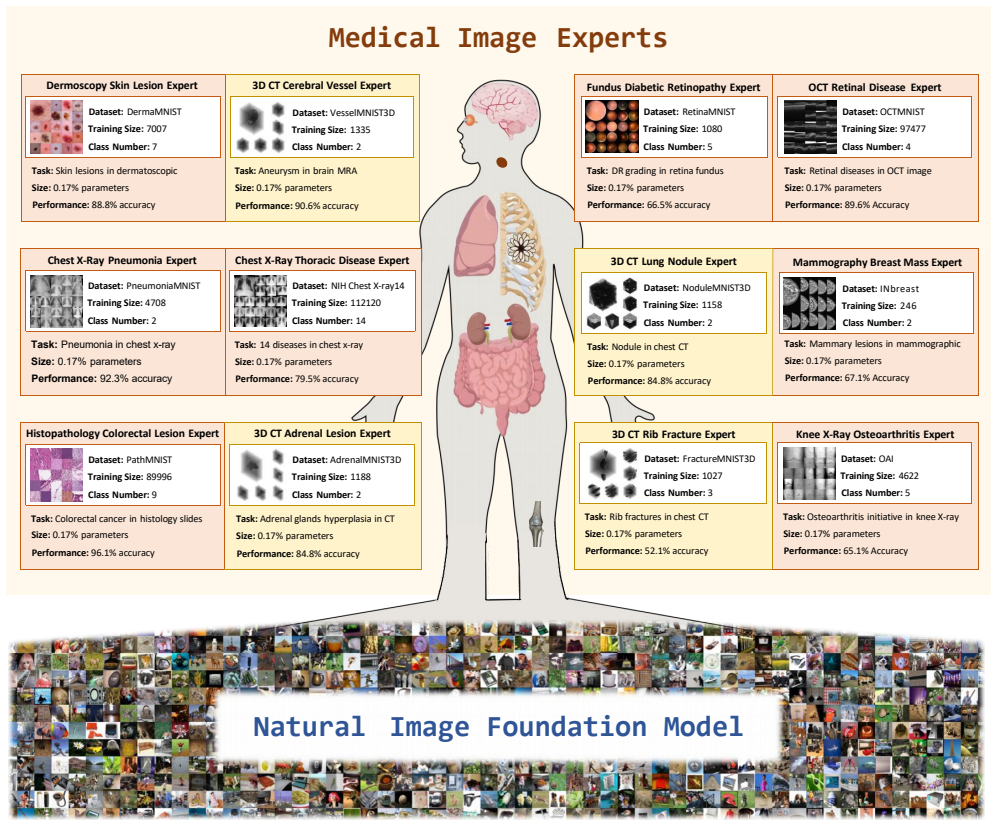
UniCAD's central claim is that a ViT pre-trained on natural 2D images, left entirely frozen, can serve as the shared engine of a multi-task medical diagnosis system: a trainable unified embedding layer converts both 2D images and 3D volumes into token sequences, and each task contributes only LoRA expert matrices that modify the query and value projections of every attention block via the update $\Delta W = BA$ with $B \in \mathbb{R}^{d \times r}$ and $A \in \mathbb{R}^{r \times d}$. Across 11 single-label and one multi-label diagnostic tasks, including the ChestX-ray14 benchmark, these experts (0.17% of the weights) match or slightly exceed the accuracy of fully fine-tuned ViT and ResNet50 models while holding GPU memory near that of a single model: UniCAD scores DEAR 1.010 on the 11 single-label tasks versus 0.204 for individually fine-tuned ViTs. The paper further claims that a randomly ordered clinical flow of mixed 2D and 3D tasks can be served in one batched forward pass by padding token sequences to a common length and zero-padding differently ranked LoRA experts to a shared maximum rank, and that accuracy improves monotonically as the frozen backbone grows from ViT-base to ViT-giga, a scaling behavior full fine-tuning does not reliably exhibit.
Load-bearing premise
The load-bearing premise is that a trainable 3D patch-embedding layer with 3D positional embeddings is enough to let the frozen, 2D-pretrained transformer blocks reason about volumetric images; if the 2D attention priors do not transfer to 3D token statistics, the reported 3D results would collapse, and the paper does not ablate this transfer or state how the 3D positional embeddings are initialized.
Editorial extensions
If this is right
- A single frozen backbone plus task modules holds GPU memory near 0.93G as the number of tasks grows, whereas loading one fine-tuned ViT per task pushes memory from 1.45G to 3.94G at eight tasks and keeps growing.
- In a simulated randomly ordered clinical flow, UniCAD batches mixed 2D and 3D tasks together at batch size 32 with about 0.9 seconds of latency and 1.77G of memory, and this holds when the backbone is upgraded from ViT-base to ViT-giga.
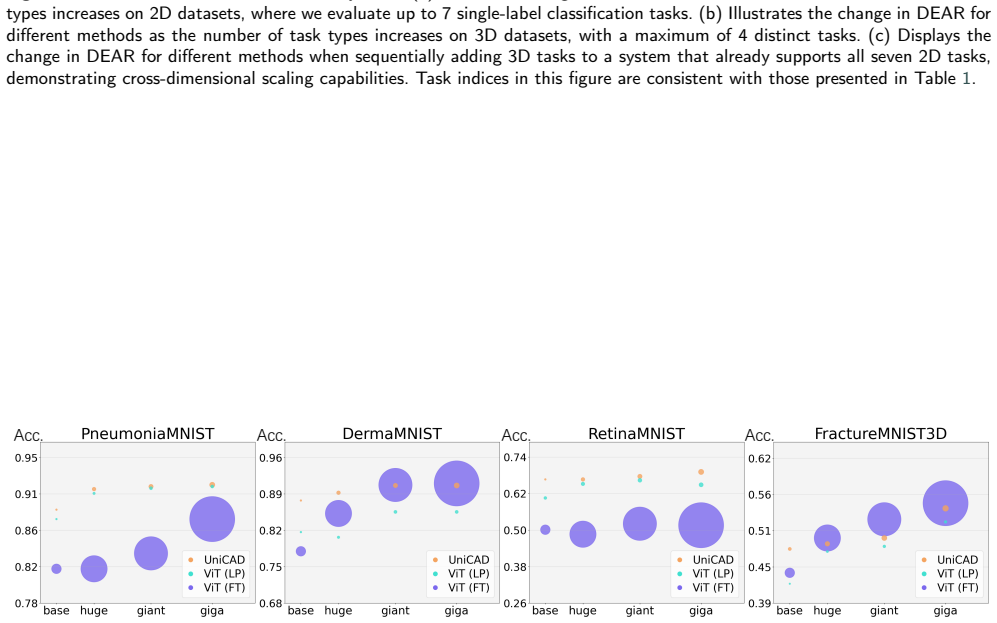
- Diagnostic accuracy improves monotonically as the frozen foundation model scales from base to giga without proportional growth in trainable parameters, so larger future vision models could be absorbed by swapping the frozen backbone alone.
- Because only 0.17% of the weights are task-specific, institutions could exchange diagnostic expertise by sharing these small modules without sharing patient data or retraining the shared backbone.
- On the ChestX-ray14 multi-label benchmark, UniCAD's average AUC of 0.795 edges out fully fine-tuned ViT (0.788) and ResNet50 (0.780), indicating the parameter-efficient route does not sacrifice performance on complex multi-label diagnosis.
Reading between the lines
- If the 3D transfer premise holds, a natural testable extension is applying the same UEL recipe to non-classification tasks such as nodule segmentation, lesion detection, or report generation, where the frozen attention prior must produce spatially structured outputs rather than a single label.
- The rank-standardization trick implies the ecosystem can accept experts built by different groups with different ranks, so one could push further by allowing per-layer rank allocation and measuring how much accuracy is lost to zero-padding at the batch level.
- The paper never tests how the 3D positional embeddings are initialized relative to the pretrained 2D grid, so comparing inflation from 2D against random initialization would isolate how much of the 3D success belongs to the trainable embedding versus the frozen attention itself.
- The DEAR exponent k=3 is introduced empirically, and the qualitative ranking of methods could shift under a different k; a sensitivity analysis would show how robust the efficiency conclusion is to that choice.
Signed reviews
Editorial analysis
A structured set of objections, weighed in public.
Referee Report
Summary. The paper proposes UniCAD, a multi-task computer-aided diagnosis (CAD) architecture that combines a frozen, pretrained Vision Transformer (ViT) backbone with a trainable Unified Embedding Layer (UEL) to handle both 2D and 3D medical images, and per-task low-rank adaptation (LoRA) experts. The claimed contributions are (1) parameter efficiency—only 0.17% trainable parameters relative to full fine-tuning—paired with accuracy comparable to fully fine-tuned ViTs across 12 diagnostic datasets; (2) plug-and-play extensibility via lightweight task-specific experts; and (3) an open ecosystem for sharing CAD experts. The paper introduces a new evaluation metric, DEAR, to capture the accuracy-memory tradeoff in multi-task deployment, and reports experiments comparing UniCAD with foundation models (CLIP variants, Med-Flamingo, M3D-LaMed), fine-tuned ViT/ResNet, and linear probing.
Significance. If the efficiency claims are validated, the work addresses a practically important problem: deploying multiple diagnostic tasks on a shared vision foundation model with minimal GPU memory and trainable-parameter overhead. The benchmark coverage is reasonably broad (8 2D and 4 3D datasets), and the architecture is simple and plausible. The authors provide source code and a project page, which supports reproducibility. The accuracy results appear to be independent measurements, and the paper is honest about the limitation that expert training still requires annotated data. However, the central efficiency metric (DEAR) is not reproducible from the reported numbers, the headline 0.17% parameter figure is underspecified, and the 3D transfer assumption is not ablated. These issues currently prevent a reader from verifying the paper's primary quantitative claims, although the core architecture remains a credible direction for future work.
major comments (4)
- [§4.3, Eq. (3), Table 3] The DEAR values in Table 3 are inconsistent with the definition in Eq. (3). Using the reported Avg ACC values for the 11 tasks, the numerator is (0.795/0.788)^3 ≈ 1.03. For UniCAD's reported DEAR of 1.010, the denominator would need to be ≈ 1.02, implying an average per-task memory for the ViT baseline of about 0.083 GB—far below the 1.45 GB reported for a single fine-tuned ViT in Table 4. If instead the GRAM totals in Table 3 are used directly (0.93 GB for UniCAD vs 4.48 GB for ViT), the denominator under any natural reading of Eq. (3) gives DEAR values of roughly 4.9 or 54.5, not 1.010. Please specify precisely what E_i^M and E_ViT represent (per-task memory, total system memory, or something else) and provide a step-by-step numerical example for one row of Table 3. Without this, the paper's headline efficiency metric cannot be reproduced or interpreted.
- [Abstract, §1, §3.3, §3.5] The claim that UniCAD introduces only 0.17% trainable parameters is not precisely defined or reproducible. The LoRA rank r is never stated, and the paper does not specify whether the 0.17% is relative to the ViT-base backbone only, includes the classification heads, or uses some other denominator. Section 3.5 reports only the learning rate, optimizer, and training epochs; it omits the LoRA rank, patch sizes for 2D and 3D inputs, and input resolutions. These are all load-bearing hyperparameters: without them, the 0.17% figure and the parameter-efficiency comparisons in Table 3 and Figure 7 cannot be verified. Please state the exact hyperparameters and a formula for the parameter count.
- [§3.2, §4.2, Table 1] The central assumption that a frozen, 2D-pretrained ViT can reason effectively about 3D patch tokens is not tested. The paper does not state how the 3D positional embeddings are initialized relative to the pretrained 2D ones (interpolation, learned from scratch, or something else), and it does not provide an ablation that varies the 3D embedding strategy or compares against a 3D-pretrained backbone. This matters because the 3D accuracy differences between UniCAD and fully fine-tuned 3D ViT are very small (e.g., 0.521 vs 0.517 on FractureMNIST3D, 0.848 vs 0.842 on NoduleMNIST3D) and could easily be within run-to-run variation. The claim of "performance on par" on 3D tasks requires error bars or statistical significance testing, and the transfer assumption needs a direct ablation.
- [Table 4] The memory measurements for fine-tuned ViT in Table 4 appear inconsistent with the narrative that all task-specific ViTs must be loaded simultaneously. For a single task the reported GRAM is 1.45 GB (base model, batch size 1), but for 8 tasks it is only 3.94 GB, which is sublinear and contradicts the claim that each extra task adds a full ViT. This also conflicts with Table 3, where 11 fine-tuned ViT tasks are listed as 4.48 GB total. Please clarify what is actually measured (e.g., shared backbone weights, sequential processing, or only a subset of models loaded) and ensure that memory definitions are consistent across Tables 3 and 4, because these numbers directly feed into the DEAR metric and the deployment-efficiency conclusions.
minor comments (6)
- [§3.5] For reproducibility, please report the batch size, weight decay, LoRA dropout, data augmentation, and the exact optimizer settings, in addition to the learning rate and epoch count.
- [Table 1] The column layout of Table 1 is hard to read because the model category headers span across both 2D and 3D blocks. Consider splitting the table into two separate panels or formatting the header rows so that each model's category is clearly associated with its columns.
- [§4.3] The exponent k=3 is described only as "empirically introduced." Please provide a sensitivity analysis showing how the DEAR rankings change for different values of k (e.g., 1, 2, 3, 4) so that the metric's conclusions are not driven by an arbitrary choice.
- [Figure 7] Figure 7 plots accuracy versus foundation model scale, but the exact parameter counts and the LoRA rank used at each scale are not reported in the text. Adding these details would let readers replicate the scaling curves.
- [References] The reference to Hu et al. (LoRA) is missing the publication venue and year; the entries for MoELoRA and LViT should also be checked for completeness.
- [§4.2] The symbol PMC-CLIP* is used in the tables and text but is only partially defined earlier; please state explicitly in the table footnotes and in §4.2 that the asterisk denotes the fine-tuned version of PMC-CLIP.
Circularity Check
No circularity: UniCAD's accuracy results are independent measurements, and the DEAR index is a defined metric rather than a derived prediction.
full rationale
UniCAD is an empirical architecture paper. Its central claims are that low-rank experts attached to a frozen ViT match fully fine-tuned accuracy and that a unified embedding layer enables 2D/3D processing. Both claims are supported by direct measurements on 12 external datasets (MedMNIST2D/3D, NIH Chest X-ray14, INbreast, OAI) against baseline models fine-tuned and evaluated under the same protocol. The accuracy numbers in Tables 1 and 2 are measured outcomes, not functions of the paper's own parameter counts or of the DEAR formula. The 0.17% trainable-parameter figure is a ratio of trainable weights to total model weights; although the paper does not precisely define the denominator (e.g., whether the classification heads and the Unified Embedding Layer are included), this is a reporting ambiguity rather than a circular reduction. The DEAR metric in Eq. (3) is presented as a proposed evaluation index, not as a prediction or first-principles result; the text explicitly states that the exponent k=3 is 'empirically introduced,' so the metric is a definition with a chosen weighting, not a derived consequence. The qualitative efficiency conclusion does not hinge on the exponent because the memory term alone separates the shared-backbone design from the linearly growing memory of independently fine-tuned models. The citation of the authors' prior MeLo work describes the lineage of the LoRA-based adaptation approach, but the paper re-specifies the LoRA update in Eqs. (1)-(2) and evaluates the new architecture in this paper, so the prior self-citation is not load-bearing. No step in the paper's derivation or evaluation chain reduces by construction to a fitted parameter, a renamed known result, or an unsupported self-citation; the derivation is therefore self-contained with respect to circularity.
Assumptions & free parameters
free parameters (4)
- LoRA rank r =
not reported (implied r=4 for ViT-base)
- DEAR exponent k =
3
- UEL patch sizes =
not specified
- Maximum padded sequence length =
not specified
assumptions (5)
- domain assumption Pre-trained ViT features transfer to medical imaging domains
- standard math LoRA effectively adapts large models
- domain assumption Frozen 2D Transformer blocks can process 3D patch sequences
- standard math Zero-padding LoRA matrices is output-equivalent
- domain assumption Official dataset splits and labels are reliable
Cite this review
Pith. "Pith review of UniCAD: Efficient and Extendable Architecture for Multi-Task Computer-Aided Diagnosis System." pith.science (2026). https://pith.science/paper/U45PBC4X
@misc{pith2026250509178,
  author       = {Pith},
  title        = {Pith review of: UniCAD: Efficient and Extendable Architecture for Multi-Task Computer-Aided Diagnosis System},
  year         = {2026},
  howpublished = {\url{https://pith.science/paper/U45PBC4X}},
  note         = {Machine review of arXiv:2505.09178}
}
read the original abstract
The growing complexity and scale of visual model pre-training have made developing and deploying multi-task computer-aided diagnosis (CAD) systems increasingly challenging and resource-intensive. Furthermore, the medical imaging community lacks an open-source CAD platform to enable the rapid creation of efficient and extendable diagnostic models. To address these issues, we propose UniCAD, a unified architecture that leverages the robust capabilities of pre-trained vision foundation models to seamlessly handle both 2D and 3D medical images while requiring only minimal task-specific parameters. UniCAD introduces two key innovations: (1) Efficiency: A low-rank adaptation strategy is employed to adapt a pre-trained visual model to the medical image domain, achieving performance on par with fully fine-tuned counterparts while introducing only 0.17% trainable parameters. (2) Plug-and-Play: A modular architecture that combines a frozen foundation model with multiple plug-and-play experts, enabling diverse tasks and seamless functionality expansion. Building on this unified CAD architecture, we establish an open-source platform where researchers can share and access lightweight CAD experts, fostering a more equitable and efficient research ecosystem. Comprehensive experiments across 12 diverse medical datasets demonstrate that UniCAD consistently outperforms existing methods in both accuracy and deployment efficiency. The source code and project page are available at https://mii-laboratory.github.io/UniCAD/.
Figures


Figures from the paper (4 more)


Reference graph
Works this paper leans on
-
[1]
author Bai, F. , author Du, Y. , author Huang, T. , author Meng, M.Q.H. , author Zhao, B. , year 2024 . title M3d: Advancing 3d medical image analysis with multi-modal large language models . journal arXiv preprint arXiv:2404.00578
arXiv 2024
-
[2]
author Dehghani, M. , author Djolonga, J. , author Mustafa, B. , author Padlewski, P. , author Heek, J. , author Gilmer, J. , author Steiner, A.P. , author Caron, M. , author Geirhos, R. , author Alabdulmohsin, I. , et al., year 2023 . title Scaling vision transformers to 22 billion parameters , in: booktitle International Conference on Machine Learning ,...
work page 2023
-
[3]
author Dosovitskiy, A. , author Beyer, L. , author Kolesnikov, A. , author Weissenborn, D. , author Zhai, X. , author Unterthiner, T. , author Dehghani, M. , author Minderer, M. , author Heigold, G. , author Gelly, S. , et al., year 2020 . title An image is worth 16x16 words: Transformers for image recognition at scale , in: booktitle International Confer...
work page 2020
-
[4]
, author Zhang, X
author He, K. , author Zhang, X. , author Ren, S. , author Sun, J. , year 2016 . title Deep residual learning for image recognition , in: booktitle Proceedings of the IEEE conference on computer vision and pattern recognition , pp. pages 770--778
2016
-
[5]
author Heker, M. , author Greenspan, H. , year 2020 . title Joint liver lesion segmentation and classification via transfer learning , in: booktitle Medical Imaging with Deep Learning
work page 2020
-
[6]
author Hu, E.J. , author Wallis, P. , author Allen-Zhu, Z. , author Li, Y. , author Wang, S. , author Wang, L. , author Chen, W. , et al., . title Lora: Low-rank adaptation of large language models , in: booktitle International Conference on Learning Representations
-
[7]
author Kellgren, J. , author Lawrence, J. , year 1957 . title Radiological assessment of osteo-arthrosis . journal Annals of the rheumatic diseases volume 16 , pages 494
work page 1957
-
[8]
author Kirillov, A. , author Mintun, E. , author Ravi, N. , author Mao, H. , author Rolland, C. , author Gustafson, L. , author Xiao, T. , author Whitehead, S. , author Berg, A.C. , author Lo, W.Y. , et al., year 2023 . title Segment anything , in: booktitle Proceedings of the IEEE/CVF international conference on computer vision , pp. pages 4015--4026
work page 2023
Show all 37 references
-
[9]
, author Asgariandehkordi, H
author Koleilat, T. , author Asgariandehkordi, H. , author Rivaz, H. , author Xiao, Y. , year 2024 . title Medclip-sam: Bridging text and image towards universal medical image segmentation , in: booktitle International Conference on Medical Image Computing and Computer-Assiste...
2024
-
[10]
, author Wu, J
author Lai, Z. , author Wu, J. , author Chen, S. , author Zhou, Y. , author Hovakimyan, N. , year 2024 . title Residual-based language models are free boosters for biomedical imaging . journal CoRR
2024
-
[11]
, author Wong, C
author Li, C. , author Wong, C. , author Zhang, S. , author Usuyama, N. , author Liu, H. , author Yang, J. , author Naumann, T. , author Poon, H. , author Gao, J. , year 2023 a. title Llava-med: Training a large language-and-vision assistant for biomedicine in one day . journa...
2023
-
[12]
, author Li, Y
author Li, Z. , author Li, Y. , author Li, Q. , author Wang, P. , author Guo, D. , author Lu, L. , author Jin, D. , author Zhang, Y. , author Hong, Q. , year 2023 b. title Lvit: language meets vision transformer in medical image segmentation . journal IEEE transactions on medi...
2023
-
[13]
, author Menell, J.H
author Liberman, L. , author Menell, J.H. , year 2002 . title Breast imaging reporting and data system (bi-rads). journal Radiologic Clinics of North America volume 40 , pages 409--430
2002
-
[14]
, author Zhao, Z
author Lin, W. , author Zhao, Z. , author Zhang, X. , author Wu, C. , author Zhang, Y. , author Wang, Y. , author Xie, W. , year 2023 . title Pmc-clip: Contrastive language-image pre-training using biomedical documents , in: booktitle International Conference on Medical Image ...
2023
-
[15]
, author Wu, X
author Liu, Q. , author Wu, X. , author Zhao, X. , author Zhu, Y. , author Xu, D. , author Tian, F. , author Zheng, Y. , year 2023 . title Moelora: An moe-based parameter efficient fine-tuning method for multi-task medical applications . journal CoRR
2023
-
[16]
, author Jain, A
author Liu, Y. , author Jain, A. , author Eng, C. , author Way, D.H. , author Lee, K. , author Bui, P. , author Kanada, K. , author de Oliveira Marinho, G. , author Gallegos, J. , author Gabriele, S. , et al., year 2020 . title A deep learning system for differential diagnosis...
2020
-
[17]
, author He, Y
author Ma, J. , author He, Y. , author Li, F. , author Han, L. , author You, C. , author Wang, B. , year 2024 . title Segment anything in medical images . journal Nature Communications volume 15 , pages 654
2024
-
[18]
, author Sieniek, M
author McKinney, S.M. , author Sieniek, M. , author Godbole, V. , author Godwin, J. , author Antropova, N. , author Ashrafian, H. , author Back, T. , author Chesus, M. , author Corrado, G.S. , author Darzi, A. , et al., year 2020 . title International evaluation of an ai syste...
2020
-
[19]
, author Chen, C
author Miao, J. , author Chen, C. , author Zhang, K. , author Chuai, J. , author Li, Q. , author Heng, P.A. , year 2024 . title Cross prompting consistency with segment anything model for semi-supervised medical image segmentation , in: booktitle International Conference on Me...
2024
-
[20]
, author Huang, Q
author Moor, M. , author Huang, Q. , author Wu, S. , author Yasunaga, M. , author Dalmia, Y. , author Leskovec, J. , author Zakka, C. , author Reis, E.P. , author Rajpurkar, P. , year 2023 . title Med-flamingo: a multimodal medical few-shot learner , in: booktitle Machine Lear...
2023
-
[21]
, author Amaral, I
author Moreira, I. , author Amaral, I. , author Domingues, I. , author Cardoso, A. , author Cardoso, M.J. , author Cardoso, J.S. , year 2012 . title Inbreast: toward a full-field digital mammographic database. journal Academic Radiology volume 19 , pages 236--248
2012
-
[22]
, author Kim, J.W
author Radford, A. , author Kim, J.W. , author Hallacy, C. , author Ramesh, A. , author Goh, G. , author Agarwal, S. , author Sastry, G. , author Askell, A. , author Mishkin, P. , author Clark, J. , et al., year 2021 . title Learning transferable visual models from natural lan...
2021
-
[23]
, author Naz, S
author Razzak, M.I. , author Naz, S. , author Zaib, A. , year 2018 . title Deep learning for medical image processing: Overview, challenges and the future . journal Classification in BioApps: Automation of Decision Making , pages 323--350
2018
-
[24]
, author Dahan, A
author Shaharabany, T. , author Dahan, A. , author Giryes, R. , author Wolf, L. , year 2023 . title Autosam: Adapting sam to medical images by overloading the prompt encoder . journal arXiv preprint arXiv:2306.06370
2023 arXiv
-
[25]
, author Ouyang, X
author Shen, Z. , author Ouyang, X. , author Xiao, B. , author Cheng, J.Z. , author Shen, D. , author Wang, Q. , year 2023 . title Image synthesis with disentangled attributes for chest x-ray nodule augmentation and detection . journal Medical image analysis volume 84 , pages 102708
2023
-
[26]
, author Kim, J
author Shi, Z. , author Kim, J. , author Li, W. , author Li, Y. , author Pfister, H. , year 2024 . title Mora: Lora guided multi-modal disease diagnosis with missing modality , in: booktitle International Conference on Medical Image Computing and Computer-Assisted Intervention...
2024
-
[27]
, author Guo, S
author Wang, H. , author Guo, S. , author Ye, J. , author Deng, Z. , author Cheng, J. , author Li, T. , author Chen, J. , author Su, Y. , author Huang, Z. , author Shen, Y. , et al., year 2023 . title Sam-med3d: towards general-purpose segmentation models for volumetric medica...
2023 arXiv
-
[28]
, author Peng, Y
author Wang, X. , author Peng, Y. , author Lu, L. , author Lu, Z. , author Bagheri, M. , author Summers, R.M. , year 2017 . title Chestx-ray8: Hospital-scale chest x-ray database and benchmarks on weakly-supervised classification and localization of common thorax diseases , in...
2017
-
[29]
, author Wu, Z
author Wang, Z. , author Wu, Z. , author Agarwal, D. , author Sun, J. , year 2022 . title Medclip: Contrastive learning from unpaired medical images and text , in: booktitle Proceedings of the Conference on Empirical Methods in Natural Language Processing. Conference on Empiri...
2022
-
[30]
, year 2019
author Wightman, R. , year 2019 . title Pytorch image models . howpublished https://github.com/rwightman/pytorch-image-models . :10.5281/zenodo.4414861
2019 doi
-
[31]
, author Zhang, X
author Wu, C. , author Zhang, X. , author Zhang, Y. , author Wang, Y. , author Xie, W. , year 2023 . title Medklip: Medical knowledge enhanced language-image pre-training . journal Proceedings of the IEEE/CVF International Conference on Computer Vision
2023
-
[32]
, author Shi, R
author Yang, J. , author Shi, R. , author Wei, D. , author Liu, Z. , author Zhao, L. , author Ke, B. , author Pfister, H. , author Ni, B. , year 2023 . title Medmnist v2-a large-scale lightweight benchmark for 2d and 3d biomedical image classification . journal Scientific Data...
2023
-
[33]
, author Liu, D
author Zhang, K. , author Liu, D. , year 2023 . title Customized segment anything model for medical image segmentation . journal arXiv preprint arXiv:2304.13785
2023 arXiv
-
[34]
, author Xu, Y
author Zhang, S. , author Xu, Y. , author Usuyama, N. , author Xu, H. , author Bagga, J. , author Tinn, R. , author Preston, S. , author Rao, R. , author Wei, M. , author Valluri, N. , author Wong, C. , author Tupini, A. , author Wang, Y. , author Mazzola, M. , author Shukla, ...
2024
-
[35]
, author Du, S
author Zhou, Y. , author Du, S. , author Li, H. , author Yao, J. , author Zhang, Y. , author Wang, Y. , year 2024 . title Reprogramming distillation for medical foundation models , in: booktitle International Conference on Medical Image Computing and Computer-Assisted Interven...
2024
-
[36]
, author Shen, Z
author Zhu, Y. , author Shen, Z. , author Zhao, Z. , author Wang, S. , author Wang, X. , author Zhao, X. , author Shen, D. , author Wang, Q. , year 2024 . title Melo: Low-rank adaptation is better than fine-tuning for medical image diagnosis , in: booktitle 2024 IEEE Internati...
2024
-
[37]
write newline
" write newline "" before.all 'output.state := FUNCTION n.dashify 't := "" t empty not t #1 #1 substring "-" = t #1 #2 substring "--" = not "--" * t #2 global.max substring 't := t #1 #1 substring "-" = "-" * t #2 global.max substring 't := while if t #1 #1 substring * t #2 gl...
Reviewed August 15, 2026 · model on record in the stance chip above.
Discussion (0). Continue with ORCID to comment.