REVIEW 2 major objections 5 minor 45 references
Data-driven Internal Model Control for Output Regulation
T0 review · 2 major / 5 minor · reviewed 2026-08-15 · deepseek-v4-flash
Pith's one-line read Output regulation of unknown systems becomes stabilization of an augmented plant: one data-based LMI yields zero tracking error from noisy data, plus kth-order nonlinear and multi-agent extensions.
desk verdict A nice internal-model trick for data-driven output regulation, but the main guarantee rests on a noise bound that cannot be verified from data and the MAS section has a complex-eigenvalue bug. read the letter →
The pith
A machine-rendered reading of the paper's core claim, the machinery that carries it, and where it could break.
The reading
What carries the argument
The load-bearing object is the augmented system $\dot\xi=A_\xi\xi+B_\xi u+E_\xi v$, $e=C_\xi\xi+Fv$, formed by appending the internal model $\dot z=G_1 z+G_2 e$ to the unknown plant, with $\xi=\mathrm{col}(x,z)$. The paper's key move is the internal-model-principle reduction: finding a controller that solves output regulation is replaced by finding $K_\xi$ that makes $A_\xi+B_\xi K_\xi$ Hurwitz, so no output regulation equations are needed. On the data side, the workhorse is a robust data-driven stabilization result: from noisy trajectories of $\xi$ one builds matrices $\Psi$, $\Upsilon$, $\Sigma$ and a quadratic inequality describing the set of all augmented systems consistent with the data; feasibility of LMI (23) then yields a gain that stabilizes every system in that set, including the true plant.
What would settle it
Simulate the robot example with known matrices, record the true combined disturbance-exosignal matrix $E_\xi V+D$, and take $\Delta$ from its largest singular value; then rerun the LMI with a deliberately smaller $\Delta$ while holding the data fixed. If the LMI remains feasible and the closed-loop tracking error fails to converge to zero, Theorem 2's claim is contradicted, because the true augmented system no longer belongs to the data-consistent set on which the proof relies.
Extended reading notes
Core claim
At the core is a reduction: for an unknown LTI plant whose reference and disturbance signals are generated by a known matrix $S$, the paper designs a controller $u=K_x x+K_z z$ with $\dot z=G_1 z+G_2 e$, where $(G_1,G_2)$ is an $n_y$-copy internal model of $S$. Embedding the generator dynamics into the controller is the key step: by the internal model principle, whenever $A_\xi+B_\xi K_\xi$ is Hurwitz, the output regulation equations are automatically solvable and $e(t)\to 0$. The main theorem states that, under a persistency-of-excitation condition and a known energy bound on the combined noise and exosignal contribution, feasibility of the data-based LMI (23) produces $K_\xi=YP^{-1}$ that stabilizes the true augmented system and solves the regulation problem. The same construction, using a $k$-fold internal model of the exosystem, solves the $k$th-order nonlinear output regulation problem, and distributed versions solve linear and nonlinear cooperative output regulation for heterogeneous multi-agent systems.
Load-bearing premise
The result depends on the user first knowing a bound on the combined effect of the measurement noise and the reference/disturbance signal during data collection; because that effect involves the unknown plant, the bound cannot be verified from data alone, and if it is chosen too small the zero-error conclusion collapses.
Editorial extensions
If this is right
- For unknown LTI systems, zero steady-state tracking error is achievable from noisy data by solving one convex LMI; the controller neither solves output regulation equations nor requires online measurements of the reference or disturbance signal.
- For smooth nonlinear systems, a $k$-fold internal model makes the tracking error converge to a term of order $O(v^{k+1})$, so higher-order internal models give higher-order asymptotic tracking without identifying the nonlinear functions.
- For heterogeneous linear multi-agent systems under a directed spanning-tree graph, the distributed protocol makes every agent's output track the exosystem output exactly; for nonlinear agents the same protocol gives $k$th-order cooperative output regulation.
- Because the design reduces output regulation to robust stabilization, the data-based stabilization LMI is the only plant-dependent computation, and the resulting controller is obtained directly from offline noisy data rather than from a system identification step.
Reading between the lines
- The practical bottleneck implied by this approach is the choice of the energy bound in Assumption 5; a data-only procedure that validates or adaptively tightens $\Delta$ would make the zero-error guarantee usable in applications, but no such procedure is given.
- Because the reduction is modular, other data-driven stabilization designs with different noise models or Lyapunov functions could be substituted for the robust stabilization step used here, potentially reducing conservativeness; the paper points toward this in Remark 6 but does not develop it.
- A natural stress test not reported in the paper is to fix a known plant, collect data with a large exosignal, choose $\Delta$ from a smaller exosignal, and check whether the tracking error still converges; the theory predicts it will not, because the true augmented system then falls outside the data-consistent set.
Signed reviews
Editorial analysis
A structured set of objections, weighed in public.
Referee Report
Summary. The paper addresses the output regulation problem for unknown linear time-invariant systems, kth-order nonlinear systems, and multi-agent systems using noisy input-state data. The main idea is to augment the plant with an internal model of the exosystem, transforming output regulation into a stabilization problem, and then to design the stabilizing gain via the robust data-driven LMI based on Petersen's lemma. The paper claims exact zero tracking error without solving output regulation equations. The claims are supported by four numerical examples and comparisons with a polytopic data-driven synchronization method.
Significance. The internal-model reformulation is an interesting and potentially impactful way to avoid the generally infeasible data-based output regulation equations, and the reduction to a convex LMI is elegant. If the core guarantees were fully data-driven, the paper would be a significant contribution to direct data-driven control. However, as discussed in the major comments, the main theorem is conditional on an unverifiable matrix bound that involves the unknown plant matrices, and a proof step in the multi-agent extension assumes diagonalizability of the graph matrix H. With these gaps repaired or the claims appropriately qualified, the paper would be a useful contribution for the data-driven control community.
major comments (2)
- [III-A3, Eq. (20); Theorems 2–5] Assumption 5 requires a known matrix Δ such that (EξV+D)(EξV+D)^T ⪯ ΔΔ^T, but Eξ = col(E, G2F) is defined in terms of the unknown plant matrices E and F. The paper does not provide a data-only procedure to construct or certify Δ; it only states existence. For finite data such a Δ always exists, so the substantive content is that a certified bound is available, and the examples do not establish this because E and F are known to the authors when the data are generated. If Δ is chosen too small, the true pair [Aξ,Bξ] may lie outside Cξ in (21), so LMI (23) gives no guarantee for the actual closed loop; if Δ is chosen too large, the LMI may be infeasible. The same issue propagates through Assumption 9 and Theorems 3, 4, and 5. The central claim of exact model-free output regulation is therefore not established as stated.
- [IV-A, proof of Theorem 4] The proof assumes a unitary T1 with T1 H T1^{-1} = diag{λ1,...,λN}. This is not guaranteed for the matrix H = L+Λ of a directed graph satisfying Assumption 7; H can be non-diagonalizable (for example, a directed path with the leader as root gives a Jordan block). The stability conclusion can still be obtained by using a Schur triangular form of H and the fact that a block-triangular matrix is Hurwitz if all diagonal blocks are Hurwitz, but the proof as written is not valid for general directed graphs. This also affects Theorem 5, which relies on Theorem 4.
minor comments (5)
- [III-A3, around Eq. (19)] Please clarify how the augmented state ξ = col(x,z) data are collected; in particular, specify that v is measured during the offline experiment and that z is obtained by simulating the internal model (15b) using the measured error e, since z is not a physical state.
- [Theorem 2 proof, Eq. (24)] The term "-P" on the left-hand side is not a consequence of Theorem 1's LMI (7b)/(23); either remove it or provide a separate argument for the stronger inequality.
- [Theorem 4 proof, Eq. (56)] The stabilizing gain obtained from LMI (55) is Y_i P_i^{-1} = λ_i Kξ_i, so the displayed inequality should involve λ_i B̄ξi Kξ_i (or a tilde gain) to match the definition Kξ_i := Y_i P_i^{-1}/λ_i.
- [Assumption 5] The wording "there exists some matrix Δ" should be changed to "a known matrix Δ is available such that ..." to avoid a vacuous-existence interpretation that does not yield a constructor.
- [General] There are several minor typos: "diagraph" in Problems 3 and 4 should be "digraph"; in Eq. (42b), the term "h0x1x2/4" appears to have missing or ambiguous parentheses; and in Property 2 of Problem 2, the expression `(e(t)− O(v(k+1)(t))` has an unbalanced parenthesis.
Circularity Check
No significant circularity: the derivation is a chain of external robustness and internal-model theorems, and the earlier self-citation is only a comparison.
full rationale
The paper's derivation chain is self-contained and externally supported. The data equation Ξ+ = AξΞ− + BξU− + EξV + D, together with Assumption 5 bounding EξV+D, places the true augmented pair [Aξ,Bξ] in the data-consistent set Cξ defined in (21)-(22). Feasibility of LMI (23) is then exactly the hypothesis of the external Petersen-lemma result Theorem 1 from [16], applied to the augmented system (18). That yields a Hurwitz Aξ+BξKξ. The final zero-error conclusion is the standard internal-model implication [1, Lemma 1.27], imported as an external theorem. Nothing in the paper fits a parameter to the target tracking error and then renames the fit as a prediction; the controller gain is synthesized from the LMI, not fitted to the regulated output. The only prior-work overlap, [36], appears as a comparison baseline rather than a load-bearing premise. Assumption 5 does require a bound on EξV+D, which depends on unknown plant matrices, but this is a verifiability/correctness concern about whether the user can certify Δ, not circularity: the theorem's implication from data plus assumption to output regulation is not equivalent to its input by construction.
Assumptions & free parameters
free parameters (1)
- noise-energy bound Δ =
not given; user-supplied in Assumptions 2, 5, and 9
assumptions (6)
- domain assumption Internal model principle for linear systems ([1, Lemma 1.27]): if the augmented system (Aξ,Bξ) is stabilized by Kξ and (G1,G2) is an ny-copy internal model of S, then the OREs (14) have a solution and the controller solves Problem 1.
- domain assumption Internal model principle for kth-order nonlinear servomechanism ([8, Theorem 3.12]): stabilizing the linearized augmented system with a k-fold internal model solves Problem 2.
- standard math Petersen's lemma robust stabilization result of Bisoffi, De Persis, and Tesi (Theorem 1): feasibility of LMI (7) yields a gain stabilizing all systems in the data-consistent set C.
- standard math Persistency of excitation, i.e., full row rank of the data matrix [U; X] (Assumptions 1, 4, and 8).
- domain assumption Existence of a known energy bound Δ for the combined exosignal and disturbance term (Assumptions 2, 5, and 9).
- domain assumption Exosystem conditions: S is known with no eigenvalues in the open left half-plane for the linear case (Assumption 3), all eigenvalues on the imaginary axis for the nonlinear case (Assumption 6), and the graph contains a directed spanning tree rooted at the exosystem (Assumption 7).
Cite this review
Pith. "Pith review of Data-driven Internal Model Control for Output Regulation." pith.science (2026). https://pith.science/paper/4U4NOP3O
@misc{pith2026250509255,
  author       = {Pith},
  title        = {Pith review of: Data-driven Internal Model Control for Output Regulation},
  year         = {2026},
  howpublished = {\url{https://pith.science/paper/4U4NOP3O}},
  note         = {Machine review of arXiv:2505.09255}
}
abstract
Output regulation is a fundamental problem in control theory, extensively studied since the 1970s. Traditionally, research has primarily addressed scenarios where the system model is explicitly known, leaving the problem in the absence of a system model less explored. Leveraging the recent advancements in Willems et al.'s fundamental lemma, data-driven control has emerged as a powerful tool for stabilizing unknown systems. This paper tackles the output regulation problem for unknown single and multi-agent systems (MASs) using noisy data. Previous approaches have attempted to solve data-based output regulation equations (OREs), which are inadequate for achieving zero tracking error with noisy data. To circumvent the need for solving data-based OREs, we propose an internal model-based data-driven controller that reformulates the output regulation problem into a stabilization problem. This method is first applied to linear time-invariant (LTI) systems, demonstrating exact solution capabilities, i.e., zero tracking error, through solving a straightforward data-based linear matrix inequality (LMI). Furthermore, we extend our approach to solve the $k$th-order output regulation problem for nonlinear systems. Extensions to both linear and nonlinear MASs are discussed. Finally, numerical tests validate the effectiveness and correctness of the proposed controllers.
Figures


Figures from the paper (6 more)


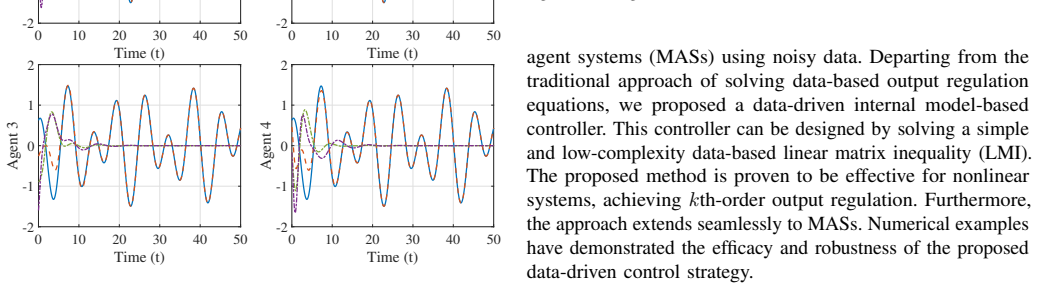

Reference graph
Works this paper leans on
-
[36]
Data-driven polytopic output synchronization from noisy data,
Y . Li, W. Liu, G. Wang, J. Sun, L. Xie, and J. Chen, “Data-driven polytopic output synchronization from noisy data,” IEEE Trans. Autom. Control, vol. 69, no. 12, pp. 8513–8525, 2024
work page 2024
-
[1]
Huang, Nonlinear Output Regulation: Theory and Applications
J. Huang, Nonlinear Output Regulation: Theory and Applications. SIAM, 2004
work page 2004
-
[2]
Efficient and robust time-optimal trajectory planning and control for agile quadrotor flight,
Z. Zhou, G. Wang, J. Sun, J. Wang, and J. Chen, “Efficient and robust time-optimal trajectory planning and control for agile quadrotor flight,” IEEE Robot. Autom. Lett. , vol. 8, no. 12, pp. 7913–7920, 2023
work page 2023
-
[3]
M. Liaquat and M. B. Malik, “Sampled data output regulation of n-link robotic manipulator using a realizable reconstruction filter,” Robotica, vol. 34, no. 4, pp. 900–912, Aug. 2016
work page 2016
-
[4]
Output regulation control for satellite formation flying using differential drag,
M. Shouman, M. Bando, and S. Hokamoto, “Output regulation control for satellite formation flying using differential drag,” J. Guid. Control Dyn., vol. 42, no. 10, pp. 2220–2232, July, 2019
work page 2019
-
[5]
W. M. Wonham, Linear Multivariable Control . Springer-Verlag New York Berlin Heidelberg Tokyo, 1974, vol. 101
work page 1974
-
[6]
The internal model principle of control theory,
B. A. Francis and W. M. Wonham, “The internal model principle of control theory,” Automatica, vol. 12, no. 5, pp. 457–465, Sept. 1976
work page 1976
-
[7]
The robust control of a servomechanism problem for linear time-invariant multivariable systems,
E. Davison, “The robust control of a servomechanism problem for linear time-invariant multivariable systems,” IEEE Trans. Autom. Control, vol. 21, no. 1, pp. 25–34, Feb. 1976
work page 1976
Show all 45 references
-
[8]
On a robust nonlinear servomechanism problem,
J. Huang and C. Lin, “On a robust nonlinear servomechanism problem,” IEEE Trans. Autom. Control , vol. 39, no. 7, pp. 1510–1513, Jul. 1994
1994
-
[9]
Cooperative output regulation of linear multi-agent systems,
Y . Su and J. Huang, “Cooperative output regulation of linear multi-agent systems,” IEEE Trans. Autom. Control , vol. 57, no. 4, pp. 1062–1066, Apr. 2011. 13
2011
-
[10]
Cooperative output regulation with application to multi-agent consensus under switching network,
——, “Cooperative output regulation with application to multi-agent consensus under switching network,” IEEE Trans. Syst. Man. Cybern. B Cybern., vol. 42, no. 3, pp. 864–875, June, 2012
2012
-
[11]
Robust cooperative output regulation of heterogeneous uncertain linear multiagent systems with time-varying communication topologies,
L. Wang, C. Wen, Z. Liu, H. Su, and J. Cai, “Robust cooperative output regulation of heterogeneous uncertain linear multiagent systems with time-varying communication topologies,” IEEE Trans. Autom. Control , vol. 65, no. 10, pp. 4340–4347, Oct. 2020
2020
-
[12]
An internal model principle is necessary and sufficient for linear output synchronization,
P. Wieland, R. Sepulchre, and F. Allg ¨ower, “An internal model principle is necessary and sufficient for linear output synchronization,” Automatica, vol. 47, no. 5, pp. 1068–1074, May, 2011
2011
-
[13]
Distributed nash equilibrium seeking with dynamics subject to disturbance of unknown frequencies over jointly strongly connected switching networks,
X. He and J. Huang, “Distributed nash equilibrium seeking with dynamics subject to disturbance of unknown frequencies over jointly strongly connected switching networks,” IEEE Trans. Autom. Control , vol. 69, no. 1, pp. 606–613, Jan. 2023
2023
-
[14]
A note on persistency of excitation,
J. C. Willems, I. Markovsky, P. Rapisarda, and B. L. M. De Moor, “A note on persistency of excitation,” Syst. Control Lett. , vol. 56, no. 4, pp. 325–329, May, 2005
2005
-
[15]
From noisy data to feedback controllers: Nonconservative design via a matrix S-lemma,
H. J. van Waarde, M. K. Camlibel, and M. Mesbahi, “From noisy data to feedback controllers: Nonconservative design via a matrix S-lemma,” IEEE Trans. Autom. Control , vol. 67, no. 1, pp. 162–175, Dec. 2020
2020
-
[16]
Data-driven control via Petersen’s lemma,
A. Bisoffi, C. De Persis, and P. Tesi, “Data-driven control via Petersen’s lemma,” Automatica, vol. 145, p. 110537, Nov. 2022
2022
-
[17]
Learning robust data- based LQG controllers from noisy data,
W. Liu, G. Wang, J. Sun, F. Bullo, and J. Chen, “Learning robust data- based LQG controllers from noisy data,” IEEE Trans. Automa. Control , vol. 69, no. 12, pp. 8526–8538, June, 2024
2024
-
[18]
Distributed data-driven unknown-input observers for state estimation,
Y . Wei, G. Disar `o, W. Liu, J. Sun, M. E. Valcher, and G. Wang, “Distributed data-driven unknown-input observers for state estimation,” arXiv preprint arXiv:2401.04660 , Jan. 2024
2024 arXiv
-
[19]
Data-enabled predictive control: In the shallows of the DeePC,
J. Coulson, J. Lygeros, and F. D ¨orfler, “Data-enabled predictive control: In the shallows of the DeePC,” in Proc. Eur. Control Conf., Naples, Italy, Italy, June, 25-28 2019, pp. 307–312
2019
-
[20]
Data-driven model predictive control with stability and robustness guarantees,
J. Berberich, J. K ¨ohler, M. A. M ¨uller, and F. Allg ¨ower, “Data-driven model predictive control with stability and robustness guarantees,” IEEE Trans. Autom. Control, vol. 66, no. 4, pp. 1702–1717, Apr. 2021
2021
-
[21]
Data-driven resilient predictive control under Denial-of-Service,
W. Liu, J. Sun, G. Wang, F. Bullo, and J. Chen, “Data-driven resilient predictive control under Denial-of-Service,” IEEE Trans. Autom. Control, vol. 68, no. 8, pp. 4722–4737, Aug. 2023
2023
-
[22]
Data-driven analysis and controller design for discrete-time systems under aperiodic sampling,
S. Wildhagen, J. Berberich, M. Hertneck, and F. Allg ¨ower, “Data-driven analysis and controller design for discrete-time systems under aperiodic sampling,” IEEE Trans. Autom. Control , vol. 68, no. 6, pp. 3210–3225, June, 2023
2023
-
[23]
Data-driven L2-stability analysis for dynamic event-triggered networked control systems: A hybrid system approach,
W. Qi, K. Liu, R. Wang, and X. Sun, “Data-driven L2-stability analysis for dynamic event-triggered networked control systems: A hybrid system approach,” IEEE Trans. Ind. Electron. , vol. 70, no. 6, pp. 6151–6158, June, 2023
2023
-
[24]
Self-triggered consensus control of multiagent systems from data,
Y . Li, X. Wang, J. Sun, G. Wang, and J. Chen, “Self-triggered consensus control of multiagent systems from data,” IEEE Trans. Autom. Control , vol. 69, no. 7, pp. 4702–4709, Jul. 2024
2024
-
[25]
Data-driven aperiodic sampled-data control of markovian jump system,
G. Chen, L. Wang, J. Xia, X. Xie, and J. H. Park, “Data-driven aperiodic sampled-data control of markovian jump system,” IEEE Trans. Syst. Man. Cybern., 2025
2025
-
[26]
Learning controllers from data via approximate nonlinearity cancellation,
C. De Persis, M. Rotulo, and P. Tesi, “Learning controllers from data via approximate nonlinearity cancellation,” IEEE Trans. Autom. Control , vol. 68, no. 10, pp. 6082–6097, Oct. 2023
2023
-
[27]
Enforcing contraction via data,
Z. Hu, C. De Persis, and P. Tesi, “Enforcing contraction via data,” arXiv:2401.07819, Jan. 2024
2024 arXiv
-
[28]
Data-driven feedback domination control of a class of nonlinear systems,
J. Li, K. Hu, and T. Liu, “Data-driven feedback domination control of a class of nonlinear systems,” IEEE Control Syst. Lett. , vol. 8, pp. 1739–1744, June, 2024
2024
-
[29]
Localized data-driven consen- sus control,
Z. Chang, J. Jiao, and Z. Li, “Localized data-driven consen- sus control,” IEEE Trans. Autom. Control , pp. 1–15, 2025, doi: 10.1109/TAC.2025.3543472
2025
-
[30]
Cautious optimization via data informativity,
J. Eising and J. Cort ´es, “Cautious optimization via data informativity,” arXiv:2307.10232, Jul. 2023
2023 arXiv
-
[31]
Data-driven dissipativity analysis: Application of the matrix S-lemma,
H. J. van Waarde, M. K. Camlibel, P. Rapisarda, and H. L. Trentelman, “Data-driven dissipativity analysis: Application of the matrix S-lemma,” IEEE Control Syst. Mag. , vol. 42, no. 3, pp. 140–149, June, 2022
2022
-
[32]
Minimum input design for direct data-driven property identification of unknown linear systems,
S. Kang and K. You, “Minimum input design for direct data-driven property identification of unknown linear systems,” Automatica, vol. 156, p. 111130, Oct. 2023
2023
-
[33]
Data-enabled policy optimization for direct adaptive learning of the LQR,
F. Zhao, F. D ¨orfler, A. Chiuso, and K. You, “Data-enabled policy optimization for direct adaptive learning of the LQR,” arXiv preprint arXiv:2401.14871, 2024
2024 arXiv
-
[34]
Adaptive dynamic programming and adaptive optimal output regulation of linear systems,
W. Gao and Z.-P. Jiang, “Adaptive dynamic programming and adaptive optimal output regulation of linear systems,” IEEE Trans. Autom. Control, vol. 61, no. 12, pp. 4164–4169, 2016
2016
-
[35]
Data-driven output synchronization of heterogeneous leader- follower multi-agent systems,
J. Jiao, H. J. van Waarde, H. L. Trentelman, M. K. Camlibel, and S. Hirche, “Data-driven output synchronization of heterogeneous leader- follower multi-agent systems,” in Proc. IEEE Conf. Decis. Control , Austin, TX, USA, Dec. 2021, pp. 466–471
2021
-
[37]
Distributed adaptive cooperative optimal output regulation via integral reinforcement learning,
L. Lin and J. Huang, “Distributed adaptive cooperative optimal output regulation via integral reinforcement learning,” Automatica, vol. 170, p. 111861, 2024
2024
-
[38]
Data informativity for robust output reg- ulation,
L. Zhu and Z. Chen, “Data informativity for robust output reg- ulation,” IEEE Trans. Autom. Control , pp. 1–7, Apr. 2024, doi: 10.1109/TAC.2024.3389742
2024
-
[39]
The informativity approach: To data-driven analysis and control,
H. J. van Waarde, J. Eising, M. K. Camlibel, and H. L. Trentelman, “The informativity approach: To data-driven analysis and control,” IEEE Control Syst. Mag. , vol. 43, no. 6, pp. 32–66, Dec. 2023
2023
-
[40]
Low-complexity learning of linear quadratic regulators from noisy data,
C. De Persis and P. Tesi, “Low-complexity learning of linear quadratic regulators from noisy data,” Automatica, vol. 128, p. 109548, June, 2021
2021
-
[41]
Data-driven min-max MPC for linear systems: Robustness and adaptation,
Y . Xie, J. Berberich, and F. Allg ¨ower, “Data-driven min-max MPC for linear systems: Robustness and adaptation,” arXiv:2404.19096, Apr. 2024
2024 arXiv
-
[42]
CVX: Matlab software for disciplined convex programming, version 2.1,
M. Grant and S. Boyd, “CVX: Matlab software for disciplined convex programming, version 2.1,” http://cvxr.com/cvx/citing/, 2014
2014
-
[43]
A general result on the robust cooperative output regulation for linear uncertain multi-agent systems,
Y . Su, Y . Hong, and J. Huang, “A general result on the robust cooperative output regulation for linear uncertain multi-agent systems,” IEEE Trans. Autom. Control, vol. 58, no. 5, pp. 1275–1279, May, 2012
2012
-
[44]
Data-driven stabilizer design and closed-loop analysis of general nonlinear systems via Taylor’s expansion,
M. Guo, C. De Persis, and P. Tesi, “Data-driven stabilizer design and closed-loop analysis of general nonlinear systems via Taylor’s expansion,” arXiv:2209.01071, Apr. 2023
2023 arXiv
-
[45]
Data-based system representation and synchronization for multiagent systems,
V . G. Lopez and M. A. M ¨uller, “Data-based system representation and synchronization for multiagent systems,” arXiv.2404.13937, Apr. 2024
2024 arXiv
Reviewed August 15, 2026 · model on record in the stance chip above.
Discussion (0). Continue with ORCID to comment.