REVIEW 2 major objections 4 minor 2 cited by
Constraining superluminal Einstein-\AE{}ther gravity through gravitational memory
T0 review · 2 major / 4 minor · reviewed 2026-08-15 · deepseek-v4-flash
Pith's one-line read This paper computes the first gravitational displacement memory in Einstein-Aether gravity and finds that superluminal scalar or vector aether waves generate a formally divergent tensor memory along the critical directions where their…
desk verdict A careful, honest first computation of gravitational memory in Einstein-Æther gravity with a genuinely new superluminal divergence mechanism, but the advertised exclusion of superluminal parameter space remains a conjecture whose quantitative basis is missing exactly where the effect is largest. read the letter →
The pith
A machine-rendered reading of the paper's core claim, the machinery that carries it, and where it could break.
The reading
What carries the argument
The argument rides on three pieces: (i) a manifestly gauge-invariant second-order action for the linearized theory written in terms of only the five dynamical degrees of freedom (tensor $h^{TT}_{ij}$, vector $\Sigma_i$, scalar $\Theta$); (ii) a second-variation method that converts this action into a gauge-invariant asymptotic Isaacson energy-momentum tensor; and (iii) the velocity factor $V_\psi = 1/(1 - \beta_\psi/\beta_T \, \vec{n}'\cdot\vec{n})$ appearing in the memory Green's function. The factor $V_\psi$ diverges when the emission direction and the observer direction satisfy $\vec{n}'\cdot\vec{n} = \beta_T/\beta_\psi$, and that divergence is the physical core of the paper.
What would settle it
Compute the displacement memory at the critical direction $\vec{n}_p\cdot\vec{n} = \beta_T/\beta_S$ using a source with finite spatial extent, or a fully nonlinear numerical relativity simulation of an Einstein-Aether binary merger: if the amplitude saturates to a finite value as the source size shrinks, the claimed unbounded memory is an artifact and the exclusion conjecture fails; if it grows without bound as the source is made smaller, the conjecture is supported.
Extended reading notes
Core claim
The central discovery is that the tensor displacement memory in Einstein-Aether gravity, sourced by the self-stress of scalar and vector aether radiation, is not always finite. When a source emits aether waves with group velocity $\beta_S > \beta_T$, there is a critical emission direction $\vec{n}_p \cdot \vec{n} = \beta_T/\beta_S$ at which the memory Green's function formally diverges, because the wave's causal cone intersects the past null cone of the memory event. In the luminal case this divergence is cancelled by the transverse-traceless projection of the source, but for superluminal sources no such cancellation occurs. The authors conjecture, from this unbounded formal amplitude together with existing constraints on luminal tensor waves, that Einstein-Aether theory is only viable if all modes propagate at the speed of light, $\beta_T = \beta_V = \beta_S = 1$.
Load-bearing premise
The conjecture depends on the assumption that the formally divergent memory amplitude computed with the localized-source approximation ($r'\ll r$) is a physical, unbounded effect rather than a sign that the approximation itself has broken down at the critical direction, where finite source size, backreaction, or nonlinearity could cut off the divergence.
Editorial extensions
If this is right
- If the conjecture holds, the viable parameter space of Einstein-Aether gravity collapses to the luminal surface $\beta_T = \beta_V = \beta_S = 1$, eliminating all superluminal aether propagation.
- In the luminal theory, vector polarizations disappear from the detector response while the scalar longitudinal and breathing polarizations remain, so gravitational-wave polarimetry can directly test the theory.
- The absence of large memory signals in current LIGO/Virgo/KAGRA binary coalescence events becomes a direct observational check of the conjecture.
- The same divergent-memory mechanism applies to vector aether waves, so the constraint does not depend on scalar radiation alone.
- The critical-angle relation $\vec{n}_p\cdot\vec{n} = \beta_T/\beta_S$ gives a concrete angular signature that future memory searches could target.
Reading between the lines
- The divergence mechanism is structurally analogous to the Cherenkov angle, suggesting that finite-size or nonlinear effects might regulate the memory amplitude to a large but finite value rather than removing it entirely, which would still leave observable signals.
- The mechanism should extend beyond Einstein-Aether: any metric theory of gravity whose additional degrees of freedom propagate faster than the tensor modes is likely to exhibit the same unprotected memory directions.
- A fully nonlinear numerical-relativity computation of an Einstein-Aether binary merger, with finite source sizes and metric backreaction, would settle whether the divergence is physical or an artifact of the localized-source approximation.
- If superluminal aether modes existed, memory signals would be statistically enhanced toward the critical cone, producing a characteristic angular bias across multiple observed events.
Signed reviews
Editorial analysis
A structured set of objections, weighed in public.
Referee Report
Summary. This paper computes gravitational displacement memory in Einstein-Æther (EÆ) gravity using an Isaacson-based, gauge-invariant framework. The authors derive a manifestly gauge-invariant second-order action (Eq. (46)), identify the propagating scalar, vector, and tensor degrees of freedom with their respective speeds (Eqs. (25), (33), (39)), determine the gravitational polarization content (Eq. (59)), and construct the asymptotic Isaacson energy-momentum tensor. The central technical result is the luminal tensor memory formula (Eq. (127)), which is cross-checked against prior literature in Appendices E and F. The paper then considers superluminal scalar and vector aether waves in the simplified context of individual energy pulses (Sec. IV B 2) and finds that the memory amplitude contains a factor V_p^S = 1/(1 - beta_S n_p·n) that diverges at the critical direction n_p·n = 1/beta_S (Eq. (114)). Based on this formal divergence, the authors conjecture that the superluminal parameter space of EÆ gravity is excluded by current gravitational wave data (Sec. IV B 4).
Significance. If the technical derivation stands, the paper makes several solid contributions: a new gauge-invariant second-order action for EÆ gravity, a complete analysis of its gravitational polarizations in gauge-invariant language, and a luminal memory formula that is explicitly cross-checked against earlier results in Refs. [16,74]. These results are reproducible from the provided equations and are valuable for future work on Lorentz-violating metric theories. The identification of a potential mechanism for large memory along critical directions is an interesting and falsifiable idea in principle. However, the paper's headline claim—the exclusion of superluminal EÆ gravity—is a conjecture that is not established by the presented computation, because the divergence occurs precisely where the authors' own approximations break down and no regulated amplitude or observational comparison is provided. The manuscript is therefore more convincing as a derivation of the memory framework and of a formal critical-direction enhancement than as a constraint on the theory's parameter space.
major comments (2)
- [Sec. IV B 2, Eqs. (112)–(114) and (118), (123)] The exclusion conjecture rests on treating the divergence of V_p^S at n_p·n = 1/beta_S as a physical unbounded memory. However, the divergence is an artifact of a singular change of variables: in deriving Eq. (95), the delta-function identity δ(g(r')) = δ(r' - r0)/|g'(r0)| is invoked, but at the critical direction the coefficient of r' in g(r') vanishes, so the identity is not a valid distributional statement. For a finite-size source, the r' integral is bounded by the source extent, and the contribution along the critical ray is a coherent superposition over a finite region, not an infinite amplitude. The authors explicitly acknowledge in Sec. IV B 4 that 'strictly speaking not valid at the diverging point,' that perturbation theory may break down, and that finite-size effects are neglected. Since no regulated amplitude is computed, the step from the formal divergence in Eqs. (118) and (123) to the conclusion that the theory is 'incompatible with current gravitational wave data' is not established. A finite-source calculation, or at least an explicit regularization scheme, is required to support the conjecture.
- [Sec. IV B 4] The paper moves from 'a priori unbound memory' to a statement about current observational data without a quantitative bridge. Even if the formal divergence were physical, the authors do not estimate the expected memory amplitude for realistic sources (e.g., neutron star binaries), do not compare it to LIGO/Virgo detector noise or to existing memory upper limits, and do not quantify how 'large' the effect must be to be excluded. The text says 'we do not provide a quantitative calculation of how big the memory offset will truly be' and that a full waveform knowledge would be required. In the absence of such estimates, the assertion that 'already the statement ... is, from our point of view, a notable new mechanism' is a reasonable qualitative conclusion, but the title and abstract's 'stringent exclusion of the superluminal parameter space' overstates what the computation supports. The authors should either provide a concrete observational bound or explicitly reframe the result as a conjectural mechanism that requires further work before any exclusion can be claimed.
minor comments (4)
- [Sec. II B 2 vs. Appendix G, Eq. (G1b)] The main text (after Eq. (33)) assumes c14 ≠ 0, but Appendix G, Eq. (G1b) states a condition 'c14 ≠ 1.' Please reconcile the notation; if both conditions are intended, state them explicitly.
- [Sec. IV B 2, Fig. 2 caption] The caption refers to a 'source regarded time'; this appears to be a typo for 'source retarded time.' Please correct.
- [Sec. IV B 4, footnote 17] The text relies on scalar and vector emission from compact objects, but notes that 'the precise nature of EÆ black holes... is not yet completely settled.' This caveat weakens the claim that binary black hole mergers would necessarily source the predicted large memory. Please state more explicitly how the final conjecture depends on this unsettled issue.
- [Sec. III C 2] The claim that gauge invariance of the linear equations 'automatically carries over' to the Isaacson energy-momentum tensor is stated without a proof; given the known gauge ambiguities in earlier literature (Ref. [74]), a brief argument or a pointer to the second-variation theorem would strengthen the presentation.
Circularity Check
No significant circularity: the superluminal memory divergence follows from the Einstein-Æther action and the retarded Green's function, not from fitted inputs or self-defined quantities.
full rationale
The paper's central result — the formally divergent tensor displacement memory at n_p·n = 1/β_S for β_S > β_T — is obtained by solving the Isaacson memory equation (84) with the retarded Green's function of the tensor wave operator, Eqs. (85)-(95), and the explicit point-pulse energy-momentum tensor constructed in Appendix D (Eqs. (104)-(110)). No step equates the output to an input: the divergence is not put in by hand, and the pulse amplitude E_p is a bookkeeping parameter, not fitted to the memory signal. The external constraints β_T = 1 from GW170817 and β_ψ ≥ 1 from Cherenkov bounds are imported as observational inputs, not derived from or calibrated by the memory computation. The framework of Refs. [7,30,55] is cited for the general Isaacson/Lemma-1 reduction, but those citations are parameter-free and their assumptions do not include the EÆ superluminal divergence, so they are independent support rather than load-bearing circularity. The paper itself flags the breakdown of the localized-source and perturbative assumptions at the critical direction (Sec. IV B 4) and labels the exclusion statement a conjecture; that is a validity caveat, not a circularity. I find no equation or fitted parameter that reduces by construction.
Assumptions & free parameters
assumptions (6)
- domain assumption The Einstein-Aether action in Eq. (1) is the correct classical theory for the gravitational sector, with a fixed-norm aether vector field.
- domain assumption The asymptotic background is Minkowski with a purely temporal, constant aether vector and the source-centered frame aligned with the preferred frame.
- domain assumption High-frequency and low-frequency scales are cleanly separated and the Isaacson averaging rules hold.
- domain assumption The source is localized with r' << r at all points where the memory source is nonzero.
- domain assumption Tensor waves propagate luminally (beta_T = 1 from GW170817) and Cherenkov constraints rule out subluminal aether modes (beta_psi >= 1).
- domain assumption Nondispersive propagation makes phase velocity equal to group velocity for each Einstein-Aether mode.
Cite this review
Pith. "Pith review of Constraining superluminal Einstein-\AE{}ther gravity through gravitational memory." pith.science (2026). https://pith.science/paper/ZOXHEJAP
@misc{pith2026250509544,
  author       = {Pith},
  title        = {Pith review of: Constraining superluminal Einstein-\AEther gravity through gravitational memory},
  year         = {2026},
  howpublished = {\url{https://pith.science/paper/ZOXHEJAP}},
  note         = {Machine review of arXiv:2505.09544}
}
read the original abstract
Every emission of radiation in gravity also includes a nonwavelike component that leaves a permanent change in proper distances of the spacetime it travels through. This phenomenon is known as gravitational displacement memory. Building up on a recently developed computation framework that harnesses Isaacson's insights on a fundamental definition of gravitational waves, we compute the leading displacement memory formula in Einstein-Aether gravity. Our analysis represents the first direct calculation of gravitational memory in a metric theory with nontrivial asymptotic vector field value. We find that an emission of scalar and vector aether waves at a propagation speed greater than the speed of tensor radiation features unprotected causal directions with a priori unbound memory build-up. Based on the results and the existing constraint of luminally propagating tensor waves, we conjecture a stringent exclusion of the superluminal parameter space of Einstein-Aether gravity.
Figures


Figures from the paper (1 more)

Forward citations
Cited by 2 Pith papers
-
Scalar memory from compact binary coalescences
In Ricci-coupled scalar-Gauss-Bonnet gravity, the change in scalar charge during binary black hole mergers generates a scalar memory contribution that modifies the total memory signal on observable timescales.
-
Gravitational Memory in Generalized Proca Gravity
The displacement memory formula for Generalized Proca gravity is derived for a massive Lorentz-invariant branch and a massless Lorentz-violating branch, with the dispersive branch requiring a frequency-integrated treatment.
Reference graph
Works this paper leans on
-
[74]
Gravitational-Wave Observations as a Tool for Testing Relativistic Gravity,
D. M. Eardley, D. L. Lee, and A. P. Lightman, “Gravitational-Wave Observations as a Tool for Testing Relativistic Gravity,” Phys. Rev. D 8 (Nov,
-
[1]
Equations of motion Constraint equation. If we directly vary the action with respect to the coefficient λ, we will obtain a constraint equation in terms of the gauge-invariant quantities −2 ¯AΩ + 2 ¯A2Φ = 0, (F7) which in the gauge in Eq. (F6) reads 2 ¯Aω0 + ¯A2h00 = 0. (F8) This equation agrees with the corresponding Eq.(96) in Ref. [74] when choosing ¯A...
-
[2]
(59)] in terms of the SO(3)-invariant components [Eq
Gravitational polarizations Expanding the polarization modes [Eq. (59)] in terms of the SO(3)-invariant components [Eq. (18)] of the perturbation fields, then switching the notation using Eq. (F1) and (F3) we have P+ = eij + 2 ETT ij = eij + 2 ϕTT ij , (F21a) P× = eij × 2 ETT ij = eij + 2 ϕTT ij , (F21b) Pu =− ¯Ac13 βV (aT i + 1 2 ¯AET i )ui =− ¯Ac13 βV (...
-
[3]
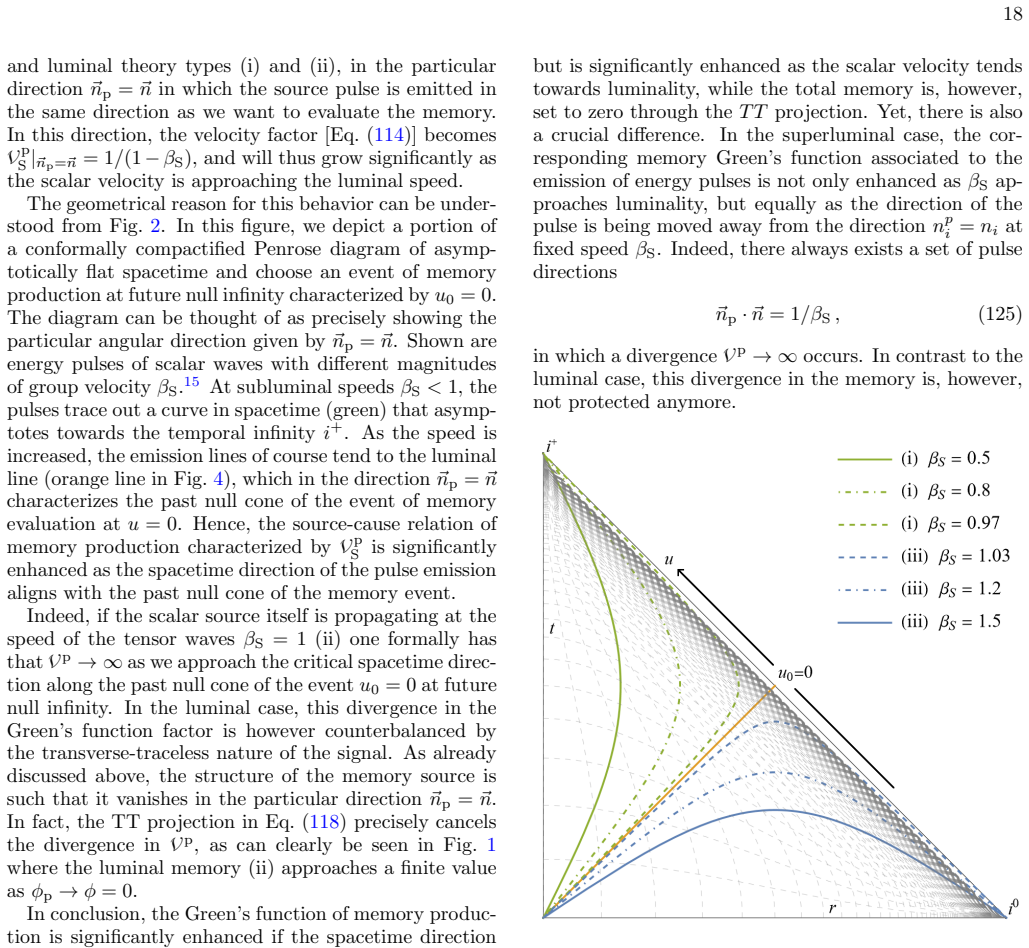
source regarded time
Understanding the directions of large memory buildup We are now in a place to physically understand the divergence in the memory computation that relates the two regimes Vp S > 0 (I) and Vp S < 0 (II) identified above, and deduce a conjecture on a severe constraint on super- luminal EÆ theory. Through Eq. (112), the magnitude of this factor determines the...
-
[4]
Conjecture of new constraint on EÆ Gravity Given the physical origin of this divergence in the memory formula, it represents first of all an interesting feature of Lorentz-breaking theories that might provide a characterizing signature in GW data. Our computa- tion is strictly speaking not valid at the diverging point, since basic assumptions are not sati...
-
[5]
C. M. Will, Theory and Experiment in Gravitational Physics. Cambridge University Press, 2 ed., 2018
2018
-
[6]
Coleman Miller and N
M. Coleman Miller and N. Yunes, Gravitational Waves in Physics and Astrophysics . IOP, 12, 2021
2021
-
[7]
(74) using Eq
Asymtotic energy-momentum tensor To compare the self-stress-energy tensor, we perform gauge fixing on Eq. (74) using Eq. (F6), as follows (2)tT ij = 1 4κ0 D ∂iϕTT ab ∂jϕab TT E = ninj 4κ0β2 T D ˙ϕTT ab ˙ϕab TT E , (F23a) (2)tV ij = ¯CV 4κ0 D ∂iνa∂jνa E = ¯CVninj 4κ0β2 V D ˙νa ˙νa E , (F23b) (2)tS ij = ¯CS 4κ0 1 4 D ∂iF∂jF E = ¯CSninj 4κ0β2 S D ˙F ˙F E , (...
Show all 117 references
-
[8]
Experimental relativity,
R. H. Dicke, “Experimental relativity,” in Les Houches Summer Shcool of Theoretical Physics: Relativity, Groups and Topology, pp. 165–316. Gordon and Breach Science Publishers, 1964
1964
-
[9]
Poisson and C
E. Poisson and C. M. Will, Gravity: Newtonian, Post-Newtonian, Relativistic. Cambridge University Press, 2014
2014
-
[10]
Gravity and Scalar Fields,
T. P. Sotiriou, “Gravity and Scalar Fields,” in Modifications of Einstein’s Theory of Gravity at Large Distances, E. Papantonopoulos, ed., pp. 3–24. Springer International Publishing, Cham, 2015
2015
-
[11]
A systematic approach to generalisations of General Relativity and their cosmological implications,
L. Heisenberg, “A systematic approach to generalisations of General Relativity and their cosmological implications,” Phys. Rept. 796 (2019) 1–113, arXiv:1807.01725 [gr-qc]
2019 arXiv
-
[12]
On Lorentz violation in Horava-Lifshitz type theories,
M. Pospelov and Y. Shang, “On Lorentz violation in Horava-Lifshitz type theories,” Phys. Rev. D 85 (2012) 105001, arXiv:1010.5249 [hep-th]
2012 arXiv
-
[13]
Gravity with a dynamical preferred frame,
T. Jacobson and D. Mattingly, “Gravity with a dynamical preferred frame,” Phys. Rev. D 64 (2001) 024028, arXiv:gr-qc/0007031
2001 arXiv
-
[14]
Zosso, Probing Gravity - Fundamental Aspects of Metric Theories and their Implications for Tests of General Relativity
J. Zosso, Probing Gravity - Fundamental Aspects of Metric Theories and their Implications for Tests of General Relativity. PhD thesis, Zurich, ETH, 2024. arXiv:2412.06043 [gr-qc]
2024 arXiv
-
[15]
The Confrontation between general relativity and experiment,
C. M. Will, “The Confrontation between general relativity and experiment,” Living Rev. Rel. 9 (2006) 3, arXiv:gr-qc/0510072 [gr-qc]
2006 arXiv
-
[16]
Modern Tests of Lorentz Invariance,
D. Mattingly, “Modern Tests of Lorentz Invariance,” Living Reviews in Relativity 8 no. 1, (Sept., 2005)
2005
-
[17]
Einstein-aether gravity: A Status report,
T. Jacobson, “Einstein-aether gravity: A Status report,” PoS QG-PH (2007) 020, arXiv:0801.1547 [gr-qc]
2007 arXiv
-
[18]
From gravitons to gravity: Myths and reality,
T. Padmanabhan, “From gravitons to gravity: Myths and reality,” Int. J. Mod. Phys. D 17 (2008) 367–398, arXiv:gr-qc/0409089
2008 arXiv
-
[19]
Nonlinear nature of gravitation and gravitational wave experiments,
D. Christodoulou, “Nonlinear nature of gravitation and gravitational wave experiments,” Phys. Rev. Lett. 67 (1991) 1486–1489
1991
-
[20]
Hereditary effects in gravitational radiation,
L. Blanchet and T. Damour, “Hereditary effects in gravitational radiation,” Phys. Rev. D 46 (1992) 4304–4319
1992
-
[21]
Einstein-Aether waves,
T. Jacobson and D. Mattingly, “Einstein-Aether waves,” Phys. Rev. D 70 (2004) 024003, arXiv:gr-qc/0402005
2004 arXiv
-
[22]
Energy in the Einstein-aether theory,
C. Eling, “Energy in the Einstein-aether theory,” Phys. Rev. D 73 (2006) 084026, arXiv:gr-qc/0507059. [Erratum: Phys.Rev.D 80, 129905 (2009)]
2006 arXiv
-
[23]
Radiation damping in Einstein-aether theory,
B. Z. Foster, “Radiation damping in Einstein-aether theory,” Phys. Rev. D 73 (2006) 104012, arXiv:gr-qc/0602004. [Erratum: Phys.Rev.D 75, 129904 (2007)]
2006 arXiv
-
[24]
Generalized Einstein-Aether theories and the Solar System,
C. Bonvin, R. Durrer, P. G. Ferreira, G. Starkman, and T. G. Zlosnik, “Generalized Einstein-Aether theories and the Solar System,” Phys. Rev. D 77 (2008) 024037, arXiv:0707.3519 [astro-ph]
2008 arXiv
-
[25]
Constraints on Einstein-Æther theory and Hoˇ rava gravity from binary pulsar observations,
K. Yagi, D. Blas, E. Barausse, and N. Yunes, “Constraints on Einstein-Æther theory and Hoˇ rava gravity from binary pulsar observations,” Phys. Rev. D 89 no. 8, (2014) 084067, arXiv:1311.7144 [gr-qc] . [Erratum: Phys.Rev.D 90, 069902 (2014), Erratum: Phys.Rev.D 90, 069901 (2014)]
2014 arXiv
-
[26]
The gravitational-wave memory effect,
M. Favata, “The gravitational-wave memory effect,” Class. Quant. Grav. 27 (2010) 084036, arXiv:1003.3486 [gr-qc]
2010 arXiv
-
[27]
Gravitational Memory, BMS Supertranslations and Soft Theorems,
A. Strominger and A. Zhiboedov, “Gravitational Memory, BMS Supertranslations and Soft Theorems,” JHEP 01 (2016) 086, arXiv:1411.5745 [hep-th]
2016 arXiv
-
[28]
Note on the memory effect,
J. Frauendiener, “Note on the memory effect,” Class. Quant. Grav. 9 (06, 1992) 1639–1641
1992
-
[29]
Geodesic deviation at null infinity and the physical effects of very long wave gravitational radiation,
M. Ludvigsen, “Geodesic deviation at null infinity and the physical effects of very long wave gravitational radiation,” General Relativity and Gravitation 21 (1989) 1205–1212
1989
-
[30]
Gravitational-wave bursts with memory: The Christodoulou effect,
K. S. Thorne, “Gravitational-wave bursts with memory: The Christodoulou effect,” Phys. Rev. D 45 no. 2, (1992) 520–524
1992
-
[31]
Christodoulou’s nonlinear gravitational-wave memory: Evaluation in the quadrupole approximation,
A. G. Wiseman and C. M. Will, “Christodoulou’s nonlinear gravitational-wave memory: Evaluation in the quadrupole approximation,” Phys. Rev. D 44 (Nov, 1991) R2945–R2949
1991
-
[32]
Nonlinear gravitational-wave memory from binary black hole mergers,
M. Favata, “Nonlinear gravitational-wave memory from binary black hole mergers,” Astrophys. J. Lett. 696 (2009) L159–L162, arXiv:0902.3660 [astro-ph.SR]
2009 arXiv
-
[33]
Kinematic Resonance and Memory Effect in Free Mass Gravitational Antennas,
V. B. Braginsky and L. P. Grishchuk, “Kinematic Resonance and Memory Effect in Free Mass Gravitational Antennas,” Sov. Phys. JETP 62 (1985) 427–430
1985
-
[34]
Gravitational-wave bursts with memory and experimental prospects,
V. Braginsky and K. Thorne, “Gravitational-wave bursts with memory and experimental prospects,” Nature 327 (1987) 123–125
1987
-
[35]
Gravitational Waves and Their Memory in General Relativity,
L. Bieri, D. Garfinkle, and S.-T. Yau, “Gravitational Waves and Their Memory in General Relativity,” arXiv:1505.05213 [gr-qc]
-
[36]
Gravitational wave memory and the wave equation,
D. Garfinkle, “Gravitational wave memory and the wave equation,” Class. Quant. Grav. 39 no. 13, (2022) 32 135010, arXiv:2201.05543 [gr-qc]
2022 arXiv
-
[37]
Gravitational wave memory beyond general relativity,
L. Heisenberg, N. Yunes, and J. Zosso, “Gravitational wave memory beyond general relativity,” Phys. Rev. D 108 no. 2, (2023) 024010, arXiv:2303.02021 [gr-qc]
2023 arXiv
-
[38]
Radiation of gravitational waves by a cluster of superdense stars,
Y. B. Zel’dovich and A. G. Polnarev, “Radiation of gravitational waves by a cluster of superdense stars,” Sov. Astron. 18 (1974) 17
1974
-
[39]
Gravitational radiation from point-masses in unbound orbits: Newtonian results,
M. Turner, “Gravitational radiation from point-masses in unbound orbits: Newtonian results,” Astrophysical Journal 216 (1977) 610–619
1977
-
[40]
Spin memory effect for compact binaries in the post-Newtonian approximation,
D. A. Nichols, “Spin memory effect for compact binaries in the post-Newtonian approximation,” Phys. Rev. D 95 no. 8, (2017) 084048, arXiv:1702.03300 [gr-qc]
2017 arXiv
-
[41]
Center-of-mass angular momentum and memory effect in asymptotically flat spacetimes,
D. A. Nichols, “Center-of-mass angular momentum and memory effect in asymptotically flat spacetimes,” Phys. Rev. D 98 no. 6, (2018) 064032, arXiv:1807.08767 [gr-qc]
2018 arXiv
-
[42]
Post-Newtonian corrections to the gravitational-wave memory for quasi-circular, inspiralling compact binaries,
M. Favata, “Post-Newtonian corrections to the gravitational-wave memory for quasi-circular, inspiralling compact binaries,” Phys. Rev. D 80 (2009) 024002, arXiv:0812.0069 [gr-qc]
2009 arXiv
-
[43]
Symmetries of asymptotically flat 4 dimensional spacetimes at null infinity revisited,
G. Barnich and C. Troessaert, “Symmetries of asymptotically flat 4 dimensional spacetimes at null infinity revisited,” Phys. Rev. Lett. 105 (2010) 111103, arXiv:0909.2617 [gr-qc]
2010 arXiv
-
[44]
Perturbative and gauge invariant treatment of gravitational wave memory,
L. Bieri and D. Garfinkle, “Perturbative and gauge invariant treatment of gravitational wave memory,” Phys. Rev. D 89 no. 8, (2014) 084039, arXiv:1312.6871 [gr-qc]
2014 arXiv
-
[45]
Geometry and physics of null infinity,
A. Ashtekar, “Geometry and physics of null infinity,” Surveys Diff. Geom. 20 no. 1, (2015) 99–122, arXiv:1409.1800 [gr-qc]
2015 arXiv
-
[46]
New Gravitational Memories,
S. Pasterski, A. Strominger, and A. Zhiboedov, “New Gravitational Memories,” JHEP 12 (2016) 053, arXiv:1502.06120 [hep-th]
2016 arXiv
-
[47]
Testing Brans-Dicke Gravity with Screening by Scalar Gravitational Wave Memory,
K. Koyama, “Testing Brans-Dicke Gravity with Screening by Scalar Gravitational Wave Memory,” Phys. Rev. D 102 no. 2, (2020) 021502, arXiv:2006.15914 [gr-qc]
2020 arXiv
-
[48]
Gravitational memory effects and Bondi-Metzner-Sachs symmetries in scalar-tensor theories,
S. Hou and Z.-H. Zhu, “Gravitational memory effects and Bondi-Metzner-Sachs symmetries in scalar-tensor theories,” JHEP 01 (2021) 083, arXiv:2005.01310 [gr-qc]
2021 arXiv
-
[49]
The Poincar´ e and BMS flux-balance laws with application to binary systems,
G. Comp` ere, R. Oliveri, and A. Seraj, “The Poincar´ e and BMS flux-balance laws with application to binary systems,” JHEP 10 (2020) 116, arXiv:1912.03164 [gr-qc]
2020 arXiv
-
[50]
Gravitational Waves in Full, Non-Linear General Relativity,
F. D’Ambrosio, S. D. B. Fell, L. Heisenberg, D. Maibach, S. Zentarra, and J. Zosso, “Gravitational Waves in Full, Non-Linear General Relativity,” arXiv:2201.11634 [gr-qc]
-
[51]
Compact binary systems in scalar-tensor gravity. II. Tensor gravitational waves to second post-Newtonian order,
R. N. Lang, “Compact binary systems in scalar-tensor gravity. II. Tensor gravitational waves to second post-Newtonian order,” Phys. Rev. D 89 no. 8, (2014) 084014, arXiv:1310.3320 [gr-qc]
2014 arXiv
-
[52]
Compact binary systems in scalar-tensor gravity. III. Scalar waves and energy flux,
R. N. Lang, “Compact binary systems in scalar-tensor gravity. III. Scalar waves and energy flux,” Phys. Rev. D 91 no. 8, (2015) 084027, arXiv:1411.3073 [gr-qc]
2015 arXiv
-
[53]
Gravitational Wave Memory: A New Approach to Study Modified Gravity,
S. M. Du and A. Nishizawa, “Gravitational Wave Memory: A New Approach to Study Modified Gravity,” Phys. Rev. D 94 no. 10, (2016) 104063, arXiv:1609.09825 [gr-qc]
2016 arXiv
-
[54]
Conserved charges in Chern-Simons modified theory and memory effects,
S. Hou, T. Zhu, and Z.-H. Zhu, “Conserved charges in Chern-Simons modified theory and memory effects,” JCAP 04 no. 04, (2022) 032, arXiv:2112.13049 [gr-qc]
2022 arXiv
-
[55]
Unifying ordinary and null memory,
L. Heisenberg, G. Xu, and J. Zosso, “Unifying ordinary and null memory,” JCAP 05 (2024) 119, arXiv:2401.05936 [gr-qc]
2024 arXiv
-
[56]
Brans-Dicke theory in Bondi-Sachs form: Asymptotically flat solutions, asymptotic symmetries and gravitational-wave memory effects,
S. Tahura, D. A. Nichols, A. Saffer, L. C. Stein, and K. Yagi, “Brans-Dicke theory in Bondi-Sachs form: Asymptotically flat solutions, asymptotic symmetries and gravitational-wave memory effects,” Phys. Rev. D 103 no. 10, (2021) 104026, arXiv:2007.13799 [gr-qc]
2021 arXiv
-
[57]
Gravitational-wave memory effects in Brans-Dicke theory: Waveforms and effects in the post-Newtonian approximation,
S. Tahura, D. A. Nichols, and K. Yagi, “Gravitational-wave memory effects in Brans-Dicke theory: Waveforms and effects in the post-Newtonian approximation,” Phys. Rev. D 104 no. 10, (2021) 104010, arXiv:2107.02208 [gr-qc]
2021 arXiv
-
[58]
”Conserved charges
S. Hou and Z.-H. Zhu, “”Conserved charges” of the Bondi-Metzner-Sachs algebra in the Brans-Dicke theory,” Chin. Phys. C 45 no. 2, (2021) 023122, arXiv:2008.05154 [gr-qc]
2021 arXiv
-
[59]
Gravitational memory effects in Brans-Dicke theory,
S. Hou, “Gravitational memory effects in Brans-Dicke theory,” Astron. Nachr. 342 no. 1-2, (2021) 96–102, arXiv:2011.02087 [gr-qc]
2021 arXiv
-
[60]
Asymptotic analysis of Chern-Simons modified gravity and its memory effects,
S. Hou, T. Zhu, and Z.-H. Zhu, “Asymptotic analysis of Chern-Simons modified gravity and its memory effects,” Phys. Rev. D 105 no. 2, (2022) 024025, arXiv:2109.04238 [gr-qc]
2022 arXiv
-
[61]
S. M. Carroll, Spacetime and Geometry: An Introduction to General Relativity. Cambridge University Press, 2019
2019
-
[62]
The Basics of gravitational wave theory,
E. E. Flanagan and S. A. Hughes, “The Basics of gravitational wave theory,” New J. Phys. 7 (2005) 204, arXiv:gr-qc/0501041
2005 arXiv
-
[63]
Gravitational Radiation in the Limit of High Frequency. I. The Linear Approximation and Geometrical Optics,
R. A. Isaacson, “Gravitational Radiation in the Limit of High Frequency. I. The Linear Approximation and Geometrical Optics,” Phys. Rev. 166 (Feb, 1968) 1263–1271
1968
-
[64]
Gravitational Radiation in the Limit of High Frequency. II. Nonlinear Terms and the Effective Stress Tensor,
R. A. Isaacson, “Gravitational Radiation in the Limit of High Frequency. II. Nonlinear Terms and the Effective Stress Tensor,” Phys. Rev. 166 (Feb, 1968) 1272–1280
1968
-
[65]
Asymptotic analysis of Einstein-Æther theory and its memory effects: The linearized case,
S. Hou, A. Wang, and Z.-H. Zhu, “Asymptotic analysis of Einstein-Æther theory and its memory effects: The linearized case,” Phys. Rev. D 109 no. 4, (2024) 044025, arXiv:2309.01165 [gr-qc]
2024 arXiv
-
[66]
The general property of the tensor gravitational memory effect in theories of gravity,
S. Hou, “The general property of the tensor gravitational memory effect in theories of gravity,” arXiv:2411.17318 [gr-qc]
-
[67]
Republication of: On the gravitational stability of the expanding universe,
E. Lifshitz, “Republication of: On the gravitational stability of the expanding universe,” J. Phys. (USSR) 10 no. 2, (1946) 116
1946
-
[68]
Maggiore, Gravitational Waves: Volume 1: Theory and Experiments
M. Maggiore, Gravitational Waves: Volume 1: Theory and Experiments. Oxford University Press, 10, 2007
2007
-
[69]
Polarizations of Gravitational Waves in Horndeski Theory,
S. Hou, Y. Gong, and Y. Liu, “Polarizations of Gravitational Waves in Horndeski Theory,” Eur. Phys. J. C 78 no. 5, (2018) 378, arXiv:1704.01899 [gr-qc]
2018 arXiv
-
[70]
Second-order Gauge-invariant Cosmological Perturbation Theory: Current Status updated in 2019,
K. Nakamura, “Second-order Gauge-invariant Cosmological Perturbation Theory: Current Status updated in 2019,” arXiv:1912.12805 [gr-qc]
2019 arXiv
-
[71]
Gravitational waves in Einstein-æther and generalized 33 TeVeS theory after GW170817,
Y. Gong, S. Hou, D. Liang, and E. Papantonopoulos, “Gravitational waves in Einstein-æther and generalized 33 TeVeS theory after GW170817,” Phys. Rev. D 97 no. 8, (2018) 084040, arXiv:1801.03382 [gr-qc]
2018 arXiv
-
[72]
Gravitational wave polarizations with different propagation speeds,
K. Schumacher, N. Yunes, and K. Yagi, “Gravitational wave polarizations with different propagation speeds,” Phys. Rev. D 108 no. 10, (2023) 104038, arXiv:2308.05589 [gr-qc]
2023 arXiv
-
[73]
Gravitational-Wave Observations as a Tool for Testing Relativistic Gravity,
D. M. Eardley, D. L. Lee, A. P. Lightman, R. V. Wagoner, and C. M. Will, “Gravitational-Wave Observations as a Tool for Testing Relativistic Gravity,” Phys. Rev. Lett. 30 (Apr, 1973) 884–886
1973
-
[75]
The averaged lagrangian and high-frequency gravitational waves,
M. A. H. Maccallum and A. H. Taub, “The averaged lagrangian and high-frequency gravitational waves,” Commun. Math. Phys. 30 (1973) 153–169
1973
-
[76]
Analyzing gravitational wave effects in general modified gravity: an example based on the most general vector-tensor theory,
Y.-Q. Dong, X.-B. Lai, Y.-Q. Liu, and Y.-X. Liu, “Analyzing gravitational wave effects in general modified gravity: an example based on the most general vector-tensor theory,” arXiv:2409.11838 [gr-qc]
-
[77]
Hence, the energy-momentum current associated to pp µ is natu- rally given by tµi p (x′)≡pµ pβi pδ(3)(⃗ x′−⃗ xp(t′))
which in this work we denote as βi p =βpni p. Hence, the energy-momentum current associated to pp µ is natu- rally given by tµi p (x′)≡pµ pβi pδ(3)(⃗ x′−⃗ xp(t′)). (D6) Defining the group four-velocity βµ p≡ (1,βi p), (D7) one can combine these two definitions into the familia...
-
[78]
Note on the memory effect,
J. Frauendiener, “Note on the memory effect,” Classical and Quantum Gravity 9 no. 6, (Jun, 1992) 1639
1992
-
[79]
C. W. Misner, K. S. Thorne, and J. A. Wheeler, Gravitation. W. H. Freeman, San Francisco, 1973
1973
-
[80]
Space-time averages of classical physical fields,
R. Zalaletdinov, “Space-time averages of classical physical fields,” arXiv:gr-qc/0411004
-
[81]
Effective Gravitational Wave Stress-energy Tensor in Alternative Theories of Gravity,
L. C. Stein and N. Yunes, “Effective Gravitational Wave Stress-energy Tensor in Alternative Theories of Gravity,” Phys. Rev. D 83 (2011) 064038, arXiv:1012.3144 [gr-qc]
2011 arXiv
-
[82]
The gravitational wave stress–energy (pseudo)-tensor in modified gravity,
A. Saffer, N. Yunes, and K. Yagi, “The gravitational wave stress–energy (pseudo)-tensor in modified gravity,” Class. Quant. Grav. 35 no. 5, (2018) 055011, arXiv:1710.08863 [gr-qc]
2018 arXiv
-
[83]
Gravitational wave constraints on Einstein-æther theory with LIGO/Virgo data,
K. Schumacher, S. E. Perkins, A. Shaw, K. Yagi, and N. Yunes, “Gravitational wave constraints on Einstein-æther theory with LIGO/Virgo data,” Phys. Rev. D 108 no. 10, (2023) 104053, arXiv:2304.06801 [gr-qc]
2023 arXiv
-
[84]
General Theorems on the Equivalence of Group Velocity and Energy Transport,
M. A. Biot, “General Theorems on the Equivalence of Group Velocity and Energy Transport,” Phys. Rev. 105 (Feb, 1957) 1129–1137
1957
-
[85]
Gravitational radiation and isotropic change of the spatial geometry,
I. Racz, “Gravitational radiation and isotropic change of the spatial geometry,” arXiv:0912.0128 [gr-qc]
-
[86]
On the use of projection operators in electrodynamics,
A. Frenkel and I. R´ acz, “On the use of projection operators in electrodynamics,” Eur. J. Phys. 36 no. 1, (2015) 015022, arXiv:1407.7396 [math-ph]
2015 arXiv
-
[87]
On the ambiguity in the notion of transverse traceless modes of gravitational waves,
A. Ashtekar and B. Bonga, “On the ambiguity in the notion of transverse traceless modes of gravitational waves,” Gen. Rel. Grav. 49 no. 9, (2017) 122, arXiv:1707.09914 [gr-qc]
2017 arXiv
-
[88]
J. D. Jackson, Classical Electrodynamics. Wiley, 1998
1998
-
[89]
Gravitational Waves and Gamma-rays from a Binary Neutron Star Merger: GW170817 and GRB 170817A,
LIGO Scientific, Virgo, Fermi-GBM, INTEGRAL Collaboration, B. P. Abbott et al., “Gravitational Waves and Gamma-rays from a Binary Neutron Star Merger: GW170817 and GRB 170817A,” Astrophys. J. Lett. 848 no. 2, (2017) L13, arXiv:1710.05834 [astro-ph.HE]
2017 arXiv
-
[90]
Strong field effects on binary systems in Einstein-aether theory,
B. Z. Foster, “Strong field effects on binary systems in Einstein-aether theory,” Phys. Rev. D 76 (2007) 084033, arXiv:0706.0704 [gr-qc]
2007 arXiv
-
[91]
Visible luminescence of pure liquids under the influence of γ-radiation,
P. A. Cherenkov, “Visible luminescence of pure liquids under the influence of γ-radiation,” Dokl. Akad. Nauk SSSR 2 no. 8, (1934) 451–454
1934
-
[92]
propagate
poses a theoretically well-founded constraint on un- expectedly large values of displacement memory. The constraints are, of course, even more stringent as soon as also an emission of EÆ scalar and vector radiation from 20 binary black hole systems is expected [93]. 17 We ther...
-
[93]
Cerenkov radiation and its applications,
J. V. Jelley, “Cerenkov radiation and its applications,” British Journal of Applied Physics 6 no. 7, (Jul, 1955) 227
1955
-
[94]
Ratcliff and J
B. Ratcliff and J. Schwiening, Cherenkov Radiation, pp. 583–608. Springer International Publishing, Cham, 2021
2021
-
[95]
Constraining the New Aether: gravitational Cherenkov radiation,
J. W. Elliott, G. D. Moore, and H. Stoica, “Constraining the New Aether: gravitational Cherenkov radiation,” Journal of High Energy Physics 2005 no. 08, (Aug., 2005) 066–066. http: //dx.doi.org/10.1088/1126-6708/2005/08/066
2005 doi
-
[96]
New binary pulsar constraints on Einstein-æther theory after GW170817,
T. Gupta, M. Herrero-Valea, D. Blas, E. Barausse, N. Cornish, K. Yagi, and N. Yunes, “New binary pulsar constraints on Einstein-æther theory after GW170817,” Class. Quant. Grav. 38 no. 19, (2021) 195003, arXiv:2104.04596 [gr-qc]
2021 arXiv
-
[97]
Well-posed Cauchy formulation for Einstein-æther theory,
O. Sarbach, E. Barausse, and J. A. Preciado-L´ opez, “Well-posed Cauchy formulation for Einstein-æther theory,” Class. Quant. Grav. 36 no. 16, (2019) 165007, arXiv:1902.05130 [gr-qc]
2019 arXiv
-
[98]
Compact binary systems in Einstein-Æther gravity: Direct integration of the relaxed field equations to 2.5 post-Newtonian order,
F. Taherasghari and C. M. Will, “Compact binary systems in Einstein-Æther gravity: Direct integration of the relaxed field equations to 2.5 post-Newtonian order,” Phys. Rev. D 108 no. 12, (2023) 124026, arXiv:2308.13243 [gr-qc]
2023 arXiv
-
[99]
Leveraging gravitational-wave memory to distinguish neutron star-black hole binaries from black hole binaries,
S. Tiwari, M. Ebersold, and E. Z. Hamilton, “Leveraging gravitational-wave memory to distinguish neutron star-black hole binaries from black hole binaries,” Phys. Rev. D 104 no. 12, (2021) 123024, arXiv:2110.11171 [gr-qc]
2021 arXiv
-
[100]
Does spacetime have memories? Searching for gravitational-wave memory in the third LIGO-Virgo-KAGRA gravitational-wave transient catalogue,
S. Y. Cheung, P. D. Lasky, and E. Thrane, “Does spacetime have memories? Searching for gravitational-wave memory in the third LIGO-Virgo-KAGRA gravitational-wave transient catalogue,” Class. Quant. Grav. 41 no. 11, (2024) 115010, arXiv:2404.11919 [gr-qc]
2024 arXiv
-
[101]
Black Holes in Einstein-Aether Theory,
C. Eling and T. Jacobson, “Black Holes in Einstein-Aether Theory,” Class. Quant. Grav. 23 (2006) 5643–5660, arXiv:gr-qc/0604088. [Erratum: Class.Quant.Grav. 27, 049802 (2010)]
2006 arXiv
-
[102]
Gravitational spectrum of black holes in the Einstein-Aether theory,
R. A. Konoplya and A. Zhidenko, “Gravitational spectrum of black holes in the Einstein-Aether theory,” Phys. Lett. B 648 (2007) 236–239, arXiv:hep-th/0611226
2007 arXiv
-
[103]
Black holes in Einstein-aether and Horava-Lifshitz gravity,
E. Barausse, T. Jacobson, and T. P. Sotiriou, “Black holes in Einstein-aether and Horava-Lifshitz gravity,” Phys. Rev. D 83 (2011) 124043, arXiv:1104.2889 [gr-qc]
2011 arXiv
-
[104]
Black holes in Lorentz-violating gravity theories,
E. Barausse and T. P. Sotiriou, “Black holes in Lorentz-violating gravity theories,” Class. Quant. Grav. 30 (2013) 244010, arXiv:1307.3359 [gr-qc]
2013 arXiv
-
[105]
Universal horizons and black holes in gravitational theories with broken Lorentz symmetry,
K. Lin, E. Abdalla, R.-G. Cai, and A. Wang, “Universal horizons and black holes in gravitational theories with broken Lorentz symmetry,” Int. J. Mod. Phys. D 23 no. 13, (2014) 1443004, arXiv:1408.5976 [gr-qc]. 34
2014 arXiv
-
[106]
Rotating black holes in Einstein-aether theory,
A. Adam, P. Figueras, T. Jacobson, and T. Wiseman, “Rotating black holes in Einstein-aether theory,” Class. Quant. Grav. 39 no. 12, (2022) 125001, arXiv:2108.00005 [gr-qc]
2022 arXiv
-
[107]
Black holes, multiple propagation speeds, and energy extraction,
V. Cardoso, S. Mukohyama, N. Oshita, and K. Takahashi, “Black holes, multiple propagation speeds, and energy extraction,” Phys. Rev. D 109 no. 12, (2024) 124036, arXiv:2404.05790 [gr-qc]
2024 arXiv
-
[108]
Cherenkov radiation as ghost instability,
E. Babichev, “Cherenkov radiation as ghost instability,” arXiv:2412.20093 [gr-qc]
-
[109]
Generalization of the Proca Action,
L. Heisenberg, “Generalization of the Proca Action,” JCAP 05 (2014) 015, arXiv:1402.7026 [hep-th]
2014 arXiv
-
[110]
Derivative self-interactions for a massive vector field,
J. Beltran Jimenez and L. Heisenberg, “Derivative self-interactions for a massive vector field,” Phys. Lett. B 757 (2016) 405–411, arXiv:1602.03410 [hep-th]
2016 arXiv
-
[111]
Generalized Proca action for an Abelian vector field,
E. Allys, P. Peter, and Y. Rodriguez, “Generalized Proca action for an Abelian vector field,” JCAP 02 no. 02, (2016) 004, arXiv:1511.03101 [hep-th]
2016 arXiv
-
[112]
Lorentz violation at high energy: Concepts, phenomena and astrophysical constraints,
T. Jacobson, S. Liberati, and D. Mattingly, “Lorentz violation at high energy: Concepts, phenomena and astrophysical constraints,” Annals Phys. 321 (2006) 150–196, arXiv:astro-ph/0505267
2006 arXiv
-
[113]
Causality and black holes in spacetimes with a preferred foliation,
J. Bhattacharyya, M. Colombo, and T. P. Sotiriou, “Causality and black holes in spacetimes with a preferred foliation,” Class. Quant. Grav. 33 no. 23, (2016) 235003, arXiv:1509.01558 [gr-qc]
2016 arXiv
-
[114]
Quantum Gravity at a Lifshitz Point,
P. Horava, “Quantum Gravity at a Lifshitz Point,” Phys. Rev. D 79 (2009) 084008, arXiv:0901.3775 [hep-th]
2009 arXiv
-
[115]
Weinberg, Gravitation and Cosmology: Principles and Applications of the General Theory of Relativity
S. Weinberg, Gravitation and Cosmology: Principles and Applications of the General Theory of Relativity . Wiley, 1972
1972
-
[116]
Energy-Momentum Tensor for Plane Waves,
P. A. Sturrock, “Energy-Momentum Tensor for Plane Waves,” Phys. Rev. 121 (Jan, 1961) 18–19
1961
-
[117]
Lorentz-violating vector fields slow the universe down,
S. Carroll and E. Lim, “Lorentz-violating vector fields slow the universe down,” Physical Review D 70 no. 12, (Dec., 2004) . http://dx.doi.org/10.1103/PhysRevD.70.123525
2004 doi
Reviewed August 15, 2026 · model on record in the stance chip above.
Discussion (0). Continue with ORCID to comment.