Recognition: 2 theorem links
· Lean TheoremScalar memory from compact binary coalescences
Pith reviewed 2026-05-11 02:05 UTC · model grok-4.3
The pith
The change in scalar charge during a black-hole merger produces a new scalar-memory signal in Ricci-coupled scalar-Gauss-Bonnet gravity that rivals the size of the tensor-memory correction.
A machine-rendered reading of the paper's core claim, the machinery that carries it, and where it could break.
Core claim
In Ricci-coupled scalar-Gauss-Bonnet gravity the scalar charge of a binary black-hole system is not conserved across merger; the resulting change sources a scalar-memory term whose amplitude is comparable to the scalar-Gauss-Bonnet correction to ordinary tensor memory, thereby substantially increasing the total observable deviation from general relativity on the detector timescale.
What carries the argument
Scalar-memory contribution generated by the jump in the system's scalar charge, which sources an extra breathing polarization in the gravitational-wave strain.
If this is right
- The total memory deviation from general relativity is at least twice as large as the pure scalar-Gauss-Bonnet tensor correction over a broad range of inclinations and distances.
- Scalar memory appears on the same observable timescale as tensor memory, allowing both to be extracted from the same post-merger data segment.
- Any modified-gravity model in which a compact-binary merger changes an asymptotic charge of an extra field will produce an analogous leading low-frequency signature if that field excites an observable polarization.
- Memory searches in ground-based and space-based detectors can place new constraints on the coupling constants of Ricci-coupled scalar-Gauss-Bonnet gravity even when the high-frequency waveform deviations remain small.
Where Pith is reading between the lines
- Memory measurements could become the dominant channel for testing scalar-tensor theories once the high-frequency ringdown has been used to fix the source parameters.
- The mechanism suggests that memory signals should be re-examined in other theories that carry additional asymptotic charges, such as certain vector-tensor or higher-curvature models.
- Detector networks with good low-frequency response below 10 Hz would gain the largest sensitivity gain from including the scalar-memory term in template banks.
Load-bearing premise
Numerical-relativity waveforms accurately track the scalar-charge evolution through merger and the breathing polarization reaches the detector without being suppressed by other effects.
What would settle it
A direct comparison of the low-frequency strain offset measured in a detector network for a GW150914-like event against the prediction obtained by subtracting the general-relativity memory from the full scalar-Gauss-Bonnet waveform with and without the scalar-charge jump.
Figures

read the original abstract
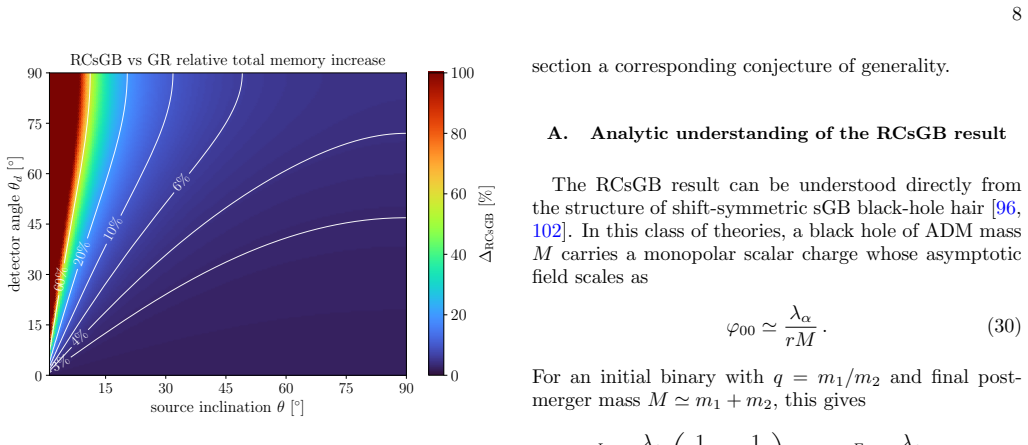
Gravitational memory provides a distinctive low-frequency probe of gravity, but explicit merger studies beyond general relativity remain limited. In this work, we investigate memory from binary black hole mergers in Ricci-coupled scalar-Gauss-Bonnet gravity, a natural extension of scalar-Gauss-Bonnet theory that admits an additional scalar breathing polarization. Based on numerical-relativity waveforms of binary black hole coalescences, we show that the change in the scalar charge of the system across merger generates a significant scalar-memory contribution. For a GW150914-like system, this effect modifies the memory signal in a gravitational-wave detector on the same observable timescale and by an amount comparable to the pure scalar-Gauss-Bonnet correction to tensor memory. Thus, it can substantially enhance the total deviation from the general-relativity prediction over a broad range of source and detector configurations. We argue that this identifies a general mechanism: whenever a compact-binary merger changes the asymptotic charge of an additional gravitational field, and that field sources an observable extra polarization, the resulting memory can provide a leading low-frequency signature of new gravitational physics.
Editorial analysis
A structured set of objections, weighed in public.
Referee Report
Summary. The paper claims that in Ricci-coupled scalar-Gauss-Bonnet gravity, the change in asymptotic scalar charge during binary black hole mergers generates a scalar-memory contribution. Using post-processed numerical-relativity waveforms for GW150914-like systems, it shows this effect modifies the detector memory signal on the same observable timescale and with amplitude comparable to the pure sGB correction to tensor memory, substantially enhancing the total deviation from GR over a range of source and detector configurations. It identifies this as a general mechanism whenever a merger changes the asymptotic charge of an additional field that sources an observable polarization.
Significance. If the central extraction and comparison hold, the work provides a concrete, falsifiable low-frequency signature of modified gravity via memory and breathing modes, extending beyond existing tensor-memory studies in sGB. The general mechanism argument is a strength, as it ties directly to charge evolution without introducing new free parameters beyond the coupling strength.
major comments (2)
- [Numerical setup and scalar-charge extraction (likely §3–4)] Numerical setup and scalar-charge extraction (likely §3–4): the headline quantitative claims—that the scalar memory modifies the signal on the same timescale and by an amount comparable to the sGB tensor-memory correction—rest on post-processing GR NR waveforms to obtain the scalar-charge history. Because the Ricci coupling alters the background metric and merger dynamics, the inspiral duration, ringdown, and dQ/dt are not guaranteed to match GR; no controlled comparison to modified-gravity waveforms or back-reaction error budget is provided, leaving the 'comparable amount' and 'same timescale' statements unverified at the level needed for the detector-response assertion.
- [Detector-response and memory integral (likely §5)] Detector-response and memory integral (likely §5): the statement that the scalar-memory contribution is observable without suppression requires explicit propagation of the breathing polarization through the detector response function, including any projection factors or frequency-dependent filtering. The manuscript does not appear to show the full time-domain strain including both tensor and scalar memory for a network of detectors, which is load-bearing for the claim that the effect 'substantially enhance[s] the total deviation'.
minor comments (2)
- [Abstract and §1] The abstract and introduction should explicitly state the range of scalar-Gauss-Bonnet coupling strengths for which the 'comparable' statement holds, rather than leaving it implicit.
- [Theory and memory definitions] Notation for the scalar charge Q and its time derivative should be unified across equations; currently the memory integral appears to use an asymptotic value without clarifying the matching to the near-zone charge evolution.
Simulated Author's Rebuttal
We thank the referee for their careful and constructive review. The comments identify key areas where the presentation and justification can be strengthened. We address each major comment below and will revise the manuscript to incorporate clarifications and additional analysis where feasible.
read point-by-point responses
-
Referee: Numerical setup and scalar-charge extraction (likely §3–4): the headline quantitative claims—that the scalar memory modifies the signal on the same timescale and by an amount comparable to the sGB tensor-memory correction—rest on post-processing GR NR waveforms to obtain the scalar-charge history. Because the Ricci coupling alters the background metric and merger dynamics, the inspiral duration, ringdown, and dQ/dt are not guaranteed to match GR; no controlled comparison to modified-gravity waveforms or back-reaction error budget is provided, leaving the 'comparable amount' and 'same timescale' statements unverified at the level needed for the detector-response assertion.
Authors: We acknowledge that the quantitative results rely on post-processing of GR NR waveforms. This is justified in the weak-coupling regime, where the Ricci coupling induces only perturbative corrections to the metric and dynamics; the leading scalar-charge evolution can be extracted consistently at the order relevant for memory. However, we agree that an explicit discussion of the approximation's validity is needed. In the revision we will add a dedicated subsection estimating the size of back-reaction effects via perturbative arguments and qualifying the statements on amplitude and timescale accordingly. A full controlled comparison with modified-gravity NR waveforms lies beyond the present scope. revision: partial
-
Referee: Detector-response and memory integral (likely §5): the statement that the scalar-memory contribution is observable without suppression requires explicit propagation of the breathing polarization through the detector response function, including any projection factors or frequency-dependent filtering. The manuscript does not appear to show the full time-domain strain including both tensor and scalar memory for a network of detectors, which is load-bearing for the claim that the effect 'substantially enhance[s] the total deviation'.
Authors: We agree that explicit propagation through the detector response is required to substantiate the observability claim. In the revised manuscript we will include the full time-domain strain for a detector network, incorporating the breathing-mode response, antenna-pattern projections, and any relevant filtering. This will demonstrate the combined tensor-plus-scalar memory signal and the resulting enhancement relative to GR. revision: yes
- A complete set of numerical-relativity waveforms evolved directly in Ricci-coupled scalar-Gauss-Bonnet gravity (required for a fully controlled back-reaction comparison) is not available and would necessitate substantial new code development and computational resources outside the scope of this work.
Circularity Check
No significant circularity detected
full rationale
The paper computes the scalar-memory contribution directly from the observed change in asymptotic scalar charge across merger, using that change as an input extracted from numerical-relativity waveforms. This constitutes a standard forward calculation rather than a self-definitional loop, a fitted parameter relabeled as prediction, or a load-bearing self-citation chain. No equations or steps in the provided abstract reduce the claimed memory effect to the inputs by construction; the result remains an independent consequence of the simulated charge evolution and is therefore self-contained against external benchmarks.
Axiom & Free-Parameter Ledger
free parameters (1)
- scalar-Gauss-Bonnet coupling strength
axioms (1)
- domain assumption The Ricci-coupled scalar-Gauss-Bonnet theory admits a scalar breathing polarization that couples to the detector response.
Lean theorems connected to this paper
-
IndisputableMonolith/Foundation/RealityFromDistinction.leanreality_from_one_distinction unclear?
unclearRelation between the paper passage and the cited Recognition theorem.
the change in the scalar charge of the system across merger generates a significant scalar-memory contribution... ΔPmem(t) ... δb ≡ |ΔRCsGB − ΔsGB| / ...
-
IndisputableMonolith/Cost/FunctionalEquation.leanwashburn_uniqueness_aczel unclear?
unclearRelation between the paper passage and the cited Recognition theorem.
Pij = e+ij h+ + e×ij h× − σ/ρ eb_ij φ1 ... F(u,Ω′) ≡ ∫ du′ r′² ⟨|ḣ|² + ρ² φ̇1²⟩
What do these tags mean?
- matches
- The paper's claim is directly supported by a theorem in the formal canon.
- supports
- The theorem supports part of the paper's argument, but the paper may add assumptions or extra steps.
- extends
- The paper goes beyond the formal theorem; the theorem is a base layer rather than the whole result.
- uses
- The paper appears to rely on the theorem as machinery.
- contradicts
- The paper's claim conflicts with a theorem or certificate in the canon.
- unclear
- Pith found a possible connection, but the passage is too broad, indirect, or ambiguous to say the theorem truly supports the claim.
Reference graph
Works this paper leans on
-
[1]
Concretely, we employ the waveforms presented in Refs
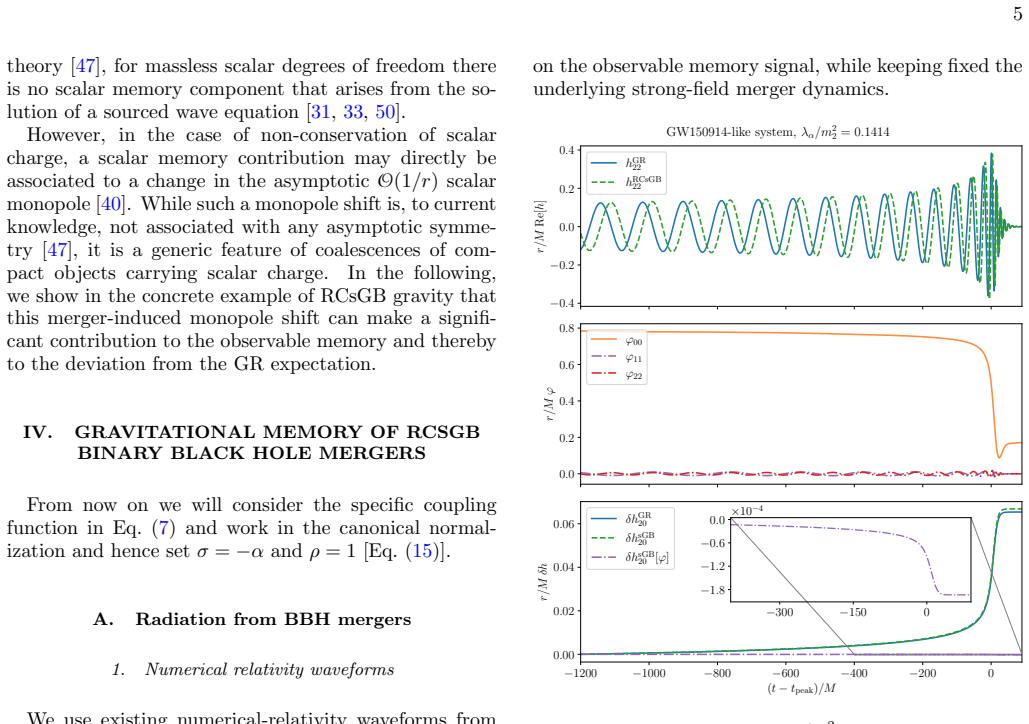
Numerical relativity waveforms We use existing numerical-relativity waveforms from shift-symmetric sGB gravity as the dynamical input for our proof-of-principle study of memory in RCsGB grav- ity. Concretely, we employ the waveforms presented in Refs. [93, 96] of BBH simulations performed with GRFolres[97], an extension ofGRChombo[98]. The logic for using...
-
[2]
Concrete radiation events As a representative proof-of-principle example, we con- sider a GW150914-like BBH configuration from [93], corresponding to a non-spinning near-equal-mass binary with mass ratioq=m 1/m2 = 1.221 at relatively large GB couplingλ/m 2 2 = 0.1414, wherem 2 denotes the ADM mass of the secondary black hole in the underlying Einstein-fra...
-
[3]
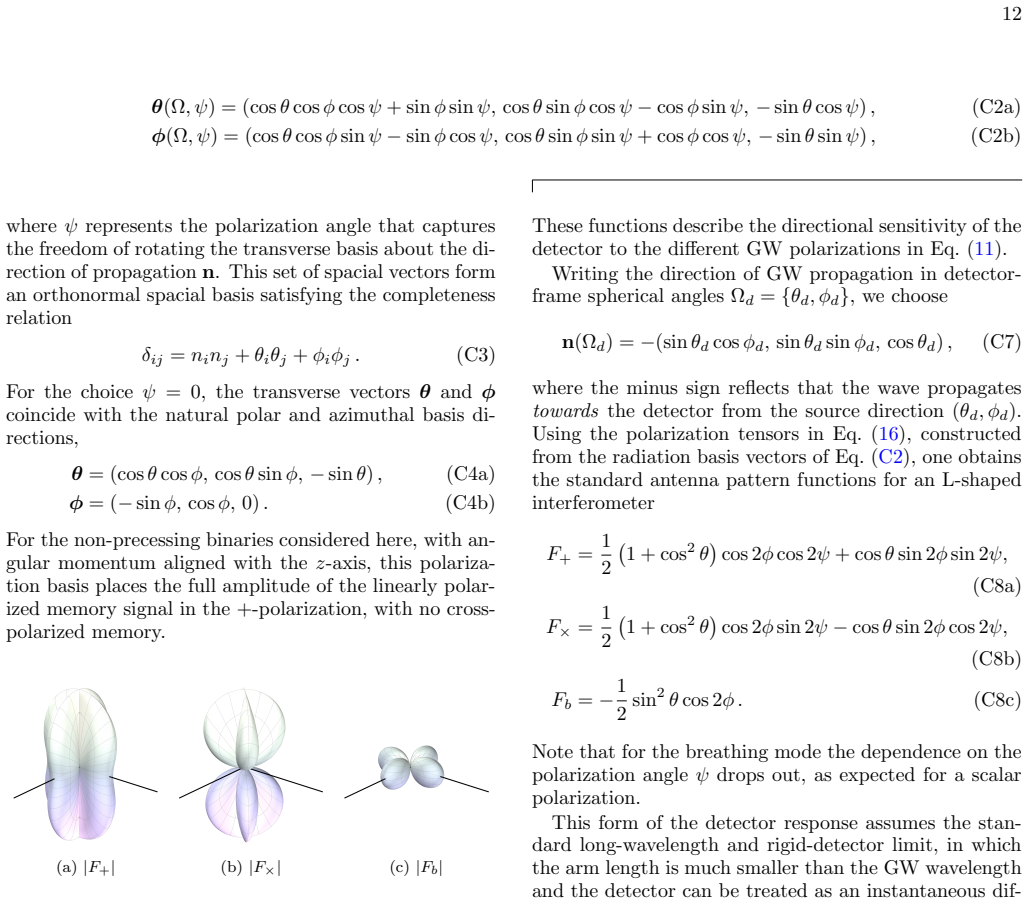
Detector geometry In order to quantify the effect of the presence of the ad- ditional scalar polarization on memory, we consider the specific detector geometry of an equal-arm rectangular interferometer as the fundamental building block of cur- rent and future ground-based detector networks. In the short-timescale and long-wavelength approximation rele- v...
-
[4]
Memory in RCsGB gravity We now come to the central result of this work: in RCsGB gravity, the observable memory in the detector response receives not only the beyond-GR correction al- ready present in pure sGB through the tensor sector, but in addition a scalar-memory contribution associated with the net change of scalar charge across merger. In the prese...
-
[5]
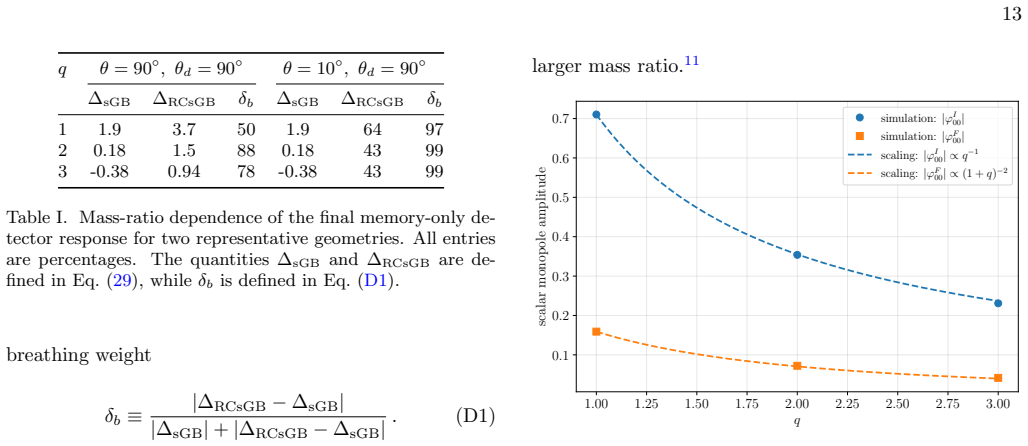
monopolar scalar charges. At fixedλ α/m2 2 and fixed total mass, the overall amplitudes therefore scale asφ I 00 ∝1/qandφ F 00 ∝1/(1+ q)2 (see Fig. 5 in Appendix. D), while their ratio is φI 00 φF 00 ≃ (1 +q) 2 q = 1 η .(32) This insight directly explains the sudden drop in scalar charge by a factor of the order of 1/η≃4 for a near equal mass configuratio...
-
[6]
LAS is partly funded by Interuniversitaire Bi- jzonder Onderzoeksfonds (IBOF)/21/084. DD ac- knowledges financial support from the Spanish Min- istry of Science and Innovation through the Ram´ on y Cajal programme (grant RYC2023-042559-I), funded by MCIN/AEI/10.13039/501100011033, from an Emmy Noether Research Group funded by the German Re- search Foundat...
-
[7]
Full results in Horndeski gravity For Horndeski theory the formulas for gravitational po- larizations [32, 84] and gravitational memory [31–33, 52] in asymptotically flat spacetime as defined in Sec. II C was computed in full generality such that the specific Ricci-coupled sGB results can straightforwardly be re- trieved through Eq. (A6) within the asympt...
-
[8]
Recovering Ricci-coupled sGB results Since the scalar DOF in RCsGB is massless due to the absence of a scalar field potential, we have m= 0⇔v S = 1,(A12) implying the absence of any longitudinal polarization. However, in general, the theory admits the presence of a transverse breathing scalar polarization, since [Eq. (A8)] σ= f ′(φ0) f(φ0) ,(A13) which is...
-
[9]
Radiation basis Given a source-centered spherical coordinate system {t, r,Ω = (θ, ϕ)}the unit radial vector reads n(Ω) = (sinθcosϕ,sinθsinϕ,cosθ).(C1) The associated transverse space of a given directionn(Ω) can then be described through 12 θ(Ω, ψ) = (cosθcosϕcosψ+ sinϕsinψ,cosθsinϕcosψ−cosϕsinψ,−sinθcosψ),(C2a) ϕ(Ω, ψ) = (cosθcosϕsinψ−sinϕcosψ,cosθsinϕsi...
-
[10]
Detector pattern functions For an equal-arm interferometer with arms along the detector-frame directionse xd ande yd, the detector re- sponse to the polarization matrixP ij in Eq. (10) is P(t) = 1 2 exd i exd j −e yd i eyd j P ij .(C5) The response to each individual polarization is encoded in the correspondingantenna pattern function FΛ ≡ 1 2 exd i exd j...
-
[11]
Tests of General Relativity with GWTC-3
Markers denote numerical values extracted from the scalar waveform. Smooth curves show the analytic scalings in Eq. (D2) normalized to the correspondingq= 1 value. 11 Interestingly, in the large-qlimit the absolute scalar jump scales as|∆φ 00| ∼q −1, and therefore even decreases more slowly with qthan the total tensor memory scaling ∆h∼η 1.65 ∼q −1.65 fou...
work page internal anchor Pith review arXiv 2025
-
[12]
Cosmic Explorer: The U.S. Contribution to Gravitational-Wave Astronomy beyond LIGO
D. Reitzeet al., “Cosmic Explorer: The U.S. Contribution to Gravitational-Wave Astronomy beyond LIGO,”Bull. Am. Astron. Soc.51no. 7, (2019) 035,arXiv:1907.04833 [astro-ph.IM]. [6]LISACollaboration, M. Colpiet al., “LISA Definition Study Report,”arXiv:2402.07571 [astro-ph.CO]. [7]TianQinCollaboration, J. Meiet al., “The TianQin project: current progress on...
work page internal anchor Pith review arXiv 2019
-
[13]
Radiation of gravitational waves by a cluster of superdense stars,
Y. B. Zel’dovich and A. G. Polnarev, “Radiation of gravitational waves by a cluster of superdense stars,” Sov. Astron.18(1974) 17
work page 1974
-
[14]
Kinematic Resonance and Memory Effect in Free Mass Gravitational Antennas,
V. B. Braginsky and L. P. Grishchuk, “Kinematic Resonance and Memory Effect in Free Mass Gravitational Antennas,”Sov. Phys. JETP62(1985) 427–430
work page 1985
-
[15]
Gravitational-wave bursts with memory and experimental prospects,
V. B. Braginsky and K. S. Thorne, “Gravitational-wave bursts with memory and experimental prospects,”Nature327(1987) 123–125
work page 1987
-
[16]
Gravitational-wave bursts with memory: The Christodoulou effect,
K. S. Thorne, “Gravitational-wave bursts with memory: The Christodoulou effect,”Phys. Rev. D45 (Jan, 1992) 520–524.https: //link.aps.org/doi/10.1103/PhysRevD.45.520
-
[17]
Nonlinear nature of gravitation and gravitational wave experiments,
D. Christodoulou, “Nonlinear nature of gravitation and gravitational wave experiments,”Phys. Rev. Lett. 67(1991) 1486–1489
work page 1991
-
[18]
Hereditary effects in gravitational radiation,
L. Blanchet and T. Damour, “Hereditary effects in gravitational radiation,”Phys. Rev. D46(1992) 4304–4319
work page 1992
-
[19]
Christodoulou’s nonlinear gravitational wave memory: Evaluation in the quadrupole approximation,
A. G. Wiseman and C. M. Will, “Christodoulou’s nonlinear gravitational wave memory: Evaluation in the quadrupole approximation,”Phys. Rev. D44 no. 10, (1991) R2945–R2949
work page 1991
-
[20]
Nonlinear gravitational-wave memory from binary black hole mergers,
M. Favata, “Nonlinear gravitational-wave memory from binary black hole mergers,”Astrophys. J. Lett. 696(2009) L159–L162,arXiv:0902.3660 [astro-ph.SR]
-
[21]
Gravitational waves in general relativity. 7. Waves from axisymmetric isolated systems,
H. Bondi, M. G. J. van der Burg, and A. W. K. Metzner, “Gravitational waves in general relativity. 7. Waves from axisymmetric isolated systems,”Proc. Roy. Soc. Lond. A269(1962) 21–52
work page 1962
-
[22]
R. K. Sachs, “Gravitational waves in general relativity
-
[23]
Waves in asymptotically flat space-times,”Proc. Roy. Soc. Lond. A270(1962) 103–126
work page 1962
-
[24]
Infrared Photons and Gravitons,
S. Weinberg, “Infrared Photons and Gravitons,”Phys. Rev.140(Oct, 1965) B516–B524
work page 1965
-
[25]
Lectures on the Infrared Structure of Gravity and Gauge Theory
A. Strominger,Lectures on the Infrared Structure of Gravity and Gauge Theory. Princeton University Press, 2018.arXiv:1703.05448 [hep-th]
work page Pith review arXiv 2018
-
[26]
On BMS Invariance of Gravitational Scattering
A. Strominger, “On BMS Invariance of Gravitational Scattering,”JHEP07(2014) 152,arXiv:1312.2229 [hep-th]
-
[27]
BMS supertranslations and Weinberg's soft graviton theorem
T. He, V. Lysov, P. Mitra, and A. Strominger, “BMS supertranslations and Weinberg’s soft graviton theorem,”JHEP05(2015) 151,arXiv:1401.7026 [hep-th]
work page Pith review arXiv 2015
-
[28]
A. Strominger and A. Zhiboedov, “Gravitational Memory, BMS Supertranslations and Soft Theorems,” JHEP01(2016) 086,arXiv:1411.5745 [hep-th]
-
[29]
S. Pasterski, A. Strominger, and A. Zhiboedov, “New Gravitational Memories,”JHEP12(2016) 053, arXiv:1502.06120 [hep-th]
-
[30]
Measuring gravitational-wave memory in the first LIGO/Virgo gravitational-wave transient catalog,
M. H¨ ubner, C. Talbot, P. D. Lasky, and E. Thrane, “Measuring gravitational-wave memory in the first LIGO/Virgo gravitational-wave transient catalog,” Phys. Rev. D101no. 2, (2020) 023011, arXiv:1911.12496 [astro-ph.HE]
-
[31]
Memory remains undetected: Updates from the second LIGO/Virgo gravitational-wave transient catalog,
M. H¨ ubner, P. Lasky, and E. Thrane, “Memory remains undetected: Updates from the second LIGO/Virgo gravitational-wave transient catalog,” Phys. Rev. D104no. 2, (2021) 023004, arXiv:2105.02879 [gr-qc]
-
[32]
A. M. Grant and D. A. Nichols, “Outlook for detecting the gravitational-wave displacement and spin memory effects with current and future gravitational-wave detectors,”Phys. Rev. D107no. 6, (2023) 064056, arXiv:2210.16266 [gr-qc]. [Erratum: Phys.Rev.D 108, 029901 (2023)]
-
[33]
Can gravitational-wave memory help constrain binary black-hole parameters? A LISA case study,
S. Gasparotto, R. Vicente, D. Blas, A. C. Jenkins, and E. Barausse, “Can gravitational-wave memory help constrain binary black-hole parameters? A LISA case study,”Phys. Rev. D107no. 12, (2023) 124033, arXiv:2301.13228 [gr-qc]
-
[34]
H. Inchausp´ e, S. Gasparotto, D. Blas, L. Heisenberg, J. Zosso, and S. Tiwari, “Measuring gravitational wave memory with LISA,”Phys. Rev. D111no. 4, (2025) 044044,arXiv:2406.09228 [gr-qc]
-
[35]
A. Cogez, S. Gasparotto, J. Zosso, H. Inchausp´ e, C. Pitte, L. Maga˜ na Zertuche, A. Petiteau, and M. Besancon, “Detectability of Gravitational-Wave Memory with LISA: A Bayesian Approach,” arXiv:2601.23230 [gr-qc]
-
[36]
Towards Claiming a Detection of Gravitational Memory,
J. Zosso, L. Maga˜ na Zertuche, S. Gasparotto, A. Cogez, H. Inchausp´ e, and M. Jacobs, “Towards Claiming a Detection of Gravitational Memory,” 1, 2026
work page 2026
-
[37]
Gravitational wave memory beyond general relativity,
L. Heisenberg, N. Yunes, and J. Zosso, “Gravitational wave memory beyond general relativity,”Phys. Rev. D 108no. 2, (2023) 024010,arXiv:2303.02021 [gr-qc]
-
[38]
Unifying ordinary and null memory,
L. Heisenberg, G. Xu, and J. Zosso, “Unifying ordinary and null memory,”JCAP05(2024) 119, arXiv:2401.05936 [gr-qc]
-
[39]
J. Zosso,Probing Gravity - Fundamental Aspects of Metric Theories and their Implications for Tests of General Relativity. PhD thesis, Zurich, ETH, 2024. 15 arXiv:2412.06043 [gr-qc]
-
[40]
J. Zosso, “Continuing Isaacson’s Legacy: A general metric theory perspective on gravitational memory and the non-linearity of gravity,” in59th Rencontres de Moriond on Gravitation: Moriond 2025 Gravitation. 5, 2025.arXiv:2505.17603 [gr-qc]
-
[41]
Constraining superluminal Einstein-Æther gravity through gravitational memory,
L. Heisenberg, B. Rosatello, G. Xu, and J. Zosso, “Constraining superluminal Einstein-Æther gravity through gravitational memory,”Phys. Rev. D112 no. 2, (2025) 024052,arXiv:2505.09544 [gr-qc]
-
[42]
Gravitational memory in generalized Proca gravity,
L. Heisenberg, B. Rosatello, G. Xu, and J. Zosso, “Gravitational memory in generalized Proca gravity,” Phys. Rev. D112no. 10, (2025) 104073, arXiv:2508.20545 [gr-qc]
-
[43]
D. Maibach and J. Zosso, “Balance flux laws beyond general relativity,”arXiv:2601.07091 [gr-qc]
-
[44]
R. N. Lang, “Compact binary systems in scalar-tensor gravity. II. Tensor gravitational waves to second post-Newtonian order,”Phys. Rev. D89no. 8, (2014) 084014,arXiv:1310.3320 [gr-qc]
work page Pith review arXiv 2014
-
[45]
Compact binary systems in scalar-tensor gravity. III. Scalar waves and energy flux
R. N. Lang, “Compact binary systems in scalar-tensor gravity. III. Scalar waves and energy flux,”Phys. Rev. D91no. 8, (2015) 084027,arXiv:1411.3073 [gr-qc]
work page Pith review arXiv 2015
-
[46]
Gravitational Wave Memory: A New Approach to Study Modified Gravity,
S. M. Du and A. Nishizawa, “Gravitational Wave Memory: A New Approach to Study Modified Gravity,”Phys. Rev. D94no. 10, (2016) 104063, arXiv:1609.09825 [gr-qc]
-
[47]
Gravitational waveforms in scalar-tensor gravity at 2PN relative order
N. Sennett, S. Marsat, and A. Buonanno, “Gravitational waveforms in scalar-tensor gravity at 2PN relative order,”Phys. Rev. D94no. 8, (2016) 084003,arXiv:1607.01420 [gr-qc]
work page Pith review arXiv 2016
-
[48]
S. Tahura, D. A. Nichols, A. Saffer, L. C. Stein, and K. Yagi, “Brans-Dicke theory in Bondi-Sachs form: Asymptotically flat solutions, asymptotic symmetries and gravitational-wave memory effects,”Phys. Rev. D 103no. 10, (2021) 104026,arXiv:2007.13799 [gr-qc]
-
[49]
S. Tahura, D. A. Nichols, and K. Yagi, “Gravitational-wave memory effects in Brans-Dicke theory: Waveforms and effects in the post-Newtonian approximation,”Phys. Rev. D104no. 10, (2021) 104010,arXiv:2107.02208 [gr-qc]
-
[50]
Gravitational memory effects and Bondi-Metzner-Sachs symmetries in scalar-tensor theories,
S. Hou and Z.-H. Zhu, “Gravitational memory effects and Bondi-Metzner-Sachs symmetries in scalar-tensor theories,”JHEP01(2021) 083,arXiv:2005.01310 [gr-qc]
-
[51]
S. Hou and Z.-H. Zhu, “”Conserved charges” of the Bondi-Metzner-Sachs algebra in the Brans-Dicke theory,”Chin. Phys. C45no. 2, (2021) 023122, arXiv:2008.05154 [gr-qc]
-
[52]
Testing Brans-Dicke Gravity with Screening by Scalar Gravitational Wave Memory,
K. Koyama, “Testing Brans-Dicke Gravity with Screening by Scalar Gravitational Wave Memory,” Phys. Rev. D102no. 2, (2020) 021502, arXiv:2006.15914 [gr-qc]
-
[53]
Gravitational breathing memory and dual symmetries,
A. Seraj, “Gravitational breathing memory and dual symmetries,”JHEP05(2021) 283,arXiv:2103.12185 [hep-th]
-
[54]
L. Bernard, L. Blanchet, and D. Trestini, “Gravitational waves in scalar-tensor theory to one-and-a-half post-Newtonian order,”JCAP08 no. 08, (2022) 008,arXiv:2201.10924 [gr-qc]
-
[55]
D. Trestini, “Quasi-Keplerian parametrization for eccentric compact binaries in scalar-tensor theories at second post-Newtonian order and applications,”Phys. Rev. D109no. 10, (2024) 104003,arXiv:2401.06844 [gr-qc]
-
[56]
S. Ma, K. C. Nelli, J. Moxon, M. A. Scheel, N. Deppe, L. E. Kidder, W. Throwe, and N. L. Vu, “Einstein–Klein–Gordon system via Cauchy-characteristic evolution: computation of memory and ringdown tail,”Class. Quant. Grav.42 no. 5, (2025) 055006,arXiv:2409.06141 [gr-qc]
-
[57]
Gravitational-wave memory effects in the Damour-Esposito-Far` ese extension of Brans-Dicke theory,
S. Tahura, D. A. Nichols, and K. Yagi, “Gravitational-wave memory effects in the Damour-Esposito-Far` ese extension of Brans-Dicke theory,”Phys. Rev. D112no. 8, (2025) 084037, arXiv:2501.07488 [gr-qc]
-
[58]
Gravitational Memory from Hairy Binary Black Hole Mergers
S. Gasparotto, J. Zosso, L. Arest´ e Sal´ o, D. D. Doneva, and S. S. Yazadjiev, “Gravitational Memory from Hairy Binary Black Hole Mergers,”arXiv:2604.09350 [gr-qc]
work page internal anchor Pith review Pith/arXiv arXiv
-
[59]
Effective Field Theory for Inflation
S. Weinberg, “Effective Field Theory for Inflation,” Phys. Rev. D77(2008) 123541,arXiv:0804.4291 [hep-th]
work page Pith review arXiv 2008
-
[60]
Higher-derivative Lagrangians, nonlocality, problems, and solutions,
J. Z. Simon, “Higher-derivative Lagrangians, nonlocality, problems, and solutions,”Phys. Rev. D41 (Jun, 1990) 3720–3733
work page 1990
-
[61]
Gravitational Wave Tests of General Relativity with Ground-Based Detectors and Pulsar Timing Arrays
N. Yunes and X. Siemens, “Gravitational-Wave Tests of General Relativity with Ground-Based Detectors and Pulsar Timing-Arrays,”Living Rev. Rel.16 (2013) 9,arXiv:1304.3473 [gr-qc]
work page Pith review arXiv 2013
-
[62]
Curvature Squared Terms and String Theories,
B. Zwiebach, “Curvature Squared Terms and String Theories,”Phys. Lett. B156(1985) 315–317
work page 1985
-
[63]
Superstring Modifications of Einstein’s Equations,
D. J. Gross and E. Witten, “Superstring Modifications of Einstein’s Equations,”Nucl. Phys. B277(1986) 1
work page 1986
-
[64]
Effective Gravity Theories With Dilatons,
D. G. Boulware and S. Deser, “Effective Gravity Theories With Dilatons,”Phys. Lett. B175(1986) 409–412
work page 1986
-
[65]
R. R. Metsaev and A. A. Tseytlin, “Order alpha-prime (Two Loop) Equivalence of the String Equations of Motion and the Sigma Model Weyl Invariance Conditions: Dependence on the Dilaton and the Antisymmetric Tensor,”Nucl. Phys. B293(1987) 385–419
work page 1987
-
[66]
Dilatonic Black Holes with Gauss-Bonnet Term
T. Torii, H. Yajima, and K.-i. Maeda, “Dilatonic black holes with Gauss-Bonnet term,”Phys. Rev. D55 (1997) 739–753,arXiv:gr-qc/9606034
work page Pith review arXiv 1997
-
[67]
F. Moura and R. Schiappa, “Higher-derivative corrected black holes: Perturbative stability and absorption cross-section in heterotic string theory,” Class. Quant. Grav.24(2007) 361–386, arXiv:hep-th/0605001
work page Pith review arXiv 2007
- [68]
-
[69]
Field Equations in Chern-Simons-Gauss-Bonnet Gravity,
A. Ortega, T. Daniel, and S. M. Koushiappas, “Field Equations in Chern-Simons-Gauss-Bonnet Gravity,” arXiv:2411.05911 [gr-qc]
-
[70]
G. Antoniou, A. Leh´ ebel, G. Ventagli, and T. P. Sotiriou, “Black hole scalarization with Gauss-Bonnet and Ricci scalar couplings,”Phys. Rev. D104no. 4, (2021) 044002,arXiv:2105.04479 [gr-qc]
-
[71]
T. Evstafyeva, M. Agathos, and J. L. Ripley, “Measuring the ringdown scalar polarization of gravitational waves in Einstein-scalar-Gauss-Bonnet gravity,”Phys. Rev. D107no. 12, (2023) 124010, arXiv:2212.11359 [gr-qc]. 16
-
[72]
3+1 nonlinear evolution of Ricci-coupled scalar-Gauss-Bonnet gravity,
D. D. Doneva, L. Arest´ e Sal´ o, and S. S. Yazadjiev, “3+1 nonlinear evolution of Ricci-coupled scalar-Gauss-Bonnet gravity,”Phys. Rev. D110no. 2, (2024) 024040,arXiv:2404.15526 [gr-qc]
-
[73]
T. P. Sotiriou, “Gravity and Scalar Fields,” in Modifications of Einstein’s Theory of Gravity at Large Distances, E. Papantonopoulos, ed., pp. 3–24. Springer International Publishing, Cham, 2015
work page 2015
-
[74]
C. M. Will,Theory and Experiment in Gravitational Physics. Cambridge University Press, 2 ed., 2018
work page 2018
-
[75]
Second-order scalar-tensor field equations in a four-dimensional space,
G. W. Horndeski, “Second-order scalar-tensor field equations in a four-dimensional space,”Int. J. Theor. Phys.10(1974) 363–384
work page 1974
-
[76]
The galileon as a local modification of gravity
A. Nicolis, R. Rattazzi, and E. Trincherini, “The Galileon as a local modification of gravity,”Phys. Rev. D79(2009) 064036,arXiv:0811.2197 [hep-th]
work page Pith review arXiv 2009
-
[77]
C. Deffayet, G. Esposito-Farese, and A. Vikman, “Covariant Galileon,”Phys. Rev. D79(2009) 084003, arXiv:0901.1314 [hep-th]
-
[78]
C. Deffayet, S. Deser, and G. Esposito-Farese, “Generalized Galileons: All scalar models whose curved background extensions maintain second-order field equations and stress-tensors,”Phys. Rev. D80 (2009) 064015,arXiv:0906.1967 [gr-qc]
-
[79]
A systematic approach to generalisations of General Relativity and their cosmological implications,
L. Heisenberg, “A systematic approach to generalisations of General Relativity and their cosmological implications,”Phys. Rept.796(2019) 1–113,arXiv:1807.01725 [gr-qc]
-
[80]
Horndeski theory and beyond: a review
T. Kobayashi, “Horndeski theory and beyond: a review,”Rept. Prog. Phys.82no. 8, (2019) 086901, arXiv:1901.07183 [gr-qc]
work page Pith review arXiv 2019
discussion (0)
Sign in with ORCID, Apple, or X to comment. Anyone can read and Pith papers without signing in.