REVIEW 3 major objections 6 minor 71 references
Clumpy Starburst in a Local Dwarf Galaxy, NGC 1522
T0 review · 3 major / 6 minor · reviewed 2026-08-15 · deepseek-v4-flash
Pith's one-line read The nine star-forming clumps in the dwarf galaxy NGC 1522 are about 0.2–0.3 dex more metal-poor than their surroundings, which the authors interpret as evidence that infalling metal-poor gas, not a merger, fuels the starburst.
desk verdict A useful first MUSE look at NGC 1522 with a credible clump catalog, but the central accretion claim rests on a metallicity gradient that is not yet cleanly separated from ionization and DIG effects. read the letter →
The pith
A machine-rendered reading of the paper's core claim, the machinery that carries it, and where it could break.
The reading
What carries the argument
The argument is carried by spatially resolved emission-line ratio maps built from MUSE spectroscopy, combined with three diagnostic tools: the N2 and O3N2 strong-line calibrations that turn $[\mathrm{N\,II}]/\mathrm{H}\alpha$ and $[\mathrm{O\,III}]/\mathrm{H}\beta$ into oxygen abundance; the N2S2-based empirical relation that turns $[\mathrm{N\,II}]/[\mathrm{S\,II}]$ into $\log(\mathrm{N/O})$; and dendrogram-based clump detection on the extinction-corrected Hα map. The key identifying observation is that the clumps are offset from the photometric center and sit at lower metallicity than their surroundings, with the SFR surface density anti-correlating with metallicity while N/O shows no corresponding trend.
What would settle it
Detect the auroral line $[\mathrm{O\,III}]\,\lambda4363$ in the clumps and their surroundings with deep spectroscopy and compare electron-temperature metallicities; if the clumps are not more metal-poor than their surroundings by the same margin, the accretion claim fails. A 21-cm H I map showing no companion reservoir or kinematically distinct infalling gas would also weaken the case.
Extended reading notes
Core claim
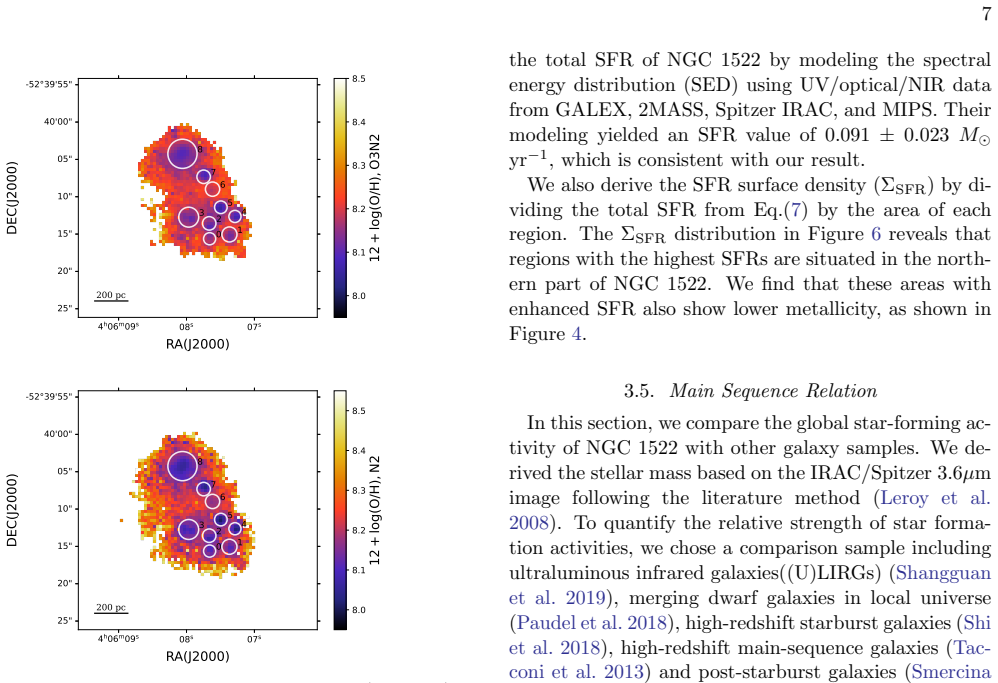
The central claim is that the star-forming clumps of NGC 1522 are chemically distinct: their metallicities, derived from the N2 and O3N2 strong-line indices, are about 0.2 to 0.3 dex lower than the gas around them, while log(N/O) stays flat. The authors identify nine Hα-bright clumps arranged in a ring with a deprojected radius of roughly 300 pc and a total star formation rate of about 0.1 $M_\odot$ yr$^{-1}$. Because the gas velocity field shows slow rotation with no sign of merging, and the low-metallicity, high-SFR regions coincide spatially, the authors conclude that external metal-poor gas is accreting onto the galaxy, triggering and sustaining the starburst; they explicitly postulate that the inside-out positive metallicity gradient is explained by external gas accretion.
Load-bearing premise
The load-bearing premise is that the N2 and O3N2 strong-line calibrations yield unbiased oxygen abundances at NGC 1522's low metallicity; if ionization-parameter or diffuse ionized gas effects raise the measured ratios, the apparent 0.2–0.3 dex gradient could be an artifact.
Editorial extensions
If this is right
- If NGC 1522 is accreting metal-poor gas, then isolated dwarf galaxies can undergo starburst episodes without a major merger, with gas inflow as the trigger.
- The positive (inside-out) metallicity gradient would be a diagnostic signature of external gas accretion, opposite to the negative gradient expected from closed-box enrichment.
- Spatially resolved metallicity and N/O maps can distinguish accretion-driven from merger-driven star formation in dwarf galaxies even when kinematics alone are inconclusive.
- The clumps, with specific star formation rates in the starburst regime, strengthen the case that local dwarf starbursts are valid analogues of high-redshift clumpy galaxies.
Reading between the lines
- If the accretion interpretation is correct, the inflowing gas should be visible as a neutral hydrogen reservoir or molecular gas component whose kinematics or direction is decoupled from the galaxy's rotation; 21-cm and sub-millimeter mapping could test this directly.
- A deeper spectrum that detects the auroral line $[\mathrm{O\,III}]\,\lambda4363$ would provide electron-temperature-based metallicities, bypassing the strong-line calibrations and settling whether the clumps' apparent metal poverty is real.
- The flat N/O ratio at low O/H is notable because simple dilution by metal-poor gas would tend to lower both; if confirmed, it may imply that the accreted gas is not purely primordial and that some nitrogen enrichment has already occurred.
- Comparing several isolated blue compact dwarfs in the same way could show whether inside-out positive metallicity gradients are a generic cold-accretion signature rather than a peculiarity of NGC 1522.
Signed reviews
Editorial analysis
A structured set of objections, weighed in public.
Referee Report
Summary. The paper presents VLT/MUSE integral-field spectroscopy of the nearby dwarf galaxy NGC 1522, one of the Dwarf Galaxy Integral Survey targets. The authors produce extinction-corrected emission-line maps, identify nine star-forming clumps in a ring-like configuration using astrodendro, and derive a total star formation rate of 0.098 Msun/yr that agrees with an earlier SED-based estimate. Using strong-line diagnostics (N2, O3N2, and N2S2), they map the gas-phase oxygen abundance and N/O ratio. The central claim is that the clumps have metallicities 0.2-0.3 dex lower than their surrounding regions while the N/O ratio is flat, which they interpret as evidence that ongoing star formation is triggered and sustained by accretion of external metal-poor gas rather than by a major merger.
Significance. If the metallicity gradient is real, NGC 1522 would be a valuable local, spatially resolved analogue to high-redshift clumpy star-forming galaxies and a direct case study of cold-gas accretion driving star formation in a dwarf galaxy. The paper uses standard, externally calibrated diagnostics, and the SFR consistency with independent SED fitting is a strength. However, the central interpretation rests entirely on the reliability of the N2 and O3N2 abundance calibrations in exactly the regime where ionization-parameter and diffuse-ionized-gas effects are strongest, so the significance of the claimed detection is conditional on a quantitative check of those biases.
major comments (3)
- [§3.2 and §4.1, Eqs. (2) and (4)] The load-bearing claim that the nine clumps are 0.2-0.3 dex more metal-poor than their surroundings is not yet secured against the known systematic biases of the N2 and O3N2 calibrators. Both indices respond to ionization parameter in the same direction that would artificially produce the observed pattern: the clumps have the highest [OIII]/Hbeta and lowest [NII]/Halpha (Figure 2), so both N2 and O3N2 are biased toward low inferred abundance; the outer comparison spaxels, which are DIG-dominated, have low [OIII]/Hbeta and enhanced [NII]/Halpha, so their inferred abundances are biased high. The DIG discussion in Section 4.1 only bounds the contribution of a 0.2 dex [NII]/Halpha enhancement to less than 0.1 dex in metallicity; it does not quantify the opposite, potentially larger bias in the high-excitation clump spaxels themselves, nor does it test whether the full 0.2-0.3 dex offset can be mimicked by plausible ionization-parameter differences within the Marino et al. (2013) calibration scatter. I request a quantitative test, such as comparing with a calibration that is less sensitive to ionization parameter, running a photoionization-model grid over the observed line ratios, or at minimum demonstrating that the offset survives plausible variations of ionization parameter across the clump and DIG spaxels.
- [§2.2 (clump detection)] The clump catalog is central to the paper, but the astrodendro detection thresholds are incompletely specified. The text states that the minimum radius is based on the seeing value and that min_npix is set to 6, but the min_value and min_delta parameters are not given. Without these values the clump list is not reproducible, and the sensitivity of the clump sample to reasonable threshold variations is not assessed. Please report the exact parameters and show the stability of the identified nine clumps under small perturbations of the thresholds.
- [§3.2 and Figure 4] The '0.2-0.3 dex lower' metallicity statement is made from visual inspection of the maps, without a quantitative comparison between the clump apertures and the surrounding region. There is no statistical test, no statement of the number of spaxels involved, and no error bar on the metallicity maps themselves. Because this difference is the central result, a robust measurement with propagated uncertainties and a significance estimate is needed before the accretion interpretation can be evaluated.
minor comments (6)
- [§2.1 / Figure 1 caption] Typo: 'coverd' should be 'covered' in the description of the MUSE field of view.
- [§4.3] Typo: 'SFR surface densicy' should be 'SFR surface density'.
- [Figure 8 caption] Typo: 'fited' should be 'fitted'.
- [Figures 1, 2, and 9 captions] The color of the clump markers is inconsistent across captions: Figure 1 says 'black circles', the text in §3.1 says 'blue circles', and Figure 2 says 'black(white) circles'. Please unify the descriptions.
- [§2.1] The statement 'spectral resolution of 1.25 Å' is ambiguous; please clarify whether this is the spectral sampling, the instrumental FWHM, or the resolving power.
- [Figures 6 and 7] The axis labels for SFR surface density appear with missing superscripts (e.g., 'log( SFR/M yr 1kpc 2)'), which should be typeset as yr^-1 kpc^-2.
Circularity Check
No significant circularity: all metallicity, N/O, and SFR measurements come from externally calibrated relations, and the central interpretation is not secured by any fitted parameter or self-citation.
full rationale
The paper's derivation chain is self-contained with respect to its inputs. Clump identification (Section 2.2) is based only on the extinction-corrected H-alpha map using the external Astrodendro algorithm, with no use of metallicity or line-ratio information, so the later finding that the clumps are metal-poor is not built into their selection. Gas-phase metallicities (Section 3.2, Eqs. 2 and 4) are computed by applying the Marino et al. (2013) calibrations to the measured N2 and O3N2 indices; no free parameter is fitted in this paper, and the calibrations are external literature results validated on CALIFA and direct-Te samples. The N/O abundances (Section 3.3, Eq. 5) similarly use the external Perez-Montero & Contini (2009) calibration. Star formation rates (Section 3.4, Eq. 7) use the standard Kennicutt (1998) calibration, and the starburst classification (Section 3.5) compares against the external main-sequence fits of Chang et al. (2015) and Belfiore et al. (2018). The central claim of external gas accretion is an interpretive step based on the resulting maps, not a quantity that is made to match its own inputs. The self-citations present, namely the DGIS survey description (Li et al. 2025) and the Haro 11 / NGC 4809-4810 comparison samples (Gao et al. 2022, 2023), are used as data provenance and external comparison benchmarks; the central claim does not rest on any assertion unique to those papers. The concern that the N2 and O3N2 calibrators may be biased by ionization parameter or diffuse ionized gas is a systematic/correctness risk, not a circularity, because the paper does not tune those calibrators to produce its result. Therefore no circular step is exhibited and the score is 0.
Assumptions & free parameters
free parameters (5)
- N2 metallicity calibration coefficients (Marino et al. 2013) =
12+log(O/H) = 8.667 + 0.455*N2
- O3N2 metallicity calibration coefficients (Marino et al. 2013) =
12+log(O/H) = 8.505 - 0.221*O3N2
- N2S2 to log(N/O) coefficients (Perez-Montero and Contini 2009) =
log(N/O) = 1.26*N2S2 - 0.86
- SFR-to-H-alpha calibration constant (Kennicutt 1998) =
7.92e-42 M_sun/yr per erg/s
- Astrodendro clump detection thresholds =
min_npix=6; min_value and min_delta not reported
assumptions (4)
- domain assumption NGC 1522 is at distance 9.3 Mpc (Lee et al. 2010) and the adopted cosmology applies.
- domain assumption Case B recombination and the Calzetti extinction curve describe the dust attenuation of the ionized gas.
- domain assumption The Marino et al. (2013) strong-line calibrations are valid at 12+log(O/H) ~ 8.1 to 8.3.
- domain assumption There is no hidden AGN or recent major merger in NGC 1522.
Cite this review
Pith. "Pith review of Clumpy Starburst in a Local Dwarf Galaxy, NGC 1522." pith.science (2026). https://pith.science/paper/RD37SCKJ
@misc{pith2026250510078,
  author       = {Pith},
  title        = {Pith review of: Clumpy Starburst in a Local Dwarf Galaxy, NGC 1522},
  year         = {2026},
  howpublished = {\url{https://pith.science/paper/RD37SCKJ}},
  note         = {Machine review of arXiv:2505.10078}
}
abstract
To investigate the star-forming process in nearby dwarf galaxies, we present Integral Field Units (IFU) observation of the star-forming dwarf galaxy, NGC 1522, with the Very Large Telescope (VLT)/Multi Unit Spectroscopic Explorer (MUSE) as a part of Dwarf Galaxy Integral Survey (DGIS). Our observation reveals the presence of a star-forming clumpy ring in its central region. We identify nine distinct star-forming clumps based on extinction-corrected H$\alpha$ emission-line map, with the total star formation rate (SFR) of about 0.1 $M_\odot$ yr$^{-1}$. The nine clumps are considered to be starbursts, which represent an extreme case in the local universe, without invoking major merging. We investigate the properties of ionized gas using the strong emission lines and `BPT' diagrams, in conjunction with the velocity mapping. Our analysis unveils intriguing patterns, including the positive metallicity gradient and low N/O abundance ratio. This peculiar distribution of metallicity may signify external gas accretion. Our results suggest that the ongoing star formation in NGC 1522 might be triggered and sustained by the inflow of external metal-poor gas.
Figures


Figures from the paper (7 more)


Reference graph
Works this paper leans on
-
[1]
Allen, M. G., Groves, B. A., Dopita, M. A., Sutherland, R. S., & Kewley, L. J. 2008,ApJS, 178, 20, doi: 10.1086/589652
doi:10.1086/589652 2008
-
[2]
Alloin, D., Collin-Souffrin, S., Joly, M., & Vigroux, L. 1979, A&A, 78, 200
work page 1979
-
[3]
2014,ApJ, 783, 135, doi: 10.1088/0004-637X/783/2/135
Amblard, A., Riguccini, L., Temi, P., et al. 2014,ApJ, 783, 135, doi: 10.1088/0004-637X/783/2/135
-
[4]
Andrews, B. H., & Martini, P. 2013,ApJ, 765, 140, doi: 10.1088/0004-637X/765/2/140
-
[5]
2022, Nature Astronomy, 6, 48, doi: 10.1038/s41550-021-01575-x
Annibali, F., & Tosi, M. 2022, Nature Astronomy, 6, 48, doi: 10.1038/s41550-021-01575-x
-
[6]
Bacon, R., Accardo, M., Adjali, L., et al. 2010, in SPIE Proceedings, ed. I. S. McLean, S. K. Ramsay, & H. Takami (SPIE), doi: 10.1117/12.856027
-
[7]
Baldwin, J. A., Phillips, M. M., & Terlevich, R. 1981, PASP, 93, 5, doi: 10.1086/130766
doi:10.1086/130766 1981
-
[8]
2015,MNRAS, 449, 867, doi: 10.1093/mnras/stv296 —
Belfiore, F., Maiolino, R., Bundy, K., et al. 2015,MNRAS, 449, 867, doi: 10.1093/mnras/stv296 —. 2018,MNRAS, 477, 3014, doi: 10.1093/mnras/sty768
Show all 71 references
-
[9]
R., Stierwalt, S., et al
Besla, G., Patton, D. R., Stierwalt, S., et al. 2018,MNRAS, 480, 3376, doi: 10.1093/mnras/sty2041
2018 doi
-
[10]
C., et al
Calzetti, D., Armus, L., Bohlin, R. C., et al. 2000,ApJ, 533, 682, doi: 10.1086/308692
2000 doi
- [11]
-
[12]
2004,PASP, 116, 138, doi: 10.1086/381875
Cappellari, M., & Emsellem, E. 2004,PASP, 116, 138, doi: 10.1086/381875
2004 doi
-
[13]
2015, The Astrophysical Journal Supplement Series, 219, 8, doi: 10.1088/0067-0049/219/1/8
Chang, Y.-Y., van der Wel, A., da Cunha, E., & Rix, H.-W. 2015, The Astrophysical Journal Supplement Series, 219, 8, doi: 10.1088/0067-0049/219/1/8
2015 doi
-
[14]
2018,ApJ, 867, 142, doi: 10.3847/1538-4357/aae374
Shen, S. 2018,ApJ, 867, 142, doi: 10.3847/1538-4357/aae374
2018 doi
-
[15]
A., Boquien, M., Turner, J
Dale, D. A., Boquien, M., Turner, J. A., et al. 2023,AJ, 165, 260, doi: 10.3847/1538-3881/accffe del Valle-Espinosa, M. G., S´ anchez-Janssen, R., Amor´ ın, R., et al. 2023,MNRAS, 522, 2089, doi: 10.1093/mnras/stad1087 Della Bruna, L., Adamo, A., Bik, A., et al. 2020,A&A, 635,...
2023
-
[16]
Domgorgen, H., & Mathis, J. S. 1994,ApJ, 428, 647, doi: 10.1086/174275
1994 doi
-
[17]
A., Kewley, L
Dopita, M. A., Kewley, L. J., Heisler, C. A., & Sutherland, R. S. 2000,ApJ, 542, 224, doi: 10.1086/309538
2000 doi
-
[18]
A., Kewley, L
Dopita, M. A., Kewley, L. J., Sutherland, R. S., & Nicholls, D. C. 2016, Ap&SS, 361, 61, doi: 10.1007/s10509-016-2657-8
2016 doi
-
[19]
A., Rich, J., Vogt, F
Dopita, M. A., Rich, J., Vogt, F. P. A., et al. 2014, Ap&SS, 350, 741, doi: 10.1007/s10509-013-1753-2
2014 doi
-
[20]
2016,A&A, 585, A79, doi: 10.1051/0004-6361/201527141 F¨ orster Schreiber, N
Zackrisson, E. 2016,A&A, 585, A79, doi: 10.1051/0004-6361/201527141 F¨ orster Schreiber, N. M., Genzel, R., Renzini, A., et al. 2011, The Messenger, 145, 39
2016 doi
- [21]
-
[22]
2022, Astronomy and Astrophysics, 661, A136, doi: 10.1051/0004-6361/202142309
Gao, Y., Gu, Q., Shi, Y., et al. 2022, Astronomy and Astrophysics, 661, A136, doi: 10.1051/0004-6361/202142309
2022 doi
-
[23]
2011, The Astrophysical Journal, 745, 11, doi: 10.1088/0004-637X/745/1/11 Gil de Paz, A., & Madore, B
Genel, S., Naab, T., Genzel, R., et al. 2011, The Astrophysical Journal, 745, 11, doi: 10.1088/0004-637X/745/1/11 Gil de Paz, A., & Madore, B. F. 2005,ApJS, 156, 345, doi: 10.1086/427068 14 Gil de Paz, A., Madore, B. F., & Pevunova, O. 2003,ApJS, 147, 29, doi: 10.1086/374737
2011 doi
-
[24]
A., Rosolowsky, E
Goodman, A. A., Rosolowsky, E. W., Borkin, M. A., et al. 2009,Nature, 457, 63, doi: 10.1038/nature07609
2009 doi
-
[25]
K., Heckman, T
Hwang, H.-C., Barrera-Ballesteros, J. K., Heckman, T. M., et al. 2019,ApJ, 872, 144, doi: 10.3847/1538-4357/aaf7a3
2019 doi
-
[26]
Kauffmann, G., Guiderdoni, B., & White, S. D. M. 1994, MNRAS, 267, 981, doi: 10.1093/mnras/267.4.981
1994 doi
-
[27]
M., Tremonti, C., et al
Kauffmann, G., Heckman, T. M., Tremonti, C., et al. 2003, MNRAS, 346, 1055, doi: 10.1111/j.1365-2966.2003.07154.x
2003
-
[28]
Kaufmann, T., Wheeler, C., & Bullock, J. S. 2007,MNRAS, 382, 1187, doi: 10.1111/j.1365-2966.2007.12436.x
2007
-
[29]
1998,ApJ, 498, 541, doi: 10.1086/305588
Kennicutt, Robert C., J. 1998,ApJ, 498, 541, doi: 10.1086/305588
1998 doi
- [30]
-
[31]
J., Dopita, M
Kewley, L. J., Dopita, M. A., Sutherland, R. S., Heisler, C. A., & Trevena, J. 2001,ApJ, 556, 121, doi: 10.1086/321545
2001 doi
- [32]
-
[34]
H., & Cisternas, M
Knapen, J. H., & Cisternas, M. 2015,ApJL, 807, L16, doi: 10.1088/2041-8205/807/1/L16
2015 doi
- [35]
-
[36]
2000, A&A Rv, 10, 1, doi: 10.1007/s001590000005
Kunth, D., & ¨Ostlin, G. 2000, A&A Rv, 10, 1, doi: 10.1007/s001590000005
2000 doi
-
[37]
C., de Paz, A
Lee, J. C., de Paz, A. G., Kennicutt, R. C., et al. 2010, The Astrophysical Journal Supplement Series, 192, 6, doi: 10.1088/0067-0049/192/1/6
2010 doi
-
[38]
K., Walter, F., Brinks, E., et al
Leroy, A. K., Walter, F., Brinks, E., et al. 2008,AJ, 136, 2782, doi: 10.1088/0004-6256/136/6/2782
2008 doi
- [39]
-
[40]
2018,ApJ, 857, 17, doi: 10.3847/1538-4357/aab3d5
Liu, Q., Wang, E., Lin, Z., et al. 2018,ApJ, 857, 17, doi: 10.3847/1538-4357/aab3d5
2018 doi
-
[41]
A., & Heckman, T
Loaiza-Agudelo, M., Overzier, R. A., & Heckman, T. M. 2020,ApJ, 891, 19, doi: 10.3847/1538-4357/ab6f6b L´ opez-S´ anchez,´A. R., Esteban, C., Garc´ ıa-Rojas, J.,
2020 doi
-
[42]
2007,ApJ, 656, 168, doi: 10.1086/510112
Peimbert, M., & Rodr´ ıguez, M. 2007,ApJ, 656, 168, doi: 10.1086/510112
2007 doi
-
[43]
2014,ApJL, 789, L16, doi: 10.1088/2041-8205/789/1/L16
Luo, W., Yang, X., & Zhang, Y. 2014,ApJL, 789, L16, doi: 10.1088/2041-8205/789/1/L16
2014 doi
-
[44]
2021,ApJ, 908, 183, doi: 10.3847/1538-4357/abd1df
Luo, Y., Heckman, T., Hwang, H.-C., et al. 2021,ApJ, 908, 183, doi: 10.3847/1538-4357/abd1df
2021 doi
-
[45]
2019, A&A Rv, 27, 3, doi: 10.1007/s00159-018-0112-2
Maiolino, R., & Mannucci, F. 2019, A&A Rv, 27, 3, doi: 10.1007/s00159-018-0112-2
2019 doi
-
[46]
A., Rosales-Ortega, F
Marino, R. A., Rosales-Ortega, F. F., S´ anchez, S. F., et al. 2013,A&A, 559, A114, doi: 10.1051/0004-6361/201321956
2013 doi
-
[47]
2023, arXiv e-prints, arXiv:2308.00041, doi: 10.48550/arXiv.2308.00041
Martin, A., Guo, Y., Wang, X., et al. 2023, arXiv e-prints, arXiv:2308.00041, doi: 10.48550/arXiv.2308.00041
2023 doi
-
[48]
1994,ApJ, 420, 576, doi: 10.1086/173588
Masegosa, J., Moles, M., & Campos-Aguilar, A. 1994,ApJ, 420, 576, doi: 10.1086/173588
1994 doi
-
[49]
F., Shapiro Griffin, K., Genzel, R., et al
Newman, S. F., Shapiro Griffin, K., Genzel, R., et al. 2012, ApJ, 752, 111, doi: 10.1088/0004-637X/752/2/111
2012 doi
-
[50]
C., Dopita, M
Nicholls, D. C., Dopita, M. A., Jerjen, H., & Meurer, G. R. 2011,AJ, 142, 83, doi: 10.1088/0004-6256/142/3/83
2011 doi
-
[51]
2018,ApJS, 237, 36, doi: 10.3847/1538-4365/aad555 P´ erez-Montero, E., & Contini, T
Duc, P.-A. 2018,ApJS, 237, 36, doi: 10.3847/1538-4365/aad555 P´ erez-Montero, E., & Contini, T. 2009,MNRAS, 398, 949, doi: 10.1111/j.1365-2966.2009.15145.x P´ erez-Montero, E., & D´ ıaz, A. I. 2005,MNRAS, 361, 1063, doi: 10.1111/j.1365-2966.2005.09263.x
2018
-
[52]
Peroux, C., & Howk, J. C. 2020, Annual Review of Astronomy and Astrophysics, vol. 58, pp. 363-406 (2020), doi: 10/ghdspz
2020
-
[53]
C., Krumholz, M
Petit, A. C., Krumholz, M. R., Goldbaum, N. J., & Forbes, J. C. 2015,MNRAS, 449, 2588, doi: 10.1093/mnras/stv493
2015 doi
-
[54]
2014,MNRAS, 437, 3980, doi: 10.1093/mnras/stt2211
Kroupa, P. 2014,MNRAS, 437, 3980, doi: 10.1093/mnras/stt2211
2014 doi
-
[55]
2012, A&A, 539, A93, doi: 10.1051/0004-6361/201117718
Queyrel, J., Contini, T., Kissler-Patig, M., et al. 2012, A&A, 539, A93, doi: 10.1051/0004-6361/201117718
2012 doi
-
[56]
2000,MNRAS, 316, 559, doi: 10.1046/j.1365-8711.2000.03526.x
Raimann, D., Storchi-Bergmann, T., Bica, E., Melnick, J., & Schmitt, H. 2000,MNRAS, 316, 559, doi: 10.1046/j.1365-8711.2000.03526.x
2000
-
[57]
Salpeter, E. E. 1955,ApJ, 121, 161, doi: 10.1086/145971
1955 doi
-
[58]
M., & Bothun, G
Mazzarella, J. M., & Bothun, G. D. 2002,AJ, 124, 191, doi: 10.1086/340951 S´ anchez Almeida, J., Caon, N., Mu˜ noz-Tu˜ n´ on, C., Filho, M., & Cervi˜ no, M. 2018,MNRAS, 476, 4765, doi: 10.1093/mnras/sty510 S´ anchez Almeida, J., Elmegreen, B. G., Mu˜ noz-Tu˜ n´ on, C., & Elmeg...
2002 doi
-
[59]
G., & M´ endez-Abreu, J
Elmegreen, B. G., & M´ endez-Abreu, J. 2013,ApJ, 767, 74, doi: 10.1088/0004-637X/767/1/74 15 S´ anchez Almeida, J., Elmegreen, B. G., Mu˜ noz-Tu˜ n´ on, C., et al. 2015,ApJL, 810, L15, doi: 10.1088/2041-8205/810/2/L15 S´ anchez-Bl´ azquez, P., Peletier, R. F., Jim´ enez-Vicent...
2013
-
[60]
C., Li, R., et al
Shangguan, J., Ho, L. C., Li, R., et al. 2019,ApJ, 870, 104, doi: 10.3847/1538-4357/aaf21a
2019 doi
-
[61]
2018,ApJ, 853, 149, doi: 10.3847/1538-4357/aaa3e6
Shi, Y., Yan, L., Armus, L., et al. 2018,ApJ, 853, 149, doi: 10.3847/1538-4357/aaa3e6
2018 doi
-
[62]
Smercina, A., Smith, J. D. T., Dale, D. A., et al. 2018,ApJ, 855, 51, doi: 10.3847/1538-4357/aaafcd
2018 doi
-
[63]
T., French, K
Smercina, A., Smith, J.-D. T., French, K. D., et al. 2022, ApJ, 929, 154, doi: 10.3847/1538-4357/ac5d5f
2022 doi
-
[64]
S., & White, S
Springel, V., Frenk, C. S., & White, S. D. M. 2006,Nature, 440, 1137, doi: 10.1038/nature04805
2006 doi
-
[65]
Storchi-Bergmann, T., Calzetti, D., & Kinney, A. L. 1994, ApJ, 429, 572, doi: 10.1086/174345
1994 doi
-
[66]
J., Neri, R., Genzel, R., et al
Tacconi, L. J., Neri, R., Genzel, R., et al. 2013,ApJ, 768, 74, doi: 10.1088/0004-637X/768/1/74
2013 doi
- [67]
-
[68]
2018, MNRAS, 480, 4931, doi: 10.1093/mnras/sty2217
Vaghmare, K., Barway, S., V¨ ais¨ anen, P., et al. 2018, MNRAS, 480, 4931, doi: 10.1093/mnras/sty2217
2018 doi
-
[69]
2010,MNRAS, 404, 1639, doi: 10.1111/j.1365-2966.2010.16407.x
Vazdekis, A., S´ anchez-Bl´ azquez, P., Falc´ on-Barroso, J., et al. 2010,MNRAS, 404, 1639, doi: 10.1111/j.1365-2966.2010.16407.x
2010
-
[70]
2016,MNRAS, 462, 3314, doi: 10.1093/mnras/stw1812
Watts, A., & Bekki, K. 2016,MNRAS, 462, 3314, doi: 10.1093/mnras/stw1812
2016 doi
-
[71]
2022,MNRAS, 509, 1237, doi: 10.1093/mnras/stab3013
Xu, K., Gu, Q., Lu, S., et al. 2022,MNRAS, 509, 1237, doi: 10.1093/mnras/stab3013
2022 doi
-
[72]
2017,MNRAS, 466, 3217, doi: 10.1093/mnras/stw3308
Zhang, K., Yan, R., Bundy, K., et al. 2017,MNRAS, 466, 3217, doi: 10.1093/mnras/stw3308
2017 doi
Reviewed August 15, 2026 · model on record in the stance chip above.
Discussion (0). Continue with ORCID to comment.