REVIEW 3 major objections 5 minor 39 references
Data-driven discovery of the equations of turbulent convection
T0 review · 3 major / 5 minor · reviewed 2026-08-15 · deepseek-v4-flash
Pith's one-line read SPIDER, a symmetry-adapted weak-form sparse-regression framework, recovers from DNS data the governing equations, the incompressibility constraint, and the boundary conditions of turbulent convection over a wider range of Rayleigh numbers…
desk verdict A useful and mostly honest benchmark of SPIDER vs pySINDy on convection DNS, with a practical subdomain-sizing heuristic and a real DNS-validation idea, but the headline comparison is not yet fair enough to take at face value. read the letter →
The pith
A machine-rendered reading of the paper's core claim, the machinery that carries it, and where it could break.
The reading
What carries the argument
The load-bearing mechanism is weak-form sparse regression on symmetry-adapted libraries. Each candidate term is multiplied by a smooth weight function and integrated over rectangular spatiotemporal subdomains; integration by parts shifts derivatives from the data, where numerical differentiation is noisy, onto the weight function. SPIDER constructs its candidate terms by combining the physical fields $\{u,p,T\}$ with differential operators $\partial_t$, $\nabla$, and the symmetry-breaking unit vectors, giving a 26-term scalar library and a 27-term vector library; projections onto irreducible representations under rotations about the boundary normal separate normal and tangential boundary relations. This small, physically structured search space is what allows SPIDER to recover vector equations, the divergence constraint, and boundary conditions without the memory-heavy brute-force libraries and coefficient interlinking that the pySINDy application required.
What would settle it
Run pySINDy with a small symmetry-adapted library comparable in size to SPIDER's (about 26 scalar and 27 vector terms, without additional coefficient interlinking) on the same 2D DNS data; if it then recovers the Navier-Stokes and heat equations at $R=10^{10}$ or $R=10^{12}$, the claim that SPIDER is inherently easier and more capable would be refuted, because the difference would trace to library construction rather than to the algorithm.
Extended reading notes
Core claim
The central claim is that for Rayleigh-Bénard convection and plane convective Couette flow, the SPIDER framework recovers the full set of statements that govern the data—the momentum (Navier-Stokes) equation, the heat advection-diffusion equation, the incompressibility constraint $\nabla\cdot u=0$, and the stress-free or no-slip boundary conditions—whereas the weak-form SINDy implementation, applied through a large brute-force library, recovers the 2D equations only for a narrower range of Rayleigh numbers, with the diffusive terms (coefficients proportional to $1/\sqrt{R}$) the first to be lost as turbulence strengthens. SPIDER works from a 26-term scalar and 27-term vector library built from the fields $\{u,p,T\}$ and differential operators, using no problem-specific knowledge beyond symmetry and the choice of variables. At $R=10^{12}$, SPIDER recovers the Euler equation but not the diffusive term; the paper shows via horizontal power spectra above the boundary layer that this failure coincides with under-resolved small scales in the DNS, and concludes the failure is a property of the data rather than of the method. In 3D convection and in the Couette flow, SPIDER recovers the governing equations and boundary conditions throughout the range studied.
Load-bearing premise
The paper's central comparison assumes that the way pySINDy is configured here—a 104-term brute-force library pruned and interlinked using knowledge of the exact equations—is a fair and representative way to use that method; if that configuration is not good SINDy practice, the reported advantage of SPIDER could reflect the implementation rather than the algorithms.
Editorial extensions
If this is right
- Diffusive terms are the first to disappear as the Rayleigh number rises: both methods recover the Euler (inviscid) equations before the $1/\sqrt{R}$-scaled Laplacian terms, so anyone applying these methods at high $R$ should expect viscosity to be the hardest physics to retrieve.
- SPIDER recovered equations, the incompressibility constraint, and boundary conditions in three-dimensional convection ($R=10^4$ to $10^7$) and in two-dimensional convective Couette flow ($R=10^8$), cases in which the pySINDy implementation could not be applied because of memory limits in this study.
- The spatial correlation length and correlation time of the flow give a sensible default subdomain size; the optimal pySINDy subdomains and the SPIDER integration boxes both fall near those scales, so future users can start there instead of sweeping hyperparameters blindly.
- Because SPIDER recovers the Euler rather than the Navier-Stokes equation exactly where the horizontal power spectra show unresolved boundary-layer scales, equation-discovery residuals can serve as an independent check on whether a DNS is adequately resolved.
Reading between the lines
- If the symmetry-adapted library is the real source of SPIDER's advantage, then a pySINDy user who hand-builds a comparably small library instead of pruning a 104-term brute-force library should recover much of the gap; this is a direct test the paper does not run.
- The correlation-scale heuristic should transfer to other weak-form discovery problems: compute the autocorrelation length and time of the data before choosing integration subdomains, rather than sweeping sizes; the paper demonstrates the idea only on 2D Rayleigh-Bénard convection.
- SPIDER's selection of the Euler equation at $R=10^{12}$ could be repurposed as a cheap resolution diagnostic for boundary-layer-resolving simulations; the paper suggests machine-learning validation, and this is the specific failure mode to look for.
- For the intended next step of finding subgrid-scale closure equations, the same machinery would need to be run on filtered fields and should first recover the known unfiltered equations as a sanity check before any new terms are trusted.
Signed reviews
Editorial analysis
A structured set of objections, weighed in public.
Referee Report
Summary. This manuscript benchmarks two sparse-regression equation-discovery frameworks, pySINDy (weak-form SINDy with MIOSR) and SPIDER, on noiseless spectral DNS data of 2D and 3D Rayleigh-Bénard convection and 2D convective plane Couette flow. The authors show that with a constrained library pySINDy recovers the 2D governing equations up to R = 10^8 (and only the Euler equation at R = 10^12), while SPIDER recovers the momentum and temperature equations, the incompressibility constraint, and the boundary conditions over a wider range, including the 3D cases. They further propose that flow correlation length scales and timescales should inform the initial choice of weak-form subdomain sizes, and they argue that failures at the highest Rayleigh numbers are caused by under-resolved DNS rather than by the discovery methods.
Significance. If the comparison is accepted, the paper is a practically useful demonstration that symmetry-adapted libraries and weak-form regression can reduce user burden in equation discovery, that constraints and boundary conditions can be recovered from data, and that equation recovery can serve as a diagnostic of numerical resolution. The manuscript is unusually transparent: it documents hyperparameter sweeps, residual tables, recovered coefficients, and power spectra, and it provides simulation and analysis scripts in a data repository. Those strengths do not remove the main weakness: the headline advantage of SPIDER over pySINDy rests on a comparison that is not cost-matched in library construction, prior knowledge, or computational effort, so the central claim is only conditional.
major comments (3)
- [Sections 4.1.2 and 4.2] The central 'smaller library and more easily recovered' claim is not established because the two methods are given different prior information. The pySINDy search starts from a brute-force 104-term library in 2D and is then artificially pruned and interlinked using exact knowledge of the solution: incompressibility is imposed via Eq. (9), diffusion is restricted to the Laplacian form, coefficients are interlinked across vector components, and individual terms are switched off; the text states these choices are 'justified only by comparison to the known correct model.' SPIDER instead starts from the 26-term and 27-term symmetry libraries of Eqs. (11)-(12), with no term-level knowledge of the exact equations. The comparison therefore conflates the algorithm with the library-construction protocol. I would ask for either a cost-matched comparison (for instance, SPIDER with the same brute-force library, or pySINDy with a library built from the same symmetry principles) or an explicit reporting of user effort, memory, and wall-clock time for a shared discovery task. Without this, the abstract's 'more easily' is an artifact of the setup rather than an established algorithmic property.
- [Sections 5.1 and 5.2.2] The claim that SPIDER 'goes beyond pySINDy' by recovering constraints and boundary conditions is not supported as a comparison, because pySINDy is only applied to bulk 2D governing equations. No pySINDy experiment is reported for recovering ∇·u = 0 or for recovering boundary conditions, so the paper demonstrates that these tasks were not attempted with pySINDy, not that pySINDy cannot perform them. This claim should be either tested in the same framework (for example, by a weak-form regression on boundary data) or explicitly restated as a capability demonstration for SPIDER only.
- [Sections 5.2.1 and 6.2] The interpretation that failures at R = 10^12 are due to under-resolution, while plausible and supported by the power spectra in Fig. 8, is not proven because no counterfactual is provided. A higher-resolution run at the same Rayleigh number (for example, with 2048 or 4096 points in the horizontal direction) is needed to show that SPIDER then recovers the diffusive term and the full Navier-Stokes equation. Without such a test, the failure could also be attributed to hyperparameter selection, weak-form quadrature error, or the near-machine-precision magnitude of the diffusion coefficient (~10^-6). This point is load-bearing because the 'wider range of R' and the proposed validation/verification use both rest on attributing the high-R failure to the data rather than to the methods.
minor comments (5)
- [Figure 3 and Figure 4 captions] The captions spell 'Rayleigh' as 'Rayeigh'; please correct this typo.
- [Section 3] The text states Dedalus version 3.0.11, but the accompanying URL footnote points to v3.0.1; please reconcile this version discrepancy.
- [Section 5.1.1] The fourth pySINDy test is described as 'inconclusive,' but no quantitative criterion for success or failure is given; please specify what would have qualified as a conclusive recovery.
- [Section 6.1 and Table 4] The correlation scales are computed only for the 2D Rayleigh-Bénard simulations, yet the guidance to use them as a default is presented generally for pySINDy and SPIDER; please flag this as an extrapolation to the 3D and Couette cases.
- [Equation (12)] The term u·(∇u) in the vector library L1 is not defined; please clarify whether it denotes (u·∇)u, a contraction with the velocity-gradient tensor, or another expression.
Circularity Check
No significant circularity: this is a benchmark against data generated from known equations; the disclosed known-model-constrained pySINDy tuning is a fairness issue, not a circular derivation.
full rationale
Walks the claimed derivation chain: there is no equation-level circularity. The paper does not claim to derive the Boussinesq/Navier-Stokes equations from first principles; it benchmarks two sparse-regression frameworks on DNS generated from those equations, so recovering the generating equations is the intended test, not a circular derivation. The SPIDER libraries (Eqs. 11-12) are generic symmetry-adapted libraries; their terms include the target equation terms, but the incompressibility constraint, momentum equation, heat equation, and boundary conditions are selected by regression and residual analysis rather than imposed term-by-term. The pySINDy setup does encode known-model information: Section 4.1.2 states that the 104-term library 'includes all the terms that we know appear in the governing equations' and that the library is then artificially constrained using incompressibility, Laplacian-only diffusion, and interlinked vector coefficients 'justified only by comparison to the known correct model.' This is a genuine benchmark-fairness concern, and the constrained-library recovery is partly an in-sample parameter-estimation exercise. However, the paper transparently uses the constrained fits only to guide hyperparameter selection and then performs unconstrained regression in Section 5.1.3. That unconstrained regression is not forced by construction to return the target equations: the tuned quantities are integration-domain hyperparameters, not the equation terms themselves. The under-resolution interpretation at high R is separately checked against boundary-layer power spectra (Fig. 8), so it is not a circular self-confirmation of the SPIDER failure. The paper itself concedes in Section 7 that a harder comparison would include higher derivatives in both libraries and that 'it is little surprise that a method performs better when more knowledge is applied in the generation of the library'; that is an admission about benchmark design, not circular reasoning. Self-citations to Gurevich et al. (2024) and Golden et al. (2023) supply the SPIDER machinery and prior demonstrations, but the present paper independently applies that machinery to new DNS data, so the self-citations are not the load-bearing evidence for the headline claims. Overall: no significant circularity; the score of 2 reflects the disclosed known-model-constrained pySINDy tuning and the developer self-citation, which are validity and fairness concerns rather than circular derivation.
Assumptions & free parameters
free parameters (6)
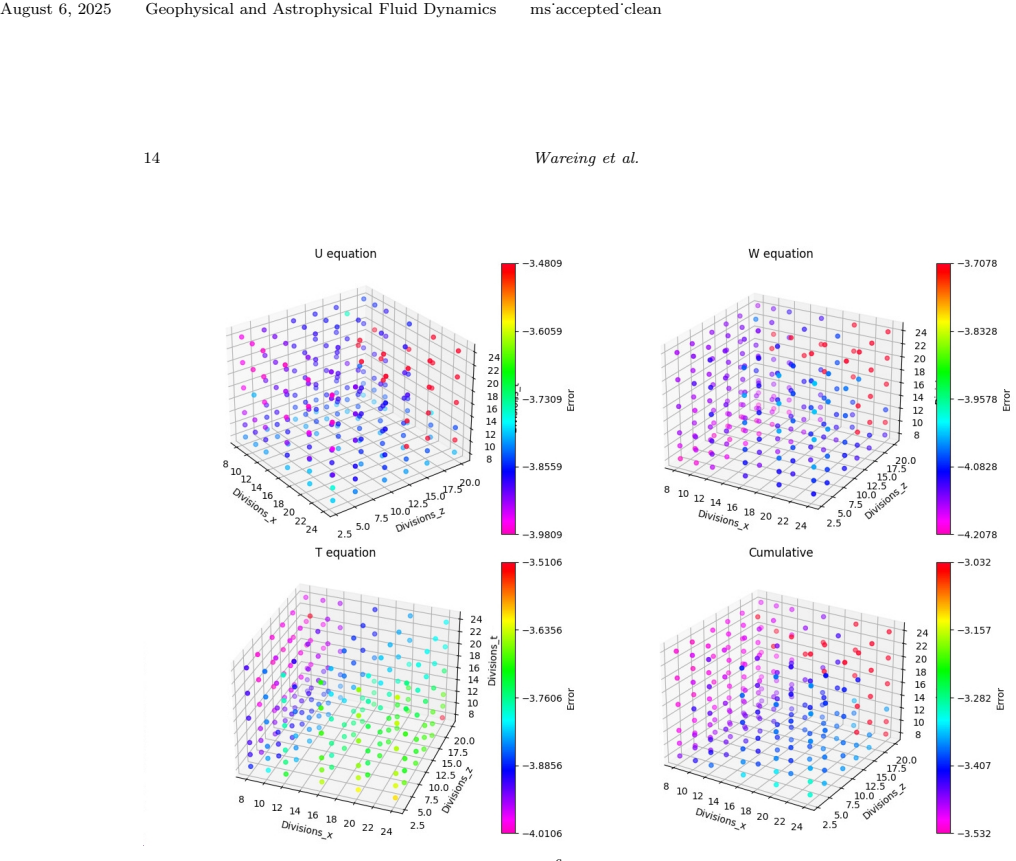
- pySINDy spatiotemporal domain divisions (xdiv, zdiv, tdiv) =
12, 10, 8 at R=1e6
- SPIDER weight exponent beta =
4, 8, or 12 depending on case
- SPIDER subdomain size and subdomain count =
e.g., Omega_i=64 and K=1024 for R=1e10 in 2D
- MIOSR sparsity targets =
15 total (5,6,0,4) for 2D Rayleigh-Benard
- pySINDy interpolating polynomial order =
6
- Correlation-scale threshold =
Autocorrelation drop to 0.5
assumptions (5)
- domain assumption The Boussinesq approximation and the stated nondimensionalization correctly describe the simulated convection.
- domain assumption The DNS solutions accurately represent the continuous PDE solutions at the stated resolutions.
- domain assumption The candidate libraries contain the true operators that appear in the governing equations.
- standard math Weak-form integration, integration by parts, and trapezoidal quadrature are accurate enough for the regression.
- domain assumption The true equations are sparse linear combinations of library terms.
Cite this review
Pith. "Pith review of Data-driven discovery of the equations of turbulent convection." pith.science (2026). https://pith.science/paper/YJOGWI5F
@misc{pith2026250510109,
  author       = {Pith},
  title        = {Pith review of: Data-driven discovery of the equations of turbulent convection},
  year         = {2026},
  howpublished = {\url{https://pith.science/paper/YJOGWI5F}},
  note         = {Machine review of arXiv:2505.10109}
}
read the original abstract
We compare the efficiency and ease-of-use of the Sparse Identification of Nonlinear Dynamics (SINDy) algorithm and Sparse Physics-Informed Discovery of Empirical Relations (SPIDER) framework in recovering the relevant governing equations and boundary conditions from data generated by direct numerical simulations (DNS) of turbulent convective flows. In the former case, a weak-form implementation pySINDy is used. Time-dependent data for two- (2D) and three-dimensional (3D) DNS simulation of Rayleigh-Benard convection and convective plane Couette flow is generated using the Dedalus PDE framework for spectrally solving differential equations. Using pySINDy we are able to recover the governing equations of 2D models of Rayleigh-Benard convection at Rayleigh numbers, R, from laminar, through transitional to moderately turbulent flow conditions, albeit with increasing difficulty with larger Rayleigh number, especially in recovery of the diffusive terms (with coefficient magnitude proportional to 1/R^0.5). SPIDER requires a much smaller library of terms and we are able to recover more easily the governing equations for a wider range of R in 2D and 3D convection and plane flow models and go on to recover constraints (the incompressibility condition) and boundary conditions, demonstrating the benefits and capabilities of SPIDER to go beyond pySINDy for these fluid problems governed by second-order PDEs. [We] demonstrat[e] the potential of machine-learning methods to validate numerical solvers and solutions for such flow problems. We also find that properties of the flow, specifically the correlation time and spatial scales, should inform the initial selection of spatiotemporal subdomain sizes [abbreviated]
Figures


Figures from the paper (5 more)


Reference graph
Works this paper leans on
-
[1]
, " * write output.state after.block = add.period write newline
ENTRY address author booktitle chapter chaptertitle englishtitle edition editor eid howpublished institution journal key month note number organization pages publisher location school series seriesnumber title type volume year label extra.label sort.label short.list INTEGERS output.state before.all mid.sentence after.sentence after.block FUNCTION init.sta...
-
[2]
" write newline "" before.all 'output.state := FUNCTION n.dashify 't := "" t empty not t #1 #1 substring "-" = t #1 #2 substring "--" = not "--" * t #2 global.max substring 't := t #1 #1 substring "-" = "-" * t #2 global.max substring 't := while if t #1 #1 substring * t #2 global.max substring 't := if while FUNCTION word.in bbl.in " " * FUNCTION word.pl...
-
[3]
Abramovic, I., Alves, E.P., Greenwald, M., Data-driven model discovery for plasma turbulence modelling. 2022, J. Plasma Physics, 88, 895880604
work page 2022
-
[4]
Ascher, U.M., Ruuth, S.J. and Spiteri R.J., Implicit-explicit Runge-Kutta methods for time-dependent partial differential equations. 1997, Applied Numerical Mathematics, 25 (2-3), 151-167
work page 1997
-
[5]
2023, Nonlinear Dynamics, 111, 6585–6604
Bertsimas, D., Gurnee, W., Learning sparse nonlinear dynamics via mixed-integer optimization. 2023, Nonlinear Dynamics, 111, 6585–6604
work page 2023
-
[6]
2016, The Annals of Statistics, 44 (2), 813-852
Bertsimas, D., King, A., Mazumder, R., Best subset selection via a modern optimization lens. 2016, The Annals of Statistics, 44 (2), 813-852
work page 2016
-
[7]
Bolton, T., Zanna, L., Applications of Deep Learning to Ocean Data Inference and Subgrid Parameterization. 2019, J. Adv. Model. Earth Syst., 11(1), 376-399
work page 2019
-
[8]
Bortz, D.M., Messenger, D.A., and Tran, A. Chapter 2 - Weak form-based data-driven modeling: Computationally efficient and noise robust equation learning and parameter inference, in Handbook of Numerical Analysis, vol. 25, 2024, pages 53-82
work page 2024
Show all 39 references
-
[9]
and Kutz, J.N., Discovering governing equations from data by sparse identification of nonlinear dynamical systems
Brunton, S.L., Proctor, J.L. and Kutz, J.N., Discovering governing equations from data by sparse identification of nonlinear dynamical systems. 2016, Proceedings of the National Academy of Sciences, 113(15), 3932–3937
2016
- [10]
-
[11]
and Brown, B.P., Dedalus: A Flexible Framework for Numerical Simulations with Spectral Methods
Burns, K.J., Vasil, G.M., Oishi, J.S., Lecoanet, D. and Brown, B.P., Dedalus: A Flexible Framework for Numerical Simulations with Spectral Methods. 2020, Physical Review Research, 2(2), 023068
2020
-
[12]
2019, Proceedings of the National Academy of Sciences, 116 (45), 22445-22451
Champion, K., Lusch, B., Kutz, J.N., Brunton, S.L., Data-driven discovery of coordinates and governing equations. 2019, Proceedings of the National Academy of Sciences, 116 (45), 22445-22451
2019
-
[13]
2002, Physica D, 166, 239-257
Chorin, A.J., Hald, O.H., Kupferman, R., Optimal prediction with memory. 2002, Physica D, 166, 239-257
2002
-
[14]
2008, Princeton University Press, ISBN:978-0-691-11836-9
Cvitanovi\'c, P., Group theory: birdtracks, Lie's and exceptional groups. 2008, Princeton University Press, ISBN:978-0-691-11836-9
2008
-
[15]
2022, Journal of Computational Physics, 448, 110733
Dubois, P., Gomez, T., Planckaert, L., Perret, L., Machine learning for fluid flow reconstruction from limited measurements. 2022, Journal of Computational Physics, 448, 110733
2022
-
[16]
2024, arXiv:2402.15357
Fung, L., Fasel, U., Juniper, M.P., Rapid Bayesian identification of sparse nonlinear dynamics from scarce and noisy data. 2024, arXiv:2402.15357
2024 arXiv
-
[17]
and Stellmach, S., A model of the entropy flux and Reynolds stress in turbulence convection
Garaud, P., Ogilvie, G.I., Miller, N. and Stellmach, S., A model of the entropy flux and Reynolds stress in turbulence convection. 2010, MNRAS, 407, 2451-2467
2010
-
[18]
2024, Proc
Gao, M.L., Kutz, N.J., Bayesian autoencoders for data-driven discovery of coordinates, governing equations and fundamental constants. 2024, Proc. R. Soc. A., 480, 20230506
2024
-
[19]
and Fernandez-Nieves, A., Physically informed data-driven modeling of active nematics
Golden, M., Grigoriev, R.O., Nambisan, J. and Fernandez-Nieves, A., Physically informed data-driven modeling of active nematics. 2023, Science Advances, 9(27), eabq6120
2023
-
[20]
2024, arXiv:2405.09579
Golden, M., Scalable sparse regression for model discovery: the fast lane to insight. 2024, arXiv:2405.09579
2024 arXiv
-
[21]
and Grigoriev, R.O., Robust and optimal sparse regression for nonlinear PDE models
Gurevich, D.R., Reinbold, P.A.K. and Grigoriev, R.O., Robust and optimal sparse regression for nonlinear PDE models. 2019, Chaos, 29(10), 103113
2019
-
[22]
and Grigoriev, R.O., Learning fluid physics from highly turbulent data using sparse physics-informed discovery of empirical relations (SPIDER)
Gurevich, D.R., Golden, M.R., Reinbold, P.A.K. and Grigoriev, R.O., Learning fluid physics from highly turbulent data using sparse physics-informed discovery of empirical relations (SPIDER). 2024, Journal of Fluid Mechanics, 996, A25
2024
-
[23]
and Hassanzadeh, P., Learning closed-form equations for subgrid-scale closures from high-fidelity data: promises and challenges
Jakhar, K., Guan, Y., Mojgani, R., Chattopadhyah, A. and Hassanzadeh, P., Learning closed-form equations for subgrid-scale closures from high-fidelity data: promises and challenges. 2024, Journal of Advances in Modeling Earth Systems, 16, e2023MS003874
2024
-
[24]
2020, Proc
Kaheman, K., Kutz, J.N., Brunton, S.L., SINDy-PI: a robust algorithm for parallel implicit sparse identification of nonlinear dynamics. 2020, Proc. R. Soc. A: Math. Phys. Eng. Sci., 476 (2242), 20200279
2020
-
[25]
2021, Phys
Kaptanoglu, A.A., Callaham, J.L., Aravkin, A., Hansen, C.J., Brunton, S.L., Promoting global stability in data-driven models of quadratic nonlinear dynamics. 2021, Phys. Rev. Fluids, 9 (6), 094401
2021
-
[26]
Benchmarking sparse system identification with low-dimensional chaos
Kaptanoglu, A.A., Zhang, L., Nicolaou, Z.G., Fasel, U., Brunton, S.L. Benchmarking sparse system identification with low-dimensional chaos. 2023, Nonlinear Dyn., 111, 13143–13164
2023
-
[27]
and Tobias, S.M
Marston, J.B. and Tobias, S.M. Recent Developments in Theories of Inhomogeneous and Anisotropic Turbulence 2023, Annual Review of Fluid Mechanics, 55, 351-375
2023
-
[28]
and Bortz, D.M., Weak SINDy for Partial Differential Equations
Messenger, D.A. and Bortz, D.M., Weak SINDy for Partial Differential Equations. 2021, J. Comp. Phys., 443, 110525
2021
-
[29]
and Yalla, G.R., Statistical Properties of Subgrid-Scale Turbulence Models
Moser, R.D., Haering, S.W. and Yalla, G.R., Statistical Properties of Subgrid-Scale Turbulence Models. 2021, Ann. Rev. Fl. Mech., 53, 255-286
2021
-
[30]
and Grigoriev, R.O., Data-driven discovery of partial differential equation models with latent variables
Reinbold, P.A.K. and Grigoriev, R.O., Data-driven discovery of partial differential equation models with latent variables. 2019, Physical Review E, 100(2), 022219
2019
-
[31]
and Grigoriev, R.O., Using noisy or incomplete data to discover models of spatiotemporal dynamics
Reinbold, P.A.K., Gurevich, D.R. and Grigoriev, R.O., Using noisy or incomplete data to discover models of spatiotemporal dynamics. 2020, Physical Review E, 101(1), 010203(R)
2020
-
[32]
and Grigoriev, R.O., Robust learning from noisy, incomplete, high-dimensional experimental data via physically constrained symbolic regression
Reinbold, P.A.K., Kageorge, L.M., Schatz, M.F. and Grigoriev, R.O., Robust learning from noisy, incomplete, high-dimensional experimental data via physically constrained symbolic regression. 2021, Nature Communications, 12, 3219
2021
-
[33]
and Kutz, J.N
Rudy, S.H., Brunton, S.L., Proctor, J.L. and Kutz, J.N. Data-driven discovery of partial differential equations. 2017, Science Advances, 3(4), e1602614, 2017
2017
-
[34]
Saxton, C.J., Marston, J.B., Oishi, J., Tobias, S.M., Ordering of time scales predicts applicability of quasilinear theory in unstable flows 2024, Journal of Fluid Mechanics, 998, A37
2024
-
[35]
and Ward, R., Extracting Sparse High-Dimensional Dynamics from Limited Data
Schaeffer, H., Tran, G. and Ward, R., Extracting Sparse High-Dimensional Dynamics from Limited Data. 2018, SIAM Journal on Applied Mathematics, 78 (6), 3279-3295
2018
-
[36]
2020, Journal of Open Source Software, 5(49), 2104
de Silva, B.M., Champion, K., Quade, M., Loiseau, J., Kutz, J.N., Brunton, S.L., pySINDy: A Python package for the sparse identification of nonlinear dynamical systems from data. 2020, Journal of Open Source Software, 5(49), 2104
2020
-
[37]
V\'eras, P., Balarac, G., M\'etais, O., Georges, D., Bombenger, A., Reconstruction of numerical inlet boundary conditions using machine learning: Application to the swirling flow inside a conical diffuser 2021, Physics of Fluids, 33, 085132
2021
-
[38]
2020, Geophysical Research Letters, 47, e2020GL088376
Zanna, L., Bolton T., Data-Driven Equation Discovery of Ocean Mesoscale Closures. 2020, Geophysical Research Letters, 47, e2020GL088376
2020
-
[39]
2018, PRL, 120, 144502
Zhu, X., Mathai, V., Stevens, R.J.A.M., Verzicco, R., Lohse, D., Transition to the Ultimate Regime in Two-Dimensional Rayleigh-B\'enard Convection. 2018, PRL, 120, 144502
2018
Reviewed August 15, 2026 · model on record in the stance chip above.
Discussion (0). Continue with ORCID to comment.