REVIEW 4 major objections 5 minor 1 cited by
Characterizing AI-Generated Misinformation on Social Media
T0 review · 4 major / 5 minor · reviewed 2026-08-15 · deepseek-v4-flash
Pith's one-line read AI-generated misinformation on X is measurably more viral than other misleading posts, gaining about 11% more retweets, 34% more likes, and 10% more views after controls for account size and content.
desk verdict A genuinely new dataset for studying AI misinformation in the wild, but the AI label is read off the Community Note rather than the post, and internal inconsistencies undercut the headline virality claim. read the letter →
The pith
A machine-rendered reading of the paper's core claim, the machinery that carries it, and where it could break.
The reading
What carries the argument
The central object is the binary indicator AIGenerated_i, obtained by giving a large language model each Community Note and asking whether the note indicates AI-generated content; a balanced subset of 3,000 posts is further annotated for sentiment, topic, harmfulness, and believability. That indicator is the key regressor in three count-regression models (negative binomial) explaining retweets, likes, and impressions, with media type and account attributes as controls and month-year fixed effects. The size and significance of its coefficient is what supports the virality claim.
What would settle it
Inspect the original images or videos of a random sample of posts the model labels AI-generated and check provenance or run forensic deepfake detectors; if most contain no detectable AI-created media, the virality gap is an artifact of note wording rather than of AI generation.
Extended reading notes
Core claim
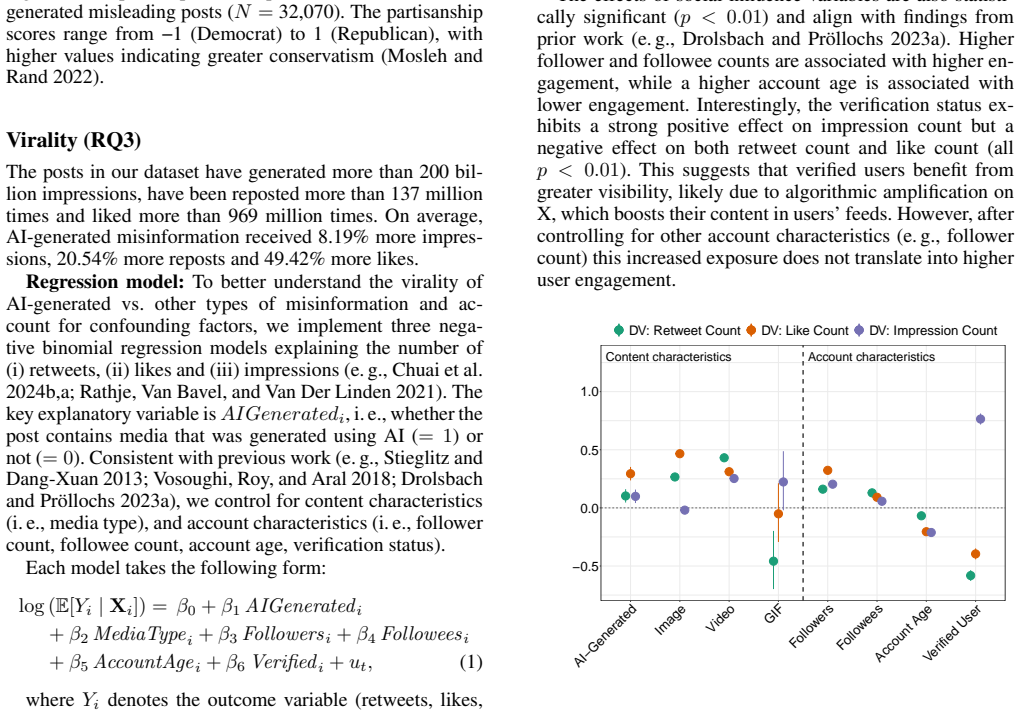
Across 91,452 misleading posts flagged on X's Community Notes from January 2023 to January 2025, the paper identifies a subset as AI-generated by having a language model read each Community Note and decide whether it refers to AI-created content. Its central claim is that this subset behaves differently enough to be treated as its own category. AI-generated misleading posts receive 10.81% more retweets, 34.16% more likes, and 10.32% more impressions than non-AI misleading posts in negative binomial regressions that control for media type, follower and followee counts, account age, verification status, and month-year fixed effects. They are also 1.33 times more likely to carry media, more often categorized as entertainment with positive sentiment, more likely to originate from smaller yet older and more conservative accounts, and slightly less believable and harmful than conventional misinformation.
Load-bearing premise
The load-bearing assumption is that a post actually contains AI-generated media when a language model reads its Community Note and judges that the note refers to AI; the human validation shows raters agree the note mentions AI, not that the underlying media was truly AI-made.
Editorial extensions
If this is right
- AI-generation status should become a standard explanatory variable in social-media misinformation research; the paper finds its engagement effect survives controls for content, sentiment, and account size.
- Platform moderation should not rely on account prominence as the primary risk signal, because AI-generated misinformation spreads further despite coming from smaller accounts.
- Fact-checking and detection systems geared toward negative or overtly political content will under-serve the part of the AI-generated misinformation ecosystem that is entertaining and positive in tone.
- The finding that AI-generated posts are slightly less believable and harmful than conventional fakes implies that their viral advantage is not explained by higher perceived credibility.
- Text-only sentiment analysis misses part of the positive tone carried by attached media, so multimodal annotation is needed to characterize AI-generated content.
Reading between the lines
- Because AI-generation is inferred from Community Notes, the virality estimates may partly reflect selection in who writes notes and which posts get them; a post needs a note mentioning AI to enter the AI group, and such notes may be more likely on striking or widely seen posts.
- The larger effect on likes (34%) than retweets (11%) hints that AI-generated content succeeds by triggering an emotional or entertainment response that rewards approval more than sharing; a follow-up experiment could test whether labeling a post as AI-generated changes users' engagement.
- Extending the same design to a different platform would clarify whether the virality premium is a property of AI content or of X's recommendation algorithm; persistence across platforms would suggest content-intrinsic appeal.
Signed reviews
Editorial analysis
A structured set of objections, weighed in public.
Referee Report
Summary. The paper presents a large-scale observational study of misinformation posts flagged on X's Community Notes platform between January 2023 and January 2025. The authors use GPT-4-turbo to classify posts as AI-generated based on the text of the associated Community Note, and then compare AI-generated and non-AI-generated misleading posts across four research questions: content characteristics (sentiment, topic, media type), author account characteristics, virality (retweets, likes, impressions), and perceived believability/harmfulness. The central claim is that AI-generated misinformation is more viral than other misinformation: the negative binomial regressions in Eq. (1) report 10.81% more retweets, 34.16% more likes, and 10.32% more impressions for AI-generated posts after controlling for media type, account characteristics, and month-year fixed effects. Secondary findings are that AI-generated misinformation tends to be more positive in sentiment, more entertainment-focused, more likely to come from smaller accounts, and slightly less believable and harmful. The paper also provides an LLM-based annotation of a 3,000-post subsample for sentiment, topic, believability, and harmfulness.
Significance. If the identification strategy were valid, this would be one of the first large-scale empirical accounts of real-world AI-generated misinformation, with direct implications for platform moderation and misinformation research. The paper contributes a sizable public dataset, transparent prompts, and regression specifications with fixed effects and standard robustness checks. The main empirical claims, however, rest entirely on the validity of the AI-generated label, and that label is currently derived from Community Note text in a way that is not independently validated against the posts' actual content. The internal inconsistencies in the reported numbers further reduce confidence. The significance of the findings is therefore conditional on resolving these measurement and reporting issues.
major comments (4)
- [Identification of AI-generated misinformation / Validation] The AI-generated indicator is constructed by an LLM that sees only the Community Note text, not the post's media or original content ('Identify whether you expect the original post to contain AI-generated content based on the community note provided'). The validation study then presents human raters with the same Community Note plus the post, so agreement between the LLM and raters largely demonstrates that notes mentioning AI are recognized as mentioning AI, not that the underlying posts contain AI-generated media. The reported Fleiss kappa of 0.322 (fair) and the 22% rate at which non-AI posts were rated as AI further indicate label noise. This issue is load-bearing for every downstream comparison, including the virality coefficients in Eq. (1). The authors should re-validate the label with raters who judge the post's media and text without seeing the Community Note, and ideally cross-check a sample against external provenance information.
- [Data source / Virality (RQ3, Eq. 1)] The sample consists only of posts that received a helpful Community Note, which requires users to write a note and other users to rate it as helpful. Visible and controversial posts are more likely to enter the sample, and the probability of being flagged may differ systematically between AI-generated and non-AI-generated posts. If AI-generated posts are disproportionately flagged when they are already viral, the regression coefficient on AIGenerated in Eq. (1) is biased upward. The Limitations section acknowledges the selection problem qualitatively but does not quantify it. A bounding exercise, a selection model, or a sensitivity analysis based on note-writing rates should be added before the virality claim can be accepted.
- [Empirical Analysis (RQ1) / Table S1] The reported number of AI-generated posts is internally inconsistent. The text in Section 'Empirical Analysis' states that the dataset includes 4,577 AI-generated posts (5.06%), which is consistent with N=91,452 only if the AI variable is coded as 0.050. Yet Table S1 reports the mean of AI-generated as 0.12 (12%) for the same N=91,452. Additionally, the abstract given at the start of the manuscript says 82,076 misleading posts, whereas the full text and Table S1 use 91,452. These discrepancies must be resolved because the prevalence of AI-generated misinformation is a central descriptive finding and the AI/non-AI split enters every subsequent analysis.
- [Author characteristics (RQ2)] The sentence in Section 'Author characteristics' reads 'AI-generated misleading posts tend to originate from accounts with significantly more followers (950,660 vs. 585,671),' but Table S1 reports the opposite: the mean follower count is 585,671 for AI-generated posts and 950,660 for non-AI-generated posts. The Discussion and abstract explicitly rely on the 'smaller accounts' direction for RQ2, so this reversal is not a harmless typo; it directly contradicts the paper's own summary statistics and must be corrected.
minor comments (5)
- [Model checks] The model checks list is numbered '(1) ... (3) ... (iii)', which appears to be a typographical inconsistency; the items should be numbered consistently.
- [Implications] The final sentence of the Implications section ends with an incomplete phrase 'types of misleading information.' that appears to be a leftover from an earlier draft and should be removed.
- [Introduction] The Introduction contains the phrase 'addresses this gap with by characterizing'; the word 'with' should be deleted.
- [Table S1] The means for Believability (0.34) and Harmfulness (0.41) in Table S1 appear to be binary-coded conversions, but the main text reports three-level distributions (low/medium/high) for the same LLM-annotated sub-sample (N=3,000). The coding scheme should be clarified so that the table and the text are reconcilable.
- [Data availability] The footnote about the Community Notes data download is referenced as '1Available via ...' with no spacing after the footnote marker; also, the URL is not rendered as a clickable link in the text.
Circularity Check
The AI-generated label is read from Community Note text; the human validation reuses the same note text, so the label and its benchmark are not independent.
-
self definitional
[Data and Methods, 'Identification of AI-generated misinformation' (Validation; SI prompt)]
"Specifically, we deployed an OpenAI Assistant (based on gpt-4-turbo), which was given the task of identifying whether a Community Note refers to AI-generated content. ... Each assistant independently reviewed 400 randomly selected posts (1/3 AI and 2/3 non-AI), including both the original post and the corresponding textual Community Note. ... Identify whether you expect the original post to contain AI-generated content based on the community note provided."
The AI-generated indicator is operationalized as a property of the Community Note text: the LLM never sees the post media, only the note, and is told to decide 'based on the community note provided.' The human validation then presents raters with that same Community Note text alongside the post. High LLM-human agreement (M_AI/AI = 0.75 vs M_AI/nonAI = 0.22) therefore mostly demonstrates that notes mentioning AI are recognized as mentioning AI; it does not independently verify that the post contains AI-generated media. Because this label is the key explanatory variable in Eq.
full rationale
This is an empirical observational study, not a derivational paper, so most of the analysis is not circular in the technical sense: the negative binomial coefficients in Eq. (1) are estimated from data, not fitted to the outcome and then re-predicted, and the control variables are standard. The one load-bearing circular component is the identification and validation of the AI-generated indicator. The LLM label is defined by whether the Community Note refers to AI-generated content, and the human raters are shown the same Community Note text, so the validation reduces to inter-annotator consistency about note wording rather than independent confirmation about the post media. This weakens the construct validity of the key predictor and thus the interpretation of the virality regression, although it does not force the coefficients by construction. The paper's Limitations section acknowledges dependence on Community Notes for identifying misinformation but does not flag this self-referential validation. An additional internal inconsistency (5.06% AI posts in the text vs. a mean of 0.12 in Table S1 for the same N = 91,452) further suggests ambiguity in the label computation, though it is not itself a circularity. No self-citation chain or uniqueness theorem drives the results.
Assumptions & free parameters
assumptions (4)
- domain assumption Community Notes rated as helpful are an accurate proxy for misinformation on X.
- domain assumption gpt-4-turbo's classifications of AI-generation from Community Note text are valid labels of AI-generated content.
- domain assumption LLM ratings of believability, harmfulness, sentiment, and topic reflect how general audiences would perceive or rate the posts.
- domain assumption The negative binomial regression in Eq. 1 has no confounding omitted variables beyond controls and fixed effects.
Cite this review
Pith. "Pith review of Characterizing AI-Generated Misinformation on Social Media." pith.science (2026). https://pith.science/paper/TQ6SKMNE
@misc{pith2026250510266,
  author       = {Pith},
  title        = {Pith review of: Characterizing AI-Generated Misinformation on Social Media},
  year         = {2026},
  howpublished = {\url{https://pith.science/paper/TQ6SKMNE}},
  note         = {Machine review of arXiv:2505.10266}
}
read the original abstract
AI-generated misinformation (e.g., deepfakes) poses a growing threat to information integrity on social media. However, prior research has largely focused on its potential societal consequences rather than its real-world prevalence. In this study, we conduct a large-scale empirical analysis of AI-generated misinformation on the social media platform X. Specifically, we analyze a dataset comprising 82,076 misleading posts, both AI-generated and non-AI-generated, that have been identified and flagged through X's Community Notes platform. Our analysis yields four main findings: (i) AI-generated misinformation is more often centered on entertaining content and tends to exhibit a more positive sentiment than conventional forms of misinformation, (ii) it is perceived as less believable and less harmful than conventional misinformation, (iii) it more often originates from smaller user accounts, while authors posting such content are also associated with higher levels of partisanship and misinformation exposure, and (iv) AI-generated misinformation is significantly more likely to go viral. Altogether, our findings highlight the unique characteristics of AI-generated misinformation on social media and offer important implications for platforms and future research.
Figures


Figures from the paper (5 more)



Forward citations
Cited by 1 Pith paper
-
Towards a Humanized Social-Media Ecosystem: AI-Augmented HCI Design Patterns for Safety, Agency & Well-Being
Five browser-side design patterns (rewriter, integrity meter, feed curator, micro-withdrawal, recovery mode) aim to give users control over social feeds through an explainable AI intermediary, with evaluation still pending.
Reference graph
Works this paper leans on
-
[1]
, " * write output.state after.block = add.period write newline
ENTRY address archivePrefix author booktitle chapter edition editor eid eprint howpublished institution isbn journal key month note number organization pages publisher school series title type volume year label extra.label sort.label short.list INTEGERS output.state before.all mid.sentence after.sentence after.block FUNCTION init.state.consts #0 'before.a...
-
[2]
write newline
" write newline "" before.all 'output.state := FUNCTION n.dashify 't := "" t empty not t #1 #1 substring "-" = t #1 #2 substring "--" = not "--" * t #2 global.max substring 't := t #1 #1 substring "-" = "-" * t #2 global.max substring 't := while if t #1 #1 substring * t #2 global.max substring 't := if while FUNCTION word.in bbl.in capitalize " " * FUNCT...
-
[3]
Akinwande, M. O.; Dikko, H. G.; Samson, A.; et al. 2015. Variance inflation factor: as a condition for the inclusion of suppressor variable (s) in regression analysis. Open Journal of Statistics, 5(7): 754--767
work page 2015
-
[4]
A.; Pennycook, G.; and Rand, D
Allen, J.; Arechar, A. A.; Pennycook, G.; and Rand, D. G. 2021. Scaling up fact-checking using the wisdom of crowds. Science Advances, 7(36): eabf4393
2021
-
[5]
Almars, A. M. 2021. Deepfakes Detection Techniques Using Deep Learning: A Survey. Journal of Computer and Communications, 9: 20--35
work page 2021
-
[6]
a r, D.; Pr \
B \"a r, D.; Pr \"o llochs, N.; and Feuerriegel, S. 2023. New threats to society from free-speech social media platforms. Communications of the ACM, 66(10): 37--40
2023
-
[7]
Barbieri, F.; Camacho-Collados, J.; Neves, L.; and Espinosa-Anke, L. 2020. TweetEval: Unified benchmark and comparative evaluation for tweet classification. arXiv preprint arXiv:2010.12421
arXiv 2020
-
[8]
Bashardoust, A.; Feuerriegel, S.; and Shrestha, Y. R. 2024. Comparing the willingness to share for human-generated vs. AI-generated fake news. Proceedings of the ACM on Human-Computer Interaction, 8(CSCW2)
work page 2024
Show all 53 references
-
[9]
D.; Johnson, S
Bray, S. D.; Johnson, S. D.; and Kleinberg, B. 2023. Testing human ability to detect ‘deepfake’ images of human faces. Journal of Cybersecurity, 9(1): tyad011
2023
-
[10]
Chuai, Y.; Pilarski, M.; Renault, T.; Restrepo-Amariles, D.; Troussel-Cl \'e ment, A.; Lenzini, G.; and Pr \"o llochs, N. 2024 a . Community-based fact-checking reduces the spread of misleading posts on social media. arXiv preprint arXiv:2409.08781
2024 arXiv
-
[11]
Chuai, Y.; Sergeeva, A.; Lenzini, G.; and Pr \"o llochs, N. 2025 a . Community fact-checks trigger moral outrage in replies to misleading posts on social media. In CHI
2025
-
[12]
Chuai, Y.; Tian, H.; Pr \"o llochs, N.; and Lenzini, G. 2024 b . Did the roll-Out of community notes reduce engagement with misinformation on X/T witter? Proceedings of the ACM on Human-Computer Interaction, 8(CSCW2)
2024
-
[13]
Chuai, Y.; Zhao, J.; Pr \"o llochs, N.; and Lenzini, G. 2025 b . Is fact-Checking politically neutral? asymmetries in how US fact-checking organizations pick up false statements mentioning political elites. In ICWSM
2025
-
[14]
Cooke, D.; Edwards, A.; Barkoff, S.; and Kelly, K. 2024. As Good As A Coin Toss: Human detection of AI-generated images, videos, audio, and audiovisual stimuli. arXiv preprint arXiv:2403.16760
2024 arXiv
-
[15]
o ter, I. C.; MacDorman, K. F.; Teufel, M.; and B \
Diel, A.; Lalgi, T.; Schr \"o ter, I. C.; MacDorman, K. F.; Teufel, M.; and B \"a uerle, A. 2024. Human performance in detecting deepfakes: A systematic review and meta-analysis of 56 papers. Computers in Human Behavior Reports, 16: 100538
2024
-
[16]
Dobber, T.; Metoui, N.; Trilling, D.; Helberger, N.; and De Vreese, C. 2021. Do (microtargeted) deepfakes have real effects on political attitudes? The International Journal of Press/Politics, 26(1): 69--91
2021
-
[17]
Drolsbach, C.; and Pr \"o llochs, N. 2023 a . Diffusion of community fact-checked misinformation on T witter. Proceedings of the ACM on Human-Computer Interaction, 7(CSCW2)
2023
-
[18]
P.; and Pr \"o llochs, N
Drolsbach, C. P.; and Pr \"o llochs, N. 2023 b . Believability and harmfulness shape the virality of misleading social media posts. In WWW
2023
-
[19]
P.; Solovev, K.; and Pr \"o llochs, N
Drolsbach, C. P.; Solovev, K.; and Pr \"o llochs, N. 2024. Community notes increase trust in fact-checking on social media. PNAS Nexus, pgae217
2024
-
[20]
A.; Kumar, S.; Lorenz-Spreen, P.; Tomz, M.; and Pr \"o llochs, N
Feuerriegel, S.; DiResta, R.; Goldstein, J. A.; Kumar, S.; Lorenz-Spreen, P.; Tomz, M.; and Pr \"o llochs, N. 2023. Research can help to tackle AI-generated disinformation. Nature Human Behaviour, 7(11): 1818--1821
2023
-
[21]
a r, D.; Geissler, D.; Schweisthal, J.; Pr \
Feuerriegel, S.; Maarouf, A.; B \"a r, D.; Geissler, D.; Schweisthal, J.; Pr \"o llochs, N.; Robertson, C. E.; Rathje, S.; Hartmann, J.; Mohammad, S. M.; et al. 2025. Using natural language processing to analyse text data in behavioural science. Nature Reviews Psychology, 4: 96--111
2025
-
[22]
A.; Sastry, G.; Musser, M.; DiResta, R.; Gentzel, M.; and Sedova, K
Goldstein, J. A.; Sastry, G.; Musser, M.; DiResta, R.; Gentzel, M.; and Sedova, K. 2023. Generative language models and automated influence operations: Emerging threats and potential mitigations. arXiv preprint arXiv:2301.04246
2023 arXiv
-
[23]
T.; Pisharody, N.; Carroll, F.; and Shapiro, J
Greene, K. T.; Pisharody, N.; Carroll, F.; and Shapiro, J. N. 2025. Fact-checks focus on famous politicians, not partisans. PNAS Nexus, 4(1): pgae567
2025
-
[24]
Grinberg, N.; Joseph, K.; Friedland, L.; Swire-Thompson, B.; and Lazer, D. 2019. Fake news on T witter during the 2016 U.S. presidential election. Science, 363(6425): 374--378
2019
-
[25]
Y.; Lippman, A.; and Picard, R
Groh, M.; Sankaranarayanan, A.; Singh, N.; Kim, D. Y.; Lippman, A.; and Picard, R. 2024. Human detection of political speech deepfakes across transcripts, audio, and video. Nature Communications, 15(1): 7629
2024
-
[26]
M.; Lerner, M.; Lyons, B.; Montgomery, J
Guess, A. M.; Lerner, M.; Lyons, B.; Montgomery, J. M.; Nyhan, B.; Reifler, J.; and Sircar, N. 2020. A digital media literacy intervention increases discernment between mainstream and false news in the United States and India. Proceedings of the National Academy of Sciences (P...
2020
-
[27]
T.; and Bailenson, J
Hancock, J. T.; and Bailenson, J. N. 2021. The social impact of deepfakes. Cyberpsychology, Behavior, and Social Networking, 24(3): 149--152
2021
-
[28]
He, B.; Hu, Y.; Lee, Y.-C.; Oh, S.; Verma, G.; and Kumar, S. 2025. A survey on the role of crowds in combating online misinformation: Annotators, evaluators, and creators. ACM Transactions on Knowledge Discovery from Data, 19(1): 1--30
2025
-
[29]
M.; Mortensen, T.; and Liu, J
Jones-Jang, S. M.; Mortensen, T.; and Liu, J. 2021. Does media literacy help identification of fake news? Information literacy helps, but other literacies don’t. American Behavioral Scientist, 65(2): 371--388
2021
-
[30]
C.; Dole z alov \'a , B.; and Soraperra, I
K \"o bis, N. C.; Dole z alov \'a , B.; and Soraperra, I. 2021. Fooled twice: People cannot detect deepfakes but think they can. iScience, 24(11)
2021
-
[31]
M.; and Brundage, M
Kreps, S.; McCain, R. M.; and Brundage, M. 2022. All the news that’s fit to fabricate: AI-generated text as a tool of media misinformation. Journal of Experimental Political Science, 9(1): 104--117
2022
-
[32]
E.; and Camacho-Collados, J
Loureiro, D.; Barbieri, F.; Neves, L.; Anke, L. E.; and Camacho-Collados, J. 2022. TimeLMs: Diachronic language models from Twitter. arXiv preprint arXiv:2202.03829
2022 arXiv
-
[33]
Martel, C.; Allen, J.; Pennycook, G.; and Rand, D. G. 2024. Crowds can effectively identify misinformation at scale. Perspectives on Psychological Science, 19(2): 477--488
2024
-
[34]
M.; Hao, H.; Yarlagadda, S
Montserrat, D. M.; Hao, H.; Yarlagadda, S. K.; Baireddy, S.; Shao, R.; Horv \'a th, J.; Bartusiak, E.; Yang, J.; Guera, D.; Zhu, F.; et al. 2020. Deepfakes detection with automatic face weighting. In IEEE/CVPR, 668--669
2020
-
[35]
Mosleh, M.; and Rand, D. G. 2022. Measuring exposure to misinformation from political elites on Twitter . Nature Communications , 13(1): 7144
2022
-
[36]
Pilarski, M.; Solovev, K.; and Pr \"o llochs, N. 2024. Community notes vs. snoping: How the crowd selects fact-checking targets on social sedia. In ICWSM
2024
-
[37]
Pr \"o llochs, N. 2022. Community-based fact-checking on T witter's B irdwatch platform. In ICWSM
2022
-
[38]
J.; and Van Der Linden, S
Rathje, S.; Van Bavel, J. J.; and Van Der Linden, S. 2021. Out-group animosity drives engagement on social media. Proceedings of the National Academy of Sciences, 118(26): e2024292118
2021
-
[39]
M.; and Lewis, B
Rivers, C. M.; and Lewis, B. L. 2014. Ethical research standards in a world of big data. F1000Research, 3: 38
2014
-
[40]
Sippy, T.; Enock, F.; Bright, J.; and Margetts, H. Z. 2024. Behind the Deepfake: 8\ exposure to and perceptions of deepfakes in the UK. arXiv preprint arXiv:2407.05529
2024 arXiv
-
[41]
Solovev, K.; and Pr \"o llochs, N. 2025. References to unbiased sources increase the helpfulness of community fact-checks. arXiv preprint arXiv:2503.10560
2025 arXiv
-
[42]
Somoray, K.; and Miller, D. J. 2023. Providing detection strategies to improve human detection of deepfakes: An experimental study. Computers in Human Behavior, 149: 107917
2023
-
[43]
Stieglitz, S.; and Dang-Xuan, L. 2013. Emotions and information diffusion in social media: Sentiment of microblogs and sharing behavior. Journal of Management Information Systems, 29(4): 217--248
2013
-
[44]
Fake News
Tandoc Jr, E. C.; Lim, Z. W.; and Ling, R. 2018. Defining “Fake News”: A typology of scholarly definitions. Digital Journalism, 6(2): 137--153
2018
-
[45]
Timmerman, B.; Mehta, P.; Deb, P.; Gallagher, K.; Dolan-Gavitt, B.; Garg, S.; and Greenstadt, R. 2023. Studying the online deepfake community. Journal of Online Trust and Safety, 2(1)
2023
-
[46]
Vaccari, C.; and Chadwick, A. 2020. Deepfakes and disinformation: Exploring the impact of synthetic political video on deception, uncertainty, and trust in news. Social Media+ Society, 6(1)
2020
-
[47]
Vosoughi, S.; Roy, D.; and Aral, S. 2018. The spread of true and false news online. Science, 359(6380): 1146--1151
2018
-
[48]
Westerlund, M. 2019. The emergence of deepfake technology: A review. Technology Innovation Management Review, 9: 40--53
2019
-
[49]
Wojcik, S.; Hilgard, S.; Judd, N.; Mocanu, D.; Ragain, S.; Hunzaker, M.; Coleman, K.; and Baxter, J. 2022. Birdwatch: Crowd wisdom and bridging algorithms can inform understanding and reduce the spread of misinformation. arXiv preprint arXiv:2210.15723
2022 arXiv
-
[50]
X. 2021. Introducing B irdwatch, a community-based approach to misinformation. https://blog.twitter.com/en_us/topics/product/2021/introducing-birdwatch-a-community-based-approach-to-misinformation
2021
-
[51]
Y.; Morrow, G.; Yang, K.-C.; and Wihbey, J
Yan, H. Y.; Morrow, G.; Yang, K.-C.; and Wihbey, J. 2025. The origin of public concerns over AI supercharging misinformation in the 2024 US presidential election. Harvard Kennedy School Misinformation Review
2025
-
[52]
G.; and De Choudhury, M
Zhou, J.; Zhang, Y.; Luo, Q.; Parker, A. G.; and De Choudhury, M. 2023. Synthetic lies: Understanding AI-generated misinformation and evaluating algorithmic and human solutions. In CHI
2023
-
[53]
Zi, B.; Chang, M.; Chen, J.; Ma, X.; and Jiang, Y.-G. 2020. Wilddeepfake: A challenging real-world dataset for deepfake detection. In MM, 2382--2390
2020
Reviewed August 15, 2026 · model on record in the stance chip above.
Discussion (0). Continue with ORCID to comment.