REVIEW 3 major objections 5 minor 2 cited by
SMIET: Fast and accurate synthesis of radio pulses from extensive air shower using simulated templates
T0 review · 3 major / 5 minor · reviewed 2026-08-15 · deepseek-v4-flash
Pith's one-line read One simulated shower can produce any target air shower's radio pulse in seconds, matching full simulation within 4%.
desk verdict Genuinely useful generalization of template synthesis, honestly presented, but headline accuracy is in-sample and the 'any atmosphere' claim outruns the independent tests. read the letter →
The pith
A machine-rendered reading of the paper's core claim, the machinery that carries it, and where it could break.
The reading
What carries the argument
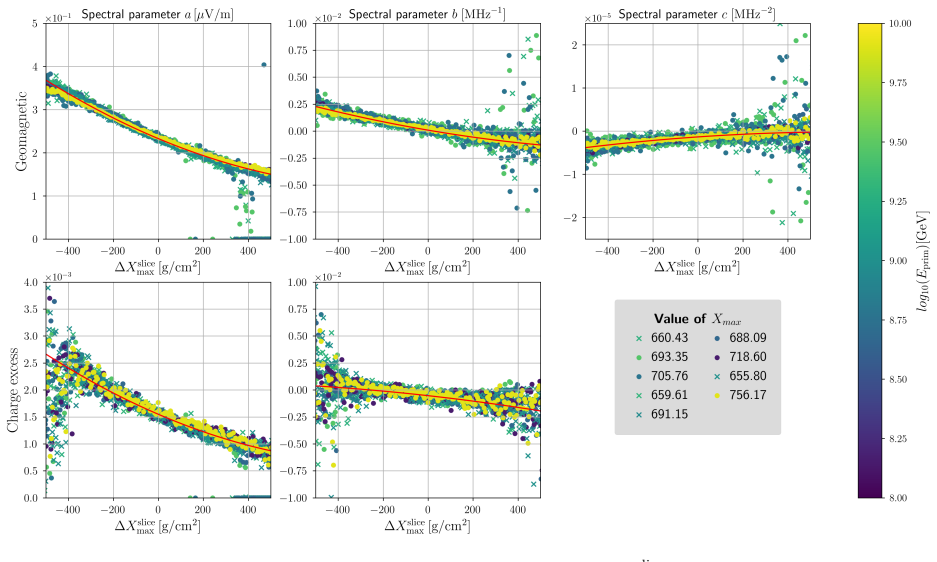
The load-bearing object is the 'spectral function', a semi-analytic parametrisation of a slice's amplitude frequency spectrum after removing geometrical scalings. The spectral parameters a, b, and c are fitted as parabolas in ΔX_max, one set per normalised viewing angle, where the viewing angle is the opening angle between the shower axis and the antenna divided by the local Cherenkov angle. This machinery, together with explicit phase correction based on geometric arrival times, lets the method rescale the origin shower to any target geometry in seconds while retaining the full phase information from the microscopic simulation.
What would settle it
Use the precomputed spectral functions to synthesise the pulse of a shower at a third site, with a magnetic field strength and observation level clearly different from the two already tested, and compare to a full simulation; if the peak-ratio scatter for |ΔX_max| ≤ 100 g/cm² exceeds 4% for the geomagnetic trace or 6% for the charge-excess trace, the claimed universality of the spectral functions is refuted.
Extended reading notes
Core claim
The central claim is that the radio emission of an extensive air shower is a universal function of the longitudinal profile: once the emission of each atmospheric slice is normalised by distance, particle count, geomagnetic-angle sine, air density for the geomagnetic component, and local Cherenkov angle for the charge-excess component, the remaining amplitude spectrum depends only on the slice's distance to the shower maximum and on the viewing angle expressed as a fraction of the local Cherenkov angle. These dependencies are encoded in fitted 'spectral functions', parabolas in ΔX_max, one set per viewing angle, extracted from a library of about 800 CORSIKA/CoREAS showers. To synthesise a new shower, the origin template's slice spectra are rescaled by the inverse factors evaluated at target parameters, and the phases are shifted by the geometric arrival-time difference between origin and target geometry. The benchmark over the [30, 500] MHz band gives a peak-amplitude scatter of at most 4% for the geomagnetic component and 6% for the charge-excess component when |ΔX_max| ≤ 100 g/cm², with a bias symmetric about ΔX_max = 0 that is correctable by interpolating between two origin showers. The method is verified for zenith angles up to 50°, at a second observation level with a different magnetic field, under a 10% denser atmosphere, and for modest geometry changes of a few degrees during synthesis.
Load-bearing premise
The load-bearing assumption is that a slice's radio emission, after simple rescalings, depends only on the slice's distance to the shower maximum and on the viewing angle, and not on what kind of particle started the shower, how energetic it was, or which atmosphere, magnetic field, or site geometry it is in.
Editorial extensions
If this is right
- With a template bank of origins spaced roughly 100 g/cm² in X_max and the interpolated synthesis correction, pulses can be synthesised for any target X_max with scatter at or below the benchmarked 4–6% level.
- Event-level analyses can afford thousands of synthesised showers per recorded event, making chi-squared or likelihood-based reconstruction of X_max, energy, and geometry routine.
- Because the JAX version is fully differentiable, gradient-based and Bayesian information-field-theory inversions can reconstruct the full longitudinal profile, not just X_max.
- The benchmarked universality across primary types, energies, atmospheres, observation levels, and magnetic fields means one set of spectral functions can be reused at many sites, provided the site parameters are entered into the scaling relations.
- The method applies up to about 50° zenith angle; for more inclined showers it is designed to hand off to Radio Morphing, together covering the full range of arrival directions.
Reading between the lines
- The paper does not push the density rescaling to its stated validity limit; a test with an atmosphere well below 600 g/m³ would show whether per-slice cancellation absorbs the breakdown of the inverse-density scaling.
- Because the observed bias is symmetric in ΔX_max, its origin is likely an even function of the profile difference, for instance slice-to-slice phase coherence; isolating that quantity could replace interpolation with a single-origin analytic correction.
- If the residual phase dispersion beyond the linear arrival-time term were parametrised, the demonstrated few-degree zenith-angle range during synthesis might extend substantially, enabling direct direction fits without resimulating origin showers.
- A consolidated library of a few origin showers and one set of p-parameters per frequency band could serve all radio experiments, removing the need for each detector to build its own Monte-Carlo library; the paper provides the parts but leaves this consolidation unstated.
Signed reviews
Editorial analysis
A structured set of objections, weighed in public.
Referee Report
Summary. The paper presents SMIET, a template-based method for fast synthesis of radio pulses from extensive air showers. Starting from a single sliced CoREAS simulation (the origin shower), the method rescales the emission from each atmospheric slice using semi-analytical spectral functions that depend on the shower age and the normalised viewing angle, and applies explicit arrival-time corrections to allow small changes in the shower geometry. The authors extract the spectral functions from a library of almost 800 showers covering zenith angles of 20–50 degrees, then benchmark the method by synthesising every shower onto every other shower in the same library. The headline result is that, for |ΔXmax| ≤ 100 g/cm², the scatter on the peak amplitudes is at most 4% for the geomagnetic component and smaller than 6% for the charge-excess component. A position-dependent bias of up to 5% is reported and a weighted-average ('interpolated synthesis') correction is proposed. The paper also describes the open-source SMIET package with NumPy and JAX implementations, and presents three smaller validation scenarios: a different site (AERA), a 10%-denser atmosphere, and geometry changes of up to a few degrees.
Significance. If the claimed accuracy holds for genuinely different sites, atmospheres, and observation levels, SMIET would be a valuable tool for the radio-detection community, enabling large simulation sets for reconstruction, machine-learning analyses, and information-field-theory applications. The paper is transparent about its approach, releases the code publicly, and includes machine-checked benchmarks and a fully differentiable JAX implementation, which are notable strengths. The method is novel in generalising template synthesis beyond a fixed geometry, and the observation that the spectral functions are universal in ΔXmax is a useful physics result. However, the central accuracy claim rests primarily on an in-sample benchmark, and the independent validation is limited to a small number of scenarios, so the quantitative headline should be treated with caution until out-of-sample evidence is provided.
major comments (3)
- [Section 4.1 vs Section 3.1] The headline scatter values (4% for GEO, 6% for CE at |ΔXmax| ≤ 100 g/cm²) are computed by synthesising every shower in the same simulation library from which the spectral functions were extracted in Section 3.1. This makes the main benchmark partly in-sample: a systematic offset common to all library showers (for example, induced by the US-standard atmosphere, the LOFAR magnetic field, or the sea-level observation level) would be invisible to this test. The independent checks in Section 5 use only 20 showers per scenario and still apply the same spectral functions, so they constrain the transferability only weakly. I ask the authors to add an out-of-sample validation, for example by withholding a subset of showers from the spectral-function fit and benchmarking on that held-out set, or to explicitly state in the abstract and conclusions that the 4%/6% scatter is demonstrated only for the training library and that site-to-site transfer is supported only by the limited Section 5 tests.
- [Section 5.3 (Figures 11 and 12)] The conclusion that zenith-angle changes up to about 3 degrees keep the peak ratio within one standard deviation is based on manual inspection, as the authors state, without a statistical analysis over the full antenna set. The outliers that motivated plotting the median instead of the mean are not quantified, and the antenna-distance dependence visible in Figure 12 is not characterised. Provide a quantitative criterion, for example the fraction of synthesis cases within a given tolerance as a function of Δθ, so that the 'up to 3 degrees' claim is reproducible. As written, the arrival-direction reconstruction use case is not firmly established.
- [Section 4.2 (Figure 8)] The interpolated-synthesis bias correction is demonstrated on a single antenna, and the residual bias and scatter after correction are not quantified over the benchmark set. Because the paper recommends interpolated synthesis for practical applications, please report the mean and standard deviation of the corrected peak ratios as a function of ΔXmax and antenna distance, or otherwise provide statistical evidence that the correction removes the bias without inflating the scatter.
minor comments (5)
- [Appendix A and Section 2.7] The displayed formula for the emission time contains a typographical error: the expression after 'd·cos(θ) =' should involve a natural logarithm, not an exponential, and the argument of the logarithm should be (Xslice·cosθ − a_i)/b_i. Please correct the equation in the main text and the corresponding derivation in Appendix A.
- [Section 2.4] The limitation of the 1/ρ scaling at low densities is discussed in Section 6.4, but Section 2.4 states the scaling without this caveat. Adding a sentence noting that the scaling is verified in the literature only down to about 600 g/m³ would prevent readers from applying the method to very inclined showers or high-altitude sites beyond its validated range.
- [Section 3.1 and Section 4.1] The 20-degree zenith simulation set has a geomagnetic angle of only 2.3 degrees, and the GEO component is excluded from the main benchmark for this reason. It would be helpful to state in the conclusions that the quoted GEO accuracy assumes a sufficiently large geomagnetic angle, not just zenith angle.
- [Section 5] The universality tests use CORSIKA v7.7550, while the spectral functions were extracted with v7.6400. Please state explicitly whether the simulation-code update affects the radio-emission calculation, so that readers can rule out a version dependence as a confounding factor.
- [Section 5.3 and Figure 12] The text says the peak ratio drops quickly with increasing zenith-angle difference, but the quantitative relation (for example, a linear fit of the score versus Δθ) is not given. Adding such a fit would make the 'up to 3 degrees' statement more precise and easier to test.
Circularity Check
Headline 4%/6% scatter is quoted from a benchmark on the same library used to fit the spectral functions; only Section 5 gives a small out-of-sample check.
-
fitted input called prediction
[Section 1 (paper organization) and Section 4.1 / Section 3.1]
"The benchmarks are performed with the same showers from which the spectral functions were extracted however, so in Section 5 we proceed to test template synthesis under different conditions. ... We will use the same simulation set used to extract the spectral functions, which is described in subsection 3.1."
The spectral functions are quadratic fits (Section 2.5, Algorithm 1) to spectral parameters fitted to amplitude spectra of every slice/antenna across the ~800-shower library of Section 3.1. Section 4 benchmarks SMIET by synthesising each library shower onto the others and comparing S_peak against CoREAS traces from that same library. Each target trace therefore belongs to the data set that defined the spectral function used to predict it; the quoted 4%/6% scatter is a residual of the training set around its own fit, not an out-of-sample predictive error. The paper honestly flags this and supplies Section 5 as an external test, but those scenarios use only 20 showers each, so the abstract's headline accuracy remains an in-sample validation metric.
full rationale
The synthesis algorithm itself is not circular by construction: no parameter is fitted per target trace, the target enters only through its longitudinal profile and geometry, the phase treatment is derived from geometry (Section 2.7), and the scaling relations are taken from external work [18] rather than from the present fit. The main circularity is statistical rather than algebraic: the spectral functions are fits to the Section 3.1 library, and the headline 4%/6% accuracy is measured on that same library, so the central accuracy claim is partly self-referential. The paper explicitly acknowledges this and provides Section 5 as a genuinely out-of-sample check with different observation level/magnetic field, a denser atmosphere, and geometry changes; those tests are encouraging but statistically much weaker (20 showers per scenario). The self-citation to [14] for the 4% intrinsic shower-to-shower floor is a minor load point, but [14] is a published, externally falsifiable measurement, so it does not by itself make the argument circular. Overall, the score reflects one partial circularity in the headline validation metric, while the method's independent content in Section 5 and the absence of per-target fitting prevent a higher score.
Assumptions & free parameters
free parameters (4)
- Spectral function p-parameters (15 per viewing angle) =
Not stated individually; stored in the SMIET package
- Per-slice spectral parameters (ageo, bgeo, cgeo, ace, bce) =
Not reported; intermediate fits
- Central frequency f0 =
Not reported precisely; text says usually 50-100 MHz
- Viewing-angle grid and slice binning choices =
Viewing angles from 0.1 to 2.0 with denser sampling near 1.0; 5 g/cm2 slices
assumptions (6)
- domain assumption The total radio signal is a coherent sum of independent slice emissions (Equation 1): E(r,t) = sum over slices E_slice(X,r,t).
- domain assumption After applying the scaling factors, the amplitude spectrum of a slice depends only on ΔXmax and the normalized viewing angle.
- domain assumption The scaling relations of Ammerman-Yebra et al. [18], derived for full-shower emission, hold per slice in the form used in Equations (3) and (4).
- domain assumption Phase spectra from the origin shower can be reused for the target, shifted only by geometric arrival times; residual phase dispersion is small and independent of shower age.
- standard math Flat-Earth geometry for emission times and travel times is valid up to about 70 degrees zenith, and the method is tested to 50 degrees.
- domain assumption CoREAS provides the ground truth for radio emission.
Cite this review
Pith. "Pith review of SMIET: Fast and accurate synthesis of radio pulses from extensive air shower using simulated templates." pith.science (2026). https://pith.science/paper/NI4OPZKP
@misc{pith2026250510459,
  author       = {Pith},
  title        = {Pith review of: SMIET: Fast and accurate synthesis of radio pulses from extensive air shower using simulated templates},
  year         = {2026},
  howpublished = {\url{https://pith.science/paper/NI4OPZKP}},
  note         = {Machine review of arXiv:2505.10459}
}
abstract
Interpreting the data from radio detectors for extensive air showers typically relies on Monte-Carlo based simulation codes, which, despite their accuracy are computationally expensive and present bottlenecks for analyses. To address this issue we developed a novel method called template synthesis, which synthesises the radio emission from cosmic ray air showers in seconds. This hybrid approach uses a microscopically simulated, sliced shower (the origin) as an input. It rescales the emission from each slice individually to synthesise the emission from a shower with different properties (the target). In order to be able to change the arrival direction during synthesis, we adjust the phases based on the expected geometrical delays. We benchmark the method by comparing synthesised traces to CoREAS simulations over a wide frequency range of [30, 500] MHz . The synthesis quality is primarily influenced by the difference in $X_{max}$ between the origin and target shower. When $\Delta X_{max} \leq 100 g/cm^2$ , the scatter on the maximum amplitudes of the geomagnetic traces is at most 4%. For the traces from the charge-excess component this scatter is smaller than 6%. We also observe a bias with $\Delta X_{max}$ up to 5% for both components, which appears to depend on the antenna position. Since the bias is symmetrical around $\Delta X_{max} = 0 g/cm^2$, we can use an interpolation approach to correct for it. We have implemented the template synthesis algorithm in a Python package called \texttt{SMIET}, which includes all the necessary parameters. This package has been successfully tested with air showers with zenith angles up to $50^{\circ}$ and can be used with any atmosphere, observation level and magnetic field. We demonstrate that the synthesis quality remains comparable to our main benchmarks across various scenarios and discuss use cases, including machine-learning-based analyses.
Figures


Figures from the paper (10 more)


Forward citations
Cited by 2 Pith papers
-
A LOFAR-style reconstruction of cosmic-ray air showers with SKA-Low
Applying LOFAR's reconstruction method to full SKA-Low simulations yields 5 to 8 g/cm2 precision on the air-shower maximum between 10^16.6 and 10^18 eV, with beamforming extending the range down to 10^16 eV.
-
Generative Neural Network for Simulating Radio Emission from Extensive Air Showers
A neural network trained on CoREAS showers generates AERA radio pulses and reconstructs Xmax with resolution within about 25% of full Monte Carlo, within the trained phase space.
Reference graph
Works this paper leans on
-
[14]
M. Desmet, S. Buitink, T. Huege, D. Butler, R.Engel, O.Scholten, Proofofprinciplefortem- plate synthesis approach for the radio emission from vertical extensive air showers, Astroparti- clePhysics157(2024)102923, arXiv:2307.02939. doi:10.1016/j.astropartphys.2023.102923
work page Pith review arXiv 2024
-
[1]
F. G. Schröder, Radio detection of cosmic-ray air showers and high-energy neutrinos, Progress in Particle and Nuclear Physics 93 (2017) 1–68. doi:10.1016/j.ppnp.2016.12.002. URLhttps://www.sciencedirect.com/ science/article/pii/S0146641016300758
-
[2]
T. Huege, Radio detection of cosmic ray air showers in the digital era, Physics Reports 620 (2016) 1–52, arXiv: 1601.07426.doi:10.1016/ j.physrep.2016.02.001
arXiv 2016
-
[3]
A. Castellina (On behalf of The Pierre Auger Collaboration), AugerPrime: the Pierre Auger Observatory Upgrade, EPJ Web of Con- ferences 210 (2019) 06002, publisher: EDP Sci- ences.doi:10.1051/epjconf/201921006002. URLhttps://doi.org/10.1051%2Fepjconf% 2F201921006002
arXiv 2019
-
[4]
O. Scholten, K. Werner, F. Rusydi, A macro- scopic description of coherent geo-magnetic radiation from cosmic-ray air showers, As- troparticle Physics 29 (2) (2008) 94–103. doi:10.1016/j.astropartphys.2007.11.012. URLhttps://www.sciencedirect.com/ science/article/pii/S0927650507001703
-
[5]
G. A. Askaryan, COHERENT RADIO EMIS- SION FROM COSMIC SHOWERS IN AIR AND IN DENSE MEDIA, Journal of Experi- mental and Theoretical Physics (JETP) 21 (3) (1965) 658–659, publisher: XI Solvay Congress. URLhttp://www.jetp.ras.ru/cgi-bin/e/ index/e/21/3/p658?a=list
work page 1965
- [6]
-
[7]
D. Heck, J. Knapp, J. N. Capdevielle, G. Schatz, T. Thouw, CORSIKA: A Monte Carlo Code to Simulate Extensive Air Showers, Forschungszen- trum Karlsruhe FZKA 6019 (1998) 1–90
work page 1998
Show all 34 references
-
[8]
Huege, M
T. Huege, M. Ludwig, C. W. James, Simulating radio emission from air showers with CoREAS, AIP Conference Proceedings 1535 (1) (2013) 128, arXiv: 1301.2132 Publisher: American In- stitute of Physics (AIP) ISBN: 9780735411593. doi:10.1063/1.4807534. URLhttps://aip.scitation.org/...
2013 arXiv
-
[9]
S. J. Sciutto, Air Shower Simulations with the AIRES System (1999).doi:10.48550/ARXIV. ASTRO-PH/9905185
1999 doi
-
[10]
Alvarez-Muñiz, W
J. Alvarez-Muñiz, W. R. Carvalho, E. Zas, Monte Carlo simulations of radio pulses in at- mospheric showers using ZHAireS, Astroparticle Physics 35 (6) (2012) 325–341, arXiv: 1107.1189 Publisher: North-Holland.doi:10.1016/J. ASTROPARTPHYS.2011.10.005
2012 arXiv
-
[11]
Dewdney, P
P. Dewdney, P. Hall, R. Schilizzi, T. Lazio, The Square Kilometre Array, in: Proceedings of the IEEE, Vol. 97, Institute of Electri- cal and Electronics Engineers Inc., 2009, pp. 1482–1496, issue: 8 ISSN: 0018-9219. doi:10.1109/jproc.2009.2021005. URLhttp://ieeexplore.ieee.org...
2009
-
[12]
Scholten, T
O. Scholten, T. Trinh, K. de Vries, B. Hare, Analytic calculation of radio emission from parametrized extensive air show- ers: A tool to extract shower parameters, 33 Physical Review D 97 (2) (2018) 023005, publisher: American Physical Society. doi:10.1103/PhysRevD.97.023005. ...
2018 doi
-
[13]
Mitra, High Precision Reconstruction of Air Shower Properties With Dense Radio Arrays, PhD Thesis, Vrije Universiteit Brussel (2021)
P. Mitra, High Precision Reconstruction of Air Shower Properties With Dense Radio Arrays, PhD Thesis, Vrije Universiteit Brussel (2021)
2021
-
[15]
Desmet, K
M. Desmet, K. Watanabe, SMIET: Synthesis Modelling In-air Emission using Templates (May 2025).doi:10.5281/zenodo.15194465. URLhttps://gitlab.iap.kit.edu/ AirShowerPhysics/smiet-cr-synthesis
2025 doi
-
[16]
Zilles, O
A. Zilles, O. Martineau-Huynh, K. Kotera, M. Tueros, K. de Vries, W. Carvalho, V. Niess, N. Renault-Tinacci, V. Decoene, Radio Mor- phing: towards a fast computation of the radio signal from air showers, Astroparticle Physics 114 (2020) 10–21, arXiv: 1811.01750. doi:10.1016/j....
2020 arXiv
-
[17]
The Pierre Auger Collaboration, Measurement of the Radiation Energy in the Radio Signal of Extensive Air Showers as a Universal Estimator of Cosmic-Ray Energy, Physical Review Letters 116 (24) (2016) 241101, arXiv:1605.02564 [astro- ph].doi:10.1103/PhysRevLett.116.241101
2016 arXiv
-
[18]
Ammerman-Yebra, J
J. Ammerman-Yebra, J. Alvarez-Muñiz, E. Zas, Density and magnetic field strength dependence of radio pulses induced by energetic air showers, Journal of Cosmology and Astroparticle Physics 2023 (08) (2023) 015, publisher: IOP Publish- ing.doi:10.1088/1475-7516/2023/08/015. URL...
2023 doi
-
[19]
Corstanje, S
A. Corstanje, S. Buitink, M. Desmet, H. Falcke, B. Hare, J. Hörandel, T. Huege, V. Jhansi, N. Karastathis, G. Krampah, P. Mitra, K. Mulrey, A. Nelles, K. Nivedita, H. Pandya, O. Scholten, K. Terveer, S. Thoudam, G. Trinh, S. ter Veen, A high-precision interpolation method for ...
2023 doi
-
[20]
D. Heck, T. Pierog, Extensive Air Shower Simulation with CORSIKA: A User’s Guide, Tech. Rep. v7.7410, Institute for Astroparti- cle Physics, Karlsruhe Institute for Technology (KIT) (2021)
2021
-
[21]
Glaser, D
C. Glaser, D. García-Fernández, A. Nelles, J. Alvarez-Muñiz, S. W. Barwick, D. Z. Besson, B. A. Clark, A. Connolly, C. Deaconu, K. D. de Vries, J. C. Hanson, B. Hokanson-Fasig, R. Lahmann, U. Latif, S. A. Kleinfelder, C. Persichilli, Y. Pan, C. Pfendner, I. Plaisier, D. Seckel...
2018
-
[22]
Krause, AERA - The auger engineering ra- dio array, in: Frascati Physics Series, Vol
R. Krause, AERA - The auger engineering ra- dio array, in: Frascati Physics Series, Vol. 58, 2014, pp. 315–322. URLhttp://www.auger. org/archive/authors_2011_05.html
2014
-
[23]
Corstanje, S
A. Corstanje, S. Buitink, H. Falcke, B. M. Hare, J. R. Hörandel, T. Huege, G. K. Krampah, P. Mitra, K. Mulrey, A. Nelles, H. Pandya, J. P. Rachen, O. Scholten, S. Ter Veen, S. Thoudam, G. Trinh, T. Winchen, Depth of shower maxi- mum and mass composition of cosmic rays from 50 ...
2021 arXiv
-
[24]
T. A. Enßlin, Information theory for fields, Annalen der Physik 531 (3) (2019) 1800127, arXiv:1804.03350 [astro-ph].doi:10.1002/ andp.201800127
2019 arXiv
-
[25]
URLhttp://github.com/google/jax
James Bradbury, Roy Frostig, Peter Hawkins, Matthew James Johnson, Chris Leary, Dou- gal Maclaurin, George Necula, Adam Paszke, Jake VanderPlas, Skye Wanderman-Milne, Qiao Zhang, JAX: Composable transformations of Python+NumPy programs (2018). URLhttp://github.com/google/jax
2018
-
[26]
Watanabe, S
K. Watanabe, S. Buitink, M. Desmet, T. En- sslin, T. Huege, A novel approach for air shower profile reconstruction with dense radio antenna arrays using information field theory, in: Pro- ceedings of 39th International Cosmic Ray Con- ference (ICRC2025), forthcoming
-
[27]
Falcke, B
A.Corstanje, S.Buitink, J.Bhavani, M.Desmet, H. Falcke, B. M. Hare, J. R. Hörandel, T. Huege, N. Karasthatis, G. K. Krampah, P. Mitra, K. Mulrey, A. Nelles, K. Nivedita, H. Pandya, J. P. Rachen, O. Scholten, S. Thoudam, G. Trinh, S. t. Veen, Prospects for measuring the longitu...
2023 arXiv
-
[28]
Scholten, T
O. Scholten, T. N. G. Trinh, S. Buitink, A. Corstanje, B. M. Hare, T. Huege, B. V. Jhansi, K. Mulrey, A. Nelles, H. Schoorlemmer, S. Thoudam, P. Turekova, K. d. Vries, Aper- ture correction for Beamforming in radiomet- ric detection of ultra-high energy cosmic rays, arXiv:2411...
2024 doi
-
[29]
W. R. Carvalho, J. Alvarez-Muñiz, Deter- mination of cosmic-ray primary mass on an event-by-event basis using radio detec- tion, Astroparticle Physics 109 (2019) 41–49. doi:10.1016/j.astropartphys.2019.02.005. URLhttps://www.sciencedirect.com/ science/article/pii/S092765051830029X
2019 doi
-
[30]
age" and
P. Lipari, Concepts of "age" and "universal- ity" in cosmic ray showers, Phys. Rev. D 79 (6) (2009) 1–17, arXiv: 0809.0190.doi:10.1103/ PhysRevD.79.063001
2009 arXiv
-
[31]
Mendizabal, N
S. Mendizabal, N. V. M, S. Tapia, R. P. R, B. Gutiérrez, C. Valdivieso, Revisiting the Longitudinal Development of Electromagnetic Air Showers: Analytical Improvements to the Greisen Formalism with Zenith Angle Depen- dence, arXiv:2504.09359 [astro-ph] (Apr. 2025)
2025 arXiv
-
[32]
Giller, A
M. Giller, A. Kacperczyk, J. Malinowski, W. Tkaczyk, G. Wieczorek, Similarity of ex- tensive air showers with respect to the shower age, Journal of Physics G: Nuclear and Parti- cle Physics 31 (2005) 947–958.doi:10.1088/ 0954-3899/31/8/023
2005
-
[33]
Schlüter, T
F. Schlüter, T. Huege, Signal model and event reconstruction for the radio detection of inclined air showers, Journal of Cosmol- ogy and Astroparticle Physics 2023 (01) (2023) 008, publisher: IOP Publishing. doi:10.1088/1475-7516/2023/01/008. URLhttps://dx.doi.org/10.1088/ 147...
2023 doi
-
[34]
Chiche, C
S. Chiche, C. Zhang, F. Schlüter, K. Kotera, T. Huege, K. D. de Vries, M. Tueros, M. Guelfand, Loss of Coherence and Change in Emission Physics for Radio Emission from Very Inclined Cosmic-Ray Air Show- ers, Physical Review Letters 132 (23) (2024) 231001, publisher: American P...
2024 doi
Reviewed August 15, 2026 · model on record in the stance chip above.
Discussion (0). Continue with ORCID to comment.