REVIEW 4 major objections 6 minor 62 references
Efficient Heuristics Generation for Solving Combinatorial Optimization Problems Using Large Language Models
T0 review · 4 major / 6 minor · reviewed 2026-08-15 · deepseek-v4-flash
Pith's one-line read By abstracting elite heuristics' core components as prompt prior knowledge, Hercules steers LLMs to specific search directions, and its confidence-gated fitness predictor cuts search time by up to 59%.
desk verdict The PPP performance predictor is a genuinely new and useful idea with broad experiments, but the universal SOTA claim overshoots the evidence and the 'proof' of CAP is an identity plus an assumption. read the letter →
The pith
A machine-rendered reading of the paper's core claim, the machinery that carries it, and where it could break.
The reading
What carries the argument
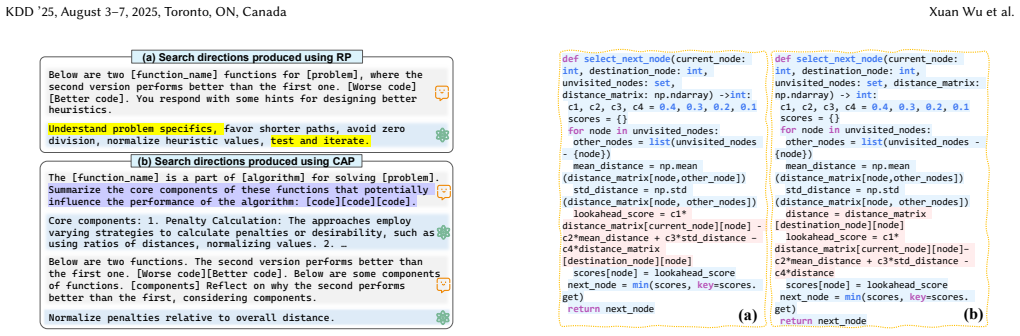
The central object is the prompting pipeline wrapped around a generational loop. Core Abstraction Prompting (CAP) is a zero-shot prompt that summarizes the top-k heuristics' core components, e.g., 'normalize penalties relative to overall distance', and feeds them as prior knowledge for search directions. Performance Prediction Prompting (PPP) is a few-shot prompt that presents a set of previously evaluated heuristics with distinct fitness values and asks the LLM to predict the fitness of new code from semantic similarity, returning a confidence score. Two small mechanisms make PPP usable: EXEMPLAR selects the historical best/worst plus top parents with distinct fitness values as examples, and Confidence Stratification (ConS) decides per heuristic whether to accept the LLM's predicted fitness or pay for a real COP-instance evaluation, using the acceptance threshold schedule m_t = ⌊α·β^t·N_o⌋. Together they carry the paper's twin claims: CAP reduces unspecificity (with a proven entropy bound) and PPP reduces evaluation cost without degrading population quality.
What would settle it
Measure prediction error separately for heuristics that ConS trusts (confidence at least 1−δ) and for those it re-evaluates; if the trusted set's errors are not significantly smaller in absolute value than the untrusted set's, then the confidence signal carries no information and Hercules-P's speedup is not the reliable filtering the paper claims, so rerunning Hercules-P with shuffled confidence values should leave search time and gain essentially unchanged.
Extended reading notes
Core claim
The paper's central claim is that feeding an LLM the abstracted core components of its best-so-far heuristics, rather than asking for reflections on performance, shifts the distribution of generated search directions toward actionable task-specific ideas, and that this shift can be quantified as an information gain. In formal terms, partitioning the space of possible directions by the k core components reduces entropy from H(Ω_t) to ∑ p_j H(Ω_j), giving IG = −∑ p_j log p_j in (0, log(k+1)]; the authors prove this identity and present it as the mechanism behind CAP's improvement. The companion claim is that an LLM can act as a fitness predictor: given a few well-chosen evaluated heuristics (best, worst, and top parents with distinct fitness values), the LLM predicts a new heuristic's performance from semantic similarity and outputs a confidence value; the ConS rule then decides which predictions to trust. Empirically, Hercules outperforms previous LLM-based heuristic generators across four tasks, five combinatorial optimization problems, and eight LLMs, while Hercules-P delivers similar gains in less compute.
Load-bearing premise
Hercules-P's time savings rest on the assumption that the LLM's self-reported confidence in its fitness prediction reliably flags predictions worth trusting; the paper reports only a 0.39 correlation between predicted and true fitness, so a miscalibrated confidence could let poor heuristics slip through while the claimed on-par performance is not guaranteed.
Editorial extensions
If this is right
- Hercules sets a new performance bar across four heuristic-generation tasks, five combinatorial optimization problems, and eight LLMs, so the specificity gain from CAP transfers across model families and problem types.
- Hercules-P cuts search time by 7% to 59% while matching Hercules's gain, making LLM-driven heuristic design practical in settings with limited compute, such as near-real-time resource allocation.
- The theoretical bound IG = −∑ p_j log p_j ∈ (0, log(k+1)] implies that any partitioning of the direction space by core components reduces entropy, so the benefit of CAP is structural rather than accidental to one model.
- The rank-based selection mechanism and the early-iteration use of elite components accelerate convergence, as shown by the ablation where replacing rank-based selection with random selection drops gain from 11.10% to 8.49%.
- PPP's EXEMPLAR mechanism improves predictive accuracy by 26% to 37% in median accuracy relative to using duplicate-fitness or random examples, indicating that example quality matters more than example quantity for LLM fitness prediction.
Reading between the lines
- If CAP's entropy-reduction argument applies as generally as stated, the same abstraction trick could be applied to other LLM-driven program synthesis tasks beyond combinatorial optimization, such as circuit design or scheduling policies, which the paper does not explore.
- The paper documents that LLMs frequently produce semantically equivalent heuristics; this suggests an explicit deduplication step based on code embedding similarity could complement PPP and further cut evaluation counts, a step the authors do not take.
- ConS currently thresholds confidence into three discrete bands; smoothing the acceptance probability as a continuous function of the confidence value could recover more of PPP's time savings while avoiding the bias-variance cliff at band boundaries.
- A stress test for PPP would be to run it on a search space where semantic novelty is high; in such a regime the semantic-similarity signal may weaken, and the claimed 7%–59% speedup could shrink or require more real evaluations.
Signed reviews
Editorial analysis
A structured set of objections, weighed in public.
Referee Report
Summary. The paper proposes two components for LLM-based heuristic generation. Core Abstraction Prompting (CAP) extracts core components from elite heuristics and feeds them into prompts so that LLM-generated search directions are more specific; a theoretical claim is made that CAP reduces unspecificity in the sense of information gain. The second component, Performance Prediction Prompting (PPP), uses a few-shot LLM prompt to predict fitness values of newly generated heuristics, together with an EXEMPLAR selection mechanism and a Confidence Stratification (ConS) acceptance rule, yielding a resource-efficient variant Hercules-P. The authors report extensive experiments across four heuristic-generation tasks, five combinatorial optimization problems, and eight LLMs, and claim state-of-the-art gains for Hercules and 7%--59% search-time reductions for Hercules-P at on-par quality.
Significance. If the empirical claims hold, the paper makes a useful practical contribution: CAP is a simple, zero-shot mechanism that plausibly improves the specificity of LLM search directions, and PPP is, to my knowledge, a novel use of LLMs as fitness predictors in heuristic generation. The manuscript is also strong in breadth: it covers multiple LLMs, seed algorithms, and problem types, and the authors release code and prompts. The ablation studies, especially the statistical comparison of EXEMPLAR variants in Figure 6, are a good-faith attempt to isolate design choices. However, the current evidence does not support the universal SOTA claim in the abstract and introduction, and the theoretical argument in Section 3.1/Appendix A is better described as a formalization of an assumption than a proof of CAP's benefit. These are load-bearing issues for the paper's central claims.
major comments (4)
- [Section 3.1 and Appendix A] The proof of Proposition 1 is internally correct only after assuming the conditional-probability identity p_j * p(omega_i | Omega_j) = p(omega_i | Omega_t) for every subset j and every direction omega_i. This identity is not a consequence of probability calculus; it is an assumption that the abstraction partitions the direction space without loss. Furthermore, the claimed positivity range (0, log(k+1)] in Eq. (4) requires that no subset has probability 1, and this non-degeneracy is exactly the behavioral conclusion the theorem is supposed to establish. Please state these assumptions explicitly and either prove them from the CAP mechanism or reframe the result as a formalization of the intended effect rather than a proof of empirical benefit.
- [Section 1, Tables 1, 3, and 5] The headline claim that Hercules outperforms state-of-the-art LLM-based HG algorithms across four tasks, five COPs, and eight LLMs is not supported by the paper's own tables. Table 1 shows that with Llama3-70b at n=200, Hercules obtains gain 3.42 versus EoH's 5.82. Table 3 shows average gains of 4.87 for Hercules versus 4.80 for EoH, a near tie with no reported variance. In Table 5, POMO TSP n=200 gives Hercules 2.49 versus Random 3.05 and EoH 2.19, and LEHD TSP n=1000 gives Hercules 5.14 versus EoH 6.09. A systematic win/loss count across all cells and statistical significance tests are needed before the universal SOTA statement can be made.
- [Tables 5 and 6, Section 4.5] The on-par performance claim for Hercules-P is not demonstrated. Table 5 contains several cells where Hercules-P is substantially worse than Hercules or even negative, e.g., POMO TSP n=200 (-0.10 vs 2.49) and POMO CVRP n=200 (-0.57 vs 1.53). Table 6 reports only search time, not quality, so the reported 7%--59% savings do not by themselves establish resource efficiency at on-par performance. In addition, the reliance of ConS on the LLM's self-reported confidence phi_i is weakly supported: the paper itself reports a Pearson correlation of only 0.39 between predicted and true fitness values (Section 4.5), and no calibration analysis for the confidence values is provided. The authors should report quality and time jointly, and provide evidence that the confidence threshold in Eq. (7) is well-calibrated.
- [Experimental methodology, Tables 1--5] Most gain tables report only the mean over three independent runs, without standard deviations or tests, while the few reported standard deviations (Table 4) show overlapping intervals for several key comparisons, e.g., BPP n=1000 Hercules 2.19 +/- 0.20 versus ReEvo 2.01 +/- 0.34. Given that the universal SOTA claim rests on small numeric gaps, the paper should report per-cell standard deviations or confidence intervals and run paired significance tests (or a systematic win/loss summary) across all tasks and LLMs. Without this, the claim that Hercules outperforms SOTA is not verifiable from the presented data.
minor comments (6)
- [Abstract and Introduction] The phrase "we theoretically prove the effectiveness of CAP in reducing unspecificity" overstates what Eq. (4) establishes; consider replacing it with "formalize the intended reduction" or similar.
- [Section 4.1] There is a typo in "real-wolrd case study" that should be corrected to "real-world".
- [Section 4.4, Table 5] The text notes that Random outperforms the other methods on some NCO tasks, but the discussion does not reconcile this with the universal SOTA claim; please add an explicit discussion of these counterexamples.
- [Section 4.5, Figure 6] The figure label contains garbled text ("w w/o w/o1") and the figure is difficult to read; the axis labels and legend should be clarified.
- [Appendix G] There is a typo "repsectively" that should be "respectively".
- [Appendix A] The paragraph after the proof argues that the one-to-one mapping assumption is reasonable, but the argument would be more convincing if it stated that the information-gain formula changes only by replacing k with k_c; the notation should be made explicit.
Circularity Check
Information-gain 'proof' of CAP reduces to the non-degeneracy assumption it needs to establish; empirical SOTA claims remain independent.
-
self definitional
[Section 3.1, Eqs. (1)-(4); Appendix A, Proposition 1 and its proof]
"As proven in Appendix A, Eq. (3) simplifies to the following expression, whose value ranges within the (0,log(k+1)] interval: IG(Ωt)=−∑_{j=0}^k p_j log p_j. Therefore, in theory, providing the core components as prior knowledge in prompts can reduce unspecificity in LLM responses and yield more specific search directions. ... However, due to the diverse nature of LLM training corpora, the LLM will not consistently provide the same direction. Therefore, by abstracting core components, the unspecificity (entropy) can decrease within the (0,log(k+1)] interval."
IG is defined as H(Ω_t)−Σ p_j H(Ω_j), and the 'with abstraction' entropy is H(direction | subset membership), where subsets are defined post hoc by which core component an output direction is associated with. The proof reduces IG to −Σ p_j log p_j; the advertised (0, log(k+1)] range requires this entropy of p_j to be positive. The paper obtains positivity by asserting 'the LLM will not consistently provide the same direction.' Under the paper's formalization, 'CAP reduces unspecificity' is exactly IG>0, so this assertion is the conclusion assumed as a property of the output distribution. No mechanism of CAP is used to derive it; the proof is a conditional identity, not an independent derivation.
full rationale
The empirical pipeline is self-contained and benchmarked against external baselines (Random, EoH, ReEvo; KGLS, ACO, POMO, LEHD seeds), so the SOTA claims are not circular. The CAP ablation, rank-based selection, and PPP/EXEMPLAR/ConS ablations are evaluated with true fitness on test sets. The only load-bearing derivation that reduces by definition is the information-gain proof of CAP: its conclusion is built into the assumption that the post-abstraction direction distribution is non-degenerate. Self-citations in the paper (e.g., [43]-[45], [48], [49]) are background references and are not load-bearing for any central claim. The paper's own tables also contain cells where Hercules does not beat baselines and few significance tests, but that is a correctness/robustness concern rather than circularity. Overall, there is one definitional circularity in a theoretical sub-claim, while the central empirical contribution has independent content.
Assumptions & free parameters
free parameters (5)
- lambda (CAP elite ratio) =
0.7
- delta (ConS confidence interval width) =
0.1
- alpha (ConS acceptance decay base) =
0.5
- beta (ConS acceptance decay rate) =
0.8
- k (number of elite heuristics for CAP) =
5
assumptions (4)
- ad hoc to paper The space of possible search directions can be partitioned into k+1 subsets associated with the k core components plus one independent subset, with p_j times p(omega_i | Omega_j) equal to p(omega_i | Omega_t).
- domain assumption The LLM will not always output the same direction, so p_j is strictly less than 1 for every subset, which makes the information gain positive.
- domain assumption Gain computed relative to seed heuristics on training and test datasets from the prior study [53] is a valid measure of heuristic quality.
- domain assumption LLM-predicted fitness values and confidence scores correlate with true fitness well enough for ConS to filter unreliable predictions.
Cite this review
Pith. "Pith review of Efficient Heuristics Generation for Solving Combinatorial Optimization Problems Using Large Language Models." pith.science (2026). https://pith.science/paper/HSI7Z3T6
@misc{pith2026250512627,
  author       = {Pith},
  title        = {Pith review of: Efficient Heuristics Generation for Solving Combinatorial Optimization Problems Using Large Language Models},
  year         = {2026},
  howpublished = {\url{https://pith.science/paper/HSI7Z3T6}},
  note         = {Machine review of arXiv:2505.12627}
}
read the original abstract
Recent studies exploited Large Language Models (LLMs) to autonomously generate heuristics for solving Combinatorial Optimization Problems (COPs), by prompting LLMs to first provide search directions and then derive heuristics accordingly. However, the absence of task-specific knowledge in prompts often leads LLMs to provide unspecific search directions, obstructing the derivation of well-performing heuristics. Moreover, evaluating the derived heuristics remains resource-intensive, especially for those semantically equivalent ones, often requiring omissible resource expenditure. To enable LLMs to provide specific search directions, we propose the Hercules algorithm, which leverages our designed Core Abstraction Prompting (CAP) method to abstract the core components from elite heuristics and incorporate them as prior knowledge in prompts. We theoretically prove the effectiveness of CAP in reducing unspecificity and provide empirical results in this work. To reduce computing resources required for evaluating the derived heuristics, we propose few-shot Performance Prediction Prompting (PPP), a first-of-its-kind method for the Heuristic Generation (HG) task. PPP leverages LLMs to predict the fitness values of newly derived heuristics by analyzing their semantic similarity to previously evaluated ones. We further develop two tailored mechanisms for PPP to enhance predictive accuracy and determine unreliable predictions, respectively. The use of PPP makes Hercules more resource-efficient and we name this variant Hercules-P. Extensive experiments across four HG tasks, five COPs, and eight LLMs demonstrate that Hercules outperforms the state-of-the-art LLM-based HG algorithms, while Hercules-P excels at minimizing required computing resources. In addition, we illustrate the effectiveness of CAP, PPP, and the other proposed mechanisms by conducting relevant ablation studies.
Figures


Figures from the paper (2 more)


Reference graph
Works this paper leans on
-
[1]
Florian Arnold and Kenneth Sörensen. 2019. Knowledge-guided local search for the vehicle routing problem.Computers & Operations Research105 (2019), 32–46
work page 2019
-
[2]
Bowen Baker, Otkrist Gupta, Nikhil Naik, and Ramesh Raskar. 2017. Designing neural network architectures using reinforcement learning. Inthe International Conference on Learning Representations. 1–18
work page 2017
-
[3]
Yoshua Bengio, Andrea Lodi, and Antoine Prouvost. 2021. Machine learning for combinatorial optimization: A methodological tour d’horizon.European Journal of Operational Research290, 2 (2021), 405–421
work page 2021
-
[4]
Aigerim Bogyrbayeva, Meraryslan Meraliyev, Taukekhan Mustakhov, and Bis- senbay Dauletbayev. 2024. Machine learning to solve vehicle routing problems: A survey.IEEE Transactions on Intelligent Transportation Systems25, 6 (2024), 4754–4772
work page 2024
-
[5]
Edmund K Burke, Michel Gendreau, Matthew Hyde, Graham Kendall, Gabriela Ochoa, Ender Özcan, and Rong Qu. 2013. Hyper-heuristics: A survey of the state of the art.Journal of the Operational Research Society64, 12 (2013), 1695–1724
work page 2013
-
[6]
Lin Chen, Fengli Xu, Nian Li, Zhenyu Han, Meng Wang, Yong Li, and Pan Hui
-
[7]
Xiangxiang Chu, Shun Lu, Xudong Li, and Bo Zhang. 2023. MixPath: A unified approach for one-shot neural architecture search. InProceedings of the IEEE/CVF International Conference on Computer Vision. 5972–5981
work page 2023
-
[8]
Marco Dorigo, Mauro Birattari, and Thomas Stutzle. 2006. Ant colony optimiza- tion.IEEE Computational Intelligence Magazine1, 4 (2006), 28–39
work page 2006
Show all 62 references
-
[9]
Gabriel Duflo, Emmanuel Kieffer, Matthias R Brust, Grégoire Danoy, and Pascal Bouvry. 2019. A GP hyper-heuristic approach for generating TSP heuristics. In Proceedings of IEEE International Parallel and Distributed Processing Symposium Workshops. 521–529
2019
-
[10]
Yunfan Gao, Yun Xiong, Xinyu Gao, Kangxiang Jia, Jinliu Pan, Yuxi Bi, Yi Dai, Jiawei Sun, and Haofen Wang. 2023. Retrieval-augmented generation for large language models: A survey. arXiv: 2312.10997
2023 arXiv
-
[11]
2017.An extension of the Lin-Kernighan-Helsgaun TSP solver for constrained traveling salesman and vehicle routing problems: Technical report
Keld Helsgaun. 2017.An extension of the Lin-Kernighan-Helsgaun TSP solver for constrained traveling salesman and vehicle routing problems: Technical report
2017
-
[12]
Qingchun Hou, Jingwei Yang, Yiqiang Su, Xiaoqing Wang, and Yuming Deng
-
[13]
Zhiyuan Hu, Chumin Liu, Xidong Feng, Yilun Zhao, See-Kiong Ng, Anh Tuan Luu, Junxian He, Pang Wei Koh, and Bryan Hooi. 2024. Uncertainty of thoughts: Uncertainty-aware planning enhances information seeking in large language models. Inthe International Conference on Learning Re...
2024
-
[14]
Sukhatme
Zhehui Huang, Guangyao Shi, and Gaurav S. Sukhatme. 2024. Can large language models solve robot routing? arXiv: 2403.10795
2024 arXiv
-
[15]
Ganesh Jawahar, Muhammad Abdul-Mageed, Laks V. S. Lakshmanan, and Dujian Ding. 2024. LLM performance predictors are good initializers for architecture search. Inthe Findings of the Association for Computational Linguistics. 10540– 10560
2024
-
[16]
Zhuoxuan Jiang, Haoyuan Peng, Shanshan Feng, Fan Li, and Dongsheng Li. 2024. LLMs can find mathematical reasoning mistakes by pedagogical chain-of-thought. InProceedings of the International Joint Conference on Artificial Intelligence. 3439– 3447
2024
-
[17]
R. E. Keller and R. Poli. 2007. Linear genetic programming of parsimonious metaheuristics. InProceedings of the IEEE Congress on Evolutionary Computation. 4508–4515
2007
-
[18]
Yeong-Dae Kwon, Jinho Choo, Byoungjip Kim, Iljoo Yoon, Youngjune Gwon, and Seungjai Min. 2020. POMO: Policy optimization with multiple optima for reinforcement learning. InProceedings of the Advances in Neural Information Processing Systems. 21188–21198
2020
-
[19]
Abdur Razzaque, Md
Nadia Motalib Laboni, Sadia Jahangir Safa, Selina Sharmin, Md. Abdur Razzaque, Md. Mustafizur Rahman, and Mohammad Mehedi Hassan. 2024. A hyper heuris- tic algorithm for efficient resource allocation in 5G mobile edge clouds.IEEE Transactions on Mobile Computing23, 1 (2024), 29–41
2024
-
[20]
Liam Li and Ameet Talwalkar. 2020. Random search and reproducibility for neural architecture search. InProceedings of Uncertainty in Artificial Intelligence. 367–377
2020
-
[21]
Fei Liu, Xi Lin, Zhenkun Wang, Qingfu Zhang, Tong Xialiang, and Mingxuan Yuan. 2024. Multi-Task learning for routing problem with cross-problem zero- shot generalization. InProceedings of the ACM SIGKDD Conference on Knowledge Discovery and Data Mining. 1898–1908
2024
-
[22]
Fei Liu, Xialiang Tong, Mingxuan Yuan, Xi Lin, Fu Luo, Zhenkun Wang, Zhichao Lu, and Qingfu Zhang. 2024. Evolution of heuristics: Towards efficient automatic algorithm design using large language model. InProceedings of the International Conference on Machine Learning. 32201–32223
2024
-
[23]
Fei Liu, Xialiang Tong, Mingxuan Yuan, and Qingfu Zhang. 2023. Algorithm evolution using large language model. arXiv: 2311.15249
2023 arXiv
-
[24]
Jingyu Liu, Jun Ai, Minyan Lu, Jie Wang, and Haoxiang Shi. 2023. Semantic feature learning for software defect prediction from source code and external knowledge.Journal of Systems and Software204 (2023), 111753
2023
-
[25]
Tennison Liu, Nicolás Astorga, Nabeel Seedat, and Mihaela van der Schaar. 2024. Large language models to enhance bayesian optimization. Inthe International Conference on Learning Representations. 1–33
2024
-
[26]
Yuqiao Liu, Yehui Tang, Zeqiong Lv, Yunhe Wang, and Yanan Sun. 2022. Bridge the gap between architecture spaces via a cross-domain predictor. InProceedings of the Advances in Neural Information Processing Systems. 13355–13366
2022
-
[27]
Fu Luo, Xin Li, Fei Liu, Qingfu Zhang, and Zhenkun Wang. 2023. Neural combi- natorial optimization with heavy decoder: Toward large scale generalization. In Proceedings of the Advances in Neural Information Processing Systems. 8845–8864
2023
-
[28]
Qitan Lv, Jie Wang, Hanzhu Chen, Bin Li, Yongdong Zhang, and Feng Wu. 2024. Coarse-to-fine highlighting: Reducing knowledge hallucination in large language models. InProceedings of the International Conference on Machine Learning. 32612– 32642
2024
-
[29]
Zeyuan Ma, Hongshu Guo, Jiacheng Chen, Guojun Peng, Zhiguang Cao, Yining Ma, and Yue-Jiao Gong. 2024. LLaMoCo: Instruction tuning of large language models for optimization code generation. arXiv: 2403.01131
2024 arXiv
-
[30]
OpenAI. [n. d.]. https://openai.com/api/pricing/
-
[31]
Padberg and G
M. Padberg and G. Rinaldi. 1987. Optimization of a 532-city symmetric traveling salesman problem by branch and cut.Operations Research Letters6, 1 (1987), 1–7
1987
-
[32]
Zhengzhong Qiu, Wei Bi, Dong Xu, Hua Guo, Hongwei Ge, Yanchun Liang, Heow Pueh Lee, and Chunguo Wu. 2023. Efficient self-learning evolutionary neural architecture search.Applied Soft Computing146 (2023), 110671
2023
-
[33]
César Rego, Dorabela Gamboa, Fred Glover, and Colin Osterman. 2011. Travel- ing salesman problem heuristics: Leading methods, implementations and latest advances.European Journal of Operational Research211, 3 (2011), 427–441
2011
-
[34]
Gerhard Reinelt. 1991. TSPLIB—A traveling salesman problem library.ORSA journal on computing3 (1991), 376–384
1991
-
[35]
Pawan Kumar, Emilien Dupont, Francisco J
Bernardino Romera-Paredes, Mohammadamin Barekatain, Alexander Novikov, Matej Balog, M. Pawan Kumar, Emilien Dupont, Francisco J. R. Ruiz, Jordan S. Ellenberg, Pengming Wang, Omar Fawzi, Pushmeet Kohli, and Alhussein Fawzi
-
[36]
Zhiqing Sun and Yiming Yang. 2023. DIFUSCO: Graph-based diffusion solvers for combinatorial optimization. InProceedings of the Advances in Neural Information Processing Systems. 3706–3731
2023
-
[37]
Niki van Stein and Thomas Bäck. 2024. LLaMEA: A large language model evolutionary algorithm for automatically generating metaheuristics
2024
-
[38]
Nature625 (2024), 468–475
Mathematical discoveries from program search with large language models. Nature625 (2024), 468–475
2024
-
[39]
Mingzhao Wang, You Zhou, Zhiguang Cao, Yubin Xiao, Xuan Wu, Wei Pang, Yuan Jiang, Hui Yang, Peng Zhao, and Yuanshu Li. 2025. An Efficient Diffusion-based Non-Autoregressive Solver for Traveling Salesman Problem. InProceedings of the ACM SIGKDD Conference on Knowledge Discovery...
2025
-
[40]
Yang Wang, Ya-Hui Jia, Wei-Neng Chen, and Yi Mei. 2024. Distance-aware attention reshaping: Enhance generalization of neural solver for large-scale vehicle routing problems. arXiv: 2401.06979. KDD ’25, August 3–7, 2025, Toronto, ON, Canada Xuan Wu et al
2024 arXiv
-
[41]
Wachowiak, Mitchell C
Mark P. Wachowiak, Mitchell C. Timson, and David J. DuVal. 2017. Adaptive particle swarm optimization with heterogeneous multicore parallelism and GPU acceleration.IEEE Transactions on Parallel and Distributed Systems28, 10 (2017), 2784–2793
2017
-
[42]
Junru Wu, Xiyang Dai, Dongdong Chen, Yinpeng Chen, Mengchen Liu, Ye Yu, Zhangyang Wang, Zicheng Liu, Mei Chen, and Lu Yuan. 2021. Stronger NAS with weaker predictors. InProceedings of the Advances in Neural Information Processing Systems. 28904–28918
2021
-
[43]
Xuan Wu, Jizong Han, Di Wang, Pengyue Gao, Quanlong Cui, Liang Chen, Yanchun Liang, Han Huang, Heow Pueh Lee, Chunyan Miao, You Zhou, and Chunguo Wu. 2023. Incorporating Surprisingly Popular Algorithm and Euclidean distance-based adaptive topology into PSO.Swarm and Evolutiona...
2023
-
[44]
Jason Wei, Xuezhi Wang, Dale Schuurmans, Maarten Bosma, Fei Xia, Ed Chi, Quoc V Le, and Denny Zhou. 2022. Chain-of-thought prompting elicits reasoning in large language models. InProceedings of the Advances in Neural Information Processing Systems. 24824–24837
2022
-
[45]
Maskell, and You Zhou
Xuan Wu, Di Wang, Lijie Wen, Yubin Xiao, Chunguo Wu, Yuesong Wu, Chaoyu Yu, Douglas L. Maskell, and You Zhou. 2024. Neural combinatorial optimization algorithms for solving vehicle routing problems: A comprehensive survey with perspectives. arXiv: 2406.00415
2024 arXiv
-
[46]
Xingyu Wu, Sheng-hao Wu, Jibin Wu, Liang Feng, and Kay Chen Tan. 2025. Evo- lutionary computation in the era of large language model: Survey and roadmap. IEEE Transactions on Evolutionary Computation29, 2 (2025), 534–554
2025
-
[47]
Xuan Wu, Di Wang, Huanhuan Chen, Lele Yan, Yubin Xiao, Chunyan Miao, Hongwei Ge, Dong Xu, Yanchun Liang, Kangping Wang, Chunguo Wu, and You Zhou. 2024. Neural Architecture Search for Text Classification with Limited Computing Resources Using Efficient Cartesian Genetic Program...
2024
-
[48]
Yubin Xiao, Di Wang, Boyang Li, Mingzhao Wang, Xuan Wu, Changliang Zhou, and You Zhou. 2024. Distilling Autoregressive Models to Obtain High- Performance Non-Autoregressive Solvers for Vehicle Routing Problems with Faster Inference Speed. InProceedings of the AAAI Conference o...
2024
-
[49]
Yubin Xiao, Di Wang, Xuan Wu, Yuesong Wu, Boyang Li, Wei Du, Liupu Wang, and You Zhou. 2025. Improving generalization of neural vehicle routing problem solvers through the lens of model architecture.Neural Networks187 (2025), 107380
2025
-
[50]
Yaoxin Wu, Wen Song, Zhiguang Cao, Jie Zhang, and Andrew Lim. 2022. Learning improvement heuristics for solving routing problems.IEEE Transactions on Neural Networks and Learning Systems33, 9 (2022), 5057–5069
2022
-
[51]
Browne, and Xin Yao
Bing Xue, Mengjie Zhang, Will N. Browne, and Xin Yao. 2016. A survey on evolutionary computation approaches to feature selection.IEEE Transactions on Evolutionary Computation20, 4 (2016), 606–626
2016
-
[52]
Chengrun Yang, Xuezhi Wang, Yifeng Lu, Hanxiao Liu, Quoc V Le, Denny Zhou, and Xinyun Chen. 2024. Large language models as optimizers. Inthe International Conference on Learning Representations. 1–42
2024
-
[53]
Yixing Xu, Yunhe Wang, Kai Han, Yehui Tang, Shangling Jui, Chunjing Xu, and Chang Xu. 2021. ReNAS: Relativistic evaluation of neural architecture search. In Proceedings of the IEEE/CVF Conference on Computer Vision and Pattern Recognition. 4411–4420
2021
-
[54]
Chris Ying, Aaron Klein, Eric Christiansen, Esteban Real, Kevin Murphy, and Frank Hutter. 2019. NAS-Bench-101: Towards reproducible neural architecture search. InProceedings of the International Conference on Machine Learning. 7105– 7114
2019
-
[55]
Junchi Yu, Ran He, and Zhitao Ying. 2024. Thought Propagation: An analogical approach to complex reasoning with large language model. Inthe International Conference on Learning Representations. 1–27
2024
-
[56]
Haoran Ye, Jiarui Wang, Zhiguang Cao, Federico Berto, Chuanbo Hua, Haeyeon Kim, Jinkyoo Parkand, and Guojie Song. 2024. Large language models as hyper- heuristics for combinatorial optimization. InProceedings of the Advances in Neural Information Processing Systems
2024
-
[57]
Fangfang Zhang, Yi Mei, Su Nguyen, and Mengjie Zhang. 2021. Correlation coefficient-based recombinative guidance for genetic programming hyperheuris- tics in dynamic flexible job shop scheduling.IEEE Transactions on Evolutionary Computation25, 3 (2021), 552–566
2021
-
[58]
Chi, Quoc V Le, and Denny Zhou
Huaixiu Steven Zheng, Swaroop Mishra, Xinyun Chen, Heng-Tze Cheng, Ed H. Chi, Quoc V Le, and Denny Zhou. 2024. Take a step back: Evoking reasoning via abstraction in large language models. Inthe International Conference on Learning Representations. 1–38
2024
-
[59]
Zhi-Hui Zhan, Jun Zhang, Yun Li, and Henry Shu-Hung Chung. 2009. Adaptive particle swarm optimization.IEEE Transactions on Systems, Man, and Cybernetics, Part B (Cybernetics)39, 6 (2009), 1362–1381
2009
-
[62]
Normalizing values
Jianan Zhou, Yaoxin Wu, Wen Song, Zhiguang Cao, and Jie Zhang. 2023. Towards omni-generalizable neural methods for vehicle routing problems. InProceedings of the International Conference on Machine Learning. 42769–42789. A Derivation of Information Gain Formula Proposition 1.T...
2023
-
[2023]
Inthe International Conference on Learning Representations
Generalize learned heuristics to solve large-scale vehicle routing problems in real-time. Inthe International Conference on Learning Representations. 1–37
-
[2024]
InProceedings of the ACM SIGKDD Conference on Knowledge Discovery and Data Mining
Large language model-driven meta-structure discovery in heterogeneous information network. InProceedings of the ACM SIGKDD Conference on Knowledge Discovery and Data Mining. 307–318
Reviewed August 15, 2026 · model on record in the stance chip above.
Discussion (0). Continue with ORCID to comment.