REVIEW 5 major objections 6 minor 49 references
Computer Vision Models Show Human-Like Sensitivity to Geometric and Topological Concepts
T0 review · 5 major / 6 minor · reviewed 2026-08-15 · deepseek-v4-flash
Pith's one-line read Transformer-based computer vision models outperform 3- to 6-year-old children on geometric and topological odd-one-out tasks while closely matching the children's pattern of easy and hard concepts.
desk verdict A useful benchmark extension—transformers beat kids, VLMs flop—but the headline gap needs a significance test and the cosine-similarity decision rule deserves a robustness check. read the letter →
The pith
A machine-rendered reading of the paper's core claim, the machinery that carries it, and where it could break.
The reading
What carries the argument
The evaluating device is a zero-shot odd-one-out probe on the penultimate layer: for each six-image stimulus, the model's six final-hidden-layer representations are compared by pairwise cosine similarity, and the image with the lowest average similarity to the other five is chosen as odd. This probe is applied to eight pretrained models spanning CNNs, transformers, and VLMs, and the resulting class-level accuracies are compared to three published human datasets through Pearson correlation of the seven-class profiles. The load-bearing identity is the assumption that lowest-average-cosine is the visual analogue of the human 'odd one out' judgment; all accuracy and alignment claims pass through it.
What would settle it
Run a control study on the same 43 stimuli in which the cosine-similarity rule is replaced by a linear probe trained on human odd-one-out choices for half the concepts and tested on the remaining half; if the transformer accuracy advantage over children disappears, or if the correlation with human profiles is recomputed at the level of the 43 individual concepts and drops to near zero, the central claim is falsified.
Extended reading notes
Core claim
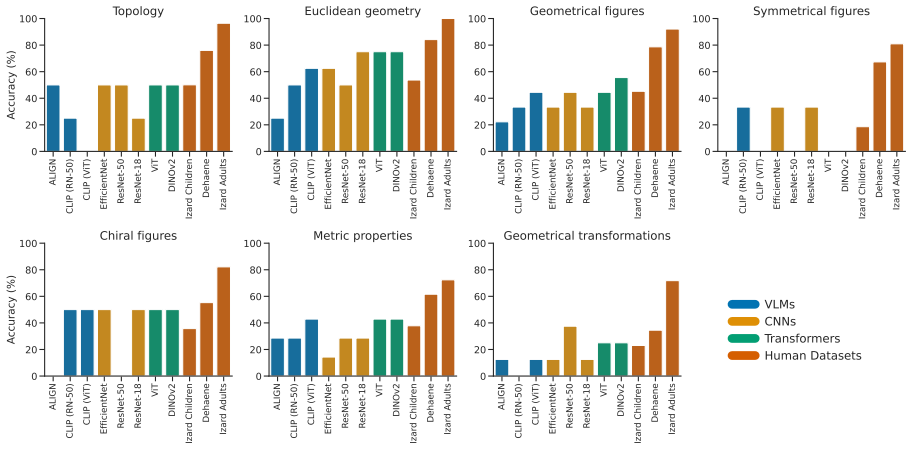
On the 43-concept, seven-class odd-one-out stimuli originally designed to test non-schooled humans, the paper reports that transformer-based vision models, especially DINOv2 (48.89% accuracy) and ViT (46.67%), surpass the 37.72% overall accuracy of the published 3–6-year-old children sample, while remaining far below the adult samples (65.34% and 85.10%). The transformers' class-level accuracy profiles align with the children's profiles at r = 0.93 and r = 0.91, the highest alignment of any model class tested. Contrastively trained vision-language models — CLIP with ResNet or ViT backbones, and ALIGN — show lower accuracy (33.33–37.78% for CLIP, 24.44% for ALIGN, the latter not above chance) and weaker human alignment, which the paper interprets as evidence that text-image contrastive alignment can impair the formation of abstract geometric representations. These results are framed as supporting the 'learning for free' account of geometric and topological concepts: sensitivity need not be innate because it can be acquired through large-scale visual pretraining, and the transformer-child correlation points to these models as candidate cognitive and developmental models.
Load-bearing premise
The whole comparison rests on treating 'the image with the lowest average pairwise cosine similarity in the final hidden layer' as the model's odd-one-out answer; if that probe does not track perceptual oddity on these exact stimuli, the model accuracies, the child-surpassing result, and the alignment correlations lose their meaning.
Editorial extensions
If this is right
- Transformer models clear the child benchmark for the first time in this paradigm: they are as accurate or more accurate than 3–6-year-olds on all 7 concept classes, not just overall.
- The strong child-profile correlations (r > 0.90) make transformer encoders plausible computational models for studying how geometric sensitivity develops over training, through representation-level analyses rather than behavior alone.
- The VLM result undercuts the naive expectation from dual-coding theory that adding language should help: contrastive image-text training at current scale appears to reduce sensitivity to abstract geometric and topological concepts.
- Because transformers were trained on much larger image corpora than CNNs, the accuracy gain is consistent with a scale-driven learning account, though the paper does not isolate architecture from data size.
- The common easy/hard ordering — Euclidean geometry easiest, transformations and symmetry hardest — suggests graded continuity between human and model GT sensitivity, with Symmetrical Figures as a clear remaining gap.
Reading between the lines
- A stricter test of the learning-for-free claim would replace the zero-shot cosine probe with a linear readout trained on one set of GT concepts and tested on held-out concepts; if sensitivity dissolves under that probe, the current accuracy may reflect the probe rather than the representation.
- The r-values are computed on only 7 class means; correlating model and child accuracy at the level of the 43 individual concepts would be a harder, more diagnostic alignment test.
- The VLM deficit is confounded with training data: CLIP and ALIGN were trained on natural image-caption pairs, so a vision-only encoder trained on the same image collections would be needed to separate the effect of modality alignment from data distribution.
- One testable extension is to track DINOv2's class-level accuracy during training; if Euclidean geometry sensitivity emerges before transformation sensitivity in the same order as in children, the developmental-alignment claim would gain direct support.
Signed reviews
Editorial analysis
A structured set of objections, weighed in public.
Referee Report
Summary. The paper evaluates eight pretrained computer vision models (three CNNs, two transformers, three VLMs) on the 43-concept odd-one-out battery of Dehaene et al. (2006), using a deterministic decision rule: the image with the lowest average pairwise cosine similarity in the final hidden layer is chosen as the odd-one-out. It compares model accuracy and class-level accuracy profiles (seven GT classes) against published human data from Dehaene et al. (2006), Izard and Spelke (2009) children and adults. The main empirical claims are that DINOv2 (48.89%) and ViT (46.67%) surpass Izard-Spelke children (37.72%), that their class-accuracy profiles correlate with children's at r > 0.90, and that VLMs underperform both CNNs and transformers. These findings are interpreted as evidence that GT concepts can be learned from visual experience, contrary to the core-knowledge account, and that current text-image alignment harms abstract geometric sensitivity.
Significance. If the decision rule validly operationalizes human odd-one-out judgments, the results are theoretically significant: they provide a sufficiency argument that abstract geometric and topological sensitivity can arise from large-scale visual pretraining, without innate dedicated GT circuitry, and they extend prior CNN-only findings to transformer and VLM classes. The paper's strengths are its use of external human benchmarks, publicly available models, and a fully specified parameter-free evaluation protocol that is easy to reproduce. The strongest evidence is the transformer-children class-profile alignment, but its statistical basis is thin (seven class means, one with three concepts), and the VLM/architecture comparisons are confounded. The central claims therefore require additional validation and re-analysis rather than being unfixable.
major comments (5)
- [Evaluation on Neural Models] The odd-one-out decision rule is never validated against human perceptual judgments on these stimuli. The rule selects the image with the lowest average pairwise cosine similarity in the final hidden layer; because the stimulus set deliberately varies low-level visual features across the six images, the selected image could be an outlier in color, texture, or orientation rather than in the intended geometric/topological concept. Since the overall accuracy comparison in Figure 2 and the class-profile alignment in Figure 4 are both computed from this rule, its construct validity is load-bearing for the paper's main claims. Please provide stimulus-level validation of the rule (e.g., human similarity ratings for the six-image sets, alternative similarity metrics, or an analysis of which images are selected and why), and report how the headline results change with the choice of representation layer or pooling.
- [Results, Overall sensitivity (Figure 2)] The claim that transformers surpass young children is not significance-tested. DINOv2's 48.89% is 21/43 correct and ViT's 46.67% is 20/43; the Izard-Spelke children's 37.72% is an aggregate of participant-level accuracy. With 43 binary trials per model, the standard error of a model proportion near 0.5 is roughly 7.6 percentage points, so the reported gap of about 11 points between DINOv2 and the children is well within the range that could arise by chance when the variance of the child sample is also considered. Please report a statistical test that accounts for item-level and participant-level variation (e.g., bootstrap over stimuli and children, or a mixed-effects model), and adjust the abstract's 'surpassing' wording accordingly.
- [Results, Alignment to human profiles (Figure 4)] The alignment correlations are computed on only seven class means, and one class (Symmetrical Figures) contains just three stimuli, a limitation the manuscript itself notes in 'Sensitivity by class.' With n=7, the 95% confidence interval for r=0.91 is wide, and a single noisy class mean can move the correlation substantially. The 'strong alignment' claim should be supported by per-concept correlations or by bootstrap/jackknife intervals over the 43 stimuli, and ideally by a weighting of classes by their item counts.
- [Table 1 and Discussion] The attribution of model-class differences to architecture or to language supervision is confounded. The VLMs differ from vision-only models in architecture, parameter count, training dataset size, and supervised vs self-supervised objective, in addition to the contrastive text-image loss; the transformers differ from CNNs in architecture, dataset scale, and label/no-label training. The Discussion's claim that 'modality alignment with text reduces the sensitivity to GT concepts' is therefore not supported by the present design. Please either run controlled comparisons (e.g., a ViT with and without language supervision, trained on comparable data) or re-frame these conclusions explicitly as hypotheses.
- [Discussion, 'Transformer models show higher sensitivity to GT concepts'] The inferential leap from 'trained on large image datasets' to 'learned for free through everyday interaction' is not justified. The CNNs were trained with ImageNet-1k human class labels, which are a form of explicit supervision rather than unsupervised everyday experience; even the self-supervised DINOv2 was trained on LVD-142M, a curated dataset of internet images with statistics very different from a child's visual environment. Because the paper's title and abstract frame the result as evidence against the core-knowledge account, the authors should state explicitly which training regimes they consider proxies for 'free' learning, or restrict the conclusion to 'can arise from large-scale visual pretraining.'
minor comments (6)
- [Abstract] Typo: 'computer visions models' should be 'computer vision models.'
- [Discussion, 'Transformers show higher sensitivity to GT concepts'] Typo: 'for two reason' should be 'for two reasons.'
- [Discussion, 'From cognitive alignment to developmental alignment'] Typo: 'the Transformer models and and the young children' contains a duplicated 'and.'
- [Results, 'Alignment to human profiles'] In the text, 'CLIP (RN5-50)' should be 'CLIP (RN-50).'
- [Evaluation on Neural Models] The description of the final hidden layer is not architecture-specific enough for reproduction: for ViT/DINOv2, is the representation the [CLS] token, a mean over patch tokens, or the pre-logits pooled feature? For CNNs, is it the global average pooled feature map? Please specify the exact layer and pooling for each of the eight models.
- [Figure 4] The significance asterisks in the heatmap are uncorrected across 24 correlations (8 models x 3 human datasets); please report adjusted p-values or note that the pairwise p-values are uncorrected.
Circularity Check
No material circularity: the paper compares fixed pretrained models against externally published human benchmarks, and no fitted parameter is renamed as a prediction.
full rationale
The paper's central claims are empirical comparisons rather than derivations: pretrained models produce final-layer representations, a fixed cosine-similarity rule selects the odd-one-out, and the resulting accuracies are compared with human data from Dehaene et al. (2006) and Izard and Spelke (2009). No parameter is fitted to the human data, and the model scores are not defined in terms of the human targets, so the child-surpassing result and the alignment correlations cannot be true by construction. The cosine-similarity operationalization is an unvalidated assumption about perceptual oddity, but that is a validity threat, not a circularity. The one self-referential element is the citation of the authors' own prior work, Upadhyay et al. (2025), for the evaluation method and for the 'learned for free' framing; this citation is not load-bearing because the evaluation procedure is fully described in the present paper and the decisive benchmarks are external human datasets. The paper also explicitly flags the small number of concepts in the Symmetrical Figures class when interpreting that class-level pattern. No circular derivation, fitted-input-called-prediction step, or self-citation chain is present.
Assumptions & free parameters
assumptions (4)
- domain assumption The 43 stimulus items of the Dehaene et al. odd-one-out battery validly measure sensitivity to their corresponding GT concepts.
- domain assumption Lowest mean pairwise cosine similarity in the final hidden layer captures perceptual oddity in these stimuli.
- domain assumption Human accuracies from the three published studies are comparable to each other and to the model evaluation despite different task formats and samples.
- ad hoc to paper Pretrained models trained on large labeled or self-supervised image datasets (ImageNet-21k, LVD-142M) can stand in for learning 'for free' through everyday interaction with the environment.
Cite this review
Pith. "Pith review of Computer Vision Models Show Human-Like Sensitivity to Geometric and Topological Concepts." pith.science (2026). https://pith.science/paper/KO2WQJ4A
@misc{pith2026250513281,
  author       = {Pith},
  title        = {Pith review of: Computer Vision Models Show Human-Like Sensitivity to Geometric and Topological Concepts},
  year         = {2026},
  howpublished = {\url{https://pith.science/paper/KO2WQJ4A}},
  note         = {Machine review of arXiv:2505.13281}
}
read the original abstract
With the rapid improvement of machine learning (ML) models, cognitive scientists are increasingly asking about their alignment with how humans think. Here, we ask this question for computer vision models and human sensitivity to geometric and topological (GT) concepts. Under the core knowledge account, these concepts are innate and supported by dedicated neural circuitry. In this work, we investigate an alternative explanation, that GT concepts are learned ``for free'' through everyday interaction with the environment. We do so using computer visions models, which are trained on large image datasets. We build on prior studies to investigate the overall performance and human alignment of three classes of models -- convolutional neural networks (CNNs), transformer-based models, and vision-language models -- on an odd-one-out task testing 43 GT concepts spanning seven classes. Transformer-based models achieve the highest overall accuracy, surpassing that of young children. They also show strong alignment with children's performance, finding the same classes of concepts easy vs. difficult. By contrast, vision-language models underperform their vision-only counterparts and deviate further from human profiles, indicating that na\"ive multimodality might compromise abstract geometric sensitivity. These findings support the use of computer vision models to evaluate the sufficiency of the learning account for explaining human sensitivity to GT concepts, while also suggesting that integrating linguistic and visual representations might have unpredicted deleterious consequences.
Figures


Figures from the paper (1 more)

Reference graph
Works this paper leans on
-
[1]
write newline
" write newline " cite write " FUNCTION editor.postfix editor num.names #1 > "( )" "( )" if FUNCTION editor.trans.postfix editor num.names #1 > "( )" "( )" if FUNCTION trans.postfix translator num.names #1 > "( )" "( )" if FUNCTION authors.editors.reflist.apa5 'field := 'dot := field num.names 'numnames := numnames 'format.num.names := format.num.names na...
-
[2]
ahn2024largelanguagemodelsmathematical APACrefauthors Ahn, J. , Verma, R. , Lou, R. , Liu, D. , Zhang, R. \ Yin, W. APACrefauthors \ 2024 . Large Language Models for Mathematical Reasoning: Progresses and Challenges. Large language models for mathematical reasoning: Progresses and challenges. APACrefURL https://arxiv.org/abs/2402.00157 APACrefURL
arXiv 2024
- [3]
-
[4]
Human-Like Geometric Abstraction in Large Pre-trained Neural Networks
campbell2024humanlikegeometricabstractionlarge APACrefauthors Campbell, D. , Kumar, S. , Giallanza, T. , Griffiths, T L. \ Cohen, J D. APACrefauthors \ 2024 . Human-Like Geometric Abstraction in Large Pre-trained Neural Networks. Human-like geometric abstraction in large pre-trained neural networks. APACrefURL https://arxiv.org/abs/2402.04203 APACrefURL
work page Pith review arXiv 2024
-
[5]
chang2022word APACrefauthors Chang, T A. \ Bergen, B K. APACrefauthors \ 2022 . Word acquisition in neural language models Word acquisition in neural language models . Transactions of the Association for Computational Linguistics 10 1--16
work page 2022
-
[6]
Chiandetti2007 APACrefauthors Chiandetti, C. \ Vallortigara, G. APACrefauthors \ 2007 07 . Is there an innate geometric module? Effects of experience with angular geometric cues on spatial re-orientation based on the shape of the environment Is there an innate geometric module? effects of experience with angular geometric cues on spatial re-orientation ba...
-
[7]
conwell2022testingrelationalunderstandingtextguided APACrefauthors Conwell, C. \ Ullman, T. APACrefauthors \ 2022 . Testing Relational Understanding in Text-Guided Image Generation. Testing relational understanding in text-guided image generation. APACrefURL https://arxiv.org/abs/2208.00005 APACrefURL
arXiv 2022
-
[8]
cordonnier2020relationshipselfattentionconvolutionallayers APACrefauthors Cordonnier, J B. , Loukas, A. \ Jaggi, M. APACrefauthors \ 2020 . On the Relationship between Self-Attention and Convolutional Layers. On the relationship between self-attention and convolutional layers. APACrefURL https://arxiv.org/abs/1911.03584 APACrefURL
arXiv 2020
Show all 49 references
-
[9]
, Cavicchi, S
De_Cesarei2021-gk APACrefauthors De Cesarei, A. , Cavicchi, S. , Cristadoro, G. \ Lippi, M. APACrefauthors \ 2021 06 . Do humans and deep convolutional neural networks use visual information similarly for the categorization of natural scenes? Do humans and deep convolutional n...
2021
-
[10]
, Izard, V
Dehaene2006 APACrefauthors Dehaene, S. , Izard, V. , Pica, P. \ Spelke, E. APACrefauthors \ 2006 01 . Core Knowledge of Geometry in an Amazonian Indigene Group Core knowledge of geometry in an amazonian indigene group . Science 311 5759 381–384 . APACrefURL http://dx.doi.org/1...
2006 doi
-
[11]
, Dong, W
imagenet APACrefauthors Deng, J. , Dong, W. , Socher, R. , Li, L J. , Li, K. \ Fei-Fei, L. APACrefauthors \ 2009 . ImageNet: A large-scale hierarchical image database Imagenet: A large-scale hierarchical image database . 2009 IEEE Conference on Computer Vision and Pattern Reco...
2009
-
[12]
, Beyer, L
dosovitskiy2021imageworth16x16words APACrefauthors Dosovitskiy, A. , Beyer, L. , Kolesnikov, A. , Weissenborn, D. , Zhai, X. , Unterthiner, T. Houlsby, N. APACrefauthors \ 2021 . An Image is Worth 16x16 Words: Transformers for Image Recognition at Scale. An image is worth 16x1...
2021 arXiv
-
[13]
, Lakretz, Y
evanson2023languageacquisitionchildrenlanguage APACrefauthors Evanson, L. , Lakretz, Y. \ King, J R. APACrefauthors \ 2023 . Language acquisition: do children and language models follow similar learning stages? Language acquisition: do children and language models follow simil...
2023 arXiv
-
[14]
APACrefauthors \ 1979
Gibson1979TheEA APACrefauthors Gibson, J J. APACrefauthors \ 1979 . The Ecological Approach to Visual Perception The ecological approach to visual perception . . APACrefURL https://api.semanticscholar.org/CorpusID:33656271 APACrefURL
1979
-
[15]
, Zhang, X
he2015deepresiduallearningimage APACrefauthors He, K. , Zhang, X. , Ren, S. \ Sun, J. APACrefauthors \ 2015 . Deep Residual Learning for Image Recognition. Deep residual learning for image recognition. APACrefURL https://arxiv.org/abs/1512.03385 APACrefURL
2015 arXiv
-
[16]
he2023hitombenchmarkevaluatinghigherorder APACrefauthors He, Y. , Wu, Y. , Jia, Y. , Mihalcea, R. , Chen, Y. \ Deng, N. APACrefauthors \ 2023 . HI-TOM: A Benchmark for Evaluating Higher-Order Theory of Mind Reasoning in Large Language Models. Hi-tom: A benchmark for evaluating...
2023 arXiv
-
[17]
hsu2022geoclideanfewshotgeneralizationeuclidean APACrefauthors Hsu, J. , Wu, J. \ Goodman, N D. APACrefauthors \ 2022 . Geoclidean: Few-Shot Generalization in Euclidean Geometry. Geoclidean: Few-shot generalization in euclidean geometry. APACrefURL https://arxiv.org/abs/2211.1...
2022 arXiv
-
[18]
\ Spelke, E S
Izard2009-ok APACrefauthors Izard, V. \ Spelke, E S. APACrefauthors \ 2009 01 . Development of sensitivity to geometry in visual forms Development of sensitivity to geometry in visual forms . Hum. Evol. 23 3 213--248
2009
-
[19]
, Pramod, R T
Jacob2021-ek APACrefauthors Jacob, G. , Pramod, R T. , Katti, H. \ Arun, S P. APACrefauthors \ 2021 03 . Qualitative similarities and differences in visual object representations between brains and deep networks Qualitative similarities and differences in visual object represe...
2021
-
[20]
, Simonyan, K
jaderberg2016spatialtransformernetworks APACrefauthors Jaderberg, M. , Simonyan, K. , Zisserman, A. \ Kavukcuoglu, K. APACrefauthors \ 2016 . Spatial Transformer Networks. Spatial transformer networks. APACrefURL https://arxiv.org/abs/1506.02025 APACrefURL
2016 arXiv
-
[21]
, Yang, Y
jia2021scalingvisualvisionlanguagerepresentation APACrefauthors Jia, C. , Yang, Y. , Xia, Y. , Chen, Y T. , Parekh, Z. , Pham, H. Duerig, T. APACrefauthors \ 2021 . Scaling Up Visual and Vision-Language Representation Learning With Noisy Text Supervision. Scaling up visual and...
2021 arXiv
-
[22]
jin2024exploringconceptdepthlarge APACrefauthors Jin, M. , Yu, Q. , Huang, J. , Zeng, Q. , Wang, Z. , Hua, W. Zhang, Y. APACrefauthors \ 2024 . Exploring Concept Depth: How Large Language Models Acquire Knowledge at Different Layers? Exploring concept depth: How large language...
2024 arXiv
-
[23]
, Kim, D
jung2024perceptionsbeliefsexploringprecursory APACrefauthors Jung, C. , Kim, D. , Jin, J. , Kim, J. , Seonwoo, Y. , Choi, Y. Kim, H. APACrefauthors \ 2024 . Perceptions to Beliefs: Exploring Precursory Inferences for Theory of Mind in Large Language Models. Perceptions to beli...
2024 arXiv
-
[24]
, Sutskever, I
NIPS2012_c399862d APACrefauthors Krizhevsky, A. , Sutskever, I. \ Hinton, G E. APACrefauthors \ 2012 . ImageNet Classification with Deep Convolutional Neural Networks Imagenet classification with deep convolutional neural networks . F. Pereira, C. Burges, L. Bottou \ K. Weinbe...
2012
-
[25]
, Savinov, N
laptev2016tipoolingtransformationinvariantpoolingfeature APACrefauthors Laptev, D. , Savinov, N. , Buhmann, J M. \ Pollefeys, M. APACrefauthors \ 2016 . TI-POOLING: transformation-invariant pooling for feature learning in Convolutional Neural Networks. Ti-pooling: transformati...
2016 arXiv
-
[26]
APACrefauthors \ 2021 09
Lindsay_2021 APACrefauthors Lindsay, G W. APACrefauthors \ 2021 09 . Convolutional Neural Networks as a Model of the Visual System: Past, Present, and Future Convolutional neural networks as a model of the visual system: Past, present, and future . Journal of Cognitive Neurosc...
2021 doi
-
[27]
, Pan, J
ma2023world APACrefauthors Ma, Z. , Pan, J. \ Chai, J. APACrefauthors \ 2023 . World-to-Words: Grounded Open Vocabulary Acquisition through Fast Mapping in Vision-Language Models World-to-words: Grounded open vocabulary acquisition through fast mapping in vision-language model...
2023
-
[28]
, Sansom, J
ma2024holisticlandscapesituatedtheory APACrefauthors Ma, Z. , Sansom, J. , Peng, R. \ Chai, J. APACrefauthors \ 2024 . Towards A Holistic Landscape of Situated Theory of Mind in Large Language Models. Towards a holistic landscape of situated theory of mind in large language mo...
2024 arXiv
-
[29]
, Wang, Z
ma2024babysitlanguagemodelscratch APACrefauthors Ma, Z. , Wang, Z. \ Chai, J. APACrefauthors \ 2024 . Babysit A Language Model From Scratch: Interactive Language Learning by Trials and Demonstrations. Babysit a language model from scratch: Interactive language learning by tria...
2024 arXiv
-
[30]
\ Varma, S
Marupudi2023 APACrefauthors Marupudi, V. \ Varma, S. APACrefauthors \ 2023 03 . Graded human sensitivity to geometric and topological concepts Graded human sensitivity to geometric and topological concepts . Cognition 232 105331 . APACrefURL http://dx.doi.org/10.1016/j.cogniti...
2023
-
[31]
\ Mumuni, F
Mumuni2021 APACrefauthors Mumuni, A. \ Mumuni, F. APACrefauthors \ 2021 06 . CNN Architectures for Geometric Transformation-Invariant Feature Representation in Computer Vision: A Review Cnn architectures for geometric transformation-invariant feature representation in computer...
2021 doi
-
[32]
, Dippel, J
muttenthaler2023human APACrefauthors Muttenthaler, L. , Dippel, J. , Linhardt, L. , Vandermeulen, R A. \ Kornblith, S. APACrefauthors \ 2023 May . Human alignment of neural network representations Human alignment of neural network representations . 11th International Conferenc...
2023
-
[33]
, Linhardt, L
muttenthaler2023improving APACrefauthors Muttenthaler, L. , Linhardt, L. , Dippel, J. , Vandermeulen, R A. , Hermann, K. , Lampinen, A. \ Kornblith, S. APACrefauthors \ 2023 . Improving neural network representations using human similarity judgments Improving neural network re...
2023
-
[34]
, Darcet, T
oquab2024dinov2learningrobustvisual APACrefauthors Oquab, M. , Darcet, T. , Moutakanni, T. , Vo, H. , Szafraniec, M. , Khalidov, V. Bojanowski, P. APACrefauthors \ 2024 . DINOv2: Learning Robust Visual Features without Supervision. Dinov2: Learning robust visual features witho...
2024 arXiv
-
[35]
APACrefauthors \ 1991 09
Paivio1991 APACrefauthors Paivio, A. APACrefauthors \ 1991 09 . Dual coding theory: Retrospect and current status. Dual coding theory: Retrospect and current status. Canadian Journal of Psychology / Revue canadienne de psychologie 45 3 255–287 . APACrefURL http://dx.doi.org/10...
1991 doi
-
[36]
\ Connor, C E
Pasupathy1999 APACrefauthors Pasupathy, A. \ Connor, C E. APACrefauthors \ 1999 11 . Responses to Contour Features in Macaque Area V4 Responses to contour features in macaque area v4 . Journal of Neurophysiology 82 5 2490–2502 . APACrefURL http://dx.doi.org/10.1152/jn.1999.82....
1999 doi
-
[37]
APACrefauthors \ 2022
portelance2022neural APACrefauthors Portelance, E. APACrefauthors \ 2022 . Neural Network Approaches to the Study of Word Learning Neural network approaches to the study of word learning . , Stanford University
2022
-
[38]
, Kim, J W
radford2021learningtransferablevisualmodels APACrefauthors Radford, A. , Kim, J W. , Hallacy, C. , Ramesh, A. , Goh, G. , Agarwal, S. Sutskever, I. APACrefauthors \ 2021 . Learning Transferable Visual Models From Natural Language Supervision. Learning transferable visual model...
2021 arXiv
-
[39]
, Unterthiner, T
raghu2022visiontransformerslikeconvolutional APACrefauthors Raghu, M. , Unterthiner, T. , Kornblith, S. , Zhang, C. \ Dosovitskiy, A. APACrefauthors \ 2022 . Do Vision Transformers See Like Convolutional Neural Networks? Do vision transformers see like convolutional neural net...
2022 arXiv
-
[40]
, Ellis, K
sablemeyer2022language APACrefauthors Sable-Meyer, M. , Ellis, K. , Tenenbaum, J. \ Dehaene, S. APACrefauthors \ 2022 . A language of thought for the mental representation of geometric shapes A language of thought for the mental representation of geometric shapes . Cognitive P...
2022
-
[41]
, Cogswell, M
Selvaraju_2019 APACrefauthors Selvaraju, R R. , Cogswell, M. , Das, A. , Vedantam, R. , Parikh, D. \ Batra, D. APACrefauthors \ 2019 10 . Grad-CAM: Visual Explanations from Deep Networks via Gradient-Based Localization Grad-cam: Visual explanations from deep networks via gradi...
2019 doi
-
[42]
, Marupudi, V
shah2023humanbehavioralbenchmarkingnumeric APACrefauthors Shah, R S. , Marupudi, V. , Koenen, R. , Bhardwaj, K. \ Varma, S. APACrefauthors \ 2023 . Human Behavioral Benchmarking: Numeric Magnitude Comparison Effects in Large Language Models. Human behavioral benchmarking: Nume...
2023 arXiv
-
[43]
APACrefauthors \ 1994 03
Shepard1994 APACrefauthors Shepard, R N. APACrefauthors \ 1994 03 . Perceptual-cognitive universals as reflections of the world Perceptual-cognitive universals as reflections of the world . Psychonomic Bulletin &; Review 1 1 2–28 . APACrefURL http://dx.doi.org/10.3758/BF032007...
1994 doi
-
[44]
\ Zisserman, A
simonyan2015deepconvolutionalnetworkslargescale APACrefauthors Simonyan, K. \ Zisserman, A. APACrefauthors \ 2015 . Very Deep Convolutional Networks for Large-Scale Image Recognition. Very deep convolutional networks for large-scale image recognition. APACrefURL https://arxiv....
2015 arXiv
-
[45]
\ Kinzler, K D
Spelke2007 APACrefauthors Spelke, E S. \ Kinzler, K D. APACrefauthors \ 2007 01 . Core knowledge Core knowledge . Developmental Science 10 1 89–96 . APACrefURL http://dx.doi.org/10.1111/j.1467-7687.2007.00569.x APACrefURL APACrefDOI doi:10.1111/j.1467-7687.2007.00569.x APACrefDOI
2007
-
[46]
\ Le, Q V
tan2020efficientnetrethinkingmodelscaling APACrefauthors Tan, M. \ Le, Q V. APACrefauthors \ 2020 . EfficientNet: Rethinking Model Scaling for Convolutional Neural Networks. Efficientnet: Rethinking model scaling for convolutional neural networks. APACrefURL https://arxiv.org/...
2020 arXiv
-
[47]
, Marupudi, V
upadhyay2025alignment APACrefauthors Upadhyay, N. , Marupudi, V. , Varma, K. \ Varma, S. APACrefauthors \ 2025 February . Alignment of CNN and human judgments of geometric and topological concepts Alignment of cnn and human judgments of geometric and topological concepts . Pro...
2025
-
[48]
APACrefauthors \ 2018 01
Vallortigara2018 APACrefauthors Vallortigara, G. APACrefauthors \ 2018 01 . Comparative cognition of number and space: the case of geometry and of the mental number line Comparative cognition of number and space: the case of geometry and of the mental number line . Philosophic...
2018
-
[49]
, Shah, R S
vemuri2024deeplearningmodelscapture APACrefauthors Vemuri, S K. , Shah, R S. \ Varma, S. APACrefauthors \ 2024 . How Well Do Deep Learning Models Capture Human Concepts? The Case of the Typicality Effect. How well do deep learning models capture human concepts? the case of the...
2024 arXiv
Reviewed August 15, 2026 · model on record in the stance chip above.
Discussion (0). Continue with ORCID to comment.