REVIEW 3 major objections 5 minor 1 cited by
KHRONOS: a Kernel-Based Neural Architecture for Rapid, Resource-Efficient Scientific Computation
T0 review · 3 major / 5 minor · reviewed 2026-08-15 · deepseek-v4-flash
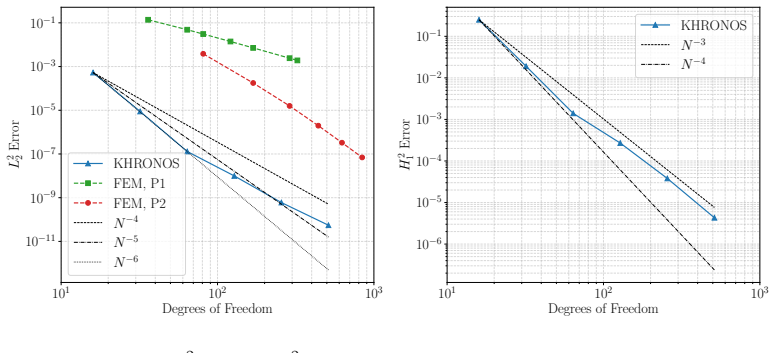
Pith's one-line read The paper argues that KHRONOS, a sum of tensorized per-coordinate B-spline modes, solves a 2D Poisson benchmark down to $6\times10^{-11}$ squared L2 error at 512 degrees of freedom, while also handling regression and batch inversion.
desk verdict The 20D noisy-regression headline is mathematically impossible under the paper's own noise model; the separable Poisson core is plausible but the empirical evidence as presented does not support the claimed gains. read the letter →
The pith
A machine-rendered reading of the paper's core claim, the machinery that carries it, and where it could break.
The reading
What carries the argument
The load-bearing object is a mode: each input coordinate $x_p$ passes through $L$ stacked kernel-expansion layers using quadratic B-spline kernels with compact support, producing a scalar feature $f_p^{(L)}(x_p)$; a mode multiplies one such feature per coordinate, $M_j(x)=\prod_p f_{p,j}^{(L)}(x_p)$, and the surrogate is $\hat u(x)=\sum_j M_j(x)$. Because each mode is a product of one-dimensional functions, integrals of $\hat u$ and its derivatives factor into products of one-dimensional inner products, which become entries of Gram matrices $G, G', H, H'$ and cross matrices $A, B$. This separability is what carries the argument: it turns the 2D variational energy into a trace formula and reduces the cost from $O(n^2)$ to roughly $O(n_{\mathrm{gauss}}n_e(2M^2+MN))$ with $n_{\mathrm{gauss}}, n_e, M, N \ll n$.
What would settle it
Re-run the 20D Sobol-G benchmark with $\sigma=0.01$ noise explicitly added to both training and test targets; if the test MSE is reproducibly below $10^{-4}$, the reported protocol is inconsistent. Separately, solve the 2D Poisson problem with a non-separable source such as $f(x,y)=\exp(xy)$ and check whether the pre-asymptotic $\mathrm{DoF}^{-6}$ scaling still appears or falls back to $\mathrm{DoF}^{-4}$.
Extended reading notes
Core claim
The central discovery is that hierarchical composition of per-dimension B-spline expansions, combined across dimensions by tensor products and superposed over a small number of modes, yields a differentiable surrogate with a favorable accuracy-versus-complexity tradeoff. The paper argues that because each mode is separable, the variational energy for a 2D Poisson problem collapses to Gram-matrix traces, $\tfrac12(\operatorname{tr}(G'^T H)+\operatorname{tr}(H'^T G))-\operatorname{tr}(A^T B)$, reducing the integral cost from $O(n^2)$ to $O(n_{\mathrm{gauss}}n_e(2M^2+MN))$. This lets KHRONOS reach squared L2 errors of $5\times10^{-4}$ at 16 degrees of freedom and $6\times10^{-11}$ at 512, with empirical scaling laws of approximately $\mathrm{DoF}^{-6}$ pre-asymptotically and $\mathrm{DoF}^{-4}$ asymptotically. The paper further claims the same architecture achieves $R^2=0.9994$ on a noisy 20D Sobol-G benchmark with 1560 parameters and enables batched Gauss-Newton inversion at sub-microsecond per-sample latency.
Load-bearing premise
The load-bearing premise is that the 20D noisy-regression protocol is internally consistent: with additive Gaussian noise of $\sigma=0.01$ in the targets, the best possible test MSE is $10^{-4}$, yet the paper reports $6.8\times10^{-7}$, so either the held-out labels were not corrupted or the reported number is misstated.
Editorial extensions
If this is right
- The same architecture can serve as a forward PDE solver, a supervised regression model, and an inverse solver, so a single differentiable representation could replace separate pipelines in control and monitoring applications.
- If the Poisson error scaling holds, high accuracy becomes available at hundreds rather than thousands or millions of parameters, making full-field prediction feasible on constrained hardware.
- Batched Gauss-Newton inversion at sub-microsecond per-sample latency would bring level-set recovery into real-time, online regimes for problems such as shape recovery and inverse design.
- The claimed model-free results suggest that tensorized kernel modes can reach high $R^2$ with an order of magnitude fewer parameters than tree ensembles and MLPs on moderate-dimensional benchmarks.
Reading between the lines
- Editorial inference: the steep pre-asymptotic $\mathrm{DoF}^{-6}$ rate is probably tied to the benchmark's exact separability, $\sin(\pi x)\sin(\pi y^2)$; on non-separable fields the generic $\mathrm{DoF}^{-4}$ rate is the likely ceiling.
- Editorial inference: if the noisy-regression result survives a corrected noise protocol, the architecture behaves like a low-rank tensor decomposition of high-dimensional functions, so its real utility may lie in problems with moderate intrinsic dimensionality.
- Editorial inference: a direct stress test is to replace the Poisson source with a non-separable function and to add noise to held-out test labels in the Sobol-G benchmark; both are cheap experiments that would separate the architecture's generic properties from benchmark-specific ones.
Signed reviews
Editorial analysis
A structured set of objections, weighed in public.
Referee Report
Summary. The paper introduces KHRONOS, a kernel-based surrogate architecture that projects each input dimension through hierarchical B-spline kernel expansions, combines them via tensor products into modes, and superposes the modes. The authors evaluate KHRONOS on three task classes: model-free regression (8D borehole and 20D noisy Sobol-G), model-based PDE solving (2D Poisson via a Galerkin/energy-minimization loss), and model inversion (batched Gauss-Newton level-set recovery). The main claims are that KHRONOS achieves L2-square errors from 5e-4 to 6e-11 on the Poisson benchmark with 16 to 512 degrees of freedom, outperforming KAN and linear FEM by orders of magnitude, and that it reaches near-perfect accuracy on the 20D noisy regression benchmark while using fewer parameters than baselines.
Significance. If the results were reproducible, the architecture would be an interesting contribution to scientific machine learning: the Galerkin-style variational training with hierarchical B-spline bases is principled, and the emphasis on parameter efficiency and fast inference is timely. The 2D Poisson energy-minimization derivation is internally coherent, and the batch-inversion procedure is a natural use of the differentiable surrogate. However, the high-dimensional regression result is mathematically impossible under the stated protocol, the baseline comparisons are not reimplemented or statistically characterized, and the absence of code and data makes verification difficult. These issues undermine the paper's central claims as presented.
major comments (3)
- [Section 3.1.2, Eqs. (51)-(52), Table 2] The reported KHRONOS test MSE of 6.8e-7 is below the irreducible noise floor sigma^2 = 1e-4. Since the test targets are stated to be the noisy outputs unoisy = u(p) + epsilon, epsilon ~ N(0, 0.01^2), the expected test MSE of any predictor is at least sigma^2 = 1e-4 (because E[(f(p) - u_noisy)^2] = E[(f(p) - u(p))^2] + sigma^2). Thus the value 6.8e-7 is impossible if the protocol was followed. Moreover, the reported R2 = 0.9994 is inconsistent with this MSE: the Sobol-G function has variance considerably larger than 1e-3, so an MSE of 6.8e-7 would imply R2 much closer to 1. The authors must either clarify that the test labels were not corrupted, re-run the experiment with the stated protocol, or correct the numbers; no code or data are provided to disambiguate. This invalidates the model-free high-dimensional claim in the abstract and conclusions.
- [Section 3.2, Table 3 and Figure 4] The headline comparisons against KAN and FEM are not reimplemented or described with sufficient detail. The text states that KAN 'constructed with the same second order b-splines' achieves certain scalings, and Figure 4 includes P1/P2 FEM curves, but the manuscript does not specify how these baselines were configured, how the degrees of freedom were matched, whether the results are from the authors' own runs or cited from the literature, or what error bars or repeated trials were used. Without this information, the claimed '>100-fold gain over KAN' and '1e6-fold improvement over FEM' cannot be independently verified, and the lack of error bars makes it impossible to assess statistical significance of the scaling laws.
- [Section 3.1.1, text and Table 1] The text claims that 'KHRONOS achieved an R2-score of 0.9935 with as few as 64 trainable parameters,' but Table 1 reports a KHRONOS configuration with 240 parameters and test R2 = 0.9998, and no 64-parameter result is shown. This is an unsupported claim; the reader cannot tell which configuration corresponds to the 64-parameter model, what the test error was, or why it is omitted from the table.
minor comments (5)
- [Section 2.2.1] The heading 'Forward Propogation' contains a typo; it should read 'Forward Propagation'.
- [Section 7 Acknowledgments] The sentence 'S. Saha gratefully acknowledges the start-up fund provided by the by the Kevin T. Crofton Department...' contains a duplicated 'by the'.
- [Section 2.2.2] The complexity expression O(ngaussne(2M2 +MN)) is written without a space and the symbol n is not defined; please clarify what n represents and use consistent notation (e.g., O(n_gauss n_e (2M^2 + MN))).
- [Table 3] The column headers 'Epoch Time (µs) Inference (µs)' are ambiguous because the table body appears to interleave time and error values in a way that is difficult to parse; please reformat the table so that each column has a clear header and the numerical entries are unambiguous.
- [Throughout] The manuscript does not include a data availability or code availability statement, which is important given that the central regression result appears to violate the stated protocol and no implementation is provided for verification.
Circularity Check
No significant circularity: the central PDE, regression, and inversion benchmarks are evaluated against externally fixed targets, and self-citations are contextual rather than load-bearing.
full rationale
The paper's derivation chain is self-contained with respect to its benchmarks. In the model-based Poisson section, the exact solution u(x,y)=sin(pi x) sin(pi y^2) is prescribed externally (Section 3.2), the source f is derived analytically from that solution, the energy functional (Eq. 55) is a standard variational formulation, and the reported L2^2 and H1^2 errors are measured against that fixed exact solution. No fitted parameter is recycled as a prediction: the B-spline weights are trained by minimizing the energy, and accuracy is then assessed against the known solution. The claimed scaling laws (DoF^-6, DoF^-4, DoF^-3) are empirical observations from an external benchmark, not consequences of the ansatz's definition. The 8D borehole and 20D Sobol-G model-free comparisons use fixed analytic functions (Eqs. 38 and 48) and held-out data; the architecture itself does not encode these target functions. The inversion section trains a surrogate on an externally defined toy function (Eq. 56) and then inverts it; this is a standard forward-surrogate-plus-optimizer evaluation. The self-citations to HIDeNN and INN (Refs. 17 and 18) are architectural context and analogies, not mathematical premises that force the reported accuracy. No uniqueness theorem is imported from the authors' prior work to forbid alternative models, and no ansatz is smuggled in via citation: the per-dimension quadratic B-spline expansion is stated directly in Section 2.1. The only notable issue is a correctness/consistency problem rather than circularity: Eq. (52) sets sigma=0.01 for the noisy 20D targets, giving an irreducible test-MSE floor of 1e-4, while Table 2 reports KHRONOS test MSE 6.8e-7, which cannot be achieved under the written protocol. This makes the 20D claim internally inconsistent, but it is not an instance of a fitted input being renamed as a prediction or of the derivation reducing to its own inputs. Accordingly, no circular step is established, and the appropriate score is 0.
Assumptions & free parameters
free parameters (5)
- Number of B-spline elements per dimension (N_e^p) =
varies: 4 per dimension for borehole, 40 for 20D Sobol-G, and values corresponding to 16-512 total DoF for Poisson
- Number of superposition modes (J) =
3 for borehole, 1 for 20D Sobol-G, implied by DoF counts for Poisson
- Hierarchical layer depth (L) =
not reported for the experiments
- Gauss-Legendre quadrature points (n_gauss) =
not reported
- Optimizer and learning-rate schedule =
Adam with cosine schedule 0.15 to 0.05 for 20D; Adam 0.001 for MLP baseline
assumptions (4)
- standard math The energy functional for the Poisson benchmark has a unique minimizer in H1_0 by the Direct Method.
- domain assumption The source term f in the benchmark is separable, reducing the energy to Gram-matrix traces.
- standard math Quadratic B-spline basis functions are C1 and in H1, making the ansatz admissible for the variational Poisson formulation.
- domain assumption The learned surrogate is continuously differentiable, so Gauss-Newton updates in Eq. (37) are well defined.
Cite this review
Pith. "Pith review of KHRONOS: a Kernel-Based Neural Architecture for Rapid, Resource-Efficient Scientific Computation." pith.science (2026). https://pith.science/paper/6DKD6U4G
@misc{pith2026250513315,
  author       = {Pith},
  title        = {Pith review of: KHRONOS: a Kernel-Based Neural Architecture for Rapid, Resource-Efficient Scientific Computation},
  year         = {2026},
  howpublished = {\url{https://pith.science/paper/6DKD6U4G}},
  note         = {Machine review of arXiv:2505.13315}
}
read the original abstract
Contemporary models of high dimensional physical systems are constrained by the curse of dimensionality and a reliance on dense data. We introduce KHRONOS (Kernel Expansion Hierarchy for Reduced Order, Neural Optimized Surrogates), an AI framework for model based, model free and model inversion tasks. KHRONOS constructs continuously differentiable target fields with a hierarchical composition of per-dimension kernel expansions, which are tensorized into modes and then superposed. We evaluate KHRONOS on a canonical 2D, Poisson equation benchmark: across 16 to 512 degrees of freedom (DoFs), it obtained L_2-square errors of 5e-4 down to 6e-11. This represents a greater than 100-fold gain over Kolmogorov Arnold Networks (which itself reports a 100 times improvement on MLPs/PINNs with 100 times fewer parameters) when controlling for the number of parameters. This also represents a 1e6-fold improvement in L_2-square error compared to standard linear FEM at comparable DoFs. Inference complexity is dominated by inner products, yielding sub-millisecond full-field predictions that scale to an arbitrary resolution. For inverse problems, KHRONOS facilitates rapid, iterative level set recovery in only a few forward evaluations, with sub-microsecond per sample latency. KHRONOS's scalability, expressivity, and interpretability open new avenues in constrained edge computing, online control, computer vision, and beyond.
Figures


Figures from the paper (2 more)

Forward citations
Cited by 1 Pith paper
-
Agile Reinforcement Learning through Separable Neural Architecture and Applications
SPAN, a KHRONOS-derived spline network with a learnable preprocessing layer, reports better sample efficiency and success rates than small MLPs across several RL benchmarks, though the abstract overclaims and omits th...
Reference graph
Works this paper leans on
-
[1]
Frank Rosenblatt. The perceptron: a probabilistic model for information storage and organiza- tion in the brain.Psychological review, 65(6):386, 1958
work page 1958
-
[2]
Machine learning: Trends, perspectives, and prospects
Michael I Jordan and Tom M Mitchell. Machine learning: Trends, perspectives, and prospects. Science, 349(6245):255–260, 2015
2015
-
[3]
Scientific machine learning through physics–informed neural networks: Where we are and what’s next.Journal of Scientific Computing, 92(3):88, 2022
Salvatore Cuomo, Vincenzo Schiano Di Cola, Fabio Giampaolo, Gianluigi Rozza, Maziar Raissi, and Francesco Piccialli. Scientific machine learning through physics–informed neural networks: Where we are and what’s next.Journal of Scientific Computing, 92(3):88, 2022
2022
-
[4]
Promising directions of machine learning for partial differential equations.Nature Computational Science, 4(7):483–494, 2024
Steven L Brunton and J Nathan Kutz. Promising directions of machine learning for partial differential equations.Nature Computational Science, 4(7):483–494, 2024
2024
-
[5]
Backpropagation applied to handwritten zip code recognition
Yann LeCun, Bernhard Boser, John S Denker, Donnie Henderson, Richard E Howard, Wayne Hubbard, and Lawrence D Jackel. Backpropagation applied to handwritten zip code recognition. Neural computation, 1(4):541–551, 1989
1989
-
[6]
Learning internal representa- tions by error propagation, 1985
David E Rumelhart, Geoffrey E Hinton, Ronald J Williams, et al. Learning internal representa- tions by error propagation, 1985
work page 1985
-
[7]
Attention is all you need.Advances in neural information processing systems, 30, 2017
Ashish Vaswani, Noam Shazeer, Niki Parmar, Jakob Uszkoreit, Llion Jones, Aidan N Gomez, Łukasz Kaiser, and Illia Polosukhin. Attention is all you need.Advances in neural information processing systems, 30, 2017
2017
-
[8]
Maziar Raissi, Paris Perdikaris, and George E Karniadakis. Physics-informed neural networks: A deep learning framework for solving forward and inverse problems involving nonlinear partial differential equations.Journal of Computational physics, 378:686–707, 2019
2019
Show all 24 references
-
[9]
Green ai.Communications of the ACM, 63(12):54–63, 2020
Roy Schwartz, Jesse Dodge, Noah A Smith, and Oren Etzioni. Green ai.Communications of the ACM, 63(12):54–63, 2020
2020
-
[10]
Kafnets: Kernel-based non-parametric activation functions for neural networks.Neural Networks, 110:19– 32, 2019
Simone Scardapane, Steven Van Vaerenbergh, Simone Totaro, and Aurelio Uncini. Kafnets: Kernel-based non-parametric activation functions for neural networks.Neural Networks, 110:19– 32, 2019
2019
-
[11]
Kernel methods match deep neural networks on timit
Po-Sen Huang, Haim Avron, Tara N Sainath, Vikas Sindhwani, and Bhuvana Ramabhadran. Kernel methods match deep neural networks on timit. In2014 IEEE international conference on acoustics, speech and signal processing (ICASSP), pages 205–209. IEEE, 2014. 12
2014
-
[12]
When do neural networks outperform kernel methods?Advances in Neural Information Processing Systems, 33:14820–14830, 2020
Behrooz Ghorbani, Song Mei, Theodor Misiakiewicz, and Andrea Montanari. When do neural networks outperform kernel methods?Advances in Neural Information Processing Systems, 33:14820–14830, 2020
2020
-
[13]
Neural tangent kernel beyond the infinite-width limit: Effects of depth and initialization
Mariia Seleznova and Gitta Kutyniok. Neural tangent kernel beyond the infinite-width limit: Effects of depth and initialization. InInternational Conference on Machine Learning, pages 19522–19560. PMLR, 2022
2022
-
[14]
Kan 2.0: Kolmogorov-arnold networks meet science.arXiv preprint arXiv:2408.10205, 2024
Ziming Liu, Pingchuan Ma, Yixuan Wang, Wojciech Matusik, and Max Tegmark. Kan 2.0: Kolmogorov-arnold networks meet science.arXiv preprint arXiv:2408.10205, 2024
2024 arXiv
-
[15]
Ginn-kan: Inter- pretability pipelining with applications in physics informed neural networks.arXiv preprint arXiv:2408.14780, 2024
Nisal Ranasinghe, Yu Xia, Sachith Seneviratne, and Saman Halgamuge. Ginn-kan: Inter- pretability pipelining with applications in physics informed neural networks.arXiv preprint arXiv:2408.14780, 2024
2024 arXiv
-
[16]
Can kan cans? input-convex kolmogorov-arnold networks (kans) as hyperelastic constitutive artificial neural networks (cans).arXiv preprint arXiv:2503.05617, 2025
Prakash Thakolkaran, Yaqi Guo, Shivam Saini, Mathias Peirlinck, Benjamin Alheit, and Sid- dhant Kumar. Can kan cans? input-convex kolmogorov-arnold networks (kans) as hyperelastic constitutive artificial neural networks (cans).arXiv preprint arXiv:2503.05617, 2025
2025 arXiv
-
[17]
Hierarchical deep learning neural network (hidenn): an artificial intelligence (ai) framework for computational science and engineering
Sourav Saha, Zhengtao Gan, Lin Cheng, Jiaying Gao, Orion L Kafka, Xiaoyu Xie, Hengyang Li, Mahsa Tajdari, H Alicia Kim, and Wing Kam Liu. Hierarchical deep learning neural network (hidenn): an artificial intelligence (ai) framework for computational science and engineering. Co...
2021
-
[18]
Bessa, Dong Qian, Wei Chen, Gregory J
Chanwook Park, Sourav Saha, Jiachen Guo, Hantao Zhang, Xiaoyu Xie, Miguel A. Bessa, Dong Qian, Wei Chen, Gregory J. Wagner, Jian Cao, and Wing Kam Liu. Interpolating neural network: A novel unification of machine learning and interpolation theory.arXiv preprint, arXiv:2404.10296, 2024
2024 arXiv
-
[19]
Springer, 2nd edition, 1997
Les Piegl and Wayne Tiller.The NURBS Book. Springer, 2nd edition, 1997
1997
-
[20]
John Wiley & Sons, 2000
Roger Fletcher.Practical methods of optimization. John Wiley & Sons, 2000
2000
-
[21]
Random forests.Machine learning, 45:5–32, 2001
Leo Breiman. Random forests.Machine learning, 45:5–32, 2001
2001
-
[22]
Xgboost: A scalable tree boosting system
Tianqi Chen and Carlos Guestrin. Xgboost: A scalable tree boosting system. InProceedings of the 22nd acm sigkdd international conference on knowledge discovery and data mining, pages 785–794, 2016
2016
-
[23]
Hou, Marin Solja ˇci´c, and Max Tegmark
Ziming Liu, Yixuan Wang, Sachin Vaidya, Fabian Ruehle, James Halverson, Thomas Y . Hou, Marin Solja ˇci´c, and Max Tegmark. Kolmogorov–arnold networks (kan).Preprint, 2024. arXiv:2404.19756
2024 arXiv
-
[24]
World Scientific, 2003
Enrico Giusti.Direct methods in the calculus of variations. World Scientific, 2003. 13
2003
Reviewed August 15, 2026 · model on record in the stance chip above.
Discussion (0). Continue with ORCID to comment.