REVIEW 4 major objections 6 minor 41 references
Self-Reasoning Language Models: Unfold Hidden Reasoning Chains with Few Reasoning Catalyst
T0 review · 4 major / 6 minor · reviewed 2026-08-07 · deepseek-v4-flash
Pith's one-line read Self-Reasoning Language Models use 1,000 seed catalyst rationales to teach a model to expand its own reasoning chains and iteratively self-improve, gaining about 2.5 points on average across five benchmarks.
desk verdict A coherent self-improvement recipe with plausible gains, but the evaluation is best-of-five, single-seed, and the selectors assume unverified labels are correct. read the letter →
The pith
A machine-rendered reading of the paper's core claim, the machinery that carries it, and where it could break.
The reading
On five benchmarks (MMLU, GSM8K, ARC-C, HellaSwag, and BBH), the authors report that the best iteration across five rounds beats a GPT-4o-generated baseline by about 2.5 points on average for Llama3.1-8B and Mistral-7B. They also show that if you sample up to 64 candidate answers at inference and take the best, the gap grows.
This is a plausible way to make small models improve without a stronger teacher at every step. The main caveats are that the reported gain is the best of five iterations, no error bars are given, and the selection rules assume the original answers are correct.
Extended reading notes
Core claim
The paper's central claim, stated in the abstract, is that SRLM 'achieves an average absolute improvement of more than +2.5 points across five reasoning tasks: MMLU, GSM8K, ARC-C, HellaSwag, and BBH on two backbone models' and that with 64 sampling times it reaches an average improvement of +7.89. Section 4.2 further claims that 'small-size SRLMs can generate better instruction-tuning samples than GPT-4o.' If correct, a 7B or 8B model can self-improve on general instruction-following data using only 1,000 catalyst examples and iterative self-generated rationales.
Load-bearing premise
The original instruction-tuning answers y_i are correct, so the off-policy and on-policy selectors in Section 3.2.2 (Eq. 3) can use P(y_i | x_i, r_i) as a quality signal. The paper never verifies these answers. If they contain errors, the selectors will preferentially keep rationales that lead to the wrong answer, and the iterative loop will reinforce those errors. This assumption is load-bearing because the entire selection mechanism reduces to scoring rationales against unverified labels.
Editorial analysis
A structured set of objections, weighed in public.
Referee Report
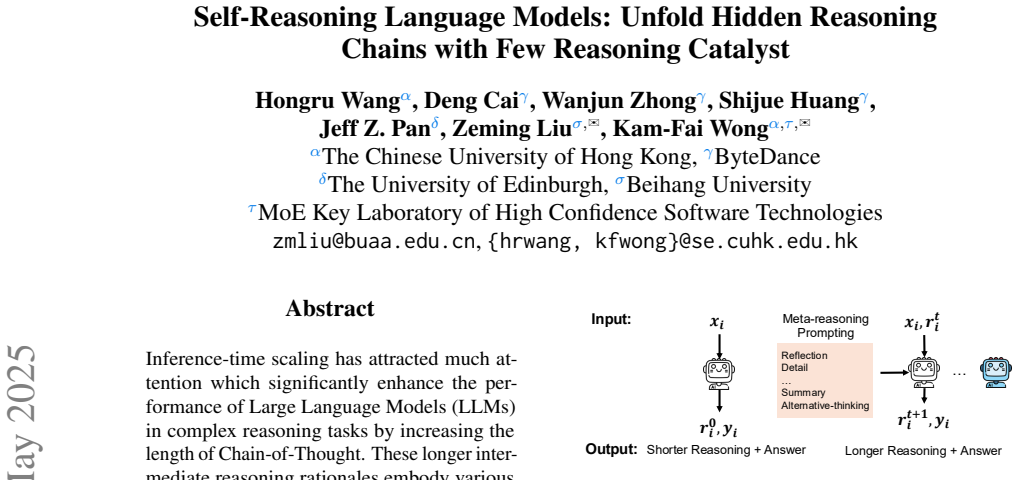
Summary. The paper proposes Self-Reasoning Language Models (SRLM), an iterative self-training procedure for instruction-tuned models. Starting from a base model and an instruction-tuning dataset whose responses are synthesized by GPT-4o (Magpie data refined by reflection-tuning), the authors add 1,000 'reasoning catalyst' samples that demonstrate how to expand a short chain of thought into a longer one using meta-reasoning skills. The model is fine-tuned on the original data plus catalyst data, then iteratively generates enriched rationales for every instruction, selects among the old and new rationales using one of three selectors (length, off-policy likelihood, on-policy likelihood), and retrains from the base model on the selected data plus the fixed catalyst data. The method is evaluated on MMLU, GSM8K, ARC-C, HellaSwag, and BBH with Llama3.1-8B and Mistral-7B. The abstract claims an average absolute improvement of more than +2.5 points over baselines and a +7.89 average improvement with 64 sampling times. The paper also reports win-rate improvements on Arena-Hard and Alpaca Eval and additional experiments on Alpaca data and Qwen2.5-14B.
Significance. If the central claims held, the contribution would be valuable: it suggests that a small base model can bootstrap its own reasoning quality using only a tiny amount of teacher-generated catalyst data, without per-iteration access to a stronger model and without verifiable answers. The catalyst idea, the simple selectors, and the extensive ablation study (catalyst size, new/updated catalyst, effect of iterations) are well chosen and useful for the community. The paper also provides detailed per-iteration tables and a non-cherry-picked case study, which aid reproducibility. However, the current evidence is not yet convincing because the selection mechanism is built on unverified synthetic labels, the headline numbers are the best over five iterations without variance or a clearly specified significance test, and the best-of-N evaluation protocol is not described. These issues are fixable within the scope of the manuscript, so the work is worth pursuing after major revision.
major comments (4)
- [§3.2.2, Eq. (3); §4.1] The off-policy and on-policy selectors in Eq. (3) choose the rationale r_j that maximizes P(y_i | x_i, r_j), thereby treating the original answer y_i as ground truth. Section 4.1 constructs D0 by taking 50k Magpie samples and reflecting them with GPT-4o; these y_i are synthetic and unverified. If y_i is incorrect, the selectors will preferentially retain rationales that rationalize the wrong answer, and because every iteration retrains on the same y_i, errors can be reinforced. This directly affects Section 4.2's claim that small SRLMs 'generate better instruction-tuning samples than GPT-4o': as written, the evidence supports only 'better at reproducing the original labels,' not 'better at producing correct reasoning.' The authors should report a label-quality audit for D0 (e.g., human or LLM-judge error rates, agreement analysis) and, ideally, an error analysis of the rationales selected at each iteration.
- [Figure 4 caption; §4.2] The headline '+2.5 points' result is the best performance over five iterations for each selector, as stated in the Figure 4 caption. No variance or multiple-seed numbers are reported, and the only significance statement is a single clause, 'p < 0.05,' with no description of the test, the pairing, the number of runs, or multiple-comparison correction. Since Figure 6 shows non-monotonic trajectories and degradation for all selectors, the abstract's phrase 'more stable and consistent improvements in subsequent iterations' is not supported by the evidence presented. Please report mean and standard deviation over seeds, full per-iteration results, and a clearly specified significance test.
- [§5.1, Figure 5, Table 12] The best-of-N inference-time comparison does not specify how the 'best' answer is selected from N samples. If the evaluation uses an oracle that picks the correct sample, the comparison is not a realistic inference-time scaling method, and the +7.89 average improvement claim would be overstated. If the selection uses majority voting, confidence, or some other criterion, that procedure must be described, because the Table 12 numbers (e.g., MMLU 96.15 at 64 samples) depend critically on this protocol. Please state the selection rule and, ideally, compare it with standard self-consistency or verifier-based selection.
- [§5.2, Figure 6, Table 7] The abstract and Section 4.2 claim stable and consistent improvements across iterations, but Figure 6 and Table 7 show that all three selectors degrade at later iterations on both backbone models; for example, the Llama3.1-8B length selector reaches its best average of 56.96 at M3 and then declines to 55.07 at M5. The explanation that the number of selected samples decreases is plausible but is not tested. The authors should either qualify the stability claim to the first several iterations or provide a controlled experiment that links the sample-count decrease to the performance decline.
minor comments (6)
- [Abstract; §3.2.1; §4.1] The paper repeatedly states that the reasoning catalyst data is 'only 0.02%' of the training data, but 1,000 samples out of 50,000 is 2%, not 0.02%. This numerical error should be corrected in the abstract, the contributions, and the method section.
- [§4.1] There is a typo: 'tasks necessniate complex reasoning' should be 'tasks necessitate complex reasoning.' Also, the acronym 'Reflect-tuning' appears once where 'Reflection-tuning' is used elsewhere.
- [Figure 3] The legend text contains broken mathematical notation: 'pof f' should be 'p_off' and 'pon' should be 'p_on.' Please use consistent subscript notation.
- [Limitations] The Limitations section contains a typo: 'acorss' should be 'across.'
- [Table 8] In the Qwen2.5-14B row, the ARC-C value for IT2 is given as '67..65', which is a typo and should be a single number.
- [§5.1] The fitted logarithmic functions in Appendix A.2 are reported without any goodness-of-fit measures or confidence intervals; adding R² would help the reader assess the claim that SRLM has a larger logarithmic coefficient.
Assumptions & free parameters
free parameters (3)
- Reasoning catalyst dataset size =
1,000 samples (0.02% of training data)
- Number of sampling attempts N =
5 (main experiments), up to 64 in analysis
- Maximum number of iterations =
5
assumptions (5)
- domain assumption The original instruction-tuning answers y_i are correct and can be used to score rationales.
- domain assumption Longer rationales are better proxies for reasoning quality.
- domain assumption A 1,000-sample catalyst teaches generalizable meta-reasoning skills.
- domain assumption Downstream benchmark accuracy is a faithful measure of instruction-following improvement.
- domain assumption Self-generated data does not suffer from model collapse over iterations.
Cite this review
Pith. "Pith review of Self-Reasoning Language Models: Unfold Hidden Reasoning Chains with Few Reasoning Catalyst." pith.science (2026). https://pith.science/paper/Q26KVSYF
@misc{pith2026250514116,
  author       = {Pith},
  title        = {Pith review of: Self-Reasoning Language Models: Unfold Hidden Reasoning Chains with Few Reasoning Catalyst},
  year         = {2026},
  howpublished = {\url{https://pith.science/paper/Q26KVSYF}},
  note         = {Machine review of arXiv:2505.14116}
}
abstract
Inference-time scaling has attracted much attention which significantly enhance the performance of Large Language Models (LLMs) in complex reasoning tasks by increasing the length of Chain-of-Thought. These longer intermediate reasoning rationales embody various meta-reasoning skills in human cognition, such as reflection and decomposition, being difficult to create and acquire. In this work, we introduce \textit{Self-Reasoning Language Model} (SRLM), where the model itself can synthesize longer CoT data and iteratively improve performance through self-training. By incorporating a few demonstration examples (i.e., 1,000 samples) on how to unfold hidden reasoning chains from existing responses, which act as a reasoning catalyst, we demonstrate that SRLM not only enhances the model's initial performance but also ensures more stable and consistent improvements in subsequent iterations. Our proposed SRLM achieves an average absolute improvement of more than $+2.5$ points across five reasoning tasks: MMLU, GSM8K, ARC-C, HellaSwag, and BBH on two backbone models. Moreover, it brings more improvements with more times of sampling during inference, such as absolute $+7.89$ average improvement with $64$ sampling times, revealing the in-depth, diverse and creative reasoning paths in SRLM against the strong baseline.
Figures


Figures from the paper (6 more)


Reference graph
Works this paper leans on
-
[1]
Yinlam Chow, Guy Tennenholtz, Izzeddin Gur, Vincent Zhuang, Bo Dai, Sridhar Thiagarajan, Craig Boutilier, Rishabh Agarwal, Aviral Kumar, and Aleksandra Faust. 2024. https://arxiv.org/abs/2412.15287 Inference-aware fine-tuning for best-of-n sampling in large language models . Preprint, arXiv:2412.15287
arXiv 2024
-
[2]
Peter Clark, Isaac Cowhey, Oren Etzioni, Tushar Khot, Ashish Sabharwal, Carissa Schoenick, and Oyvind Tafjord. 2018. https://arxiv.org/abs/1803.05457 Think you have solved question answering? try arc, the ai2 reasoning challenge . Preprint, arXiv:1803.05457
arXiv 2018
-
[3]
Karl Cobbe, Vineet Kosaraju, Mohammad Bavarian, Mark Chen, Heewoo Jun, Lukasz Kaiser, Matthias Plappert, Jerry Tworek, Jacob Hilton, Reiichiro Nakano, Christopher Hesse, and John Schulman. 2021. https://arxiv.org/abs/2110.14168 Training verifiers to solve math word problems . Preprint, arXiv:2110.14168
arXiv 2021
-
[4]
DeepSeek-AI, Daya Guo, Dejian Yang, Haowei Zhang, Junxiao Song, Ruoyu Zhang, Runxin Xu, Qihao Zhu, Shirong Ma, Peiyi Wang, Xiao Bi, Xiaokang Zhang, Xingkai Yu, Yu Wu, Z. F. Wu, Zhibin Gou, Zhihong Shao, Zhuoshu Li, Ziyi Gao, Aixin Liu, Bing Xue, Bingxuan Wang, Bochao Wu, Bei Feng, Chengda Lu, Chenggang Zhao, Chengqi Deng, Chenyu Zhang, Chong Ruan, Damai D...
arXiv 2025
-
[5]
Yiwen Ding, Zhiheng Xi, Wei He, Zhuoyuan Li, Yitao Zhai, Xiaowei Shi, Xunliang Cai, Tao Gui, Qi Zhang, and Xuanjing Huang. 2024. https://arxiv.org/abs/2411.00750 Mitigating tail narrowing in llm self-improvement via socratic-guided sampling . Preprint, arXiv:2411.00750
arXiv 2024
-
[6]
Hanze Dong, Wei Xiong, Deepanshu Goyal, Yihan Zhang, Winnie Chow, Rui Pan, Shizhe Diao, Jipeng Zhang, Kashun Shum, and Tong Zhang. 2023. Raft: Reward ranked finetuning for generative foundation model alignment. arXiv preprint arXiv:2304.06767
arXiv 2023
-
[7]
Vanessa Dye. 2011. Reflection, reflection, reflection. i’m thinking all the time, why do i need a theory or model of reflection?’. Developing Reflective Practice: A guide for beginning teachers. Maidenhead: McGraw-Hill Education, pages 217--234
work page 2011
-
[8]
Gerd Gigerenzer. 1991. From tools to theories: A heuristic of discovery in cognitive psychology. Psychological review, 98(2):254
work page 1991
Show all 41 references
-
[9]
Aaron Grattafiori, Abhimanyu Dubey, Abhinav Jauhri, Abhinav Pandey, and Abhishek Kadian et al. 2024. https://arxiv.org/abs/2407.21783 The llama 3 herd of models . Preprint, arXiv:2407.21783
2024 arXiv
-
[10]
Patrick Haluptzok, Matthew Bowers, and Adam Tauman Kalai. 2022. Language models can teach themselves to program better. arXiv preprint arXiv:2207.14502
2022 arXiv
-
[11]
Dan Hendrycks, Collin Burns, Steven Basart, Andy Zou, Mantas Mazeika, Dawn Song, and Jacob Steinhardt. 2021. https://arxiv.org/abs/2009.03300 Measuring massive multitask language understanding . Preprint, arXiv:2009.03300
2021 arXiv
-
[12]
Minda Hu, Qiyuan Zhang, Yufei Wang, Bowei He, Hongru Wang, Jingyan Zhou, Liangyou Li, Yasheng Wang, Chen Ma, and Irwin King. 2024. https://arxiv.org/abs/2412.16686 Nile: Internal consistency alignment in large language models . Preprint, arXiv:2412.16686
2024
-
[13]
Jiaxin Huang, Shixiang Gu, Le Hou, Yuexin Wu, Xuezhi Wang, Hongkun Yu, and Jiawei Han. 2023. https://doi.org/10.18653/v1/2023.emnlp-main.67 Large language models can self-improve . In Proceedings of the 2023 Conference on Empirical Methods in Natural Language Processing, pages...
2023 doi
-
[14]
Albert Q. Jiang, Alexandre Sablayrolles, Arthur Mensch, Chris Bamford, Devendra Singh Chaplot, Diego de las Casas, Florian Bressand, Gianna Lengyel, Guillaume Lample, Lucile Saulnier, Lélio Renard Lavaud, Marie-Anne Lachaux, Pierre Stock, Teven Le Scao, Thibaut Lavril, Thomas ...
2023 arXiv
-
[15]
Philip Nicholas Johnson-Laird. 1988. The computer and the mind: An introduction to cognitive science. Harvard University Press
1988
-
[16]
Ming Li, Lichang Chen, Jiuhai Chen, Shwai He, Jiuxiang Gu, and Tianyi Zhou. 2024 a . https://doi.org/10.18653/v1/2024.findings-acl.958 Selective reflection-tuning: Student-selected data recycling for LLM instruction-tuning . In Findings of the Association for Computational Lin...
2024 doi
-
[17]
Gonzalez, and Ion Stoica
Tianle Li, Wei-Lin Chiang, Evan Frick, Lisa Dunlap, Tianhao Wu, Banghua Zhu, Joseph E. Gonzalez, and Ion Stoica. 2024 b . https://arxiv.org/abs/2406.11939 From crowdsourced data to high-quality benchmarks: Arena-hard and benchbuilder pipeline . Preprint, arXiv:2406.11939
2024 arXiv
-
[18]
Hashimoto
Xuechen Li, Tianyi Zhang, Yann Dubois, Rohan Taori, Ishaan Gulrajani, Carlos Guestrin, Percy Liang, and Tatsunori B. Hashimoto. 2023. Alpacaeval: An automatic evaluator of instruction-following models. https://github.com/tatsu-lab/alpaca_eval
2023
-
[19]
Jianqiao Lu, Zhiyang Dou, WANG Hongru, Zeyu Cao, Jianbo Dai, Yunlong Feng, and Zhijiang Guo. 2024. Autopsv: Automated process-supervised verifier. In The Thirty-eighth Annual Conference on Neural Information Processing Systems
2024
-
[20]
OpenAI. 2024. https://openai.com/index/learning-to-reason-with-llms/ Learning to reason with llms
2024
-
[21]
Baolin Peng, Chunyuan Li, Pengcheng He, Michel Galley, and Jianfeng Gao. 2023. https://arxiv.org/abs/2304.03277 Instruction tuning with gpt-4 . Preprint, arXiv:2304.03277
2023 arXiv
-
[22]
Qwen. 2024. https://qwenlm.github.io/blog/qwq-32b-preview/ Qwq: Reflect deeply on the boundaries of the unknown . Accessed: 2025-02-01
2024
-
[23]
Mirac Suzgun, Nathan Scales, Nathanael Sch \"a rli, Sebastian Gehrmann, Yi Tay, Hyung Won Chung, Aakanksha Chowdhery, Quoc V Le, Ed H Chi, Denny Zhou, , and Jason Wei. 2022. Challenging big-bench tasks and whether chain-of-thought can solve them. arXiv preprint arXiv:2210.09261
2022 arXiv
-
[24]
Hashimoto
Rohan Taori, Ishaan Gulrajani, Tianyi Zhang, Yann Dubois, Xuechen Li, Carlos Guestrin, Percy Liang, and Tatsunori B. Hashimoto. 2023. Stanford alpaca: An instruction-following llama model. https://github.com/tatsu-lab/stanford_alpaca
2023
-
[25]
Pan, and Kam-Fai Wong
Hongru Wang, Yujia Qin, Yankai Lin, Jeff Z. Pan, and Kam-Fai Wong. 2024 a . https://doi.org/10.1145/3626772.3661381 Empowering large language models: Tool learning for real-world interaction . In Proceedings of the 47th International ACM SIGIR Conference on Research and Develo...
2024
-
[26]
Hongru Wang, Huimin Wang, Lingzhi Wang, Minda Hu, Rui Wang, Boyang Xue, Yongfeng Huang, and Kam-Fai Wong. 2024 b . https://doi.org/10.1007/978-981-97-9434-8_22 Tpe: Towards better compositional reasoning over cognitive tools via multi-persona collaboration . In Natural Languag...
2024 doi
-
[27]
Hongru Wang, Rui Wang, Fei Mi, Yang Deng, Zezhong Wang, Bin Liang, Ruifeng Xu, and Kam-Fai Wong. 2023 a . https://doi.org/10.18653/v1/2023.findings-emnlp.806 Cue- C o T : Chain-of-thought prompting for responding to in-depth dialogue questions with LLM s . In Findings of the A...
2023 doi
-
[28]
Hongru Wang, Boyang Xue, Baohang Zhou, Tianhua Zhang, Cunxiang Wang, Huimin Wang, Guanhua Chen, and Kam-Fai Wong. 2025 a . https://aclanthology.org/2025.naacl-long.331/ Self- DC : When to reason and when to act? self divide-and-conquer for compositional unknown questions . In ...
2025
-
[29]
Xuezhi Wang, Jason Wei, Dale Schuurmans, Quoc Le, Ed Chi, Sharan Narang, Aakanksha Chowdhery, and Denny Zhou. 2023 b . https://arxiv.org/abs/2203.11171 Self-consistency improves chain of thought reasoning in language models . Preprint, arXiv:2203.11171
2023 arXiv
-
[30]
Yizhong Wang, Yeganeh Kordi, Swaroop Mishra, Alisa Liu, Noah A Smith, Daniel Khashabi, and Hannaneh Hajishirzi. 2023 c . Self-instruct: Aligning language models with self-generated instructions. In Proceedings of the 61st Annual Meeting of the Association for Computational Lin...
2023
-
[31]
Yizhong Wang, Swaroop Mishra, Pegah Alipoormolabashi, Yeganeh Kordi, Amirreza Mirzaei, Atharva Naik, Arjun Ashok, Arut Selvan Dhanasekaran, Anjana Arunkumar, David Stap, Eshaan Pathak, Giannis Karamanolakis, Haizhi Lai, Ishan Purohit, Ishani Mondal, Jacob Anderson, Kirby Kuzni...
2022
-
[32]
Yue Wang, Qiuzhi Liu, Jiahao Xu, Tian Liang, Xingyu Chen, Zhiwei He, Linfeng Song, Dian Yu, Juntao Li, Zhuosheng Zhang, Rui Wang, Zhaopeng Tu, Haitao Mi, and Dong Yu. 2025 b . https://arxiv.org/abs/2501.18585 Thoughts are all over the place: On the underthinking of o1-like llm...
2025 arXiv
-
[33]
Jason Wei, Xuezhi Wang, Dale Schuurmans, Maarten Bosma, Fei Xia, Ed Chi, Quoc V Le, Denny Zhou, et al. 2022. Chain-of-thought prompting elicits reasoning in large language models. Advances in neural information processing systems, 35:24824--24837
2022
-
[34]
Can Xu, Qingfeng Sun, Kai Zheng, Xiubo Geng, Pu Zhao, Jiazhan Feng, Chongyang Tao, and Daxin Jiang. 2023. https://arxiv.org/abs/2304.12244 Wizardlm: Empowering large language models to follow complex instructions . Preprint, arXiv:2304.12244
2023 arXiv
-
[35]
Zhangchen Xu, Fengqing Jiang, Luyao Niu, Yuntian Deng, Radha Poovendran, Yejin Choi, and Bill Yuchen Lin. 2024. https://arxiv.org/abs/2406.08464 Magpie: Alignment data synthesis from scratch by prompting aligned llms with nothing . Preprint, arXiv:2406.08464
2024 arXiv
-
[36]
Weizhe Yuan, Richard Yuanzhe Pang, Kyunghyun Cho, Xian Li, Sainbayar Sukhbaatar, Jing Xu, and Jason Weston. 2024. https://arxiv.org/abs/2401.10020 Self-rewarding language models . Preprint, arXiv:2401.10020
2024 arXiv
-
[37]
Rowan Zellers, Ari Holtzman, Yonatan Bisk, Ali Farhadi, and Yejin Choi. 2019. https://arxiv.org/abs/1905.07830 Hellaswag: Can a machine really finish your sentence? Preprint, arXiv:1905.07830
2019 arXiv
-
[38]
Yaowei Zheng, Richong Zhang, Junhao Zhang, Yanhan Ye, and Zheyan Luo. 2024. https://doi.org/10.18653/v1/2024.acl-demos.38 L lama F actory: Unified efficient fine-tuning of 100+ language models . In Proceedings of the 62nd Annual Meeting of the Association for Computational Lin...
2024 doi
-
[39]
Pei Zhou, Jay Pujara, Xiang Ren, Xinyun Chen, Heng-Tze Cheng, Quoc V Le, Ed H Chi, Denny Zhou, Swaroop Mishra, and Huaixiu Steven Zheng. 2024. Self-discover: Large language models self-compose reasoning structures. arXiv preprint arXiv:2402.03620
2024 arXiv
-
[40]
online" 'onlinestring :=
ENTRY address archivePrefix author booktitle chapter edition editor eid eprint eprinttype howpublished institution journal key month note number organization pages publisher school series title type volume year doi pubmed url lastchecked label extra.label sort.label short.list...
-
[41]
write newline
" write newline "" before.all 'output.state := FUNCTION n.dashify 't := "" t empty not t #1 #1 substring "-" = t #1 #2 substring "--" = not "--" * t #2 global.max substring 't := t #1 #1 substring "-" = "-" * t #2 global.max substring 't := while if t #1 #1 substring * t #2 gl...
Reviewed August 7, 2026 · model on record in the stance chip above.
Discussion (0). Continue with ORCID to comment.