REVIEW 4 major objections 6 minor 5 cited by
ThinkSwitcher: When to Think Hard, When to Think Fast
T0 review · 4 major / 6 minor · reviewed 2026-08-07 · deepseek-v4-flash
Pith's one-line read ThinkSwitcher claims that a single large reasoning model can cut inference token use by 20–30% by learning to choose between short and long chain-of-thought per question, with only a small accuracy drop.
desk verdict A clean, useful routing method with broad experiments, but the undertested query embedding and missing error bars keep the headline numbers from being fully reproducible. read the letter →
The pith
A machine-rendered reading of the paper's core claim, the machinery that carries it, and where it could break.
The reading
What carries the argument
The switching mechanism is a five-layer multi-layer perceptron (MLP) that takes the reasoning model's query embedding $x_q$ and outputs two predicted pass rates $\hat{y}_{SC}$ and $\hat{y}_{LC}$; the routing rule sends a query to long CoT only when $\hat{y}_{LC} - \hat{y}_{SC}$ exceeds a tunable threshold $\tau$. Training uses a margin-aware objective $L_{\text{switch}} = L_{\text{MSE}} + \lambda_{\text{margin}} L_{\text{margin}}$, where the margin term supervises the predicted difference directly, and the supervision targets are empirical pass rates computed from $k=8$ sampled responses per mode. The other load-bearing piece is the prompt intervention: the empty <think></think> block that elicits short CoT without modifying backbone weights.
What would settle it
On a held-out benchmark, compute the rank correlation between the switcher's predicted margin $\hat{y}_{LC} - \hat{y}_{SC}$ and the true pass-rate gap $y_{LC} - y_{SC}$; if the correlation is near zero, the router is no better than random at choosing which questions deserve long thinking. Equivalently, compare accuracy on the questions ThinkSwitcher routes to long CoT against the same number of randomly selected questions at the same token budget: if the routed subset shows no accuracy advantage, the central claim collapses.
Extended reading notes
Core claim
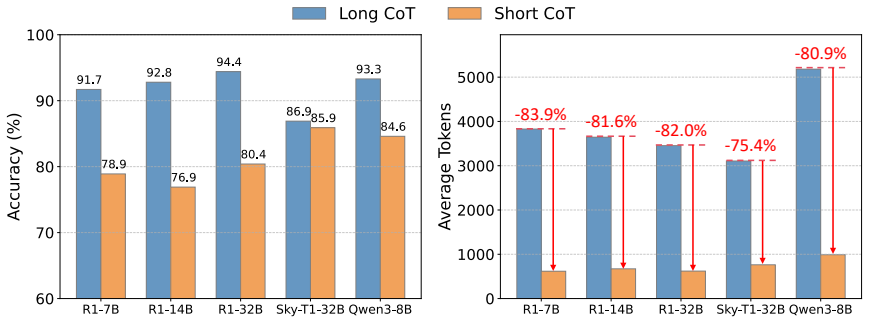
The central discovery is that a single large reasoning model can adapt its reasoning depth per query without any weight change. Short chain-of-thought is induced reliably by appending an empty think block to the prompt, and a small regressor trained on the model's own pass rates can decide between the short and long paths from the query embedding alone. The paper reports that on GSM8K, MATH-500, AIME 2024 and 2025, LiveAoPSBench, Omni-MATH-500, and the math subset of OlympiadBench, ThinkSwitcher produces a better accuracy–cost frontier than always-long, always-short, random, and BERT-based routing, cutting token counts by roughly 20–30% with a 1–2% average accuracy drop and reducing decoding FLOPs by a similar margin.
Load-bearing premise
The load-bearing premise is that the question embedding fed to the switcher carries enough information about task difficulty and the relative benefit of long versus short reasoning that the regressor's predicted pass-rate margins are trustworthy, since the paper does not specify which hidden state or pooling produces the embedding or analyze prediction failures.
Editorial extensions
If this is right
- A single model deployment can replace dual-model systems that keep one fast and one slow reasoner, removing extra memory and serving cost while keeping complex-task accuracy.
- The reported 20–30% token reduction translates to a similar reduction in decoding FLOPs, while the switcher itself adds only millions of FLOPs against trillions for decoding.
- Smaller and weaker models gain the most from switching because they are more prone to over-elaboration, so the benefit scales with deployment pressure.
- The empty-think-block prompt is a zero-training intervention that works across several reasoning-model families and can be adopted immediately as a cheap efficiency baseline.
- Because pass-rate labels come from the backbone model's own responses, the same self-supervised pipeline can regenerate training data for new benchmarks without human annotation.
Reading between the lines
- A testable consequence of the paper's design is that the ceiling of the method is set by how much difficulty information the query embedding carries; on out-of-distribution questions where that embedding is uninformative, the router should degrade toward random selection.
- The same switching idea could be carried over to code generation or agentic tasks, but the pass-rate gap between short and long reasoning will be harder to estimate there because correctness is less easily verifiable.
- The margin-aware loss suggests a general design principle for learned routers: when the decision depends on a predicted difference, the training objective should supervise that difference directly, not just its components.
- A natural extension is to use the predicted margin to interpolate reasoning effort continuously rather than choosing between two discrete modes, which could smooth the accuracy-cost frontier further.
Editorial analysis
A structured set of objections, weighed in public.
Referee Report
Summary. The paper proposes ThinkSwitcher, a framework that lets a single large reasoning model (DeepSeek-R1-Distill-Qwen-1.5B/7B/14B) dynamically choose between a long chain-of-thought (LC) and a prompt-induced short chain-of-thought (SC) mode. The core idea is to train a lightweight MLP regressor on self-supervised labels: for each training question, the pass rates of SC and LC are estimated by sampling k responses, and the regressor predicts those pass rates from a query embedding xq. At inference, LC is selected when the predicted LC pass rate exceeds the predicted SC pass rate by a tunable threshold τ. Experiments on seven math benchmarks (GSM8K, MATH500, AIME24, AIME25, LiveAoPS, Omni-MATH-500, OlympiadBench) report that ThinkSwitcher reduces average output tokens by roughly 20–30% relative to LC-Only, with a 1–2% average accuracy drop, and that it outperforms random mixing and a ModernBERT-based router on the accuracy–cost frontier. The authors also provide a prompt-design observation (empty <think> block suffices to induce short CoT), an ablation of the margin loss, an analysis of the pass-rate sampling count k, and an estimate of the switcher's negligible FLOP overhead.
Significance. If the central claims hold, ThinkSwitcher is a useful practical contribution: it addresses the overthinking problem of LRMs at inference time without backbone modification or large-scale post-training, and it introduces a margin-aware, self-supervised training objective for routing between reasoning modes. The empirical scope is real: three model sizes, seven math benchmarks, and a comparison against random and BERT-based routers. The paper is also honest about several limitations (math-only evaluation, up to 14B parameters). The strongest assets are the clean prompt-based short-CoT induction, the explicit formulation of pass-rate regression targets, and the cost-overhead table that shows the router's computational impact is negligible. However, the manuscript currently leaves a key component underspecified—the query embedding xq—and the headline numbers rest on test-set-selected thresholds without error bars, which weakens confidence in the claimed accuracy–efficiency frontier.
major comments (4)
- [§4.2] The query embedding xq is never defined: the paper says only that it is 'extracted from the reasoning model,' without specifying the hidden layer, the token position, or the pooling operation. This is the load-bearing input to the router, and the entire per-query routing claim depends on it. The authors should specify exactly how xq is computed, and provide an analysis of router prediction quality (e.g., correlation between predicted pass-rate margin and realized margin, calibration plots, and failure cases). Without this, the 20–30% token reduction at 1–2% accuracy loss cannot be attributed to learned per-query selection.
- [§5.2 and Table 1] The main results use decision thresholds τ selected on the test benchmarks themselves ('selected to achieve a favorable balance,' τ = 0.04/0.05/0.03 for 1.5B/7B/14B), while the Random baselines are fixed-probability policies that are not tuned on the test set. This asymmetry can inflate ThinkSwitcher's apparent advantage. The authors should either select τ on a held-out validation set and report the resulting test performance, or report the full τ-sweep curves with a clear statement of which operating points are chosen and how. The current presentation mixes model selection with evaluation.
- [Table 1 and §6.1] No variance or confidence intervals are reported for any accuracy or token count, and several test sets are small (e.g., AIME24/AIME25 have only 30 questions each per year). Single-run numbers on such sets can easily move by several points, and the claimed 1–2% accuracy drop and the per-benchmark token savings are not supported without error bars or multiple seeds. The authors should provide at least three independent generations per setting (or bootstrap confidence intervals) for the headline accuracy and token metrics.
- [Abstract and §7] The paper claims a general solution for 'complex tasks' and positions ThinkSwitcher as a unified LRM deployment framework, but all experiments are on mathematics benchmarks. The limitations section acknowledges this, but the abstract and conclusion do not qualify the claim. Either the scope should be explicitly narrowed in the abstract/conclusion to mathematical reasoning, or at least one non-math benchmark (e.g., code, general knowledge) should be added to support the generality.
minor comments (6)
- [Table 1] The 14B ThinkSwitcher row is garbled: '42.5 1006565.8 6018' appears to be a formatting corruption, likely splitting the AIME25 accuracy and token count. Please fix the table typesetting and verify all numbers.
- [Appendix C] The mechanism analysis (cosine similarity ranking) is presented as supporting a 'suppression-and-reversion' hypothesis, but the three similarity values 0.926, 0.919, 0.916 are extremely close and no statistical test or confidence interval is given. Please soften the causal interpretation or add a proper significance test.
- [§4.1] The labels y_m(q) are called self-supervised, but they require executing the backbone model and checking correctness of responses; this is better described as self-generated supervision rather than fully self-supervised in the usual sense. Please clarify the terminology.
- [§6.2] The margin-loss ablation in Table 2 reports only nAUC-AC. Reporting the final accuracy and token counts for λmargin ∈ {0, 1, 2} would make the effect more transparent.
- [§6.3] Figure 5 shows nAUC-AC as a function of k, but the text says 'approximately 174 at k = 1' while the figure appears to begin around 174–176. Please align the text and figure values, and state the random-seed handling for the sampled responses.
- [Appendix D] The hyperparameter search uses Ray Tune, but the final hyperparameter values (learning rate, batch size, dropout) are not reported; please list the selected configuration for reproducibility.
Circularity Check
No significant circularity: the router's self-generated labels and empirical trade-off curves do not reduce to the paper's inputs by construction.
full rationale
ThinkSwitcher's derivation is an empirical pipeline rather than a circular one. The switcher is trained to regress empirical pass rates of short-CoT and long-CoT prompted responses generated by the same backbone (Eqs. 2-3), but this self-supervised labeling scheme does not define the reported accuracy or token savings: a poor regressor would produce poor routing, so the 20-30% token reduction at 1-2% accuracy loss is a measured outcome, not a consequence of the training objective. The decision rule (Eq. 5) compares predicted pass-rate margins against a threshold, and the margin loss (Eq. 7) supervises that margin; neither equation assumes the final trade-off. The Appendix C 'mechanism' analysis is explicitly presented as a hypothesis and supported by cosine-similarity measurements, not used as a derivation. There are no load-bearing self-citations or imported uniqueness theorems; the cited prior work (e.g., Ma et al. 2025, Qwen3) is external and used for context. The main validity caveats—the unspecified query embedding xq in Section 4.2 and the test-set selection of tau in Section 5.2—are evaluation and reproducibility concerns, not circular reductions; the reported numbers could in principle have been unfavorable at the chosen operating point. The Limitations section acknowledges scope limits (math only, models up to 14B) but does not assert or conceal a definitional dependency. Overall, the central claim is self-contained and empirically falsifiable, so the circularity score is 0.
Assumptions & free parameters
free parameters (3)
- Decision threshold τ =
0.04 (1.5B), 0.05 (7B), 0.03 (14B)
- Margin loss weight λmargin =
1
- Pass-rate sampling count k =
8
assumptions (4)
- domain assumption Prompting with an empty <think> block reliably induces short chain-of-thought with acceptable accuracy in LRMs.
- ad hoc to paper The query embedding xq extracted from the LRM captures task difficulty relevant to mode selection.
- domain assumption Empirical pass rates over k=8 samples are a faithful estimate of mode performance.
- domain assumption The evaluation benchmarks do not overlap with training data.
Cite this review
Pith. "Pith review of ThinkSwitcher: When to Think Hard, When to Think Fast." pith.science (2026). https://pith.science/paper/I6D57CIT
@misc{pith2026250514183,
  author       = {Pith},
  title        = {Pith review of: ThinkSwitcher: When to Think Hard, When to Think Fast},
  year         = {2026},
  howpublished = {\url{https://pith.science/paper/I6D57CIT}},
  note         = {Machine review of arXiv:2505.14183}
}
read the original abstract
Large reasoning models (LRMs) excel at solving complex tasks by leveraging long chain-of-thought (CoT) reasoning. However, this often leads to overthinking on simple tasks, resulting in unnecessary computational overhead. We observe that LRMs inherently possess the capability for efficient short CoT reasoning, which can be reliably elicited through prompt design. To leverage this capability, we propose ThinkSwitcher, a framework that enables a single LRM to dynamically switch between short and long CoT modes based on task complexity. ThinkSwitcher introduces a lightweight switching module trained with supervision signals derived from the relative performance of each reasoning mode across tasks. Experiments on multiple reasoning benchmarks show that ThinkSwitcher reduces computational cost by 20-30% while maintaining high accuracy on complex tasks. This demonstrates the effectiveness of ThinkSwitcher as a scalable and efficient solution for unified LRM deployment.
Figures


Figures from the paper (7 more)


Forward citations
Cited by 5 Pith papers
-
Compress the Easy, Explore the Hard: Difficulty-Aware Entropy Regularization for Efficient LLM Reasoning
CEEH selectively applies entropy regularization to hard questions and a shortest-correct-length penalty to easy ones, reducing reasoning length while preserving accuracy across six math benchmarks.
-
Scaling Up, Speeding Up: A Benchmark of Speculative Decoding for Efficient LLM Test-Time Scaling
N-gram based speculative decoding methods, especially SAM and hybrid SAM[EAGLE-3], achieve strong speedups in LLM test-time scaling by exploiting repetitive reasoning patterns.
-
Hierarchical Budget Policy Optimization for Adaptive Reasoning
Training reasoning models with hierarchical token budgets and budget-aware rewards produces up to 60.6% token reduction with no accuracy loss, and benchmark-level evidence of length adaptation.
-
How Far Are We from Optimal Reasoning Efficiency?
The authors define a reasoning efficiency frontier and a gap metric (REG), then train models with REO-RL to shrink the gap by at least 50% with only small accuracy losses.
-
Towards Concise and Adaptive Thinking in Large Reasoning Models: A Survey
A comprehensive review that categorizes methods for shortening and adaptively triggering chain-of-thought reasoning in large language models.
Reference graph
Works this paper leans on
-
[1]
online" 'onlinestring :=
ENTRY address archivePrefix author booktitle chapter edition editor eid eprint eprinttype howpublished institution journal key month note number organization pages publisher school series title type volume year doi pubmed url lastchecked label extra.label sort.label short.list INTEGERS output.state before.all mid.sentence after.sentence after.block STRING...
-
[2]
write newline
" write newline "" before.all 'output.state := FUNCTION n.dashify 't := "" t empty not t #1 #1 substring "-" = t #1 #2 substring "--" = not "--" * t #2 global.max substring 't := t #1 #1 substring "-" = "-" * t #2 global.max substring 't := while if t #1 #1 substring * t #2 global.max substring 't := if while FUNCTION word.in bbl.in capitalize " " * FUNCT...
-
[3]
Abien Fred Agarap. 2019. Deep learning using rectified linear units (relu). arXiv preprint arXiv:1803.08375
arXiv 2019
-
[4]
Anthropic. 2025. https://api.semanticscholar.org/CorpusID:276612236 Claude 3.7 sonnet system card
work page 2025
-
[5]
Akhiad Bercovich, Itay Levy, Izik Golan, Mohammad Dabbah, Ran El-Yaniv, Omri Puny, Ido Galil, Zach Moshe, Tomer Ronen, Najeeb Nabwani, and 1 others. 2025. Llama-nemotron: Efficient reasoning models. arXiv preprint arXiv:2505.00949
arXiv 2025
-
[6]
Mark Chen, Jerry Tworek, Heewoo Jun, Qiming Yuan, Henrique Ponde De Oliveira Pinto, Jared Kaplan, Harri Edwards, Yuri Burda, Nicholas Joseph, Greg Brockman, and 1 others. 2021. Evaluating large language models trained on code. arXiv preprint arXiv:2107.03374
arXiv 2021
-
[7]
Xingyu Chen, Jiahao Xu, Tian Liang, Zhiwei He, Jianhui Pang, Dian Yu, Linfeng Song, Qiuzhi Liu, Mengfei Zhou, Zhuosheng Zhang, and 1 others. 2024. Do not think that much for 2+ 3=? on the overthinking of o1-like llms. arXiv preprint arXiv:2412.21187
arXiv 2024
-
[8]
Karl Cobbe, Vineet Kosaraju, Mohammad Bavarian, Mark Chen, Heewoo Jun, Lukasz Kaiser, Matthias Plappert, Jerry Tworek, Jacob Hilton, Reiichiro Nakano, and 1 others. 2021. Training verifiers to solve math word problems. arXiv preprint arXiv:2110.14168
arXiv 2021
Show all 51 references
-
[9]
Codeforces. 2025. https://codeforces.com/ Codeforces - competitive programming platform . Accessed: 2025-03-18
2025
-
[10]
Alejandro Cuadron, Dacheng Li, Wenjie Ma, Xingyao Wang, Yichuan Wang, Siyuan Zhuang, Shu Liu, Luis Gaspar Schroeder, Tian Xia, Huanzhi Mao, and 1 others. 2025. The danger of overthinking: Examining the reasoning-action dilemma in agentic tasks. arXiv preprint arXiv:2502.08235
2025 arXiv
-
[11]
Di Zhang . 2025. https://doi.org/10.57967/hf/4687 Aime\_1983\_2024 (revision 6283828)
2025 doi
-
[12]
Kanishk Gandhi, Ayush Chakravarthy, Anikait Singh, Nathan Lile, and Noah D Goodman. 2025. Cognitive behaviors that enable self-improving reasoners, or, four habits of highly effective stars. arXiv preprint arXiv:2503.01307
2025 arXiv
-
[13]
Bofei Gao, Feifan Song, Zhe Yang, Zefan Cai, Yibo Miao, Qingxiu Dong, Lei Li, Chenghao Ma, Liang Chen, Runxin Xu, Zhengyang Tang, Benyou Wang, Daoguang Zan, Shanghaoran Quan, Ge Zhang, Lei Sha, Yichang Zhang, Xuancheng Ren, Tianyu Liu, and Baobao Chang. 2025. Omni- MATH : A un...
2025
-
[14]
Google. 2025. https://blog.google/technology/google-deepmind/gemini-model-thinking-updates-march-2025/ Gemini 2.5 pro
2025
-
[15]
Daya Guo, Dejian Yang, Haowei Zhang, Junxiao Song, Ruoyu Zhang, Runxin Xu, Qihao Zhu, Shirong Ma, Peiyi Wang, Xiao Bi, and 1 others. 2025. Deepseek-r1: Incentivizing reasoning capability in llms via reinforcement learning. arXiv preprint arXiv:2501.12948
2025 arXiv
-
[16]
Chaoqun He, Renjie Luo, Yuzhuo Bai, Shengding Hu, Zhen Thai, Junhao Shen, Jinyi Hu, Xu Han, Yujie Huang, Yuxiang Zhang, and 1 others. 2024. Olympiadbench: A challenging benchmark for promoting agi with olympiad-level bilingual multimodal scientific problems. In Proceedings of ...
2024
-
[17]
Dan Hendrycks, Collin Burns, Saurav Kadavath, Akul Arora, Steven Basart, Eric Tang, Dawn Song, and Jacob Steinhardt. 2021. Measuring mathematical problem solving with the math dataset. In Thirty-fifth Conference on Neural Information Processing Systems Datasets and Benchmarks Track
2021
-
[18]
Wenyue Hua and Yongfeng Zhang. 2022. System 1+ system 2= better world: Neural-symbolic chain of logic reasoning. In Findings of the Association for Computational Linguistics: EMNLP 2022, pages 601--612
2022
-
[19]
Sergey Ioffe and Christian Szegedy. 2015. Batch normalization: Accelerating deep network training by reducing internal covariate shift. In International conference on machine learning
2015
-
[20]
Aaron Jaech, Adam Kalai, Adam Lerer, Adam Richardson, Ahmed El-Kishky, Aiden Low, Alec Helyar, Aleksander Madry, Alex Beutel, Alex Carney, and 1 others. 2024. Openai o1 system card. arXiv preprint arXiv:2412.16720
2024 arXiv
-
[21]
Daniel Kahneman. 2003. Maps of bounded rationality: Psychology for behavioral economics. American economic review, 93(5):1449--1475
2003
-
[22]
Daniel Kahneman. 2011. Thinking, fast and slow. macmillan
2011
-
[23]
Yu Kang, Xianghui Sun, Liangyu Chen, and Wei Zou. 2024. C3ot: Generating shorter chain-of-thought without compromising effectiveness. arXiv preprint arXiv:2412.11664
2024 arXiv
-
[24]
Abhinav Kumar, Jaechul Roh, Ali Naseh, Marzena Karpinska, Mohit Iyyer, Amir Houmansadr, and Eugene Bagdasarian. 2025. Overthink: Slowdown attacks on reasoning llms. arXiv preprint arXiv:2502.02542
2025
-
[25]
Woosuk Kwon, Zhuohan Li, Siyuan Zhuang, Ying Sheng, Lianmin Zheng, Cody Hao Yu, Joseph Gonzalez, Hao Zhang, and Ion Stoica. 2023. Efficient memory management for large language model serving with pagedattention. In Proceedings of the 29th Symposium on Operating Systems Princip...
2023
-
[26]
Zhong-Zhi Li, Duzhen Zhang, Ming-Liang Zhang, Jiaxin Zhang, Zengyan Liu, Yuxuan Yao, Haotian Xu, Junhao Zheng, Pei-Jie Wang, Xiuyi Chen, and 1 others. 2025. From system 1 to system 2: A survey of reasoning large language models. arXiv preprint arXiv:2502.17419
2025 arXiv
-
[27]
Gonzalez, and Ion Stoica
Richard Liaw, Eric Liang, Robert Nishihara, Philipp Moritz, Joseph E. Gonzalez, and Ion Stoica. 2018. Tune: A research platform for distributed model selection and training. arXiv preprint arXiv:1807.05118
2018 arXiv
-
[28]
Hunter Lightman, Vineet Kosaraju, Yuri Burda, Harrison Edwards, Bowen Baker, Teddy Lee, Jan Leike, John Schulman, Ilya Sutskever, and Karl Cobbe. 2024. Let's verify step by step. In The Twelfth International Conference on Learning Representations
2024
-
[29]
Ilya Loshchilov and Frank Hutter. 2019. Decoupled weight decay regularization. In International Conference on Learning Representations
2019
-
[30]
Haotian Luo, Li Shen, Haiying He, Yibo Wang, Shiwei Liu, Wei Li, Naiqiang Tan, Xiaochun Cao, and Dacheng Tao. 2025. O1-pruner: Length-harmonizing fine-tuning for o1-like reasoning pruning. arXiv preprint arXiv:2501.12570
2025 arXiv
-
[31]
Wenjie Ma, Jingxuan He, Charlie Snell, Tyler Griggs, Sewon Min, and Matei Zaharia. 2025. Reasoning models can be effective without thinking. arXiv preprint arXiv:2504.09858
2025 arXiv
-
[32]
MAA. 2025. https://maa.org/maa-invitational-competitions/ American invitational mathematics examination - aime
2025
-
[33]
Sadegh Mahdavi, Muchen Li, Kaiwen Liu, Christos Thrampoulidis, Leonid Sigal, and Renjie Liao. 2025. Leveraging online olympiad-level math problems for llms training and contamination-resistant evaluation. arXiv preprint arXiv:2501.14275
2025 arXiv
-
[34]
Yu Meng, Mengzhou Xia, and Danqi Chen. 2024. Sim PO : Simple preference optimization with a reference-free reward. In Advances in Neural Information Processing Systems
2024
-
[35]
Gonzalez, M Waleed Kadous, and Ion Stoica
Isaac Ong, Amjad Almahairi, Vincent Wu, Wei-Lin Chiang, Tianhao Wu, Joseph E. Gonzalez, M Waleed Kadous, and Ion Stoica. 2025. Route LLM : Learning to route LLM s from preference data. In The Thirteenth International Conference on Learning Representations
2025
-
[36]
Xiaoye Qu, Yafu Li, Zhaochen Su, Weigao Sun, Jianhao Yan, Dongrui Liu, Ganqu Cui, Daizong Liu, Shuxian Liang, Junxian He, and 1 others. 2025. A survey of efficient reasoning for large reasoning models: Language, multimodality, and beyond. arXiv preprint arXiv:2503.21614
2025
-
[37]
QwenTeam. 2025. Qwq-32b: Embracing the power of reinforcement learning. ://qwenlm.github.io/blog/qwq-32b/. Accessed: 6 March 2025
2025
-
[38]
Rafael Rafailov, Archit Sharma, Eric Mitchell, Christopher D Manning, Stefano Ermon, and Chelsea Finn. 2023. Direct preference optimization: Your language model is secretly a reward model. In Advances in Neural Information Processing Systems
2023
-
[39]
Matthew Renze and Erhan Guven. 2024. https://doi.org/10.1109/fllm63129.2024.10852493 The benefits of a concise chain of thought on problem-solving in large language models . In 2024 2nd International Conference on Foundation and Large Language Models (FLLM), page 476–483. IEEE
2024
-
[40]
John Schulman, Filip Wolski, Prafulla Dhariwal, Alec Radford, and Oleg Klimov. 2017. Proximal policy optimization algorithms. ArXiv, abs/1707.06347
2017 arXiv
-
[41]
Zhihong Shao, Peiyi Wang, Qihao Zhu, Runxin Xu, Junxiao Song, Xiao Bi, Haowei Zhang, Mingchuan Zhang, YK Li, Y Wu, and 1 others. 2024. Deepseekmath: Pushing the limits of mathematical reasoning in open language models. arXiv preprint arXiv:2402.03300
2024 arXiv
-
[42]
Yi Shen, Jian Zhang, Jieyun Huang, Shuming Shi, Wenjing Zhang, Jiangze Yan, Ning Wang, Kai Wang, and Shiguo Lian. 2025. Dast: Difficulty-adaptive slow-thinking for large reasoning models. arXiv preprint arXiv:2503.04472
2025
-
[43]
Nitish Srivastava, Geoffrey Hinton, Alex Krizhevsky, Ilya Sutskever, and Ruslan Salakhutdinov. 2014. Dropout: a simple way to prevent neural networks from overfitting. The journal of machine learning research, 15(1):1929--1958
2014
-
[44]
Yang Sui, Yu-Neng Chuang, Guanchu Wang, Jiamu Zhang, Tianyi Zhang, Jiayi Yuan, Hongyi Liu, Andrew Wen, Shaochen Zhong, Hanjie Chen, and 1 others. 2025. Stop overthinking: A survey on efficient reasoning for large language models. arXiv preprint arXiv:2503.16419
2025 arXiv
-
[45]
Kimi Team, Angang Du, Bofei Gao, Bowei Xing, Changjiu Jiang, Cheng Chen, Cheng Li, Chenjun Xiao, Chenzhuang Du, Chonghua Liao, and 1 others. 2025. Kimi k1. 5: Scaling reinforcement learning with llms. arXiv preprint arXiv:2501.12599
2025 arXiv
-
[46]
NovaSky Team. 2025. Sky-t1: Train your own o1 preview model within \ 450. https://novasky-ai.github.io/posts/sky-t1
2025
-
[47]
Benjamin Warner, Antoine Chaffin, Benjamin Clavié, Orion Weller, Oskar Hallström, Said Taghadouini, Alexis Gallagher, Raja Biswas, Faisal Ladhak, Tom Aarsen, Nathan Cooper, Griffin Adams, Jeremy Howard, and Iacopo Poli. 2024. Smarter, better, faster, longer: A modern bidirecti...
2024 arXiv
-
[48]
Heming Xia, Yongqi Li, Chak Tou Leong, Wenjie Wang, and Wenjie Li. 2025. Tokenskip: Controllable chain-of-thought compression in llms. arXiv preprint arXiv:2502.12067
2025
-
[49]
Silei Xu, Wenhao Xie, Lingxiao Zhao, and Pengcheng He. 2025. Chain of draft: Thinking faster by writing less. arXiv preprint arXiv:2502.18600
2025 arXiv
-
[50]
An Yang, Anfeng Li, Baosong Yang, Beichen Zhang, Binyuan Hui, Bo Zheng, Bowen Yu, Chang Gao, Chengen Huang, Chenxu Lv, and 1 others. 2025. Qwen3 technical report. arXiv preprint arXiv:2505.09388
2025 arXiv
-
[51]
Weihao Zeng, Yuzhen Huang, Qian Liu, Wei Liu, Keqing He, Zejun Ma, and Junxian He. 2025. Simplerl-zoo: Investigating and taming zero reinforcement learning for open base models in the wild. arXiv preprint arXiv:2503.18892
2025 arXiv
Reviewed August 7, 2026 · model on record in the stance chip above.
Discussion (0). Sign in to comment.