REVIEW 3 major objections 5 minor 50 references
Concept Incongruence: An Exploration of Time and Death in Role Playing
T0 review · 3 major / 5 minor · reviewed 2026-08-07 · deepseek-v4-flash
Pith's one-line read Role-play prompts that cast an LLM as a dead figure expose incongruent knowledge boundaries: models rarely abstain after death, change behavior gradually at the death year, and lose accuracy as temporal representations shift.
desk verdict A well-measured behavioral study of role-play death boundaries, but the probe-based causal story doesn't hold up under its own data; the paper deserves review and revision, not desk rejection. read the letter →
The pith
A machine-rendered reading of the paper's core claim, the machinery that carries it, and where it could break.
The reading
What carries the argument
The machinery has three parts: the behavioral metrics (abstention rate, answer rate, conditional accuracy), which separate refusal from answering and catch the mixed 'abstain and answer' response; the linear probe on hidden activations, a classifier trained to read 'dead/alive' and death-year labels from layer activations; and a ridge-regression time probe that maps activations to a year and is scored by Spearman correlation and RMSE. The probes are what let the paper claim the behavior is caused by representation-level gaps rather than just shallow prompt effects.
What would settle it
Train the dead/alive probe on held-out role-play prompts, then check per-example whether the probe's predicted death state predicts the model's abstention behavior. If models abstain correctly when the probe is near chance, or fail to abstain when the probe is highly accurate, the claimed causal role of death-state encoding is contradicted.
Extended reading notes
Core claim
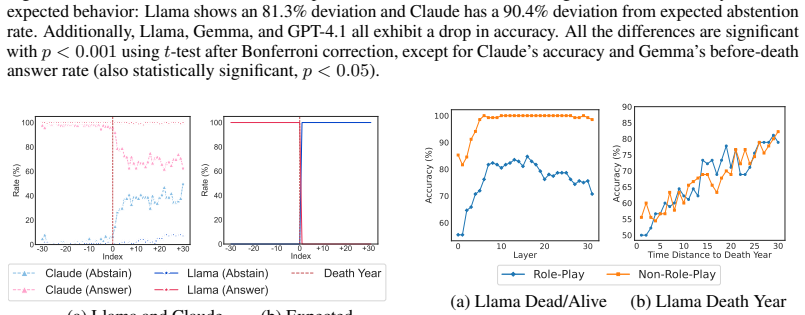
On its own terms, the paper claims that concept incongruence—when concept boundaries specified in a prompt clash, here a role's lifespan versus the time of a question—is a distinct failure mode worth measuring, and that in the role-play setting models exhibit two quantifiable failures. Across Llama, Gemma, Claude, and GPT-4.1, after a character's death the abstention rate rises to only 18.7% for the best model and stays under 3% for two others, while answer rates remain near 90% or above; conditional accuracy drops by roughly 8 points relative to the same questions without role-play, and the drop persists with living figures. The paper argues via linear probes that the 'dead/alive' state is not linearly encoded under role-play, that the exact death year is not precisely represented in either setting, and that role-play shifts the model's internal temporal representation (Spearman correlation drops from 0.996 to 0.974 and RMSE rises from 2.6 to 10.8 years for Llama on president questions). Making the death year explicit and demanding abstention boosts after-death abstention to 94.2% for Llama but further degrades accuracy, which the paper reads as a representation-space trade-off between role immersion and world knowledge.
Load-bearing premise
The causal story rests on the assumption that a linear probe on hidden activations reveals the internal representation that actually drives behavior; if abstention failures instead come from response policy, hedging, or guessing, the probe results describe correlations but do not explain the failures.
Editorial extensions
If this is right
- The mixed 'abstain and answer' response is a distinct failure mode: models often refuse first and then answer through a workaround, so abstention rate and answer rate must be measured separately.
- Knowledge-boundary failures are not explained by the character being dead, since the same accuracy drop appears with living figures; role-play itself disrupts temporal alignment.
- Explicitly supplying the death year and demanding a time check improves abstention but worsens accuracy, so prompt specification alone cannot fix both dimensions.
- Because non-role-play accuracy is near perfect while role-play accuracy and temporal-probe RMSE degrade together, role-play evaluation should include temporal-representation checks rather than only surface answers.
Reading between the lines
- Going beyond the paper: the large rise in RMSE with high Spearman correlation implies the model keeps the relative order of dates but loses absolute anchoring, so fine-grained date discrimination within a short window should be near chance even outside role-play; this is testable on the paper's own released artwork dataset.
- Going beyond the paper: the 'ask my husband' and similar workarounds suggest abstention leakage may be a generic refusal-bypass channel; a direct test would compare answer rates for post-death questions when hearsay sources are explicitly prohibited.
- Going beyond the paper: the abstention-accuracy trade-off under stricter role-play prompts suggests a Pareto frontier; interpolating prompt strictness and measuring both metrics would reveal whether any specification satisfies both objectives.
Editorial analysis
A structured set of objections, weighed in public.
Referee Report
Summary. The paper introduces the notion of 'concept incongruence' and studies a concrete instance: asking an LLM to role-play a dead historical figure and then posing questions about events after that figure's death. The authors propose three behavioral metrics—abstention rate, answer rate, and conditional accuracy—and evaluate four LLMs in role-play versus non-role-play settings using a new dataset of 100 historical figures. They report that models rarely abstain after death, that abstention and answer rates change gradually rather than sharply around the death year, and that conditional accuracy drops relative to the non-role-play setting. They then use linear probing of hidden activations to argue for two causes: (i) unreliable internal encoding of the death state and death year, and (ii) role-play-induced shifts in temporal representations that distort world knowledge. A restricted prompt that specifies the death year and instructs the model to abstain after death improves abstention behavior but further lowers accuracy.
Significance. If the behavioral findings are taken on their own, this is a solid empirical contribution: the three metrics are simple and reusable, the benchmark and living-figure control are well designed, the judge is validated against human annotations (96.3% agreement for abstention/answer and 100% for accuracy per Appendix D), and the code is released. The gradual-change result and the 'abstain-and-answer' pattern are interesting and likely useful for future work on role-playing and temporal reasoning. However, the paper's causal interpretation of the probing results is not established. The linear probes are correlational, the paper's own direct prompting tests show that models often know the death status, and the quantitative mismatch between probe shifts and accuracy drops points to alternative explanations such as response-policy effects. The causal claims in the abstract and Sections 4–5 should therefore be treated as hypotheses, not as demonstrated mechanisms.
major comments (3)
- [Section 4.1] The claim that models 'lack a reliable representation of the death state' is not supported by the presented evidence. The paper itself reports that, in the ROLE-PLAY setting, the model answers 'Are you <character> dead or alive?' correctly in 88.9% of trials and 'Which year did <character> die?' in 84% of trials. If the representation were typically missing, one would expect abstention failures to track probe accuracy much more closely than they do; instead, Llama's after-death abstention rate is only 18.7% (Section 3), and 60% of abstentions are followed by an explicit answer. This gap is more plausibly explained by response-policy effects—helpfulness pressure, refusal calibration, or persona-based circumvention such as 'Let me ask my husband'—which the probes do not measure. Since the abstract and Section 4 present 'unreliable encoding' as a cause of the behavior, this is load-bearing. The authors should either reframe the probing results as descriptive/correlational or add behavioral controls that distinguish representation failure from response policy.
- [Section 4.2, Table 3] The quantitative mismatch between the temporal-probe shift and the accuracy drop undermines the causal claim. For Llama, ROLE-PLAY increases the artwork RMSE by only 0.4 years (from 7.3 to 7.7), yet conditional accuracy falls from 85.0% to 38.6%. A 0.4-year shift in a linear regression probe cannot, on its face, explain a 46.4-point accuracy drop on yes/no questions about a single year. The accuracy drop more likely reflects role-play-induced hedging, guessing, or instruction-following tradeoffs, which the probe does not measure. The statement 'These shifts in temporal representations ... explain the accuracy drop' needs support from a joint model that maps probe predictions to answer outcomes, or from additional experiments that control for abstention-and-answer behavior, confidence, and answer rate.
- [Section 5] The restricted-prompt experiment is not a test of the representational account. The new prompt explicitly instructs the model to 'check the year of your death and year of the events' and to abstain if the event is after the death year, so the resulting approximately 94% abstention rate is expected from instruction following alone. The accuracy drop under this prompt is also consistent with a policy/calibration tradeoff rather than a further shift in temporal representations. The statement that this 'is consistent with our early interpretation' is not confirmatory evidence; it is compatible with alternative response-policy explanations. The Section 5 results should be presented as an intervention study, not as evidence for the representation-shift hypothesis.
minor comments (5)
- [Section 2.2] The model name 'Llama-3.1-8B-Instructed' should be 'Llama-3.1-8B-Instruct', and the cited reference [36] is for the original Llama, not Llama-3.1.
- [Appendix D, Tables 7–8] The evaluation prompts contain corrupted tokens such as 'George W. BU.S.h' and 'becaU.S.e' (apparently 'Bush' and 'because'); these should be corrected.
- [Section 3, Figure 2 caption] The sentence 'All the differences are significant with p < 0.001 using t-test after Bonferroni correction, except for Claude's accuracy and Gemma's before-death answer rate (also statistically significant, p < 0.05)' is confusingly worded; the parenthetical should be moved or the sentence restructured to make clear which comparisons reach which significance level.
- [Section 3] The 'expected behavior' is an author-defined normative stance; Section 7 acknowledges this, but Section 3 would benefit from an earlier, explicit statement that the expected behavior is one plausible choice rather than a ground-truth label.
- [Appendix B, Table 5] The five-year chunk correlations are mostly near zero, which supports the broad-temporal-order claim, but the table would benefit from confidence intervals or sample-size information for each bin.
Circularity Check
No circularity found: the behavioral metrics are measured from model outputs, the probes are descriptive with held-out splits, and the paper's stated expectations are explicit normative assumptions, not derived conclusions.
full rationale
The paper's target behaviors—abstention rate, answer rate, and conditional accuracy—are computed directly from model outputs using an explicit rubric, and those outputs are not produced by any fitted parameter or probe. The probing analyses in Section 4 train linear classifiers and ridge-regression probes on hidden activations with separate train/test splits; their accuracies, RMSEs, and correlations are descriptive measurements, not inputs used to construct the behavioral metrics. The 'expected behavior' in Section 2.1 is an openly stated normative benchmark, and Section 7 explicitly acknowledges that these role-play patterns 'may not be universally accepted'; measuring deviation from an acknowledged expectation is not a derivational circularity. The temporal-probe methodology is imported from Gurnee and Tegmark [11], a non-overlapping prior work, and the role-play versus non-role-play comparison plus the generalization to artwork questions are new empirical comparisons. The Limitations section acknowledges that most evaluations center on U.S. presidents, which is a scope limitation rather than a circular step. The main weakness in the causal story—linear probe failure need not imply behavioral cause, and response-policy effects such as persona hedging are not probed—is an inferential validity concern, not an equation-level reduction of the claimed result to its inputs. No load-bearing self-citation, imported uniqueness argument, or ansatz smuggled in via citation is present.
Assumptions & free parameters
assumptions (5)
- domain assumption Expected behavior norm: a role-play character should abstain from post-death knowledge.
- domain assumption Linear probing reflects internal knowledge.
- domain assumption LLM judge reliability.
- domain assumption Factual ground truth of the dataset.
- standard math Temporal ridge probe from prior work is appropriate.
Cite this review
Pith. "Pith review of Concept Incongruence: An Exploration of Time and Death in Role Playing." pith.science (2026). https://pith.science/paper/SS4IWURO
@misc{pith2026250514905,
  author       = {Pith},
  title        = {Pith review of: Concept Incongruence: An Exploration of Time and Death in Role Playing},
  year         = {2026},
  howpublished = {\url{https://pith.science/paper/SS4IWURO}},
  note         = {Machine review of arXiv:2505.14905}
}
read the original abstract
Consider this prompt "Draw a unicorn with two horns". Should large language models (LLMs) recognize that a unicorn has only one horn by definition and ask users for clarifications, or proceed to generate something anyway? We introduce concept incongruence to capture such phenomena where concept boundaries clash with each other, either in user prompts or in model representations, often leading to under-specified or mis-specified behaviors. In this work, we take the first step towards defining and analyzing model behavior under concept incongruence. Focusing on temporal boundaries in the Role-Play setting, we propose three behavioral metrics--abstention rate, conditional accuracy, and answer rate--to quantify model behavior under incongruence due to the role's death. We show that models fail to abstain after death and suffer from an accuracy drop compared to the Non-Role-Play setting. Through probing experiments, we identify two main causes: (i) unreliable encoding of the "death" state across different years, leading to unsatisfactory abstention behavior, and (ii) role playing causes shifts in the model's temporal representations, resulting in accuracy drops. We leverage these insights to improve consistency in the model's abstention and answer behaviors. Our findings suggest that concept incongruence leads to unexpected model behaviors and point to future directions on improving model behavior under concept incongruence.
Figures


Figures from the paper (5 more)


Reference graph
Works this paper leans on
-
[1]
Amro Abbas, Kushal Tirumala, Dániel Simig, Surya Ganguli, and Ari S Morcos. Semd- edup: Data-efficient learning at web-scale through semantic deduplication.arXiv preprint arXiv:2303.09540, 2023
arXiv 2023
-
[2]
Jaewoo Ahn, Taehyun Lee, Junyoung Lim, Jin-Hwa Kim, Sangdoo Yun, Hwaran Lee, and Gunhee Kim. Timechara: Evaluating point-in-time character hallucination of role-playing large language models.arXiv preprint arXiv:2405.18027, 2024
arXiv 2024
-
[3]
Guillaume Alain and Yoshua Bengio. Understanding intermediate layers using linear classifier probes.arXiv preprint arXiv:1610.01644, 2016
arXiv 2016
-
[4]
Probing classifiers: Promises, shortcomings, and advances.Computational Linguistics, 48(1):207–219, 2022
Yonatan Belinkov. Probing classifiers: Promises, shortcomings, and advances.Computational Linguistics, 48(1):207–219, 2022
2022
-
[5]
Language models are few-shot learners.Advances in neural information processing systems, 33:1877–1901, 2020
Tom Brown, Benjamin Mann, Nick Ryder, Melanie Subbiah, Jared D Kaplan, Prafulla Dhariwal, Arvind Neelakantan, Pranav Shyam, Girish Sastry, Amanda Askell, et al. Language models are few-shot learners.Advances in neural information processing systems, 33:1877–1901, 2020
1901
-
[6]
Large language models meet harry potter: A dataset for aligning dialogue agents with characters
Nuo Chen, Yan Wang, Haiyun Jiang, Deng Cai, Yuhan Li, Ziyang Chen, Longyue Wang, and Jia Li. Large language models meet harry potter: A dataset for aligning dialogue agents with characters. InFindings of the Association for Computational Linguistics: EMNLP 2023, pages 8506–8520, 2023
work page 2023
-
[7]
A dataset for answering time-sensitive questions.arXiv preprint arXiv:2108.06314, 2021
Wenhu Chen, Xinyi Wang, and William Yang Wang. A dataset for answering time-sensitive questions.arXiv preprint arXiv:2108.06314, 2021
arXiv 2021
-
[8]
Time-aware language models as temporal knowledge bases.Transactions of the Association for Computational Linguistics, 10:257–273, 2022
Bhuwan Dhingra, Jeremy R Cole, Julian Martin Eisenschlos, Daniel Gillick, Jacob Eisenstein, and William W Cohen. Time-aware language models as temporal knowledge bases.Transactions of the Association for Computational Linguistics, 10:257–273, 2022
2022
Show all 50 references
-
[9]
Bowman, and Evan Hubinger
Ryan Greenblatt, Carson Denison, Benjamin Wright, Fabien Roger, Monte MacDiarmid, Sam Marks, Johannes Treutlein, Tim Belonax, Jack Chen, David Duvenaud, Akbir Khan, Julian Michael, Sören Mindermann, Ethan Perez, Linda Petrini, Jonathan Uesato, Jared Kaplan, Buck Shlegeris, Sam...
2024
-
[10]
A survey on llm-as-a-judge.arXiv preprint arXiv:2411.15594, 2024
Jiawei Gu, Xuhui Jiang, Zhichao Shi, Hexiang Tan, Xuehao Zhai, Chengjin Xu, Wei Li, Yinghan Shen, Shengjie Ma, Honghao Liu, et al. A survey on llm-as-a-judge.arXiv preprint arXiv:2411.15594, 2024
2024 arXiv
-
[11]
Language models represent space and time, 2024
Wes Gurnee and Max Tegmark. Language models represent space and time, 2024
2024
-
[12]
Pingpong: A benchmark for role-playing language models with user emulation and multi-model evaluation, 2024
Ilya Gusev. Pingpong: A benchmark for role-playing language models with user emulation and multi-model evaluation, 2024
2024
-
[13]
Retrieval augmented language model pre-training
Kelvin Guu, Kenton Lee, Zora Tung, Panupong Pasupat, and Mingwei Chang. Retrieval augmented language model pre-training. InInternational conference on machine learning, pages 3929–3938. PMLR, 2020
2020
-
[14]
Deduplication of scholarly documents using locality sensitive hashing and word embeddings
Bikash Gyawali, Lucas Anastasiou, and Petr Knoth. Deduplication of scholarly documents using locality sensitive hashing and word embeddings. 2020. 10
2020
-
[15]
A survey on hallucination in large language models: Principles, taxonomy, challenges, and open questions.ACM Transactions on Information Systems, 43(2):1–55, 2025
Lei Huang, Weijiang Yu, Weitao Ma, Weihong Zhong, Zhangyin Feng, Haotian Wang, Qiang- long Chen, Weihua Peng, Xiaocheng Feng, Bing Qin, et al. A survey on hallucination in large language models: Principles, taxonomy, challenges, and open questions.ACM Transactions on Informati...
2025
-
[16]
Do language models have a common sense regarding time? revisiting temporal commonsense reasoning in the era of large language models
Raghav Jain, Daivik Sojitra, Arkadeep Acharya, Sriparna Saha, Adam Jatowt, and Sandipan Dandapat. Do language models have a common sense regarding time? revisiting temporal commonsense reasoning in the era of large language models. InProceedings of the 2023 Conference on Empir...
2023
-
[17]
Survey of hallucination in natural language generation
Ziwei Ji, Nayeon Lee, Rita Frieske, Tiezheng Yu, Dan Su, Yan Xu, Etsuko Ishii, Ye Jin Bang, Andrea Madotto, and Pascale Fung. Survey of hallucination in natural language generation. ACM computing surveys, 55(12):1–38, 2023
2023
-
[18]
Active retrieval augmented generation
Zhengbao Jiang, Frank F Xu, Luyu Gao, Zhiqing Sun, Qian Liu, Jane Dwivedi-Yu, Yiming Yang, Jamie Callan, and Graham Neubig. Active retrieval augmented generation. InProceedings of the 2023 Conference on Empirical Methods in Natural Language Processing, pages 7969–7992, 2023
2023
-
[19]
Mind the gap: Assessing temporal generalization in neural language models.Advances in Neural Information Processing Systems, 34:29348–29363, 2021
Angeliki Lazaridou, Adhi Kuncoro, Elena Gribovskaya, Devang Agrawal, Adam Liska, Tayfun Terzi, Mai Gimenez, Cyprien de Masson d’Autume, Tomas Kocisky, Sebastian Ruder, et al. Mind the gap: Assessing temporal generalization in neural language models.Advances in Neural Informati...
2021
-
[20]
Oxford University Press, USA, 2004
Muriel Deutsch Lezak.Neuropsychological assessment. Oxford University Press, USA, 2004
2004
-
[21]
From generation to judgment: Opportunities and challenges of llm-as-a-judge.arXiv preprint arXiv:2411.16594, 2024
Dawei Li, Bohan Jiang, Liangjie Huang, Alimohammad Beigi, Chengshuai Zhao, Zhen Tan, Amrita Bhattacharjee, Yuxuan Jiang, Canyu Chen, Tianhao Wu, et al. From generation to judgment: Opportunities and challenges of llm-as-a-judge.arXiv preprint arXiv:2411.16594, 2024
2024
-
[22]
Prejudice and volatility: A statistical framework for measuring social discrimination in large language models.arXiv preprint arXiv:2402.15481, 2024
Y Liu, K Yang, Z Qi, X Liu, Y Yu, and C Zhai. Prejudice and volatility: A statistical framework for measuring social discrimination in large language models.arXiv preprint arXiv:2402.15481, 2024
2024 arXiv
-
[23]
Timelms: Diachronic language models from twitter.arXiv preprint arXiv:2202.03829, 2022
Daniel Loureiro, Francesco Barbieri, Leonardo Neves, Luis Espinosa Anke, and Jose Camacho- Collados. Timelms: Diachronic language models from twitter.arXiv preprint arXiv:2202.03829, 2022
2022 arXiv
-
[24]
Time waits for no one! analysis and challenges of temporal misalignment.arXiv preprint arXiv:2111.07408, 2021
Kelvin Luu, Daniel Khashabi, Suchin Gururangan, Karishma Mandyam, and Noah A Smith. Time waits for no one! analysis and challenges of temporal misalignment.arXiv preprint arXiv:2111.07408, 2021
2021 arXiv
-
[25]
Locating and editing factual associations in gpt.Advances in neural information processing systems, 35:17359–17372, 2022
Kevin Meng, David Bau, Alex Andonian, and Yonatan Belinkov. Locating and editing factual associations in gpt.Advances in neural information processing systems, 35:17359–17372, 2022
2022
-
[26]
OpenAI, :, Aaron Hurst, Adam Lerer, Adam P. Goucher, Adam Perelman, Aditya Ramesh, Aidan Clark, AJ Ostrow, Akila Welihinda, Alan Hayes, Alec Radford, Aleksander M ˛ adry, Alex Baker-Whitcomb, Alex Beutel, Alex Borzunov, Alex Carney, Alex Chow, Alex Kirillov, Alex Nichol, Alex ...
2024
-
[27]
O’Brien, Carrie J
Joon Sung Park, Joseph C. O’Brien, Carrie J. Cai, Meredith Ringel Morris, Percy Liang, and Michael S. Bernstein. Generative agents: Interactive simulacra of human behavior. In Proceedings of the 2023 CHI Conference on Human Factors in Computing Systems. ACM, 2023. 12
2023
-
[28]
Chatdev: Communicative agents for software development
Chen Qian, Wei Liu, Hongzhang Liu, Nuo Chen, Jiahao Li, Cheng Yang, Weize Chen, Yusheng Su, Xin Cong, Juyuan Xu, Dahai Li, Zhiyuan Liu, and Maosong Sun. Chatdev: Communicative agents for software development. InProceedings of the 62nd Annual Meeting of the Association for Comp...
2024
-
[29]
In-context retrieval-augmented language models.Transactions of the Association for Computational Linguistics, 11:1316–1331, 2023
Ori Ram, Yoav Levine, Itay Dalmedigos, Dor Muhlgay, Amnon Shashua, Kevin Leyton-Brown, and Yoav Shoham. In-context retrieval-augmented language models.Transactions of the Association for Computational Linguistics, 11:1316–1331, 2023
2023
-
[30]
A survey of hallucination in large foundation models.arXiv preprint arXiv:2309.05922, 2023
Vipula Rawte, Amit Sheth, and Amitava Das. A survey of hallucination in large foundation models.arXiv preprint arXiv:2309.05922, 2023
2023 arXiv
-
[31]
Mitigating hallucination in fictional character role-play, 2024
Nafis Sadeq, Zhouhang Xie, Byungkyu Kang, Prarit Lamba, Xiang Gao, and Julian McAuley. Mitigating hallucination in fictional character role-play, 2024
2024
-
[32]
Role play with large language models
Murray Shanahan, Kyle McDonell, and Laria Reynolds. Role play with large language models. Nature, 623(7987):493–498, 2023
2023
-
[33]
Character-llm: A trainable agent for role-playing, 2023
Yunfan Shao, Linyang Li, Junqi Dai, and Xipeng Qiu. Character-llm: A trainable agent for role-playing, 2023
2023
-
[34]
Studies of interference in serial verbal reactions.Journal of experimental psychology, 18(6):643, 1935
J Ridley Stroop. Studies of interference in serial verbal reactions.Journal of experimental psychology, 18(6):643, 1935
1935
-
[35]
Gemma Team. Gemma. 2024
2024
-
[36]
Llama: Open and efficient foundation language models.arXiv preprint arXiv:2302.13971, 2023
Hugo Touvron, Thibaut Lavril, Gautier Izacard, Xavier Martinet, Marie-Anne Lachaux, Timo- thée Lacroix, Baptiste Rozière, Naman Goyal, Eric Hambro, Faisal Azhar, et al. Llama: Open and efficient foundation language models.arXiv preprint arXiv:2302.13971, 2023
2023 arXiv
-
[37]
Charactereval: A chinese benchmark for role-playing conversational agent evaluation
Quan Tu, Shilong Fan, Zihang Tian, Tianhao Shen, Shuo Shang, Xin Gao, and Rui Yan. Charactereval: A chinese benchmark for role-playing conversational agent evaluation. In Proceedings of the 62nd Annual Meeting of the Association for Computational Linguistics, 2024
2024
-
[38]
Knowledge mechanisms in large language models: A survey and perspective.arXiv preprint arXiv:2407.15017, 2024
Mengru Wang, Yunzhi Yao, Ziwen Xu, Shuofei Qiao, Shumin Deng, Peng Wang, Xiang Chen, Jia-Chen Gu, Yong Jiang, Pengjun Xie, et al. Knowledge mechanisms in large language models: A survey and perspective.arXiv preprint arXiv:2407.15017, 2024
2024 arXiv
-
[39]
Rolellm: Benchmarking, eliciting, and enhancing role-playing abilities of large language models.arXiv preprint arXiv:2310.00746, 2023
Zekun Moore Wang, Zhongyuan Peng, Haoran Que, Jiaheng Liu, Wangchunshu Zhou, Yuhan Wu, Hongcheng Guo, Ruitong Gan, Zehao Ni, Jian Yang, et al. Rolellm: Benchmarking, eliciting, and enhancing role-playing abilities of large language models.arXiv preprint arXiv:2310.00746, 2023
-
[40]
Jailbroken: How does llm safety training fail?Advances in Neural Information Processing Systems, 36:80079–80110, 2023
Alexander Wei, Nika Haghtalab, and Jacob Steinhardt. Jailbroken: How does llm safety training fail?Advances in Neural Information Processing Systems, 36:80079–80110, 2023
2023
-
[41]
Llm lies: Hallucinations are not bugs, but features as adversarial examples.arXiv preprint arXiv:2310.01469, 2023
Jia-Yu Yao, Kun-Peng Ning, Zhen-Hui Liu, Mu-Nan Ning, Yu-Yang Liu, and Li Yuan. Llm lies: Hallucinations are not bugs, but features as adversarial examples.arXiv preprint arXiv:2310.01469, 2023
2023 arXiv
-
[42]
Editing large language models: Problems, methods, and opportunities
Yunzhi Yao, Peng Wang, Bozhong Tian, Siyuan Cheng, Zhoubo Li, Shumin Deng, Huajun Chen, and Ningyu Zhang. Editing large language models: Problems, methods, and opportunities. arXiv preprint arXiv:2305.13172, 2023
2023 arXiv
-
[43]
Situatedqa: Incorporating extra-linguistic contexts into qa
Michael JQ Zhang and Eunsol Choi. Situatedqa: Incorporating extra-linguistic contexts into qa. arXiv preprint arXiv:2109.06157, 2021
2021 arXiv
-
[44]
Revealing the challenge of detecting character knowledge errors in llm role-playing.arXiv preprint arXiv:2409.11726, 2024
Wenyuan Zhang, Jiawei Sheng, Shuaiyi Nie, Zefeng Zhang, Xinghua Zhang, Yongquan He, and Tingwen Liu. Revealing the challenge of detecting character knowledge errors in llm role-playing.arXiv preprint arXiv:2409.11726, 2024
2024 arXiv
-
[45]
Siren’s song in the ai ocean: a survey on hallucination in large language models.arXiv preprint arXiv:2309.01219, 2023
Yue Zhang, Yafu Li, Leyang Cui, Deng Cai, Lemao Liu, Tingchen Fu, Xinting Huang, Enbo Zhao, Yu Zhang, Yulong Chen, et al. Siren’s song in the ai ocean: a survey on hallucination in large language models.arXiv preprint arXiv:2309.01219, 2023. 13
2023 arXiv
-
[46]
Vibe: Topic-driven temporal adaptation for twitter classifi- cation.arXiv preprint arXiv:2310.10191, 2023
Yuji Zhang, Jing Li, and Wenjie Li. Vibe: Topic-driven temporal adaptation for twitter classifi- cation.arXiv preprint arXiv:2310.10191, 2023
2023 arXiv
-
[47]
The law of knowledge overshadowing: Towards understanding, predicting, and preventing llm hallucination.arXiv preprint arXiv:2502.16143, 2025
Yuji Zhang, Sha Li, Cheng Qian, Jiateng Liu, Pengfei Yu, Chi Han, Yi R Fung, Kathleen McKeown, Chengxiang Zhai, Manling Li, et al. The law of knowledge overshadowing: Towards understanding, predicting, and preventing llm hallucination.arXiv preprint arXiv:2502.16143, 2025
2025 arXiv
-
[48]
Judging llm-as-a-judge with mt-bench and chatbot arena.Advances in Neural Information Processing Systems, 36:46595–46623, 2023
Lianmin Zheng, Wei-Lin Chiang, Ying Sheng, Siyuan Zhuang, Zhanghao Wu, Yonghao Zhuang, Zi Lin, Zhuohan Li, Dacheng Li, Eric Xing, et al. Judging llm-as-a-judge with mt-bench and chatbot arena.Advances in Neural Information Processing Systems, 36:46595–46623, 2023
2023
-
[49]
dead / alive
Jinfeng Zhou, Zhuang Chen, Dazhen Wan, Bosi Wen, Yi Song, Jifan Yu, Yongkang Huang, Lib- iao Peng, Jiaming Yang, Xiyao Xiao, et al. Characterglm: Customizing chinese conversational ai characters with large language models.arXiv preprint arXiv:2311.16832, 2023. 14 A Datasets We...
2023 arXiv
-
[1977]
0" or "1
The 37th U.S. president is Richard Nixon, who served from 1969 to 1974. The 36th U.S. president is Lyndon B. Johnson, who served from 1963 to 1969. The 35th U.S. president is John F. Kennedy, who served 1961 to 1963. The 34th U.S. president is Dwight D. Eisenhower, who served ...
1969
Reviewed August 7, 2026 · model on record in the stance chip above.
Discussion (0). Sign in to comment.