REVIEW 4 major objections 5 minor 13 references
Cosmos: A CXL-Based Full In-Memory System for Approximate Nearest Neighbor Search
T0 review · 4 major / 5 minor · reviewed 2026-08-07 · deepseek-v4-flash
Pith's one-line read A CXL memory device with built-in general-purpose cores can run the entire approximate nearest neighbor search locally, removing the host and PCIe link from the critical path.
desk verdict A coherent CXL-PNM architecture proposal with a genuine contribution in full ANNS offload and rank-level distance computation, but the headline speedups are upper bounds because the GPC and PU compute are unmodeled in the simulator. read the letter →
The pith
A machine-rendered reading of the paper's core claim, the machinery that carries it, and where it could break.
The reading
What carries the argument
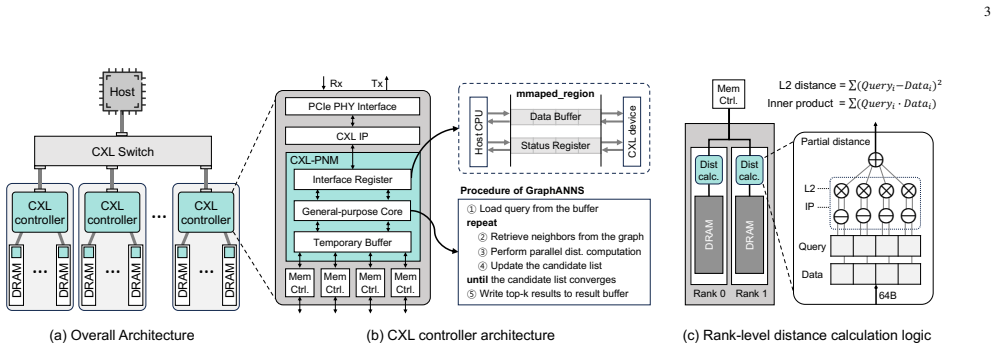
The load-bearing mechanism is the general-purpose core embedded in each CXL controller, which runs the ANNS loop locally: it loads the query, follows graph edges, requests neighbor vectors, updates the candidate list, and writes back only the local top-k results to the host. Around it sit two complementary mechanisms: rank-level processing units that split each vector's dimensions across DRAM ranks to compute partial distances in parallel on 64-byte sub-vectors, and an adjacency-aware placement algorithm that uses centroid distances and cluster sizes to spread nearby clusters across devices without runtime profiling.
What would settle it
Build a cycle-accurate model or a small FPGA/ASIC prototype that includes the GPC pipeline and rank-level PUs, run the same SIFT1B and DEEP1B query traces through it, and compare end-to-end QPS. If the measured throughput improvement over the host-side CXL baseline falls materially below 6.72x (SIFT1B) and 5.35x (DEEP1B), or below 2.35x over the distance-offload baseline, the central claim is falsified; the specific number to watch is whether GPC instruction throughput or PU processing latency becomes the new bottleneck.
Extended reading notes
Core claim
The central discovery is that a compute-capable CXL memory device can act as the executing engine, not just the storage tier, for graph-based ANNS. By integrating a programmable general-purpose core in the CXL controller, Cosmos moves graph traversal and candidate-list management out of the host; a rank-level processing unit computes partial L2 or inner-product distances concurrently on each DRAM rank; and an adjacency-aware placement algorithm assigns clusters to CXL devices so that neighboring clusters land on different devices. The paper reports that this combination raises query throughput by up to 6.72x over a host-side CXL baseline on SIFT1B traces and 5.35x on DEEP1B, and by 2.35x over a state-of-the-art CXL-based distance-offload approach, while substantially reducing graph-traversal and distance-calculation latency.
Load-bearing premise
The paper assumes that a general-purpose core embedded in a CXL memory controller can execute the graph traversal and candidate-list maintenance quickly enough, and that the rank-level processing units add negligible latency, so that memory bandwidth rather than the core becomes the bottleneck.
Editorial extensions
If this is right
- Host-side bandwidth stops being the bottleneck: the only data crossing the PCIe link is the incoming query and the returned local top-k lists, so more CXL devices can be added without saturating the host interface.
- Distance computation becomes a parallel, bandwidth-efficient operation: splitting each vector's dimensions across DRAM ranks lets partial distances be computed concurrently in each rank's processing unit.
- Query load stays balanced across CXL devices even when many queries hit nearby clusters, because the adjacency-aware placement deliberately separates neighboring clusters.
- The same CXL hardware can track changes in ANN algorithms or search parameters through its programmable general-purpose core, avoiding fixed-accelerator redesign.
Reading between the lines
- Because the reported simulator injects precomputed memory traces and does not model the general-purpose core's instruction pipeline or the rank-level processing units' area and power cost, the 6.72x and 2.35x gains are best read as upper bounds until a cycle-accurate or silicon-level validation appears.
- The full-offload pattern should transfer to other graph workloads where traversal, scoring, and top-k maintenance are the hot loop, such as sparse graph analytics or recommendation scoring, as long as the working set fits in CXL-attached memory.
- The adjacency-aware placement could be paired with a query-router that deliberately sends each query to the device holding the closest cluster first, with spill-over to neighbors only if the candidate list is not full, which might cut redundant probing.
- If the GPC and rank-level processing units prove cheap in area and power, CXL memory could become a general near-memory compute tier for database operators, not just ANNS.
Editorial analysis
A structured set of objections, weighed in public.
Referee Report
Summary. The paper proposes COSMOS, a CXL-attached memory system in which general-purpose cores inside CXL controllers execute the full graph-based ANNS pipeline (graph traversal, distance computation, candidate-list updates, and top-k selection), while rank-level processing units compute partial distances in parallel to exploit DRAM rank parallelism. It also proposes an adjacency-aware cluster placement algorithm that distributes neighboring clusters across CXL devices to balance query load. The evaluation uses Ramulator with DiskANN memory-access traces from SIFT1B and DEEP1B, reporting up to 6.72x higher throughput than a host-side CXL baseline and about 2.35x over the CXL-ANNS baseline.
Significance. If the architectural assumptions hold, the paper addresses a timely and important problem: reducing host-device data movement and PCIe round trips for billion-scale RAG retrieval. The work has several strengths: it uses independent public datasets, compares against a published baseline, provides an explicit placement algorithm, and evaluates the placement component against round-robin on identical traces, so that component is not circular. The central weakness is that the quantitative headline is an upper bound rather than a measured result: the simulator models only DRAM/memory-system behavior, while the GPC instruction stream and rank-level PU execution costs are absent. Because the paper's claimed contribution is precisely that these compute elements can be embedded in CXL devices without becoming bottlenecks, the missing compute model is load-bearing for the speedup claims.
major comments (4)
- [Section V-A] The simulator injects only precomputed DiskANN memory traces into Ramulator. Section V-A states that node-visit traces were extracted and that the generated memory requests were injected to measure query latency, which means graph traversal, candidate-list maintenance, and local top-k selection exist in the evaluation only as memory-access patterns. Section IV-A, however, assigns all of these operations to the GPC. The GPC's instruction throughput, pipeline stalls, temporary-buffer accesses, and control-flow overhead are not modeled. The reported 6.72x, 5.35x, and 2.35x improvements therefore assume that the GPC is never the bottleneck, which is exactly the assumption that the paper needs to justify. A GPC timing model, or at least a sensitivity analysis over GPC cycles per node visit and per candidate update, is required before the headline throughput claims can be considered supported.
- [Section IV-A / Fig. 3(c)] The rank-level PUs are modeled as free computation. The architecture assigns partial-distance accumulation to PUs inside each DRAM rank, yet the evaluation does not model PU latency, throughput, die area, power, or the overhead of transferring partial results from the PUs to the GPC. The 'w/o rank.' ablation in Fig. 4(a) attributes a large performance gain to the rank-level PUs, but because the only simulated component is the DRAM memory system, this gain is really the effect of assuming distance computation costs nothing beyond the memory requests it generates. Without a quantitative model of PU cost and its interaction with DRAM commands, the rank-level design cannot be distinguished from an idealized zero-overhead accelerator.
- [Section V-B] The CXL-ANNS reproduction excludes hop-count-based graph caching on the stated grounds that it is 'beyond the scope of this work' and has 'negligible impact.' This is not supported by the presented data: Fig. 4(b) shows graph traversal as a substantial latency component for CXL-ANNS, and caching directly targets that component. Excluding a baseline optimization can only overstate COSMOS's relative speedup. The authors should either implement the caching component or provide trace-level measurements demonstrating that its latency impact is indeed negligible, and this justification should appear before the 2.35x comparison is reported.
- [Section V-B / Fig. 4(a)] All throughput results are reported only as normalized values, with no absolute QPS, absolute latency, or confidence intervals for the 10,000-query traces. Given that the entire evaluation is simulation-based, absolute numbers are important for assessing whether the modeled configuration is realistic and for reproducing the claims. The authors should report raw QPS and mean/p99 latencies for at least SIFT1B and DEEP1B, along with variance across query batches.
minor comments (5)
- [Algorithm 1] The penalty computation in lines 5-8 is unclear: 'proximity' is initialized to the number of devices and then decremented after each adjacent cluster found on a candidate device, so later adjacent clusters contribute smaller penalties. The intended priority (e.g., weighting the closest neighbor most heavily) should be stated explicitly, and the decrement order should be defined with respect to the sorted adjacency list.
- [Abstract / Section V-B] The abstract reports '2.35x over a state-of-the-art CXL-based solution,' but Section V-B does not state this number explicitly; it appears only in Fig. 4(a). The text should identify the CXL-ANNS comparison value for both SIFT1B and DEEP1B.
- [Section IV-B] The statement that mlock() pins HDM regions needs clarification: HDM is device-attached memory mapped into the host physical address space, so the authors should specify whether mlock() pins host pages, device memory, or both, and how this interacts with the static HDM mapping described earlier.
- [Fig. 3(c)] The figure shows 64B sub-vector segments per rank, but it is not explained how vector dimensions are partitioned across ranks for different data types (uint8 for SIFT, fp32 for DEEP, int8 for MSSPACEV). A brief description of the dimension-to-rank mapping would help readers evaluate the generality of the rank-level PU design.
- [Section V-C] The load-imbalance results in Fig. 5(a) are presented without numerical values in the text; the authors should report the LIR numbers and, ideally, the standard deviation across query sets, to support the claim that COSMOS 'consistently' achieves lower LIR than round-robin.
Circularity Check
No significant circularity: the paper's architecture and placement algorithm are evaluated against independent baselines and external datasets, and no claim reduces to its own inputs by construction.
full rationale
The paper's performance claims are supported by a Ramulator-based simulation that injects memory requests derived from DiskANN node-visit traces, not by fitting parameters to the target metrics. The baseline comparisons (DRAM-only, CXL-ANNS, round-robin placement) are independent of the proposed mechanism. The adjacency-aware placement algorithm is a heuristic whose evaluation measures load imbalance on the same trace workload, but this is a sanity check of the algorithm's intended behavior, not a circular derivation of a prediction from the algorithm's definition. The paper does not define a key quantity in terms of the result it claims to predict, nor does it fit a parameter and then rename that fit as a prediction. The only self-citation of note is reference [11] (a Samsung CXL-PNM platform paper with overlapping authors), used as background evidence that CXL devices can include near-memory compute; this is not load-bearing for the paper's central claims, which stand on the simulation study. The main limitation is architectural modeling completeness: the GPC's instruction throughput and the rank-level PU's compute latency are not explicitly modeled, so the reported speedups are best interpreted as upper bounds. However, an unmodeled component is a validation gap, not a circularity, and the paper's derivation chain does not reduce to its own inputs.
Assumptions & free parameters
free parameters (1)
- Adjacency penalty step in Algorithm 1 =
1
assumptions (4)
- standard math L2 distance and inner product over a vector can be computed as the sum of partial distances over dimension partitions.
- domain assumption An in-memory general-purpose core in a CXL device can run graph traversal, candidate maintenance, and top-k update fast enough not to become the bottleneck.
- domain assumption Ramulator plus the custom CXL-PNM modeling captures the memory access and bandwidth behavior of the proposed CXL devices, including CXL protocol overhead.
- domain assumption DiskANN traces from 10,000 queries per dataset are representative of production RAG retrieval workloads.
invented entities (2)
-
Rank-level Processing Unit (PU)
-
General-Purpose Core (GPC) in the CXL memory controller
Cite this review
Pith. "Pith review of Cosmos: A CXL-Based Full In-Memory System for Approximate Nearest Neighbor Search." pith.science (2026). https://pith.science/paper/7QOPFRMU
@misc{pith2026250516096,
  author       = {Pith},
  title        = {Pith review of: Cosmos: A CXL-Based Full In-Memory System for Approximate Nearest Neighbor Search},
  year         = {2026},
  howpublished = {\url{https://pith.science/paper/7QOPFRMU}},
  note         = {Machine review of arXiv:2505.16096}
}
read the original abstract
Retrieval-Augmented Generation (RAG) is crucial for improving the quality of large language models by injecting proper contexts extracted from external sources. RAG requires high-throughput, low-latency Approximate Nearest Neighbor Search (ANNS) over billion-scale vector databases. Conventional DRAM/SSD solutions face capacity/latency limits, whereas specialized hardware or RDMA clusters lack flexibility or incur network overhead. We present Cosmos, integrating general-purpose cores within CXL memory devices for full ANNS offload and introducing rank-level parallel distance computation to maximize memory bandwidth. We also propose an adjacency-aware data placement that balances search loads across CXL devices based on inter-cluster proximity. Evaluations on SIFT1B and DEEP1B traces show that Cosmos achieves up to 6.72x higher throughput than the baseline CXL system and 2.35x over a state-of-the-art CXL-based solution, demonstrating scalability for RAG pipelines.
Figures


Figures from the paper (1 more)

Reference graph
Works this paper leans on
-
[1]
Towards Understanding Systems Trade-offs in Retrieval- Augmented Generation Model Inference,
M. Shenet al., “Towards Understanding Systems Trade-offs in Retrieval- Augmented Generation Model Inference,” 2024, arXiv:2412.11854
arXiv 2024
-
[2]
Agentic Retrieval-Augmented Generation: A Survey on Agentic RAG,
A. Singhet al., “Agentic Retrieval-Augmented Generation: A Survey on Agentic RAG,” 2025, arXiv:2501.09136
arXiv 2025
-
[3]
Scalable Billion-point Approximate Nearest Neighbor Search Using SmartSSDs,
B. Tianet al., “Scalable Billion-point Approximate Nearest Neighbor Search Using SmartSSDs,” inUSENIX ATC, 2024
work page 2024
-
[4]
R. Chenget al., “Characterizing the Dilemma of Performance and Index Size in Billion-Scale Vector Search and Breaking It with Second-Tier Memory,” 2024, arXiv:2405.03267
work page Pith review arXiv 2024
-
[5]
Y . Wanget al., “NDSEARCH: Accelerating Graph-Traversal-Based Approximate Nearest Neighbor Search through Near Data Processing,” inISCA, 2024
work page 2024
-
[6]
Direct Access, High-Performance Memory Disaggre- gation with DirectCXL,
D. Gouket al., “Direct Access, High-Performance Memory Disaggre- gation with DirectCXL,” inUSENIX ATC, 2022
work page 2022
-
[7]
DiskANN: fast accurate billion-point nearest neighbor search on a single node,
S. J. Subramanyaet al., “DiskANN: fast accurate billion-point nearest neighbor search on a single node,” inNeurIPS, 2019
work page 2019
-
[8]
W. Jianget al., “Chameleon: A Heterogeneous and Disaggregated Accelerator System for Retrieval-Augmented Language Models,”Proc. VLDB Endowment, 2024
work page 2024
Show all 13 references
-
[9]
CXL-ANNS: Software-Hardware Collaborative Memory Disaggregation and Computation for Billion-Scale Approximate Nearest Neighbor Search,
J. Janget al., “CXL-ANNS: Software-Hardware Collaborative Memory Disaggregation and Computation for Billion-Scale Approximate Nearest Neighbor Search,” inUSENIX ATC, 2023
2023
-
[10]
PIM Is All You Need: A CXL-Enabled GPU-Free System for Large Language Model Inference,
Y . Guet al., “PIM Is All You Need: A CXL-Enabled GPU-Free System for Large Language Model Inference,” inASPLOS, 2025
2025
-
[11]
An LPDDR-based CXL-PNM Platform for TCO- efficient Inference of Transformer-based Large Language Models,
S.-S. Parket al., “An LPDDR-based CXL-PNM Platform for TCO- efficient Inference of Transformer-based Large Language Models,” in HPCA, 2024
2024
-
[12]
Big ANN Benchmarks,
“Big ANN Benchmarks,” 2024. [Online]. Available: https: //big-ann-benchmarks.com
2024
-
[13]
Ramulator: A Fast and Extensible DRAM Simulator,
Y . Kim, W. Yang, and O. Mutlu, “Ramulator: A Fast and Extensible DRAM Simulator,” p. 45–49, 2016
2016
Reviewed August 7, 2026 · model on record in the stance chip above.
Discussion (0). Continue with ORCID to comment.