REVIEW 2 major objections 5 minor 52 references
Locality-Sensitive Hashing for Efficient Hard Negative Sampling in Contrastive Learning
T0 review · 2 major / 5 minor · reviewed 2026-08-07 · deepseek-v4-flash
Pith's one-line read The paper claims that LSH-binarized embeddings can replace exact cosine-based hard-negative sampling in contrastive learning, matching or beating its accuracy while cutting search overhead from 93.01% to 5.59% of training time on MS MARCO.
desk verdict A practically promising LSH-based hard negative mining idea whose empirical speedup is credible, but the paper's theoretical guarantee has a reversed inequality and the implementation does not match the analysis. read the letter →
The pith
A machine-rendered reading of the paper's core claim, the machinery that carries it, and where it could break.
The reading
What carries the argument
The load-bearing object is a random-projection locality-sensitive hash family: a random orthonormal matrix $R \in \mathbb{R}^{b\times d}$ maps each embedding to $b$ real projections, which are centered and thresholded at zero to give a $b$-bit binary code. Angular distance between two points controls their collision probability, $\Pr[h_i(c)=h_i(y)] = 1 - \theta_{cy}/\pi$, so Hamming distance between codes orders points by cosine similarity in expectation. The paper uses this ordering to select the top-$K$ Hamming-nearest negatives as hard negatives, and uses the central limit theorem on the per-bit separation indicator $Z_i$ to bound the probability that a nearer point stays Hamming-closer than a farther one.
What would settle it
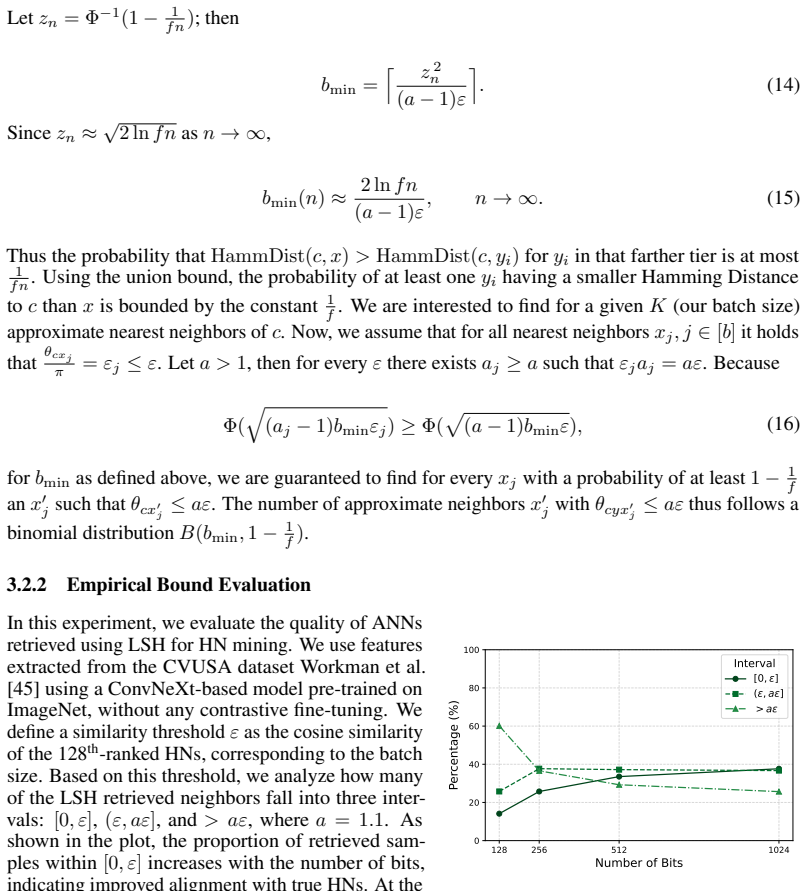
On one of the reported datasets, fix an anchor set, and measure the empirical fraction of true nearest neighbours found among the top-$K$ Hamming neighbours with centering on and off. If the bound of Section 3.2.1—which guarantees each true neighbour is matched within angle $a\varepsilon$ with probability at least $1 - 1/f$—is satisfied only when centering is removed, the theory does not describe the hash family that produced the reported results.
Extended reading notes
Core claim
The central claim is that hard-negative mining in contrastive learning can be replaced by approximate nearest-neighbour search over binary codes without losing accuracy. Embeddings are multiplied by a random orthonormal matrix, centered, and reduced to their signs; the resulting bits preserve angular similarity in expectation, so Hamming distance under XOR/popcount approximates cosine distance. The authors prove that with enough bits, any true nearest neighbour of an anchor is matched by a retrieved point within angle $a\varepsilon$ with probability at least $1 - 1/f$, and they verify empirically that higher bit counts increase overlap with exact cosine neighbours. Across six image and text datasets, LSH-based sampling matches or exceeds pre-epoch exact sampling at high bit counts while reducing search time and memory by an order of magnitude or more.
Load-bearing premise
The theoretical guarantee assumes the anchor and candidate points lie on a unit sphere and that every separating hyperplane passes through the origin, while the implementation centers the projected features before assigning signs; if that centering disrupts the Hamming-distance ordering, the match-quality guarantee could lapse even though the speed benefit remains.
Editorial extensions
If this is right
- At 512–1024 bits on image retrieval, LSH matches the accuracy of exact pre-epoch incremental sampling while adding under 1% overhead to per-epoch training time.
- On MS MARCO, 768-bit LSH reaches MRR@10 26.44, above the 26.24 of exact pre-epoch full sampling, so approximate search is not necessarily a quality compromise in text retrieval.
- Because the binary index is rebuilt after each epoch, hard negatives track the evolving embedding rather than relying on stale pre-extracted negatives.
- Binarization cuts memory by a factor of 32, making global hard-negative mining feasible at dataset sizes where storing full float vectors is impractical.
- The bit-count formula $b_{\min} \approx 2\ln(fn)/((a-1)\varepsilon)$ gives a principled starting point for choosing hash length instead of tuning it by trial and error.
Reading between the lines
- The paper's cost argument extends to unsupervised contrastive learning, where a binary LSH index could replace the fixed-size queue of negatives and give access to true global negatives rather than only recent batch negatives.
- The weaker overlap on text data hints that multi-concept embeddings may need a query-adaptive or multi-index hash; this is an inference beyond the paper's evaluation.
- A testable extension is an adaptive bit schedule, growing the hash length as the embedding stabilizes, guided by the paper's $b_{\min}$ formula.
- A centered-versus-uncentered comparison would separate the speed benefit, which does not depend on the theory, from the match-quality guarantee, which is derived without centering.
Editorial analysis
A structured set of objections, weighed in public.
Referee Report
Summary. The paper proposes a locality-sensitive hashing (LSH) scheme for global hard negative sampling in supervised contrastive learning. Embeddings are projected with a random rotation matrix, centered, and binarized with sign(); after each epoch, hard negatives are retrieved via Hamming distance. The paper provides a theoretical analysis in Section 3.2.1 intended to bound the probability that a true nearest neighbor has smaller Hamming distance than a farther point, and evaluates the method on six datasets across vision and text (CVUSA, CV ACT, VIGOR, SOP, InShop, MS MARCO) against Random, BatchHard, Pre-Epoch Full, and Pre-Epoch Incremental sampling. Empirically, LSH at 512-1024 bits matches or slightly exceeds the incremental baseline on most datasets and is much faster than exact pre-epoch sampling; on MS MARCO, LSH768 achieves MRR@10 26.44 versus 26.24 for Pre-Epoch Full, with search overhead of 5.6% of training time versus 93.0%.
Significance. The empirical study is solid and useful: it covers six public datasets, compares against four baselines, sweeps bit counts, and measures search overhead and neighbor overlap. The method is simple and has no learned parameters other than bit count and K. The neighbor analysis (overlap with true hard negatives, hardness levels) provides practical insight. However, the theoretical contribution is not established: the probabilistic guarantee in Section 3.2.1 is derived with a reversed inequality, and the analysis assumes origin-centered hyperplanes while the implementation centers the features. The paper's claim of 'bridging theory and practice' is therefore unsupported. If the empirical results are reproducible, the paper remains a useful engineering contribution, but it currently overstates its theoretical support.
major comments (2)
- [§3.2.1, Eq. (12)] The claimed lower bound P(Z ≤ 0) ≥ Φ(√((a−1)bε)) is derived using the substitution Pr(X_i=1, Y_i=1) ≤ ε, but σ²_Z contains the term −2Pr(X_i=1, Y_i=1), so replacing the joint probability by its upper bound ε produces a lower bound on σ²_Z, not an upper bound. The ratio −µ_Z/σ_Z is therefore at most the expression in Eq. (12), and the chain has the wrong direction; Eq. (14) for b_min does not follow. A concrete configuration shows the bound is false: take a=2, ε=0.001, b=1000, with x and y on opposite azimuths around c so that Pr(X_i=1,Y_i=1)=0; then P(HammDist(c,x) ≤ HammDist(c,y)) ≈ Φ(1/√3) ≈ 0.72, below the claimed Φ(1) ≈ 0.84. The stated 1−1/f guarantee and the conclusion that the experiments 'bridge theory and practice' are unsupported.
- [§3.2, Eq. (3) and §3.2.1, Eq. (5)] The theoretical analysis assumes random hyperplanes through the origin, for which the collision probability is 1 − θ_cy/π and the Hamming distance ordering depends on the angular distance between anchor and candidate. The implementation centers the projected vectors, V = RY − mean(RY), before the sign() operation, which moves the separating hyperplanes off the origin. The paper does not show that the collision probability or the Hamming-distance ordering bound survives this centering. Because Appendix A.6 shows that centering materially affects the overlap between LSH-retrieved and true nearest neighbors, the theory in Section 3.2.1 describes a different hash family from the one evaluated in the experiments.
minor comments (5)
- [Eq. (3)] The equation 'V = RY − RY' is missing the mean: it should read V = RY − mean(RY), which is the operation described in the text.
- [§3.2.1, Eq. (10)] The CLT is invoked 'for large d,' but the sum is over the b hash bits; the approximation should be justified for large b, and the dependence among bits induced by the orthonormal rows of the random rotation matrix should be addressed.
- [§3.2.1, paragraph before Eq. (16)] The symbol b is used both for the bit dimension and for the index of nearest neighbors in the phrase 'for all nearest neighbors x_j, j∈[b]', which is confusing. Please use a different index such as j∈[K].
- [Table 3] The search-time comparison reports only the 128-bit LSH configuration, while the best accuracy is obtained with 512 or 1024 bits. Reporting the overhead for those settings would make the 'significantly less computation' claim more precise.
- [Tables 1 and 2] The reported metrics are point estimates without variance or significance testing. Given the small margins on some datasets (e.g., CVUSA R@1 98.68 vs. 98.60; VIGORcross 59.86 vs. 57.69), multiple seeds or error bars would strengthen the parity claim.
Circularity Check
No significant circularity: the LSH construction, theoretical analysis, and empirical benchmarks are self-contained; the only self-references are minor background and baseline citations.
full rationale
The paper's central derivation chain is not circular. The LSH construction in Section 3.2 follows the standard random-hyperplane scheme of Charikar and related prior work, with no parameter fitted to the reported benchmark outcomes. The probabilistic analysis in Section 3.2.1 is derived independently from the collision probability Pr[h_i(c)=h_i(y)] = 1 - theta/pi and is not calibrated to the experimental results; Eq. (14) for b_min is a design target derived from the stated confidence level rather than a fitted quantity renamed as a prediction. The empirical Section 3.2.2 is descriptive, measuring the fraction of LSH-retrieved neighbors inside chosen cosine-similarity intervals, and does not reverse-engineer the theory from the data. The only self-references are the authors' prior geo-localization work [9, 10, 11], used as motivation and as a pre-epoch sampling baseline; these are published, externally evaluated methods and are not load-bearing for the new LSH claim. Two concerns raised by the reader are correctness issues, not circularity: the inequality direction in Eq. (12) appears reversed so the claimed 1 - 1/f guarantee is not established, and the centering in Eq. (3) means the implemented hash family may not match the origin-centered hyperplane analysis. These are theory-practice and proof-validity gaps, not reductions of the conclusions to the inputs, and the paper's own limitation section also acknowledges that the bit-size choice is empirical rather than derived a priori. Therefore no circular step can be quoted and exhibited, and the correct circularity score is 0.
Assumptions & free parameters
free parameters (2)
- LSH bit dimensionality b =
128, 256, 512, 768 (text), 1024 (vision); chosen per dataset
- Number of retrieved hard negatives K =
128
assumptions (5)
- standard math Random hyperplane collision probability Pr[h_i(c)=h_i(y)] = 1 - theta/pi (Charikar 2002)
- standard math Central limit theorem for sums of independent Bernoulli differences
- ad hoc to paper The analysis assumes points lie on the unit sphere and hashes are origin-centered, while the implementation centers features before binarization
- domain assumption Hard negative sampling improves contrastive learning, and approximate hard negatives preserve this benefit
- domain assumption Stale embeddings from the previous epoch are adequate for sampling the next epoch's batches
Cite this review
Pith. "Pith review of Locality-Sensitive Hashing for Efficient Hard Negative Sampling in Contrastive Learning." pith.science (2026). https://pith.science/paper/HU3VFS6E
@misc{pith2026250517844,
  author       = {Pith},
  title        = {Pith review of: Locality-Sensitive Hashing for Efficient Hard Negative Sampling in Contrastive Learning},
  year         = {2026},
  howpublished = {\url{https://pith.science/paper/HU3VFS6E}},
  note         = {Machine review of arXiv:2505.17844}
}
read the original abstract
Contrastive learning is a representational learning paradigm in which a neural network maps data elements to feature vectors. It improves the feature space by forming lots with an anchor and examples that are either positive or negative based on class similarity. Hard negative examples, which are close to the anchor in the feature space but from a different class, improve learning performance. Finding such examples of high quality efficiently in large, high-dimensional datasets is computationally challenging. In this paper, we propose a GPU-friendly Locality-Sensitive Hashing (LSH) scheme that quantizes real-valued feature vectors into binary representations for approximate nearest neighbor search. We investigate its theoretical properties and evaluate it on several datasets from textual and visual domain. Our approach achieves comparable or better performance while requiring significantly less computation than existing hard negative mining strategies.
Figures


Figures from the paper (10 more)


Reference graph
Works this paper leans on
-
[1]
Unicom: Universal and compact representation learning for image retrieval
Xiang An, Jiankang Deng, Kaicheng Yang, Jaiwei Li, Ziyong Feng, Jia Guo, Jing Yang, and Tongliang Liu. Unicom: Universal and compact representation learning for image retrieval. arXiv preprint arXiv:2304.05884, 2023
arXiv 2023
-
[2]
Practical and optimal lsh for angular distance
Alexandr Andoni, Piotr Indyk, Thijs Laarhoven, Ilya Razenshteyn, and Ludwig Schmidt. Practical and optimal lsh for angular distance. Advances in neural information processing systems, 28, 2015
work page 2015
-
[3]
Ms marco: A human generated machine reading comprehension dataset
Payal Bajaj, Daniel Campos, Nick Craswell, Li Deng, Jianfeng Gao, Xiaodong Liu, Rangan Majumder, Andrew McNamara, Bhaskar Mitra, Tri Nguyen, et al. Ms marco: A human generated machine reading comprehension dataset. arXiv preprint arXiv:1611.09268, 2016
arXiv 2016
-
[4]
Fatih Cakir, Kun He, Xide Xia, Brian Kulis, and Stan Sclaroff. Deep metric learning to rank. In 2019 IEEE/CVF Conference on Computer Vision and Pattern Recognition (CVPR) , pages 1861–1870, 2019. doi: 10.1109/CVPR.2019.00196
arXiv 2019
-
[5]
Moses S. Charikar. Similarity estimation techniques from rounding algorithms. In Proceedings of the Thiry-F ourth Annual ACM Symposium on Theory of Computing, STOC ’02, page 380–388, New York, NY , USA, 2002. Association for Computing Machinery. ISBN 1581134959. doi: 10.1145/509907.509965. URL https://doi.org/10.1145/509907.509965
arXiv 2002
-
[6]
S. Chopra, R. Hadsell, and Y . LeCun. Learning a similarity metric discriminatively, with application to face verification. In 2005 IEEE Computer Society Conference on Computer Vision and Pattern Recognition (CVPR’05) , volume 1, pages 539–546 vol. 1, 2005. doi: 10.1109/CVPR.2005.202
-
[7]
Ching-Yao Chuang, Joshua Robinson, Yen-Chen Lin, Antonio Torralba, and Stefanie Jegelka. Debiased contrastive learning. Advances in neural information processing systems , 33:8765– 8775, 2020
work page 2020
-
[8]
Mayur Datar, Nicole Immorlica, Piotr Indyk, and Vahab S. Mirrokni. Locality-sensitive hashing scheme based on p-stable distributions. In Proceedings of the Twentieth Annual Symposium on Computational Geometry , SCG ’04, page 253–262, New York, NY , USA, 2004. Association for Computing Machinery. ISBN 1581138857. doi: 10.1145/997817.997857. URL https://doi...
arXiv 2004
Show all 52 references
-
[9]
Sample4geo: Hard negative sampling for cross-view geo-localisation
Fabian Deuser, Konrad Habel, and Norbert Oswald. Sample4geo: Hard negative sampling for cross-view geo-localisation. In ICCV, pages 16847–16856, 2023
2023
-
[10]
Orientation-guided con- trastive learning for uav-view geo-localisation
Fabian Deuser, Konrad Habel, Martin Werner, and Norbert Oswald. Orientation-guided con- trastive learning for uav-view geo-localisation. In Proceedings of the 2023 Workshop on UA Vs in Multimedia: Capturing the World from a New Perspective , pages 7–11, 2023
2023
-
[11]
Optimizing geo-localization with k-means re-ranking in challenging weather conditions
Fabian Deuser, Martin Werner, Konrad Habel, and Norbert Oswald. Optimizing geo-localization with k-means re-ranking in challenging weather conditions. In Proceedings of the 2nd Workshop on UA Vs in Multimedia: Capturing the World from a New Perspective, pages 9–13, 2024. 10
2024
-
[12]
Deep feature learning with relative distance comparison for person re-identification
Shengyong Ding, Liang Lin, Guangrun Wang, and Hongyang Chao. Deep feature learning with relative distance comparison for person re-identification. Pattern Recognition, 48(10): 2993–3003, 2015
2015
-
[13]
An image is worth 16x16 words: Transformers for image recognition at scale
Alexey Dosovitskiy. An image is worth 16x16 words: Transformers for image recognition at scale. arXiv preprint arXiv:2010.11929, 2020
2010 arXiv
-
[14]
The faiss library
Matthijs Douze, Alexandr Guzhva, Chengqi Deng, Jeff Johnson, Gergely Szilvasy, Pierre- Emmanuel Mazaré, Maria Lomeli, Lucas Hosseini, and Hervé Jégou. The faiss library. 2024
2024
-
[15]
Fast approximate nearest neighbor search with the navigating spreading-out graph
Cong Fu, Chao Xiang, Changxu Wang, and Deng Cai. Fast approximate nearest neighbor search with the navigating spreading-out graph. Proc. VLDB Endow., 12(5):461–474, January 2019. ISSN 2150-8097. doi: 10.14778/3303753.3303754. URL https://doi.org/10.14778/ 3303753.3303754
2019
-
[16]
Hard-negatives or non-negatives? a hard- negative selection strategy for cross-modal retrieval using the improved marginal ranking loss
Damianos Galanopoulos and Vasileios Mezaris. Hard-negatives or non-negatives? a hard- negative selection strategy for cross-modal retrieval using the improved marginal ranking loss. In CVPR, pages 2312–2316, 2021
2021
-
[17]
Learning dense representations for entity retrieval
Daniel Gillick, Sayali Kulkarni, Larry Lansing, Alessandro Presta, Jason Baldridge, Eugene Ie, and Diego Garcia-Olano. Learning dense representations for entity retrieval. arXiv preprint arXiv:1909.10506, 2019
1909 arXiv
-
[18]
Iterative quantiza- tion: A procrustean approach to learning binary codes for large-scale image retrieval
Yunchao Gong, Svetlana Lazebnik, Albert Gordo, and Florent Perronnin. Iterative quantiza- tion: A procrustean approach to learning binary codes for large-scale image retrieval. IEEE Transactions on Pattern Analysis and Machine Intelligence , 35(12):2916–2929, 2013. doi: 10.110...
2013 doi
-
[19]
Clip-reident: Contrastive training for player re-identification
Konrad Habel, Fabian Deuser, and Norbert Oswald. Clip-reident: Contrastive training for player re-identification. In Proceedings of the 5th International ACM Workshop on Multimedia Content Analysis in Sports , MMSports ’22, page 129–135, New York, NY , USA, 2022. Association f...
2022
-
[20]
Approximate nearest neighbor: Towards removing the curse of dimensionality
Sariel Har-Peled, Piotr Indyk, and Rajeev Motwani. Approximate nearest neighbor: Towards removing the curse of dimensionality. 2012
2012
-
[21]
Approximate nearest neighbor: Towards removing the curse of dimensionality
Sariel Har-Peled, Piotr Indyk, and Rajeev Motwani. Approximate nearest neighbor: Towards removing the curse of dimensionality. Theory of Computing , 8(14):321–350, 2012. doi: 10. 4086/toc.2012.v008a014. URL https://theoryofcomputing.org/articles/v008a014
2012
-
[22]
In defense of the triplet loss for person re-identification
Alexander Hermans, Lucas Beyer, and Bastian Leibe. In defense of the triplet loss for person re-identification. arXiv preprint arXiv:1703.07737, 2017
2017 arXiv
-
[23]
Scaling up visual and vision-language representation learning with noisy text supervision
Chao Jia, Yinfei Yang, Ye Xia, Yi-Ting Chen, Zarana Parekh, Hieu Pham, Quoc Le, Yun-Hsuan Sung, Zhen Li, and Tom Duerig. Scaling up visual and vision-language representation learning with noisy text supervision. In International conference on machine learning, pages 4904–4916....
2021
-
[24]
Product quantization for nearest neighbor search
Herve Jégou, Matthijs Douze, and Cordelia Schmid. Product quantization for nearest neighbor search. IEEE Transactions on Pattern Analysis and Machine Intelligence , 33(1):117–128, 2011. doi: 10.1109/TPAMI.2010.57
2011 doi
-
[25]
Dense passage retrieval for open-domain question answering
Vladimir Karpukhin, Barlas Oguz, Sewon Min, Patrick SH Lewis, Ledell Wu, Sergey Edunov, Danqi Chen, and Wen-tau Yih. Dense passage retrieval for open-domain question answering. In EMNLP (1), pages 6769–6781, 2020
2020
-
[26]
Lending orientation to neural networks for cross-view geo- localization
Liu Liu and Hongdong Li. Lending orientation to neural networks for cross-view geo- localization. In Proceedings of the IEEE/CVF Conference on Computer Vision and Pattern Recognition, pages 5624–5633, 2019
2019
-
[27]
Roberta: A robustly optimized bert pretraining approach
Yinhan Liu. Roberta: A robustly optimized bert pretraining approach. arXiv preprint arXiv:1907.11692, 364, 2019. 11
1907 arXiv
-
[28]
A convnet for the 2020s
Zhuang Liu, Hanzi Mao, Chao-Yuan Wu, Christoph Feichtenhofer, Trevor Darrell, and Saining Xie. A convnet for the 2020s. In Proceedings of the IEEE/CVF conference on computer vision and pattern recognition, pages 11976–11986, 2022
2022
-
[29]
Deepfashion: Powering robust clothes recognition and retrieval with rich annotations
Ziwei Liu, Ping Luo, Shi Qiu, Xiaogang Wang, and Xiaoou Tang. Deepfashion: Powering robust clothes recognition and retrieval with rich annotations. In Proceedings of the IEEE conference on computer vision and pattern recognition , pages 1096–1104, 2016
2016
-
[30]
Deep metric learning via lifted structured feature embedding
Hyun Oh Song, Yu Xiang, Stefanie Jegelka, and Silvio Savarese. Deep metric learning via lifted structured feature embedding. In CVPR, pages 4004–4012, 2016
2016
-
[31]
Representation learning with contrastive predictive coding
Aaron van den Oord, Yazhe Li, and Oriol Vinyals. Representation learning with contrastive predictive coding. arXiv preprint arXiv:1807.03748, 2018
2018 arXiv
-
[32]
Recall@ k surrogate loss with large batches and similarity mixup
Yash Patel, Giorgos Tolias, and Jiˇrí Matas. Recall@ k surrogate loss with large batches and similarity mixup. In Proceedings of the IEEE/CVF Conference on Computer Vision and Pattern Recognition, pages 7502–7511, 2022
2022
-
[33]
Wordnet:: Similarity-measuring the relatedness of concepts
Ted Pedersen, Siddharth Patwardhan, Jason Michelizzi, et al. Wordnet:: Similarity-measuring the relatedness of concepts. In AAAI, volume 4, pages 25–29, 2004
2004
-
[34]
Rocketqa: An optimized training approach to dense passage retrieval for open-domain question answering
Yingqi Qu, Yuchen Ding, Jing Liu, Kai Liu, Ruiyang Ren, Wayne Xin Zhao, Daxiang Dong, Hua Wu, and Haifeng Wang. Rocketqa: An optimized training approach to dense passage retrieval for open-domain question answering. arXiv preprint arXiv:2010.08191, 2020
2010 arXiv
-
[35]
Learning transferable visual models from natural language supervision
Alec Radford, Jong Wook Kim, Chris Hallacy, Aditya Ramesh, Gabriel Goh, Sandhini Agarwal, Girish Sastry, Amanda Askell, Pamela Mishkin, Jack Clark, et al. Learning transferable visual models from natural language supervision. In International conference on machine learning , p...
2021
-
[36]
Sentence-bert: Sentence embeddings using siamese bert- networks
Nils Reimers and Iryna Gurevych. Sentence-bert: Sentence embeddings using siamese bert- networks. In Proceedings of the 2019 Conference on Empirical Methods in Natural Language Processing. Association for Computational Linguistics, 11 2019. URL https://arxiv.org/ abs/1908.10084
2019 arXiv
-
[37]
Making monolingual sentence embeddings multilingual using knowledge distillation
Nils Reimers and Iryna Gurevych. Making monolingual sentence embeddings multilingual using knowledge distillation. In Proceedings of the 2020 Conference on Empirical Methods in Natural Language Processing. Association for Computational Linguistics, 11 2020. URL https://arxiv.o...
2020 arXiv
-
[38]
Contrastive learning with hard negative samples
Joshua Robinson, Ching-Yao Chuang, Suvrit Sra, and Stefanie Jegelka. Contrastive learning with hard negative samples. arXiv preprint arXiv:2010.04592, 2020
2010 arXiv
-
[39]
Distilbert, a distilled version of bert: smaller, faster, cheaper and lighter
Victor Sanh, Lysandre Debut, Julien Chaumond, and Thomas Wolf. Distilbert, a distilled version of bert: smaller, faster, cheaper and lighter. ArXiv, abs/1910.01108, 2019
1910 arXiv
-
[40]
Facenet: A unified embedding for face recognition and clustering
Florian Schroff, Dmitry Kalenichenko, and James Philbin. Facenet: A unified embedding for face recognition and clustering. In Proceedings of the IEEE conference on computer vision and pattern recognition, pages 815–823, 2015
2015
-
[42]
Learning to hash for indexing big data—a survey
Jun Wang, Wei Liu, Sanjiv Kumar, and Shih-Fu Chang. Learning to hash for indexing big data—a survey. Proceedings of the IEEE, 104(1):34–57, 2015
2015
-
[43]
Multi-similarity loss with general pair weighting for deep metric learning
Xun Wang, Xintong Han, Weilin Huang, Dengke Dong, and Matthew R Scott. Multi-similarity loss with general pair weighting for deep metric learning. In Proceedings of the IEEE/CVF conference on computer vision and pattern recognition , pages 5022–5030, 2019
2019
-
[44]
Pytorch image models
Ross Wightman. Pytorch image models. https://github.com/rwightman/ pytorch-image-models, 2019. 12
2019
-
[45]
Wide-area image geolocalization with aerial reference imagery
Scott Workman, Richard Souvenir, and Nathan Jacobs. Wide-area image geolocalization with aerial reference imagery. In 2015 IEEE International Conference on Computer Vision (ICCV) , pages 3961–3969, 2015. doi: 10.1109/ICCV .2015.451
2015 doi
-
[46]
Sampling matters in deep embedding learning
Chao-Yuan Wu, R Manmatha, Alexander J Smola, and Philipp Krahenbuhl. Sampling matters in deep embedding learning. In CVPR, pages 2840–2848, 2017
2017
-
[47]
Approximate nearest neighbor negative contrastive learning for dense text retrieval
Lee Xiong, Chenyan Xiong, Ye Li, Kwok-Fung Tang, Jialin Liu, Paul Bennett, Junaid Ahmed, and Arnold Overwijk. Approximate nearest neighbor negative contrastive learning for dense text retrieval. arXiv preprint arXiv:2007.00808, 2020
2007 arXiv
-
[48]
Improved embeddings with easy positive triplet mining
Hong Xuan, Abby Stylianou, and Robert Pless. Improved embeddings with easy positive triplet mining. In Proceedings of the IEEE/CVF Winter Conference on Applications of Computer Vision, pages 2474–2482, 2020
2020
-
[49]
Hard-aware deeply cascaded embedding
Yuhui Yuan, Kuiyuan Yang, and Chao Zhang. Hard-aware deeply cascaded embedding. In Proceedings of the IEEE international conference on computer vision , pages 814–823, 2017
2017
-
[50]
Sigmoid loss for language image pre-training
Xiaohua Zhai, Basil Mustafa, Alexander Kolesnikov, and Lucas Beyer. Sigmoid loss for language image pre-training. In Proceedings of the IEEE/CVF International Conference on Computer Vision, pages 11975–11986, 2023
2023
-
[51]
Multi-camera multi-player tracking with deep player identification in sports video
Ruiheng Zhang, Lingxiang Wu, Yukun Yang, Wanneng Wu, Yueqiang Chen, and Min Xu. Multi-camera multi-player tracking with deep player identification in sports video. Pattern Recognition, 102:107260, 2020
2020
-
[52]
Vigor: Cross-view image geo-localization beyond one-to-one retrieval
Sijie Zhu, Taojiannan Yang, and Chen Chen. Vigor: Cross-view image geo-localization beyond one-to-one retrieval. In Proceedings of the IEEE/CVF Conference on Computer Vision and Pattern Recognition, pages 3640–3649, 2021
2021
-
[53]
cross" and
Sijie Zhu, Mubarak Shah, and Chen Chen. Transgeo: Transformer is all you need for cross-view image geo-localization. In Proceedings of the IEEE/CVF Conference on Computer Vision and Pattern Recognition, pages 1162–1171, 2022. 13 A Appendix A.1 Datasets We briefly describe the ...
2022
Reviewed August 7, 2026 · model on record in the stance chip above.
Discussion (0). Sign in to comment.