REVIEW 4 major objections 5 minor 2 cited by
Multiparty entanglement loops in quantum spin liquids
T0 review · 4 major / 5 minor · reviewed 2026-08-07 · deepseek-v4-flash
Pith's one-line read In quantum spin liquids, multiparty entanglement is confined to closed loops.
desk verdict The loop-positive entanglement structure is likely real and the exact string-net and Kitaev results are solid, but the categorical "entirely absent" claim outruns what the GMN witness and finite certificates can establish. read the letter →
The pith
A machine-rendered reading of the paper's core claim, the machinery that carries it, and where it could break.
The reading
What carries the argument
The engine of the analysis is entanglement microscopy: take the full quantum state of a small lattice subregion, its reduced density matrix, and evaluate its multiparty entanglement. The quantitative workhorse is the genuine multipartite negativity (GMN), a convex-roof entanglement monotone computable by semidefinite programming whose positivity certifies genuine multiparty entanglement; to convert a zero GMN value into a rigorous statement about absence of GME, the paper uses an adaptive-polytope algorithm that certifies biseparability. The organizational concept is the minimal multipartite entangled subregion (MMES), defined as the smallest subregion that carries GME, and the paper tracks how the MMES grows stepwise from three spins to four, five, and finally the six-spin hexagon as frustration increases. For the Kitaev model at zero field and in the small-field non-abelian phase, the hexagon reduced density matrices are computed exactly from the Majorana-fermion solution, providing thermodynamic-limit checkpoints that agree with the 32-site numerics.
What would settle it
On the $N=36$ Kagome ground state at $J_2=0$, compute GMN and adaptive-polytope biseparability certificates for every tree-shaped subregion with up to eight sites; a single tree with certified genuine multiparty entanglement would refute the claim that non-loopy subregions are GME-free, while a loop subregion with certified biseparability would refute the loop-positive part. A cheaper check is to repeat the same scan on the $N=32$ Kitaev cluster in the zero-field limit, where the exact solution provides ground-truth reduced density matrices.
Extended reading notes
Core claim
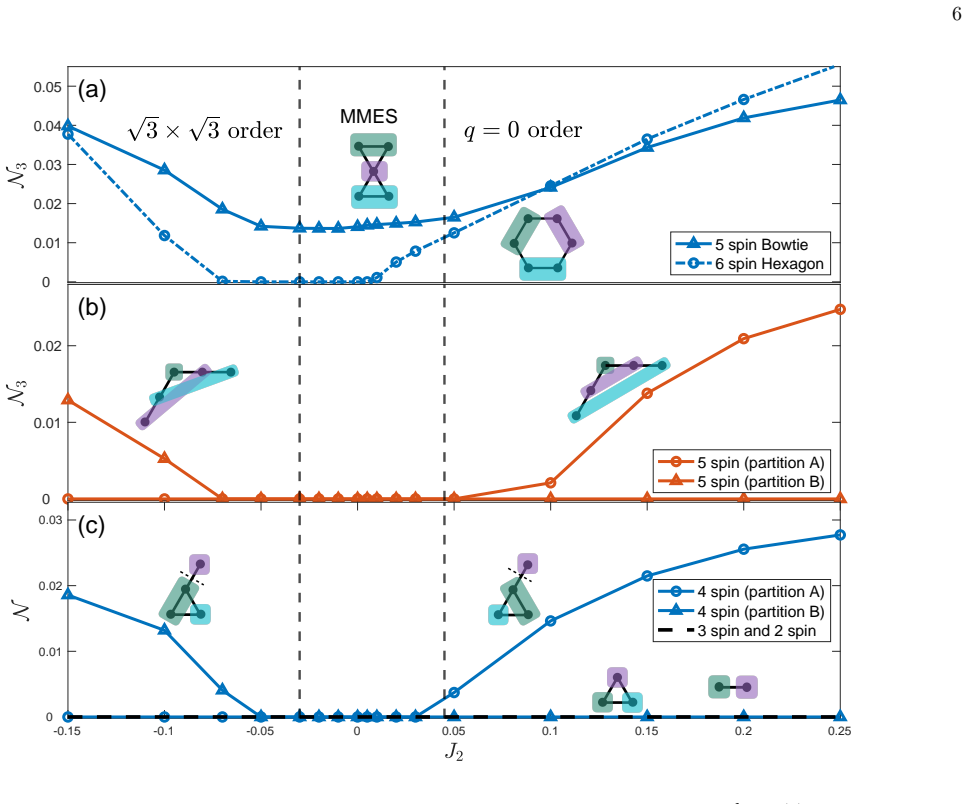
The central discovery is that in quantum spin liquids the genuine multiparty entanglement of a subregion is controlled by whether that subregion contains a loop: reduced density matrices of small non-loopy subregions have vanishing genuine multipartite negativity (GMN) across finite parameter windows, while loop-containing subregions such as the six-spin hexagonal plaquette, the five-spin Kagome bowtie, and larger loop aggregates carry positive GMN. The paper reports this loop confinement in gapped and gapless quantum spin liquids, in the Kitaev honeycomb model at zero and small $[111]$ field, in the Kagome Heisenberg model near $J_2=0$, in resonating-valence-bond wavefunctions, and in abelian and non-abelian string-net models; for abelian string-nets it proves that any non-loopy subregion is fully separable. It also reports that in the Kitaev intermediate phase, between fields $h_{c1}=0.38$ and $h_{c2}=0.64$ on the 32-site cluster, non-loopy GME appears, which it interprets as evidence against a quantum spin liquid there, while in the chiral Kagome spin liquid the minimal entangled subregion shrinks to a triangle, indicating a more loopy entanglement structure. The paper concludes by arguing that loop-localized GME is a general property of deconfined quantum gauge theories, not just of the specific spin-liquid Hamiltonians studied.
Load-bearing premise
The broad conclusion that all non-loopy subregions have zero genuine multiparty entanglement in the Kitaev and Kagome spin liquids assumes that the exact-diagonalization ground states on the 32-site honeycomb and 36-site Kagome clusters represent the thermodynamic limit, and that a zero GMN value can be read as absence of GME even where no explicit biseparability certificate was computed.
Editorial extensions
If this is right
- GME becomes a practical phase diagnostic: loop-only entanglement with the hexagon or bowtie as the minimal multipartite entangled subregion supports a stable quantum spin liquid in the Kagome Heisenberg window, while the appearance of non-loopy GME in the Kitaev intermediate phase argues against a quantum spin liquid across the whole intermediate regime.
- The zero-GME regions are stable rather than fine-tuned: because the biseparable set is convex and has full measure, sufficiently small perturbations of couplings, temperature, or environment keep non-loopy subregions free of GME, and the paper verifies finite parameter ranges where this holds.
- Loop GME is locally robust: a projective measurement on any single spin, inside or outside the loop, does not destroy the GME of a loopy subregion, so the correlation is genuinely collective around the loop.
- In abelian string-nets the absence is total: every non-loopy subregion is fully separable, so there is no entanglement of any kind there, while in non-abelian string-nets non-loopy subregions remain GME-free and the hexagon can acquire GME, as in the Ising string-net.
- For chiral quantum spin liquids, the universal edge-mode contribution to multiparty entanglement in a disk partition scales with the chiral central charge, so multiparty negativity can read off chiral edge data from the reduced density matrix of a macroscopic loopy region.
Reading between the lines
- If loop confinement of GME is universal for deconfined gauge theories, then a local GME witness defined on a loop subregion could serve as an experimental deconfinement probe in cold-atom or superconducting simulators, avoiding full state tomography; the paper mentions such a witness but does not develop the measurement protocol.
- The paper's own caveat that GMN equals zero does not strictly exclude GME means the entirely absent formulation is only as strong as the set of subregions scanned; a single counterexample among larger tree-shaped subregions, or one found by a different measure, would force the weaker claim that loop-containing regions are the first to host GME.
- A direct extension would be to test the chiral prediction by computing GMN on disks of increasing radius in the Kitaev model at small field and extracting the logarithmic slope; a matching slope in a lattice model would confirm that the chiral edge mode drives large-scale multiparty entanglement.
- Applying the same machinery to fracton orders and symmetry-protected topological states could map which phases share loop-localized GME; the paper sketches a CZX-type SPT where the square plaquette is the minimal multipartite entangled subregion, suggesting the loop rule may extend beyond gauge theories.
Signed reviews
Editorial analysis
A structured set of objections, weighed in public.
Referee Report
Summary. The paper uses entanglement microscopy to study genuine multiparty entanglement (GME) in quantum spin liquids. Its central claims are: (i) in QSLs, GME is absent in small non-loopy subregions ('entanglement frustration'); (ii) GME arises only in subregions containing a closed loop; and (iii) this 'loop-only' structure is a universal feature of deconfined quantum gauge theories. The evidence combines exact diagonalization on a 32-site honeycomb Kitaev cluster and a 36-site Kagome cluster, exact Majorana-fermion computations for Kitaev plaquette reduced density matrices, GMN semidefinite programming, adaptive-polytope separability certificates, and exact results for Abelian and non-Abelian string-net models. The paper also introduces the minimal multipartite entangled subregion (MMES) and uses its evolution to discuss the Kitaev phase diagram and the Kagome Heisenberg model under perturbations.
Significance. If the central claim is established, the paper identifies a qualitatively new organizational principle for multipartite entanglement in fractionalized phases: GME is confined to loops rather than distributed over all small clusters. This would be a substantial advance over bipartite measures and would provide a new entanglement-based diagnostic for spin-liquid phases. The exact Abelian string-net separability theorem, the exact Kitaev plaquette RDM construction, and the careful use of GMN as a convex-roof measure are genuine strengths. However, the categorical formulation 'entirely absent in non-loopy subregions' is not fully supported by the evidence, because GMN=0 does not by itself certify biseparability and the adaptive-polytope certificates cover only a finite list of subregions. With appropriate recalibration of the claims, the paper would make an important contribution.
major comments (4)
- [Abstract and Section II] The abstract and Section II state that GME is 'entirely absent' in non-loopy subregions and 'arises solely in loops.' This categorical statement is not established for the Kitaev, Kagome, and RVB examples: the evidence there is vanishing GMN, and the Methods explicitly acknowledge that N(ρ)=0 does not exclude GME. SM Table I lists adaptive-polytope certificates only for a finite set of subregions. To retain the categorical claim, the authors would need to certify biseparability for every tree subregion on the clusters or prove that GMN=0 is sufficient in these models; otherwise the abstract and Section II should be weakened to 'no GME detected' or restricted to the certified subregions.
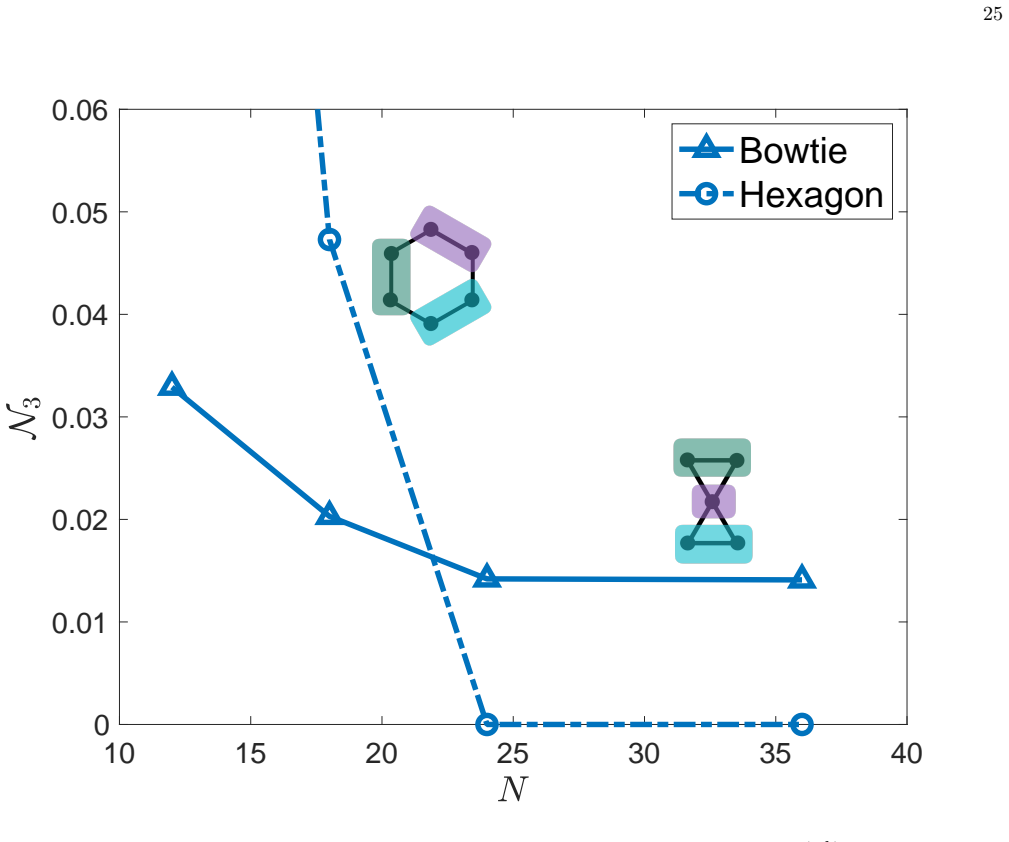
- [Section II (Figs. 3, 5) and SM IX] The 'entirely absent' part of the claim relies on ground states obtained on a single 32-site honeycomb cluster and a single 36-site Kagome cluster. The N=24 comparison and the four-point size scan for two Kagome subregions mitigate finite-size effects for those specific shapes, but they do not establish representativeness for all non-loopy subregions, especially because the MMES hierarchy involves a changing set of nested subregions. Please either quantify finite-size effects for a broader family of non-loopy subregions or explicitly restrict the claim to the subregions studied.
- [String Nets and SM X] SM X proves full separability for non-loopy subregions in Abelian string-nets. This theorem is strong and exact, but it does not apply to the Kitaev, Kagome, RVB, or non-Abelian string-net examples, where the absence of GME is inferred from vanishing GMN together with a finite list of certificates. The paper should explicitly distinguish proven absence (Abelian fixed points) from numerically observed absence, and should not present the Abelian theorem as covering the other models.
- [Discussion] The statement that 'entanglement loops are a universal property of quantum gauge theories' goes beyond the evidence presented, which consists of specific microscopic models plus the Abelian fixed-point theorem. A universal claim would require a general proof or should be explicitly labeled as a conjecture based on the examples studied. Please temper this sentence or provide a precise conjecture with stated conditions.
minor comments (5)
- [Introduction] There is a typo in 'S(k, ω.' near the discussion of the dynamic structure factor; the closing parenthesis is missing.
- [Introduction] The notation 'fQ > k' and 'fQ < k' is confusing because the integer k is also used for the number of particles; please clarify the meaning of k in these inequalities.
- [Fig. 3 caption] The caption states that solid (dashed) lines show tripartite GMN (six-partite GMN), but the meaning of '3 party' and '6 party' in the figure panels should be spelled out in terms of the actual partitions used.
- [SM Table I] The table would benefit from a short definition of each subregion (e.g., '3-hex' as three consecutive spins on a hexagon) directly in the caption, and from a statement of which Hamiltonian parameters and cluster sizes the bounds refer to.
- [Section II, Anisotropy paragraph and Fig. 4 inset] The text says the second derivative of GMN diverges at the topological transition, but the inset shows a power-law fit; please state explicitly the exponent, the fitting range, and whether the divergence is in d²N/dγ² or in a related quantity.
Circularity Check
No significant circularity: loop confinement of GME is computed from exact ground states and string-net definitions; the GMN zero-to-absence gap is a witness limitation, not a circular reduction.
full rationale
The paper's central claims—entanglement frustration and loop confinement of GME—are derived by computing the genuine multipartite negativity (GMN) from ground states obtained by exact diagonalization and exact Majorana/string-net solutions. No parameter is fitted to enforce the loop-vs-non-loopy distinction: the ED ground states come from the Kitaev, Kagome, and RVB Hamiltonians via standard Lanczos methods, and the string-net RDMs follow from the model's F-tensors and branching rules. The paper cites several works by the same group (entanglement microscopy [14], Ising-model GME [30], RVB separability [46], fate of entanglement [50]), but these are context and independent building blocks; the load-bearing loop-confinement conclusion does not reduce to any of them. The phase boundaries hc1 and hc2 are taken from the authors' forthcoming work [29], but the loop-confinement claim does not depend on those boundaries; the intermediate-phase interpretation is secondary. The Methods explicitly acknowledge that GMN=0 does not certify biseparability, and the paper partially closes this gap with adaptive-polytope certificates for selected subregions (SM Table I) and an exact Abelian string-net separability proof (SM X). The remaining gap—that 'entirely absent' is inferred from zero GMN plus a finite list of certificates—is a witness/logical-strength issue, not a circular reduction of prediction to input. Accordingly, no circular step satisfying the quote-and-reduction criterion was found.
Assumptions & free parameters
assumptions (5)
- domain assumption An Abelian string-net has branching rules with no multiplicity, so fixing any two edge labels at a trivalent vertex determines the third.
- domain assumption The Kitaev honeycomb model is exactly solvable via Majorana fermions, and the thermodynamic-limit ground state is flux free.
- domain assumption The 32-site honeycomb and 36-site Kagome exact diagonalization ground states are representative of the thermodynamic-limit spin liquids.
- domain assumption A vanishing genuine multipartite negativity is treated as absence of GME, supplemented by adaptive-polytope biseparability certificates for selected states.
- domain assumption For a chiral disk, the tripartite negativity contains a universal term log N ~ (c/4) log(R/a), and the boundary-law contributions cancel when comparing three and four slices.
Cite this review
Pith. "Pith review of Multiparty entanglement loops in quantum spin liquids." pith.science (2026). https://pith.science/paper/6PHMFM2I
@misc{pith2026250518124,
  author       = {Pith},
  title        = {Pith review of: Multiparty entanglement loops in quantum spin liquids},
  year         = {2026},
  howpublished = {\url{https://pith.science/paper/6PHMFM2I}},
  note         = {Machine review of arXiv:2505.18124}
}
read the original abstract
Quantum spin liquids (QSLs) give rise to exotic emergent particles by weaving intricate entanglement patterns in the underlying electrons. Bipartite measures between subregions can detect the presence of anyons, but little is known about the full entanglement structure of QSLs. Here, we study the multiparty entanglement of QSLs via entanglement microscopy. We find that in contrast to conventional matter, the genuine multiparty entanglement (GME) between spins is absent in the smallest subregions, a phenomenon we call "entanglement frustration". Instead, GME is more collective, and arises solely in loops. By exploiting exact results and large-scale numerics, we confirm these properties in various gapped and gapless QSLs realised in physically motivated Hamiltonians, as well as with string-net wavefunctions hosting abelian or non-abelian anyons. Our results shed new light on the phase diagram of Kitaev's honeycomb model in a Zeeman field, and the Kagome Heisenberg model under various perturbations. Going beyond QSLs, we provide evidence that entanglement loops are a universal property of quantum gauge theories. This leads to a new understanding of fractionalization, and the means by which gauge bosons encode quantum information.
Figures


Figures from the paper (12 more)




Forward citations
Cited by 2 Pith papers
-
Entanglement architecture of beyond-Landau quantum criticality
At ordinary Landau quantum critical points, genuine multipartite entanglement is strong even in tiny three-spin regions; at exotic non-Landau critical points, it vanishes in small non-loopy regions and appears only in...
-
Emergence of a Macroscopic Cat State and Multi-Channel Entanglement in a Frustrated Cluster Spin Chain
A cluster–ANNNI spin chain has a first-order QPT between a ferromagnetic cat-state phase (gap closing exponentially) and a gapped incommensurate phase with four dominant Schmidt channels.
Reference graph
Works this paper leans on
-
[29]
L. Lyu, W. Witczak-Krempa, A. Läuchli, and E. S. Sørensen, in preparation
-
[1]
Savary and L
L. Savary and L. Balents, Quantum spin liquids: a re- view, Reports on Progress in Physics80, 016502 (2016)
2016
-
[2]
Sachdev,Quantum Phases of Matter (Cambridge Uni- versity Press, 2023)
S. Sachdev,Quantum Phases of Matter (Cambridge Uni- versity Press, 2023)
work page 2023
-
[3]
Kitaev, Anyons in an exactly solved model and be- yond, Annals of Physics321, 2 (2006)
A. Kitaev, Anyons in an exactly solved model and be- yond, Annals of Physics321, 2 (2006)
2006
- [4]
- [5]
-
[6]
E. Lefrançois, G. Grissonnanche, J. Baglo, P. Lampen- Kelley, J.-Q. Yan, C. Balz, D. Mandrus, S. E. Nagler, S. Kim, Y.-J. Kim, N. Doiron-Leyraud, and L. Taille- fer, Evidence of a Phonon Hall Effect in the Kitaev Spin 10 Liquid Candidate α−RuCl3, Phys. Rev. X 12, 021025 (2022)
work page 2022
-
[7]
P. A. Lee, Quantized (or not quantized) thermal Hall ef- fect and oscillations in the thermal conductivity in the Kitaev spin liquid candidate α-RuCl3, Condensed mat- ter Journal Club 10.36471/JCCM_November_2021_02 (2021)
Show all 68 references
-
[8]
Kee, Thermal Hall conductivity ofα-RuCl3, Na- ture Materials22, 6 (2023)
H.-Y. Kee, Thermal Hall conductivity ofα-RuCl3, Na- ture Materials22, 6 (2023)
2023
-
[9]
Non-Abelian braiding of graph vertices in a supercon- ducting processor, Nature618, 264 (2023)
2023
-
[10]
Z. K. Minev, K. Najafi, S. Majumder, J. Wang, A. Stern, E.-A. Kim, C.-M. Jian, and G. Zhu, Realiz- ing string-net condensation: Fibonacci anyon braiding for universal gates and sampling chromatic polynomials, arXiv:2406.12820
-
[11]
Xu, Z.-Z
S. Xu, Z.-Z. Sun, K. Wang, H. Li, Z. Zhu, H. Dong, J. Deng, X. Zhang, J. Chen, Y. Wu, C. Zhang, F. Jin, X. Zhu, Y. Gao, A. Zhang, N. Wang, Y. Zou, Z. Tan, F. Shen, J. Zhong, Z. Bao, W. Li, W. Jiang, L.-W. Yu, Z. Song, P. Zhang, L. Xiang, Q. Guo, Z. Wang, C. Song, H. Wang, and ...
2024
-
[12]
Levin and X.-G
M. Levin and X.-G. Wen, Detecting Topological Order in a Ground State Wave Function, Phys. Rev. Lett.96, 110405 (2006)
2006
-
[13]
Kitaev and J
A. Kitaev and J. Preskill, Topological Entanglement En- tropy, Phys. Rev. Lett.96, 110404 (2006)
2006
-
[14]
T.-T. Wang, M. Song, L. Lyu, W. Witczak-Krempa, and Z. Y. Meng, Entanglement microscopy and tomography in many-body systems, Nature Communications16, 96 (2025)
2025
-
[15]
Berthiere and W
C. Berthiere and W. Witczak-Krempa, Entanglement of Skeletal Regions, Phys. Rev. Lett.128, 240502 (2022)
2022
-
[16]
Gühne and G
O. Gühne and G. Tóth, Entanglement detection, Physics Reports 474, 1 (2009)
2009
-
[17]
Hauke, M
P. Hauke, M. Heyl, L. Tagliacozzo, and P. Zoller, Mea- suring multipartite entanglement through dynamic sus- ceptibilities, Nature Physics12, 778 (2016)
2016
-
[18]
Frérot, M
I. Frérot, M. Fadel, and M. Lewenstein, Probing quan- tum correlations in many-body systems: a review of scal- able methods, Reports on Progress in Physics86, 114001 (2023)
2023
-
[19]
Laurell, A
P. Laurell, A. Scheie, E. Dagotto, and D. A. Tennant, Witnessing Entanglement and Quantum Correlations in Condensed Matter: A Review, Advanced Quantum Tech- nologies 8, 2400196 (2025)
2025
-
[20]
Tóth, Multipartite entanglement and high-precision metrology, Phys
G. Tóth, Multipartite entanglement and high-precision metrology, Phys. Rev. A85, 022322 (2012)
2012
-
[21]
Hyllus, W
P. Hyllus, W. Laskowski, R. Krischek, C. Schwem- mer, W. Wieczorek, H. Weinfurter, L. Pezzé, and A. Smerzi, Fisher information and multiparticle entan- glement, Phys. Rev. A85, 022321 (2012)
2012
-
[22]
Hickey and S
C. Hickey and S. Trebst, Emergence of a field-driven U(1) spin liquid in the Kitaev honeycomb model, Nature Com- munications 10, 530 (2019)
2019
-
[23]
Z. Zhu, I. Kimchi, D. N. Sheng, and L. Fu, Robust non- Abelian spin liquid and a possible intermediate phase in the antiferromagnetic Kitaev model with magnetic field, Phys. Rev. B97, 241110 (2018)
2018
-
[24]
Gohlke, R
M. Gohlke, R. Moessner, and F. Pollmann, Dynamical and topological properties of the Kitaev model in a [111] magnetic field, Physical Review B 98, 014418 (2018), pRB
2018
-
[25]
Holdhusen, D
W. Holdhusen, D. Huerga, and G. Ortiz, Emergent mag- netic order in the antiferromagnetic Kitaev model in a
-
[26]
Zhang, G
S.-S. Zhang, G. B. Halász, and C. D. Batista, Theory of the Kitaev model in a [111] magnetic field, Nature Communications 13, 399 (2022)
2022
-
[27]
Jungnitsch, T
B. Jungnitsch, T. Moroder, and O. Gühne, Taming Mul- tiparticle Entanglement, Physical Review Letters 106, 190502 (2011)
2011
-
[28]
Peres, Separability Criterion for Density Matrices, Phys
A. Peres, Separability Criterion for Density Matrices, Phys. Rev. Lett.77, 1413 (1996)
1996
-
[30]
L. Lyu, M. Song, T.-T. Wang, Z. Y. Meng, and W. Witczak-Krempa, Multiparty entanglement mi- croscopy of quantum Ising models in one, two, and three dimensions, Phys. Rev. B111, 245108 (2025)
2025
-
[31]
Lambert and E
J. Lambert and E. S. Sørensen, Revealing divergent lengthscalesusingquantumFisherinformationintheKi- taevhoneycombmodel,Phys.Rev.B 102,224401(2020)
2020
-
[32]
H. J. Liao, Z. Y. Xie, J. Chen, Z. Y. Liu, H. D. Xie, R. Z. Huang, B. Normand, and T. Xiang, Gapless Spin-Liquid Ground State in the S = 1/2 Kagome Antiferromagnet, Phys. Rev. Lett.118, 137202 (2017)
2017
-
[33]
Mekata, Kagome: The Story of the Basketweave Lat- tice, Physics Today56, 12 (2003)
M. Mekata, Kagome: The Story of the Basketweave Lat- tice, Physics Today56, 12 (2003)
2003
-
[34]
Y.-C. He, M. P. Zaletel, M. Oshikawa, and F. Poll- mann, Signatures of Dirac Cones in a DMRG Study of the Kagome Heisenberg Model, Phys. Rev. X7, 031020 (2017)
2017
-
[35]
Iqbal, F
Y. Iqbal, F. Becca, and D. Poilblanc, Projected wave function study ofZ2 spin liquids on the kagome lattice for the spin- 1 2 quantum Heisenberg antiferromagnet, Phys. Rev. B84, 020407 (2011)
2011
-
[36]
B. K. Clark, J. M. Kinder, E. Neuscamman, G. K.-L. Chan, and M. J. Lawler, Striped Spin Liquid Crystal Ground State Instability of Kagome Antiferromagnets, Phys. Rev. Lett.111, 187205 (2013)
2013
-
[37]
P. W. Leung and V. Elser, Numerical studies of a 36-site kagome antiferromagnet, Phys. Rev. B47, 5459 (1993)
1993
-
[38]
Lecheminant, B
P. Lecheminant, B. Bernu, C. Lhuillier, L. Pierre, and P. Sindzingre, Order versus disorder in the quantum Heisenberg antiferromagnet on the kagomé lattice using exact spectra analysis, Phys. Rev. B56, 2521 (1997)
1997
-
[39]
A. M. Läuchli, J. Sudan, and E. S. Sørensen, Ground- state energy and spin gap of spin-1 2 Kagomé-Heisenberg antiferromagnetic clusters: Large-scale exact diagonal- ization results, Phys. Rev. B83, 212401 (2011)
2011
-
[40]
A. M. Läuchli, J. Sudan, and R. Moessner,S = 1 2 kagome Heisenberg antiferromagnet revisited, Phys. Rev. B100, 155142 (2019)
2019
-
[41]
Becca, Gutzwiller projected states for theJ1 − J2 Heisenberg model on the Kagome lattice: Achievements and pitfalls, Phys
Y.Iqbal, F.Ferrari, A.Chauhan, A.Parola, D.Poilblanc, and F. Becca, Gutzwiller projected states for theJ1 − J2 Heisenberg model on the Kagome lattice: Achievements and pitfalls, Phys. Rev. B104, 144406 (2021)
2021
-
[42]
Bauer, L
B. Bauer, L. Cincio, B. P. Keller, M. Dolfi, G. Vidal, S. Trebst, and A. W. W. Ludwig, Chiral spin liquid and emergent anyons in a Kagome lattice Mott insulator, Na- ture Communications5, 5137 (2014)
2014
-
[43]
P. W. Anderson, The Resonating Valence Bond State in La2CuO4 and Superconductivity, Science 235, 1196 (1987). 11
1987
-
[44]
Schuch, D
N. Schuch, D. Poilblanc, J. I. Cirac, and D. Pérez-García, Resonating valence bond states in the PEPS formalism, Phys. Rev. B86, 115108 (2012)
2012
-
[45]
F.YangandH.Yao,FrustratedResonatingValenceBond States in Two Dimensions: Classification and Short- Range Correlations, Phys. Rev. Lett.109, 147209 (2012)
2012
-
[46]
Parez, C
G. Parez, C. Berthiere, and W. Witczak-Krempa, Sep- arability and entanglement of resonating valence-bond states, SciPost Phys.15, 066 (2023)
2023
-
[47]
D. S. Rokhsar and S. A. Kivelson, Superconductivity and theQuantumHard-CoreDimerGas,Phys.Rev.Lett. 61, 2376 (1988)
1988
-
[48]
Y. Tang, A. W. Sandvik, and C. L. Henley, Properties of resonating-valence-bond spin liquids and critical dimer models, Phys. Rev. B84, 174427 (2011)
2011
-
[49]
A. F. Albuquerque and F. Alet, Critical correlations for short-range valence-bond wave functions on the square lattice, Phys. Rev. B82, 180408 (2010)
2010
-
[50]
Parez and W
G. Parez and W. Witczak-Krempa, The Fate of Entan- glement, arXiv e-prints , arXiv:2402.06677 (2024)
2024
-
[51]
M. A. Levin and X.-G. Wen, String-net condensation: A physical mechanism for topological phases, Phys. Rev. B 71, 045110 (2005)
2005
-
[52]
Cappelli, M
A. Cappelli, M. Huerta, and G. R. Zemba, Thermal transport in chiral conformal theories and hierarchical quantum Hall states, Nuclear Physics B636, 568 (2002)
2002
-
[53]
Li and F
H. Li and F. D. M. Haldane, Entanglement Spectrum as a Generalization of Entanglement Entropy: Identification ofTopologicalOrderinNon-AbelianFractionalQuantum Hall Effect States, Phys. Rev. Lett.101, 010504 (2008)
2008
-
[54]
Calabrese, J
P. Calabrese, J. Cardy, and E. Tonni, Entanglement neg- ativity in extended systems: a field theoretical approach, Journal of Statistical Mechanics: Theory and Experi- ment 2013, P02008 (2013)
2013
-
[55]
Chen, Z.-X
X. Chen, Z.-X. Liu, and X.-G. Wen, Two-dimensional symmetry-protected topological orders and their pro- tected gapless edge excitations, Physical Review B84, 10.1103/physrevb.84.235141 (2011)
2011 doi
-
[56]
Horodecki, P
M. Horodecki, P. Horodecki, and R. Horodecki, Separa- bilityofmixedstates: necessaryandsufficientconditions, Physics Letters A223, 1 (1996)
1996
-
[57]
Hofmann, T
M. Hofmann, T. Moroder, and O. Gühne, Analytical characterization of the genuine multiparticle negativity, Journal of Physics A: Mathematical and Theoretical47, 155301 (2014)
2014
-
[58]
Ohst, X.-D
T.-A. Ohst, X.-D. Yu, O. Gühne, and H. C. Nguyen, Certifyingquantumseparabilitywithadaptivepolytopes, SciPost Phys.16, 063 (2024)
2024
-
[59]
Löfberg, inIn Proceedings of the CACSD Conference (Taipei, Taiwan, 2004)
J. Löfberg, inIn Proceedings of the CACSD Conference (Taipei, Taiwan, 2004)
2004
-
[60]
MOSEK Optimization Toolbox for MATLAB 10.2.17 , MOSEK ApS (2024)
2024
-
[61]
Lewenstein, B
M. Lewenstein, B. Kraus, J. I. Cirac, and P. Horodecki, Optimization of entanglement witnesses, Phys. Rev. A 62, 052310 (2000)
2000
-
[62]
E. H. Lieb, Flux Phase of the Half-Filled Band, Phys. Rev. Lett.73, 2158 (1994)
1994
-
[63]
Zschocke and M
F. Zschocke and M. Vojta, Physical states and finite- size effects in Kitaev’s honeycomb model: Bond disorder, spin excitations, and NMR line shape, Phys. Rev. B92, 014403 (2015)
2015
-
[64]
Yao and X.-L
H. Yao and X.-L. Qi, Entanglement Entropy and Entan- glement Spectrum of the Kitaev Model, Phys. Rev. Lett. 105, 080501 (2010)
2010
-
[65]
Baskaran, S
G. Baskaran, S. Mandal, and R. Shankar, Exact Results for Spin Dynamics and Fractionalization in the Kitaev Model, Phys. Rev. Lett.98, 247201 (2007)
2007
-
[66]
Hamma, R
A. Hamma, R. Ionicioiu, and P. Zanardi, Bipartite entan- glement and entropic boundary law in lattice spin sys- tems, Phys. Rev. A71, 022315 (2005)
2005
-
[67]
entanglement frustration
K.-C. Ha, K. H. Han, and S.-H. Kye, Separability of multi-qubit states in terms of diagonal and anti-diagonal entries, Quantum Information Processing18, 34 (2018). 12 Supplemental Materials for Multipartite Entanglement in Quantum Spin Liquids CONTENTS I. Introduction 1 II. En...
2018
-
[111]
field, Phys. Rev. B109, 174411 (2024)
2024
Reviewed August 7, 2026 · model on record in the stance chip above.
Discussion (0). Continue with ORCID to comment.