REVIEW 3 major objections 6 minor 158 references
Galaxies OBserved as Low-luminosity Identified Nebulae (GOBLIN): a catalog of 43,000 high-probability dwarf galaxy candidates in the UNIONS survey
T0 review · 3 major / 6 minor · reviewed 2026-08-07 · deepseek-v4-flash
Pith's one-line read GOBLIN: a UNIONS search returns 42,965 high-confidence dwarf galaxy candidates, 23,072 with probability above 0.9, presented as a catalog for follow-up.
desk verdict A solid, unusually honest dwarf-candidate catalog for the northern sky, with one big caveat: the headline 42,965 count rests on a calibration set that does not sample the full catalog, and the catalog itself is not released yet. read the letter →
The pith
A machine-rendered reading of the paper's core claim, the machinery that carries it, and where it could break.
The reading
What carries the argument
The load-bearing object is the soft-label classifier built from the pretrained morphology network Zoobot, adapted so it predicts a continuous dwarf probability instead of a binary class. The labels come from averaging 12 expert assessments per object (yes, unsure, and no encoded as 1, 0.5, and 0), which is what lets the model reproduce expert uncertainty. Around that classifier sits a detection chain: 4x4 binning tuned to recover the faintest known ultra-diffuse galaxies, artifact and star masking, MTObjects' max-tree segmentation with a lowered 'move factor' to keep low-surface-brightness outskirts, empirical parameter cuts separating known dwarfs from nearby non-dwarfs, three-band membership matching, and friends-of-friends deduplication.
What would settle it
Take a random sample of a few hundred GOBLIN candidates with probability $>0.9$ and obtain deep, high-resolution imaging or spectroscopy: if a large fraction show resolvable spiral structure or redshifts placing them well beyond 120 Mpc, the interpretation of the high-probability bin as dominated by dwarf galaxies would be refuted.
Extended reading notes
Core claim
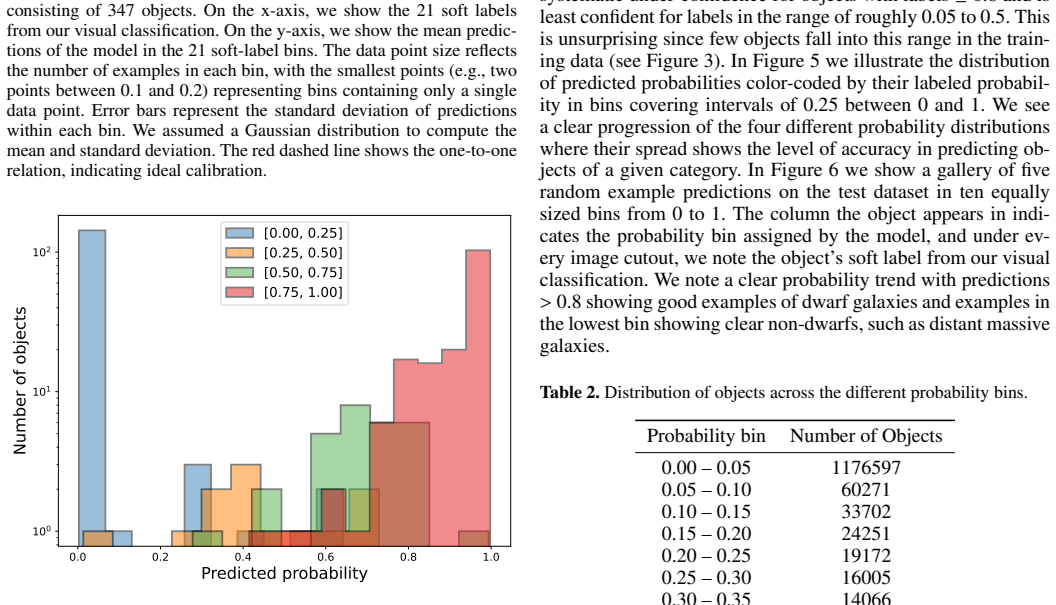
Starting from UNIONS $g$, $r$, and $i$ image tiles, the paper preprocesses the data (binning, masking artifacts, hot pixels, stars, and background over-subtraction), detects low-surface-brightness objects with the max-tree software MTObjects, applies per-band parameter cuts calibrated on known dwarfs, and cross-matches detections across bands. A fine-tuned ensemble of ten Zoobot networks, trained with soft expert labels (four raters, three passes each) under a KL-divergence loss, assigns every one of the roughly 1.5 million de-duplicated candidates a dwarf probability. The central result is that 42,965 objects receive probability $>0.8$ (23,072 with $>0.9$, and 41,462 of the $>0.8$ set were not used in training), and the high-probability objects are spatially correlated with massive galaxies ($\log(M_*/M_\odot)\ge 10$) within 120 Mpc. The paper presents this as a candidate catalog rather than a confirmed sample.
Load-bearing premise
The load-bearing premise is that expert visual labels on known dwarfs and their neighbors teach the model what 'dwarf-like' means, so a probability above 0.8 on an unseen object is a reliable sign of a genuine dwarf galaxy, even though the model has no distance information and distant background spirals can look dwarf-like.
Editorial extensions
If this is right
- The GOBLIN catalog provides positions, structural parameters in $g$, $r$, and $i$, corrected magnitudes, and dwarf probabilities for roughly 1.5 million objects, so users can select their own completeness versus contamination trade-off.
- The 42,965 candidates above $p>0.8$ (23,072 above $p>0.9$) constitute a northern-sky sample for studying dwarf populations around massive galaxies, complementing southern surveys.
- The spatial correlation of high-probability candidates with massive galaxies within 120 Mpc supports the interpretation that many candidates are associated with nearby hosts and motivates host-by-host follow-up.
- On the held-out test set the ensemble is well calibrated, with a Brier score of 0.0076 and an expected calibration error of 0.018, suggesting the probability output can be used for ranking candidates.
- Because MTO structural parameters are systemically imperfect (effective radii are underestimated and magnitudes need linear corrections with residual scatter around 0.4-0.6 mag), the catalog includes both measured and corrected values for user applications.
Reading between the lines
- A conservative reading is that 42,965 is an upper envelope: adding photometric redshifts or neutral-hydrogen follow-up would probably move some of the $p>0.8$ objects into a distant late-type galaxy population, since the 0.8 threshold is a reference point, not a purity guarantee.
- The raters also recorded morphology labels (dE, dEN, dI, dIN) and special features that this paper does not use; those labels could train a second-stage classifier that separates genuine dwarfs from distant spirals, or quantify how much of the soft-label uncertainty tracks morphological ambiguity.
- Because the pipeline is tile-based and uses only standard survey inputs, it can be re-run when UNIONS extends to lower declination or on future wide surveys, yielding a homogeneous dwarf-candidate census over larger areas and depths.
- The claimed correlation with massive galaxies could be converted into a quantitative test by comparing radial number counts around HECATE hosts with $Λ$CDM satellite predictions, which is a natural next step the authors say they plan.
Editorial analysis
A structured set of objections, weighed in public.
Referee Report
Summary. The paper presents GOBLIN, a catalog of ~1.5 million low-surface-brightness detections in the UNIONS gri-band footprint, with per-object probabilities of being a dwarf galaxy assigned by a fine-tuned Zoobot ensemble. The pipeline preprocesses UNIONS tiles, detects sources with MTObjects, applies parameter cuts and three-band cross-matching, and trains a classifier on visual labels assigned by four experts to literature dwarf candidates and nearby candidates assumed to be non-dwarfs. The authors report 42,965 candidates with model probability >0.8, of which 23,072 exceed 0.9, and show a spatial correlation between high-probability candidates and massive galaxies within 120 Mpc. The paper explicitly frames the output as candidate lists rather than confirmed dwarfs, acknowledges the lack of distance measurements, and releases the code and catalog.
Significance. If the probability scale is reliable on the full catalog, GOBLIN would be a major community resource: it is the first large dwarf-candidate catalog in the UNIONS footprint, with structural parameters and classification probabilities for ~1.5 million objects, and it enables environmental and satellite-population studies. The pipeline is described in unusual detail, the training-labeling procedure is transparent, the code is public, and the authors honestly document known biases such as MTO effective-radius underestimation and the morphological degeneracy with background spirals. The central quantitative claim, however, depends on a calibration that has not been demonstrated to transfer from the labeled training subpopulation to the full MTO candidate catalog, and the host-galaxy correlation lacks a null comparison. These issues are fixable but currently leave the headline candidate count and the environmental inference less secure than the abstract suggests.
major comments (3)
- [§4.1 and §4.2] The headline count of 42,965 candidates at p>0.8 rests on calibration metrics (Brier=0.0076, ECE=0.018) computed on a 347-object, 10% stratified test set drawn from the same labeled pool of literature dwarfs plus nearest neighbors described in §3.4. This pool is not representative of the full ~1.5 million MTO candidate catalog, which contains arbitrary field objects, artifacts, and distant galaxies. Since the paper itself states in §4.2 that background spiral galaxies can be morphologically indistinguishable from nearby dwarfs and that no distances are available, the transferability of the probability scale to the full catalog is unestablished. I ask the authors to provide an explicit contamination estimate for the p>0.8 sample, for example by applying the classifier to a sample of spectroscopically confirmed distant galaxies or to randomized sky positions, or by estimating the expected number of unresolved background spirals that pass the MTO parameter cuts. Without such a test, the 42,965 number may be substantially inflated.
- [§4.2 and Figure 8] The claimed spatial correlation between high-probability candidates and massive galaxies within 120 Mpc is presented visually without any null or control comparison. The density map in Figure 8 does not show whether the candidate overdensity around massive galaxies exceeds what would be expected from the large-scale structure sampled by the survey footprint, the survey selection function, or the variable depth/coverage of the three bands. I request a quantitative control: compare the candidate density around massive galaxies with that around random positions matched to the same footprint and depth, or compute a two-point cross-correlation with jackknife uncertainties. As written, the environmental inference is suggestive but not demonstrated.
- [§3.3 and Appendix B] The parameter cuts in Appendix B are derived using the same known dwarfs and the same 'nearest-neighbor non-dwarf' assumption that later define the training labels in §3.4. The reported removal fractions (32%, 42%, 28% of non-dwarfs, and ~1.3–1.5% of dwarfs) are therefore fitted values on the training sample, not out-of-sample estimates. This does not invalidate the filtering, but it means the final candidate pool and the subsequent classifier may be jointly overfit to the literature-dwarf population. Please either report cross-validated retention/contamination rates for the cuts or demonstrate that the cuts do not preferentially remove the population later assigned high probability.
minor comments (6)
- [§4.1 / Figure 4 caption] The caption refers to 'the 21 soft labels from our visual classification' without defining the grid; please state explicitly that the averaged labels take 21 discrete values (presumably 0, 0.05, ..., 1) and that the point size in Figure 4 reflects bin occupancy.
- [§3.1.4] The sentence introducing SEP contains a duplicated verb ('we used the detection software SEP 5 ... to detect'); please rephrase for clarity.
- [§3.4] The RGB scaling equation (1) uses Q and stretch without units or a worked example; specifying the choice Q=7, stretch=125, gamma=0.25 in the text is helpful, but a brief definition of the intensity scale (e.g., ADU after binning) would make the transformation reproducible.
- [§4.2 / Table 3] The catalog sample table and its caption do not state where the full machine-readable catalog will be permanently hosted, the format, or whether there is a DOI. For a catalog paper, an access URL or archive identifier should be included.
- [Appendix B] The i-band filter includes a large number of relational criteria (Eqs. B.9–B.16) with no indication of how they were selected or whether they were pruned to avoid redundancy; a sentence on model selection for the cuts would help.
- [Abstract and §1] The abstract states the candidates are 'unresolved dwarf galaxy candidates' while the introduction and §4.2 describe them as low-surface-brightness sources that may be resolved or partially resolved; please harmonize the terminology to avoid confusion about what 'unresolved' means in this context.
Circularity Check
No significant circularity: GOBLIN is a supervised candidate catalog whose probability scale is defined and calibrated on a held-out set of expert labels; the acknowledged lack of distance confirmation is a validity limitation, not a circular derivation.
full rationale
The paper's central deliverable is a catalog of dwarf galaxy candidates with model-assigned probabilities. The probability p_dwarf is explicitly defined as the averaged output of expert visual labels (Section 3.4: 'The final classification for each candidate was derived by averaging all 12 resulting labels. This average represents the probability that a given object is a dwarf galaxy.'). The model is then trained to reproduce these soft labels, and its calibration is evaluated on a separately held-out 10% test set (Section 4.1), not on the training data. This is standard supervised machine learning: the prediction is not equivalent to the input by construction, because the test set is independent and the reported Brier score and ECE measure generalization within the labeled distribution. The headline count of 42,965 objects with p>0.8 is an application of the trained ensemble to the full MTO candidate catalog, not a fitted parameter that directly produces that count. The paper repeatedly and explicitly frames these objects as candidates rather than confirmed dwarfs, and in Section 4.2 it acknowledges the fundamental limitation that background spiral galaxies can appear morphologically similar to nearby dwarfs and that no distance measurements are available. The spatial correlation with massive galaxies is presented as 'circumstantial evidence' rather than as a derivation, and it relies on the external HECATE catalog. The literature dwarf catalogs and Zoobot pretraining are external inputs, not self-citations. Self-citations by the authors (e.g., Müller & Jerjen 2020, Müller & Schnider 2021) appear only as contextual references and are not load-bearing for the catalog construction. Consequently, no circular step can be exhibited from the paper's text: the acknowledged limitations concern external validity and contamination, not equivalence of the prediction to its inputs.
Assumptions & free parameters
free parameters (9)
- MTO move factor =
0.39 (default 0.5)
- Filter criteria in Appendix B =
Multiple thresholds and inequality coefficients (B.1 to B.16)
- RGB stretch parameters =
Q=7, stretch=125, gamma=0.25
- Label smoothing alpha =
0.01
- Augmentation noise scale =
0.3
- Cross-match radius and band requirement =
10 arcsec, >=2 of 3 bands
- Probability threshold for headline count =
0.8
- g/r magnitude correction fits =
Linear shift(s), residuals 0.59 (g) and 0.42 (r)
- Non-dwarf sampling ratio =
20 nearest candidates per known dwarf
assumptions (6)
- domain assumption UNIONS gri images are deep enough to reveal dwarf galaxies, with the r-band reaching 28.4 mag/arcsec^2 for extended sources.
- domain assumption MTO structural parameters, despite known effective radius underestimation, separate dwarfs from non-dwarfs after the fitted cuts.
- domain assumption Averaged expert visual labels (four raters, three repetitions) are a valid ground truth for dwarf-ness.
- domain assumption The six literature catalogs used for training are representative of the dwarf population in the UNIONS footprint.
- domain assumption Unresolved background spiral galaxies do not dominate the p>0.8 probability bins.
- domain assumption Standard photometric and image-processing tools (SEP, MTO, photutils, Gaia-based masking) behave as documented.
Cite this review
Pith. "Pith review of Galaxies OBserved as Low-luminosity Identified Nebulae (GOBLIN): a catalog of 43,000 high-probability dwarf galaxy candidates in the UNIONS survey." pith.science (2026). https://pith.science/paper/KJMPRFYL
@misc{pith2026250518307,
  author       = {Pith},
  title        = {Pith review of: Galaxies OBserved as Low-luminosity Identified Nebulae (GOBLIN): a catalog of 43,000 high-probability dwarf galaxy candidates in the UNIONS survey},
  year         = {2026},
  howpublished = {\url{https://pith.science/paper/KJMPRFYL}},
  note         = {Machine review of arXiv:2505.18307}
}
abstract
The detection of low surface brightness galaxies beyond the Local Group poses significant observational challenges, yet these faint systems are fundamental to our understanding of dark matter, hierarchical galaxy formation, and cosmic structure. Their abundance and distribution provide crucial tests for cosmological models, particularly regarding the small-scale predictions of $\Lambda$CDM. We present a systematic detection framework for dwarf galaxy candidates in Ultraviolet Near Infrared Optical Northern Survey (UNIONS) data covering 4,861 deg$^{2}$. Our pipeline preprocesses UNIONS gri-band data through binning, artifact removal, and stellar masking, then employs MTObjects (MTO) for low surface brightness detection. After parameter cuts and cross-matching, we obtain $\sim$360 candidates per deg$^{2}$, totaling $\sim$1.5 million candidates forming our GOBLIN (Galaxies OBserved as Low-luminosity Identified Nebulae) catalog. We fine-tuned the deep learning model Zoobot, pre-trained on Galaxy Zoo labels, for classification. Training data came from visual inspection of literature candidates with probability labels from expert assessments, capturing consensus and uncertainty. Applied to all MTO objects, our method identifies 42,965 dwarf candidates with probability $>$ 0.8, including 23,072 with probability $>$ 0.9. High-probability candidates correlate spatially with massive galaxies (log$(M_{*}/M_{\odot}) \geq$ 10) within 120 Mpc. While some of these objects may have been previously identified in other surveys, we present this extensive catalog of candidates, including their positions, structural parameter estimates, and classification probabilities, as a resource for the community to enable studies of galaxy formation, evolution, and the distribution of dwarf galaxies in different environments.
Figures


Figures from the paper (5 more)



Reference graph
Works this paper leans on
-
[1]
, " * write output.state after.block = add.period write newline
ENTRY address archiveprefix author booktitle chapter edition editor howpublished institution eprint journal key month note number organization pages publisher school series title type volume year label extra.label sort.label short.list INTEGERS output.state before.all mid.sentence after.sentence after.block FUNCTION init.state.consts #0 'before.all := #1 ...
-
[2]
write newline
" write newline "" before.all 'output.state := FUNCTION n.dashify 't := "" t empty not t #1 #1 substring "-" = t #1 #2 substring "--" = not "--" * t #2 global.max substring 't := t #1 #1 substring "-" = "-" * t #2 global.max substring 't := while if t #1 #1 substring * t #2 global.max substring 't := if while FUNCTION word.in bbl.in " " * FUNCTION format....
-
[3]
Abbott , T. M. C., Abdalla , F. B., Allam , S., et al. 2018, , 239, 18
2018
-
[4]
2018 a , , 70, S4
Aihara , H., Arimoto , N., Armstrong , R., et al. 2018 a , , 70, S4
2018
-
[5]
2018 b , , 70, S8
Aihara , H., Armstrong , R., Bickerton , S., et al. 2018 b , , 70, S8
2018
-
[6]
2023, , 671, A17
Ay c oberry , E., Ajani , V., Guinot , A., et al. 2023, , 671, A17
2023
-
[7]
2023, , 674, A32
Babusiaux , C., Fabricius , C., Khanna , S., et al. 2023, , 674, A32
2023
-
[8]
2016, Journal of Open Source Software, 1, 58
Barbary, K. 2016, Journal of Open Source Software, 1, 58
2016
Show all 158 references
-
[9]
2020, The Astrophysical Journal Letters, 893, L9
Bennet, P., Sand, D., Crnojevi \'c , D., et al. 2020, The Astrophysical Journal Letters, 893, L9
2020
-
[10]
J., Crnojevi \'c , D., et al
Bennet , P., Sand , D. J., Crnojevi \'c , D., et al. 2017, , 850, 109
2017
-
[11]
2010, Astrophysics Source Code Library, ascl
Bertin, E. 2010, Astrophysics Source Code Library, ascl
2010
-
[12]
& Arnouts , S
Bertin , E. & Arnouts , S. 1996, , 117, 393
1996
-
[13]
W., Bottrell, C., Hani, M
Bickley, R. W., Bottrell, C., Hani, M. H., et al. 2021, Monthly Notices of the Royal Astronomical Society, 504, 372
2021
-
[14]
W., Ellison, S
Bickley, R. W., Ellison, S. L., Patton, D. R., et al. 2022, Monthly Notices of the Royal Astronomical Society, 514, 3294
2022
-
[15]
W., Ellison, S
Bickley, R. W., Ellison, S. L., Patton, D. R., & Wilkinson, S. 2023, Monthly Notices of the Royal Astronomical Society, 519, 6149
2023
-
[16]
2020, Monthly Notices of the Royal Astronomical Society, 498, 2138
B \' lek, M., Duc, P.-A., Cuillandre, J.-C., et al. 2020, Monthly Notices of the Royal Astronomical Society, 498, 2138
2020
-
[17]
Binggeli , B., Sandage , A., & Tammann , G. A. 1985, , 90, 1681
1985
-
[18]
1990, Astronomy and Astrophysics (ISSN 0004-6361), vol
Binggeli, B., Tarenghi, M., & Sandage, A. 1990, Astronomy and Astrophysics (ISSN 0004-6361), vol. 228, no. 1, Feb. 1990, p. 42-60. Research supported by SNSF., 228, 42
1990
-
[19]
2019, arXiv preprint arXiv:1911.06341
Bom, C., Poh, J., Nord, B., Blanco-Valentin, M., & Dias, L. 2019, arXiv preprint arXiv:1911.06341
2019 arXiv
-
[20]
2019, in Astronomical Society of the Pacific Conference Series, Vol
Bosch , J., AlSayyad , Y., Armstrong , R., et al. 2019, in Astronomical Society of the Pacific Conference Series, Vol. 523, Astronomical Data Analysis Software and Systems XXVII, ed. P. J. Teuben , M. W. Pound , B. A. Thomas , & E. M. Warner , 521
2019
-
[21]
2018, , 70, S5
Bosch , J., Armstrong , R., Bickerton , S., et al. 2018, , 70, S5
2018
-
[22]
2024, astropy/photutils: 1.13.0
Bradley, L., Sip o cz, B., Robitaille, T., et al. 2024, astropy/photutils: 1.13.0
2024
-
[23]
Brier, G. W. 1950, Monthly weather review, 78, 1
1950
-
[24]
Bullock, J. S. & Boylan-Kolchin, M. 2017, Annual Review of Astronomy and Astrophysics, 55, 343
2017
-
[25]
K., Nord, B., et al
Caldeira, J., Wu, W. K., Nord, B., et al. 2019, Astronomy and Computing, 28, 100307
2019
-
[26]
G., Beaton, R
Carlsten, S. G., Beaton, R. L., Greco, J. P., & Greene, J. E. 2019, The Astrophysical Journal Letters, 878, L16
2019
-
[27]
G., Greene , J
Carlsten , S. G., Greene , J. E., Beaton , R. L., Danieli , S., & Greco , J. P. 2022, , 933, 47
2022
-
[28]
C., Magnier, E., Metcalfe, N., et al
Chambers, K. C., Magnier, E., Metcalfe, N., et al. 2016, arXiv preprint arXiv:1612.05560
2016 arXiv
-
[29]
2022, Astronomy & Astrophysics, 659, A140
Chan, J., Lemon, C., Courbin, F., et al. 2022, Astronomy & Astrophysics, 659, A140
2022
-
[30]
J., Arag \'o n-Salamanca, A., et al
Cheng, T.-Y., Conselice, C. J., Arag \'o n-Salamanca, A., et al. 2020, Monthly Notices of the Royal Astronomical Society, 493, 4209
2020
-
[31]
A., Tully, R
Chiboucas, K., Jacobs, B. A., Tully, R. B., & Karachentsev, I. D. 2013, The Astronomical Journal, 146, 126
2013
-
[32]
2023, , 673, A100
Chu , A., Durret , F., Ellien , A., et al. 2023, , 673, A100
2023
-
[33]
F., Nord, B., & Peek, J
\'C iprijanovi \'c , A., Snyder, G. F., Nord, B., & Peek, J. E. 2020, Astronomy and Computing, 32, 100390
2020
-
[34]
2018, A&A, 616, A14
Collaboration, G., Mignard, F., Klioner, S., et al. 2018, A&A, 616, A14
2018
-
[35]
Collins , M. L. M., Tollerud , E. J., Rich , R. M., et al. 2020, , 491, 3496
2020
-
[36]
1995, Machine Learning
Cortes, C. 1995, Machine Learning
1995
-
[37]
2019, The Astrophysical Journal, 872, 80
Crnojevi \'c , D., Sand, D., Bennet, P., et al. 2019, The Astrophysical Journal, 872, 80
2019
-
[38]
2023, , 521, 4009
Crosby , E., Jerjen , H., M \"u ller , O., et al. 2023, , 521, 4009
2023
-
[39]
2024, , 527, 9118
Crosby , E., Jerjen , H., M \"u ller , O., et al. 2024, , 527, 9118
2024
-
[40]
& van Dokkum , P
Danieli , S. & van Dokkum , P. 2019, , 875, 155
2019
-
[41]
2017, The Astrophysical Journal, 837, 136
Danieli, S., van Dokkum, P., Merritt, A., et al. 2017, The Astrophysical Journal, 837, 136
2017
-
[42]
Davies, A., Serjeant, S., & Bromley, J. M. 2019, Monthly Notices of the Royal Astronomical Society, 487, 5263
2019
-
[43]
2023, Astronomy & Astrophysics, 674, A2
De Angeli, F., Weiler, M., Montegriffo, P., et al. 2023, Astronomy & Astrophysics, 674, A2
2023
-
[44]
J., Lang , D., et al
Dey , A., Schlegel , D. J., Lang , D., et al. 2019, , 157, 168
2019
-
[45]
W., & Dambre, J
Dieleman, S., Willett, K. W., & Dambre, J. 2015, Monthly notices of the royal astronomical society, 450, 1441
2015
-
[46]
Doliva-Dolinsky , A., Collins , M. L. M., & Martin , N. F. 2025, arXiv e-prints, arXiv:2502.06948
2025 arXiv
-
[47]
L., Gygax , J
Domber , J. L., Gygax , J. D., Aumiller , P., et al. 2022, in Society of Photo-Optical Instrumentation Engineers (SPIE) Conference Series, Vol. 12180, Space Telescopes and Instrumentation 2022: Optical, Infrared, and Millimeter Wave, ed. L. E. Coyle , S. Matsuura , & M. D. Per...
2022
-
[48]
2018, Monthly Notices of the Royal Astronomical Society, 476, 3661
Dom \' nguez S \'a nchez, H., Huertas-Company, M., Bernardi, M., Tuccillo, D., & Fischer, J. 2018, Monthly Notices of the Royal Astronomical Society, 476, 3661
2018
-
[49]
L., Nidever , D
Drlica-Wagner , A., Carlin , J. L., Nidever , D. L., et al. 2021, , 256, 2
2021
-
[50]
S., Adam \'o w , M., et al
Drlica-Wagner , A., Ferguson , P. S., Adam \'o w , M., et al. 2022, , 261, 38
2022
-
[51]
2015, Monthly Notices of the Royal Astronomical Society, 446, 120
Duc, P.-A., Cuillandre, J.-C., Karabal, E., et al. 2015, Monthly Notices of the Royal Astronomical Society, 446, 120
2015
-
[52]
L., Viswanathan, A., Patton, D
Ellison, S. L., Viswanathan, A., Patton, D. R., et al. 2019, Monthly Notices of the Royal Astronomical Society, 487, 2491
2019
-
[53]
L., Wilkinson, S., Woo, J., et al
Ellison, S. L., Wilkinson, S., Woo, J., et al. 2022, Monthly Notices of the Royal Astronomical Society: Letters, 517, L92
2022
-
[54]
2025, , 697, A1
Euclid Collaboration , Mellier , Y., Abdurro'uf , et al. 2025, , 697, A1
2025
-
[55]
J., C \^o t \'e , P., McConnachie, A
Fantin, N. J., C \^o t \'e , P., McConnachie, A. W., et al. 2021, The Astrophysical Journal, 913, 30
2021
-
[56]
J., C \^o t \'e , P., McConnachie, A
Fantin, N. J., C \^o t \'e , P., McConnachie, A. W., et al. 2019, The Astrophysical Journal, 887, 148
2019
-
[57]
M., Irwin, M
Ferguson, A. M., Irwin, M. J., Ibata, R. A., Lewis, G. F., & Tanvir, N. R. 2002, The Astronomical Journal, 124, 1452
2002
-
[58]
Ferguson , H. C. 1989, , 98, 367
1989
-
[59]
Ferguson, H. C. & Binggeli, B. 1994, The Astronomy and Astrophysics Review, 6, 67
1994
-
[60]
Ferguson , H. C. & Binggeli , B. 1994, , 6, 67
1994
-
[61]
Ferguson , H. C. & Sandage , A. 1988, , 96, 1520
1988
-
[62]
Ferguson , H. C. & Sandage , A. 1990, , 100, 1
1990
-
[63]
2012, The Astrophysical Journal Supplement Series, 200, 4
Ferrarese, L., Cote, P., Cuillandre, J.-C., et al. 2012, The Astrophysical Journal Supplement Series, 200, 4
2012
-
[64]
W., Ellison , S
Ferreira , L., Bickley , R. W., Ellison , S. L., et al. 2024, , 533, 2547
2024
-
[65]
Frenk, C. S. & White, S. D. 2012, Annalen der Physik, 524, 507
2012
-
[66]
Gaia Collaboration , Prusti , T., de Bruijne , J. H. J., et al. 2016, , 595, A1
2016
-
[67]
Gaia Collaboration , Vallenari , A., Brown , A. G. A., et al. 2023, , 674, A1
2023
-
[68]
H., Mao , Y.-Y., et al
Geha , M., Wechsler , R. H., Mao , Y.-Y., et al. 2017, , 847, 4
2017
-
[69]
Goto , H., Zaritsky , D., Karunakaran , A., Donnerstein , R., & Sand , D. J. 2023, , 166, 185
2023
-
[70]
P., Greene , J
Greco , J. P., Greene , J. E., Strauss , M. A., et al. 2018, , 857, 104
2018
-
[71]
2024, arXiv e-prints, arXiv:2412.14666
Guerrini , S., Kilbinger , M., Leterme , H., et al. 2024, arXiv e-prints, arXiv:2412.14666
2024 arXiv
-
[72]
2022, , 666, A162
Guinot , A., Kilbinger , M., Farrens , S., et al. 2022, , 666, A162
2022
-
[73]
2019, Astronomical Data Analysis Software and Systems XXVII, 523, 649
Gwyn, S. 2019, Astronomical Data Analysis Software and Systems XXVII, 523, 649
2019
-
[74]
W., Cuillandre , J.-C., et al
Gwyn , S., McConnachie , A. W., Cuillandre , J.-C., et al. 2025, arXiv e-prints, arXiv:2503.13783
2025 arXiv
-
[75]
Gwyn, S. D. 2008, Publications of the Astronomical Society of the Pacific, 120, 212
2008
-
[76]
R., Duc , P.-A., et al
Habas , R., Marleau , F. R., Duc , P.-A., et al. 2020, , 491, 1901
2020
-
[77]
F., Irwin , M., et al
Ibata , R., Martin , N. F., Irwin , M., et al. 2007, , 671, 1591
2007
-
[78]
A., Gilmore, G., & Irwin, M
Ibata, R. A., Gilmore, G., & Irwin, M. 1994, Nature, 370, 194
1994
-
[79]
A., McConnachie, A., Cuillandre, J.-C., et al
Ibata, R. A., McConnachie, A., Cuillandre, J.-C., et al. 2017 a , The Astrophysical Journal, 848, 128
2017
-
[80]
A., McConnachie, A., Cuillandre, J.-C., et al
Ibata, R. A., McConnachie, A., Cuillandre, J.-C., et al. 2017 b , The Astrophysical Journal, 848, 129
2017
-
[81]
1990, Monthly Notices of the Royal Astronomical Society (ISSN 0035-8711), vol
Irwin, M., Bunclark, P., Bridgeland, M., & McMahon, R. 1990, Monthly Notices of the Royal Astronomical Society (ISSN 0035-8711), vol. 244, May 15, 1990, p. 16P-19P., 244, 16P
1990
-
[82]
2008, The Astrophysical Journal, 676, L17
Irwin, M., Ferguson, A., Huxor, A., et al. 2008, The Astrophysical Journal, 676, L17
2008
-
[83]
M., Tyson , J
Ivezi \'c , Z ., Kahn , S. M., Tyson , J. A., et al. 2019, , 873, 111
2019
-
[84]
2019, Monthly Notices of the Royal Astronomical Society, 484, 5330
Jacobs, C., Collett, T., Glazebrook, K., et al. 2019, Monthly Notices of the Royal Astronomical Society, 484, 5330
2019
-
[85]
2016, , 588, A89
Javanmardi , B., Martinez-Delgado , D., Kroupa , P., et al. 2016, , 588, A89
2016
-
[86]
& Dressler , A
Jerjen , H. & Dressler , A. 1997, , 124, 1
1997
-
[87]
E., et al
Kaiser, N., Aussel, H., Burke, B. E., et al. 2002, in Survey and Other Telescope Technologies and Discoveries, Vol. 4836, SPIE, 154--164
2002
-
[88]
Kim, E. J. & Brunner, R. J. 2016, Monthly Notices of the Royal Astronomical Society, stw2672
2016
-
[89]
Kingma, D. P. & Ba, J. 2014, CoRR, abs/1412.6980
2014 arXiv
-
[90]
V., Valenzuela, O., & Prada, F
Klypin, A., Kravtsov, A. V., Valenzuela, O., & Prada, F. 1999, The Astrophysical Journal, 522, 82
1999
-
[91]
J., et al
Kovlakas , K., Zezas , A., Andrews , J. J., et al. 2021, , 506, 1896
2021
-
[92]
2018, Monthly Notices of the Royal Astronomical Society, 473, 3895
Lanusse, F., Ma, Q., Li, N., et al. 2018, Monthly Notices of the Royal Astronomical Society, 473, 3895
2018
-
[93]
1998, Proceedings of the IEEE, 86, 2278
LeCun, Y., Bottou, L., Bengio, Y., & Haffner, P. 1998, Proceedings of the IEEE, 86, 2278
1998
-
[94]
2024, , 969, L25
Li , Q., Kilbinger , M., Luo , W., et al. 2024, , 969, L25
2024
-
[95]
2023, , 525, 1443
Lim , S., Hill , R., Scott , D., et al. 2023, , 525, 1443
2023
-
[96]
2011, Monthly Notices of the Royal Astronomical Society, 410, 166
Lintott, C., Schawinski, K., Bamford, S., et al. 2011, Monthly Notices of the Royal Astronomical Society, 410, 166
2011
-
[97]
J., Schawinski, K., Slosar, A., et al
Lintott, C. J., Schawinski, K., Slosar, A., et al. 2008, Monthly Notices of the Royal Astronomical Society, 389, 1179
2008
-
[98]
2022, A ConvNet for the 2020s
Liu, Z., Mao, H., Wu, C.-Y., et al. 2022, A ConvNet for the 2020s
2022
-
[99]
& Hutter, F
Loshchilov, I. & Hutter, F. 2019, in International Conference on Learning Representations
2019
-
[100]
R., Fekete , G., et al
Lupton , R., Blanton , M. R., Fekete , G., et al. 2004, , 116, 133
2004
-
[101]
1987, in ESO Conference Workshop Proceedings, No
MacGillivray, H., Bhatia, R., Beard, S., & Dodd, R. 1987, in ESO Conference Workshop Proceedings, No. 27, p. 477-479, Vol. 27, 477--479
1987
-
[102]
A., Chambers , K
Magnier , E. A., Chambers , K. C., Flewelling , H. A., et al. 2020 a , , 251, 3
2020
-
[103]
A., Schlafly , E
Magnier , E. A., Schlafly , E. F., Finkbeiner , D. P., et al. 2020 b , , 251, 6
2020
-
[104]
H., et al
Mao , Y.-Y., Geha , M., Wechsler , R. H., et al. 2024, , 976, 117
2024
-
[105]
H., et al
Mao , Y.-Y., Geha , M., Wechsler , R. H., et al. 2021, , 907, 85
2021
-
[106]
2006, Monthly Notices of the Royal Astronomical Society, 371, 1983
Martin, N., Ibata, R., Irwin, M., et al. 2006, Monthly Notices of the Royal Astronomical Society, 371, 1983
2006
-
[107]
F., Ibata , R
Martin , N. F., Ibata , R. A., McConnachie , A. W., et al. 2013, , 776, 80
2013
-
[108]
F., McConnachie , A
Martin , N. F., McConnachie , A. W., Irwin , M., et al. 2009, , 705, 758
2009
-
[109]
S., et al
Martinez-Delgado , D., Stein , M., Pawlowski , M. S., et al. 2024, arXiv e-prints, arXiv:2405.03769
2024
-
[110]
L., Fischer, P., & Kunkel, W
Mateo, M., Olszewski, E., Welch, D. L., Fischer, P., & Kunkel, W. 1991, Astronomical Journal (ISSN 0004-6256), vol. 102, Sept. 1991, p. 914-926., 102, 914
1991
-
[111]
W., Huxor, A., Martin, N
McConnachie, A. W., Huxor, A., Martin, N. F., et al. 2008, The Astrophysical Journal, 688, 1009
2008
-
[112]
W., Irwin , M
McConnachie , A. W., Irwin , M. J., Ibata , R. A., et al. 2009, , 461, 66
2009
-
[113]
2014, , 787, L37
Merritt , A., van Dokkum , P., & Abraham , R. 2014, , 787, L37
2014
-
[114]
2016, , 833, 168
Merritt , A., van Dokkum , P., Danieli , S., et al. 2016, , 833, 168
2016
-
[115]
1999, The Astrophysical Journal, 524, L19
Moore, B., Ghigna, S., Governato, F., et al. 1999, The Astrophysical Journal, 524, L19
1999
-
[116]
J., Bennett , C., et al
Mosby , G., Rauscher , B. J., Bennett , C., et al. 2020, Journal of Astronomical Telescopes, Instruments, and Systems, 6, 046001
2020
-
[117]
T., Taylor , J
Mpetha , C. T., Taylor , J. E., Amoura , Y., & Haggar , R. 2024, , 532, 2521
2024
-
[118]
T., Taylor , J
Mpetha , C. T., Taylor , J. E., Amoura , Y., et al. 2025, arXiv e-prints, arXiv:2501.09147
2025
-
[119]
& Jerjen , H
M \"u ller , O. & Jerjen , H. 2020, , 644, A91
2020
-
[120]
2017 a , , 597, A7
M \"u ller , O., Jerjen , H., & Binggeli , B. 2017 a , , 597, A7
2017
-
[121]
2017 b , , 602, A119
M \"u ller , O., Scalera , R., Binggeli , B., & Jerjen , H. 2017 b , , 602, A119
2017
-
[122]
& Schnider , E
M \"u ller , O. & Schnider , E. 2021, The Open Journal of Astrophysics, 4, 3
2021
-
[123]
Pace , A. B. 2024, arXiv e-prints, arXiv:2411.07424
2024
-
[124]
2020, Monthly Notices of the Royal Astronomical Society, 491, 5151
Paranjpye, D., Mahabal, A., Ramaprakash, A., et al. 2020, Monthly Notices of the Royal Astronomical Society, 491, 5151
2020
-
[125]
2023, , 265, 57
Paudel , S., Yoon , S.-J., Yoo , J., et al. 2023, , 265, 57
2023
-
[126]
2024, arXiv preprint arXiv:2410.08062
Payerne, C., Doumerg, W., Y \`e che, C., et al. 2024, arXiv preprint arXiv:2410.08062
2024 arXiv
-
[127]
Y., Ho, L
Peng, C. Y., Ho, L. C., Impey, C. D., & Rix, H.-W. 2010, The Astronomical Journal, 139, 2097
2010
-
[128]
R., Habas , R., et al
Poulain , M., Marleau , F. R., Habas , R., et al. 2021, , 506, 5494
2021
-
[129]
& Jablonka, P
Revaz, Y. & Jablonka, P. 2018, Astronomy & Astrophysics, 616, A96
2018
-
[130]
\'A ., Zorrilla Matilla, J
Ribli, D., Pataki, B. \'A ., Zorrilla Matilla, J. M., et al. 2019, Monthly Notices of the Royal Astronomical Society, 490, 1843
2019
-
[131]
C., Irwin, M
Richardson, J. C., Irwin, M. J., McConnachie, A. W., et al. 2011, The Astrophysical Journal, 732, 76
2011
-
[132]
D., Parker, L
Roberts, I. D., Parker, L. C., Gwyn, S., et al. 2022, Monthly Notices of the Royal Astronomical Society, 509, 1342
2022
-
[133]
J., Cuillandre , J.-C., et al
Robison , B., Hudson , M. J., Cuillandre , J.-C., et al. 2023, , 523, 1614
2023
-
[134]
& Binggeli , B
Sandage , A. & Binggeli , B. 1984, , 89, 919
1984
-
[135]
2022, Astronomy & Astrophysics, 666, A1
Savary, E., Rojas, K., Maus, M., et al. 2022, Astronomy & Astrophysics, 666, A1
2022
-
[136]
E., Cerny, W., Hayes, C
Smith, S. E., Cerny, W., Hayes, C. R., et al. 2024, The Astrophysical Journal, 961, 92
2024
-
[137]
E., Jensen, J., Roediger, J., et al
Smith, S. E., Jensen, J., Roediger, J., et al. 2023, The Astronomical Journal, 166, 76
2023
-
[138]
2022, Astronomy & Astrophysics, 662, A124
Sola, E., Duc, P.-A., Richards, F., et al. 2022, Astronomy & Astrophysics, 662, A124
2022
-
[139]
2016, in Proceedings of the IEEE conference on computer vision and pattern recognition, 2818--2826
Szegedy, C., Vanhoucke, V., Ioffe, S., Shlens, J., & Wojna, Z. 2016, in Proceedings of the IEEE conference on computer vision and pattern recognition, 2818--2826
2016
-
[140]
2021 a , Astronomy and Computing, 35, 100469
Tanoglidis , D., \'C iprijanovi \'c , A., & Drlica-Wagner , A. 2021 a , Astronomy and Computing, 35, 100469
2021
-
[141]
2021 b , , 252, 18
Tanoglidis , D., Drlica-Wagner , A., Wei , K., et al. 2021 b , , 252, 18
2021
-
[142]
C., & Wilkinson, M
Teeninga, P., Moschini, U., Trager, S. C., & Wilkinson, M. H. 2015, in International Symposium on Mathematical Morphology and Its Applications to Signal and Image Processing, Springer, 157--168
2015
-
[143]
C., & Wilkinson, M
Teeninga, P., Moschini, U., Trager, S. C., & Wilkinson, M. H. 2016, Mathematical Morphology-Theory and Applications, 1
2016
-
[144]
F., Annau, N., McConnachie, A., et al
Thomas, G. F., Annau, N., McConnachie, A., et al. 2019 a , The Astrophysical Journal, 886, 10
2019
-
[145]
F., Jensen, J., McConnachie, A., et al
Thomas, G. F., Jensen, J., McConnachie, A., et al. 2020, The Astrophysical Journal, 902, 89
2020
-
[146]
F., Laporte, C
Thomas, G. F., Laporte, C. F., McConnachie, A. W., et al. 2019 b , Monthly Notices of the Royal Astronomical Society, 483, 3119
2019
-
[147]
F., McConnachie , A
Thomas , G. F., McConnachie , A. W., Ibata , R. A., et al. 2018, , 481, 5223
2018
-
[148]
G., Abraham , R., Merritt , A., et al
van Dokkum , P. G., Abraham , R., Merritt , A., et al. 2015, , 798, L45
2015
-
[149]
G., Mateo, M., Olszewski, E
Walker, M. G., Mateo, M., Olszewski, E. W., et al. 2009, The Astrophysical Journal, 704, 1274
2009
-
[150]
2023, Journal of Open Source Software, 8
Walmsley, M., Allen, C., Aussel, B., et al. 2023, Journal of Open Source Software, 8
2023
-
[151]
L., Bottrell, C., et al
Wilkinson, S., Ellison, S. L., Bottrell, C., et al. 2022, Monthly Notices of the Royal Astronomical Society, 516, 4354
2022
-
[152]
W., Lintott, C
Willett, K. W., Lintott, C. J., Bamford, S. P., et al. 2013, Monthly Notices of the Royal Astronomical Society, 435, 2835
2013
-
[153]
2010, Advances in Astronomy, 2010, 285454
Willman, B. 2010, Advances in Astronomy, 2010, 285454
2010
-
[154]
G., Adelman, J., Anderson Jr, J
York, D. G., Adelman, J., Anderson Jr, J. E., et al. 2000, The Astronomical Journal, 120, 1579
2000
-
[155]
2019, , 240, 1
Zaritsky , D., Donnerstein , R., Dey , A., et al. 2019, , 240, 1
2019
-
[156]
2023, , 267, 27
Zaritsky , D., Donnerstein , R., Dey , A., et al. 2023, , 267, 27
2023
-
[157]
H., et al
Zhang , Z., Kilbinger , M., Peters , F. H., et al. 2024, , 691, A75
2024
-
[158]
2019, Astrophysics and Space Science, 364, 1
Zhu, X.-P., Dai, J.-M., Bian, C.-J., et al. 2019, Astrophysics and Space Science, 364, 1
2019
Reviewed August 7, 2026 · model on record in the stance chip above.
Discussion (0). Sign in to comment.