REVIEW 5 major objections 5 minor 79 references
Benchmarking and Rethinking Knowledge Editing for Large Language Models
T0 review · 5 major / 5 minor · reviewed 2026-08-07 · deepseek-v4-flash
Pith's one-line read The paper benchmarks twelve knowledge-editing methods and finds that SCR, a simple retrieval-based baseline, outperforms every parameter-editing method.
desk verdict A broad and useful benchmark whose central SCR-vs-parameter-editing comparison is undermined by an unvalidated semantic-consistency judge; the qualitative critique survives, the numbers don't. read the letter →
The pith
A machine-rendered reading of the paper's core claim, the machinery that carries it, and where it could break.
The reading
What carries the argument
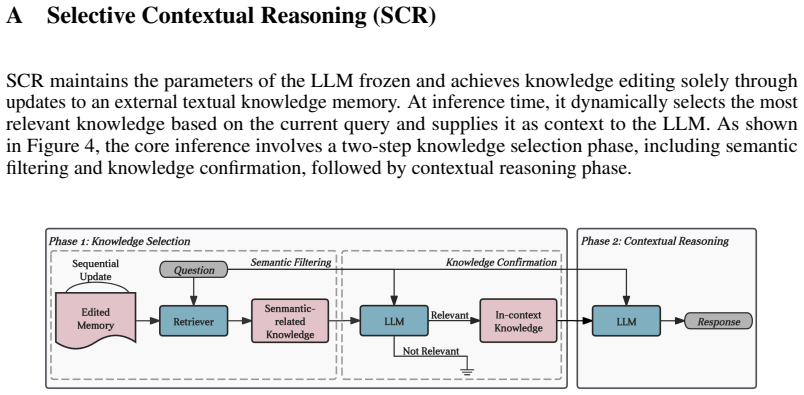
The load-bearing mechanism is SCR (Selective Contextual Reasoning), a baseline that never modifies model weights. It keeps new knowledge in an external textual memory; at query time a dense retriever ranks stored facts by cosine similarity, the LLM itself confirms which fact is relevant (returning 'no relevant fact' when none fits), and the confirmed fact is inserted into a fixed prompt that instructs the model to reason from it. The evaluation machinery is equally load-bearing: a unified autoregressive generation protocol with no teacher forcing, sequential edit batches of 1, 10, and 100, four scoring dimensions (reliability, generalization, locality, portability), and an LLM-based semantic judge for answer correctness. This protocol converts the intuition that context beats surgery into a measured comparison.
What would settle it
Take a sample of 200 generated answers per method on ZsRE and WikiData counterfact and have three human annotators score them as correct or incorrect; if parameter-editing methods, notably AlphaEdit, score much closer to SCR under human scoring than under the LLM judge, the central ordering would need revision.
Extended reading notes
Core claim
The central claim is stated plainly in the paper: 'All parameter-editing methods are outperformed by SCR, a simple and intuitive baseline.' Parameter-modification methods — locate-then-edit, meta-learning, and additional-parameter approaches — collapse as the number of edits grows: ROME, MEND, MEMIT, PMET, and AdaLoRA drop to near zero on most dimensions after sequential edits, while the one relatively stable parameter method, AlphaEdit, still trails context-based methods and scores poorly on locality and portability. The same pattern appears on event-level knowledge and on a reasoning-oriented LLM, where parameter edits can drive mathematical reasoning accuracy to zero after 100 edits. The paper concludes that knowledge should be updated through selective context, not through weight surgery.
Load-bearing premise
Every reported accuracy number flows through a single large language model used as a semantic judge, and the paper does not validate that judge's verdicts against human judgments.
Editorial extensions
If this is right
- Knowledge updates in deployed LLMs should be implemented as retrievable text stores rather than parameter rewrites, since the non-parametric baseline wins under realistic generation.
- Any future parameter-editing method must demonstrate stability under sequential edits of 100 or more before its single-edit success can be taken seriously.
- Editing reasoning-oriented LLMs is riskier than editing instruction-tuned ones: parameter edits can erase mathematical reasoning entirely after 100 edits, and the models tend to reflect outdated knowledge in their reasoning traces.
- Context-based methods handle event-level knowledge with multiple entities and relations, while parameter-based methods largely fail even at the single-edit level.
Reading between the lines
- A consequence left implicit by the paper: retrieval-augmented baselines should become a mandatory control in every knowledge-editing benchmark, because they set the bar any parametric edit must clear.
- A natural next experiment is to stress-test SCR against conflicting or outdated entries in its memory store, where retrieval selection errors would become the dominant failure mode.
- The paper's failure-mode taxonomy for reasoning LLMs (reflecting outdated knowledge, fabricating explanations, losing focus during reasoning) could serve as a diagnostic checklist when evaluating any editing method on chain-of-thought models.
- The comparison could be extended to larger models and multilingual knowledge, where retrieval latency and judge behavior may shift the relative ranking.
Editorial analysis
A structured set of objections, weighed in public.
Referee Report
Summary. The paper proposes a unified benchmark for knowledge editing in LLMs, covering fact-level (ZsRE, WikiData counterfact), event-level (ELKEN), and general mathematical-reasoning datasets, evaluated on four instruct/reasoning LLMs under autoregressive generation, with single and sequential editing, across reliability, generalization, locality, and portability. Twelve existing methods are compared against Selective Contextual Reasoning (SCR), a retrieval-based baseline that injects relevant updated facts into the prompt. The central empirical claim is that parameter-modification methods perform poorly and degrade sharply under sequential edits, while SCR and other context-injection methods remain robust, leading the authors to question the practical value of parameter-based knowledge editing.
Significance. If the results are validated, the paper would be a useful and timely negative result for the knowledge-editing community, with a broader experimental scope than most prior benchmarks: autoregressive rather than teacher-forced evaluation, sequential edits, event-level knowledge, reasoning LLMs, and preservation of mathematical reasoning. The public code repository and the inclusion of a simple retrieval baseline are concrete strengths. However, the entire quantitative comparison rests on an unvalidated LLM-as-judge pipeline, and the reported pre-edit locality numbers conflict with the paper's own definition of locality. These issues currently leave the headline conclusion unverified, though they are fixable with additional validation and re-analysis.
major comments (5)
- [§3, Eq. (4); Table 2a] The pre-edit locality scores in Table 2a are internally inconsistent with the definition of locality in Eq. (4). Equation (4) measures whether the edited model preserves the original model's output on unrelated queries; before any edit, f^t = f^0, so this quantity must be 100 by construction. The reported pre-edit locality values (11.49 for Llama-2-7B-Chat on ZsRE, 14.26 for Llama-3.1-8B-Instruct, 13.30 for Mistral-7B-Instruct) therefore cannot be computing Eq. (4). Either locality is being evaluated against ground-truth answers rather than against the original model's outputs, which conflates locality with generalization, or the judge is rejecting the model's own answers. The authors must clarify the exact computation and reconcile the numbers; as written, the locality dimension in Tables 2, 3, 6, and 7 is not interpretable.
- [§4.1, Metrics Calculation; Tables 2, 3, 6, 7] Every reported accuracy number is produced by a single unvalidated judge, Qwen2.5-72B-Instruct, which is described only as assessing 'semantic consistency.' No judge prompt, human-agreement statistics, or calibration sample are reported. The low pre-edit locality values suggest the judge is systematically harsh or format-sensitive. Because SCR and other context-injection methods place the updated fact directly in the prompt, while parameter-edited models often produce shorter or degraded answers, a strict judge can differentially penalize parameter-editing methods even when a human would accept the answer. The authors should provide the exact judge prompt, report agreement with human annotation on a sample from each dataset, and re-run at least the headline tables with an alternative evaluation (e.g., exact match after normalization, or a second judge) to demonstrate that the SCR advantage is not an artifact of the judge.
- [§4.1, Experimental Settings; Tables 2, 3, 5] No error bars, repeated runs, or significance tests are reported. Many entries in Table 2 are exactly 0.00, and claims such as 'performance drops to near zero' or 'AlphaEdit maintains a stable performance rate' are made from single executions. Since sequential editing is order-dependent and hyperparameters can vary across runs, the authors should report multiple random orderings/subsamples and paired significance tests (e.g., bootstrap or Wilcoxon) for the central comparison between SCR and parameter-editing methods. This is particularly important because several differences in the tables are small relative to the apparent noise in the evaluation.
- [§4.1, Sequential Editing Scenario and Dataset Selection] The sequential editing experiments use the first 100 knowledge items from each dataset, and edits are applied in the dataset's original order. Sequential knowledge editing is known to be sensitive to edit order, so results can depend on an arbitrary ordering. The authors should report results over multiple random orderings or at least justify why the original order is representative. Without this, the claim that parameter-editing methods 'collapse under sequential editing' may be specific to one ordering rather than a general property.
- [Appendix A, Selective Contextual Reasoning] SCR has a free parameter k (the number of retrieved facts passed to the knowledge-confirmation step), but the paper never states what value of k is used in the experiments or reports sensitivity to k. Since SCR is the reference baseline that outperforms all parameter-editing methods, the reproducibility of the central claim depends on this unspecified choice. The authors should report k, the retrieval confidence threshold if any, and a small sensitivity analysis over k (e.g., k = 1, 2, 3, 5).
minor comments (5)
- [Throughout] The dataset name is rendered inconsistently as 'WikiDatacounterfact', 'WikiData counterfact', and 'WikiDatacounterfact'; please standardize the spelling.
- [Table 4] The target answer 'William Walker Scranton' is broken across three lines in the table cell; this appears to be a formatting artifact and should be fixed.
- [Table 2a and Table 6] Cells marked '–' for AlphaEdit and other methods are not explained in the caption. The authors should state explicitly that these experiments could not be completed (e.g., the method does not support the target architecture) rather than leaving the reader to infer it.
- [Abstract and §4.2, RQ1 item 5] The phrase 'SCR consistently outperforms them across all settings' is ambiguous: 'them' refers to parameter-modification methods, but some context-injection methods outperform SCR on several rows (e.g., Table 2a, Llama-2: ICE 56.83 vs. SCR 52.53). Please make the scope of the claim explicit.
- [Table 5 caption] The table reports 'accuracy after 10 and 100 edits' but the 'Pre-edit' row and the 0.00 cells are not accompanied by any indication of the number of questions or the evaluation protocol used on the mathematical benchmarks; please clarify whether these are standard benchmark accuracies and how edits are chosen for each benchmark.
Circularity Check
No load-bearing circularity; the central claim is an empirical benchmark result. The only self-citation is the authors' SCR baseline [63], which is fully specified in the appendix and not used to force the conclusion.
full rationale
The paper's central claim (Section 4.2, RQ1, item 5) is an empirical comparison, not a derivation. SCR is introduced as a baseline in Section 4.1 and fully specified in Appendix A: it stores updated knowledge in plain text, retrieves relevant facts by Contriever cosine similarity, and injects the selected fact into the prompt. Because the reliability and generalization metrics measure whether generated text is semantically consistent with the target answer, SCR's strong performance is partly explained by the fact that, on successful retrievals, the target content is supplied in the input. But the paper openly labels SCR an 'intuitive baseline' and an in-context learning method; it does not present SCR's behavior as a prediction derived from first principles, and the parameter-editing methods' scores come from independent implementations (EasyEdit) on standard datasets. The only self-citation is [63], the authors' prior SCR paper, and the footnote states this work extends it; since the SCR design is recapitulated in Appendix A, the citation is not load-bearing. The unvalidated Qwen2.5-72B semantic-consistency judge and the anomalously low pre-edit locality values (e.g., 11.49 for Llama-2 on ZsRE in Table 2a) are serious evaluation-validity threats, but they are not instances of a claim reducing to its own inputs by construction. No equation in the paper defines SCR's accuracy in terms of the fitted target, and no uniqueness theorem or prior-work result is invoked to force the conclusion. Verdict: no significant circularity; score 2 reflects only the minor, non-load-bearing self-citation of [63] and the authors' dual role as benchmark designers and advocates of SCR.
Assumptions & free parameters
free parameters (1)
- SCR retrieval count k =
not specified in main text; appendix discusses k=1 and k>1
assumptions (5)
- domain assumption The Qwen2.5-72B-Instruct semantic consistency judge reliably measures answer correctness across all dimensions.
- domain assumption The EasyEdit implementations with default settings are fair representations of each knowledge editing method.
- domain assumption Autoregressive generation with greedy decoding is the appropriate evaluation setting for knowledge editing.
- domain assumption The first 100 items from each dataset are representative of typical knowledge editing queries.
- domain assumption GPT-4o triple extraction preserves the semantics of event descriptions for parameter-based methods.
Cite this review
Pith. "Pith review of Benchmarking and Rethinking Knowledge Editing for Large Language Models." pith.science (2026). https://pith.science/paper/GTGZU6VZ
@misc{pith2026250518690,
  author       = {Pith},
  title        = {Pith review of: Benchmarking and Rethinking Knowledge Editing for Large Language Models},
  year         = {2026},
  howpublished = {\url{https://pith.science/paper/GTGZU6VZ}},
  note         = {Machine review of arXiv:2505.18690}
}
read the original abstract
Knowledge editing aims to update the embedded knowledge within Large Language Models (LLMs). However, existing approaches, whether through parameter modification or external memory integration, often suffer from inconsistent evaluation objectives and experimental setups. To address this gap, we conduct a comprehensive benchmarking study. In addition to fact-level datasets, we introduce more complex event-based datasets and general-purpose datasets drawn from other tasks. Our evaluation covers both instruction-tuned and reasoning-oriented LLMs, under a realistic autoregressive inference setting rather than teacher-forced decoding. Beyond single-edit assessments, we also evaluate multi-edit scenarios to better reflect practical demands. We employ four evaluation dimensions, including portability, and compare all recent methods against a simple and straightforward baseline named Selective Contextual Reasoning (SCR). Empirical results reveal that parameter-based editing methods perform poorly under realistic conditions. In contrast, SCR consistently outperforms them across all settings. This study offers new insights into the limitations of current knowledge editing methods and highlights the potential of context-based reasoning as a more robust alternative.
Figures


Figures from the paper (1 more)
Reference graph
Works this paper leans on
-
[63]
Knowledge updating? no more model editing! just selective contextual reasoning,
G. He, X. Song, and A. Sun, “Knowledge updating? no more model editing! just selective contextual reasoning,” arXiv preprint arXiv:2503.05212, 2025
arXiv 2025
-
[1]
GLM-130b: An open bilingual pre-trained model,
A. Zeng, X. Liu, Z. Du, Z. Wang, H. Lai, M. Ding, Z. Yang, Y . Xu, W. Zheng, X. Xia, W. L. Tam, Z. Ma, Y . Xue, J. Zhai, W. Chen, Z. Liu, P. Zhang, Y . Dong, and J. Tang, “GLM-130b: An open bilingual pre-trained model,” in The Eleventh International Conference on Learning Representations, 2023
work page 2023
-
[2]
Llama 2: Open foundation and fine-tuned chat models,
H. Touvron, L. Martin, K. Stone, P. Albert, A. Almahairi, Y . Babaei, N. Bashlykov, S. Batra, P. Bhargava, S. Bhosaleet al., “Llama 2: Open foundation and fine-tuned chat models,” arXiv preprint arXiv:2307.09288, 2023
arXiv 2023
-
[3]
OpenAI, “Gpt-4 technical report,” arXiv preprint arXiv:2303.08774, 2023
arXiv 2023
-
[4]
How can we know what language models know?
Z. Jiang, F. F. Xu, J. Araki, and G. Neubig, “How can we know what language models know?” Transactions of the Association for Computational Linguistics, vol. 8, pp. 423–438, 2020
2020
-
[5]
A review on language models as knowledge bases,
B. AlKhamissi, M. Li, A. Celikyilmaz, M. Diab, and M. Ghazvininejad, “A review on language models as knowledge bases,” arXiv preprint arXiv:2204.06031, 2022
arXiv 2022
-
[6]
How do large language models capture the ever-changing world knowledge? a review of recent advances,
Z. Zhang, M. Fang, L. Chen, M.-R. Namazi-Rad, and J. Wang, “How do large language models capture the ever-changing world knowledge? a review of recent advances,” inProceedings of the 2023 Conference on Empirical Methods in Natural Language Processing, 2023, pp. 8289–8311
work page 2023
-
[7]
P. Liu, W. Yuan, J. Fu, Z. Jiang, H. Hayashi, and G. Neubig, “Pre-train, prompt, and predict: A systematic survey of prompting methods in natural language processing,”ACM Computing Surveys, vol. 55, no. 9, pp. 1–35, 2023
work page 2023
Show all 79 references
-
[8]
Reasoning abilities of large language models: In-depth analysis on the abstraction and reasoning corpus,
S. Lee, W. Sim, D. Shin, W. Seo, J. Park, S. Lee, S. Hwang, S. Kim, and S. Kim, “Reasoning abilities of large language models: In-depth analysis on the abstraction and reasoning corpus,” ACM Transactions on Intelligent Systems and Technology
-
[9]
Language models are few-shot learners,
T. Brown, B. Mann, N. Ryder, M. Subbiah, J. D. Kaplan, P. Dhariwal, A. Neelakantan, P. Shyam, G. Sastry, A. Askell et al., “Language models are few-shot learners,” Advances in neural information processing systems, vol. 33, pp. 1877–1901, 2020
1901
-
[10]
Training language models to follow instructions with human feedback,
L. Ouyang, J. Wu, X. Jiang, D. Almeida, C. Wainwright, P. Mishkin, C. Zhang, S. Agarwal, K. Slama, A. Ray et al., “Training language models to follow instructions with human feedback,” Advances in neural information processing systems, vol. 35, pp. 27 730–27 744, 2022
2022
-
[11]
Is your llm outdated? benchmarking llms & alignment algorithms for time-sensitive knowledge,
S. M. Mousavi, S. Alghisi, and G. Riccardi, “Is your llm outdated? benchmarking llms & alignment algorithms for time-sensitive knowledge,”arXiv preprint arXiv:2404.08700, 2024
2024 arXiv
-
[12]
Survey of hallucination in natural language generation,
Z. Ji, N. Lee, R. Frieske, T. Yu, D. Su, Y . Xu, E. Ishii, Y . J. Bang, A. Madotto, and P. Fung, “Survey of hallucination in natural language generation,” ACM Computing Surveys, vol. 55, no. 12, pp. 1–38, 2023
2023
-
[13]
Editable neural networks,
A. Sinitsin, V . Plokhotnyuk, D. Pyrkin, S. Popov, and A. Babenko, “Editable neural networks,” arXiv preprint arXiv:2004.00345, 2020
2004 arXiv
-
[14]
Modifying memories in transformer models,
A. S. Rawat, C. Zhu, D. Li, F. Yu, M. Zaheer, S. Kumar, and S. Bhojanapalli, “Modifying memories in transformer models,” in International Conference on Machine Learning (ICML), vol. 2020, 2021
2020
-
[15]
Locating and editing factual associations in gpt,
K. Meng, D. Bau, A. Andonian, and Y . Belinkov, “Locating and editing factual associations in gpt,” in Proceedings of the 36th International Conference on Neural Information Processing Systems, 2022, pp. 17 359–17 372
2022
-
[16]
Mass-editing memory in a transformer,
K. Meng, A. S. Sharma, A. J. Andonian, Y . Belinkov, and D. Bau, “Mass-editing memory in a transformer,” in The Eleventh International Conference on Learning Representations. 13
-
[17]
Pmet: Precise model editing in a transformer,
X. Li, S. Li, S. Song, J. Yang, J. Ma, and J. Yu, “Pmet: Precise model editing in a transformer,” in Proceedings of the AAAI Conference on Artificial Intelligence , vol. 38, no. 17, 2024, pp. 18 564–18 572
2024
-
[18]
Editing factual knowledge in language models,
N. De Cao, W. Aziz, and I. Titov, “Editing factual knowledge in language models,” inEMNLP 2021-2021 Conference on Empirical Methods in Natural Language Processing, Proceedings, 2021, pp. 6491–6506
2021
-
[19]
Massive editing for large language models via meta learning,
C. Tan, G. Zhang, and J. Fu, “Massive editing for large language models via meta learning,” in The Twelfth International Conference on Learning Representations
-
[20]
Transformer-patcher: One mis- take worth one neuron,
Z. Huang, Y . Shen, X. Zhang, J. Zhou, W. Rong, and Z. Xiong, “Transformer-patcher: One mis- take worth one neuron,” in The Eleventh International Conference on Learning Representations, 2023
2023
-
[21]
Melo: Enhancing model editing with neuron-indexed dynamic lora,
L. Yu, Q. Chen, J. Zhou, and L. He, “Melo: Enhancing model editing with neuron-indexed dynamic lora,” in Proceedings of the AAAI Conference on Artificial Intelligence, vol. 38, no. 17, 2024, pp. 19 449–19 457
2024
-
[22]
WISE: Rethinking the knowledge memory for lifelong model editing of large language models,
P. Wang, Z. Li, N. Zhang, Z. Xu, Y . Yao, Y . Jiang, P. Xie, F. Huang, and H. Chen, “WISE: Rethinking the knowledge memory for lifelong model editing of large language models,” inThe Thirty-eighth Annual Conference on Neural Information Processing Systems, 2024. [Online]. Avai...
2024
-
[23]
Can we edit factual knowledge by in-context learning?
C. Zheng, L. Li, Q. Dong, Y . Fan, Z. Wu, J. Xu, and B. Chang, “Can we edit factual knowledge by in-context learning?” in Proceedings of the 2023 Conference on Empirical Methods in Natural Language Processing, 2023, pp. 4862–4876
2023
-
[24]
Evaluating the ripple effects of knowledge editing in language models,
R. Cohen, E. Biran, O. Yoran, A. Globerson, and M. Geva, “Evaluating the ripple effects of knowledge editing in language models,” Transactions of the Association for Computational Linguistics, vol. 12, pp. 283–298, 2024
2024
-
[25]
Aging with grace: Lifelong model editing with discrete key-value adaptors,
T. Hartvigsen, S. Sankaranarayanan, H. Palangi, Y . Kim, and M. Ghassemi, “Aging with grace: Lifelong model editing with discrete key-value adaptors,” Advances in Neural Information Processing Systems, vol. 36, 2024
2024
-
[26]
Memory-based model editing at scale,
E. Mitchell, C. Lin, A. Bosselut, C. D. Manning, and C. Finn, “Memory-based model editing at scale,” in International Conference on Machine Learning. PMLR, 2022, pp. 15 817–15 831
2022
-
[27]
A comprehensive study of knowledge editing for large language models,
N. Zhang, Y . Yao, B. Tian, P. Wang, S. Deng, M. Wang, Z. Xi, S. Mao, J. Zhang, Y . Ni et al., “A comprehensive study of knowledge editing for large language models,”arXiv preprint arXiv:2401.01286, 2024
2024 arXiv
-
[28]
Model editing harms general abilities of large language models: Regularization to the rescue,
J.-C. Gu, H.-X. Xu, J.-Y . Ma, P. Lu, Z.-H. Ling, K.-W. Chang, and N. Peng, “Model editing harms general abilities of large language models: Regularization to the rescue,” in Proceedings of the 2024 Conference on Empirical Methods in Natural Language Processing. Association fo...
2024
-
[29]
Alphaedit: Null-space constrained knowledge editing for language models,
J. Fang, H. Jiang, K. Wang, Y . Ma, X. Wang, X. He, and T.-s. Chua, “Alphaedit: Null-space constrained knowledge editing for language models,” arXiv preprint arXiv:2410.02355, 2024
2024 arXiv
-
[30]
Adalora: Adaptive budget allocation for parameter-efficient fine-tuning,
Q. Zhang, M. Chen, A. Bukharin, N. Karampatziakis, P. He, Y . Cheng, W. Chen, and T. Zhao, “Adalora: Adaptive budget allocation for parameter-efficient fine-tuning,” arXiv preprint arXiv:2303.10512, 2023
2023 arXiv
-
[31]
Language models as knowledge bases?
F. Petroni, T. Rocktäschel, S. Riedel, P. Lewis, A. Bakhtin, Y . Wu, and A. Miller, “Language models as knowledge bases?” in Proceedings of the 2019 Conference on Empirical Methods in Natural Language Processing and the 9th International Joint Conference on Natural Language Pr...
2019
-
[32]
Transformer feed-forward layers are key-value memories,
M. Geva, R. Schuster, J. Berant, and O. Levy, “Transformer feed-forward layers are key-value memories,” in Proceedings of the 2021 Conference on Empirical Methods in Natural Language Processing, 2021, pp. 5484–5495
2021
-
[33]
Dissecting recall of factual associations in auto-regressive language models,
M. Geva, J. Bastings, K. Filippova, and A. Globerson, “Dissecting recall of factual associations in auto-regressive language models,” in The 2023 Conference on Empirical Methods in Natural Language Processing
2023
-
[34]
Knowledge neurons in pretrained transformers,
D. Dai, L. Dong, Y . Hao, Z. Sui, B. Chang, and F. Wei, “Knowledge neurons in pretrained transformers,” in Proceedings of the 60th Annual Meeting of the Association for Computational Linguistics (Volume 1: Long Papers), 2022, pp. 8493–8502. 14
2022
-
[35]
Knowledge mechanisms in large language models: A survey and perspective
M. Wang, Y . Yao, Z. Xu, S. Qiao, S. Deng, P. Wang, X. Chen, J.-C. Gu, Y . Jiang, P. Xieet al., “Knowledge mechanisms in large language models: A survey and perspective.”
-
[36]
Knowledge graph enhanced large language model editing,
M. Zhang, X. Ye, Q. Liu, P. Ren, S. Wu, and Z. Chen, “Knowledge graph enhanced large language model editing,” in Proceedings of the 2024 Conference on Empirical Methods in Natural Language Processing, 2024, pp. 22 647–22 662
2024
-
[37]
Consecutive model editing with batch alongside hook layers,
S. Li, Y . Deng, D. Cai, H. Lu, L. Chen, and W. Lam, “Consecutive model editing with batch alongside hook layers,” arXiv preprint arXiv:2403.05330, 2024
2024 arXiv
-
[38]
Wilke: Wise-layer knowledge editor for lifelong knowledge editing,
C. Hu, P. Cao, Y . Chen, K. Liu, and J. Zhao, “Wilke: Wise-layer knowledge editor for lifelong knowledge editing,” in Findings of the Association for Computational Linguistics ACL 2024, 2024, pp. 3476–3503
2024
-
[39]
Interpreting key mechanisms of factual recall in transformer-based language models,
A. Lv, K. Zhang, Y . Chen, Y . Wang, L. Liu, J.-R. Wen, J. Xie, and R. Yan, “Interpreting key mechanisms of factual recall in transformer-based language models,” arXiv preprint arXiv:2403.19521, 2024
2024 arXiv
-
[40]
Does knowledge localization hold true? surprising differences between entity and relation perspectives in language models,
Y . Wei, X. Yu, Y . Weng, H. Ma, Y . Zhang, J. Zhao, and K. Liu, “Does knowledge localization hold true? surprising differences between entity and relation perspectives in language models,” in Proceedings of the 33rd ACM International Conference on Information and Knowledge Ma...
2024
-
[41]
Physics of language models: Part 3.3, knowledge capacity scaling laws,
Z. Allen-Zhu and Y . Li, “Physics of language models: Part 3.3, knowledge capacity scaling laws,” arXiv preprint arXiv:2404.05405, 2024
2024 arXiv
-
[42]
Calibrating factual knowledge in pretrained language models,
Q. Dong, D. Dai, Y . Song, J. Xu, Z. Sui, and L. Li, “Calibrating factual knowledge in pretrained language models,” in Findings of the Association for Computational Linguistics: EMNLP 2022, 2022, pp. 5937–5947
2022
-
[43]
Dafnet: Dynamic auxiliary fusion for sequential model editing in large language models,
T. Zhang, Q. Chen, D. Li, C. Wang, X. He, L. Huang, J. Huang et al., “Dafnet: Dynamic auxiliary fusion for sequential model editing in large language models,” in Findings of the Association for Computational Linguistics ACL 2024, 2024, pp. 1588–1602
2024
-
[44]
Memoe: Enhancing model editing with mixture of experts adaptors,
R. Wang and P. Li, “Memoe: Enhancing model editing with mixture of experts adaptors,”arXiv preprint arXiv:2405.19086, 2024
2024 arXiv
-
[45]
Lemoe: Advanced mixture of experts adaptor for lifelong model editing of large language models,
——, “Lemoe: Advanced mixture of experts adaptor for lifelong model editing of large language models,” in Proceedings of the 2024 Conference on Empirical Methods in Natural Language Processing, 2024, pp. 2551–2575
2024
-
[46]
Roselora: Row and column-wise sparse low-rank adaptation of pre-trained language model for knowledge editing and fine-tuning,
H. Wang, T. Liu, R. Li, M. Cheng, T. Zhao, and J. Gao, “Roselora: Row and column-wise sparse low-rank adaptation of pre-trained language model for knowledge editing and fine-tuning,” in Proceedings of the 2024 Conference on Empirical Methods in Natural Language Processing, 202...
2024
-
[47]
Towards understanding the mixture-of-experts layer in deep learning,
Z. Chen, Y . Deng, Y . Wu, Q. Gu, and Y . Li, “Towards understanding the mixture-of-experts layer in deep learning,” in Proceedings of the 36th International Conference on Neural Information Processing Systems, 2022, pp. 23 049–23 062
2022
-
[48]
Strong model collapse,
E. Dohmatob, Y . Feng, and J. Kempe, “Strong model collapse,” arXiv preprint arXiv:2410.04840, 2024
2024 arXiv
-
[49]
Mquake: Assessing knowledge editing in language models via multi-hop questions,
Z. Zhong, Z. Wu, C. D. Manning, C. Potts, and D. Chen, “Mquake: Assessing knowledge editing in language models via multi-hop questions,” in Proceedings of the 2023 Conference on Empirical Methods in Natural Language Processing, 2023, pp. 15 686–15 702
2023
-
[50]
Learning to edit: Aligning llms with knowledge editing,
Y . Jiang, Y . Wang, C. Wu, W. Zhong, X. Zeng, J. Gao, L. Li, X. Jiang, L. Shang, R. Tanget al., “Learning to edit: Aligning llms with knowledge editing,” in Proceedings of the 62nd Annual Meeting of the Association for Computational Linguistics (Volume 1: Long Papers), 2024, ...
2024
-
[51]
Lifelong knowledge editing for llms with retrieval-augmented continuous prompt learning,
Q. Chen, T. Zhang, X. He, D. Li, C. Wang, L. Huanget al., “Lifelong knowledge editing for llms with retrieval-augmented continuous prompt learning,” in Proceedings of the 2024 Conference on Empirical Methods in Natural Language Processing, 2024, pp. 13 565–13 580
2024
-
[52]
Larimar: Large language models with episodic memory control,
P. Das, S. Chaudhury, E. Nelson, I. Melnyk, S. Swaminathan, S. Dai, A. Lozano, G. Kollias, V . Chenthamarakshan, J. Navratilet al., “Larimar: Large language models with episodic memory control,” in Forty-first International Conference on Machine Learning. 15
-
[53]
K-edit: Language model editing with contextual knowledge awareness,
E. Markowitz, A. Ramakrishna, N. Mehrabi, C. Peris, R. Gupta, K.-W. Chang, and A. Gal- styan, “K-edit: Language model editing with contextual knowledge awareness,” arXiv preprint arXiv:2502.10626, 2025
2025 arXiv
-
[54]
Editing the mind of giants: An in-depth exploration of pitfalls of knowledge editing in large language models,
C.-H. Hsueh, P. K.-M. Huang, T.-H. Lin, C.-W. Liao, H.-C. Fang, C.-W. Huang, and Y .-N. Chen, “Editing the mind of giants: An in-depth exploration of pitfalls of knowledge editing in large language models,” arXiv preprint arXiv:2406.01436, 2024
2024 arXiv
-
[55]
Emptying the ocean with a spoon: Should we edit models?
Y . Pinter and M. Elhadad, “Emptying the ocean with a spoon: Should we edit models?” in Findings of the Association for Computational Linguistics: EMNLP 2023, 2023, pp. 15 164– 15 172
2023
-
[56]
The missing piece in model editing: A deep dive into the hidden damage brought by model editing,
J. Wang, Z. Gu, Z. Xiong, H. Feng, and Y . Xiao, “The missing piece in model editing: A deep dive into the hidden damage brought by model editing,”arXiv preprint arXiv:2403.07825, 2024
2024 arXiv
-
[57]
The butterfly effect of model editing: Few edits can trigger large language models collapse,
W. Yang, F. Sun, X. Ma, X. Liu, D. Yin, and X. Cheng, “The butterfly effect of model editing: Few edits can trigger large language models collapse,” in Findings of the Association for Computational Linguistics ACL 2024, 2024, pp. 5419–5437
2024
-
[58]
The fall of rome: Understanding the collapse of llms in model editing,
W. Yang, F. Sun, J. Tan, X. Ma, D. Su, D. Yin, and H. Shen, “The fall of rome: Understanding the collapse of llms in model editing,” in Findings of the Association for Computational Linguistics: EMNLP 2024, 2024, pp. 4079–4087
2024
-
[59]
“flex tape can’t fix that
K. Halevy, A. Sotnikova, B. Alkhamissi, S. Montariol, and A. Bosselut, ““flex tape can’t fix that”: Bias and misinformation in edited language models,” in Proceedings of the 2024 Conference on Empirical Methods in Natural Language Processing, 2024, pp. 8690–8707
2024
-
[60]
Llama 3 model card,
Meta AI, “Llama 3 model card,” https://github.com/meta-llama/llama3/blob/main/MODEL_ CARD.md, 2024, accessed: 2025-04-21
2024
-
[61]
Mistral 7b,
A. Q. Jiang, A. Sablayrolles, A. Mensch, C. Bamford, D. S. Chaplot, D. d. l. Casas, F. Bressand, G. Lengyel, G. Lample, L. Saulnier et al., “Mistral 7b,” arXiv preprint arXiv:2310.06825, 2023
2023 arXiv
-
[62]
Deepseek-r1: Incentivizing reasoning capability in llms via reinforcement learning,
D. Guo, D. Yang, H. Zhang, J. Song, R. Zhang, R. Xu, Q. Zhu, S. Ma, P. Wang, X. Bi et al., “Deepseek-r1: Incentivizing reasoning capability in llms via reinforcement learning,” arXiv preprint arXiv:2501.12948, 2025
2025 arXiv
-
[64]
Zero-shot relation extraction via reading comprehension,
O. Levy, M. Seo, E. Choi, and L. Zettlemoyer, “Zero-shot relation extraction via reading comprehension,” in 21st Conference on Computational Natural Language Learning, CoNLL
-
[65]
Event-level knowledge editing,
H. Peng, X. Wang, C. Li, K. Zeng, J. Duo, Y . Cao, L. Hou, and J. Li, “Event-level knowledge editing,” arXiv preprint arXiv:2402.13093, 2024
2024 arXiv
-
[66]
Editing large language models: Problems, methods, and opportunities,
Y . Yao, P. Wang, B. Tian, S. Cheng, Z. Li, S. Deng, H. Chen, and N. Zhang, “Editing large language models: Problems, methods, and opportunities,” in The 2023 Conference on Empirical Methods in Natural Language Processing
2023
-
[67]
Numinamath: The largest public dataset in ai4maths with 860k pairs of competition math problems and solutions,
J. Li, E. Beeching, L. Tunstall, B. Lipkin, R. Soletskyi, S. Huang, K. Rasul, L. Yu, A. Q. Jiang, Z. Shen et al., “Numinamath: The largest public dataset in ai4maths with 860k pairs of competition math problems and solutions,” Hugging Face repository, vol. 13, p. 9, 2024
2024
-
[68]
Olympiadbench: A challenging benchmark for promoting agi with olympiad-level bilingual multimodal scientific problems,
C. He, R. Luo, Y . Bai, S. Hu, Z. L. Thai, J. Shen, J. Hu, X. Han, Y . Huang, Y . Zhanget al., “Olympiadbench: A challenging benchmark for promoting agi with olympiad-level bilingual multimodal scientific problems,” arXiv preprint arXiv:2402.14008, 2024
2024 arXiv
-
[69]
Measuring mathematical problem solving with the math dataset,
D. Hendrycks, C. Burns, S. Kadavath, A. Arora, S. Basart, E. Tang, D. Song, and J. Stein- hardt, “Measuring mathematical problem solving with the math dataset,” arXiv preprint arXiv:2103.03874, 2021
2021 arXiv
-
[70]
Fast model editing at scale,
E. Mitchell, C. Lin, A. Bosselut, C. Finn, and C. D. Manning, “Fast model editing at scale,” arXiv preprint arXiv:2110.11309, 2021
2021 arXiv
-
[71]
Locating and editing factual associations in gpt,
K. Meng, D. Bau, A. Andonian, and Y . Belinkov, “Locating and editing factual associations in gpt,” Advances in Neural Information Processing Systems, vol. 35, pp. 17 359–17 372, 2022
2022
-
[72]
A learning algorithm for continually running fully recurrent neural networks,
R. J. Williams and D. Zipser, “A learning algorithm for continually running fully recurrent neural networks,” Neural computation, vol. 1, no. 2, pp. 270–280, 1989. 16
1989
-
[73]
The mirage of model editing: Revisiting evaluation in the wild,
W. Yang, F. Sun, J. Tan, X. Ma, Q. Cao, D. Yin, H. Shen, and X. Cheng, “The mirage of model editing: Revisiting evaluation in the wild,” arXiv preprint arXiv:2502.11177, 2025
2025 arXiv
-
[74]
Embers of autoregression: Understanding large language models through the problem they are trained to solve,
R. T. McCoy, S. Yao, D. Friedman, M. Hardy, and T. L. Griffiths, “Embers of autoregression: Understanding large language models through the problem they are trained to solve,” arXiv preprint arXiv:2309.13638, 2023
2023 arXiv
-
[75]
Gpt-4o system card,
A. Hurst, A. Lerer, A. P. Goucher, A. Perelman, A. Ramesh, A. Clark, A. Ostrow, A. Welihinda, A. Hayes, A. Radford et al., “Gpt-4o system card,” arXiv preprint arXiv:2410.21276, 2024
2024 arXiv
-
[76]
Easyedit: An easy-to-use knowledge editing framework for large language models,
P. Wang, N. Zhang, B. Tian, Z. Xi, Y . Yao, Z. Xu, M. Wang, S. Mao, X. Wang, S. Cheng et al., “Easyedit: An easy-to-use knowledge editing framework for large language models,” in Proceedings of the 62nd Annual Meeting of the Association for Computational Linguistics (Volume 3:...
2024
-
[77]
Learning to reason under off-policy guidance,
J. Yan, Y . Li, Z. Hu, Z. Wang, G. Cui, X. Qu, Y . Cheng, and Y . Zhang, “Learning to reason under off-policy guidance,” arXiv preprint arXiv:2504.14945, 2025
2025 arXiv
-
[78]
Unsuper- vised dense information retrieval with contrastive learning,
G. Izacard, M. Caron, L. Hosseini, S. Riedel, P. Bojanowski, A. Joulin, and E. Grave, “Unsuper- vised dense information retrieval with contrastive learning,”Transactions on Machine Learning Research. 17 A Selective Contextual Reasoning (SCR) SCR maintains the parameters of the...
-
[2017]
Association for Computational Linguistics (ACL), 2017, pp. 333–342
2017
Reviewed August 7, 2026 · model on record in the stance chip above.
Discussion (0). Sign in to comment.