REVIEW 3 major objections 6 minor 47 references
Unveiling Dual Quality in Product Reviews: An NLP-Based Approach
T0 review · 3 major / 6 minor · reviewed 2026-08-07 · deepseek-v4-flash
Pith's one-line read This paper introduces the first dataset and evaluation for detecting dual-quality product reviews, showing that local Polish transformer models flag them at precision close to frontier LLMs.
desk verdict Genuinely new dataset and task for dual-quality review detection, but the SetFit screening loop biases the test set, so the deployment precision claims need a stratified re-evaluation. read the letter →
The pith
A machine-rendered reading of the paper's core claim, the machinery that carries it, and where it could break.
The reading
What carries the argument
The machinery is an iterative model-assisted data-collection loop. A SetFit model trained on a small seed set ranks all available Polish reviews by predicted dual-quality probability; annotators verify the top-ranked unseen reviews, and the verified labels become training data for the next iteration, repeated seven times. This loop makes the 1,957-review dataset feasible because dual-quality mentions are rare. The paper then frames the problem as three-way classification, dual quality versus other problems versus standard, and treats precision on the dual quality class as the primary deployment metric, since flagged reviews are meant to be read by humans.
What would settle it
Take the trained polish-roberta-large-v2 and the best LLM prompt, apply them to a freshly collected random sample of reviews from the same Polish sources without any model-based pre-filtering, and have human annotators label every review under the paper's guidelines; if unflagged reviews contain a substantial number of dual-quality cases, or if precision on that random sample falls far below the reported 84.6%, the central claim of deployable detection is weakened.
Extended reading notes
Core claim
The paper claims to provide the first resource for recognizing dual-quality reviews: a Polish dataset of 1,957 human-verified product reviews, with 540 labeled dual quality, 281 labeled other problems, and 1,136 standard, together with a small multilingual test set in English, German, and French. On the Polish test set, the local model polish-roberta-large-v2 reaches 84.6% precision and herbert-large-cased reaches 81.5%, while GPT-4o with instructive prompting reaches 85.7% precision, showing that smaller language-specific encoders can match frontier LLMs. The intended use is triage: flag likely dual-quality reviews for human verification while keeping false positives low, accepting that some true cases will be missed. The paper also finds that LLM few-shot examples can hurt performance compared with instructions alone, and that multilingual transfer is partial, with xlm-roberta-large reaching 84.8% precision on the multilingual test set.
Load-bearing premise
The central claim rests on the assumption that the seed screening model used to pick which reviews annotators see is strong enough to surface every kind of dual-quality complaint, because reviews it never ranks highly are absent from the dataset and the test set.
Editorial extensions
If this is right
- In a production triage setting, polish-roberta-large-v2 can be run locally and forward only the most likely dual-quality reviews to human analysts, keeping false positives low while missing some true cases.
- Instructive prompting, which defines the classes without worked examples, is a viable LLM alternative: GPT-4o reaches 85.7% precision on the Polish test set, and adding few-shot examples can hurt rather than help.
- The system transfers partially to English, German, and French: xlm-roberta-large reaches 84.8% precision on the multilingual test set, while LLMs trade much lower recall for higher precision.
- The annotation guidelines carve out a narrow, enforceable definition of dual quality: explicit comparisons of identical products across markets with a noticed qualitative difference, while price, availability, and general statements are deliberately excluded.
- Because dual-quality reviews are rare, the practical value of the system is as a pre-filter that reduces the volume of reviews human analysts must read, not as a standalone verdict on whether a product is dual quality.
Reading between the lines
- The collection loop can only find what its seed screening model can rank, so implicit comparisons, vague wording, or product categories absent from the seed set are likely under-represented in the dataset; reported test-set precision may therefore exceed precision on a random sample of everyday reviews.
- The "other problems" taxonomy the annotators produced, covering counterfeit suspicion, quality deterioration, and place-of-purchase differences, could be turned into a broader consumer-protection monitoring resource with little extra annotation cost.
- A direct test of the method's ceiling would be to re-run dataset creation with a different seed set or an active-learning query strategy and measure how much additional dual-quality coverage is recovered.
Editorial analysis
A structured set of objections, weighed in public.
Referee Report
Summary. The paper introduces a new NLP task—detecting product reviews that describe dual-quality issues (the same product sold in different markets with noticeably different quality)—and presents a full development pipeline for a Polish detector. It describes the construction of a 1,957-review Polish dataset (540 dual quality, 281 other problems, 1,136 standard), evaluates SetFit-based sentence transformers, transformer encoders, and LLMs (GPT-4o, DeepSeek-V3) with five seeded runs each, reports error analysis and robustness perturbations, and performs a multilingual transfer test on English, German, and French. The best Polish models reach about 84–86% precision on the dual-quality class, and the paper argues that a locally deployable encoder is competitive with frontier LLMs.
Significance. If the resource and results are as presented, this is a genuinely useful first step for a niche but practically relevant task (consumer-protection monitoring). The evaluation is broad: multiple model families, five seeded runs, confusion-matrix analysis, robustness checks, and a multilingual transfer experiment. The human-verified labels and the transparent documentation of the collection process are strengths, and the paper is honest about the rarity of the phenomenon. However, the model-assisted dataset construction introduces a selection bias that the current analysis does not quantify, and the reported metrics therefore do not yet support the stated deployment recommendation.
major comments (3)
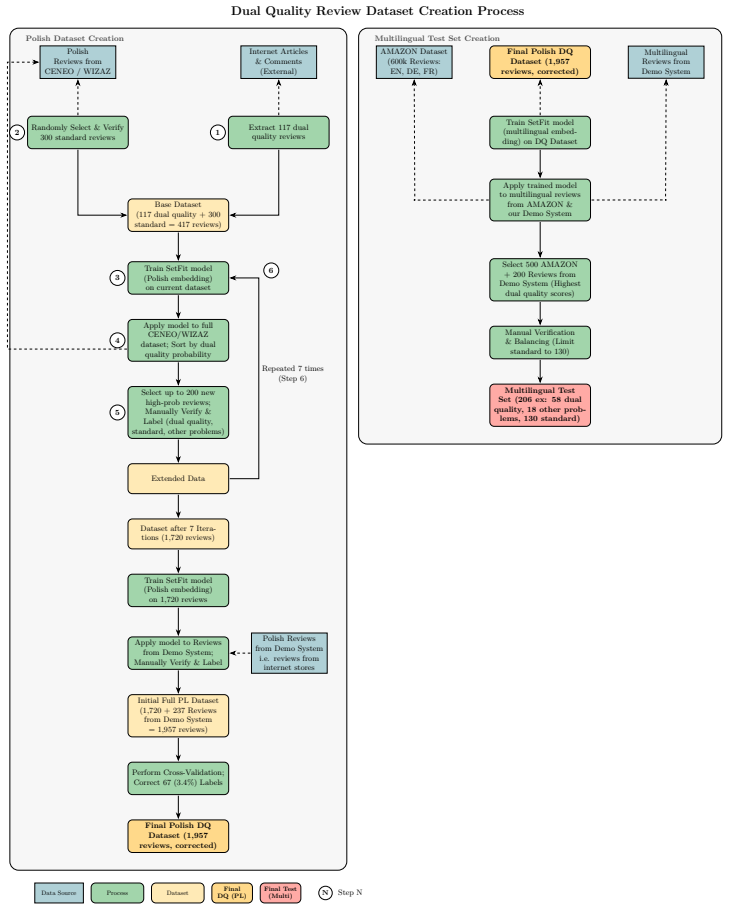
- [§3.1 (steps 3–6, Figure 4)] The model-in-the-loop collection procedure truncates the dual-quality class. Annotators only see reviews that a SetFit classifier trained on a small seed set ranks among the highest dual-quality probabilities (up to 200 per iteration), and the same screen selects the 237 demo-system positives; the 540 dual-quality labels therefore come almost entirely from the SetFit-surfaced pool (plus 107 article-derived examples). Because the 500-review test set (Table 1) is a random split of this screened pool, all metrics in Table 2 estimate performance only on reviews a surrogate model could surface; dual-quality reviews the ranker scores below threshold—for instance implicit comparisons, 'abroad' phrasings without country names, or uncommon product categories—are absent from both training and test data. This selection bias is load-bearing because the central claim is that the resource and models detect dual-quality reviews in real-world data; the paper does not quantify how many true dual-quality reviews the screening model misses.
- [§4.6 (Table 11) and §5] The multilingual experiment provides in-paper evidence of the screening leak, and the deployment claim is not supported by the reported metrics. Of 700 top-scored multilingual reviews manually verified, only 58 were dual quality (about 8% selector precision), yet the Polish test set has a 27.6% dual-quality prior (138/500 in Table 1). Because precision at a fixed threshold depends on the base rate, the Section 5 assertion that a deployed system can 'flag candidate reviews while keeping false positives low' is estimated on a set far more DQ-dense than live traffic, which the paper itself describes as rare. The paper should either re-estimate performance on a random sample from the corpus (with the true prior) or explicitly state that the reported precision values are conditional on the screening model and do not transfer to deployment.
- [§3.2 (Table 1) and §6] The conclusion that 'mentions of dual quality in product reviews are rare, in our case appearing only a few hundred times' is an artifact of the collection method rather than a measured property of the corpus. The iterative screen only surfaces a few hundred candidates, but the true number in the CENEO/WIZAZ corpus is unknown because no random sample was annotated. A random-sample annotation of a few thousand reviews would provide both an estimate of the true prior and a hard-tail evaluation set; without it, the resource's coverage and the rarity claim are unverified.
minor comments (6)
- [§3.1] Typo: 'o ensure annotation accuracy' should read 'To ensure annotation accuracy'.
- [§3.2] The sentence 'Of the dual quality reviews, 1076 were from the Internet, 265 from the CENEO / WIZAZ collection, and168 from our demo system' contains a typo: '1076' should be '107', and there is a missing space after 'and'.
- [§5] The model name 'polish-robert-large-v2' should be 'polish-roberta-large-v2' for consistency with Table 2 and Table 8.
- [§3.2] The phrase 'with over half of the reviews belong to the standard class' is ungrammatical; consider 'with over half of the reviews belonging to the standard class'.
- [General] The paper would benefit from a data availability statement; if the dataset cannot be released due to the UOKiK project constraints, that should be stated explicitly, since the contribution is framed as a new public resource.
- [§3.1] The sentence 'we conducted cross-validation and identified examples where the models were most often wrong' is vague; it should specify which models were cross-validated and how the erroneous examples were selected for relabeling.
Circularity Check
No circular derivation: the dual-quality labels are human-verified and the reported metrics are computed on held-out splits; the SetFit screening loop is a selection-bias issue, not a circular one.
full rationale
I inspected the derivation chain: dataset construction (Section 3.1 steps 1-6), experimental setup (Section 4.1), robustness (Section 4.5), multilingual transfer (Section 4.6), and deployment claims (Section 5). The only step that could resemble a loop is the SetFit-assisted screening in steps 3-5: a SetFit model trained on the seed/extended dataset ranks the CENEO/WIZAZ corpus, and up to 200 top-scoring reviews are manually verified; the verified examples are then added to the training set. This is a supervised self-training loop, but the paper breaks the loop with human verification ('Then perform manual verification of the selected reviews' and 'Of these reviews, 237 were labeled as dual quality, which we manually verified and changed if necessary'), so the labels are not defined in terms of the model's outputs. The final test set is a random split ('the dataset was divided into three subsets: train, test and valid, containing 1,200, 500, and 257 reviews'), and the reported precision and F1 values are computed on those held-out instances, not on the SetFit scores used for collection. The multilingual test set is likewise screened by a SetFit ranker and human-verified; this is a distribution and selection-bias limitation (the paper itself notes 'Manual verification showed that most were actually standard'), but it is not circular because the evaluation labels come from annotators, not from the selector. The paper's self-citations (Dadas et al. 2020, 2024a,b; Poswiata et al. 2024) are used to justify choices of pre-trained Polish sentence transformers and models, not to prove the dual-quality detection result; no uniqueness theorem or ansatz is imported from those works. I found no equation, label, or fitted parameter that is equivalent by construction to the claimed prediction. Therefore the circularity score is 0.
Assumptions & free parameters
assumptions (3)
- domain assumption The operational definition of dual quality in Table 6 (Appendix B.1): the review must report that the customer bought the same product in two countries and noticed a quality difference; price or availability differences and general statements are not dual quality.
- domain assumption Model-assisted candidate selection (Section 3.1 steps 3-5) surfaces a sufficiently representative sample of dual-quality reviews for manual verification.
- domain assumption The three-class split (dual quality, other problems, standard) is exhaustive for the collected reviews.
Cite this review
Pith. "Pith review of Unveiling Dual Quality in Product Reviews: An NLP-Based Approach." pith.science (2026). https://pith.science/paper/3ZAHQ47U
@misc{pith2026250519254,
  author       = {Pith},
  title        = {Pith review of: Unveiling Dual Quality in Product Reviews: An NLP-Based Approach},
  year         = {2026},
  howpublished = {\url{https://pith.science/paper/3ZAHQ47U}},
  note         = {Machine review of arXiv:2505.19254}
}
read the original abstract
Consumers often face inconsistent product quality, particularly when identical products vary between markets, a situation known as the dual quality problem. To identify and address this issue, automated techniques are needed. This paper explores how natural language processing (NLP) can aid in detecting such discrepancies and presents the full process of developing a solution. First, we describe in detail the creation of a new Polish-language dataset with 1,957 reviews, 540 highlighting dual quality issues. We then discuss experiments with various approaches like SetFit with sentence-transformers, transformer-based encoders, and LLMs, including error analysis and robustness verification. Additionally, we evaluate multilingual transfer using a subset of opinions in English, French, and German. The paper concludes with insights on deployment and practical applications.
Figures


Figures from the paper (5 more)


Reference graph
Works this paper leans on
-
[1]
Noa Avigdor, Guy Horowitz, Ariel Raviv, and Stav Yanovsky Daye. 2023. https://doi.org/10.18653/v1/2023.acl-industry.30 Consistent text categorization using data augmentation in e-commerce . In Proceedings of the 61st Annual Meeting of the Association for Computational Linguistics (Volume 5: Industry Track), pages 313--321, Toronto, Canada. Association for...
- [2]
-
[3]
Lucia Bartkova and Lenka Veselovska. 2023. https://doi.org/10.21272/mmi.2023.1-16 Does dual quality of products in the european union truly bother consumers? Marketing and Management of Innovations, 14
-
[4]
Lucia Bartkova, Lenka Veselovska, Marianna Sramkova, and Jan Zavadsky. 2021. https://doi.org/10.21272/mmi.2021.1-18 Dual quality of products: myths and facts through the opinions of millennial consumers . Marketing and Management of Innovations
-
[5]
L. Bartková and L. Veselovská. 2024. https://doi.org/10.1016/j.iimb.2024.05.001 Consumer behaviour under dual quality of products: Does testing reveal what consumers experience? IIMB Management Review, 36:171--184
-
[6]
Lucia Bartková. 2019. https://doi.org/10.21511/ppm.17(3).2019.31 How do consumers perceive the dual quality of goods and its economic aspects in the european union? an empirical study . Problems and Perspectives in Management, 17
-
[7]
Lucia Bartková, Lenka Veselovská, and Katarína Zimermanová. 2018. Possible solutions to dual quality of products in the european union. Scientific Papers of the University of Pardubice, Series D: Faculty of Economics and Administration, 26
work page 2018
-
[8]
I. Botunac, M. Brkić Bakarić, and M. Matetić. 2024. https://doi.org/10.3390/app14146254 Comparing fine-tuning and prompt engineering for multi-class classification in hospitality review analysis . Applied Sciences (Switzerland), 14
Show all 47 references
-
[9]
Dual Quality of Food Products
Chambers . Dual Quality of Food Products . https://chambers.com/legal-trends/dual-quality-of-food-products. [Online; accessed 06-March-2025]
2025
-
[10]
European Commission. 2018. Dual quality of food: European Commission releases common testing methodology . https://ec.europa.eu/commission/presscorner/detail/en/ip_18_4122. [Online; accessed 06-March-2025]
2018
-
[11]
Alexis Conneau, Kartikay Khandelwal, Naman Goyal, Vishrav Chaudhary, Guillaume Wenzek, Francisco Guzm \'a n, Edouard Grave, Myle Ott, Luke Zettlemoyer, and Veselin Stoyanov. 2020. https://doi.org/10.18653/v1/2020.acl-main.747 Unsupervised cross-lingual representation learning ...
2020 doi
-
[12]
S awomir Dadas, Micha Pere kiewicz, and Rafa Po \' s wiata. 2020. Pre-training polish transformer-based language models at scale. In Artificial Intelligence and Soft Computing, pages 301--314. Springer International Publishing
2020
-
[13]
Slawomir Dadas, Micha Pere kiewicz, and Rafa Po \'s wiata. 2024 a . https://aclanthology.org/2024.lrec-main.1117/ PIRB : A comprehensive benchmark of P olish dense and hybrid text retrieval methods . In Proceedings of the 2024 Joint International Conference on Computational Li...
2024
-
[14]
Sławomir Dadas, Marek Kozłowski, Rafał Poświata, Michał Perełkiewicz, Marcin Białas, and Małgorzata Grębowiec. 2024 b . https://doi.org/10.1007/s10506-024-09408-8 A support system for the detection of abusive clauses in b2c contracts . Artificial Intelligence and Law
2024 doi
-
[15]
DeepSeek-AI, :, Xiao Bi, Deli Chen, Guanting Chen, Shanhuang Chen, Damai Dai, Chengqi Deng, Honghui Ding, Kai Dong, Qiushi Du, Zhe Fu, Huazuo Gao, Kaige Gao, Wenjun Gao, Ruiqi Ge, Kang Guan, Daya Guo, Jianzhong Guo, Guangbo Hao, Zhewen Hao, Ying He, Wenjie Hu, Panpan Huang, Er...
2024 arXiv
-
[16]
Zhang, Han Bao, Hanwei Xu, Haocheng Wang, Haowei Zhang, Honghui Ding, Huajian Xin, Huazuo Gao, Hui Li, Hui Qu, J
DeepSeek-AI, Aixin Liu, Bei Feng, Bing Xue, Bingxuan Wang, Bochao Wu, Chengda Lu, Chenggang Zhao, Chengqi Deng, Chenyu Zhang, Chong Ruan, Damai Dai, Daya Guo, Dejian Yang, Deli Chen, Dongjie Ji, Erhang Li, Fangyun Lin, Fucong Dai, Fuli Luo, Guangbo Hao, Guanting Chen, Guowei L...
2025 arXiv
-
[17]
Jacob Devlin, Ming-Wei Chang, Kenton Lee, and Kristina Toutanova. 2019. https://doi.org/10.18653/v1/N19-1423 BERT : Pre-training of deep bidirectional transformers for language understanding . In Proceedings of the 2019 Conference of the North A merican Chapter of the Associat...
2019 doi
-
[18]
The better enforcement and modernisation of Union consumer protection rules
EU Monitor . The better enforcement and modernisation of Union consumer protection rules . https://www.eumonitor.eu/9353000/1/j4nvhdfcs8bljza_j9vvik7m1c3gyxp/vme85bbfssxo. [Online; accessed 06-March-2025]
2025
-
[19]
Joint Research Centre European Commission. 2023. Same pack, different ingredients: Is dual quality down-branded in EU food? https://joint-research-centre.ec.europa.eu/jrc-news-and-updates/same-pack-different-ingredients-dual-quality-down-branded-eu-food-2023-07-24_en. [Online;...
2023
-
[20]
European Parliamentary Research Service (EPRS) European Parliament. 2017. European Commission guidelines on dual quality of branded food products . https://www.europarl.europa.eu/RegData/etudes/BRIE/2017/608804/EPRS_BRI [PDF; accessed 06-March-2025]
2017
-
[21]
European Parliamentary Research Service (EPRS) European Parliament. 2019. Dual quality of products – State of play . https://www.europarl.europa.eu/RegData/etudes/BRIE/2019/644192/EPRS_BRI(2019)644192_EN.pdf. [Online; accessed 06-March-2025]
2019
-
[22]
Fangxiaoyu Feng, Yinfei Yang, Daniel Cer, Naveen Arivazhagan, and Wei Wang. 2022. https://doi.org/10.18653/v1/2022.acl-long.62 Language-agnostic BERT sentence embedding . In Proceedings of the 60th Annual Meeting of the Association for Computational Linguistics (Volume 1: Long...
2022 doi
-
[23]
Gilad Fuchs, Ido Ben-shaul, and Matan Mandelbrod. 2022. https://doi.org/10.18653/v1/2022.emnlp-industry.27 Is it out yet? automatic future product releases extraction from web data . In Proceedings of the 2022 Conference on Empirical Methods in Natural Language Processing: Ind...
2022 doi
-
[24]
Shansan Gong, Zelin Zhou, Shuo Wang, Fengjiao Chen, Xiujie Song, Xuezhi Cao, Yunsen Xian, and Kenny Zhu. 2023. https://doi.org/10.18653/v1/2023.acl-industry.46 Transferable and efficient: Unifying dynamic multi-domain product categorization . In Proceedings of the 61st Annual ...
2023 doi
-
[25]
Beizhe Hu, Qiang Sheng, Juan Cao, Yongchun Zhu, Danding Wang, Zhengjia Wang, and Zhiwei Jin. 2023. https://doi.org/10.18653/v1/2023.acl-industry.13 Learn over past, evolve for future: Forecasting temporal trends for fake news detection . In Proceedings of the 61st Annual Meeti...
2023 doi
-
[26]
Phillip Keung, Yichao Lu, Gy \"o rgy Szarvas, and Noah A. Smith. 2020. https://doi.org/10.18653/v1/2020.emnlp-main.369 The multilingual A mazon reviews corpus . In Proceedings of the 2020 Conference on Empirical Methods in Natural Language Processing (EMNLP), pages 4563--4568,...
2020 doi
-
[27]
Mamani-Coaquira and E
Y. Mamani-Coaquira and E. Villanueva. 2024. https://doi.org/10.1109/ACCESS.2024.3513321 A review on text sentiment analysis with machine learning and deep learning techniques . IEEE Access, 12:193115--193130
2024
-
[28]
Robert Mroczkowski, Piotr Rybak, Alina Wr \'o blewska, and Ireneusz Gawlik. 2021. https://www.aclweb.org/anthology/2021.bsnlp-1.1 H er BERT : Efficiently pretrained transformer-based language model for P olish . In Proceedings of the 8th Workshop on Balto-Slavic Natural Langua...
2021
-
[29]
Ravindra Nayak and Nikesh Garera. 2022. https://doi.org/10.18653/v1/2022.emnlp-industry.55 Deploying unified BERT moderation model for E -commerce reviews . In Proceedings of the 2022 Conference on Empirical Methods in Natural Language Processing: Industry Track, pages 540--54...
2022 doi
-
[30]
Stephen Obadinma, Faiza Khan Khattak, Shirley Wang, Tania Sidhorn, Elaine Lau, Sean Robertson, Jingcheng Niu, Winnie Au, Alif Munim, and Karthik Raja Kalaiselvi Bhaskar. 2022. https://doi.org/10.18653/v1/2022.emnlp-industry.44 Bringing the state-of-the-art to customers: A neur...
2022 doi
-
[31]
OpenAI, Josh Achiam, Steven Adler, Sandhini Agarwal, Lama Ahmad, Ilge Akkaya, Florencia Leoni Aleman, Diogo Almeida, Janko Altenschmidt, Sam Altman, Shyamal Anadkat, Red Avila, Igor Babuschkin, Suchir Balaji, Valerie Balcom, Paul Baltescu, Haiming Bao, Mohammad Bavarian, Jeff ...
2024 arXiv
-
[32]
Soham Parikh, Mitul Tiwari, Prashil Tumbade, and Quaizar Vohra. 2023. https://doi.org/10.18653/v1/2023.acl-industry.71 Exploring zero and few-shot techniques for intent classification . In Proceedings of the 61st Annual Meeting of the Association for Computational Linguistics ...
2023 doi
-
[33]
Rafał Poświata, Sławomir Dadas, and Michał Perełkiewicz. 2024. https://arxiv.org/abs/2405.10138 PL-MTEB: Polish Massive Text Embedding Benchmark . Preprint, arXiv:2405.10138
2024 arXiv
-
[34]
Nils Reimers and Iryna Gurevych. 2019. http://arxiv.org/abs/1908.10084 Sentence-bert: Sentence embeddings using siamese bert-networks . In Proceedings of the 2019 Conference on Empirical Methods in Natural Language Processing. Association for Computational Linguistics
2019 arXiv
-
[35]
Dual Food Quality Project
Safe Food Advocacy Europe (SAFE) . Dual Food Quality Project . https://www.safefoodadvocacy.eu/projects/dual-food-quality-project/. [Online; accessed 06-March-2025]
2025
-
[36]
Satjathanakul and T
J. Satjathanakul and T. Siriborvornratanakul. 2024. https://doi.org/10.1007/s41870-024-01907-w Sentiment analysis in product reviews in thai language . International Journal of Information Technology (Singapore)
2024 doi
-
[37]
Xiaoyu Shen, Akari Asai, Bill Byrne, and Adria De Gispert. 2023. https://doi.org/10.18653/v1/2023.acl-industry.12 x PQA : Cross-lingual product question answering in 12 languages . In Proceedings of the 61st Annual Meeting of the Association for Computational Linguistics (Volu...
2023 doi
-
[38]
Hasan Tercan and Tobias Meisen. 2022. https://doi.org/10.1007/s10845-022-01963-8 Machine learning and deep learning based predictive quality in manufacturing: a systematic review
2022 doi
-
[39]
The European Consumer Organisation (BEUC) . 2018. Dual product quality across Europe: state-of-play and the way forward . https://www.beuc.eu/sites/default/files/publications/beuc-x-2018-031_beuc_position_paper_on_dual_quality.pdf. [Online; accessed 06-March-2025]
2018
- [40]
-
[41]
Lenka Veselovská. 2022. https://doi.org/10.1080/14783363.2021.1940929 Dual quality of products in europe: a serious problem or a marketing opportunity? Total Quality Management and Business Excellence, 33
2022
-
[42]
Liang Wang, Nan Yang, Xiaolong Huang, Linjun Yang, Rangan Majumder, and Furu Wei. 2024. Multilingual e5 text embeddings: A technical report. arXiv preprint arXiv:2402.05672
2024 arXiv
-
[43]
Tianqi Wang, Lei Chen, Xiaodan Zhu, Younghun Lee, and Jing Gao. 2023. https://doi.org/10.18653/v1/2023.acl-industry.55 Weighted contrastive learning with false negative control to help long-tailed product classification . In Proceedings of the 61st Annual Meeting of the Associ...
2023 doi
-
[44]
Xin Zhang, Yanzhao Zhang, Dingkun Long, Wen Xie, Ziqi Dai, Jialong Tang, Huan Lin, Baosong Yang, Pengjun Xie, Fei Huang, et al. 2024. mgte: Generalized long-context text representation and reranking models for multilingual text retrieval. In Proceedings of the 2024 Conference ...
2024
-
[45]
Ján Závadský and Vladimír Hiadlovský. 2020. https://doi.org/10.21003/EA.V185-07 Economic problems of dual quality of everyday consumer goods . Economic Annals-XXI, 185
2020 doi
-
[46]
online" 'onlinestring :=
ENTRY address archivePrefix author booktitle chapter edition editor eid eprint eprinttype howpublished institution journal key month note number organization pages publisher school series title type volume year doi pubmed url lastchecked label extra.label sort.label short.list...
-
[47]
write newline
" write newline "" before.all 'output.state := FUNCTION n.dashify 't := "" t empty not t #1 #1 substring "-" = t #1 #2 substring "--" = not "--" * t #2 global.max substring 't := t #1 #1 substring "-" = "-" * t #2 global.max substring 't := while if t #1 #1 substring * t #2 gl...
Reviewed August 7, 2026 · model on record in the stance chip above.
Discussion (0). Sign in to comment.