REVIEW 5 major objections 5 minor 1 cited by
Integrated Finite Element Neural Network (IFENN) for Phase-Field Fracture with Minimal Input and Generalized Geometry-Load Handling
T0 review · 5 major / 5 minor · reviewed 2026-08-07 · deepseek-v4-flash
Pith's one-line read This paper claims that one CNN trained on two load increments from a single-notch tension test can replace the phase-field solver for unseen geometries, multiple cracks, and new loading paths.
desk verdict A cheap spatial-only CNN surrogate for phase-field fracture that genuinely generalizes across geometries, but the two-snapshot training doesn't yet support the 'arbitrary loading paths' claim. read the letter →
The pith
A machine-rendered reading of the paper's core claim, the machinery that carries it, and where it could break.
The reading
What carries the argument
The load-bearing mechanism is a physics-informed convolutional neural network whose kernels are made symmetric by construction: each $5\times5$ filter has only six independent learnable entries, forcing translational and rotational invariance in the learned $H\to\varphi$ map. The input is a pixel representation of the strain energy density $H$ on the Gauss-point grid, and the output is a pixel map of the phase-field $\varphi$, constrained to $[0,1]$ by a final sigmoid. The network loss is the $\ell^2$ norm of the residual of the phase-field PDE, with the Laplacian of $\varphi$ computed by a fixed nine-point finite-difference convolution filter. At inference, the network is embedded in a staggered IFENN loop in which FEM solves equilibrium, $H$ is capped, irreversibility is imposed on both $H$ and $\varphi$, and the predicted $\varphi$ is passed through a Gaussian smoothing filter before being projected back to the finite elements.
What would settle it
Keep the element size fixed but double the phase-field length scale $\ell_c$ in the single-notch tension problem and compare IFENN with FEM: because the paper reports the network preserves the $\ell_c/\ell_{\mathrm{elem}}$ ratio rather than $\ell_c$, the IFENN crack width would stay roughly unchanged while the FEM crack width doubles, directly showing the network did not learn the physical length scale.
Extended reading notes
Core claim
On the paper's own terms, the central discovery is that the coupling between strain energy density $H$ and phase-field $\varphi$ only needs to be learned locally and spatially, near the fracture process zone, and that this single local map is enough to advance a crack through entire unseen simulations when embedded in the IFENN loop. The same PICNN, trained on increments 300 and 310 of a single-notch tension case, reproduces the FEM force-displacement response and crack paths for single- and double-notch specimens, symmetric and asymmetric crack configurations, rectangular domains, three different mesh densities, and loading histories with 350, 700, and 1500 increments. The authors also report that the network predicts the formation of a second crack it never saw, that it tends to preserve the characteristic-to-element length ratio rather than the absolute physical length scale, and that a Gaussian smoothing filter leaves a small residual stiffness at the end of the curves.
Load-bearing premise
The load-bearing premise is that the $H\to\varphi$ mapping learned from exactly two snapshots of one coarse single-notch simulation is stationary and sufficient for every later load increment and every unseen configuration, so that iterating the network hundreds of times inside IFENN does not drift.
Editorial extensions
If this is right
- If the claim holds, a single five-minute training run is enough to build a phase-field fracture surrogate that can be reused across many unseen simulations, so the offline cost of hybrid modeling essentially disappears.
- Because the network is fully convolutional and has no flattening layer, the same trained model can be evaluated on finer meshes and on arbitrary rectangular domains without retraining.
- The removal of temporal features makes the surrogate indifferent to load incrementation, so the same network works with coarse or adaptive time stepping and even with changed load paths.
- The observed tendency of the network to preserve the $\ell_c/\ell_{\mathrm{elem}}$ ratio rather than $\ell_c$ implies that crack widths predicted on finer meshes are slightly thinner; this is a limitation the paper identifies and leaves for future work.
- The double-notch tests show the same network can nucleate and drive a second, unseen crack from the local $H$ field, indicating the local coupling carries enough information to trigger new damage sites.
Reading between the lines
- An extension the paper does not test: instead of using the PICNN prediction as the final phase-field value, use it as an initial guess for one or two FEM corrections of the phase-field equation; the residual-loss formulation already produces residuals, so this could remove the smoothing-filter drift and residual stiffness at almost no extra cost.
- The ratio-preserving behavior suggests a principled fix: train the PICNN on $H$-$\varphi$ maps from several $\ell_c/\ell_{\mathrm{elem}}$ values so the pixel width is decoupled from element size, which would give the network true physical length-scale awareness.
- Because the method only needs a rectangular structured grid, it could probably be ported to any Cartesian-grid PDE system with a scalar history variable, such as gradient damage or plasticity localization, but that is a conjecture going beyond the paper.
- The paper's own future-work list (damage nucleation in training, irregular geometries, unstructured meshes) defines the immediate boundary of the claimed generality; the two-snapshot training would need to be re-examined before those extensions.
Editorial analysis
A structured set of objections, weighed in public.
Referee Report
Summary. The paper introduces an IFENN (Integrated Finite Element Neural Network) variant for phase-field fracture in which the phase-field variable is computed by a physics-informed convolutional neural network (PICNN), while the equilibrium equation is still solved with FEM in a staggered loop. The PICNN is trained in an unsupervised manner by minimizing the residual of the phase-field PDE (Eqs. 15-16) on exactly two strain-energy-density profiles extracted from a coarse single-notch tension simulation (SNT1, increments 300 and 310). The authors then deploy the same trained PICNN inside IFENN across a range of test cases: three loading step sizes for the single-notch specimen, two finer meshes, a symmetric double-notch tension (SDNT) problem, and an asymmetric double-notch tension (ADNT) problem with rotated notches and a different rectangular aspect ratio. The central claim is that the local spatial H-to-phi mapping learned from these two snapshots is sufficient, without any temporal features, to model crack propagation across these unseen scenarios with excellent agreement to FEM.
Significance. If the central claims were fully supported, the contribution would be significant: training a convolutional surrogate for the phase-field subproblem in about five minutes and then reusing it across geometries, meshes, and loading-step schemes would address a real bottleneck in hybrid FEM-ML fracture modeling. The paper has several genuine strengths: the training is unsupervised with respect to FEM phase-field labels, using only the PDE residual; the network is fully convolutional, which permits variable input sizes; the double-symmetric kernel design is a principled way to embed translational/rotational invariance; and the force-displacement comparisons in Figs. 10, 12, 13, 14, 17, and 19 show qualitatively good agreement, including the challenging ADNT case with crack coalescence. The reported computational-time comparison (Fig. 15) also indicates increasing savings at finer meshes. However, the breadth of the generalization claims as stated in the abstract and introduction exceeds the evidence presented, and the absence of quantitative error metrics makes it difficult to assess the fidelity of the hybrid solver.
major comments (5)
- [Abstract and Section 5.1] The claim of 'arbitrary loading paths' is not supported by the evidence. The three SNT1 cases (I, II, III) differ only in the size and number of monotonic displacement increments; there is no unloading, cyclic, non-proportional, or otherwise non-monotonic loading. Please either add a genuinely non-monotonic loading test or restrict the claim to 'arbitrary monotonic loading step sizes' throughout the abstract, highlights, and Section 5.1.
- [Section 4 and Section 5] Training on exactly two H-profiles (increments 300 and 310) of one SNT1 simulation does not by itself constrain the H-to-phi mapping on the space of H fields encountered online, which includes multi-crack configurations, rotated cracks, and different mesh resolutions. The low residual at those two snapshots is not evidence that the learned operator is stationary or transferable; the paper asserts this stationarity as an inductive bias rather than demonstrating it. Please provide held-out validation, e.g., residual norms or phase-field errors on untrained increments of the same simulation and on the SDNT/ADNT configurations, and report quantitative error metrics (e.g., L2 errors in force-displacement curves and phase-field fields) in addition to the visual comparisons.
- [Section 3.3] The online stability of the method relies on several hand-tuned post-processing steps: capping H at 5e4 or 1e5, applying a Gaussian smoothing filter with k=5 and sigma=2, and enforcing irreversibility on both H and phi. These modifications change the effective learned mapping, and their parameters appear to be free choices. A sensitivity analysis with respect to these parameters is needed to establish that the reported agreement is not contingent on a narrow tuning of the post-processing; without it, the claim that the raw PICNN mapping is sufficient is weakened.
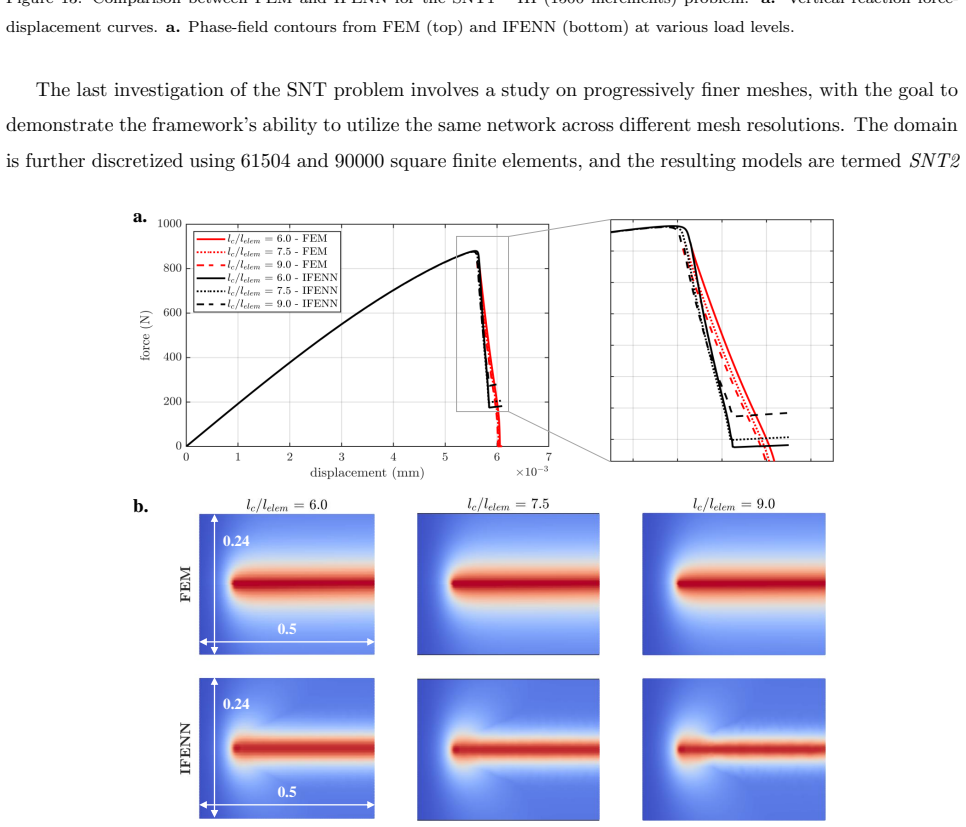
- [Section 5.1, mesh-refinement discussion] The paper itself notes in the SNT2/SNT3 study that the PICNN preserves the ratio lc/lelem rather than the physical length scale lc, leading to thinner cracks on finer meshes (Fig. 14b). This indicates that the network did not learn the actual phase-field length-scale behavior, which is a load-bearing aspect of the physics being modeled. The deviation should be quantified (e.g., crack-width or phi-profile errors at different mesh resolutions) and discussed more prominently as a limitation, since it directly affects the method's credibility for mesh-independent predictions.
- [Section 5.2 and Section 6] The highlights claim that the PICNN 'predicts the creation and nucleation of many cracks,' but the formulation explicitly excludes damage initiation and nucleation (Section 6 states this as future work), and all test cases start from pre-existing notches. The ADNT case also shows phase-field values stagnating at 0.7-0.75 after coalescence, preventing the reaction force from dropping to zero. Please temper the claims about nucleation and full crack formation, and discuss whether the stagnation after coalescence indicates a systematic limitation of the pixel-based local mapping in interactions between multiple crack fronts.
minor comments (5)
- [Throughout] Several figure captions are duplicated or mislabeled, e.g., 'Fig. 1: Comparison between FEM and IFENN...' appears over Figures 11, 12, 13, 17, and 19; these should be corrected to the actual figure numbers.
- [Section 5.2] The phrase 'predicts the formulation of both cracks' should be 'predicts the formation of both cracks'.
- [Section 3.2.4, Eq. (13)] The indices in Eq. (13) appear inconsistent: the y-direction finite difference terms should involve y_{i+1} and y_{i-1} or the notation should be clarified to avoid confusion with the x-index.
- [Abstract and Section 1.3] The wording 'arbitrary rectangular domains' is too broad given that all domains are axis-aligned rectangles with structured square meshes; please replace 'arbitrary' with 'varying rectangular' or similar.
- [Section 5.1] The discussion of the artificial stiffening caused by the Gaussian smoothing filter is placed after the results are presented; it would be clearer to state this known artifact earlier, when the smoothing filter is introduced in Section 3.3.
Circularity Check
No significant circularity: the PICNN is trained against the phase-field PDE residual and validated on FEM benchmarks not used as training labels.
full rationale
The derivation chain is not circular. The PICNN is trained by minimizing the PDE residual of Eq. 16, computed from Eq. 15, rather than by fitting to FEM phase-field labels from the benchmark cases. The two H-profiles used for training (increments 300 and 310 of the SNT1-I analysis) serve as inputs from one reference simulation, while the validation cases (SNT1-II/III, SNT2/3, SDNT, and ADNT) are solved with the same network and compared against FEM solutions that were not used in training. The self-citations (refs. 57–61) describe the prior IFENN framework and are contextual, not load-bearing; no central claim is justified by an author-supplied uniqueness theorem or by citing an unverified ansatz. The paper itself acknowledges that the two-snapshot sufficiency is an empirical finding and that post-hoc corrections (H capping, irreversibility enforcement on phi, and Gaussian smoothing) are needed for stability, which is a robustness limitation rather than a circularity. The broad generalization claim may be under-supported, but it does not reduce to its own inputs by construction.
Assumptions & free parameters
free parameters (5)
- H input cap value =
5e4 or 1e5
- Gaussian smoothing kernel size and sigma =
k=5, sigma=2
- IFENN activation threshold =
phi_nodal,max = 0.99
- Network architecture hyperparameters =
4 layers, 24 channels, lr=1e-4, 10000 epochs
- Training snapshot indices =
inc = [300, 310]
assumptions (5)
- domain assumption Phase-field AT2 model with hybrid isotropic/anisotropic split (Eq. 7) is the governing physics.
- ad hoc to paper The spatial H-to-phi mapping can be learned from two static snapshots and used time-invariantly.
- domain assumption Gauss-point values can be mapped one-to-one to pixel centers with negligible error.
- ad hoc to paper Double-symmetric 5x5 convolutional kernels are expressive enough to capture arbitrary crack front orientations.
- domain assumption Structured uniform square mesh and rectangular domains suffice for target applications.
Cite this review
Pith. "Pith review of Integrated Finite Element Neural Network (IFENN) for Phase-Field Fracture with Minimal Input and Generalized Geometry-Load Handling." pith.science (2026). https://pith.science/paper/NWEHAJJZ
@misc{pith2026250519566,
  author       = {Pith},
  title        = {Pith review of: Integrated Finite Element Neural Network (IFENN) for Phase-Field Fracture with Minimal Input and Generalized Geometry-Load Handling},
  year         = {2026},
  howpublished = {\url{https://pith.science/paper/NWEHAJJZ}},
  note         = {Machine review of arXiv:2505.19566}
}
read the original abstract
We present a novel formulation for modeling phase-field fracture propagation based on the Integrated Finite Element Neural Network (IFENN) framework. IFENN is a hybrid solver scheme that utilizes neural networks as PDE solvers within FEM, preserving accuracy via residual minimization while achieving speed-up via swift network predictions and reduction of the size of system of equations in coupled problems. In this work, we introduce a radically new formulation of IFENN in which the phase-field variable is calculated using physics-informed convolutional networks (PICNNs), while the equilibrium equation is still solved using FEM to maintain the solver robustness. Unlike conventional approaches, which rely on sequence or time-dependent models, we eliminate the need to include temporal features in the training setup and inference stage. Instead, we show that it is sufficient to learn only the spatial coupling between the strain energy density and the phase-field variable in the vicinity of the fracture process zone, and utilize this information along the advancing crack simulation. We train a single CNN in a purely physics-based, unsupervised manner on just two load increments from a single-notch tension problem, with a total training time of only 5 minutes. Following this exceptionally minimal and fast training, we show that the same PICNN can (when embedded within IFENN) model crack propagation in a very wide range of unseen scenarios, including arbitrarily rectangular domains, single and multiple interacting cracks, varying mesh densities, and arbitrary loading paths. The proposed formulation delivers breakthroughs that address many of the limitations in the existing literature of hybrid modeling, introducing a new paradigm for the development of generalizable, physics-consistent hybrid models that are applicable to fracture and other coupled problems.
Figures


Figures from the paper (15 more)




Forward citations
Cited by 1 Pith paper
-
I-FENN with DeepONets: accelerating simulations in coupled multiphysics problems
A hybrid solver that replaces the coupled temperature/pressure equation with a trained operator network inside an FEM framework reduces compute by 35-43% while keeping field errors under 5% on unseen loads in thermoel...
Reference graph
Works this paper leans on
- [1]
- [2]
-
[3]
A. Sedmak, Computational fracture mechanics: An overview from early efforts to recent achievements, Fatigue & Fracture of Engineering Materials & Structures 41 (12) (2018) 2438–2474
work page 2018
-
[4]
T. Rabczuk, Computational methods for fracture in brittle and quasi-brittle solids: state-of-the-art review and future perspectives, International Scholarly Research Notices 2013 (1) (2013) 849231
work page 2013
- [5]
- [6]
-
[7]
J.-J. Marigo, Revisiting brittle fracture as an energy minimization problem, Journal of the Mechanics and Physics of Solids 46 (8) (1998) 1319–1342
work page 1998
-
[8]
Bourdin, G
B. Bourdin, G. A. Francfort, J.-J. Marigo, Numerical experiments in revisited brittle fracture, Journal of the Mechanics and Physics of Solids 48 (4) (2000) 797–826
2000
Show all 78 references
-
[9]
A. A. Griffith, Vi. the phenomena of rupture and flow in solids, Philosophical transactions of the royal society of london. Series A, containing papers of a mathematical or physical character 221 (582-593) (1921) 163–198
1921
-
[10]
H. Ren, X. Zhuang, C. Anitescu, T. Rabczuk, An explicit phase field method for brittle dynamic fracture, Computers & Structures 217 (2019) 45–56
2019
-
[11]
D. Chu, X. Li, Z. Liu, Study the dynamic crack path in brittle material under thermal shock loading by phase field modeling, International Journal of Fracture 208 (2017) 115–130
2017
-
[12]
Svolos, C
L. Svolos, C. A. Bronkhorst, H. Waisman, Thermal-conductivity degradation across cracks in coupled thermo-mechanical systems modeled by the phase-field fracture method, Journal of the Mechanics and Physics of Solids 137 (2020) 103861
2020
-
[13]
Zhou, C.-C
S.-W. Zhou, C.-C. Xia, Propagation and coalescence of quasi-static cracks in brazilian disks: an insight from a phase field model, Acta Geotechnica 14 (4) (2019) 1195–1214
2019
-
[14]
Spatschek, E
R. Spatschek, E. Brener, A. Karma, Phase field modeling of crack propagation, Philosophical Magazine 91 (1) (2011) 75–95. 25
2011
-
[15]
P. K. Kristensen, C. F. Niordson, E. Mart ´ ınez-Pa˜ neda, Applications of phase field fracture in modelling hydrogen assisted failures, Theoretical and Applied Fracture Mechanics 110 (2020) 102837
2020
-
[16]
Bleyer, C
J. Bleyer, C. Roux-Langlois, J.-F. Molinari, Dynamic crack propagation with a variational phase-field model: limiting speed, crack branching and velocity-toughening mechanisms, International Journal of Fracture 204 (1) (2017) 79–100
2017
-
[17]
P. Li, W. Li, B. Li, S. Yang, Y. Shen, Q. Wang, K. Zhou, A review on phase field models for fracture and fatigue, Engineering Fracture Mechanics 289 (2023) 109419
2023
-
[18]
Svolos, H
L. Svolos, H. M. Mourad, G. Manzini, K. Garikipati, A fourth-order phase-field fracture model: Formulation and numerical solution using a continuous/discontinuous galerkin method, Journal of the Mechanics and Physics of Solids 165 (2022) 104910
2022
-
[19]
Schapira, L
Y. Schapira, L. Radtke, S. Kollmannsberger, A. D¨ uster, Performance of acceleration techniques for staggered phase-field solutions, Computer methods in applied mechanics and engineering 410 (2023) 116029
2023
-
[20]
Zhuang, S
X. Zhuang, S. Zhou, G. Huynh, P. Areias, T. Rabczuk, Phase field modeling and computer implementation: A review, Engineering Fracture Mechanics 262 (2022) 108234
2022
-
[21]
T. Wick, Modified newton methods for solving fully monolithic phase-field quasi-static brittle fracture propagation, Computer Methods in Applied Mechanics and Engineering 325 (2017) 577–611
2017
-
[22]
P. K. Kristensen, E. Mart ´ ınez-Pa˜ neda, Phase field fracture modelling using quasi-newton methods and a new adaptive step scheme, Theoretical and Applied Fracture Mechanics 107 (2020) 102446
2020
-
[23]
Hofacker, C
M. Hofacker, C. Miehe, Continuum phase field modeling of dynamic fracture: variational principles and staggered fe implementation, International journal of fracture 178 (2012) 113–129
2012
-
[24]
T. Jin, Z. Li, K. Chen, A novel phase-field monolithic scheme for brittle crack propagation based on the limited-memory bfgs method with adaptive mesh refinement, International Journal for Numerical Methods in Engineering 125 (22) (2024) e7572
2024
-
[25]
Bharali, S
R. Bharali, S. Goswami, C. Anitescu, T. Rabczuk, A robust monolithic solver for phase-field fracture integrated with fracture energy based arc-length method and under-relaxation, Computer Methods in Applied Mechanics and Engineering 394 (2022) 114927
2022
-
[26]
K. Li, Y. Mehmani, A multiscale preconditioner for crack evolution in porous microstructures: Accelerating phase-field methods, International Journal for Numerical Methods in Engineering 125 (11) (2024) e7463
2024
-
[27]
Badri, G
M. Badri, G. Rastiello, E. Foerster, Preconditioning strategies for vectorial finite element linear systems arising from phase-field models for fracture mechanics, Computer Methods in Applied Mechanics and Engineering 373 (2021) 113472. 26
2021
-
[28]
Svolos, L
L. Svolos, L. Berger-Vergiat, H. Waisman, Updating strategy of a domain decomposition preconditioner for parallel solution of dynamic fracture problems, Journal of Computational Physics 422 (2020) 109746
2020
-
[29]
Rannou, C
J. Rannou, C. Bovet, Domain decomposition methods and acceleration techniques for the phase field fracture staggered solver, International Journal for Numerical Methods in Engineering 125 (17) (2024) e7544
2024
-
[30]
Gupta, U
A. Gupta, U. M. Krishnan, T. K. Mandal, R. Chowdhury, V. P. Nguyen, An adaptive mesh refinement algorithm for phase-field fracture models: Application to brittle, cohesive, and dynamic fracture, Computer Methods in Applied Mechanics and Engineering 399 (2022) 115347
2022
-
[31]
X. Yang, N. Guo, Z. Yang, A finite-volume implementation of the phase-field model for brittle fracture with adaptive mesh refinement, Computers and Geotechnics 165 (2024) 105921
2024
-
[32]
Saberi, H
H. Saberi, H. Saberi, T. Q. Bui, Y. Heider, M. N. Nguyen, A multi-level adaptive mesh refinement method for phase-field fracture problems, Theoretical and Applied Fracture Mechanics 125 (2023) 103920
2023
-
[33]
Agrawal, B
V. Agrawal, B. Runnels, Block structured adaptive mesh refinement and strong form elasticity approach to phase field fracture with applications to delamination, crack branching and crack deflection, Computer Methods in Applied Mechanics and Engineering 385 (2021) 114011
2021
-
[34]
Jaccon, B
A. Jaccon, B. Prabel, G. Moln´ ar, J. Bluth´ e, A. Gravouil, Adaptive mesh refinement and cycle jumps for phase-field fatigue fracture modeling, Finite Elements in Analysis and Design 224 (2023) 104004
2023
-
[35]
Herrmann, S
L. Herrmann, S. Kollmannsberger, Deep learning in computational mechanics: a review, Computational Mechanics 74 (2) (2024) 281–331
2024
-
[36]
H. Jin, E. Zhang, H. D. Espinosa, Recent advances and applications of machine learning in experimental solid mechanics: A review, Applied Mechanics Reviews 75 (6) (2023) 061001
2023
-
[37]
N. N. Vlassis, R. Ma, W. Sun, Geometric deep learning for computational mechanics part i: Anisotropic hyperelasticity, Computer Methods in Applied Mechanics and Engineering 371 (2020) 113299
2020
-
[38]
D. W. Abueidda, S. Koric, R. A. Al-Rub, C. M. Parrott, K. A. James, N. A. Sobh, A deep learning energy method for hyperelasticity and viscoelasticity, European Journal of Mechanics-A/Solids 95 (2022) 104639
2022
-
[39]
Mendizabal, P
A. Mendizabal, P. M´ arquez-Neila, S. Cotin, Simulation of hyperelastic materials in real-time using deep learning, Medical image analysis 59 (2020) 101569
2020
-
[40]
Huang, J
D. Huang, J. N. Fuhg, C. Weißenfels, P. Wriggers, A machine learning based plasticity model using proper orthogonal decomposition, Computer Methods in Applied Mechanics and Engineering 365 (2020) 113008
2020
-
[41]
D. P. Jang, P. Fazily, J. W. Yoon, Machine learning-based constitutive model for j2-plasticity, International Journal of Plasticity 138 (2021) 102919. 27
2021
-
[42]
J. N. Fuhg, L. van Wees, M. Obstalecki, P. Shade, N. Bouklas, M. Kasemer, Machine-learning convex and texture-dependent macroscopic yield from crystal plasticity simulations, Materialia 23 (2022) 101446
2022
-
[43]
Goswami, C
S. Goswami, C. Anitescu, S. Chakraborty, T. Rabczuk, Transfer learning enhanced physics informed neural network for phase-field modeling of fracture, Theoretical and Applied Fracture Mechanics 106 (2020) 102447
2020
-
[44]
Zheng, T
B. Zheng, T. Li, H. Qi, L. Gao, X. Liu, L. Yuan, Physics-informed machine learning model for computational fracture of quasi-brittle materials without labelled data, International Journal of Mechanical Sciences 223 (2022) 107282
2022
-
[45]
Manav, R
M. Manav, R. Molinaro, S. Mishra, L. De Lorenzis, Phase-field modeling of fracture with physics-informed deep learning, Computer Methods in Applied Mechanics and Engineering 429 (2024) 117104
2024
-
[46]
L. Lu, P. Jin, G. Pang, Z. Zhang, G. E. Karniadakis, Learning nonlinear operators via deeponet based on the universal approximation theorem of operators, Nature machine intelligence 3 (3) (2021) 218–229
2021
-
[47]
D. W. Abueidda, P. Pantidis, M. E. Mobasher, Deepokan: Deep operator network based on kolmogorov arnold networks for mechanics problems, Computer Methods in Applied Mechanics and Engineering 436 (2025) 117699
2025
-
[48]
Goswami, M
S. Goswami, M. Yin, Y. Yu, G. E. Karniadakis, A physics-informed variational deeponet for predicting crack path in quasi-brittle materials, Computer Methods in Applied Mechanics and Engineering 391 (2022) 114587
2022
-
[49]
Kiyani, M
E. Kiyani, M. Manav, N. Kadivar, L. De Lorenzis, G. E. Karniadakis, Predicting crack nucleation and propagation in brittle materials using deep operator networks with diverse trunk architectures, Computer Methods in Applied Mechanics and Engineering 441 (2025) 117984
2025
-
[50]
Aldakheel, E
F. Aldakheel, E. S. Elsayed, Y. Heider, O. Weeger, Physics-based machine learning for computational fracture mechanics, Machine Learning for Computational Science and Engineering 1 (1) (2025) 18
2025
-
[51]
D. K. Klein, R. Ortigosa, J. Mart ´ ınez-Frutos, O. Weeger, Finite electro-elasticity with physics-augmented neural networks, Computer Methods in Applied Mechanics and Engineering 400 (2022) 115501
2022
-
[52]
Dammaß, K
F. Dammaß, K. A. Kalina, M. K¨ astner, Neural networks meet phase-field: A hybrid fracture model, Computer Methods in Applied Mechanics and Engineering 440 (2025) 117937
2025
-
[53]
S. Thel, L. Greve, B. van de Weg, P. van der Smagt, Introducing finite element method integrated networks (femin), Computer Methods in Applied Mechanics and Engineering 427 (2024) 117073
2024
-
[54]
S. K. Mitusch, S. W. Funke, M. Kuchta, Hybrid fem-nn models: Combining artificial neural networks with the finite element method, Journal of Computational Physics 446 (2021) 110651. 28
2021
-
[55]
R. E. Meethal, A. Kodakkal, M. Khalil, A. Ghantasala, B. Obst, K.-U. Bletzinger, R. W¨ uchner, Finite element method-enhanced neural network for forward and inverse problems, Advanced modeling and simulation in engineering sciences 10 (1) (2023) 6
2023
-
[56]
Zhang, D
W. Zhang, D. S. Li, T. Bui-Thanh, M. S. Sacks, Simulation of the 3d hyperelastic behavior of ventricular myocardium using a finite-element based neural-network approach, Computer methods in applied mechanics and engineering 394 (2022) 114871
2022
-
[57]
Pantidis, M
P. Pantidis, M. E. Mobasher, Integrated finite element neural network (I-FENN) for non-local continuum damage mechanics, Computer Methods in Applied Mechanics and Engineering 404 (2023) 115766
2023
-
[58]
Pantidis, H
P. Pantidis, H. Eldababy, C. M. Tagle, M. E. Mobasher, Error convergence and engineering-guided hyperparameter search of pinns: Towards optimized I-FENN performance, Computer Methods in Applied Mechanics and Engineering 414 (2023) 116160
2023
-
[59]
Pantidis, H
P. Pantidis, H. Eldababy, D. Abueidda, M. E. Mobasher, I-FENN with temporal convolutional networks: Expediting the load-history analysis of non-local gradient damage propagation, Computer Methods in Applied Mechanics and Engineering 425 (2024) 116940
2024
-
[60]
D. W. Abueidda, M. E. Mobasher, Variational temporal convolutional networks for I-FENN thermoelasticity, Computer Methods in Applied Mechanics and Engineering 429 (2024) 117122
2024
-
[61]
D. W. Abueidda, M. E. Mobasher, I-FENN for thermoelasticity based on physics-informed temporal convolutional network (pi-tcn), Computational Mechanics 74 (6) (2024) 1229–1259
2024
-
[62]
K. Pham, H. Amor, J.-J. Marigo, C. Maurini, Gradient damage models and their use to approximate brittle fracture, International Journal of Damage Mechanics 20 (4) (2011) 618–652
2011
-
[63]
Miehe, F
C. Miehe, F. Welschinger, M. Hofacker, Thermodynamically consistent phase-field models of fracture: Variational principles and multi-field fe implementations, International journal for numerical methods in engineering 83 (10) (2010) 1273–1311
2010
-
[64]
N. P. van Dijk, J. J. Espadas-Escalante, P. Isaksson, Strain energy density decompositions in phase-field fracture theories for orthotropy and anisotropy, International Journal of Solids and Structures 196 (2020) 140–153
2020
-
[65]
Vicentini, C
F. Vicentini, C. Zolesi, P. Carrara, C. Maurini, L. De Lorenzis, On the energy decomposition in variational phase-field models for brittle fracture under multi-axial stress states, International Journal of Fracture 247 (3) (2024) 291–317
2024
-
[66]
C. Kuhn, A. Schl¨ uter, R. M¨ uller, On degradation functions in phase field fracture models, Computational Materials Science 108 (2015) 374–384. 29
2015
-
[67]
J. M. Sargado, E. Keilegavlen, I. Berre, J. M. Nordbotten, High-accuracy phase-field models for brittle fracture based on a new family of degradation functions, Journal of the Mechanics and Physics of Solids 111 (2018) 458–489
2018
-
[68]
Svolos, J
L. Svolos, J. N. Plohr, G. Manzini, H. M. Mourad, On the convexity of phase-field fracture formulations: Analytical study and comparison of various degradation functions, International Journal of Non-Linear Mechanics 150 (2023) 104359
2023
-
[69]
Miehe, M
C. Miehe, M. Hofacker, F. Welschinger, A phase field model for rate-independent crack propagation: Robust algorithmic implementation based on operator splits, Computer Methods in Applied Mechanics and Engineering 199 (45-48) (2010) 2765–2778
2010
-
[70]
I. A. Baratta, J. P. Dean, J. S. Dokken, M. Habera, J. HALE, C. N. Richardson, M. E. Rognes, M. W. Scroggs, N. Sime, G. N. Wells, Dolfinx: the next generation fenics problem solving environment (2023)
2023
-
[71]
M. S. Alnæs, A. Logg, K. B. Ølgaard, M. E. Rognes, G. N. Wells, Unified form language: A domain-specific language for weak formulations of partial differential equations, ACM Transactions on Mathematical Software (TOMS) 40 (2) (2014) 1–37
2014
-
[72]
Archana, P
R. Archana, P. E. Jeevaraj, Deep learning models for digital image processing: a review, Artificial Intelligence Review 57 (1) (2024) 11
2024
-
[73]
Nanni, G
L. Nanni, G. Maguolo, S. Brahnam, M. Paci, An ensemble of convolutional neural networks for audio classification, Applied Sciences 11 (13) (2021) 5796
2021
-
[74]
Alsobhani, H
A. Alsobhani, H. M. ALabboodi, H. Mahdi, Speech recognition using convolution deep neural networks, in: Journal of Physics: Conference Series, Vol. 1973, IOP Publishing, 2021, p. 012166
1973
-
[75]
N. S.-N. Lam, Spatial interpolation methods: a review, The American Cartographer 10 (2) (1983) 129–150
1983
-
[76]
M. L. Minion, A projection method for locally refined grids, Journal of Computational Physics 127 (1) (1996) 158–178
1996
-
[77]
R. S. Teegavarapu, T. Meskele, C. S. Pathak, Geo-spatial grid-based transformations of precipitation estimates using spatial interpolation methods, Computers & Geosciences 40 (2012) 28–39
2012
-
[78]
X. Zhao, Z. Gong, Y. Zhang, W. Yao, X. Chen, Physics-informed convolutional neural networks for temperature field prediction of heat source layout without labeled data, Engineering Applications of Artificial Intelligence 117 (2023) 105516. 30
2023
Reviewed August 7, 2026 · model on record in the stance chip above.
Discussion (0). Continue with ORCID to comment.