REVIEW 4 major objections 6 minor 47 references
OB3D: A New Dataset for Benchmarking Omnidirectional 3D Reconstruction Using Blender
T0 review · 4 major / 6 minor · reviewed 2026-08-07 · deepseek-v4-flash
Pith's one-line read OB3D, a synthetic benchmark of twelve Blender scenes with exact camera poses and pixel-aligned depth and normals, gives 360-degree 3D reconstruction a single evaluation protocol.
desk verdict Useful first benchmark for omnidirectional 3D reconstruction, but the printed camera-rotation matrix is wrong and the baseline tables look fishy; fix those and I'd trust it. read the letter →
The pith
A machine-rendered reading of the paper's core claim, the machinery that carries it, and where it could break.
The reading
What carries the argument
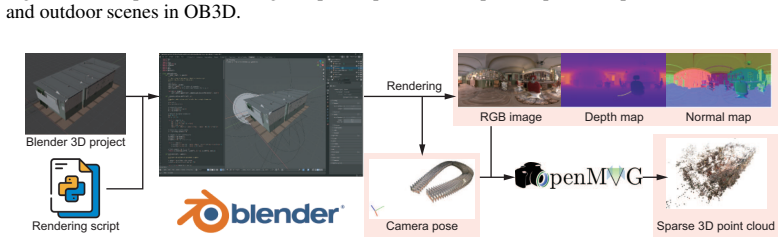
The load-bearing object is the dataset itself: twelve Blender scenes rendered with an ideal equirectangular camera, where each viewpoint has jointly produced RGB, depth, normal, and camera-pose ground truth from the same rendering pipeline, so the geometric values are aligned by construction. A second mechanism is the evaluation protocol for 3D reconstruction: instead of comparing meshes directly, the reconstructed mesh is re-rendered into depth maps and scored against the ground-truth depth maps with RMSE, MAE, AbsRel, and the fraction of pixels whose estimated depth is within 25 percent of the true depth. For pose estimation the protocol uses relative rotation and translation errors between pairs of views plus an AUC@5 threshold, so overall scale and global position differences do not distort the score. These protocols, together with the 25-image train and test split per scene, define the benchmark's operation.
What would settle it
Render a known 3D marker set in one OB3D scene, project those markers into the provided images using the provided camera poses, and compare the projected depths against the provided depth maps; any mismatch beyond rounding shows the ground truth is not self-consistent.
Extended reading notes
Core claim
The paper's central claim is that OB3D is, to the best of the authors' knowledge, the only omnidirectional image dataset that provides a complete evaluation protocol for 3D reconstruction, making it an important benchmark for methods that build mesh models from 360-degree images. The dataset provides ideal equirectangular projection with no lens distortion, ground-truth camera parameters generated by the rendering pipeline, pixel-aligned depth and normal maps, and a sparse point cloud per trajectory, over both egocentric and non-egocentric camera paths. Its evaluation protocols cover camera pose estimation via relative rotation and translation errors and trajectory error, novel view synthesis via standard image quality metrics, and 3D reconstruction by rendering depth maps from reconstructed meshes and comparing them against ground-truth depth. The baseline experiments are presented not as a method contest but as evidence that the benchmark can expose how scene scale, structure, and trajectory affect reconstruction accuracy.
Load-bearing premise
The benchmark is only as good as its ground truth: the paper assumes the rendering pipeline yields exact camera poses and pixel-aligned depth and normal maps, and it provides no independent cross-check of those values against another source.
Editorial extensions
If this is right
- Any 3D reconstruction method from omnidirectional images can be evaluated against OB3D with the same metrics, making method-to-method comparisons across papers meaningful.
- Because the same scenes are captured with egocentric and non-egocentric trajectories, the dataset can isolate how trajectory type affects pose estimation, view synthesis, and mesh quality.
- The provided sparse point clouds let radiance-field and splatting methods start from an initialization consistent with the ground-truth camera poses, as the paper demonstrates in its view-synthesis baselines.
- The released train/test split and evaluation code allow a new method to report numbers that are immediately comparable to the baselines in this paper.
- If the ground-truth geometry is exact as claimed, the dataset can serve as a clean testbed for diagnosing distortion-related failures in equirectangular representations, especially near polar regions.
Reading between the lines
- The same rendering pipeline could generate controlled variations, such as different image resolutions, added lens distortion, or altered trajectory spacing, to test how sensitive reconstruction methods are to each factor, which the paper does not do.
- Because depth and normal maps are pixel-aligned and cover the full sphere, the dataset could also be used to benchmark monocular depth or surface-normal estimation from 360-degree images, a neighboring task the authors mention but do not formalize.
- A key untested question is whether rankings obtained on this synthetic data transfer to real omnidirectional captures, where sensor noise, rolling shutter, and imperfect calibration enter; adding a small real-world companion set would settle it.
- The paper's printed pose-construction formula contains a rotation matrix whose columns are not orthogonal; if the released code matches the formula rather than a corrected version, the ground-truth poses would need to be regenerated before the benchmark is fully trustworthy.
Editorial analysis
A structured set of objections, weighed in public.
Referee Report
Summary. The paper introduces OB3D, a synthetic omnidirectional 3D reconstruction benchmark built from 12 Blender scenes. For each scene, two camera trajectories (egocentric and non-egocentric) are rendered with 100 equirectangular images at 1,600 x 800 resolution, and the dataset provides ground-truth RGB, depth, normals, camera parameters, and OpenMVG sparse point clouds. The paper proposes three evaluation protocols: camera pose estimation, novel view synthesis, and 3D reconstruction, and reports baseline experiments with OpenSfM/OpenMVG, EgoNeRF/ODGS/op43dgs/OmniGS, and COLMAP/NeuS*/OmniSDF. The central claim is that OB3D is the only dataset providing an evaluation protocol for 3D reconstruction from omnidirectional images.
Significance. If the ground-truth camera parameters and rendered depth/normal maps are correct, OB3D fills a real gap: a controlled synthetic testbed with exact poses, diverse indoor/outdoor scenes, and both egocentric and non-egocentric trajectories, with public data and evaluation code. The paper's comparison of SfM pipelines and novel-view-synthesis methods across trajectory types gives useful evidence that trajectory shape affects reconstruction accuracy, and the public release strengthens reproducibility. However, the benchmark's value depends on the correctness of the ground-truth camera poses and depth maps, which the manuscript currently does not verify.
major comments (4)
- [Section C.4, Eq. (6)] The matrix printed as R_x(θ) is not a rotation matrix: its second and third columns are not mutually orthogonal, and its determinant is sin(2θ) rather than 1. Because Eqs. (5)-(7) define the camera extrinsic used for rendering, the pose construction is not reproducible as written. If the released Blender script implements Eq. (6) literally, every camera pose in OB3D is invalid; if it implements the intended rotation, the paper misdescribes the procedure. Please correct Eq. (6) and audit the released JSON pose files: verify orthonormality (R R^T = I, det(R)=+1) for all poses and, if possible, check re-projection of the sparse point cloud into the equirectangular images.
- [Table 9 (and Table 3)] OpenSfM reports RRA = 0.405 for every scene, trajectory, and environment, and ATE = 0.000 for nearly all rows. A constant relative rotation error to three decimal places across twelve diverse scenes and both trajectory types is implausible and suggests a bug in the metric implementation, a fixed-baseline comparison, or an alignment issue. Because camera parameter estimation is one of the three headline protocols, the authors should re-run the evaluation with the public code, report the number of image pairs used for RRA/RTA averaging, and describe the alignment procedure used for ATE; if the constant is genuine, it should be explained.
- [Sections 3.2 and C.4] The paper provides no independent validation of the ground-truth camera poses, depth maps, or normal maps. The central claim of Section 2.2 depends on these being exactly correct, yet no orthonormality audit, no re-projection consistency check, and no comparison with a second renderer or analytic projection is reported. Please add a validation subsection that, for instance, re-renders a known 3D point pattern with the released render script and compares recovered poses against the JSON files, or at least checks that the printed Eqs. (5)-(7) produce consistent rotations when composed with the rendering pipeline.
- [Section 3.5(iii)] The 3D reconstruction protocol is described as rendering depth maps from reconstructed meshes and excluding 'sky' regions, but the paper does not specify how the mesh is rasterized, how the camera and image resolution for the depth render are set, or how 'sky' is identified. Without these details the RMSE/MAE/AbsRel/δ1.25 numbers in Tables 5 and 11-13 cannot be reproduced independently. Please state the exact procedure or point to the relevant function in the GitHub evaluation code, and give the threshold used to define 'extremely large depth values'.
minor comments (6)
- [Eq. (1)] The notation n_z(n_z · d_i) is ambiguous; please write n_z (n_z^T d_i) or define n_z as a column vector to make the outer product explicit.
- [Sections 3.3 and C.4] The text says the camera orientation at position i is the direction vector to the next camera position i+1, while Eq. (1) defines d_i = l_i − l_{i+1}. These statements are consistent only if one remembers that the camera Z axis faces the opposite direction of d_i; please clarify this in the main text to prevent sign errors by users who implement the protocol from the paper alone.
- [Section D.3.1] OmniGS results are obtained with a Python reproduction, not the official C++ implementation; please state whether the reproduction was validated on a standard benchmark and provide the reproduction code for transparency.
- [Tables 5 and 13] The main text should state that OmniSDF is evaluated only on Egocentric trajectories; the current caption 'Results for OmniSDF are available in the supp. material' is misleading when the supplementary table contains no Non-Egocentric rows.
- [Appendix E, reference [e]] The author list 'Z. Wang, A. Bobik, and E. Sheikh, H.R. Simoncelli' is incorrect; it should be 'Z. Wang, A. C. Bovik, H. R. Sheikh, and E. P. Simoncelli'.
- [Figures 4 and 5] The visual comparison would be easier to interpret if the depth and normal maps were displayed with a consistent color scale, since the current panels make it hard to compare scenes.
Circularity Check
No significant circularity: OB3D provides independently rendered ground truth and standard external evaluation metrics, with no fitted parameters disguised as predictions.
full rationale
The paper's central claim is that OB3D is a dataset and benchmark for omnidirectional 3D reconstruction, and its ground-truth RGB, depth, normal, and camera-pose data are produced by Blender rendering together with standard Blender camera conventions. There is no derivation chain in which an output quantity is defined in terms of another output quantity or in which a fitted parameter is renamed as a prediction. The camera parameter estimation protocol compares SfM outputs against independently rendered Blender poses; novel view synthesis compares rendered images against held-out Blender images; and 3D reconstruction renders depth maps from reconstructed meshes and compares them against Blender depth maps. In each case the reference values are external to the method being evaluated. The one self-citation is Ref. [14], whose author overlaps with Hwann-Tzong Chen, but it is cited only in the introductory list of room-layout estimation works and it is not load-bearing for the benchmark claim. The noted issue with Eq. (6) in Appendix C.4, where the printed Rx(theta) matrix is not orthonormal, is a correctness or reproducibility concern about the pose construction, not a circularity: the paper does not use that equation to define the evaluation outcome. Overall, the evaluation is self-contained against externally generated ground truth and standard metrics, so no circular step is identifiable.
Assumptions & free parameters
free parameters (5)
- Image resolution =
1600 x 800 px
- Images per trajectory =
100 (25 train / 25 test)
- OpenMVG matching ratio =
0.3
- OpenMVG feature preset =
ULTRA
- Trajectory shape parameters =
Not fully reported (radius r, loop count, Z-axis ascent, keypoint positions)
assumptions (5)
- domain assumption Blender's Python API rendering pipeline produces geometrically correct equirectangular RGB, depth, and normal maps without lens distortion.
- ad hoc to paper The camera orientation construction in Section C.4, including Eqs. (5)-(7), matches the poses actually used for rendering.
- domain assumption Ideal equirectangular projection is a sufficient camera model for benchmarking omnidirectional 3D reconstruction.
- ad hoc to paper Depth-map comparison from reconstructed meshes, with sky regions excluded, is a valid evaluation of 3D reconstruction accuracy.
- domain assumption The 12 Blender scenes are representative of real indoor and outdoor omnidirectional capture conditions.
Cite this review
Pith. "Pith review of OB3D: A New Dataset for Benchmarking Omnidirectional 3D Reconstruction Using Blender." pith.science (2026). https://pith.science/paper/S6ER2RNZ
@misc{pith2026250520126,
  author       = {Pith},
  title        = {Pith review of: OB3D: A New Dataset for Benchmarking Omnidirectional 3D Reconstruction Using Blender},
  year         = {2026},
  howpublished = {\url{https://pith.science/paper/S6ER2RNZ}},
  note         = {Machine review of arXiv:2505.20126}
}
read the original abstract
Recent advancements in radiance field rendering, exemplified by Neural Radiance Fields (NeRF) and 3D Gaussian Splatting (3DGS), have significantly progressed 3D modeling and reconstruction. The use of multiple 360-degree omnidirectional images for these tasks is increasingly favored due to advantages in data acquisition and comprehensive scene capture. However, the inherent geometric distortions in common omnidirectional representations, such as equirectangular projection (particularly severe in polar regions and varying with latitude), pose substantial challenges to achieving high-fidelity 3D reconstructions. Current datasets, while valuable, often lack the specific focus, scene composition, and ground truth granularity required to systematically benchmark and drive progress in overcoming these omnidirectional-specific challenges. To address this critical gap, we introduce Omnidirectional Blender 3D (OB3D), a new synthetic dataset curated for advancing 3D reconstruction from multiple omnidirectional images. OB3D features diverse and complex 3D scenes generated from Blender 3D projects, with a deliberate emphasis on challenging scenarios. The dataset provides comprehensive ground truth, including omnidirectional RGB images, precise omnidirectional camera parameters, and pixel-aligned equirectangular maps for depth and normals, alongside evaluation metrics. By offering a controlled yet challenging environment, OB3Daims to facilitate the rigorous evaluation of existing methods and prompt the development of new techniques to enhance the accuracy and reliability of 3D reconstruction from omnidirectional images.
Figures


Figures from the paper (8 more)


Reference graph
Works this paper leans on
-
[1]
H. Ai, Z. Cao, and L. Wang, “A survey of representation lea rning, optimization strategies, and applications for omnidirectional vision,” Int. J. Comput. Vis., Apr. 2025
work page 2025
-
[2]
Matterport3D: Learning from RGB-D data in indoor environm ents,
A. Chang, A. Dai, T. Funkhouser, H. M., M. Niessner, M. Sav va, S. Song, A. Zeng, and Y . Zhang, “Matterport3D: Learning from RGB-D data in indoor environm ents,” Int. Conf. 3D Vis., pp. 667–676, Oct. 2017
work page 2017
-
[3]
Joint 2D- 3D-semantic data for indoor scene understand- ing,
I. Armeni, S. Sax, A. R. Zamir, and S. Savarese, “Joint 2D- 3D-semantic data for indoor scene understand- ing,” CoRR, vol. abs/1702.01105, pp. 1–9, Apr. 2017
arXiv 2017
-
[4]
Real-time o mnidirectional roaming in large scale indoor scenes,
H. Huang, Y . Chen, T. Zhang, and S.-K. Yeung, “Real-time o mnidirectional roaming in large scale indoor scenes,” SIGGRAPH Asia, pp. 1–5, Nov. 2022
work page 2022
-
[5]
PICCOLO: Point clo ud-centric omnidirectional localization,
J. Kim, C. Choi, H. Jang, and Y . M. Kim, “PICCOLO: Point clo ud-centric omnidirectional localization,” Int. Conf. Comput. Vis., pp. 3313–3323, Oct. 2021
work page 2021
-
[6]
Zillow indoor dataset: Annotated floor plans with 360◦ panoramas and 3D room layouts,
S. Cruz, W. Hutchcroft, Y . Li, N. Khosravan, I. Boyadzhie v, and S. B. Kang, “Zillow indoor dataset: Annotated floor plans with 360◦ panoramas and 3D room layouts,” IEEE/CVF Conf. Comput. Vis. Pattern Recog., pp. 2133–2143, June 2021
work page 2021
-
[7]
OmniPh otos: Casual 360◦ VR photography,
T. Bertel, M. Y uan, R. Lindroos, and C. Richardt, “OmniPh otos: Casual 360◦ VR photography,” ACM Trans. Graph., vol. 39, pp. 1–12, Nov. 2020
work page 2020
-
[8]
Om nidepth: Dense depth estimation for indoors spherical panoramas,
K. Zioulis, A. Karakottas, D. Zarpalas, and P . Daras, “Om nidepth: Dense depth estimation for indoors spherical panoramas,” Eur . Conf. Comput. Vis., pp. 448–465, Sept. 2018
work page 2018
Show all 47 references
-
[9]
Balanced spherical grid for egocentric view synthesis,
C. Choi, S. M. Kim, and Y . M. Kim, “Balanced spherical grid for egocentric view synthesis,” IEEE/CVF Conf. Comput. Vis. Pattern Recog., pp. 12663–12673, June 2023
2023
-
[10]
360VO: Visual odometry using a single 360 camera,
H. Huang and S. K. Yeung, “360VO: Visual odometry using a single 360 camera,” Int Conf. Robotics and Automation, pp. 5594–5600, May 2022
2022
-
[11]
Self- supervised learning of depth and camera motion from 360◦ videos,
F.-E. Wang, H.-N. Hu, H.-T. Cheng, J.-T. Lin, S.-T. Yang , M.-L. Shih, H.-K. Chu, and M. Sun, “Self- supervised learning of depth and camera motion from 360◦ videos,” Asian Conf. Comput. Vis., pp. 53–68, May 2019
2019
-
[12]
Semantic scene completion from a single depth image,
S. Song, F. Y u, A. Zeng, A. X. Chang, M. Savva, and T. Funkh ouser, “Semantic scene completion from a single depth image,” IEEE/CVF Conf. Comput. Vis. Pattern Recog., pp. 1746–1754, July 2017
2017
-
[13]
LE D2-Net: monocular 360deg layout estimation via differentiable depth rendering,
F. E. Wang, Y . H. Yeh, M. Sun, W. C. Chiu, and Y . H. Tsai, “LE D2-Net: monocular 360deg layout estimation via differentiable depth rendering,” IEEE/CVF Conf. Comput. Vis. Pattern Recog., pp. 12956– 12965, June 2021
2021
-
[14]
Seg2Reg: djifferentiable 2D segmentation to 1D regressio n rendering for 360 room layout reconstruc- tion,
C. Sun, W.-E. Tai, Y .-L. Shih, K.-W. Chen, Y .-J. Syu, K.- S. The, Y .-C. F. Wang, and H.-T. Chen, “Seg2Reg: djifferentiable 2D segmentation to 1D regressio n rendering for 360 room layout reconstruc- tion,” IEEE/CVF Conf. Comput. Vis. Pattern Recog., pp. 10435–10445, June 2024
2024
-
[15]
360MonoDepth: H igh-resolution 360◦ monocular depth esti- mation,
M. Rey-Area, M. Y uan, and C. Richardt, “360MonoDepth: H igh-resolution 360◦ monocular depth esti- mation,” IEEE/CVF Conf. Comput. Vis. Pattern Recog., pp. 3762–3772, June 2022
2022
-
[16]
PanoNormal: monocul ar indoor 360◦ surface normal estimation,
K. Huang, F. Zhang, and N. Dogson, “PanoNormal: monocul ar indoor 360◦ surface normal estimation,” CoRR, vol. abs/2405.18745, pp. 1–17, May 2024
2024
-
[17]
NeRF: Representing scenes as neural radiance fields for view synthesis,
B. Mildenhall, P . P . Srinivasan, M. Tancik, J. T. Barron, R. Ramamoorthi, and R. Ng, “NeRF: Representing scenes as neural radiance fields for view synthesis,” Eur . Conf. Comput. Vis., pp. 405–421, Aug. 2020
2020
-
[18]
3D Gaussian splatting for real-time radiance field rendering,
B. Kerbl, G. Kopanas, T. Leimkühler, and G. Drettakis, “ 3D Gaussian splatting for real-time radiance field rendering,” ACM Trans. Graph., vol. 42, pp. 139:1–139:14, July 2023
2023
-
[19]
Egocentric scene reconstruction from an omnidirectional video,
H. Jang, A. Meuleman, D. Kang, D. Kim, C. Richardt, and M. H. Kim, “Egocentric scene reconstruction from an omnidirectional video,” ACM Trans. Graph., vol. 41, pp. 100:1–100:12, July 2022
2022
-
[20]
O mniSDF: Scene reconstruction using omnidirectional signed distance functions and adaptive binoctrees,
H. Kim, A. Meuleman, H. Jang, J. Tompkin, and M. H. Kim, “O mniSDF: Scene reconstruction using omnidirectional signed distance functions and adaptive binoctrees,” IEEE/CVF Conf. Comput. Vis. Pattern Recog., pp. 20227–20236, June 2024
2024
-
[21]
360MVSNet: Deep multi-view stereo network with 360◦ images for indoor scene reconstruction,
C. Chiu, Y . Wu, I. Shen, and Y . Chuang, “360MVSNet: Deep multi-view stereo network with 360◦ images for indoor scene reconstruction,” IEEE/CVF Winter Conf. Applications of Comput. Vis. , pp. 3057–3066, Jan. 2023
2023
-
[22]
36 0Recon: An accurate reconstruction method based on depth fusion from 360 images,
Z. Yan, Q. Wu, S. Xia, J. Deng, X. Mu, R. Jin, and L. Pei, “36 0Recon: An accurate reconstruction method based on depth fusion from 360 images,” CoRR, vol. abs/2411.19102, pp. 1–14, Nov. 2024. 10
2024 arXiv
-
[23]
Structure-from-motio n revisited,
J. L. Schönberger and J. Frahm, “Structure-from-motio n revisited,” IEEE/CVF Conf. Comput. Vis. Pattern Recog., pp. 4104–4113, June 2016
2016
-
[24]
Pixelwise view selection for unstructured multi-view stereo,
J. L. Schönberger, E. Zheng, M. Pollefeys, and J. Frahm, “Pixelwise view selection for unstructured multi-view stereo,” Eur . Conf. Comput. Vis., pp. 501–518, Sept. 2016
2016
-
[25]
SDFStudio: A unified framework for surface reconstruction ,
Z. Y u, A. Chen, B. Antic, S. Peng, A. Bhattacharyya, M. Ni emeyer, S. Tang, T. Sattler, and A. Geiger, “SDFStudio: A unified framework for surface reconstruction ,” 2022
2022
-
[26]
2D Gaussi an splatting for geometrically accurate radiance fields,
B. Huang, Z. Y u, A. Chen, A. Geiger, and S. Gao, “2D Gaussi an splatting for geometrically accurate radiance fields,” ACM SIGGRAPH, pp. 1–11, July 2024
2024
-
[27]
Mip-NeRF 360: Unbounded anti-aliased neural radiance fields,
J. T. Barron, B. Mildenhall, D. V erbin, P . P . Srinivasan , and P . Hedman, “Mip-NeRF 360: Unbounded anti-aliased neural radiance fields,” IEEE/CVF Conf. Comput. Vis. Pattern Recog. , pp. 5460–5469, June 2022
2022
-
[28]
HoGS: Uni fied near and far object reconstruction via homogeneous Gaussian splatting,
X. Liu, Z. Huang, F. Okura, and Y . Matsushita, “HoGS: Uni fied near and far object reconstruction via homogeneous Gaussian splatting,” CoRR, vol. abs/2503.19232, pp. 1–17, Mar. 2025
2025 arXiv
-
[29]
Mip- Splatting: Alias-free 3D Gaussian splatting,
Z. Y u, A. Chen, B. Huang, T. Sattler, and A. Geiger, “Mip- Splatting: Alias-free 3D Gaussian splatting,” IEEE/CVF Conf. Comput. Vis. Pattern Recog., pp. 19447–19456, June 2024
2024
-
[30]
360-G S: Layout-guided panoramic Gaussian splatting for indoor roaming,
J. Bai, L. Huang, J. Guo, W. Gong, Y . Li, and Y . Guo, “360-G S: Layout-guided panoramic Gaussian splatting for indoor roaming,” CoRR, vol. abs/2402.00763, pp. 1–11, Feb. 2024
2024 arXiv
-
[31]
ODGS: 3D scene rec onstruction from omnidirectional images with 3D Gaussian splattings,
S. Lee, J. Chung, J. Huh, and K. M. Lee, “ODGS: 3D scene rec onstruction from omnidirectional images with 3D Gaussian splattings,” Adv. Neural Inform. Process. Syst., pp. 1–26, Dec. 2024
2024
-
[32]
On the error analysis of 3D Gaussian splatting and an optimal projection strategy,
L. Huang, J. Bai, J. Guo, Y . Li, and Y . Guo, “On the error analysis of 3D Gaussian splatting and an optimal projection strategy,” Eur . Conf. Comput. Vis., pp. 247–263, Nov. 2024
2024
-
[33]
OmniGS: Omnidir ectional Gaussian splatting for fast radiance field reconstruction using omnidirectional images,
L. Li, H. Huang, S. Yeung, and H. Cheng, “OmniGS: Omnidir ectional Gaussian splatting for fast radiance field reconstruction using omnidirectional images,” IEEE/CVF Winter Conf. Applications of Comput. Vis., pp. 2260–2268, Feb. 2025
2025
-
[34]
Casual indoor HDR radiance capture from omnidirectional images,
P . Gera, M. R. K. Dastjerdi, C. Renaud, P . J. Narayanan, a nd J.-F. Lalonde, “Casual indoor HDR radiance capture from omnidirectional images,” Brit. Mach. Vis. Conf., pp. 305–318, Feb. 2023
2023
-
[35]
PGSR: Planar-based Gaussian splatting for efficient and high-fide lity surface reconstruction,
D. Chen, H. Li, W. Ye, Y . Wang, W. Xie, S. Zhai, N. Wang, H. L iu, H. Bao, and G. Zhang, “PGSR: Planar-based Gaussian splatting for efficient and high-fide lity surface reconstruction,” IEEE Trans. Vis. Comput. Graph., Nov. 2024
2024
-
[36]
MVSNet: Depth inference for unstructured multi-view stereo,
Y . Yao, Z. Luo, S. Li, T. Fang, and L. Quan, “MVSNet: Depth inference for unstructured multi-view stereo,” Eur . Conf. Comput. Vis., pp. 785–801, Oct. 2018
2018
-
[37]
Multiview neural surface reconstruction by disentangling geometry and appearance,
L. Yariv, Y . Kasten, D. Moran, M. Galun, M. Atzmon, R. Basri, and Y . Lipman, “Multiview neural surface reconstruction by disentangling geometry and appearance, ” Adv. Neural Inform. Process. Syst., pp. 2492– 2502, Dec. 2020
2020
-
[38]
NeuS: Learning neural implicit surfaces by volume rendering for multi-view reconstruction,
P . Wang, L. Liu, Y . Liu, C. Theobalt, T. Komura, and W. Wang, “NeuS: Learning neural implicit surfaces by volume rendering for multi-view reconstruction,” Adv. Neural Inform. Process. Syst., pp. 27171–27183, Dec. 2021
2021
-
[39]
V olume render ing of neural implicit surfaces,
L. Yariv, J. Gu, Y . Kasten, and Y . Lipman, “V olume render ing of neural implicit surfaces,” Adv. Neural Inform. Process. Syst., pp. 4805–4815, Dec. 2021
2021
-
[40]
Neuralangelo: high- fjidelity neural surface reconstruction,
Z. Li, T. Müller, A. Evans, R. H. Taylor, M. Unberath, M.- Y . Liu, and C.-H. Lin, “Neuralangelo: high- fjidelity neural surface reconstruction,” IEEE/CVF Conf. Comput. Vis. Pattern Recog. , pp. 8456–8465, June 2023
2023
-
[41]
Marching cubes: A high re solution 3D surface construction algorithm,
W. E. Lorensen and H. E. Cline, “Marching cubes: A high re solution 3D surface construction algorithm,” ACM SIGGAPH Comput. Grah. , vol. 21, pp. 163–169, Aug. 1987
1987
-
[42]
ImageNe t classification with deep convolutional neural networks,
A. Krizhevsky, I. Sutskever, and G. E. Hinton, “ImageNe t classification with deep convolutional neural networks,” Adv. Neural Inform. Process. Syst., pp. 1097–1105, Dec. 2012
2012
-
[43]
Very deep convolutional neural netw ork based image classification using small training sample size,
S. Liu and W. Deng, “Very deep convolutional neural netw ork based image classification using small training sample size,” Asian Conf. Pattern Recog., pp. 730–734, Nov. 2015. 11 A OpenMVG Procedure The procedure for reconstructing a sparse 3D point cloud usi ng OpenMVG is as follows
2015
-
[44]
The input image is registered and the camera is configured. Since the camera parameters of OB3D are different from those of OpenMVG, it is necessary to p erform the appropriate conver- sion and write them into a file format that OpenMVG can handle
-
[45]
To in- crease the number of reconstructed point clouds, the hyperp arameters should be adjusted for optimization
Feature points are extracted and feature point matching b etween images is performed. To in- crease the number of reconstructed point clouds, the hyperp arameters should be adjusted for optimization. Refer to Sect. D.2.1 for setting details
-
[46]
projection_type
A sparse 3D point cloud is reconstructed and camera parame ters are estimated. Since the result- ing point cloud includes points indicating the camera posit ion, a process to erase the camera is necessary to extract only the scene information. For the concrete execution comman...
-
[47]
Average (all)
EgoNeRF shows high rendering accuracy in both environmen ts and is robust to scene changes. The 3DGS-based methods vary their rendering accuracy for th e environment changes from indoor to outdoor, and for the camera trajectory changes from Egoce ntric to Non-Egocentric. In pa...
2017
Reviewed August 7, 2026 · model on record in the stance chip above.
Discussion (0). Continue with ORCID to comment.