REVIEW 4 major objections 5 minor 41 references
AlignGen: Boosting Personalized Image Generation with Cross-Modality Prior Alignment
T0 review · 4 major / 5 minor · reviewed 2026-08-07 · deepseek-v4-flash
Pith's one-line read This paper claims that zero-shot personalized image generation can beat per-concept fine-tuning by aligning textual and visual priors through a single learnable token.
desk verdict Genuinely new mechanism and solid ablations, but the 0.004 edge over DreamBooth LoRA has no error bars and a test-set-tuned hyperparameter, so the headline claim is not yet supported. read the letter →
The pith
A machine-rendered reading of the paper's core claim, the machinery that carries it, and where it could break.
The reading
What carries the argument
The Deviation Extraction Module (DEM): a residual stack of self-attention, cross-attention against the Redux tokens $c_\text{redux}$, and an MLP, which updates the learnable token $S^*$ into $S'^*$ capturing the deviation between text and image priors. The updated token is placed before the concept name in the prompt, and a selective cross-modal attention mask in the multi-modal attention blocks prevents concept-irrelevant text tokens from diluting the reference image attention. Together these components transfer the visual prior into the text path without test-time optimization.
What would settle it
Give AlignGen a reference image of a corgi and the prompt 'a photo of a cat'; if the generated image is a cat, the alignment mechanism has failed to override the textual prior, and if it preserves the corgi, the shared-space assumption behind the deviation extraction module holds.
Extended reading notes
Core claim
The central discovery is that textual and visual priors in diffusion transformers can be bridged by a single updated token, rather than by fine-tuning the whole model or injecting the image through a separate adapter. AlignGen shows that a learnable token $S^*$, refined by a deviation extraction module that cross-attends to the FLUX Redux tokens, carries the visual deviation into the text path. A selective cross-modal attention mask then reinforces the connection between the concept words and the reference image tokens. The paper presents this as the first zero-shot personalization method to outperform test-time optimization on DreamBench++, with concept preservation and prompt following scores that beat DreamBooth LoRA.
Load-bearing premise
The method assumes the Redux tokens from FLUX.1 Redux encode the reference image in the same representation space as text tokens, so that cross-attending text to those tokens yields a meaningful deviation that can be folded into one learnable token.
Editorial extensions
If this is right
- Users can personalize a diffusion model from a single reference image with no per-concept optimization, matching or beating fine-tuned methods on the DreamBench++ balance metric.
- The same single-token mechanism generalizes to adding a second reference concept without extra training, as the paper demonstrates on two-subject prompts.
- The selective cross-modal attention mask improves concept preservation without harming prompt following, so the alignment can be added to existing DiT-based injection schemes.
- The 13% improvement over the closest zero-shot baseline establishes that prior alignment, not more parameters, is the missing ingredient in zero-shot personalization.
Reading between the lines
- Because the DEM only needs a text-aligned image representation, it should transfer to other DiT models that expose such tokens, not just FLUX; swapping Redux for an equivalent adapter is a direct test of the shared-space assumption.
- The updated token $S'^*$ could serve as a warm start for test-time optimization methods like Textual Inversion, potentially cutting their optimization steps while keeping concept fidelity.
- The degradation at three or more reference images suggests the selective mask is binding one concept-reference pair at a time; a pairwise mask design would be a natural testable extension for multi-concept scenes.
Editorial analysis
A structured set of objections, weighed in public.
Referee Report
Summary. The paper proposes AlignGen, a zero-shot personalized image generation method built on FLUX.1 Dev. It introduces a learnable token S* prepended to the concept name, updates this token via a Deviation Extraction Module (DEM) that cross-attends to FLUX Redux tokens, applies a Selective Cross-Modal Attention Mask (SCMAM) to strengthen attention between concept text tokens and reference image tokens, and trains on Subject200K with random reference-image dropout and concept-name substitution. Evaluation on DreamBench++ with GPT-4o scores reports the best CP·PF balance among zero-shot methods and a higher product score than DreamBooth LoRA.
Significance. If the result holds, AlignGen would be a meaningful advance: an inference-time-only method competitive with per-concept fine-tuning, with a mechanism that directly targets cross-modal prior misalignment. The ablation study gives some support for each component (Table 2), and the training/evaluation split (Subject200K vs DreamBench++) avoids gross circularity. However, the headline numerical advantage is small and statistically unquantified, and a key hyperparameter is tuned on a subset of the same benchmark used for the headline comparison, so the empirical support is not yet conclusive.
major comments (4)
- [§4.2, Table 1] The claim of surpassing DreamBooth LoRA rests on a 0.004 difference in CP·PF (0.521 vs 0.517) with no error bars, no number of seeds, and no significance test; because GPT-4o scores are stochastic, a single evaluation run cannot support this claim. Additionally, the category breakdown shows Style CP 0.333 vs 0.718 for DreamBooth LoRA, a large regression hidden by the product metric; the authors should report variance/confidence intervals and discuss category-level trade-offs.
- [§4.3, Table 3] The reference-image drop ratio is selected by ablating on a random subset of DreamBench++ (one prompt per image), which is the same benchmark used for the headline comparison, rather than a held-out validation set. Since Table 3 shows that changing the ratio from 0.5 to 0.7 changes CP·PF from 0.500 to 0.461, test-set tuning could materially affect the reported margin; a held-out validation split or a full-benchmark comparison across ratios is needed.
- [§5 (Limitation) and Table 1] The manuscript explicitly states that performance is limited for human and style categories because of the training set, and Table 1 confirms this: Style CP is 0.333 versus 0.718 for DreamBooth LoRA. This contradicts the unqualified claim of achieving 'the optimal balance' across categories and should be qualified per category.
- [§4.3, Table 2] The default configuration achieves CP·PF 0.500 on the ablation subset but 0.521 on the full DreamBench++ (Table 1), indicating that the subset is not representative; the component ablations in Table 2 should be repeated on the full benchmark or on a prespecified validation set to ensure that the observed gains transfer.
minor comments (5)
- [§3.2, Eq. (6)] Equation (6) is missing a closing bracket: the left-hand side should be 'MMA([x_t ; c'_text ; c_ref]) = ...' rather than 'MMA([x_t ; c'_text ; c_ref] = ...'.
- [Tables 2 and 3] The arrows in Tables 2 and 3 (↓) suggest that lower values are better, while the text and Table 1 state that higher CP·PF values are better; the arrow direction should be consistent (use ↑).
- [§4.1 (Datasets)] The dataset description says that DeepSeek-V3 was used to replace target concept names with the special word 'concept' and to generate parent classes; the prompt rewriting procedure and its quality validation should be described in more detail for reproducibility.
- [§5] The spelling of 'DreamBench++' is inconsistent (e.g., 'Dreambench++' in the conclusion); please standardize.
- [§4.1 (Evaluation Metrics)] The evaluation protocol for GPT-4o scoring (number of calls, temperature, prompt template, and any aggregation) is not specified and should be stated so that the results can be reproduced.
Circularity Check
One fitted hyperparameter (reference drop ratio) is selected on a DreamBench++ subset, biasing the headline comparison; the core method itself is trained on Subject200K and is not derivationally circular.
-
fitted input called prediction
[Section 4.3, 'Effect of different reference image drop ratio' (Table 3); headline result in Section 4.2, Table 1]
"Due to the time and computational cost required for performing inference on all images in the DreamBench++ and evaluating with GPT-4o, we restrict our ablation experiments to a subset of the benchmark. This subset is constructed by randomly selecting one prompt per image from the benchmark. ... As the drop ratio decreases from 0.1 to 0.9, the product of CP and PF decreases until reaching 0.5, beyond which it deteriorates quickly. Consequently, we select 0.5 as our default setting during training for a better trade-off between CP and PF."
The drop-ratio hyperparameter is selected by evaluating CP·PF on a subset of DreamBench++, and the same benchmark (full DreamBench++) is then used for the headline comparison in Section 4.2/Table 1, where the paper claims to 'even surpass' DreamBooth LoRA. The reported margin (CP·PF 0.521 vs 0.517) is therefore not an independent prediction: the choice of 0.5 was fitted to the same evaluation distribution, and no error bars or significance test are provided. This is test-set tuning rather than an equation-level identity, so the central model trained on Subject200K retains independent content; the circularity is in the evaluation protocol, not in the derivation of the method.
full rationale
The method itself is self-contained: AlignGen is trained on Subject200K and evaluated on the external DreamBench++ benchmark, so the main contribution does not reduce to fitted parameters by construction. The learnable token, DEM, and selective mask are trained end-to-end with a denoising objective, and the paper does not invoke any uniqueness theorem or load-bearing self-citation chain; the Redux shared-representation claim is an architectural premise, not a circular derivation. The one genuine circular step is the selection of the reference-image drop ratio: Table 3 chooses 0.5 by maximizing CP·PF on a randomly chosen subset of DreamBench++ (one prompt per image), and Table 1 then reports the headline CP·PF on the full DreamBench++. This is a form of test-set tuning that can inflate the reported advantage, especially since the margin over DreamBooth LoRA is only 0.004 with no error bars and category-level regressions (e.g., Style CP 0.333 vs 0.718) are hidden by the product metric. Because the core architecture is not fitted to the benchmark, the circularity is moderate rather than total; score 4 reflects that the headline numerical claim is partially compromised by the evaluation-protocol fit, while the method's derivation remains independent.
Assumptions & free parameters
free parameters (2)
- Learnable token S* embedding =
Trained (dimension d, not specified)
- Reference image drop ratio =
0.5
assumptions (5)
- domain assumption FLUX.1 Dev provides strong text-image alignment and sufficient in-context generation capability.
- domain assumption Redux tokens share a representation space with text tokens.
- ad hoc to paper Concept tokens in the prompt can be identified and masked selectively.
- domain assumption Subject200K plus DeepSeek-V3 rewritten prompts is a sufficient training distribution for the learnable token.
- domain assumption GPT-4o evaluation scores reflect human preferences for CP and PF.
invented entities (3)
-
Learnable token S*
-
Deviation Extraction Module (DEM)
-
Selective Cross-Modal Attention Mask (SCMAM)
Cite this review
Pith. "Pith review of AlignGen: Boosting Personalized Image Generation with Cross-Modality Prior Alignment." pith.science (2026). https://pith.science/paper/FSAOV25E
@misc{pith2026250521911,
  author       = {Pith},
  title        = {Pith review of: AlignGen: Boosting Personalized Image Generation with Cross-Modality Prior Alignment},
  year         = {2026},
  howpublished = {\url{https://pith.science/paper/FSAOV25E}},
  note         = {Machine review of arXiv:2505.21911}
}
read the original abstract
Personalized image generation aims to integrate user-provided concepts into text-to-image models, enabling the generation of customized content based on a given prompt. Recent zero-shot approaches, particularly those leveraging diffusion transformers, incorporate reference image information through multi-modal attention mechanism. This integration allows the generated output to be influenced by both the textual prior from the prompt and the visual prior from the reference image. However, we observe that when the prompt and reference image are misaligned, the generated results exhibit a stronger bias toward the textual prior, leading to a significant loss of reference content. To address this issue, we propose AlignGen, a Cross-Modality Prior Alignment mechanism that enhances personalized image generation by: 1) introducing a learnable token to bridge the gap between the textual and visual priors, 2) incorporating a robust training strategy to ensure proper prior alignment, and 3) employing a selective cross-modal attention mask within the multi-modal attention mechanism to further align the priors. Experimental results demonstrate that AlignGen outperforms existing zero-shot methods and even surpasses popular test-time optimization approaches.
Figures
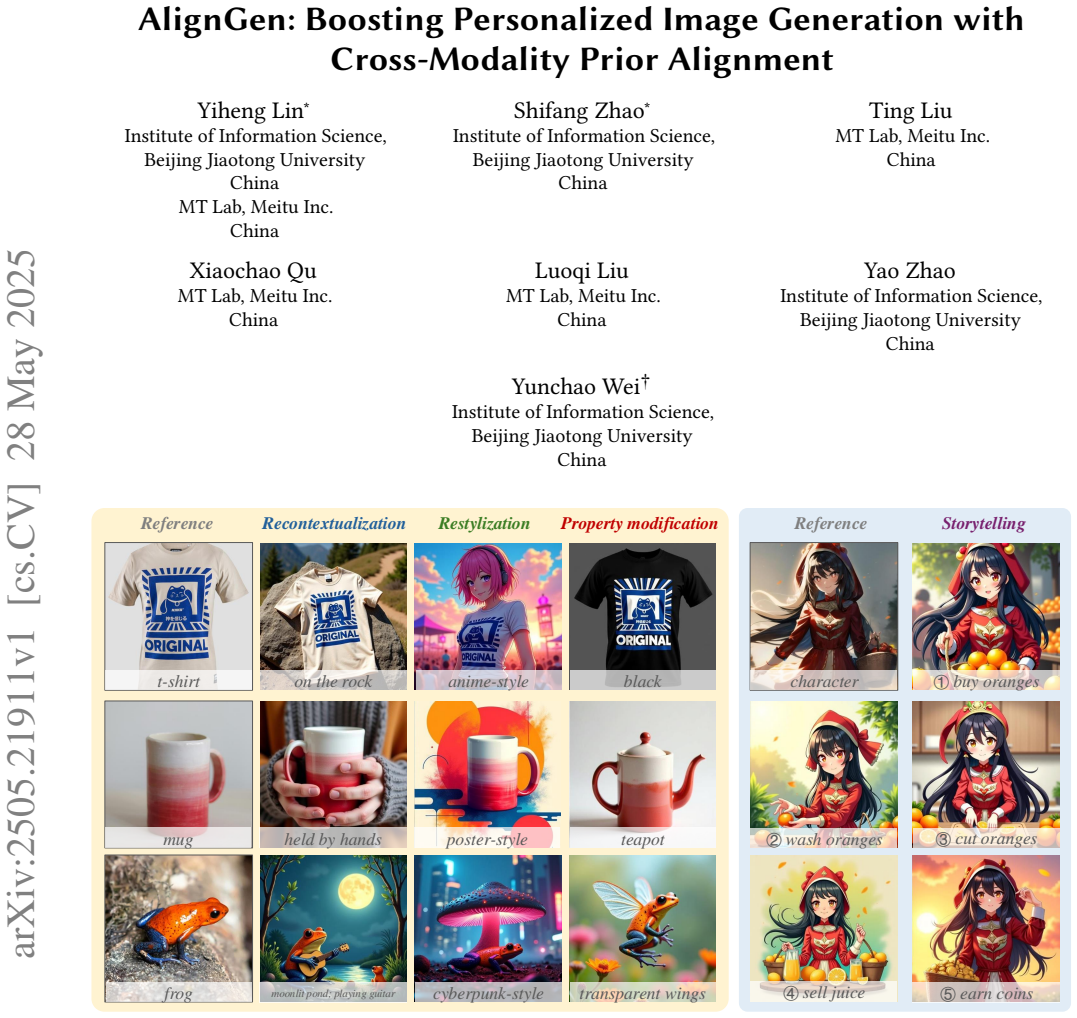


Figures from the paper (5 more)


Reference graph
Works this paper leans on
-
[1]
Yuval Alaluf, Elad Richardson, Gal Metzer, and Daniel Cohen-Or. 2023. A neural space-time representation for text-to-image personalization. ACM Transactions on Graphics (TOG) 42, 6 (2023), 1–10
work page 2023
-
[2]
Omri Avrahami, Kfir Aberman, Ohad Fried, Daniel Cohen-Or, and Dani Lischin- ski. 2023. Break-a-scene: Extracting multiple concepts from a single image. In SIGGRAPH Asia 2023 Conference Papers . 1–12
work page 2023
-
[3]
Shengqu Cai, Eric Chan, Yunzhi Zhang, Leonidas Guibas, Jiajun Wu, and Gor- don Wetzstein. 2024. Diffusion self-distillation for zero-shot customized image generation. arXiv preprint arXiv:2411.18616 (2024)
arXiv 2024
-
[4]
DeepSeek-AI. 2024. DeepSeek-V3 Technical Report. arXiv:2412.19437 [cs.CL] https://arxiv.org/abs/2412.19437
arXiv 2024
-
[5]
Alexey Dosovitskiy, Lucas Beyer, Alexander Kolesnikov, Dirk Weissenborn, Xi- aohua Zhai, Thomas Unterthiner, Mostafa Dehghani, Matthias Minderer, Georg Heigold, Sylvain Gelly, Jakob Uszkoreit, and Neil Houlsby. 2021. An Image is Worth 16x16 Words: Transformers for Image Recognition at Scale. In Interna- tional Conference on Learning Representations . http...
2021
-
[6]
Patrick Esser, Sumith Kulal, Andreas Blattmann, Rahim Entezari, Jonas Müller, Harry Saini, Yam Levi, Dominik Lorenz, Axel Sauer, Frederic Boesel, Dustin Podell, Tim Dockhorn, Zion English, and Robin Rombach. 2024. Scaling Rectified Flow Transformers for High-Resolution Image Synthesis. In Forty-first International Conference on Machine Learning . https://...
work page 2024
-
[7]
Rinon Gal, Yuval Alaluf, Yuval Atzmon, Or Patashnik, Amit Haim Bermano, Gal Chechik, and Daniel Cohen-or. 2023. An Image is Worth One Word: Per- sonalizing Text-to-Image Generation using Textual Inversion. In The Eleventh International Conference on Learning Representations . https://openreview.net/ forum?id=NAQvF08TcyG
work page 2023
-
[8]
Ligong Han, Yinxiao Li, Han Zhang, Peyman Milanfar, Dimitris Metaxas, and Feng Yang. 2023. Svdiff: Compact parameter space for diffusion fine-tuning. In Proceedings of the IEEE/CVF International Conference on Computer Vision . 7323– 7334
work page 2023
Show all 41 references
-
[9]
Jonathan Ho, Ajay Jain, and Pieter Abbeel. 2020. Denoising diffusion probabilistic models. Advances in neural information processing systems 33 (2020), 6840–6851
2020
-
[10]
Edward J Hu, Yelong Shen, Phillip Wallis, Zeyuan Allen-Zhu, Yuanzhi Li, Shean Wang, Lu Wang, Weizhu Chen, et al. 2022. Lora: Low-rank adaptation of large language models. ICLR 1, 2 (2022), 3
2022
-
[11]
Nupur Kumari, Bingliang Zhang, Richard Zhang, Eli Shechtman, and Jun-Yan Zhu. 2023. Multi-concept customization of text-to-image diffusion. InProceedings of the IEEE/CVF conference on computer vision and pattern recognition . 1931–1941
2023
-
[12]
Black Forest Labs. 2024. FLUX. https://github.com/black-forest-labs/flux
2024
-
[13]
Dongxu Li, Junnan Li, and Steven Hoi. 2023. Blip-diffusion: Pre-trained subject representation for controllable text-to-image generation and editing. Advances in Neural Information Processing Systems 36 (2023), 30146–30166
2023
-
[14]
Junnan Li, Dongxu Li, Silvio Savarese, and Steven Hoi. 2023. Blip-2: Bootstrapping language-image pre-training with frozen image encoders and large language models. In International conference on machine learning . PMLR, 19730–19742
2023
-
[15]
Yaron Lipman, Ricky T. Q. Chen, Heli Ben-Hamu, Maximilian Nickel, and Matthew Le. 2023. Flow Matching for Generative Modeling. In The Eleventh International Conference on Learning Representations . https://openreview.net/ forum?id=PqvMRDCJT9t
2023
-
[16]
Zhiheng Liu, Ruili Feng, Kai Zhu, Yifei Zhang, Kecheng Zheng, Yu Liu, Deli Zhao, Jingren Zhou, and Yang Cao. 2023. Cones: Concept Neurons in Diffusion Models for Customized Generation. In International Conference on Machine Learning . PMLR, 21548–21566
2023
-
[17]
Jian Ma, Junhao Liang, Chen Chen, and Haonan Lu. 2024. Subject-diffusion: Open domain personalized text-to-image generation without test-time fine-tuning. In ACM SIGGRAPH 2024 Conference Papers . 1–12
2024
-
[18]
Konstantin Mishchenko and Aaron Defazio. 2023. Prodigy: An expeditiously adaptive parameter-free learner. arXiv preprint arXiv:2306.06101 (2023)
2023 arXiv
-
[19]
Alexander Quinn Nichol, Prafulla Dhariwal, Aditya Ramesh, Pranav Shyam, Pamela Mishkin, Bob Mcgrew, Ilya Sutskever, and Mark Chen. 2022. GLIDE: Towards Photorealistic Image Generation and Editing with Text-Guided Diffusion Models. In International Conference on Machine Learnin...
2022
-
[20]
OpenAI. 2024. Introducing GPT-4o and more tools to ChatGPT free users. (2024). https://openai.com/index/gpt-4o-and-more-tools-to-chatgpt-free/
2024
-
[21]
William Peebles and Saining Xie. 2023. Scalable diffusion models with transform- ers. In Proceedings of the IEEE/CVF international conference on computer vision . 4195–4205
2023
-
[22]
Yuang Peng, Yuxin Cui, Haomiao Tang, Zekun Qi, Runpei Dong, Jing Bai, Chunrui Han, Zheng Ge, Xiangyu Zhang, and Shu-Tao Xia. 2025. DreamBench++: A Human-Aligned Benchmark for Personalized Image Generation. InThe Thirteenth International Conference on Learning Representations ....
2025
-
[23]
Colin Raffel, Noam Shazeer, Adam Roberts, Katherine Lee, Sharan Narang, Michael Matena, Yanqi Zhou, Wei Li, and Peter J Liu. 2020. Exploring the limits of transfer learning with a unified text-to-text transformer. Journal of machine learning research 21, 140 (2020), 1–67
2020
-
[24]
Aditya Ramesh, Prafulla Dhariwal, Alex Nichol, Casey Chu, and Mark Chen
-
[25]
Robin Rombach, Andreas Blattmann, Dominik Lorenz, Patrick Esser, and Björn Ommer. 2022. High-resolution image synthesis with latent diffusion models. In Proceedings of the IEEE/CVF conference on computer vision and pattern recognition . 10684–10695
2022
-
[26]
Olaf Ronneberger, Philipp Fischer, and Thomas Brox. 2015. U-net: Convolu- tional networks for biomedical image segmentation. In Medical image computing and computer-assisted intervention–MICCAI 2015: 18th international conference, Munich, Germany, October 5-9, 2015, proceeding...
2015
-
[27]
Nataniel Ruiz, Yuanzhen Li, Varun Jampani, Yael Pritch, Michael Rubinstein, and Kfir Aberman. 2023. Dreambooth: Fine tuning text-to-image diffusion models for subject-driven generation. In Proceedings of the IEEE/CVF conference on computer vision and pattern recognition . 22500–22510
2023
-
[28]
Chitwan Saharia, William Chan, Saurabh Saxena, Lala Li, Jay Whang, Emily L Denton, Kamyar Ghasemipour, Raphael Gontijo Lopes, Burcu Karagol Ayan, Tim Salimans, et al. 2022. Photorealistic text-to-image diffusion models with deep language understanding. Advances in neural infor...
2022
-
[29]
Jianlin Su, Murtadha Ahmed, Yu Lu, Shengfeng Pan, Wen Bo, and Yunfeng Liu. 2024. Roformer: Enhanced transformer with rotary position embedding. Neurocomputing 568 (2024), 127063. Conference acronym ’XX, June 03–05, 2025, Woodstock, NY Trovato et al
2024
-
[30]
Quan Sun, Yufeng Cui, Xiaosong Zhang, Fan Zhang, Qiying Yu, Yueze Wang, Yongming Rao, Jingjing Liu, Tiejun Huang, and Xinlong Wang. 2024. Genera- tive multimodal models are in-context learners. In Proceedings of the IEEE/CVF Conference on Computer Vision and Pattern Recognitio...
2024
-
[31]
Zhenxiong Tan, Songhua Liu, Xingyi Yang, Qiaochu Xue, and Xinchao Wang
-
[32]
Ashish Vaswani, Noam Shazeer, Niki Parmar, Jakob Uszkoreit, Llion Jones, Aidan N Gomez, Łukasz Kaiser, and Illia Polosukhin. 2017. Attention is all you need. Advances in neural information processing systems 30 (2017)
2017
-
[33]
Andrey Voynov, Qinghao Chu, Daniel Cohen-Or, and Kfir Aberman. 2023. p+: Extended textual conditioning in text-to-image generation. arXiv preprint arXiv:2303.09522 (2023)
2023 arXiv
-
[34]
Yuxiang Wei, Yabo Zhang, Zhilong Ji, Jinfeng Bai, Lei Zhang, and Wangmeng Zuo
-
[35]
Guangxuan Xiao, Tianwei Yin, William T Freeman, Frédo Durand, and Song Han
-
[36]
Shitao Xiao, Yueze Wang, Junjie Zhou, Huaying Yuan, Xingrun Xing, Ruiran Yan, Chaofan Li, Shuting Wang, Tiejun Huang, and Zheng Liu. 2024. Omnigen: Unified image generation. arXiv preprint arXiv:2409.11340 (2024)
2024 arXiv
-
[37]
Hu Ye, Jun Zhang, Sibo Liu, Xiao Han, and Wei Yang. 2023. Ip-adapter: Text compatible image prompt adapter for text-to-image diffusion models. arXiv preprint arXiv:2308.06721 (2023)
2023 arXiv
-
[39]
International Journal of Computer Vision (2024), 1–20
Fastcomposer: Tuning-free multi-subject image generation with localized attention. International Journal of Computer Vision (2024), 1–20
2024
-
[2022]
arXiv preprint arXiv:2204.06125 1, 2 (2022), 3
Hierarchical text-conditional image generation with clip latents. arXiv preprint arXiv:2204.06125 1, 2 (2022), 3
2022 arXiv
-
[2023]
In Proceedings of the IEEE/CVF International Conference on Computer Vision
Elite: Encoding visual concepts into textual embeddings for customized text-to-image generation. In Proceedings of the IEEE/CVF International Conference on Computer Vision. 15943–15953
-
[2024]
arXiv preprint arXiv:2411.15098 3 (2024)
Ominicontrol: Minimal and universal control for diffusion transformer. arXiv preprint arXiv:2411.15098 3 (2024)
2024 arXiv
Reviewed August 7, 2026 · model on record in the stance chip above.
Discussion (0). Sign in to comment.