REVIEW 4 major objections 5 minor 22 references
Loop Patterns Formed by Cellular Automata
T0 review · 4 major / 5 minor · reviewed 2026-08-15 · deepseek-v4-flash
Pith's one-line read A probabilistic cellular-automaton rule built from six overlapping tiles and template-matching noise injection can evolve stable loop patterns on fixed-boundary grids up to 32×32.
desk verdict A useful empirical extension of the authors' template-plus-noise CA scheme to fixed-boundary loop patterns, but the printed rule has a formal inconsistency in the E condition that needs correction before the results are fully reproducible. read the letter →
The pith
A machine-rendered reading of the paper's core claim, the machinery that carries it, and where it could break.
The reading
What carries the argument
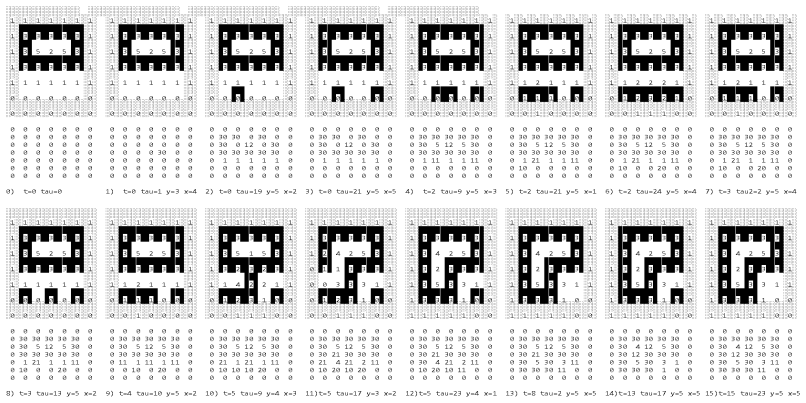
The load-bearing object is the tile set: four 3×3 corner tiles (A0–A3) and two line tiles (B0–B1), each with a central anchor pixel. From these, 38 templates are derived by shifting each tile so that each valid pixel becomes the template center. The CA rule runs three steps per cell—TEST (count matching templates), ADJUST (set the cell to the center value of the first hit), and NOISE INJECTION (flip the cell randomly under conditions such as h1≠3 for path cells or h0=0 for uncovered zeros). The key mechanism is that the required overlap level v=3 enforces the loop path condition: three tiles' one-pixels must overlap at each path site, so a line or corner is surrounded by zeroes and a closed path has a zero hull. The five rule variants are simply different subsets of noise-injection conditions selected from the general rule.
What would settle it
Run Rule4 on a grid of, say, n=200 from many random starting patterns and let it run for a large fixed number of updates; if any run ends with cells still flipping or with no loop at all, rather than a configuration in which every cell keeps its state, then the claim that the rule securely evolves stable loops is falsified for that size.
Extended reading notes
Core claim
The central claim is that one can solve the loop-pattern formation problem by combining overlapping tiles with a template-matching, noise-injection CA rule. The tiles are chosen so that maximal overlap (cover level v=3) realizes the loop path condition: every one-cell has two one-neighbors in NESW and every convex corner has an outer-diagonal zero, so loops are closed, non-touching, and separated by a hull. Hits h0 and h1 count zero-centered and one-centered template matches; if any hit exists the cell adjusts to the template's center, and if not (or if the path condition or other selected conditions fail) random noise is injected. The paper demonstrates by simulation that the general rule, specialized as Rule0 through Rule4, evolves stable loop patterns for field sizes 3×3 through 32×32, including a closed space-filling curve for 11×11, and it leaves as an explicit open question whether convergence to stable loops can be proven for all field sizes.
Load-bearing premise
The rule must settle into a stable loop pattern instead of collapsing to all zeros or toggling forever; this is observed in simulations for the tested sizes but not proved.
Editorial extensions
If this is right
- If the central claim is right, then any tested grid size admits a local rule that reaches a stable pattern containing at least one closed loop, while avoiding the all-zero fixed point once Rule1 or a stronger variant is used.
- The five rule variants give graded control over the pattern class: Rule0 allows all loop patterns plus the all-zero fixed point; Rule1 eliminates uncovered zero cells but permits toggling; Rule2 stabilizes uncovered cells at distance 2 or 3; Rule3 excludes patterns with pairs of uncovered cells at distance 2 and 3; Rule4 forbids 3×3 loops by injecting noise at cover level v=8.
- For n=11 with Rule4, closed space-filling curves appear among the evolved patterns, and the paper notes such curves can be constructed for fields of size (4k−1)×(4k−1).
- The average number of micro time-steps per cell needed to reach a stable pattern grows superlinearly with the number of cells, and the paper suggests the growth is exponential, which sets a practical limit on large grid sizes.
- When Rule4 is applied to a 32×32 grid, patterns with 2 to 11 loops are observed, and single-loop patterns are rare, indicating the rule's output distribution is biased toward multi-loop configurations.
Reading between the lines
- Editorial inference: the same template-match-plus-noise recipe should work for any locally checkable tiling constraint with a finite overlap set; the domino and sensor-coverage cases already appear in the paper, but the loop case suggests a general design rule: pick tiles whose maximal overlap encodes the constraint, then inject noise on every violation.
- Editorial inference: if convergence is eventually proven, the rule becomes a distributed asynchronous algorithm for constructing loop and space-filling structures, which would connect to self-assembly and programmable matter; a testable extension is to run the same rule under synchronous updating to see whether the noise-injection conditions still converge or instead produce persistent oscillation
- Editorial inference: the exceptional peaks at n=9 and n=16 in both convergence time and loop density hint that the tile geometry resonates with certain grid sizes; one could test this by varying the tile shapes and checking whether the peaks shift or disappear.
Signed reviews
Editorial analysis
A structured set of objections, weighed in public.
Referee Report
Summary. The paper presents a probabilistic, asynchronously updated cellular automaton rule for evolving stable loop patterns on n x n grids with fixed zero boundaries. A loop is a closed path of one-cells whose path cells have exactly two one-neighbors and whose corners are enclosed by a zero hull; a loop pattern is a set of mutually non-touching loops. The rule derives 38 local templates from six overlapping tiles (four corner tiles and two line tiles), adjusts a cell to the center of a matching template, and injects noise when the path condition or other constraints fail. Five rule variants (Rule0 through Rule4) are defined by enabling different noise-injection conditions. The authors report simulations for field sizes n = 3 to 7, selected results for n = 11 and n = 32, and a short discussion of dependencies and open problems, explicitly leaving a convergence proof as future work.
Significance. If the rule is stated precisely and the simulations are reproducible, the paper is a useful constructive demonstration that local template matching plus probabilistic noise injection can assemble non-trivial global structures such as separated loops. The use of overlapping tiles with cover level 3 to encode a hull around a path is elegant, and the explicit enumeration of all small loop patterns for n = 5 is a valuable check. The paper does not provide a theorem or a proof of convergence, and its evidence is experimental; its contribution is a design scheme together with a systematically described set of observed behaviors, not a formal guarantee. The strengths are the clear tile/template construction, the uniform rule schema with five named variants, and the authors' honest listing of open issues.
major comments (4)
- [§3.5.1 and §4.3] The formal definition of the exception condition E in Section 3.5.1, namely E = (E2 ∧ E3) ∨ Decision(πE), contradicts the accompanying prose and the Rule2 description in Section 4.3, where the condition is stated as E = E2 ∨ E3 with πE = 0.5. Taken literally, the displayed formula makes Decision(πE) true with probability 0.5 for every uncovered zero-cell regardless of distance from a path cell, because the random decision is independent of E2 and E3. The condition Q0 = (h0 = 0) ∧ NOT(E) would then suppress noise in arbitrary uncovered regions, not only at distance 2 or 3 as the text claims. This changes the set of absorbing configurations and can change which patterns are stabilized. Since the central claim is about the behavior of this specific CA rule, the printed formula must agree exactly with the rule used in the simulations; otherwise the reported patterns in Section 4 are not reproducible from the formal specification.
- [§3.5.1 and §5.1] There is a second internal contradiction in the rule specification. Section 3.5.1 states that when several templates match, 'the first hitting template is used for adjustment,' while the Summary in Section 5.1 states that 'If there are several concurrent h0 and h1 hits, then the state adjustment is random.' These two tie-breaking rules are not equivalent, and under asynchronous updating the difference can affect both transient behavior and the resulting stable patterns. The authors should state a single unambiguous tie-breaking rule and confirm which one was implemented in the simulations.
- [§3.5.1 and §3.5.2, Rule4] Rule4 is described as forbidding configurations with cover level v = 8, but its formal condition is Q1 = (h0 = 8) ∧ Decision(πQ1), where h0 is the number of zero-template hits rather than the cover level. The paper itself notes in Section 4.3 that hit values converge to cover levels only when the pattern stabilizes, so during transients h0 and v can differ. If the CA rule only reads template hits from the local neighborhood, it cannot literally test the cover level v = 8 at the selected cell. The authors should clarify whether v is part of the cell state available to the rule, or replace Q1 with the intended condition and report that the simulations used it.
- [§4, §4.8, and §5.2] The abstract's claim that the CA rule can 'securely evolve stable loop patterns' is stronger than the evidence presented. The rule variant is selected as the field size increases (the introduction to Section 4 says the rule complexity is increased from Rule0 to Rule4 as n grows), Rule0 has the all-zero configuration as a fixed point, Rule1 can leave toggling cells, and the statistics in Section 4.8 are based on 300 runs for n ≤ 15 and 100 runs for n = 16 to 20, with no error bars or confidence intervals. For n = 11 and n = 32 only selected patterns are shown, and no success rates are given. A more systematic per-variant, per-size success-rate table, or an explicit qualification that the claim covers only the simulated cases, is needed to support the central claim.
minor comments (5)
- [§3.3, Fig. 3 caption] The caption says 'A 2×3 square loop is build by overlapping tiles'; the loop shown is a 3×3 square, and 'build' is a typo for 'built'.
- [§4.4] The sentence about uncovered cells says they have a distance 'orthogonally or vertically' from a path cell; this should be 'orthogonally or diagonally.'
- [§4.8, Figs. 15 and 16] The figures plot averages without error bars or per-point dispersions. Given that the number of runs is stated, adding standard errors would make the reported dependencies easier to interpret, especially since the text speculatively calls the growth exponential.
- [§3.5.1, Q1] The symbol H is used in the bullet about cover-level threshold but is not formally defined in the displayed formula; please define H and state its value explicitly when Rule4 is discussed.
- [§3.5.1, P2] The condition P2 that 'two consecutive (h0 = 0)-cells at distance 2 and 3' exist is described in words but not written in set notation; a short formal definition would remove ambiguity about which directions and which cells are included.
Circularity Check
Partial circularity: the rule variants were developed together with the field sizes on which success is claimed, so the demonstrated capability is partly by construction; larger unseen sizes provide some independent support.
-
fitted input called prediction
[Section 4, first paragraph ('Simulations'), p. 14]
"We increase the field size step by step from3×3 to7×7 and at the same time we increase the complexity of the rule variant (from Rule0 to Rule4). In this way (i) the rule variants could be (and more or less were) developed, and (ii) we learn about their properties."
The abstract and summary claim the CA rule can securely evolve stable loop patterns, but the rule variants were not fixed before testing: Rule0..Rule4 were added as n grew from 3 to 7, with conditions P2, Q0, E, Q1 introduced to remove undesired fixed points observed at the current size (all-zero configurations, toggling uncovered cells, uncovered cells at distance 2/3, and 3x3 loops). For the tested range 3..7, success is therefore partly forced by the choice of the rule rather than being an independent prediction. The paper admits this ('more or less were developed'). Independent content remains because Rule4 was subsequently run at n=11 and n=32, and statistics were collected for n=4..20, sizes beyond the development range, so the central claim is not wholly circular.
full rationale
The paper is a constructive-design study rather than a first-principles derivation, and most of its load-bearing content is transparently empirical: the tile set and rule are specified in Figs. 2 and Section 3.5, and the nontrivial claim is that the asynchronous probabilistic dynamics converges from random initial states to the designed loop fixed points. That convergence is not guaranteed by construction, as shown by the all-zero fixed point for Rule0 and by the paper's own open issue: 'Can it be proven that the presented CA rule always produces stable loop patterns?' The only notable circularity is the developmental tuning described in the opening of Section 4: the rule variants were progressively designed while increasing the field size, so the demonstrations at n=3..7 partly verify a rule fitted to those sizes. This is mitigated by later experiments on larger fields (n=11, n=32) and by the parameter-dependence statistics for n=4..20. Self-citations to [2]-[5] are contextual and non-load-bearing; the tile set is fully shown in Fig. 2, and the rule is defined in Section 3.5 without relying on an external uniqueness or existence theorem. Separately, there is a specification inconsistency that is a reproducibility concern but not circularity: Section 3.5.1 defines E=(E2∧E3)∨Decision(πE), while Section 4.3 and the Rule2 description use E=E2∨E3 with πE=0.5; an implementer following the formal definition would obtain a different noise-suppression rule. Overall, the central derivation is mostly self-contained, with only a partial fitted-input issue, so a moderate circularity score is appropriate.
Assumptions & free parameters
free parameters (3)
- noise injection probabilities πP1, πP2, πQ0, πE, πQ1 =
0.5 for active conditions
- rule variant per field size (Rule0..Rule4) =
Rule0/Rule1 for n=3; Rule1 for n=4; Rule0..2 for n=5,6; Rule0..4 for n=7; Rule4 for n=11 and 32
- cover-level threshold H in Rule4 =
8
assumptions (4)
- domain assumption Fixed zero boundary conditions
- domain assumption Asynchronous random-sequence updating
- ad hoc to paper Target loop path condition
- ad hoc to paper Tile set completeness
invented entities (1)
-
Overlapping tile set (corner tiles A0-A3, line tiles B0, B1)
Cite this review
Pith. "Pith review of Loop Patterns Formed by Cellular Automata." pith.science (2026). https://pith.science/paper/4L2Z3ZEL
@misc{pith2026250522679,
  author       = {Pith},
  title        = {Pith review of: Loop Patterns Formed by Cellular Automata},
  year         = {2026},
  howpublished = {\url{https://pith.science/paper/4L2Z3ZEL}},
  note         = {Machine review of arXiv:2505.22679}
}
read the original abstract
A Cellular Automata (CA) rule is presented that can generate "loop patterns" in a 2D grid under fixed boundary conditions. A loop is a cyclically closed path represented by one-cells enclosed by zero-cells. A loop pattern can contain several loops that are not allowed to touch each other. The problem is solved by designing an appropriate set of tiles that can overlap and which are used in the CA rule. Templates are derived from the tiles which are used for local pattern matching. In order to drive the evolution to the desired patterns, noise is injected if the templates do not match or other constraints are not fulfilled. The general CA rule can be specialized by enabling certain conditions, and the characteristics of five rule variants are explained. Simulations illustrate that the CA rule can securely evolve stable loop patterns. The preliminary theoretical analysis of the obtained loop patterns raises many interesting research problems for the future -- several of them have been briefly discussed.
Figures


Figures from the paper (13 more)




Reference graph
Works this paper leans on
-
[1]
Douady, S. et. al. A work on reticulated patterns.C.R.Mécanique 2020, 348, 6-7, 659-678
work page 2020
-
[2]
Generating Loop Patterns with a Genetic Algorithm and a Probabilistic Cellular Automata Rule
Hoffmann, R. Generating Loop Patterns with a Genetic Algorithm and a Probabilistic Cellular Automata Rule. Algorithms 16.7 (2023): 352
work page 2023
-
[3]
Hoffmann, R. Forming Point Patterns by a Probabilistic Cellular Automata Rule.Presentation at Summer Solstice Conference on Complex Systems (2019), arXiv2022, arXiv:2202.06656
arXiv 2019
-
[4]
A cellular automata rule placing a maximal number of dominoes in the square and diamond.J
Hoffmann, R.; Désérable, D.; Seredyński, F. A cellular automata rule placing a maximal number of dominoes in the square and diamond.J. Supercomput.2021, 77, 9069–9087
work page 2021
-
[5]
Cellular automata rules solving the wireless sensor network coverage problem.Nat
Hoffmann, R.; Désérable, D.; Seredyński, F. Cellular automata rules solving the wireless sensor network coverage problem.Nat. Comp. 2022, 21, 417–447
work page 2022
-
[6]
How Agents Can Form a Specific Pattern
Hoffmann, R. How Agents Can Form a Specific Pattern. InInternational Conference on Cellular Automata; Springer: Cham, Switzerland, 2014; pp. 660–669
work page 2014
-
[7]
Minimal Covering of the Space by Domino Tiles
Hoffmann, R.; Désérable, D.; Seredyński, F. Minimal Covering of the Space by Domino Tiles. InParallel Computing Technologies; Malyshkin, V., Ed.; PaCT 2021; LNCS 12942; Springer: Cham, Switzerland, 2021; pp. 453–465
work page 2021
- [8]
Show all 22 references
-
[9]
Grünbaum, B.; Shephard, G.C.Tilings and Patterns; Courier Dover Publications: Mineola, NY, USA, 1987
1987
-
[10]
On languages of one-dimensional overlapping tiles
Janin, D. On languages of one-dimensional overlapping tiles. InSOFSEM 2013: Theory and Practice of Computer Science: 39th International Conference on Current Trends in Theory and Practice of Computer Science, Špindlerův Mlýn, Czech Republic, 26–31 January 2013; Springer: Berli...
2013
-
[11]
Minimizing completion time for loop tiling with computation and communication overlapping
Goumas, G.; Sotiropoulos, A.; Koziris, N. Minimizing completion time for loop tiling with computation and communication overlapping. In Proceedings of the 15th International Parallel and Distributed Processing Symposium. IPDPS 2001, San Francisco, CA, USA, 23–27 April 2001; IE...
2001
-
[12]
Structure, aggregation and characterization of nanoparticles
Waychunas, G.A. Structure, aggregation and characterization of nanoparticles. Rev. Mineral. Geochem. 2001, 44, 105–166
2001
-
[13]
Sur une courbe, qui remplit toute une aire plane.Math
Peano, G. Sur une courbe, qui remplit toute une aire plane.Math. Ann. 1890, 36, 157–160. (In French)
-
[14]
Ueber die stetige Abbildung einer Linie auf ein Flächenstück.Math
Hilbert, D. Ueber die stetige Abbildung einer Linie auf ein Flächenstück.Math. Ann. 1891, 38, 459–460. (In German)
-
[15]
Synthesis of space-filling curves on the square grid
Prusinkiewicz, P.; Lindenmayer, A.; Fracccia, D. Synthesis of space-filling curves on the square grid. In Fractals in the Fundamental and Applied Sciences; Peitgen, H.-O., Henrique, J.M., Pencdo, L.F., Eds.; Elsevier Science Publishers B.V.: Amsterdam, The Netherlands, 1991
1991
-
[16]
Hamiltonian Cycles in Two Dimensional Lattices
Crossley, M. Hamiltonian Cycles in Two Dimensional Lattices. InStatistical Physics in Biology; Springer: Berlin/Heidelberg, Germany, 2013
2013
-
[17]
Hamiltonian paths in some classes of grid graphs.J
Keshavarz-Kohjerdi, F.; Bagheri, A. Hamiltonian paths in some classes of grid graphs.J. Appl. Math.2012, 2012, 475087
2012
-
[18]
String topology.arXiv 1999, arXiv:math/9911159
Chas, M.; Sullivan, D. String topology.arXiv 1999, arXiv:math/9911159
1999 arXiv
-
[19]
Wolfram, S.A New Kind of Science; Wolfram Media: Champaign, IL, USA, 2002; Volume 5
2002
-
[20]
Désérable, D., Hoffmann, R., Seredyński, F. (2023). Maximal Arrangement of Dominos in the Diamond. arXiv preprint arXiv:2305.04544
2023 arXiv
-
[21]
(1994, August)
Khuri, S., Bäck, T. (1994, August). An evolutionary heuristic for the minimum vertex cover problem. In Genetic Algorithms within the Framework of Evolutionary Computation–Proc. of the KI-94 Workshop (pp. 86-90). Saarbrücken, Germany
1994
-
[22]
Malaguti, E., Monaci, M., Toth, P. (2011). An exact approach for the vertex coloring problem. Discrete Optimization, 8(2), 174-190. 27
2011
Reviewed August 15, 2026 · model on record in the stance chip above.
Discussion (0). Continue with ORCID to comment.