pith. machine review for the scientific record. sign in

nlin.CG

Cellular Automata and Lattice Gases

Computational methods, time series analysis, signal processing, wavelets, lattice gases

0
nlin.CG 2026-04-21

Game of Life patterns show temporal retention as biosignature

Temporal Retention of Information as a Biosignature

Persistent evolutions suggest information retention over time as a marker for life in abstract systems.

Figure from the paper full image
abstract click to expand
Previous publications by the authors put forward the argument that Lifelike Cellular Automata can be treated as a bona fide example of livingness in and of themselves, not simply a toy analogue to biological life. Traits known to be indicative of biological life, biosignatures, were identified in informational form as particular outlier traits of the ruleset for the lifelike cellular automata known as Conways Game of Life. This publication reverses that logic, looking at a known outlier trait of Conways Game of Life, its very long-lasting evolutions, and using this to point towards temporal retention as an informational biosignature concept.
0
0
nlin.CG 2026-04-20

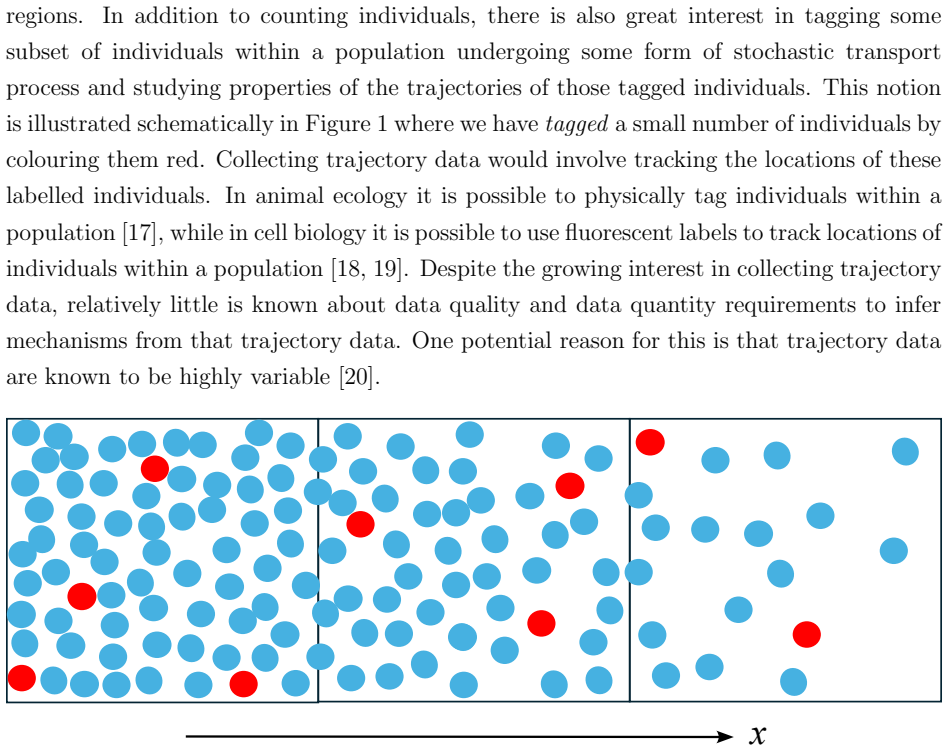
Count data alone leaves diffusion parameters unidentified

When do trajectories matter? Identifiability analysis for stochastic transport phenomena

Trajectory records resolve structural non-identifiability in lattice random walk models of population movement.

Figure from the paper full image
abstract click to expand
Stochastic models of diffusion are routinely used to study dispersal of populations, including populations of animals, plants, seeds and cells. Advances in imaging and field measurement technologies mean that data are often collected across a range of scales, including count data collected across a series of fixed sampling regions to characterize population-level dispersal, as well as individual trajectory data to examine at the motion of individuals within a diffusive population. In this work we consider a lattice-based random walk model and examine the extent to which model parameters can be determined by collecting count data and/or trajectory data. Our analysis combines agent-based stochastic simulations, mean-field partial differential equation approximations, likelihood-based estimation, identifiability analysis, and model-based prediction. These combined tools reveal that working with count data alone can sometimes lead to challenges involving structural non-identifiability that can be alleviated by collecting trajectory data. Furthermore, these tools allow us to explore how different experimental designs impact inferential precision by comparing how different trajectory data collection protocols affects practical identifiability. Open source implementations of all algorithms used in this work are available on GitHub.
0
0
nlin.CG 2026-04-17

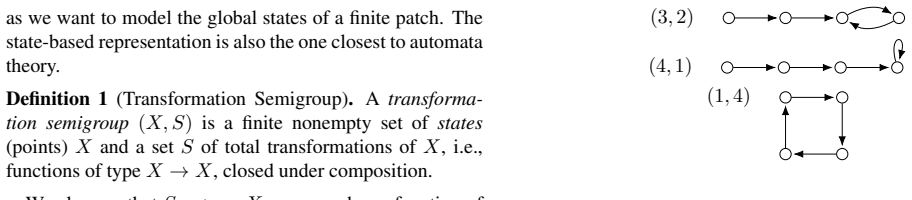
Game of Life patches become programmable semigroups

Measuring the Computational Power of Finite Patches of Cellular Automata

Mapping finite cellular automaton regions to transformation semigroups measures their interactive computational power and enables algebraic,

Figure from the paper full image
abstract click to expand
Computational power can be measured by assigning an algebraic structure to a computational device. Here, we convert a small patch of Conway's Game of Life into a transformation semigroup. The conversion captures not only time evolution but also interactive operations. In this way, the cellular automaton becomes directly programmable. Once this measurement is made, we apply hierarchical decompositions to the resulting algebraic object as a way of understanding it. These decompositions are based on a macro/micro-state division inspired by statistical mechanics. However, cellular automata have a large number of global states. Therefore, we focus on partitioning the state space and creating morphic images approximations that can serve as macro-level descriptions. The methods developed here are not limited to cellular automata; they apply more generally to discrete dynamical systems.
0
0
nlin.CG 2026-04-13

Frustrated vote automata bifurcate density above critical range

Coarsening and Bifurcations in Wide-Range Two-Dimensional Totalistic Cellular Automata

Wide-range 2D cellular automata produce stable patterns where mean-field predicts chaos or limit cycles.

Figure from the paper full image
abstract click to expand
We investigate Boolean, totalistic cellular automata with a majority or frustrated majority vote rule, and an interaction range of variable span. These two models show a behavior which differs from the mean-field one. The majority vote model is characterized by the presence of absorbing states, and there is a related bifurcation according to the initial density, in agreement with the mean-field approximation. For initial density equal to $0.5$, however, the dynamics is dominated by a coarsening process, which stops when clusters with a definite curvature radius are established. For the frustrated majority vote model, the mean-field approximation gives chaotic oscillations or a limit cycle. Instead, we observe active patterns, with stable density. Above a certain critical value for the interacting radius there is a bifurcation of the asymptotic density as a function of the initial one.
0
0
nlin.CG 2026-04-13 2 theorems

Linear cellular automata controllable exactly when matrix is invertible

General control of linear cellular automata

A single algebraic test replaces exhaustive search and decides whether chosen inputs can steer any initial grid to any target state.

Figure from the paper full image
abstract click to expand
In mathematics and engineering, control theory is concerned with the analysis of dynamical systems through the application of suitable control inputs. One of the prominent problems in control theory is controllability which concerns the ability to determine whether there exists a control input that can steer a dynamical system from an initial state to a desired final state within a finite time horizon. There is a general theory for controlling linear or linearizable system, but it cannot be applied to discrete systems like cellular automata, which is the problem of that we address in this paper. We develop a general theory for linear (and affine) cellular automata, and apply it to examples of one-dimensional and two-dimensional Boolean cases. We introduce the concept of controllability matrix and show that controllability holds if and only if the controllability matrix is invertible.
0
0
nlin.CG 2026-04-13

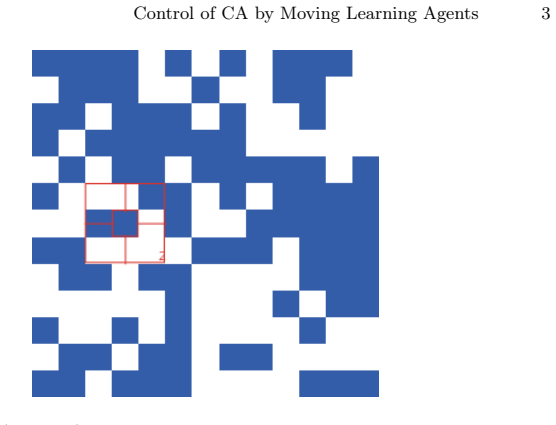
Agents learn to control passive automata but fail on active ones

Control of Cellular Automata by Moving Agents with Reinforcement Learning

In 2D cellular automata, local-sensing reinforcement learning succeeds only when the environment stays passive and fixed.

Figure from the paper full image
abstract click to expand
In this exploratory paper we introduce the problem of cognitive agents that learn how to modify their environment according to local sensing to reach a global goal. We concentrate on discrete dynamics (cellular automata) on a two-dimensional system. We show that agents may learn how to approximate their goal when the environment is passive, while this task becomes impossible if the environment follows an active dynamics.
0

browse all of nlin.CG → full archive · search · sub-categories