REVIEW 5 major objections 7 minor 80 references
WTEFNet: Real-Time Low-Light Object Detection for Advanced Driver Assistance Systems
T0 review · 5 major / 7 minor · reviewed 2026-08-07 · deepseek-v4-flash
Pith's one-line read The paper proposes WTEFNet, a real-time low-light detector that gains up to 3 mAP points over baselines and runs at 30 FPS on an embedded board.
desk verdict Useful new rainy-night dataset and a plausible integrated detector, but the missing SCI baseline and missing LLE ablation leave the central gains unattributed. read the letter →
The pith
A machine-rendered reading of the paper's core claim, the machinery that carries it, and where it could break.
The reading
What carries the argument
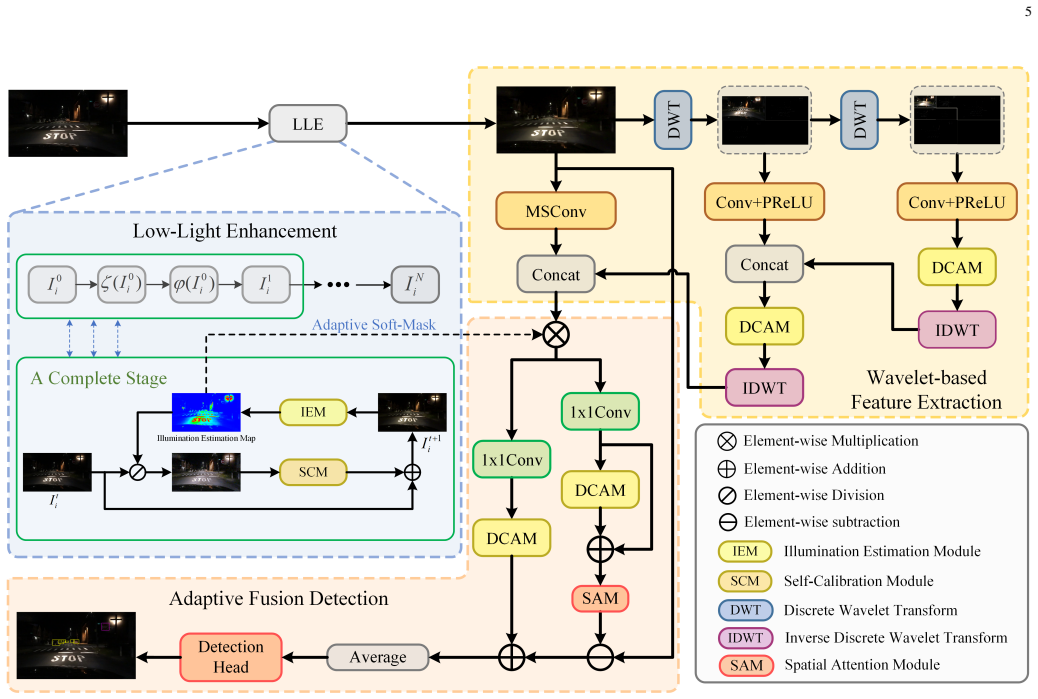
The load-bearing object is the joint illumination-map pipeline. The enhancement module computes an illumination map $x$ and feeds it both to Retinex-style division $I' = I \oslash x$ and to an Adaptive Soft-Mask confidence map $M_c$ that down-weights underexposed and overexposed pixels. The Wavelet-based Feature Extraction module then applies discrete wavelet transforms to obtain subband features ($F_o$, $F_s$), processes them with a Densely Channel Attention Module and a Multi-scale Convolution block, and reconstructs with inverse DWT so that noise is suppressed while structural features survive. The AFFD module multiplies the denoised features by $M_c$, passes them through a dual-branch attention structure, and finally sends the fused feature map to a detection head. The entire training loss weights the detection loss by $M_c$, coupling the enhancement confidence map directly to detection.
What would settle it
Run the same YOLOv10 and YOLOv12 detectors on the same low-light subsets with only the pretrained SCI enhancement module and no WFE or AFFD modules, and compare mAP@0.5 with the full WTEFNet; if that control closes most of the reported gap, the central performance claim is an artifact of the borrowed enhancer rather than of the proposed modules.
Extended reading notes
Core claim
On its own terms, the paper's central claim is that a detector-agnostic enhancement-plus-denoising front end can make existing detectors accurate in low light without sacrificing real-time operation. The proposed WTEFNet combines three modules: a stage-wise low-light enhancement that estimates an illumination map with self-calibration, a wavelet-based feature extraction module that applies a two-level discrete wavelet transform and inverse transform to remove noise while preserving structure, and an adaptive fusion detection module that weights features with a soft mask derived from the illumination map. Across BDD100K, SHIFT, nuScenes, and the introduced GSN dataset, WTEFNet achieves the highest mAP@0.5 among all compared methods, for example 49.0 on BDD100K and 53.5 on GSN no-rain conditions with YOLOv12 and YOLOv10 respectively, and it improves the same detectors by 2 to 6 points in ablation-style universal tests. The paper also reports that the framework runs at 30.4 FPS on an embedded platform, establishing that the gains are not bought with a loss of real-time capability.
Load-bearing premise
The reported accuracy gains over the enhancement-based baselines come from the proposed wavelet and fusion modules themselves, rather than from the pretrained low-light enhancement network that the framework reuses without an isolated baseline.
Editorial extensions
If this is right
- WTEFNet can wrap a range of mainstream detectors, including YOLOv10, YOLOv12, Fast R-CNN, Deformable DETR, and CenterNet, and raises their low-light mAP by roughly 2 to 6 points without changing the detection head.
- Because the full model runs at about 30.4 FPS on an NVIDIA Jetson AGX Orin, a vehicle system could include it in an online perception loop rather than only offline analysis.
- The newly collected GSN dataset of 2,031 labeled night images, including rainy scenes, provides a benchmark for measuring low-light object detection in clear and rainy urban conditions.
- A two-level wavelet decomposition is the best operating point: the ablation shows scale-2 DWT outperforms no-DWT and scale-1 and scale-3 variants under mAP@0.5 and mAP@0.5:0.95.
- The framework degrades less than the compared methods when Gaussian noise is added, which matters for real camera pipelines.
Reading between the lines
- The paper never reports the pretrained SCI enhancement network standing alone with YOLOv10 or YOLOv12, so the marginal contribution of the proposed WFE and AFFD modules is not yet isolated; running that control would settle whether the gains come from the borrowed enhancer or from the new modules.
- The wavelet denoising front end likely transfers to other nighttime perception tasks such as segmentation and depth estimation, since it operates on image features before the task-specific head.
- The illumination-derived soft mask could be reused as confidence weighting for any downstream task that struggles in glare or underexposure, not only object detection.
- Field testing on real vehicle camera feeds with changing glare, wet roads, and rain streaks would be a stronger deployment test than the static benchmarks reported here.
Editorial analysis
A structured set of objections, weighed in public.
Referee Report
Summary. WTEFNet is a low-light object detection framework that combines a low-light enhancement (LLE) module, a wavelet-based feature extraction (WFE) module using multi-level discrete wavelet transforms, and an adaptive fusion detection (AFFD) module. The framework is designed to be plugged into existing detectors, and the paper also introduces GSN, a manually annotated dataset of rainy and non-rainy nighttime driving scenes. Experiments on BDD100K, SHIFT, nuScenes, and GSN compare WTEFNet against domain-adaptation and low-light-enhancement baselines, reporting consistent mAP improvements and real-time inference on an NVIDIA Jetson AGX Orin.
Significance. If the reported results hold, this is a practically relevant contribution: the framework is detector-agnostic, improves performance across five different detectors in Table VI, and achieves about 30 FPS on an embedded platform. The paper's strengths include the multi-detector ablation, evaluation on four datasets, a robustness test under Gaussian noise, and the creation of a new labeled low-light driving dataset. However, the evidence does not yet isolate the contribution of the proposed modules from the borrowed SCI enhancement, so the significance is conditional on additional experiments that establish attribution.
major comments (5)
- [IV-C, Tables II-VII] The central performance claim is not currently attributable to the proposed WFE and AFFD modules. Section IV-C states that a pre-trained SCI model initializes the LLE module, but no comparison includes SCI followed by the base detector, and every ablation row in Table VII retains the LLE module. As a result, the gap between 'w/o DWT' (45.1) and 'DWT-scale-2' (48.9) in Table VII, and the margins over enhancement baselines in Tables II-V, could be caused by the pretrained SCI enhancement alone. Please add SCI+YOLOv10 and SCI+YOLOv12 detection baselines, and ablations that remove the LLE module or train it from scratch.
- [IV-D] The evaluation protocol is not reproducible because the construction of the low-light subsets is unspecified. The text says all evaluations are on 'the low-light portions' of BDD100K, SHIFT, and nuScenes, but does not state the selection criterion (metadata, illumination threshold, manual curation), the number of images, or the train/validation split. Please document this.
- [III-E, Eq. (11)] The training objective is under-specified. Eq. (11) uses a confidence-map-weighted detection loss with coefficients alpha and beta, and Eq. (12) adds zeta and eta, but no values are given for alpha, beta, zeta, eta, sigma, N, c1, c2, l, or r. In addition, the tensor-product symbol in Eq. (11) is ambiguous when L_det is a scalar and M_c is a per-pixel map. This prevents re-implementation of the exact objective.
- [III-C, Eqs. (5)-(7)] The channel dimensions after DWT appear incorrect. A discrete wavelet transform of an input with C channels yields 4C channels after concatenation, yet Eqs. (5) and (7) state output shapes with channel dimension 4, namely F_o in R^{H/2 x W/2 x 4} and F_s in R^{H/4 x W/4 x 4}. If a convolution reduces the channels before or after concatenation, the equations should say so.
- [IV-D, Tables II-V] All results are single-run numbers without error bars or significance tests. Since the claimed improvements over the best baselines are often only 2-3 mAP points (e.g., BDD100K 49.0 vs. 46.1, GSN no-rain 53.5 vs. 50.5), reporting mean plus/minus standard deviation over multiple seeds is needed to establish that the gains are not within run-to-run variability.
minor comments (7)
- [Abstract, Introduction] Fix grammatical errors, including 'we proposes' in the abstract and 'on a embedded platform' later in the text.
- [IV-F] The section heading 'Wavelet-baesd Feature Extraction' should read 'Wavelet-based Feature Extraction'.
- [IV-H] Figure 13 is not cited in the text; please add a reference to it or remove it.
- [IV-G] Figure 10 reports robustness to Gaussian noise but does not state the variance levels used or the exact evaluation protocol; please specify them.
- [IV-A] For nuScenes, the projection of 3D boxes onto image planes can produce noisy 2D labels for occluded or truncated objects; please describe the projection procedure and any filtering applied.
- [III-D] The fusion operation in AFFD is described as 'averaged' with the residual; please specify the exact element-wise operation and how the subtraction is computed.
- [Table VIII] In Table VIII, IAT achieves a higher FPS (38.1) than WTEFNet (30.4), so the phrase 'maintains high inference speed' should be qualified or the comparison should be framed as a speed-accuracy trade-off.
Circularity Check
No significant circularity: WTEFNet's central claims are empirical benchmark results, not derivations, and no load-bearing step reduces by construction to its own input or to a self-citation.
full rationale
WTEFNet is an engineering and empirical paper: its central claims are measured mAP/FPS numbers on BDD100K, SHIFT, nuScenes, and GSN, and the proposed modules are described constructively in Section III with explicit equations. I checked the candidate circularity patterns. The LLE module uses a pretrained SCI model (reference [42] in Section IV-C), but this is explicit external initialization, not a self-citation, and the paper does not claim the enhancement module's architecture is derived from the target detection result. The wavelet-based WFE and adaptive fusion AFFD modules are not defined in terms of the detection metric; Eqs. (1)-(10) give concrete forward operations, and Eqs. (11)-(15) define the training loss. Although Eq. (11) uses L_lle, that quantity is defined in Eq. (12) as ζL_f + ηL_s, with L_f and L_s defined in Eqs. (13)-(14), so there is no circular definition. Table VII varies the DWT scale and Table VI compares detectors with and without WTEFNet; while a SCI-only detection baseline is not reported, omitting a control is an attribution and ablation-design concern, not a circularity where the prediction equals its input by construction. No uniqueness theorem, ansatz-by-citation, or renaming of a known result is load-bearing; the statements that modules are inspired by SCI, STEPS, and Inception are ordinary attribution. Therefore no circular step is exhibited, and the appropriate score is 0.
Assumptions & free parameters
free parameters (6)
- Loss weights alpha and beta =
not reported
- Enhancement loss weights zeta and eta =
not reported
- Confidence map coefficients c1, c2 and bounds l, r =
not reported
- Gaussian kernel width sigma =
not reported
- Wavelet decomposition scale =
2
- Number of enhancement stages N =
not reported
assumptions (5)
- domain assumption Retinex decomposition I = I' x holds for low-light images, so enhancement can be done by dividing out the illumination map x.
- domain assumption Discrete wavelet transform decomposition into high- and low-frequency bands and subsequent IDWT reconstruction preserves detection-relevant structure while removing noise.
- ad hoc to paper Weighting the detection loss by confidence map M_c improves training for underexposed and overexposed regions.
- domain assumption Nighttime subsets of BDD100K, SHIFT, nuScenes, and the new GSN set are representative and comparably annotated for low-light detection.
- domain assumption Pretrained SCI weights [42] provide a suitable initialization for the LLE module.
Cite this review
Pith. "Pith review of WTEFNet: Real-Time Low-Light Object Detection for Advanced Driver Assistance Systems." pith.science (2026). https://pith.science/paper/LHZAIY7F
@misc{pith2026250523201,
  author       = {Pith},
  title        = {Pith review of: WTEFNet: Real-Time Low-Light Object Detection for Advanced Driver Assistance Systems},
  year         = {2026},
  howpublished = {\url{https://pith.science/paper/LHZAIY7F}},
  note         = {Machine review of arXiv:2505.23201}
}
read the original abstract
Object detection is a cornerstone of environmental perception in advanced driver assistance systems(ADAS). However, most existing methods rely on RGB cameras, which suffer from significant performance degradation under low-light conditions due to poor image quality. To address this challenge, we proposes WTEFNet, a real-time object detection framework specifically designed for low-light scenarios, with strong adaptability to mainstream detectors. WTEFNet comprises three core modules: a Low-Light Enhancement (LLE) module, a Wavelet-based Feature Extraction (WFE) module, and an Adaptive Fusion Detection (AFFD) module. The LLE enhances dark regions while suppressing overexposed areas; the WFE applies multi-level discrete wavelet transforms to isolate high- and low-frequency components, enabling effective denoising and structural feature retention; the AFFD fuses semantic and illumination features for robust detection. To support training and evaluation, we introduce GSN, a manually annotated dataset covering both clear and rainy night-time scenes. Extensive experiments on BDD100K, SHIFT, nuScenes, and GSN demonstrate that WTEFNet achieves state-of-the-art accuracy under low-light conditions. Furthermore, deployment on a embedded platform (NVIDIA Jetson AGX Orin) confirms the framework's suitability for real-time ADAS applications.
Figures


Figures from the paper (10 more)


Reference graph
Works this paper leans on
-
[1]
Yolov4-5d: An effective and efficient object detector for autonomous driving,
Y . Cai, T. Luan, H. Gao, H. Wang, L. Chen, Y . Li, M. A. Sotelo, and Z. Li, “Yolov4-5d: An effective and efficient object detector for autonomous driving,”IEEE Transactions on Instrumentation and Mea- surement, vol. 70, pp. 1–13, 2021
work page 2021
-
[2]
Yolov8-qsd: An improved small object detection algorithm for autonomous vehicles based on yolov8,
H. Wang, C. Liu, Y . Cai, L. Chen, and Y . Li, “Yolov8-qsd: An improved small object detection algorithm for autonomous vehicles based on yolov8,”IEEE Transactions on Instrumentation and Measurement, 2024
work page 2024
-
[3]
Real-time object detection network in uav-vision based on cnn and transformer,
T. Ye, W. Qin, Z. Zhao, X. Gao, X. Deng, and Y . Ouyang, “Real-time object detection network in uav-vision based on cnn and transformer,” IEEE Transactions on Instrumentation and Measurement, vol. 72, pp. 1–13, 2023
work page 2023
-
[4]
Msffa-yolo network: Multiclass object detection for traffic investigations in foggy weather,
Q. Zhang and X. Hu, “Msffa-yolo network: Multiclass object detection for traffic investigations in foggy weather,”IEEE Transactions on Instrumentation and Measurement, vol. 72, pp. 1–12, 2023
work page 2023
-
[5]
Triangular chain closed-loop detection network for dense pedestrian detection,
Q. Yuan, G. Huang, G. Zhong, X. Yuan, Z. Tan, Z. Lu, and C.-M. Pun, “Triangular chain closed-loop detection network for dense pedestrian detection,”IEEE Transactions on Instrumentation and Measurement, vol. 73, pp. 1–14, 2023
work page 2023
-
[6]
Pedestrian detection using stationary wavelet dilated residual super-resolution,
W.-Y . Hsu and P.-C. Chen, “Pedestrian detection using stationary wavelet dilated residual super-resolution,”IEEE Transactions on Instrumentation and Measurement, vol. 71, pp. 1–11, 2022
work page 2022
-
[7]
Miaf- net: A multi-information attention fusion network for field traffic sign detection,
Y . Zhao, C. Wang, X. Ouyang, J. Zhong, N. Zhao, and Y . Li, “Miaf- net: A multi-information attention fusion network for field traffic sign detection,”IEEE Transactions on Instrumentation and Measurement, 2024
work page 2024
-
[8]
Deep learning for large-scale traffic-sign detection and recognition,
D. Tabernik and D. Sko ˇcaj, “Deep learning for large-scale traffic-sign detection and recognition,”IEEE transactions on intelligent transporta- tion systems, vol. 21, no. 4, pp. 1427–1440, 2019
work page 2019
Show all 80 references
-
[9]
Obstacle detection and tracking for the urban challenge,
M. S. Darms, P. E. Rybski, C. Baker, and C. Urmson, “Obstacle detection and tracking for the urban challenge,”IEEE Transactions on intelligent transportation systems, vol. 10, no. 3, pp. 475–485, 2009
2009
-
[10]
Camera as the instrument: The rising trend of vision based measurement,
S. Shirmohammadi and A. Ferrero, “Camera as the instrument: The rising trend of vision based measurement,”IEEE Instrumentation & Measurement Magazine, vol. 17, no. 3, pp. 41–47, 2014
2014
-
[11]
Image enhancement based on equal area dualistic sub-image histogram equalization method,
Y . Wang, Q. Chen, and B. Zhang, “Image enhancement based on equal area dualistic sub-image histogram equalization method,”IEEE transactions on Consumer Electronics, vol. 45, no. 1, pp. 68–75, 1999
1999
-
[12]
An adaptive brightness preserv- ing bi-histogram equalization,
H. Shen, S. Sun, B. Lei, and S. Zheng, “An adaptive brightness preserv- ing bi-histogram equalization,” inMIPPR 2011: Parallel Processing of Images and Optimization and Medical Imaging Processing, vol. 8005. SPIE, 2011, pp. 171–178
2011
-
[13]
(2025) Uniad plenary talk slides
OpenDriveLab. (2025) Uniad plenary talk slides. [Online]. Available: https://opendrivelab.github.io/UniAD plenary talk slides.pdf
2025
-
[14]
CSDN user: weixin 55366265. (2022). [Online]. Available: https: //blog.csdn.net/weixin 55366265/article/details/122194997
2022
-
[15]
(2025) Document search engine
Baidu. (2025) Document search engine. [Online]. Available: https: //wenku.baidu.com/
2025
-
[16]
(2025) Image search engine
Google. (2025) Image search engine. [Online]. Available: https: //images.google.com/
2025
-
[17]
Rich feature hierarchies for accurate object detection and semantic segmentation,
R. Girshick, J. Donahue, T. Darrell, and J. Malik, “Rich feature hierarchies for accurate object detection and semantic segmentation,” inProceedings of the IEEE conference on computer vision and pattern recognition, 2014, pp. 580–587
2014
-
[18]
Fast r-cnn,
R. Girshick, “Fast r-cnn,” inProceedings of the IEEE international conference on computer vision, 2015, pp. 1440–1448
2015
-
[19]
Faster r-cnn: Towards real-time object detection with region proposal networks,
S. Ren, K. He, R. Girshick, and J. Sun, “Faster r-cnn: Towards real-time object detection with region proposal networks,”Advances in neural information processing systems, vol. 28, 2015
2015
-
[20]
You only look once: Unified, real-time object detection,
J. Redmon, S. Divvala, R. Girshick, and A. Farhadi, “You only look once: Unified, real-time object detection,” inProceedings of the IEEE conference on computer vision and pattern recognition, 2016, pp. 779– 788
2016
-
[21]
Ssd: Single shot multibox detector,
W. Liu, D. Anguelov, D. Erhan, C. Szegedy, S. Reed, C.-Y . Fu, and A. C. Berg, “Ssd: Single shot multibox detector,” inEuropean Conference on Computer Vision (ECCV). Springer, 2016, pp. 21–37
2016
-
[22]
An improved ssd-like deep network-based object detection method for indoor scenes,
J. Ni, K. Shen, Y . Chen, and S. X. Yang, “An improved ssd-like deep network-based object detection method for indoor scenes,”IEEE Transactions on Instrumentation and Measurement, vol. 72, pp. 1–15, 2023
2023
-
[23]
A multiscale retinex for bridging the gap between color images and the human observation of scenes,
D. J. Jobson, Z.-u. Rahman, and G. A. Woodell, “A multiscale retinex for bridging the gap between color images and the human observation of scenes,”IEEE Transactions on Image processing, vol. 6, no. 7, pp. 965–976, 1997
1997
-
[24]
Kindling the darkness: A practical low-light image enhancer,
Y . Zhang, J. Zhang, and X. Guo, “Kindling the darkness: A practical low-light image enhancer,” inProceedings of the 27th ACM international conference on multimedia, 2019, pp. 1632–1640
2019
-
[25]
Retinexdip: A unified deep framework for low-light image enhancement,
Z. Zhao, B. Xiong, L. Wang, Q. Ou, L. Yu, and F. Kuang, “Retinexdip: A unified deep framework for low-light image enhancement,”IEEE Transactions on Circuits and Systems for Video Technology, vol. 32, no. 3, pp. 1076–1088, 2021
2021
-
[26]
Learning to enhance low-light image via zero-reference deep curve estimation,
C. Li, C. Guo, and C. C. Loy, “Learning to enhance low-light image via zero-reference deep curve estimation,”IEEE transactions on pattern analysis and machine intelligence, vol. 44, no. 8, pp. 4225–4238, 2021
2021
-
[27]
Adaptive histogram equalization and its variations,
S. M. Pizer, E. P. Amburn, J. D. Austin, R. Cromartie, A. Geselowitz, T. Greer, B. ter Haar Romeny, J. B. Zimmerman, and K. Zuiderveld, “Adaptive histogram equalization and its variations,”Computer vision, graphics, and image processing, vol. 39, no. 3, pp. 355–368, 1987
1987
-
[28]
Properties and performance of a center/surround retinex,
D. J. Jobson, Z.-u. Rahman, and G. A. Woodell, “Properties and performance of a center/surround retinex,”IEEE transactions on image processing, vol. 6, no. 3, pp. 451–462, 1997
1997
-
[29]
A bio-inspired multi-exposure fu- sion framework for low-light image enhancement,
Z. Ying, G. Li, and W. Gao, “A bio-inspired multi-exposure fu- sion framework for low-light image enhancement,”arXiv preprint arXiv:1711.00591, 2017. 15
2017 arXiv
-
[30]
Improved measurement of camera re- sponse function and its performance evaluation,
S.-H. Chang and H.-H. P. Wu, “Improved measurement of camera re- sponse function and its performance evaluation,”Applied optics, vol. 53, no. 1, pp. 82–89, 2013
2013
-
[31]
Msr-net: Low-light image enhancement using deep convolutional network,
L. Shen, Z. Yue, F. Feng, Q. Chen, S. Liu, and J. Ma, “Msr-net: Low-light image enhancement using deep convolutional network,”arXiv preprint arXiv:1711.02488, 2017
2017 arXiv
-
[32]
Lightennet: A convolutional neural network for weakly illuminated image enhancement,
C. Li, J. Guo, F. Porikli, and Y . Pang, “Lightennet: A convolutional neural network for weakly illuminated image enhancement,”Pattern recognition letters, vol. 104, pp. 15–22, 2018
2018
-
[33]
Deep retinex decomposition for low-light enhancement,
C. Wei, W. Wang, W. Yang, and J. Liu, “Deep retinex decomposition for low-light enhancement,”arXiv preprint arXiv:1808.04560, 2018
2018 arXiv
-
[34]
Beyond brightening low-light images,
Y . Zhang, X. Guo, J. Ma, W. Liu, and J. Zhang, “Beyond brightening low-light images,”International Journal of Computer Vision, vol. 129, pp. 1013–1037, 2021
2021
-
[35]
Llnet: A deep autoencoder approach to natural low-light image enhancement,
K. G. Lore, A. Akintayo, and S. Sarkar, “Llnet: A deep autoencoder approach to natural low-light image enhancement,”Pattern Recognition, vol. 61, pp. 650–662, 2017
2017
-
[36]
Sid-nism: A self- supervised low-light image enhancement framework,
L. Zhang, X. Liu, E. Learned-Miller, and H. Guan, “Sid-nism: A self- supervised low-light image enhancement framework,”arXiv preprint arXiv:2012.08707, 2020
2012 arXiv
-
[37]
Wespe: weakly supervised photo enhancer for digital cameras,
A. Ignatov, N. Kobyshev, R. Timofte, K. Vanhoey, and L. Van Gool, “Wespe: weakly supervised photo enhancer for digital cameras,” in Proceedings of the IEEE conference on computer vision and pattern recognition workshops, 2018, pp. 691–700
2018
-
[38]
Enlightengan: Deep light enhancement without paired supervision,
Y . Jiang, X. Gong, D. Liu, Y . Cheng, C. Fang, X. Shen, J. Yang, P. Zhou, and Z. Wang, “Enlightengan: Deep light enhancement without paired supervision,”IEEE transactions on image processing, vol. 30, pp. 2340– 2349, 2021
2021
-
[39]
Generative adversarial nets,
I. J. Goodfellow, J. Pouget-Abadie, M. Mirza, B. Xu, D. Warde-Farley, S. Ozair, A. Courville, and Y . Bengio, “Generative adversarial nets,” Advances in neural information processing systems, vol. 27, 2014
2014
-
[40]
A lowlight image enhancement method learning from both paired and unpaired data by adversarial training,
Q. Yang, Y . Wu, D. Cao, M. Luo, and T. Wei, “A lowlight image enhancement method learning from both paired and unpaired data by adversarial training,”Neurocomputing, vol. 433, pp. 83–95, 2021
2021
-
[41]
Band representation- based semi-supervised low-light image enhancement: Bridging the gap between signal fidelity and perceptual quality,
W. Yang, S. Wang, Y . Fang, Y . Wang, and J. Liu, “Band representation- based semi-supervised low-light image enhancement: Bridging the gap between signal fidelity and perceptual quality,”IEEE Transactions on Image Processing, vol. 30, pp. 3461–3473, 2021
2021
-
[42]
Toward fast, flexible, and robust low-light image enhancement,
L. Ma, T. Ma, R. Liu, X. Fan, and Z. Luo, “Toward fast, flexible, and robust low-light image enhancement,” inProceedings of the IEEE/CVF conference on computer vision and pattern recognition, 2022, pp. 5637– 5646
2022
-
[43]
Unsupervised illumination adaptation for low-light vision,
W. Wang, R. Luo, W. Yang, and J. Liu, “Unsupervised illumination adaptation for low-light vision,”IEEE Transactions on Pattern Analysis & Machine Intelligence, no. 01, pp. 1–15, 2024
2024
-
[44]
Attention is all you need,
A. Vaswani, N. Shazeer, N. Parmar, J. Uszkoreit, L. Jones, A. N. Gomez, Ł. Kaiser, and I. Polosukhin, “Attention is all you need,”Advances in neural information processing systems, vol. 30, p. 5998–6008, 2017
2017
-
[45]
Retinex- former: One-stage retinex-based transformer for low-light image en- hancement,
Y . Cai, H. Bian, J. Lin, H. Wang, R. Timofte, and Y . Zhang, “Retinex- former: One-stage retinex-based transformer for low-light image en- hancement,” inProceedings of the IEEE/CVF international conference on computer vision, 2023, pp. 12 504–12 513
2023
-
[46]
Upt-flow: Multi-scale transformer-guided normalizing flow for low-light image enhancement,
L. Xu, C. Hu, Y . Hu, X. Jing, Z. Cai, and X. Lu, “Upt-flow: Multi-scale transformer-guided normalizing flow for low-light image enhancement,” Pattern Recognition, vol. 158, p. 111076, 2025
2025
-
[47]
You only need 90k parameters to adapt light: a light weight trans- former for image enhancement and exposure correction,
Z. Cui, K. Li, L. Gu, S. Su, P. Gao, Z. Jiang, Y . Qiao, and T. Harada, “You only need 90k parameters to adapt light: a light weight trans- former for image enhancement and exposure correction,”arXiv preprint arXiv:2205.14871, 2022
2022 arXiv
-
[48]
Ffenet: Learning frequency features for low-light enhancement,
Z. Liu, J. Gong, H. Lu, X. Pan, and R. Lan, “Ffenet: Learning frequency features for low-light enhancement,”IEEE Transactions on Instrumentation and Measurement, vol. 74, pp. 1–13, 2025
2025
-
[49]
Gaca: a gradient- aware and contrastive-adaptive learning framework for low-light image enhancement,
Z. Yao, J.-N. Su, G. Fan, M. Gan, and C. P. Chen, “Gaca: a gradient- aware and contrastive-adaptive learning framework for low-light image enhancement,”IEEE Transactions on Instrumentation and Measurement, vol. 73, pp. 1–14, 2024
2024
-
[50]
Imagenet classification with deep convolutional neural networks,
A. Krizhevsky, I. Sutskever, and G. E. Hinton, “Imagenet classification with deep convolutional neural networks,”Advances in neural informa- tion processing systems, vol. 25, 2012
2012
-
[51]
Spatial pyramid pooling in deep convolutional networks for visual recognition,
K. He, X. Zhang, S. Ren, and J. Sun, “Spatial pyramid pooling in deep convolutional networks for visual recognition,”IEEE transactions on pattern analysis and machine intelligence, vol. 37, no. 9, pp. 1904– 1916, 2015
1904
-
[52]
Focal loss for dense object detection,
T.-Y . Lin, P. Goyal, R. Girshick, K. He, and P. Doll ´ar, “Focal loss for dense object detection,” inProceedings of the IEEE international conference on computer vision, 2017, pp. 2980–2988
2017
-
[53]
Cornernet: Detecting objects as paired keypoints,
H. Law and J. Deng, “Cornernet: Detecting objects as paired keypoints,” inProceedings of the European conference on computer vision (ECCV), 2018, pp. 734–750
2018
-
[54]
Objects as points,
X. Zhou, D. Wang, and P. Kr ¨ahenb¨uhl, “Objects as points,”arXiv preprint arXiv:1904.07850, 2019
1904 arXiv
-
[55]
Fcos: Fully convolutional one- stage object detection,
Z. Tian, C. Shen, H. Chen, and T. He, “Fcos: Fully convolutional one- stage object detection,” inProceedings of the IEEE/CVF international conference on computer vision, 2019, pp. 9627–9636
2019
-
[56]
Yolov10: Real-time end-to-end object detection,
A. Wang, H. Chen, L. Liu, K. Chen, Z. Lin, J. Hanet al., “Yolov10: Real-time end-to-end object detection,”Advances in Neural Information Processing Systems, vol. 37, pp. 107 984–108 011, 2024
2024
-
[57]
Yolov12: Attention-centric real-time object detectors,
Y . Tian, Q. Ye, and D. Doermann, “Yolov12: Attention-centric real-time object detectors,”arXiv preprint arXiv:2502.12524, 2025
2025 arXiv
-
[58]
End-to-end object detection with transformers,
N. Carion, F. Massa, G. Synnaeve, N. Usunier, A. Kirillov, and S. Zagoruyko, “End-to-end object detection with transformers,” in European conference on computer vision. Springer, 2020, pp. 213– 229
2020
-
[59]
Deformable detr: Deformable transformers for end-to-end object detection,
X. Zhu, W. Su, L. Lu, B. Li, X. Wang, and J. Dai, “Deformable detr: Deformable transformers for end-to-end object detection,”arXiv preprint arXiv:2010.04159, 2020
2010 arXiv
-
[60]
Dino: Detr with improved denoising anchor boxes for end-to- end object detection,
H. Zhang, F. Li, S. Liu, L. Zhang, H. Su, J. Zhu, L. M. Ni, and H.-Y . Shum, “Dino: Detr with improved denoising anchor boxes for end-to- end object detection,”arXiv preprint arXiv:2203.03605, 2022
2022 arXiv
-
[61]
Pia: parallel architecture with illumination allocator for joint enhancement and detection in low-light,
T. Ma, L. Ma, X. Fan, Z. Luo, and R. Liu, “Pia: parallel architecture with illumination allocator for joint enhancement and detection in low-light,” inProceedings of the 30th ACM international conference on multimedia, 2022, pp. 2070–2078
2022
-
[62]
Rethinking image restoration for object detection,
S. Sun, W. Ren, T. Wang, and X. Cao, “Rethinking image restoration for object detection,”Advances in Neural Information Processing Systems, vol. 35, pp. 4461–4474, 2022
2022
-
[63]
Domain adaptive faster r-cnn for object detection in the wild,
Y . Chen, W. Li, C. Sakaridis, D. Dai, and L. Van Gool, “Domain adaptive faster r-cnn for object detection in the wild,” inProceedings of the IEEE conference on computer vision and pattern recognition, 2018, pp. 3339– 3348
2018
-
[64]
Cross domain object detection by target-perceived dual branch distillation,
M. He, Y . Wang, J. Wu, Y . Wang, H. Li, B. Li, W. Gan, W. Wu, and Y . Qiao, “Cross domain object detection by target-perceived dual branch distillation,” inProceedings of the IEEE/CVF Conference on Computer Vision and Pattern Recognition, 2022, pp. 9570–9580
2022
-
[65]
Cross-domain adaptive teacher for object detection,
Y .-J. Li, X. Dai, C.-Y . Ma, Y .-C. Liu, K. Chen, B. Wu, Z. He, K. Kitani, and P. Vajda, “Cross-domain adaptive teacher for object detection,” inProceedings of the IEEE/CVF conference on computer vision and pattern recognition, 2022, pp. 7581–7590
2022
-
[66]
Unbiased mean teacher for cross- domain object detection,
J. Deng, W. Li, Y . Chen, and L. Duan, “Unbiased mean teacher for cross- domain object detection,” inProceedings of the IEEE/CVF conference on computer vision and pattern recognition, 2021, pp. 4091–4101
2021
-
[67]
Boosting object detection with zero- shot day-night domain adaptation,
Z. Du, M. Shi, and J. Deng, “Boosting object detection with zero- shot day-night domain adaptation,” inProceedings of the IEEE/CVF Conference on Computer Vision and Pattern Recognition, 2024, pp. 12 666–12 676
2024
-
[68]
2pcnet: Two-phase consistency training for day-to-night unsupervised domain adaptive object detection,
M. Kennerley, J.-G. Wang, B. Veeravalli, and R. T. Tan, “2pcnet: Two-phase consistency training for day-to-night unsupervised domain adaptive object detection,” inProceedings of the IEEE/CVF conference on computer vision and pattern recognition, 2023, pp. 11 484–11 493
2023
-
[69]
Wsa-yolo: Weak-supervised and adaptive object detection in the low-light environment for yolov7,
Y . Hui, J. Wang, and B. Li, “Wsa-yolo: Weak-supervised and adaptive object detection in the low-light environment for yolov7,”IEEE Trans- actions on Instrumentation and Measurement, vol. 73, pp. 1–12, 2024
2024
-
[70]
Steps: Joint self-supervised nighttime image enhancement and depth estimation,
Y . Zheng, C. Zhong, P. Li, H.-a. Gao, Y . Zheng, B. Jin, L. Wang, H. Zhao, G. Zhou, Q. Zhanget al., “Steps: Joint self-supervised nighttime image enhancement and depth estimation,” in2023 IEEE International Conference on Robotics and Automation (ICRA). IEEE, 2023, pp. 4916–4923
2023
-
[71]
Inception-v4, inception-resnet and the impact of residual connections on learning,
C. Szegedy, S. Ioffe, V . Vanhoucke, and A. Alemi, “Inception-v4, inception-resnet and the impact of residual connections on learning,” in Proceedings of the AAAI conference on artificial intelligence, vol. 31, no. 1, 2017
2017
-
[72]
Bdd100k: A diverse driving dataset for heterogeneous multitask learning,
F. Yu, H. Chen, X. Wang, W. Xian, Y . Chen, F. Liu, V . Madhavan, and T. Darrell, “Bdd100k: A diverse driving dataset for heterogeneous multitask learning,” inProceedings of the IEEE/CVF conference on computer vision and pattern recognition, 2020, pp. 2636–2645
2020
-
[73]
Shift: a synthetic driving dataset for continuous multi-task domain adaptation,
T. Sun, M. Segu, J. Postels, Y . Wang, L. Van Gool, B. Schiele, F. Tombari, and F. Yu, “Shift: a synthetic driving dataset for continuous multi-task domain adaptation,” inProceedings of the IEEE/CVF Con- ference on Computer Vision and Pattern Recognition, 2022, pp. 21 371– 21 382
2022
-
[74]
nuscenes: A multimodal dataset for autonomous driving,
H. Caesar, V . Bankiti, A. H. Lang, S. V ora, V . E. Liong, Q. Xu, A. Krishnan, Y . Pan, G. Baldan, and O. Beijbom, “nuscenes: A multimodal dataset for autonomous driving,” inProceedings of the 16 IEEE/CVF conference on computer vision and pattern recognition, 2020, pp. 11 621–11 631
2020
-
[75]
Google maps,
Google Maps, “Google maps,” https://www.google.com/maps, 2025, accessed: 2025-05-12
2025
-
[76]
Machine learning in mea- surement part 2: Uncertainty quantification,
H. Al Osman and S. Shirmohammadi, “Machine learning in mea- surement part 2: Uncertainty quantification,”IEEE Instrumentation & Measurement Magazine, vol. 24, no. 3, pp. 23–27, 2021
2021
-
[77]
Machine learning in mea- surement part 1: Error contribution and terminology confusion,
S. Shirmohammadi and H. Al Osman, “Machine learning in mea- surement part 1: Error contribution and terminology confusion,”IEEE Instrumentation & Measurement Magazine, vol. 24, no. 2, pp. 84–92, 2021
2021
-
[78]
Self-supervised image enhancement network: Training with low light images only,
Y . Zhang, X. Di, B. Zhang, and C. Wang, “Self-supervised image enhancement network: Training with low light images only,”arXiv preprint arXiv:2002.11300, 2020. Hao Wureceived the B.S. and M.S. degree in School of Civil Engineering and Tansportation from South China University...
2002 arXiv
-
[2008]
His research interests include advanced driver assistance system (ADAS) and intelligent vehicle (IV), traffic safety operation management, and traffic safety evaluation. He has hosted 4 National Nature Science Funds related to driving behavior and traffic safety; he has finish...
2005
-
[2020]
degree in Control Science and Engineering at Sun Yat-sen University, Shenzhen, 518107, Guangdong, China
He is currently pursuing the Ph.D. degree in Control Science and Engineering at Sun Yat-sen University, Shenzhen, 518107, Guangdong, China. His research interests include computer vision, wire- less communications, and autonomous driving tech- nologies. Junzhou Chenreceived hi...
2008
Reviewed August 7, 2026 · model on record in the stance chip above.
Discussion (0). Continue with ORCID to comment.