REVIEW 5 major objections 4 minor 93 references
DA-VPT: Semantic-Guided Visual Prompt Tuning for Vision Transformers
T0 review · 5 major / 4 minor · reviewed 2026-08-07 · deepseek-v4-flash
Pith's one-line read Adding metric-learning losses to visual prompt tuning lets each prompt specialize in a cluster of semantically related classes, turning prompts into bridges that carry class-specific information to the classification token.
desk verdict Useful method-level contribution in prompt tuning; the empirical gains look real, but the semantic-mapping interpretation needs a random-assignment control before you trust the story. read the letter →
The pith
A machine-rendered reading of the paper's core claim, the machinery that carries it, and where it could break.
The reading
What carries the argument
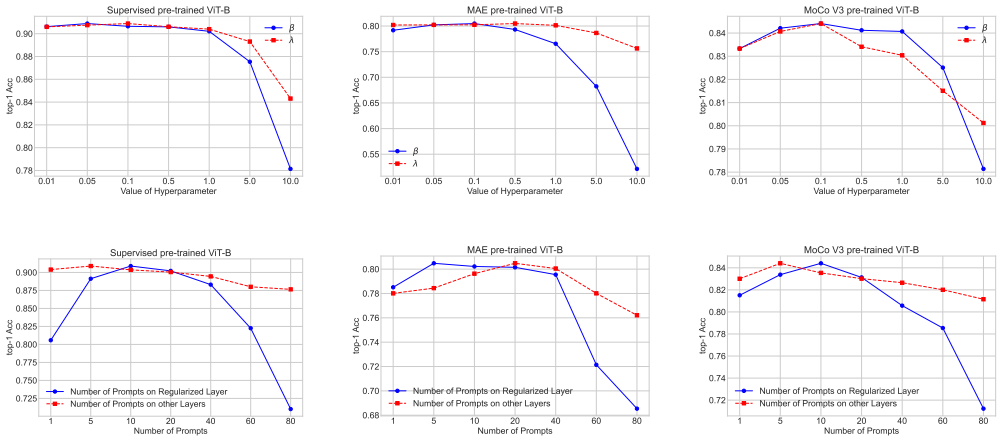
The load-bearing mechanism is a Proxy-Anchor-style metric-learning loss applied to the prompt tokens themselves, paired with a dynamic class-to-prompt mapping. In the loss, each prompt $p_k$ serves as a proxy for a cluster of classes: for a batch, $\mathcal{L}_{\mathrm{ML}}(X,P)$ raises the cosine similarity between $p_k$ and same-class visual tokens and lowers it for different-class tokens, and $\mathcal{L}_{\mathrm{ML}}(P,x_{\mathrm{cls}})$ does the same between prompts and the class token; the total loss is $\mathcal{L} = \mathcal{L}_{\mathrm{CE}} + \beta\mathcal{L}_{\mathrm{ML}}(X,P) + \lambda\mathcal{L}_{\mathrm{ML}}(P,x_{\mathrm{cls}})$. The class-to-prompt assignment comes from k-means clustering of mean-pooled class tokens from the pre-trained model, refreshed each epoch, and the loss is applied to the output of the attention layer so it compares saliency-aggregated token representations. A small auxiliary theorem, $\Delta a_i \approx a_i(1-a_i)\Delta s_i$, connects the metric-induced similarity changes to attention-weight changes, explaining why moving a prompt closer to a token in embedding space gives that token more attention.
What would settle it
Run DA-VPT on a recognition task but replace the semantic k-means mapping with a fixed random class-to-prompt assignment that is permuted each epoch; if accuracy stays at the same level as DA-VPT, the semantic clustering is not what drives the gains, whereas a drop back toward VPT-Deep would confirm the semantic assignment is load-bearing. Alternatively, measure the stability of k-means centroids across epochs on a dataset like CUB: if assignments flip heavily while accuracy remains high, the dynamic mapping is not the source of improvement.
Extended reading notes
Core claim
The central discovery is that the distribution of prompts, not just their position or connectivity, determines how well they transfer. VPT-Deep initializes prompts randomly and lets the classification loss shape them indirectly; DA-VPT instead imposes explicit semantic constraints. Each prompt is assigned, via k-means on mean-pooled pre-trained class tokens, to a cluster of classes, and two smoothed NCA (Proxy-Anchor) losses push prompts toward same-class visual tokens and away from different-class tokens, while the class token is pulled toward its matching prompt. The paper shows this makes attention maps concentrate on class-discriminative regions in deep layers, and that the guided loss works best on the final layer. With these losses, prompts capture class-specific information and the class token aggregates it, producing consistent gains across supervised and self-supervised backbones and on dense prediction tasks.
Load-bearing premise
The k-means clustering of pre-trained class-token representations must produce stable, semantically meaningful prompt-to-class assignments that stay valid while the model is being fine-tuned; if the clusters are unstable or classes are very few, the metric guidance can mislead the prompts.
Editorial extensions
If this is right
- If prompts are shaped by class semantics, the number of prompts can be cut: DA-VPT uses about 20 prompts and still outperforms methods that rely on more prompts, meaning the limiting factor is not prompt count but prompt informativeness.
- The gains are largest on self-supervised backbones (MAE, MoCo-v3), where DA-VPT+ surpasses even full fine-tuning on VTAB-1K, suggesting semantic guidance compensates for missing label structure during pre-training.
- Because the metric losses make bias tuning helpful, PEFT methods that previously found bias tuning harmful can be combined with distribution guidance.
- The approach transfers to dense prediction: on ADE20K and PASCAL Context, DA-VPT+ reaches near-full-tuning mIoU with 4.3 percent of the tunable parameters.
- The attention-similarity relationship implies the guidance effect is local and layer-dependent, so applying the loss to deeper layers, where semantics are abstract, is where most of the benefit comes from.
Reading between the lines
- If the semantic-bridge mechanism is real, the same k-means-plus-metric recipe should transfer to other token-based architectures and modalities, such as frozen text or multimodal encoders, where prompts could be assigned to clusters of label semantics per task.
- A testable extension: instead of re-clustering every epoch, one could learn the class-to-prompt assignment end-to-end with a differentiable assignment, which would remove the k-means refresh cost that the paper shows is non-negligible in early epochs.
- The dependence on image-level class labels is a potential ceiling: in weakly labeled or open-set tasks, the metric positives would be noisy, and the method would likely need pseudo-labeling or outlier prompts to remain effective, a direction the paper only partially covers.
- The attention-similarity theorem suggests a diagnostic: measuring per-prompt attention concentration on same-class patches could serve as a training-free proxy for whether the metric guidance is working.
Editorial analysis
A structured set of objections, weighed in public.
Referee Report
Summary. The paper proposes DA-VPT, an extension of VPT-Deep that adds two metric-learning losses to the fine-tuning objective: L_ML(X,P) between prompts and visual tokens and L_ML(P,x_cls) between prompts and the class token (Eq. 5). Classes are assigned to prompts by k-means clustering of pre-trained CLS representations, with the mapping updated each epoch (Section 3.4). DA-VPT+ additionally unfreezes bias terms in the attention Key and Value projections (Section 3.5). The authors report consistent gains over VPT-Deep and related methods on FGVC, VTAB-1K, and two segmentation benchmarks, and they argue via attention-map visualizations that prompts become semantic bridges between image patches and the class token.
Significance. If substantiated, the method is a useful contribution to parameter-efficient fine-tuning: it adds a principled distributional regularizer to visual prompts, is evaluated across 24 recognition tasks and two segmentation benchmarks on supervised, MAE, and MoCo-v3 backbones, ablates the main components, compares alternative metric losses and connection structures, and releases code. The strongest evidence is the consistent improvement of DA-VPT+ over VPT-Deep and E2VPT in Tables 1-3. However, the load-bearing interpretive claim - that the specific semantic class-to-prompt mapping, rather than the extra metric objective alone, drives the gains - is not tested, and the effect sizes are reported without variance. The paper is therefore promising but needs additional controls and reporting changes before the central claim is established.
major comments (5)
- [Section 3.4, Eq. (4), Table 4] The paper never ablates the class-to-prompt assignment itself. The Proxy-Anchor loss in Eq. (4) is a contrastive objective that pulls each prompt toward whatever subset of visual tokens it is assigned to and pushes it away from other tokens; this objective will improve discrimination even if the assignment is arbitrary. A control with a random or shuffled class-to-prompt mapping, and a comparison between the dynamic re-clustering in Section 3.4 and a static mapping computed once from pre-trained features, are needed. If a random mapping performs as well as the k-means mapping, the reported gains support only the weaker claim that an additional metric objective helps, not the 'semantic bridge' interpretation in the title and abstract.
- [Section 5.1, Appendix A.3] The per-task hyperparameter search is very large and its budget is not matched against baselines. Appendix A.3 searches over base learning rate {1e-3, 5e-4, 1e-4, 5e-5}, weight decay {0.001, 0.005, 0.01, 0.05, 0.1, 0.5, 1.0}, guided-layer position {12, 10, 8, 6, 4, 2, 0}, and prompt counts {5, 10, 20, 40}. The main tables compare DA-VPT to baselines whose own search protocols and budgets are not specified, and no per-dataset selected configurations are given. Because the reported advantage could partly reflect a larger search budget, the paper should report the search protocol used for each baseline, the number of trials per dataset, and the chosen hyperparameters, or provide a budget-matched comparison.
- [Appendix A.2, Tables 1, 4, 9] Appendix A.2 states that mean accuracy across three runs is reported, but no standard deviations or per-seed values appear in the main tables. Several reported differences are very small, for example Table 4 shows +0.02 and +0.06 pp for individual LML components on VTAB-Natural, and Table 9 contains numerous 0.1-0.3 pp differences between methods. These margins are within typical seed noise for VTAB-1K, so the statistical significance of several claimed gains cannot be evaluated. The authors should add standard deviations or release per-seed numbers for the main results.
- [Appendix A.2, segmentation paragraph; Table 2] For multi-class segmentation, the target class for prompt assignment is selected randomly per iteration, so the assigned class may not be present in the image at all. This makes the class-to-prompt mapping effectively decoupled from pixel content in the segmentation experiments, weakening the semantic-guidance interpretation of Table 2. At minimum, the authors should ablate this choice (e.g., selecting only classes present in the sample, or using a predicted dominant class) and report sensitivity, since the segmentation results are a stated contribution.
- [Appendix F vs Appendix A.2] The treatment of tasks with few classes is internally inconsistent. Appendix A.2 says extra unassigned prompts are 'not guided by semantic metrics loss,' while Appendix F recommends supplemental prompts that are 'guided by the metric learning loss.' Appendix F also lists Retinopathy as a limited-class task even though Table 6 reports five classes for it, which does not match the stated C < 5 criterion. This contradiction should be resolved because it affects reproduction of the VTAB-1K results on Patch Camelyon, Retinopathy, and KITTI-Dist.
minor comments (4)
- [Appendix E] The heading 'The Proof and Detial of theorem 1' contains a typo ('Detial' should be 'Detail'), and the appendix restates Theorem 1 as Theorem 2 without explaining the relationship between the two labels.
- [Figures 4d and 5] Figures 4d and Figure 5 appear to report the same prompt-initialization experiment with slightly different numbers for the VTAB-Natural baseline (80.4 vs 80.1). The duplication should be removed or the discrepancy explained.
- [Appendix E, Theorem 1 proof] The proof assumes that the weighted sum of off-diagonal perturbations is negligible, but this assumption is stated only in the appendix; it should be stated in the main text alongside Theorem 1 so that the approximation's scope is clear.
- [Section 3.1, Eq. (1)] Equation (1) uses the placeholder '[ ]' for the reserved prompt positions in the next layer, which is confusing; writing the output sequence with explicit indexed variables would improve readability.
Circularity Check
One self-definitional support for the 'semantic bridge' narrative; benchmark gains remain independent.
-
self definitional
[Section 4.2 'Analysis of Guided Attention Maps', with Eq. (5) from Section 3.2 and Section 3.4]
"Our positive prompt (∗p) successfully identifies informative patches that are subsequently selected by the [CLS] token. ... These visualizations demonstrate that positively labeled prompts serve as effective 'bridges' for semantic information flow to the [CLS] token in deep layers."
The 'positive prompt' is the prompt whose assigned class matches the image's class via the k-means mapping of Section 3.4. Eq. (5) trains LML(X,P) to make that prompt more similar to same-class visual tokens than to other classes, and LML(P,x_cls) to make the CLS token more similar to the corresponding prompt. Thus the attention-map finding that the positive prompt attends to class-discriminative patches and the CLS token then attends to them is a direct consequence of the optimization objective, not an independent empirical discovery of emergent bridging. The headline accuracy improvements, however, are benchmark comparisons against external baselines and are not fitted by these losses, so the circularity is limited to the interpretive 'bridge' claim.
full rationale
The paper's quantitative claims are self-contained: DA-VPT and DA-VPT+ are compared with VPT-Deep, E2VPT, and other methods on 24 recognition and 2 segmentation tasks, and the reported gains are not fitted values or renamed training losses. The metric loss hyperparameters (delta, tau) come from Proxy-Anchor defaults, and the class-to-prompt k-means mapping uses pre-trained features, not the evaluation labels. The only circular-adjacent step is interpretive: the 'semantic bridge' behavior shown in attention maps is largely enforced by Eq. (5), since LML(X,P) and LML(P,x_cls) directly optimize prompt-to-patch and CLS-to-prompt similarity. This makes the qualitative 'bridge' demonstration partly by construction, but it is not the load-bearing evidence for the headline improvement. The missing random-mapping control noted by the skeptic is a genuine underdetermination of the semantic-guidance interpretation, but it is a missing control, not a circular reduction. Self-citations ([64]-[66]) appear only in related-work discussion and are not load-bearing. No fitted parameter is renamed as a prediction, and no uniqueness claim is imported from the authors' prior work.
Assumptions & free parameters
free parameters (5)
- beta and lambda (loss weights in Eq. 5) =
searched per task; optimal below 1.0 (Fig. 6)
- Number of prompts M =
approximately 20 for most tasks
- Number and location of guided layers =
final layer is optimal in most cases (Fig. 4a)
- Margin delta and temperature tau in Proxy-Anchor =
delta = 32, tau = 10
- Choice of bias terms to unfreeze (bK, bV) =
bK and bV only
assumptions (4)
- domain assumption Pre-trained [CLS] representations clustered with k-means yield a stable, semantically meaningful class-to-prompt assignment.
- ad hoc to paper Visual tokens after the attention layer (MHSA output) serve as a sufficient saliency aggregation for positive/negative sample selection.
- domain assumption Cosine similarity between prompts and tokens is a valid proxy for attention match in the optimized attention map.
- domain assumption Proxy-Anchor loss is stable and appropriate under the M << N asymmetry between prompts and visual tokens.
Cite this review
Pith. "Pith review of DA-VPT: Semantic-Guided Visual Prompt Tuning for Vision Transformers." pith.science (2026). https://pith.science/paper/WIHBHPZG
@misc{pith2026250523694,
  author       = {Pith},
  title        = {Pith review of: DA-VPT: Semantic-Guided Visual Prompt Tuning for Vision Transformers},
  year         = {2026},
  howpublished = {\url{https://pith.science/paper/WIHBHPZG}},
  note         = {Machine review of arXiv:2505.23694}
}
read the original abstract
Visual Prompt Tuning (VPT) has become a promising solution for Parameter-Efficient Fine-Tuning (PEFT) approach for Vision Transformer (ViT) models by partially fine-tuning learnable tokens while keeping most model parameters frozen. Recent research has explored modifying the connection structures of the prompts. However, the fundamental correlation and distribution between the prompts and image tokens remain unexplored. In this paper, we leverage metric learning techniques to investigate how the distribution of prompts affects fine-tuning performance. Specifically, we propose a novel framework, Distribution Aware Visual Prompt Tuning (DA-VPT), to guide the distributions of the prompts by learning the distance metric from their class-related semantic data. Our method demonstrates that the prompts can serve as an effective bridge to share semantic information between image patches and the class token. We extensively evaluated our approach on popular benchmarks in both recognition and segmentation tasks. The results demonstrate that our approach enables more effective and efficient fine-tuning of ViT models by leveraging semantic information to guide the learning of the prompts, leading to improved performance on various downstream vision tasks.
Figures


Figures from the paper (4 more)



Reference graph
Works this paper leans on
-
[1]
Charles Beattie, Joel Z Leibo, Denis Teplyashin, Tom Ward, Marcus Wainwright, Heinrich Küttler, Andrew Lefrancq, Si- mon Green, Víctor Valdés, Amir Sadik, et al. Deepmind lab. arXiv preprint arXiv:1612.03801, 2016. 13
arXiv 2016
-
[2]
Language models are few-shot learners
Tom Brown, Benjamin Mann, Nick Ryder, Melanie Sub- biah, Jared D Kaplan, Prafulla Dhariwal, Arvind Neelakantan, Pranav Shyam, Girish Sastry, Amanda Askell, et al. Language models are few-shot learners. NeurIPS, 33:1877–1901, 2020. 2
1901
-
[3]
One-for-all: Generalized lora for parameter- efficient fine-tuning
Arnav Chavan, Zhuang Liu, Deepak Gupta, Eric Xing, and Zhiqiang Shen. One-for-all: Generalized lora for parameter- efficient fine-tuning. arXiv preprint arXiv:2306.07967, 2023. 2
arXiv 2023
-
[4]
Adaptformer: Adapting vision transformers for scalable visual recognition
Shoufa Chen, Chongjian Ge, Zhan Tong, Jiangliu Wang, Yib- ing Song, Jue Wang, and Ping Luo. Adaptformer: Adapting vision transformers for scalable visual recognition. NeurIPS,
-
[5]
An empiri- cal study of training self-supervised vision transformers
Xinlei Chen, Saining Xie, and Kaiming He. An empiri- cal study of training self-supervised vision transformers. In CVPR, pages 9640–9649, 2021. 6, 7
2021
-
[6]
Person re-identification by multi-channel parts-based cnn with improved triplet loss function
De Cheng, Yihong Gong, Sanping Zhou, Jinjun Wang, and Nanning Zheng. Person re-identification by multi-channel parts-based cnn with improved triplet loss function. In CVPR, pages 1335–1344, 2016. 3, 5
2016
-
[7]
Remote sensing image scene classification: Benchmark and state of the art
Gong Cheng, Junwei Han, and Xiaoqiang Lu. Remote sensing image scene classification: Benchmark and state of the art. Proceedings of the IEEE, pages 1865–1883, 2017. 13
2017
-
[8]
Learning a similarity metric discriminatively, with application to face verification
Sumit Chopra, Raia Hadsell, and Yann LeCun. Learning a similarity metric discriminatively, with application to face verification. In CVPR. IEEE, 2005. 3
2005
Show all 93 references
-
[9]
Describing textures in the wild
Mircea Cimpoi, Subhransu Maji, Iasonas Kokkinos, Sammy Mohamed, and Andrea Vedaldi. Describing textures in the wild. In CVPR, pages 3606–3613, 2014. 13
2014
-
[10]
Multi-head attention: Collaborate instead of concatenate
Jean-Baptiste Cordonnier, Andreas Loukas, and Martin Jaggi. Multi-head attention: Collaborate instead of concatenate. arXiv preprint arXiv:2006.16362, 2020. 5
2006 arXiv
-
[11]
Vision transformers need registers
Timothée Darcet, Maxime Oquab, Julien Mairal, and Piotr Bojanowski. Vision transformers need registers. ICLR, 2024. 5
2024
-
[12]
Scaling vision transformers to 22 billion pa- rameters
Mostafa Dehghani, Josip Djolonga, Basil Mustafa, Piotr Padlewski, Jonathan Heek, Justin Gilmer, Andreas Peter Steiner, Mathilde Caron, Robert Geirhos, Ibrahim Alabdul- mohsin, et al. Scaling vision transformers to 22 billion pa- rameters. In ICML, pages 7480–7512. PMLR, 2023. 2
2023
-
[13]
Imagenet: A large-scale hierarchical image database
Jia Deng, Wei Dong, Richard Socher, Li-Jia Li, Kai Li, and Li Fei-Fei. Imagenet: A large-scale hierarchical image database. In CVPR, pages 248–255. Ieee, 2009. 1, 6
2009
-
[14]
An image is worth 16x16 words: Trans- formers for image recognition at scale
Alexey Dosovitskiy, Lucas Beyer, Alexander Kolesnikov, Dirk Weissenborn, Xiaohua Zhai, Thomas Unterthiner, Mostafa Dehghani, Matthias Minderer, Georg Heigold, Syl- vain Gelly, et al. An image is worth 16x16 words: Trans- formers for image recognition at scale. arXiv preprint a...
2010 arXiv
-
[15]
Diabetic retinopathy detection, 2015
Emma Dugas, Jorge Jared, and Will Cukierski. Diabetic retinopathy detection, 2015. 13
2015
-
[16]
Hyperbolic vision transform- ers: Combining improvements in metric learning
Aleksandr Ermolov, Leyla Mirvakhabova, Valentin Khrulkov, Nicu Sebe, and Ivan Oseledets. Hyperbolic vision transform- ers: Combining improvements in metric learning. In CVPR, pages 7409–7419, 2022. 3
2022
-
[17]
One-shot learn- ing of object categories
Li Fei-Fei, Robert Fergus, and Pietro Perona. One-shot learn- ing of object categories. IEEE TPAMI, 28(4):594–611, 2006. 13
2006
-
[18]
Compositional prompt tuning with motion cues for open-vocabulary video relation detection
Kaifeng Gao, Long Chen, Hanwang Zhang, Jun Xiao, and Qianru Sun. Compositional prompt tuning with motion cues for open-vocabulary video relation detection. ICLR, 2023. 2
2023
-
[19]
Tuning pre-trained model via moment probing
Mingze Gao, Qilong Wang, Zhenyi Lin, Pengfei Zhu, Qinghua Hu, and Jingbo Zhou. Tuning pre-trained model via moment probing. In CVPR, pages 11803–11813, 2023. 7, 12
2023
-
[20]
Vi- sual prompt tuning for test-time domain adaptation
Yunhe Gao, Xingjian Shi, Yi Zhu, Hao Wang, Zhiqiang Tang, Xiong Zhou, Mu Li, and Dimitris N Metaxas. Vi- sual prompt tuning for test-time domain adaptation. arXiv preprint arXiv:2210.04831, 2022. 2
2022 arXiv
-
[21]
Fine-grained car detection for visual census estimation
Timnit Gebru, Jonathan Krause, Yilun Wang, Duyun Chen, Jia Deng, and Li Fei-Fei. Fine-grained car detection for visual census estimation. In AAAI, 2017. 12, 13
2017
-
[22]
Vision meets robotics: The kitti dataset
Andreas Geiger, Philip Lenz, Christoph Stiller, and Raquel Urtasun. Vision meets robotics: The kitti dataset. The In- ternational Journal of Robotics Research, pages 1231–1237,
-
[23]
Dimension- ality reduction by learning an invariant mapping
Raia Hadsell, Sumit Chopra, and Yann LeCun. Dimension- ality reduction by learning an invariant mapping. In CVPR. IEEE, 2006. 3
2006
-
[24]
Eˆ 2vpt: An effec- tive and efficient approach for visual prompt tuning
Cheng Han, Qifan Wang, Yiming Cui, Zhiwen Cao, Wenguan Wang, Siyuan Qi, and Dongfang Liu. Eˆ 2vpt: An effec- tive and efficient approach for visual prompt tuning. arXiv preprint arXiv:2307.13770, 2023. 2, 7
2023 arXiv
-
[25]
Sensitivity-aware visual parameter-efficient fine- tuning
Haoyu He, Jianfei Cai, Jing Zhang, Dacheng Tao, and Bohan Zhuang. Sensitivity-aware visual parameter-efficient fine- tuning. In CVPR, pages 11825–11835, 2023. 7
2023
-
[26]
Momentum contrast for unsupervised visual repre- sentation learning
Kaiming He, Haoqi Fan, Yuxin Wu, Saining Xie, and Ross Girshick. Momentum contrast for unsupervised visual repre- sentation learning. In CVPR, pages 9729–9738, 2020. 1
2020
-
[27]
Masked autoencoders are scalable vision learners
Kaiming He, Xinlei Chen, Saining Xie, Yanghao Li, Piotr Dollár, and Ross Girshick. Masked autoencoders are scalable vision learners. In CVPR, pages 16000–16009, 2022. 1, 6, 7
2022
-
[28]
Masked autoencoders are scalable vision learners
Kaiming He, Xinlei Chen, Saining Xie, Yanghao Li, Piotr Dollár, and Ross Girshick. Masked autoencoders are scalable vision learners. In CVPR, pages 16000–16009, 2022. 2
2022
-
[29]
Eurosat: A novel dataset and deep learning benchmark for land use and land cover classification
Patrick Helber, Benjamin Bischke, Andreas Dengel, and Damian Borth. Eurosat: A novel dataset and deep learning benchmark for land use and land cover classification. IEEE Journal of Selected Topics in Applied Earth Observations and Remote Sensing, pages 2217–2226, 2019. 13
2019
-
[30]
In defense of the triplet loss for person re-identification
Alexander Hermans, Lucas Beyer, and Bastian Leibe. In defense of the triplet loss for person re-identification. arXiv preprint arXiv:1703.07737, 2017. 5
2017 arXiv
-
[31]
Parameter-efficient transfer learning for nlp
Neil Houlsby, Andrei Giurgiu, Stanislaw Jastrzebski, Bruna Morrone, Quentin De Laroussilhe, Andrea Gesmundo, Mona Attariyan, and Sylvain Gelly. Parameter-efficient transfer learning for nlp. In ICML, pages 2790–2799. PMLR, 2019. 1, 2, 7, 17
2019
-
[32]
Lora: Low-rank adaptation of large language models.arXiv preprint arXiv:2106.09685, 2021
Edward J Hu, Yelong Shen, Phillip Wallis, Zeyuan Allen-Zhu, Yuanzhi Li, Shean Wang, Lu Wang, and Weizhu Chen. Lora: Low-rank adaptation of large language models.arXiv preprint arXiv:2106.09685, 2021. 1
2021 arXiv
-
[33]
Visual prompt tuning
Menglin Jia, Luming Tang, Bor-Chun Chen, Claire Cardie, Serge Belongie, Bharath Hariharan, and Ser-Nam Lim. Visual prompt tuning. In ECCV, pages 709–727. Springer, 2022. 1, 2, 3, 6, 7, 12, 13, 17
2022
-
[34]
Clevr: A diagnostic dataset for compositional language and elementary visual reasoning
Justin Johnson, Bharath Hariharan, Laurens Van Der Maaten, Li Fei-Fei, C Lawrence Zitnick, and Ross Girshick. Clevr: A diagnostic dataset for compositional language and elementary visual reasoning. In CVPR, pages 2901–2910, 2017. 13
2017
-
[35]
Novel dataset for fine-grained image cat- egorization: Stanford dogs
Aditya Khosla, Nityananda Jayadevaprakash, Bangpeng Yao, and Fei-Fei Li. Novel dataset for fine-grained image cat- egorization: Stanford dogs. In Proc. CVPR workshop on fine-grained visual categorization (FGVC). Citeseer, 2011. 12, 13
2011
-
[36]
Proxy anchor loss for deep metric learning
Sungyeon Kim, Dongwon Kim, Minsu Cho, and Suha Kwak. Proxy anchor loss for deep metric learning. In CVPR, pages 3238–3247, 2020. 3, 4, 5
2020
-
[37]
Segment any- thing
Alexander Kirillov, Eric Mintun, Nikhila Ravi, Hanzi Mao, Chloe Rolland, Laura Gustafson, Tete Xiao, Spencer White- head, Alexander C Berg, Wan-Yen Lo, et al. Segment any- thing. In CVPR, pages 4015–4026, 2023. 1
2023
-
[38]
Do better imagenet models transfer better? In CVPR, pages 2661–2671,
Simon Kornblith, Jonathon Shlens, and Quoc V Le. Do better imagenet models transfer better? In CVPR, pages 2661–2671,
-
[39]
Cross-image-attention for conditional embeddings in deep metric learning
Dmytro Kotovenko, Pingchuan Ma, Timo Milbich, and Björn Ommer. Cross-image-attention for conditional embeddings in deep metric learning. In CVPR, pages 11070–11081, 2023. 3
2023
-
[40]
Learning multiple layers of features from tiny images
Alex Krizhevsky, Geoffrey Hinton, et al. Learning multiple layers of features from tiny images. 2009. 13
2009
-
[41]
M-adda: Unsuper- vised domain adaptation with deep metric learning
Issam H Laradji and Reza Babanezhad. M-adda: Unsuper- vised domain adaptation with deep metric learning. Domain adaptation for visual understanding, pages 17–31, 2020. 3
2020
-
[42]
Learning methods for generic object recognition with invariance to pose and lighting
Yann LeCun, Fu Jie Huang, and Leon Bottou. Learning methods for generic object recognition with invariance to pose and lighting. In CVPR. IEEE, 2004. 13
2004
-
[43]
The power of scale for parameter-efficient prompt tuning
Brian Lester, Rami Al-Rfou, and Noah Constant. The power of scale for parameter-efficient prompt tuning. arXiv preprint arXiv:2104.08691, 2021. 2
2021 arXiv
-
[44]
Prefix-tuning: Optimiz- ing continuous prompts for generation
Xiang Lisa Li and Percy Liang. Prefix-tuning: Optimiz- ing continuous prompts for generation. arXiv preprint arXiv:2101.00190, 2021. 1, 2
2021 arXiv
-
[45]
Scaling & shifting your features: A new baseline for efficient model tuning
Dongze Lian, Daquan Zhou, Jiashi Feng, and Xinchao Wang. Scaling & shifting your features: A new baseline for efficient model tuning. Neurips, 35:109–123, 2022. 2, 7, 12
2022
-
[46]
Pre-train, prompt, and predict: A systematic survey of prompting methods in natural language processing
Pengfei Liu, Weizhe Yuan, Jinlan Fu, Zhengbao Jiang, Hi- roaki Hayashi, and Graham Neubig. Pre-train, prompt, and predict: A systematic survey of prompting methods in natural language processing. ACM Computing Surveys, 55(9):1–35,
-
[47]
P-tuning v2: Prompt tuning can be comparable to fine-tuning universally across scales and tasks
Xiao Liu, Kaixuan Ji, Yicheng Fu, Weng Lam Tam, Zhengx- iao Du, Zhilin Yang, and Jie Tang. P-tuning v2: Prompt tuning can be comparable to fine-tuning universally across scales and tasks. arXiv preprint arXiv:2110.07602, 2021. 2
-
[48]
Sgdr: Stochastic gradient descent with warm restarts
Ilya Loshchilov and Frank Hutter. Sgdr: Stochastic gradient descent with warm restarts. arXiv preprint arXiv:1608.03983,
-
[49]
Decoupled weight decay regularization
Ilya Loshchilov and Frank Hutter. Decoupled weight decay regularization. arXiv preprint arXiv:1711.05101, 2017. 12
2017 arXiv
-
[50]
Exploring the limits of weakly supervised pretraining
Dhruv Mahajan, Ross Girshick, Vignesh Ramanathan, Kaim- ing He, Manohar Paluri, Yixuan Li, Ashwin Bharambe, and Laurens Van Der Maaten. Exploring the limits of weakly supervised pretraining. In ECCV, pages 181–196, 2018. 1
2018
-
[51]
dsprites: Disentanglement testing sprites dataset,
Loic Matthey, Irina Higgins, Demis Hassabis, and Alexander Lerchner. dsprites: Disentanglement testing sprites dataset,
-
[52]
The role of context for object detection and semantic segmentation in the wild
Roozbeh Mottaghi, Xianjie Chen, Xiaobai Liu, Nam-Gyu Cho, Seong-Whan Lee, Sanja Fidler, Raquel Urtasun, and Alan Yuille. The role of context for object detection and semantic segmentation in the wild. In CVPR, pages 891–898,
-
[53]
No fuss distance metric learning using proxies
Yair Movshovitz-Attias, Alexander Toshev, Thomas K Leung, Sergey Ioffe, and Saurabh Singh. No fuss distance metric learning using proxies. In CVPR, pages 360–368, 2017. 3
2017
-
[54]
Reading digits in natural images with unsupervised feature learning
Yuval Netzer, Tao Wang, Adam Coates, Alessandro Bissacco, Baolin Wu, Andrew Y Ng, et al. Reading digits in natural images with unsupervised feature learning. In NIPS workshop on deep learning and unsupervised feature learning, page 7. Granada, Spain, 2011. 13
2011
-
[55]
Toward under- standing catastrophic forgetting in continual learning
Cuong V Nguyen, Alessandro Achille, Michael Lam, Tal Has- sner, Vijay Mahadevan, and Stefano Soatto. Toward under- standing catastrophic forgetting in continual learning. arXiv preprint arXiv:1908.01091, 2019. 1
1908 arXiv
-
[56]
A visual vocabulary for flower classification
M-E Nilsback and Andrew Zisserman. A visual vocabulary for flower classification. In CVPR, pages 1447–1454. IEEE,
-
[57]
Automated flower classification over a large number of classes
Maria-Elena Nilsback and Andrew Zisserman. Automated flower classification over a large number of classes. In ICVGIP. IEEE, 2008. 12, 13
2008
-
[58]
Cats and dogs
Omkar M Parkhi, Andrea Vedaldi, Andrew Zisserman, and CV Jawahar. Cats and dogs. In CVPR, pages 3498–3505. IEEE, 2012. 13
2012
-
[59]
Recall@ k surro- gate loss with large batches and similarity mixup
Yash Patel, Giorgos Tolias, and Jiˇrí Matas. Recall@ k surro- gate loss with large batches and similarity mixup. In CVPR, pages 7502–7511, 2022. 3
2022
-
[60]
Sa 2vp: Spatially aligned-and- adapted visual prompt
Wenjie Pei, Tongqi Xia, Fanglin Chen, Jinsong Li, Jiandong Tian, and Guangming Lu. Sa 2vp: Spatially aligned-and- adapted visual prompt. In AAAI, 2024. 2
2024
-
[61]
Adapterhub: A framework for adapting transformers
Jonas Pfeiffer, Andreas Rücklé, Clifton Poth, Aishwarya Ka- math, Ivan Vuli ´c, Sebastian Ruder, Kyunghyun Cho, and Iryna Gurevych. Adapterhub: A framework for adapting transformers. arXiv preprint arXiv:2007.07779, 2020. 1
2007 arXiv
-
[62]
Learning transferable visual models from natural language supervision
Alec Radford, Jong Wook Kim, Chris Hallacy, Aditya Ramesh, Gabriel Goh, Sandhini Agarwal, Girish Sastry, Amanda Askell, Pamela Mishkin, Jack Clark, et al. Learning transferable visual models from natural language supervision. In ICML, pages 8748–8763. PMLR, 2021. 2
2021
-
[63]
Learning transferable visual models from natural language supervision
Alec Radford, Jong Wook Kim, Chris Hallacy, Aditya Ramesh, Gabriel Goh, Sandhini Agarwal, Girish Sastry, Amanda Askell, Pamela Mishkin, Jack Clark, et al. Learning transferable visual models from natural language supervision. In ICML, pages 8748–8763. PMLR, 2021. 1
2021
-
[64]
Beyond the deep metric learning: enhance the cross-modal matching with adversarial discriminative domain regularization
Li Ren, Kai Li, LiQiang Wang, and Kien Hua. Beyond the deep metric learning: enhance the cross-modal matching with adversarial discriminative domain regularization. In ICPR, pages 10165–10172. IEEE, 2021. 3
2021
-
[65]
To- wards improved proxy-based deep metric learning via data- augmented domain adaptation
Li Ren, Chen Chen, Liqiang Wang, and Kien Hua. To- wards improved proxy-based deep metric learning via data- augmented domain adaptation. In AAAI, 2024. 3
2024
-
[66]
Li Ren, Chen Chen, Liqiang Wang, and Kien A. Hua. Learn- ing semantic proxies from visual prompts for parameter- efficient fine-tuning in deep metric learning. In ICLR, 2024. 1, 3
2024
-
[67]
Non-isotropy regularization for proxy-based deep metric learning
Karsten Roth, Oriol Vinyals, and Zeynep Akata. Non-isotropy regularization for proxy-based deep metric learning. InCVPR, pages 7420–7430, 2022. 3
2022
-
[68]
Neighbourhood component analysis
Sam Roweis, Geoffrey Hinton, and Ruslan Salakhutdinov. Neighbourhood component analysis. NeurIPS, 2004. 3
2004
-
[69]
Revisiting unreasonable effectiveness of data in deep learning era
Chen Sun, Abhinav Shrivastava, Saurabh Singh, and Abhinav Gupta. Revisiting unreasonable effectiveness of data in deep learning era. In ICCV, pages 843–852, 2017. 1
2017
-
[70]
Prox- ynca++: Revisiting and revitalizing proxy neighborhood com- ponent analysis
Eu Wern Teh, Terrance DeVries, and Graham W Taylor. Prox- ynca++: Revisiting and revitalizing proxy neighborhood com- ponent analysis. In ECCV, pages 448–464. Springer, 2020. 3, 5
2020
-
[71]
Llama 2: Open foundation and fine-tuned chat models
Hugo Touvron, Louis Martin, Kevin Stone, Peter Albert, Am- jad Almahairi, Yasmine Babaei, Nikolay Bashlykov, Soumya Batra, Prajjwal Bhargava, Shruti Bhosale, et al. Llama 2: Open foundation and fine-tuned chat models. arXiv preprint arXiv:2307.09288, 2023. 2
2023 arXiv
-
[72]
Convolu- tional visual prompt for robust visual perception
Yun-Yun Tsai, Chengzhi Mao, and Junfeng Yang. Convolu- tional visual prompt for robust visual perception. Advances in Neural Information Processing Systems, 36, 2024. 3
2024
-
[73]
Visual query tuning: Towards effective usage of intermediate representa- tions for parameter and memory efficient transfer learning
Cheng-Hao Tu, Zheda Mai, and Wei-Lun Chao. Visual query tuning: Towards effective usage of intermediate representa- tions for parameter and memory efficient transfer learning. In CVPR, pages 7725–7735, 2023. 2
2023
-
[74]
Building a bird recognition app and large scale dataset with citizen scientists: The fine print in fine-grained dataset collection
Grant Van Horn, Steve Branson, Ryan Farrell, Scott Haber, Jessie Barry, Panos Ipeirotis, Pietro Perona, and Serge Be- longie. Building a bird recognition app and large scale dataset with citizen scientists: The fine print in fine-grained dataset collection. In CVPR, pages 595–...
2015
-
[75]
Attention is all you need
Ashish Vaswani, Noam Shazeer, Niki Parmar, Jakob Uszko- reit, Llion Jones, Aidan N Gomez, Łukasz Kaiser, and Illia Polosukhin. Attention is all you need. NeurIPS, 30, 2017. 2
2017
-
[76]
Attention is all you need
Ashish Vaswani, Noam Shazeer, Niki Parmar, Jakob Uszko- reit, Llion Jones, Aidan N Gomez, Łukasz Kaiser, and Illia Polosukhin. Attention is all you need. Neurips, 30, 2017. 3
2017
-
[77]
Rotation equivariant cnns for digital pathology
Bastiaan S Veeling, Jasper Linmans, Jim Winkens, Taco Co- hen, and Max Welling. Rotation equivariant cnns for digital pathology. In MICCAI, pages 210–218. Springer, 2018. 13
2018
-
[78]
It takes two to tango: Mixup for deep metric learning
Shashanka Venkataramanan, Bill Psomas, Yannis Avrithis, Ewa Kijak, Laurent Amsaleg, and Konstantinos Karantzalos. It takes two to tango: Mixup for deep metric learning. ICLR,
-
[79]
The caltech-ucsd birds-200-2011 dataset
Catherine Wah, Steve Branson, Peter Welinder, Pietro Perona, and Serge Belongie. The caltech-ucsd birds-200-2011 dataset
2011
-
[80]
Adversarial cross-modal retrieval
Bokun Wang, Yang Yang, Xing Xu, Alan Hanjalic, and Heng Tao Shen. Adversarial cross-modal retrieval. In Multi- media, pages 154–162, 2017. 3
2017
-
[81]
Adapting shortcut with normalizing flow: An efficient tuning framework for visual recognition
Yaoming Wang, Bowen Shi, Xiaopeng Zhang, Jin Li, Yuchen Liu, Wenrui Dai, Chenglin Li, Hongkai Xiong, and Qi Tian. Adapting shortcut with normalizing flow: An efficient tuning framework for visual recognition. In CVPR. IEEE, 2023. 7
2023
-
[82]
Revisiting the power of prompt for visual tuning
Yuzhu Wang, Lechao Cheng, Chaowei Fang, Dingwen Zhang, Manni Duan, and Meng Wang. Revisiting the power of prompt for visual tuning. arXiv preprint arXiv:2402.02382,
-
[83]
Sun database: Large-scale scene recog- nition from abbey to zoo
Jianxiong Xiao, James Hays, Krista A Ehinger, Aude Oliva, and Antonio Torralba. Sun database: Large-scale scene recog- nition from abbey to zoo. In CVPR, pages 3485–3492. IEEE,
-
[84]
Difffit: Unlocking transferability of large diffusion models via simple parameter- efficient fine-tuning
Enze Xie, Lewei Yao, Han Shi, Zhili Liu, Daquan Zhou, Zhaoqiang Liu, Jiawei Li, and Zhenguo Li. Difffit: Unlocking transferability of large diffusion models via simple parameter- efficient fine-tuning. In CVPR, pages 4230–4239, 2023. 2
2023
-
[85]
Improving visual prompt tuning for self- supervised vision transformers
Seungryong Yoo, Eunji Kim, Dahuin Jung, Jungbeom Lee, and Sungroh Yoon. Improving visual prompt tuning for self- supervised vision transformers. InICML, pages 40075–40092. PMLR, 2023. 2, 7, 14
2023
-
[86]
Bitfit: Simple parameter-efficient fine-tuning for transformer-based masked language-models
Elad Ben Zaken, Shauli Ravfogel, and Yoav Goldberg. Bitfit: Simple parameter-efficient fine-tuning for transformer-based masked language-models. arXiv preprint arXiv:2106.10199,
-
[87]
A large-scale study of representation learning with the visual task adaptation benchmark
Xiaohua Zhai, Joan Puigcerver, Alexander Kolesnikov, Pierre Ruyssen, Carlos Riquelme, Mario Lucic, Josip Djolonga, An- dre Susano Pinto, Maxim Neumann, Alexey Dosovitskiy, et al. A large-scale study of representation learning with the visual task adaptation benchmark. arXiv pr...
1910 arXiv
-
[88]
Mosa: Mixture of sparse adapters for visual efficient tuning
Qizhe Zhang, Bocheng Zou, Ruichuan An, Jiaming Liu, and Shanghang Zhang. Mosa: Mixture of sparse adapters for visual efficient tuning. arXiv preprint arXiv:2312.02923 ,
-
[89]
Neural prompt search
Yuanhan Zhang, Kaiyang Zhou, and Ziwei Liu. Neural prompt search. arXiv preprint arXiv:2206.04673, 2022. 2
2022 arXiv
-
[90]
Rethinking semantic segmentation from a sequence-to-sequence perspective with transformers
Sixiao Zheng, Jiachen Lu, Hengshuang Zhao, Xiatian Zhu, Zekun Luo, Yabiao Wang, Yanwei Fu, Jianfeng Feng, Tao Xi- ang, Philip HS Torr, et al. Rethinking semantic segmentation from a sequence-to-sequence perspective with transformers. In CVPR, pages 6881–6890, 2021. 12
2021
-
[91]
Semantic understand- ing of scenes through the ade20k dataset
Bolei Zhou, Hang Zhao, Xavier Puig, Tete Xiao, Sanja Fidler, Adela Barriuso, and Antonio Torralba. Semantic understand- ing of scenes through the ade20k dataset. IJCV, 127:302–321,
-
[93]
Following established proto- cols [19, 33, 45], we report mean accuracy across three runs with different random seeds
We determine optimal hyperparameters through cross- validation on the validation set. Following established proto- cols [19, 33, 45], we report mean accuracy across three runs with different random seeds. Segmentation Tasks. We implement our experiments us- ing the SETR framew...
-
[2019]
Details About the Experiments A.1
6, 13 Appendix A. Details About the Experiments A.1. Datasets Classification Datasets. FGVC encompasses five fine- grained visual classification datasets: CUB-200-2011 [79], NABirds [74], Oxford Flowers [ 57], Stanford Dogs [ 35], and Stanford Cars [21]. Following Jia et al. [...
2011
Reviewed August 7, 2026 · model on record in the stance chip above.
Discussion (0). Sign in to comment.