REVIEW 3 major objections 5 minor 88 references
The Northern Cross Fast Radio Burst project: V. Search for transient radio emission from Galactic magnetars
T0 review · 3 major / 5 minor · reviewed 2026-08-07 · deepseek-v4-flash
Pith's one-line read A 560-hour watch of seven Galactic magnetars found no bright radio pulses, capping the burst rate below 52 per year and pointing toward ordinary magnetars being insufficient to explain fast radio bursts.
desk verdict A clean 560-hour null result with solid Poisson upper limits, wrapped in a model-dependent FRB-population conclusion that is honestly hedged in the body but slightly overpressed in the abstract. read the letter →
The pith
A machine-rendered reading of the paper's core claim, the machinery that carries it, and where it could break.
The reading
What carries the argument
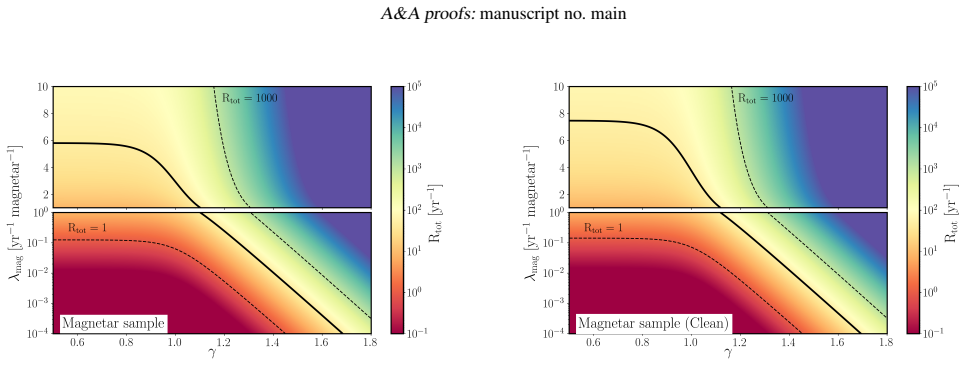
The carrying object is a single power-law distribution of single-burst energies, $dN/dE \propto E^{-\gamma}$, normalized so that $\lambda_{\mathrm{mag}}$ is the rate of bursts above a reference energy $E_0 = 3.2\times10^{34}\,\mathrm{erg}$ (the inferred energy of the SGR J1935+2154 FRB-like event). The distribution runs from a per-source minimum detectable energy up to a common maximum $E_{\max}=1.2\times10^{41}\,\mathrm{erg}$, set by the magnetic energy reservoir and a radio efficiency of $10^{-5}$. The telescope's primary-beam gain is divided into time intervals, and Eq. (7) converts $\lambda_{\mathrm{mag}}$ and $\gamma$, weighted by exposure per interval, into the rate expected from the whole sample; comparing that expectation with the Poisson upper limit from zero detections maps out the excluded region of $(\gamma,\lambda_{\mathrm{mag}})$ space.
What would settle it
A wideband monitor pointed at an active magnetar such as SGR J1935+2154 could catch enough bursts to reconstruct the energy distribution directly. If the observed distribution is not a single power law with a common slope, or if a burst with energy near the FRB-like reference energy arrives during a comparable exposure, the paper's claim that ordinary magnetars cannot explain fast radio bursts would need revision.
Extended reading notes
Core claim
The paper's central result is an exclusion: in 565.92 hours of Northern Cross observations, no dispersed radio pulse associated with any monitored magnetar was detected. With zero events and a Poisson model of burst arrival times, the 95% confidence upper limit on the rate of bright events is $R_{\mathrm{tot,clean}} < 52\,\mathrm{yr}^{-1}$ once the unconfirmed candidate SGR 2013+34 is removed. The paper then plugs this null result into a power-law energy model: each magnetar emits bursts with $dN/dE \propto E^{-\gamma}$ up to a common maximum energy, and $\lambda_{\mathrm{mag}}$ is the rate of events above the energy of the SGR J1935+2154 FRB-like burst. The surviving parameter region favors flat slopes ($\gamma \lesssim 1.1$) and, when combined with prior nearby-galaxy monitoring, restricts $\lambda_{\mathrm{mag}}$ to $0.007$–$0.043\,\mathrm{yr}^{-1}$; steeper slopes near $\gamma \simeq 2.1$, which other work uses to explain the extragalactic FRB rate, are disfavored. The authors conclude that ordinary magnetars similar to SGR J1935+2154 cannot alone account for the FRB population.
Load-bearing premise
The argument assumes that every magnetar's radio bursts are drawn from one shared power-law energy distribution with a single slope and a common maximum energy; if the true distribution is curved, has a lower cutoff, or varies from source to source, the derived limit on FRB-like bursts does not follow.
Editorial extensions
If this is right
- Even with no detections, roughly 560 hours of monitoring caps the bright radio burst rate of the sampled magnetars at fewer than 52 events per year at 95% confidence.
- The model excludes steep energy distributions: for slopes around $\gamma \gtrsim 1.4$–$1.5$, the expected rate of FRB-like events from the sample falls below what would be needed to explain extragalactic FRBs.
- Combining the magnetar campaign with prior nearby-galaxy monitoring narrows the allowed per-magnetar rate of events above the SGR J1935+2154 reference energy to $0.007$–$0.043\,\mathrm{yr}^{-1}$ for flat slopes.
- If the all-sky FRB rate is set by ordinary magnetars, the required steep slope near $\gamma \simeq 2.1$ is disfavored, implying that an additional, more exotic magnetar population is needed.
- The null detections occurred while none of the monitored targets showed X-ray bursting or outburst activity, supporting the idea that FRB-like radio emission is tied to magnetar activity windows.
Reading between the lines
- Beyond the paper, the same silence could be reinterpreted as a duty-cycle constraint: if bright radio bursts occur mainly during X-ray-active windows, none of the monitored sources were in such a window, so the per-active-magnetar rate could be much higher than the sample-wide average.
- A direct extension would be to collect many bursts from SGR J1935+2154 itself and check whether its energy distribution really is a single power law with a common slope; that would test the model rather than the null result.
- The paper's FRB conclusion applies to ordinary magnetars like those monitored; it leaves open that undiscovered or exotic magnetars with different burst statistics produce a substantial share of extragalactic FRBs.
- Targeting magnetar-rich environments such as the Galactic center or nearby starburst galaxies with the same exposure model would test whether the low per-source rate holds where FRB-like activity is expected to be denser.
Editorial analysis
A structured set of objections, weighed in public.
Referee Report
Summary. This paper reports a 565.92-hour monitoring campaign of seven Galactic magnetars plus one candidate (SGR 2013+34) with the Northern Cross radio telescope at 408 MHz. No radio bursts were found. The authors derive 95% Poisson upper limits on the burst rate per source and a combined limit of R<46 yr^-1 for the full sample and R<52 yr^-1 when the candidate is excluded, with energies above the per-source minimum detectable energies (ranging from ~5e26 to ~4e28 erg). They then model the burst energy distribution as a single power law with slope gamma and rate lambda_mag above the SGR J1935+2154-like energy E0=3.2e34 erg, and use the non-detections to constrain the gamma-lambda_mag parameter space. Combining with previous CHIME/FRB and Northern Cross nearby-galaxy limits, they obtain 0.007<lambda_mag<0.043 yr^-1 for flat slopes and argue that the data disfavor slopes steeper than ~1.5, implying tension with models in which the entire FRB population is produced by SGR J1935+2154-like magnetars.
Significance. If the model-dependent conclusion holds, this is an important observational constraint on the magnetar-FRB connection, complementing the SGR J1935+2154 detection with a long, well-characterized null result. The clean non-detection and the careful treatment of the telescope gain profile and sensitivity (Eqs. 1-2 and Fig. 1) are strengths. The paper makes explicit the assumptions behind the power-law analysis, uses standard pipeline tools (HEIMDALL, FETCH, IQRM), and provides per-source limits that will be useful for future population studies. The main scientific value lies in the upper limits; the FRB-population claim is conditional on the assumed energy distribution and needs further robustness work.
major comments (3)
- [Sec. 4.1, Eqs. (3)-(6); abstract; Sec. 6] The conclusion that magnetar bursts cannot explain the entire FRB population rests on the assumption of a single power-law energy distribution with a common slope gamma and a common E_max over the range E_min~10^26-10^28 erg to E0=3.2e34 erg. The non-detection is extrapolated to high energies through the factor (E0/E_min)^(gamma-1) in Eq. (6); for gamma=2.1 this factor is ~10^7-10^8, so the low-energy null translates into a very tight constraint on lambda_mag. If the true burst energy distribution has a break or flattens at high energies, as the sparse SGR J1935+2154 data may suggest, the low-energy upper limits do not bound the high-energy rate and the 'cannot be explained' claim would not follow. Please add a sensitivity test with a broken power law (varying the break energy and the high-energy slope) or explicitly limit the abstract's claim to the single power-law model.
- [Sec. 4.1, Eq. (5); Table 1] The adopted common maximum energy E_max=1.2e41 erg corresponds to B=2e14 G and eta=1e-5 in Eq. (5), but the sample spans B_dip from 6e12 G (SGR 0418+5729) to 8e14 G (SGR 1900+14). Applying Eq. (5) per source would change E_max by about four orders of magnitude. While the paper correctly notes that E_max is unimportant for gamma>1.5, it directly affects the flat-slope region (gamma<=1.1) and the combined lambda_mag < 0.043 yr^-1 quoted in Secs. 5.1 and 6. Please quantify how the allowed parameter space in Figs. 4 and 5 changes when E_max is evaluated for each source's magnetic field rather than set to a common value.
- [Sec. 5.1; Fig. 5] The combined limit lambda_mag < 0.043 yr^-1, which is used in the abstract and conclusions, is stated without showing the calculation. It evidently combines the present 565.92 h with the ~695 h of Pelliciari et al. (2023) and assumes N_mag=29 (or scales from N_mag=500 to 29), but the expected-count formula, the sensitivity factors, and the Poisson upper limit used are not given. Please provide the explicit computation for this quantity, including how the different energy thresholds of the two campaigns enter the combination.
minor comments (5)
- [Abstract; Table 2] The abstract quotes the limit as '<52 yr^-1 on the rate of events with energy >10^28 erg', but Table 2 shows per-source E_min intervals that extend down to 5e26 erg; the combined limit is computed with the source-specific E_min values. Please clarify the exact threshold(s) to which the quoted 52 yr^-1 applies.
- [Eq. (1); Sec. 3] The sentence 'The number of receivers is A=64, in the current 16 cylinders configuration' is confusing: the text states that 16 cylinders were used, so the relationship between A=64 and the active cylinders should be explained.
- [Sec. 4.1] There is a typo: 'FBR-like event' should read 'FRB-like event'.
- [Sec. 5.1] The phrase 'power-law indexes' should be 'power-law indices' or 'power-law slopes'.
- [Sec. 6] The paper notes that none of the targets showed X-ray bursting activity and interprets this as a possible hint that FRB-like events are related to activity windows. It would be useful to state explicitly that the derived upper limits are time-averaged rates and do not constrain the rate during active periods, where SGR J1935+2154's FRB-like event occurred.
Circularity Check
No significant circularity: the upper limits and model constraints are derived from external observations under explicit power-law assumptions; the few self-citations are not load-bearing.
full rationale
The paper's central quantitative result, the 95% confidence upper limit of <52 yr^-1 on bursts with E > 10^28 erg, is a Poissonian upper limit (Gehrels 1986) computed directly from 565.92 hours of non-detections on external telescope data; it does not reuse any fitted value from the authors' prior papers. The energy-dependent constraints come from Eqs. (3)-(7), which are algebraic rearrangements of an explicitly stated single power-law assumption ('assuming an energy power-law distribution of single bursts', Sec. 4.1). The free parameters lambda_mag and gamma are constrained by the observations rather than defined in terms of the target conclusion. The reference energy E0 = 3.2e34 erg is anchored to the independently measured SGR J1935+2154 FRB-like event (Margalit et al. 2020; CHIME/FRB Collaboration et al. 2020), not to the present non-detections. The broad FRB-population statement is explicitly hedged ('under some assumptions', 'point towards') and rests on external inputs (CHIME/FRB 2020 nearby-galaxy limits; James et al. 2022 FRB luminosity slope) combined with the present constraints. Citations to Pelliciari et al. (2023, 2024), Trudu et al. (2022), and Locatelli et al. (2020) provide calibration, observation time, and a nearby-galaxy upper limit that is an independent, falsifiable observable; they are not used as an unverified uniqueness theorem or as a fitted parameter that predetermines the result. The main vulnerability is the assumed common power-law energy distribution and common E_max, which is a modeling assumption and a correctness risk, not a circular step. Score 2 reflects only the presence of minor, non-load-bearing self-citations to the project's earlier papers.
Assumptions & free parameters
free parameters (3)
- gamma (power-law slope) =
constrained, not fitted
- lambda_mag (rate above E0) =
constrained, not fitted
- E_max (maximum burst energy) =
1.2e41 erg (assumed)
assumptions (5)
- domain assumption Single power-law energy distribution with common slope gamma for all magnetars
- domain assumption Poissonian time distribution of radio events
- domain assumption Reference energy E0 = 3.2e34 erg
- domain assumption Radio efficiency eta = 1e-5 and dipolar field B = 2e14 G for all magnetars
- domain assumption Milky Way active magnetar population N_mag = 500
Cite this review
Pith. "Pith review of The Northern Cross Fast Radio Burst project: V. Search for transient radio emission from Galactic magnetars." pith.science (2026). https://pith.science/paper/HWIZUNH7
@misc{pith2026250524049,
  author       = {Pith},
  title        = {Pith review of: The Northern Cross Fast Radio Burst project: V. Search for transient radio emission from Galactic magnetars},
  year         = {2026},
  howpublished = {\url{https://pith.science/paper/HWIZUNH7}},
  note         = {Machine review of arXiv:2505.24049}
}
abstract
Context. The radio emission from magnetars is poorly understood and poorly characterized observationally, in particular for what concerns single pulses and sporadic events. The interest in it was boosted by the detection in 2020 of an extremely bright ms radio signal from the Galactic magnetar designated Soft Gamma Repeater (SGR) SGR J1935+2154, which occurred almost simultaneously with a typical magnetar short burst of X-rays. As of now, this event remains the Galactic radio pulse that is the most reminiscent of fast radio bursts (FRBs) and the only one with a sound association with a known progenitor. Aims. We aim to constrain the rate of impulsive radio events from magnetars, by means of an intensive monitoring using a high-sensitivity radio telescope. Methods. We performed a long-term campaign on seven Galactic magnetars (plus one candidate) using the Northern Cross transit radio telescope (in Medicina, Italy) searching for short timescales and dispersed radio pulses. Results. We obtained no detections in more than 560 hours of observation, setting an upper limit at 95% confidence level of <52 yr$^{-1}$ on the rate of events with energy >10$^{28}$ erg, which is consistent with limits in literature. Furthermore, under some assumptions on the magnetars properties and energetic behavior, we found that our upper limits point towards the fact that the entire population of FRBs observed cannot be explained by radio bursts emitted by magnetars.
Figures


Figures from the paper (2 more)

Reference graph
Works this paper leans on
-
[1]
2020, MNRAS, 497, 1661
Daniels, N. 2020, MNRAS, 497, 1661
2020
-
[2]
2022, Science, 378, abj3043
Bailes, M. 2022, Science, 378, abj3043
2022
-
[3]
R., Bailes, M., Barnes, D
Barsdell, B. R., Bailes, M., Barnes, D. G., & Fluke, C. J. 2012, MNRAS, 422, 379
2012
-
[4]
D., Baumgartner, W
Barthelmy, S. D., Baumgartner, W. H., Beardmore, A. P., et al. 2008, The As- tronomer’s Telegram, 1676, 1
2008
-
[5]
D., Ravi, V ., Belov, K
Bochenek, C. D., Ravi, V ., Belov, K. V ., et al. 2020, Nature, 587, 59
2020
-
[6]
L., et al
Borghese, A., Coti Zelati, F., Israel, G. L., et al. 2022, MNRAS, 516, 602
2022
-
[7]
2022, MNRAS, 510, 1996
Caleb, M., Rajwade, K., Desvignes, G., et al. 2022, MNRAS, 510, 1996
2022
-
[8]
2014, MNRAS, 438, 3291
Camero, A., Papitto, A., Rea, N., et al. 2014, MNRAS, 438, 3291
2014
Show all 88 references
-
[9]
B., Chandra, P., Ray, A., et al
Cameron, P. B., Chandra, P., Ray, A., et al. 2005, Nature, 434, 1112
2005
-
[10]
M., Halpern, J
Camilo, F., Ransom, S. M., Halpern, J. P., & Reynolds, J. 2007, ApJ, 666, L93
2007
-
[11]
M., Halpern, J
Camilo, F., Ransom, S. M., Halpern, J. P., et al. 2006, Nature, 442, 892 CHIME/FRB Collaboration, Amiri, M., Andersen, B. C., et al. 2024, ApJ, 969, 145 CHIME/Frb Collaboration, Amiri, M., Andersen, B. C., et al. 2023a, ApJS, 264, 53 CHIME/Frb Collaboration, Andersen, B. C., B...
2006
-
[12]
A., Levan, A
Chrimes, A. A., Levan, A. J., Lyman, J. D., et al. 2025, arXiv e-prints, arXiv:2504.08892
2025 arXiv
-
[13]
Cordes, J. M. & Lazio, T. J. W. 2002, arXiv e-prints, astro Coti Zelati, F., Rea, N., Pons, J. A., Campana, S., & Esposito, P. 2018, MNRAS, 474, 961 Dall’Osso, S. & Stella, L. 2022, in Astrophysics and Space Science Library, V ol. 465, Astrophysics and Space Science Library, e...
2002
-
[14]
F., Kudritzki, R.-P., et al
Davies, B., Figer, D. F., Kudritzki, R.-P., et al. 2009, ApJ, 707, 844
2009
-
[15]
S., Marsh, T
Dhillon, V . S., Marsh, T. R., Littlefair, S. P., et al. 2011, MNRAS, 416, L16
2011
-
[16]
& Kaspi, V
Dib, R. & Kaspi, V . M. 2014, ApJ, 784, 37
2014
-
[17]
& van Kerkwijk, M
Durant, M. & van Kerkwijk, M. H. 2006, ApJ, 650, 1070
2006
-
[18]
L., Turolla, R., et al
Esposito, P., Israel, G. L., Turolla, R., et al. 2010, MNRAS, 405, 1787
2010
-
[19]
L., Zane, S., et al
Esposito, P., Israel, G. L., Zane, S., et al. 2008, MNRAS, 390, L34
2008
-
[20]
2020, ApJ, 896, L30
Esposito, P., Rea, N., Borghese, A., et al. 2020, ApJ, 896, L30
2020
-
[21]
Esposito, P., Rea, N., & Israel, G. L. 2021, in Astrophysics and Space Science
2021
-
[22]
Fahlman, G. G. & Gregory, P. C. 1981, Nature, 293, 202
1981
-
[23]
2012, GRB Coordinates Network, 13280, 1
Foley, S., Kouveliotou, C., Kaneko, Y ., & Collazzi, A. 2012, GRB Coordinates Network, 13280, 1
2012
-
[24]
A., Kulkarni, S
Frail, D. A., Kulkarni, S. R., & Bloom, J. S. 1999, Nature, 398, 127
1999
-
[25]
1986, ApJ, 303, 336 Göˇgü¸ s, E., Kouveliotou, C., Woods, P
Gehrels, N. 1986, ApJ, 303, 336 Göˇgü¸ s, E., Kouveliotou, C., Woods, P. M., et al. 2001, ApJ, 558, 228 Gullón, M., Pons, J. A., Miralles, J. A., et al. 2015, MNRAS, 454, 615
1986
-
[26]
Gupta, O., Beniamini, P., Kumar, P., & Finkelstein, S. L. 2025, arXiv e-prints, arXiv:2501.09810
2025 arXiv
-
[27]
Y ., & Kaspi, V
He, C., Ng, C. Y ., & Kaspi, V . M. 2013, ApJ, 768, 64
2013
-
[28]
H., & Kulkarni, S
Hulleman, F., van Kerkwijk, M. H., & Kulkarni, S. R. 2000, Nature, 408, 689
2000
-
[29]
H., & Kulkarni, S
Hulleman, F., van Kerkwijk, M. H., & Kulkarni, S. R. 2004, A&A, 416, 1037
2004
-
[30]
Y ., Borghese, A., Coti Zelati, F., et al
Ibrahim, A. Y ., Borghese, A., Coti Zelati, F., et al. 2024, ApJ, 965, 87
2024
-
[31]
L., Burgay, M., Rea, N., et al
Israel, G. L., Burgay, M., Rea, N., et al. 2021, ApJ, 907, 7
2021
-
[32]
L., Esposito, P., Rea, N., et al
Israel, G. L., Esposito, P., Rea, N., et al. 2016, MNRAS, 457, 3448
2016
-
[33]
L., Mereghetti, S., & Stella, L
Israel, G. L., Mereghetti, S., & Stella, L. 1994, ApJ, 433, L25
1994
-
[34]
L., Romano, P., Mangano, V ., et al
Israel, G. L., Romano, P., Mangano, V ., et al. 2008, ApJ, 685, 1114
2008
-
[35]
W., Prochaska, J
James, C. W., Prochaska, J. X., Macquart, J. P., et al. 2022, MNRAS, 510, L18
2022
-
[36]
W., & van Straten, W
Karuppusamy, R., Stappers, B. W., & van Straten, W. 2010, A&A, 515, A36
2010
-
[37]
Kaspi, V . M. & Beloborodov, A. M. 2017, ARA&A, 55, 261
2017
-
[38]
Keane, E. F. 2018, Nature Astronomy, 2, 865
2018
-
[39]
P., Jenkins, M., et al
Kirsten, F., Snelders, M. P., Jenkins, M., et al. 2021, Nature Astronomy, 5, 414
2021
-
[40]
& Foster, T
Kothes, R. & Foster, T. 2012, ApJ, 746, L4
2012
-
[41]
2018, ApJ, 852, 54
Kothes, R., Sun, X., Gaensler, B., & Reich, W. 2018, ApJ, 852, 54
2018
-
[42]
1999, ApJ, 510, L115
Kouveliotou, C., Strohmayer, T., Hurley, K., et al. 1999, ApJ, 510, L115
1999
-
[43]
W., Jessner, A., Lyne, A
Kramer, M., Stappers, B. W., Jessner, A., Lyne, A. G., & Jordan, C. A. 2007, MNRAS, 377, 107
2007
-
[44]
2010, ApJ, 721, L33
Levin, L., Bailes, M., Bates, S., et al. 2010, ApJ, 721, L33
2010
-
[45]
G., et al
Lin, L., Kouveliotou, C., Baring, M. G., et al. 2011, ApJ, 739, 87
2011
-
[46]
T., Bernardi, G., Bianchi, G., et al
Locatelli, N. T., Bernardi, G., Bianchi, G., et al. 2020, MNRAS, 494, 1229
2020
-
[47]
Lorimer, D. R. 2011, SIGPROC: Pulsar Signal Processing Programs, Astro- physics Source Code Library, record ascl:1107.016
2011
-
[48]
R., Bailes, M., McLaughlin, M
Lorimer, D. R., Bailes, M., McLaughlin, M. A., Narkevic, D. J., & Crawford, F. 2007, Science, 318, 777
2007
-
[49]
Lorimer, D. R. & Kramer, M. 2012, Handbook of Pulsar Astronomy
2012
-
[50]
C., Cordes, J
Lundgren, S. C., Cordes, J. M., Ulmer, M., et al. 1995, ApJ, 453, 433
1995
-
[51]
Margalit, B., Beniamini, P., Sridhar, N., & Metzger, B. D. 2020, ApJ, 899, L27
2020
-
[52]
2008, A&A Rev., 15, 225
Mereghetti, S. 2008, A&A Rev., 15, 225
2008
-
[53]
2006, ApJ, 653, 1423
Mereghetti, S., Esposito, P., Tiengo, A., et al. 2006, ApJ, 653, 1423
2006
-
[54]
2020, ApJ, 898, L29
Mereghetti, S., Savchenko, V ., Ferrigno, C., et al. 2020, ApJ, 898, L29
2020
-
[55]
M., & Stappers, B
Morello, V ., Rajwade, K. M., & Stappers, B. W. 2022, MNRAS, 510, 1393
2022
-
[56]
2005, ApJ, 622, 544
Morii, M., Kawai, N., & Shibazaki, N. 2005, ApJ, 622, 544
2005
-
[57]
P., Gaensler, B
Muno, M. P., Gaensler, B. M., Nechita, A., Miller, J. M., & Slane, P. O. 2008, ApJ, 680, 639
2008
-
[58]
Nimmo, K., Hessels, J. W. T., Kirsten, F., et al. 2022, Nature Astronomy, 6, 393
2022
-
[59]
Olausen, S. A. & Kaspi, V . M. 2014, ApJS, 212, 6
2014
-
[60]
M., Barthelmy, S., Gehrels, N., et al
Palmer, D. M., Barthelmy, S., Gehrels, N., et al. 2005, Nature, 434, 1107
2005
-
[61]
2024, A&A, 690, A219
Pelliciari, D., Bernardi, G., Pilia, M., et al. 2024, A&A, 690, A219
2024
-
[62]
2023, A&A, 674, A223
Pelliciari, D., Bernardi, G., Pilia, M., et al. 2023, A&A, 674, A223
2023
-
[63]
2019, A&A, 626, A39
Pizzocaro, D., Tiengo, A., Mereghetti, S., et al. 2019, A&A, 626, A39
2019
-
[64]
2019, Phys
Platts, E., Weltman, A., Walters, A., et al. 2019, Phys. Rep., 821, 1
2019
-
[65]
C., Kaspi, V
Pleunis, Z., Good, D. C., Kaspi, V . M., et al. 2021, ApJ, 923, 1
2021
-
[66]
B., Postnov, K
Popov, S. B., Postnov, K. A., & Pshirkov, M. S. 2018, Physics Uspekhi, 61, 965
2018
-
[67]
A., & Tian, W
Ranasinghe, S., Leahy, D. A., & Tian, W. 2018, Open Physics Journal, 4, 1 Article number, page 9 A&A proofs:manuscript no. main
2018
-
[68]
& Esposito, P
Rea, N. & Esposito, P. 2011, in Astrophysics and Space Science Proceedings, V ol. 21, High-Energy Emission from Pulsars and their Systems, ed. D. F. Torres & N. Rea, 247
2011
-
[69]
2010, Science, 330, 944
Rea, N., Esposito, P., Turolla, R., et al. 2010, Science, 330, 944
2010
-
[70]
L., Turolla, R., et al
Rea, N., Israel, G. L., Turolla, R., et al. 2009, MNRAS, 396, 2419
2009
-
[71]
L., et al
Rea, N., Nichelli, E., Israel, G. L., et al. 2007, MNRAS, 381, 293
2007
-
[72]
L., Pons, J
Rea, N., Viganò, D., Israel, G. L., Pons, J. A., & Torres, D. F. 2014, ApJ, 781, L17
2014
-
[73]
Rehan, N. S. & Ibrahim, A. I. 2025, ApJS, 276, 60
2025
-
[74]
J., Bigot-Sazy, M
Remazeilles, M., Dickinson, C., Banday, A. J., Bigot-Sazy, M. A., & Ghosh, T. 2015, MNRAS, 451, 4311
2015
-
[75]
D., Bannister, K
Ryder, S. D., Bannister, K. W., Bhandari, S., et al. 2023, Science, 382, 294
2023
-
[76]
2021, Nature Astronomy, 5, 401
Tavani, M., Casentini, C., Ursi, A., et al. 2021, Nature Astronomy, 5, 401
2021
-
[77]
P., Cameron, P
Tendulkar, S. P., Cameron, P. B., & Kulkarni, S. R. 2013, ApJ, 772, 31
2013
-
[78]
2022, MNRAS, 513, 1858
Trudu, M., Pilia, M., Bernardi, G., et al. 2022, MNRAS, 513, 1858
2022
-
[79]
Turolla, R., Zane, S., & Watts, A. L. 2015, Reports on Progress in Physics, 78, 116901 van der Horst, A. J., Connaughton, V ., Kouveliotou, C., et al. 2010, ApJ, 711, L1
2015
-
[80]
M., Kaspi, V
Woods, P. M., Kaspi, V . M., Thompson, C., et al. 2004, ApJ, 605, 378
2004
-
[81]
L., Yang, Z
Xie, L., Han, J. L., Yang, Z. L., et al. 2024, arXiv e-prints, arXiv:2411.15960
2024 arXiv
-
[82]
2023, Universe, 9, 330
Xu, J., Feng, Y ., Li, D., et al. 2023, Universe, 9, 330
2023
-
[83]
J., Zheng, X
Xu, Y ., Reid, M. J., Zheng, X. W., & Menten, K. M. 2006, Science, 311, 54
2006
-
[84]
M., Manchester, R
Yao, J. M., Manchester, R. N., & Wang, N. 2017, ApJ, 835, 29
2017
-
[85]
2023, Rev
Zhang, B. 2023, Rev. Mod. Phys., 95, 035005
2023
-
[86]
2020, ApJ, 898, L5
Zhong, S.-Q., Dai, Z.-G., Zhang, H.-M., & Deng, C.-M. 2020, ApJ, 898, L5
2020
-
[87]
2014, ApJ, 781, L16
Zhou, P., Chen, Y ., Li, X.-D., et al. 2014, ApJ, 781, L16
2014
-
[88]
2023, Science Advances, 9, eadf6198 Article number, page 10 A
Zhu, W., Xu, H., Zhou, D., et al. 2023, Science Advances, 9, eadf6198 Article number, page 10 A. Geminardi et al.: V Appendix A: Individual magnetar results In Fig. A.1, we report on our results for each individual target, obtained using Eq. 7. Article number, page 11 A&A proo...
2023
Reviewed August 7, 2026 · model on record in the stance chip above.
Discussion (0). Continue with ORCID to comment.