REVIEW 4 major objections 5 minor 1 cited by
Hold My Beer: Learning Gentle Humanoid Locomotion and End-Effector Stabilization Control
T0 review · 4 major / 5 minor · reviewed 2026-08-07 · deepseek-v4-flash
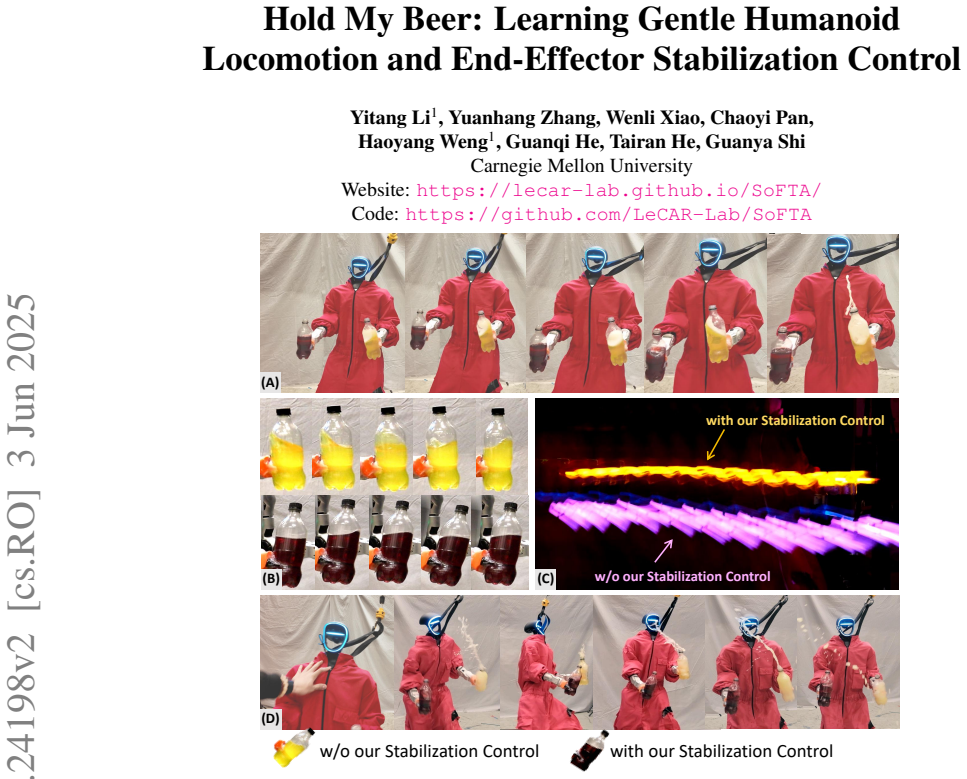
Pith's one-line read SoFTA, a slow-fast two-agent reinforcement learning framework, claims to cut end-effector acceleration 2–5× during humanoid locomotion by running upper-body control at 100 Hz and lower-body control at 50 Hz with separate rewards.
desk verdict SoFTA's slow-fast two-agent split for humanoid end-effector stabilization is a plausible new idea, but the headline 2-5x and 'human-level' claims overstate the evidence, and the real-world metric pipeline needs transparency. read the letter →
The pith
A machine-rendered reading of the paper's core claim, the machinery that carries it, and where it could break.
The reading
What carries the argument
The load-bearing mechanism is the SoFTA architecture: two PPO agents with separate actor and critic networks, a shared full-body observation, and disjoint action spaces—14 arm DoFs for the upper-body agent and 13 leg/waist DoFs for the lower-body agent. Frequency separation (100 Hz upper, 50 Hz lower) is what lets the arm react quickly to contact-driven base accelerations while the legs stay robust and deployable; the paper's ablations show that higher lower-body rates degrade real-world stability while higher upper-body rates shorten recovery time and lower peak errors. Separate reward groups—end-effector acceleration and tilt penalties for the arm, velocity and gait tracking for the legs, with a shared termination reward—resolve the credit-assignment conflict that a single whole-body critic faces. Training with random end-effector position commands is also load-bearing, since fixing the target position overfits to simulator dynamics and hurts sim-to-real transfer.
What would settle it
Recompute the real-world end-effector acceleration from the raw 200 Hz motion-capture logs without the abnormal-point removal or filtering steps, and compare peak acceleration across SoFTA, whole-body RL, and the default controller over many more runs; if the 2–5× gap shrinks or reverses, the headline result is an artifact of the measurement pipeline.
Extended reading notes
Core claim
On the paper's own terms, the discovery is that decoupling upper-body and lower-body control in both time and reward space resolves the interference between robust locomotion and precise end-effector stabilization. The upper-body agent (14 arm joints) acts at 100 Hz and is rewarded for low end-effector acceleration, low angular acceleration, and minimal gravity tilt; the lower-body agent (legs and waist) acts at 50 Hz and is rewarded for velocity and gait tracking. The two agents share the same full-body observation but have separate actors and critics, so each learns its own specialization. SoFTA emerges with active arm compensation that peaks during foot impacts and external pushes, and it achieves mean end-effector accelerations below 2 m/s² across tapping, trajectory tracking, turning, and random-command scenarios in simulation and on the Unitree G1 and Booster T1 humanoids.
Load-bearing premise
The real-world acceleration numbers—the main evidence for the 2–5× reduction—assume that removing 'abnormal points' from the 200 Hz motion-capture data and then filtering the double-differentiated accelerations does not systematically erase the high-acceleration transients that separate SoFTA from the baselines, and that three trial runs per condition represent the true distribution.
Editorial extensions
If this is right
- If SoFTA's results hold, humanoids can carry open containers or hold cameras steady during ordinary walking, turning, and even after shoves, using only controller architecture rather than custom hardware or a frozen base.
- The 50 Hz lower-body / 100 Hz upper-body pairing is the best among the tested frequency combinations, so the design gives a concrete deployment rule: keep locomotion control slow and robust, and push the arm control as fast as the board allows.
- The same training recipe transfers to a second embodiment (Booster T1) without embodiment-specific tuning, suggesting the slow-fast separation is a structural prior for humanoid control rather than a one-robot fix.
- The separate reward groups resolve a specific failure mode of whole-body RL—reward conflict between gait tracking and end-effector penalties—so the framework is a candidate template for other multi-objective, multi-timescale control problems.
Reading between the lines
- The acceleration post-processing is the single most important thing to scrutinize: a raw-log re-analysis could either confirm the 2–5× claim or reduce it to an artifact, and we would recommend that as the first independent check.
- The slow-fast principle likely generalizes beyond humanoids to any mobile manipulator with a fast arm on a slower base (wheeled or quadrupedal robots), since the same timescale mismatch appears there.
- Randomizing the commanded end-effector position during training appears to act as a form of exploration that prevents the arm policy from memorizing a single pose; this suggests a curriculum over target positions could further improve sim-to-real robustness.
Editorial analysis
A structured set of objections, weighed in public.
Referee Report
Summary. The paper proposes SoFTA, a slow-fast two-agent reinforcement learning framework for humanoid locomotion with end-effector (EE) stabilization. The upper-body agent runs at 100 Hz and controls the arms, while the lower-body agent runs at 50 Hz and controls the legs and waist; the two agents have separate actors, critics, and reward groups. Experiments in Isaac Gym and on Unitree G1 and Booster T1 hardware report EE acceleration reductions of 50-80% relative to baselines and demonstrate applications such as carrying a cup without spilling and recording stable video. The paper also includes frequency ablations, cross-embodiment deployment, and a discussion of limitations.
Significance. If the reported reductions are robust, the slow-fast two-agent design is a useful contribution to humanoid loco-manipulation: it offers a principled way to decouple control rates and reward objectives, and the real-world demonstrations with liquid carrying and camera stabilization are compelling. The paper ships code and a project website, and the cross-embodiment transfer is a positive sign. However, the headline quantitative claims currently rest on evaluation metrics that overlap with the optimized reward terms, on a real-world measurement pipeline that is underspecified, and on only three runs per condition; these issues must be resolved before the significance can be fully assessed.
major comments (4)
- [Section 3.1 and Table 7] The evaluation metrics Acc, AngAcc, Acc-Z, and Grav-XY are, up to exponentiation and weighting, exactly the upper-body reward terms 'penalty end effector acc', 'penalty end effector ang acc', and 'penalty end effector tilt' in Table 7. The policy is explicitly rewarded to minimize these quantities, so reporting them as the primary evaluation metrics makes the headline reduction partly a tautology rather than an emergent property. I recommend reporting additional metrics not present in the reward, such as EE tracking error, liquid slosh measures, or task success rates, and also reporting metric values from policies trained with the reward terms held fixed across methods.
- [Section 4, Metrics] The real-world acceleration pipeline is underspecified: the paper states that 200 Hz mocap pose data are 'first interpolated, with abnormal points removed, and then double differentiation and filtering are applied', but it does not specify the interpolation method, the outlier-removal criterion, the number of removed points per trial and per method, or the filter type and cutoff frequency. Since the real-world 2-5x claim is the central evidence, the authors must provide these details and a robustness analysis (e.g., raw versus filtered values, sensitivity to filter cutoff, and per-trial trajectories) to rule out that the post-processing removes high-acceleration transients more aggressively for baselines than for SoFTA.
- [Tables 1 and 2] The claim that SoFTA 'consistently outperforms' the baselines is not supported by every cell. In Table 1, Tapping Grav-XY mean is worse for SoFTA (0.11) than for Whole-body RL (0.09), and in Table 2, Tapping Grav-XY mean is substantially worse (0.43 versus 0.17). Several other cells overlap within one standard deviation. The abstract and Section 5 state a 2-5x reduction and 50-80% reduction without specifying the comparison baseline; for example, against Whole-body RL the real-world Acc reductions in Table 2 are roughly 1.4x to 2.6x, not 5x. The authors should report effect sizes and confidence intervals for every metric and clearly state which baseline the factor claims refer to.
- [Section 4, Experiment Setup and Section 4.1] All quantitative results are based on only three runs per condition, and the paper does not state whether the reported variation is standard deviation or standard error. With n=3 and no per-trial data, the observed differences are not statistically reliable. I request the per-trial numbers, the number of trials for each real-world condition, and either a statistical test or explicit error bars that account for the small sample size.
minor comments (5)
- [Section 5] There are several typos and grammatical errors: 'Slow-False' should be 'Slow-Fast', 'show up SoFTA can have' is ungrammatical, and 'much more closer' should be 'much closer'.
- [Section 4, Experiment Setup] The sentence 'o verify generalization' should read 'To verify generalization'.
- [Section 4.1 and Figure 8] The text refers to 'Figure 8' for reward curves, but the manuscript contains another Figure 8 for the Booster T1 results; the figure numbering should be corrected or the references disambiguated.
- [Appendix A.1, Table 7] The implementation line states 'lambda_acc = 0.25, lambda_acc = 0.0044'; the second value is presumably lambda_ang-acc and should be labeled accordingly.
- [Section 4.4] The cross-embodiment validation on Booster T1 is only qualitative; adding quantitative EE-stability numbers would strengthen the generalization claim.
Circularity Check
The reported success metrics (Acc, AngAcc, Grav-XY) are, by the paper's own equations, the very reward terms SoFTA is trained to minimize, so the absolute '2–5× reduction and human-level stability' headline partly restates the training objective; the same-reward baseline comparison and real-robot demos keep the central claim only partially circular.
-
fitted input called prediction
[Section 3.1 (Reward Formulation) and Section 4 (Metrics), cf. Appendix A.1 Table 7]
"Several rewards r_t are defined to achieve stable end-effector control: 1) penalizing high linear/angular acceleration, r_acc = −∥p̈_EE∥²; ... 3) penalizing gravity tilt in the end-effector frame, r_grav-xy = −∥P_xy(R_EE^T g)∥². ... We evaluated EE stability using the following metrics: linear acceleration norm (Acc), angular acceleration norm (AngAcc), and projected gravity in the XY plane of EE frame (Grav-XY). [Table 7:] penalty end effector acc -0.1 −∥p̈_EE∥²; penalty end effector ang acc -0.01 −∥ω̇_EE∥²; penalty end effector tilt -5.0 −∥P_xy(R_EE^T g)∥²."
The evaluation metrics are, up to monotone transforms, exactly the reward penalties the SoFTA policy is fitted to maximize the negative of: Acc is the norm of p̈_EE whose squared norm appears as reward r_acc and as the 'penalty end effector acc' term (weight −0.1); AngAcc is the norm of ω̇_EE from r_ang-acc; Grav-XY is ∥P_xy(R_EE^T g)∥ from r_grav-xy. The headline 'reduces EE acceleration by 2–5× relative to baselines' and 'much closer to human-level stability' therefore report the fitted policy's own objective value rather than an independent yardstick; the large gap over the Robot Default Controller, which has no EE-acceleration penalty, is the expected consequence of adding that penalty to the reward.
full rationale
Verdict: one partial circularity (score 6), not a full reduction. The paper's quantitative success metrics coincide, in its own equations, with the reward penalties SoFTA is trained to minimize (§3.1 and Appendix A.1 Table 7, vs. §4 Metrics), so the absolute headline figures are partly a restatement of successful optimization of the training objective, and the comparison against the Robot Default Controller (which has no EE-acceleration penalty) is directionally forced. I do not score 8–10 because the central architectural claim retains independent content: the Whole-body RL baseline is trained with the same reward terms, so SoFTA's advantage in Tables 1–2 and the slow-fast frequency ablations (§4.3) are genuine empirical findings, and the real-robot bottle-carrying and video-stabilization demos are externally observable. The real-world metric pipeline in §4 (200 Hz mocap, interpolation, removal of 'abnormal points', double differentiation, unspecified filtering; 3 runs per cell) is a measurement-integrity risk that could inflate the reported 2–5× gap, but that is a correctness concern, not a circularity, and is not scored here. The 'over 10× higher than human levels' reference in §1 has no citation or human measurement, which is missing support rather than circularity; §6 candidly concedes that SoFTA 'still falls short of human-level performance.' Self-citations (HumanoidVerse [66] for the sim-to-real pipeline, ASAP [21] for reward scaling, Wococo [53]) are code-released or methodological and are not load-bearing circularity. No uniqueness import, ansatz smuggling, or renaming of known results was found.
Assumptions & free parameters
free parameters (5)
- lambda_acc (exponential reward scale for zero linear acceleration) =
0.25
- lambda_ang-acc (exponential reward scale for zero angular acceleration) =
0.0044 (paper text inconsistently writes lambda_acc here)
- Reward weights in Table 7 =
Various values, e.g. -500 termination, 10 zero-acc, -5 tilt
- EE tracking tolerance sigma_EE command range =
U(0.1, 0.2) m
- PPO initial action noise standard deviations =
lower body 0.8, upper body 0.6
assumptions (4)
- domain assumption Isaac Gym simulation, with the domain randomization in Table 6, is a sufficiently accurate proxy for real Unitree G1 dynamics that policies transfer without fine-tuning.
- domain assumption The proprioceptive observation set (5-step history of joint positions, velocities, base angular velocity, projected gravity, and past actions) is sufficient for both agents to coordinate balance and end-effector stabilization.
- ad hoc to paper Training the upper-body and lower-body agents as separate PPO policies with separate critics and disjoint action spaces, but shared observations, converges to a coordinated whole-body policy rather than to conflicting sub-policies.
- ad hoc to paper The termination reward shared by both agents is sufficient to keep the whole body from falling while the upper body performs compensation motions.
Cite this review
Pith. "Pith review of Hold My Beer: Learning Gentle Humanoid Locomotion and End-Effector Stabilization Control." pith.science (2026). https://pith.science/paper/ZH7PX2LA
@misc{pith2026250524198,
  author       = {Pith},
  title        = {Pith review of: Hold My Beer: Learning Gentle Humanoid Locomotion and End-Effector Stabilization Control},
  year         = {2026},
  howpublished = {\url{https://pith.science/paper/ZH7PX2LA}},
  note         = {Machine review of arXiv:2505.24198}
}
read the original abstract
Can your humanoid walk up and hand you a full cup of beer, without spilling a drop? While humanoids are increasingly featured in flashy demos like dancing, delivering packages, traversing rough terrain, fine-grained control during locomotion remains a significant challenge. In particular, stabilizing a filled end-effector (EE) while walking is far from solved, due to a fundamental mismatch in task dynamics: locomotion demands slow-timescale, robust control, whereas EE stabilization requires rapid, high-precision corrections. To address this, we propose SoFTA, a Slow-Fast Two-Agent framework that decouples upper-body and lower-body control into separate agents operating at different frequencies and with distinct rewards. This temporal and objective separation mitigates policy interference and enables coordinated whole-body behavior. SoFTA executes upper-body actions at 100 Hz for precise EE control and lower-body actions at 50 Hz for robust gait. It reduces EE acceleration by 2-5x relative to baselines and performs much closer to human-level stability, enabling delicate tasks such as carrying nearly full cups, capturing steady video during locomotion, and disturbance rejection with EE stability.
Figures


Figures from the paper (6 more)


Forward citations
Cited by 1 Pith paper
-
Thor: Towards Human-Level Whole-Body Reactions for Intense Contact-Rich Environments
A decoupled whole-body RL policy with a force-based lean reward enables a Unitree G1 humanoid to pull with up to 167.7 N, beating prior controllers by 69–75%.
Reference graph
Works this paper leans on
-
[1]
Q. Liao, B. Zhang, X. Huang, X. Huang, Z. Li, and K. Sreenath. Berkeley humanoid: A research platform for learning-based control.arXiv preprint arXiv:2407.21781, 2024
arXiv 2024
-
[2]
Z. Li, X. B. Peng, P. Abbeel, S. Levine, G. Berseth, and K. Sreenath. Reinforcement learning for versatile, dynamic, and robust bipedal locomotion control.The International Journal of Robotics Research, page 02783649241285161, 2024
work page 2024
-
[3]
Radosavovic, T
I. Radosavovic, T. Xiao, B. Zhang, T. Darrell, J. Malik, and K. Sreenath. Real-world humanoid locomotion with reinforcement learning.Science Robotics, 9(89):eadi9579, 2024
2024
-
[4]
I. Radosavovic, B. Zhang, B. Shi, J. Rajasegaran, S. Kamat, T. Darrell, K. Sreenath, and J. Malik. Humanoid locomotion as next token prediction. arxiv. 2024.arXiv preprint arXiv:2402.19469, 2024
arXiv 2024
- [5]
- [6]
-
[7]
J. Long, J. Ren, M. Shi, Z. Wang, T. Huang, P. Luo, and J. Pang. Learning humanoid locomo- tion with perceptive internal model.arXiv preprint arXiv:2411.14386, 2024
arXiv 2024
- [8]
Show all 67 references
-
[9]
H. Wang, Z. Wang, J. Ren, Q. Ben, T. Huang, W. Zhang, and J. Pang. Beamdojo: Learning agile humanoid locomotion on sparse footholds, 2025. URLhttps://arxiv.org/abs/ 2502.10363
2025 arXiv
-
[10]
J. Ren, T. Huang, H. Wang, Z. Wang, Q. Ben, J. Pang, and P. Luo. Vb-com: Learning vision- blind composite humanoid locomotion against deficient perception, 2025. URLhttps: //arxiv.org/abs/2502.14814
2025 arXiv
-
[11]
W. Xie, C. Bai, J. Shi, J. Yang, Y . Ge, W. Zhang, and X. Li. Humanoid whole-body locomotion on narrow terrain via dynamic balance and reinforcement learning, 2025. URLhttps: //arxiv.org/abs/2502.17219
2025 arXiv
-
[12]
R.-Z. Qiu, S. Yang, X. Cheng, C. Chawla, J. Li, T. He, G. Yan, L. Paulsen, G. Yang, S. Yi, et al. Humanoid policy˜ human policy.arXiv preprint arXiv:2503.13441, 2025
2025
-
[13]
T. Lin, K. Sachdev, L. Fan, J. Malik, and Y . Zhu. Sim-to-real reinforcement learning for vision- based dexterous manipulation on humanoids, 2025. URLhttps://arxiv.org/abs/25 02.20396
2025
-
[14]
J. Li, Y . Zhu, Y . Xie, Z. Jiang, M. Seo, G. Pavlakos, and Y . Zhu. Okami: Teaching humanoid robots manipulation skills through single video imitation, 2024. URLhttps://arxiv.or g/abs/2410.11792. 10
2024 arXiv
-
[15]
S. Atar, X. Liang, C. Joyce, F. Richter, W. Ricardo, C. Goldberg, P. Suresh, and M. Yip. Humanoids in hospitals: A technical study of humanoid surrogates for dexterous medical in- terventions, 2025. URLhttps://arxiv.org/abs/2503.12725
2025 arXiv
-
[16]
X. Shu, F. Ni, X. Fan, S. Yang, C. Liu, B. Tu, Y . Liu, and H. Liu. A versatile humanoid robot platform for dexterous manipulation and human–robot collaboration.CAAI Transactions on Intelligence Technology, 9(2):526–540, 2024. doi:https://doi.org/10.1049/cit2.12214. URL https:...
2024 doi
-
[17]
Z. Gu, J. Li, W. Shen, W. Yu, Z. Xie, S. McCrory, X. Cheng, A. Shamsah, R. Griffin, C. K. Liu, A. Kheddar, X. B. Peng, Y . Zhu, G. Shi, Q. Nguyen, G. Cheng, H. Gao, and Y . Zhao. Humanoid locomotion and manipulation: Current progress and challenges in control, planning, and le...
2025 arXiv
-
[18]
X. B. Peng, M. Andrychowicz, W. Zaremba, and P. Abbeel. Sim-to-real transfer of robotic control with dynamics randomization. In2018 IEEE international conference on robotics and automation (ICRA), pages 3803–3810. IEEE, 2018
2018
-
[19]
J. Tan, T. Zhang, E. Coumans, A. Iscen, Y . Bai, D. Hafner, S. Bohez, and V . Vanhoucke. Sim- to-real: Learning agile locomotion for quadruped robots.arXiv preprint arXiv:1804.10332, 2018
2018 arXiv
-
[20]
X. Chen, J. Hu, C. Jin, L. Li, and L. Wang. Understanding domain randomization for sim-to- real transfer, 2022. URLhttps://arxiv.org/abs/2110.03239
2022 arXiv
-
[21]
T. He, J. Gao, W. Xiao, Y . Zhang, Z. Wang, J. Wang, Z. Luo, G. He, N. Sobanbab, C. Pan, Z. Yi, G. Qu, K. Kitani, J. Hodgins, L. J. Fan, Y . Zhu, C. Liu, and G. Shi. Asap: Aligning simulation and real-world physics for learning agile humanoid whole-body skills, 2025. URL https...
2025 arXiv
-
[22]
Sobanbabu, G
N. Sobanbabu, G. He, T. He, Y . Yang, and G. Shi. Sampling-based system identification with active exploration for legged robot sim2real learning.arXiv preprint arXiv:2505.14266, 2025
2025 arXiv
-
[23]
T. Li, H. Geyer, C. G. Atkeson, and A. Rai. Using deep reinforcement learning to learn high- level policies on the atrias biped. In2019 International Conference on Robotics and Automa- tion (ICRA), pages 263–269. IEEE, 2019
2019
-
[24]
Z. Xie, P. Clary, J. Dao, P. Morais, J. Hurst, and M. Panne. Learning locomotion skills for cassie: Iterative design and sim-to-real. InConference on Robot Learning, pages 317–329. PMLR, 2020
2020
-
[25]
Z. Li, X. Cheng, X. B. Peng, P. Abbeel, S. Levine, G. Berseth, and K. Sreenath. Reinforce- ment learning for robust parameterized locomotion control of bipedal robots. In2021 IEEE International Conference on Robotics and Automation (ICRA), pages 2811–2817. IEEE, 2021
2021
-
[26]
T. He, W. Xiao, T. Lin, Z. Luo, Z. Xu, Z. Jiang, J. Kautz, C. Liu, G. Shi, X. Wang, et al. Hover: Versatile neural whole-body controller for humanoid robots.arXiv preprint arXiv:2410.21229, 2024
2024 arXiv
-
[27]
T. He, Z. Luo, W. Xiao, C. Zhang, K. Kitani, C. Liu, and G. Shi. Learning human-to-humanoid real-time whole-body teleoperation.arXiv preprint arXiv:2403.04436, 2024
2024 arXiv
-
[29]
Z. Fu, Q. Zhao, Q. Wu, G. Wetzstein, and C. Finn. Humanplus: Humanoid shadowing and imitation from humans.arXiv preprint arXiv:2406.10454, 2024. 11
2024 arXiv
-
[30]
T. He, Z. Luo, X. He, W. Xiao, C. Zhang, W. Zhang, K. Kitani, C. Liu, and G. Shi. Omnih2o: Universal and dexterous human-to-humanoid whole-body teleoperation and learning.arXiv preprint arXiv:2406.08858, 2024
2024 arXiv
-
[31]
Q. Ben, F. Jia, J. Zeng, J. Dong, D. Lin, and J. Pang. Homie: Humanoid loco-manipulation with isomorphic exoskeleton cockpit, 2025. URLhttps://arxiv.org/abs/2502.13013
2025 arXiv
-
[32]
H. Shi, W. Wang, S. Song, and C. K. Liu. Toddlerbot: Open-source ml-compatible humanoid platform for loco-manipulation, 2025. URLhttps://arxiv.org/abs/2502.00893
2025
-
[33]
J. Shi, X. Liu, D. Wang, O. Lu, S. Schwertfeger, F. Sun, C. Bai, and X. Li. Adversarial locomotion and motion imitation for humanoid policy learning, 2025. URLhttps://arxi v.org/abs/2504.14305
2025
-
[34]
B. U. Rehman, M. Focchi, J. Lee, H. Dallali, D. G. Caldwell, and C. Semini. Towards a multi-legged mobile manipulator. pages 3618–3624, 2016
2016
-
[35]
Sentis and O
L. Sentis and O. Khatib. Synthesis of whole-body behaviors through hierarchical control of behavioral primitives.International Journal of Humanoid Robotics, 2(04):505–518, 2005
2005
-
[36]
Ferrolho, V
H. Ferrolho, V . Ivan, W. Merkt, I. Havoutis, and S. Vijayakumar. RoLoMa: Robust loco- manipulation for quadruped robots with arms.Autonomous Robots, 47(8):1463–1481, 2023
2023
-
[37]
Ferrolho, W
H. Ferrolho, W. Merkt, V . Ivan, W. Wolfslag, and S. Vijayakumar. Optimizing Dynamic Tra- jectories for Robustness to Disturbances Using Polytopic Projections. pages 7477–7484, 2020
2020
-
[38]
L. Shi, X. Yu, C. Zhou, W. Jin, W. Chi, S. Zhang, D. Zhang, X. Li, and Z. Zhang. Whole- body impedance coordinative control of wheel-legged robot on uncertain terrain, 2024. URL https://arxiv.org/abs/2411.09935
2024 arXiv
-
[39]
Pankert and M
J. Pankert and M. Hutter. Perceptive model predictive control for continuous mobile manipu- lation.IEEE Robotics and Automation Letters, 5(4):6177–6184, 2020. doi:10.1109/LRA.20 20.3010721
2020 doi
-
[40]
Osman, M
M. Osman, M. W. Mehrez, S. Yang, S. Jeon, and W. Melek. End-effector stabilization of a 10-dof mobile manipulator using nonlinear model predictive control, 2021. URLhttps: //arxiv.org/abs/2103.13153
2021 arXiv
-
[41]
M. V . Minniti, F. Farshidian, R. Grandia, and M. Hutter. Whole-body mpc for a dynamically stable mobile manipulator.IEEE Robotics and Automation Letters, 4(4):3687–3694, Oct. 2019. ISSN 2377-3774. doi:10.1109/lra.2019.2927955. URLhttp://dx.doi.org/10.1109 /LRA.2019.2927955
2019
-
[42]
X. Guo, G. He, J. Xu, M. Mousaei, J. Geng, S. Scherer, and G. Shi. Flying calligrapher: Contact-aware motion and force planning and control for aerial manipulation.IEEE Robotics and Automation Letters, 2024
2024
-
[43]
G. He, X. Guo, L. Tang, Y . Zhang, M. Mousaei, J. Xu, J. Geng, S. Scherer, and G. Shi. Flying hand: End-effector-centric framework for versatile aerial manipulation teleoperation and policy learning.arXiv preprint arXiv:2504.10334, 2025
2025 arXiv
-
[44]
Y . Ma, F. Farshidian, T. Miki, J. Lee, and M. Hutter. Combining Learning-Based Locomotion Policy With Model-Based Manipulation for Legged Mobile Manipulators. 7(2):2377–2384, 2022
2022
-
[45]
M. Liu, Z. Chen, X. Cheng, Y . Ji, R. Yang, and X. Wang. Visual Whole-Body Control for Legged Loco-Manipulation. 2024
2024
-
[46]
G. Pan, Q. Ben, Z. Yuan, G. Jiang, Y . Ji, S. Li, J. Pang, H. Liu, and H. Xu. RoboDuet: Whole- body Legged Loco-Manipulation with Cross-Embodiment Deployment, 2024. 12
2024
-
[47]
Z. Fu, X. Cheng, and D. Pathak. Deep Whole-Body Control: Learning a Unified Policy for Manipulation and Locomotion. pages 138–149, 2023
2023
-
[48]
Portela, A
T. Portela, A. Cramariuc, M. Mittal, and M. Hutter. Whole-body end-effector pose tracking,
-
[49]
C. Lu, X. Cheng, J. Li, S. Yang, M. Ji, C. Yuan, G. Yang, S. Yi, and X. Wang. Mobile- television: Predictive motion priors for humanoid whole-body control, 2025. URLhttps: //arxiv.org/abs/2412.07773
2025 arXiv
-
[50]
Zhang, Y
Y . Zhang, Y . Yuan, P. Gurunath, T. He, S. Omidshafiei, A. akbar Agha-mohammadi, M. Vazquez-Chanlatte, L. Pedersen, and G. Shi. Falcon: Learning force-adaptive humanoid loco-manipulation, 2025. URLhttps://arxiv.org/abs/2505.06776
2025
-
[51]
Y . Guo, Z. Jiang, Y .-J. Wang, J. Gao, and J. Chen. Decentralized motor skill learning for complex robotic systems, 2023. URLhttps://arxiv.org/abs/2306.17411
2023 arXiv
-
[52]
K. Pang, D. Qin, Y . Fan, J. Habekost, T. Shiratori, J. Yamagishi, and T. Komura. Bodyformer: Semantics-guided 3d body gesture synthesis with transformer.ACM Transactions on Graphics, 42(4):1–12, July 2023. ISSN 1557-7368. doi:10.1145/3592456. URLhttp://dx.doi.o rg/10.1145/3592456
2023 doi
-
[53]
Zhang, W
C. Zhang, W. Xiao, T. He, and G. Shi. Wococo: Learning whole-body humanoid control with sequential contacts, 2024. URLhttps://arxiv.org/abs/2406.06005
2024 arXiv
-
[54]
Zhang, Z
K. Zhang, Z. Yang, and T. Bas ¸ar. Multi-agent reinforcement learning: A selective overview of theories and algorithms, 2021. URLhttps://arxiv.org/abs/1911.10635
2021 arXiv
-
[55]
Zhuang and H
Z. Zhuang and H. Zhao. Embrace collisions: Humanoid shadowing for deployable contact- agnostics motions.ArXiv, abs/2502.01465, 2025. URLhttps://api.semanticscho lar.org/CorpusID:276107247
2025 arXiv
-
[56]
Huang, J
T. Huang, J. Ren, H. Wang, Z. Wang, Q. Ben, M. Wen, X. Chen, J. Li, and J. Pang. Learning humanoid standing-up control across diverse postures, 2025. URLhttps://arxiv.org/ abs/2502.08378
2025 arXiv
-
[57]
Schulman, F
J. Schulman, F. Wolski, P. Dhariwal, A. Radford, and O. Klimov. Proximal policy optimization algorithms.arXiv preprint arXiv:1707.06347, 2017
2017 arXiv
-
[58]
Rajeswaran, S
A. Rajeswaran, S. Ghotra, B. Ravindran, and S. Levine. Epopt: Learning robust neural network policies using model ensembles, 2017. URLhttps://arxiv.org/abs/1610.01283
2017 arXiv
-
[59]
Hwangbo, J
J. Hwangbo, J. Lee, A. Dosovitskiy, D. Bellicoso, V . Tsounis, V . Koltun, and M. Hutter. Learn- ing agile and dynamic motor skills for legged robots.Science Robotics, 4(26), Jan. 2019. ISSN 2470-9476. doi:10.1126/scirobotics.aau5872. URLhttp://dx.doi.org/10.1126/s cirobotics.aau5872
2019 doi
-
[60]
Y . Yang, K. Caluwaerts, A. Iscen, T. Zhang, J. Tan, and V . Sindhwani. Data efficient reinforce- ment learning for legged robots, 2019. URLhttps://arxiv.org/abs/1907.03613
2019 arXiv
-
[61]
Sunehag, G
P. Sunehag, G. Lever, A. Gruslys, W. M. Czarnecki, V . Zambaldi, M. Jaderberg, M. Lanctot, N. Sonnerat, J. Z. Leibo, K. Tuyls, and T. Graepel. Value-decomposition networks for cooper- ative multi-agent learning, 2017. URLhttps://arxiv.org/abs/1706.05296
2017 arXiv
-
[62]
Iqbal and F
S. Iqbal and F. Sha. Actor-attention-critic for multi-agent reinforcement learning.CoRR, abs/1810.02912, 2018. URLhttp://arxiv.org/abs/1810.02912
2018 arXiv
-
[63]
R. Lowe, Y . Wu, A. Tamar, J. Harb, P. Abbeel, and I. Mordatch. Multi-agent actor-critic for mixed cooperative-competitive environments.CoRR, abs/1706.02275, 2017. URLhttp: //arxiv.org/abs/1706.02275. 13
2017 arXiv
-
[64]
Yarahmadi, M
H. Yarahmadi, M. E. Shiri, H. Navidi, A. Sharifi, and M. Challenger. Bankruptcy-evolutionary games based solution for the multi-agent credit assignment problem.Swarm Evol. Comput., 77:101229, 2023. URLhttps://api.semanticscholar.org/CorpusID:2557 00663
2023
-
[65]
Robotics
U. Robotics. Unitree g1 humanoid agent ai avatar, 2024. URLhttps://www.unitree. com/g1
2024
-
[66]
C. L. Lab. Humanoidverse: A multi-simulator framework for humanoid robot sim-to-real learning.https://github.com/LeCAR-Lab/HumanoidVerse, 2025
2025
-
[67]
Robotics
B. Robotics. Booster t1 humanoid robot, 2025. URLhttps://www.boosterobotics .com/. 14 A Appendix A.1 Training Details ObservationWe adopt an asymmetric observation structure to enable efficient policy learning in simulation while ensuring robust real-world deployment under par...
2025
-
[2025]
URLhttps://arxiv.org/abs/2409.16048
Reviewed August 7, 2026 · model on record in the stance chip above.
Discussion (0). Sign in to comment.